10 Best Hotel Channel Managers for 2026


Channel Managers
10 picks ranked by integrations.
Channel managers stop overbookings. They don't stop the flood of guest messages that follow every booking. Here's what to evaluate, and where the real operational gap actually lives.
The common assumption among heads of operations and VPs of operations at multi-brand or enterprise hospitality groups is that once real-time inventory sync is in place, distribution is solved and the guest experience problem becomes a staffing or training issue, not a technology gap. A hotel channel manager is the infrastructure layer that keeps room inventory, rates, and availability consistent across every OTA and booking platform a property lists on. Any property manually updating Booking.com, Expedia, and Airbnb every morning is one delayed keystroke away from a double-booking, a furious guest, and a 1-star review that no apology fully erases. See our AI for hospitality for how this works in practice.
That operational risk compounds fast at scale. What most operators discover only after implementing a channel manager is that it solves one layer of the distribution problem, not the whole thing. The booking lands cleanly. The inventory syncs. But a guest may have already messaged through Booking.com, and a mid-stay request comes in through email, each sitting in a separate inbox with no unified routing and no automated response. That second layer is where guest communication becomes its own operational challenge.
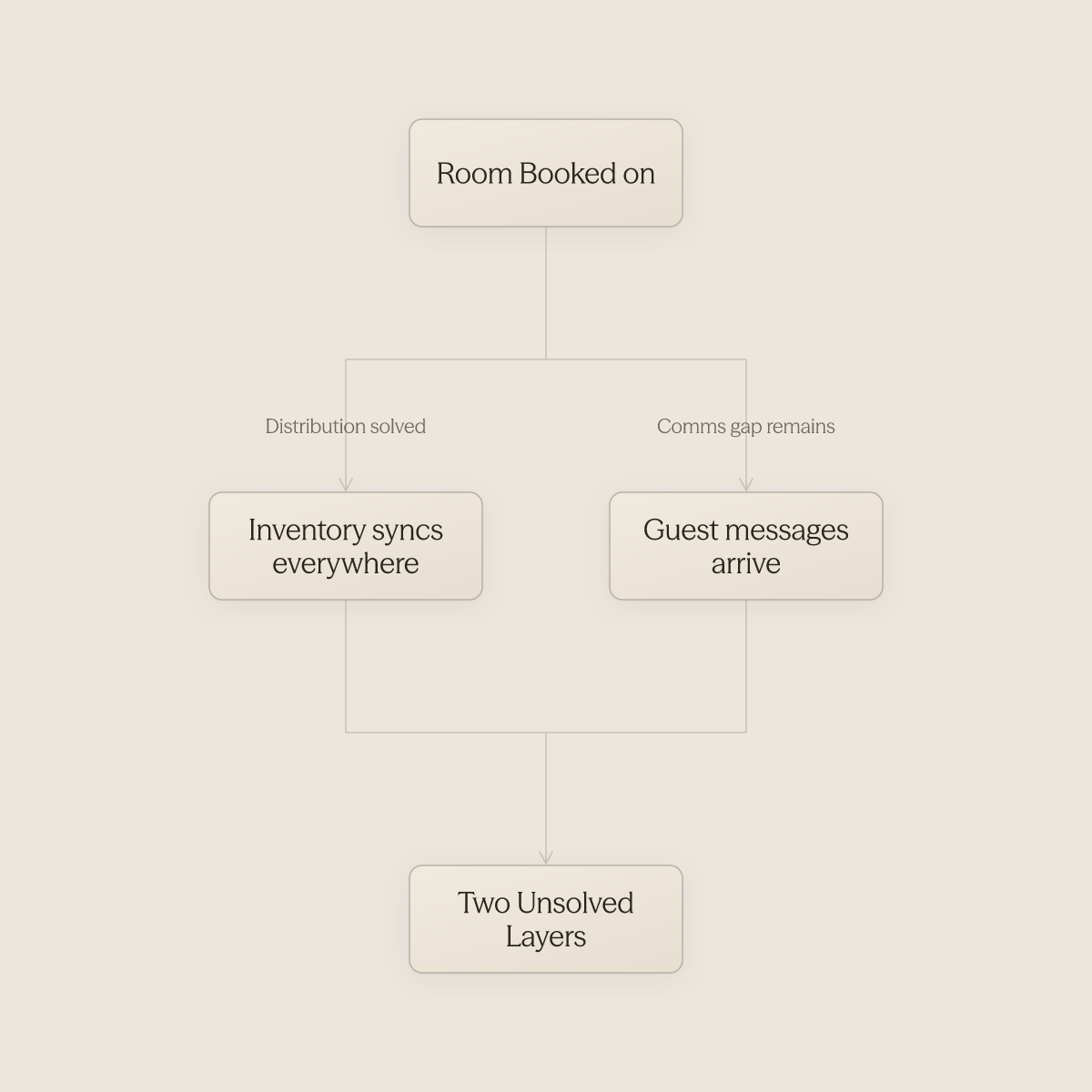
A hotel channel manager is software that centralizes OTA distribution from a single interface. When a room sells on one platform, availability updates everywhere else instantly, eliminating the overbooking risk that manual management creates. Hotels listing across multiple OTAs simultaneously face an inventory coordination challenge that becomes genuinely unmanageable without automation.
The channel manager solves that coordination problem precisely and nothing else. The gap operators underestimate is structural. Channel management software handles distribution; it is not architected to touch guest conversations.
Every booking it captures immediately generates communication: pre-arrival questions, check-in instructions, mid-stay issues, and checkout follow-ups. These land across Booking.com, email, and SMS with no equivalent sync layer behind them. Treating the channel manager as the finish line means accepting that gap as a permanent cost, paid in staff hours, inconsistent responses, and review scores that plateau regardless of how clean the inventory sync runs.
"Small boutique hotel groups struggle to find a channel manager that supports regional or local OTAs like Trip.com and MakeMyTrip, which are not available on every channel manager."
Key takeaways
- A channel manager syncs rates and inventory across OTAs, it does nothing with the guest conversation that starts the moment a booking confirms.
- Evaluating channel managers on OTA count alone is the wrong filter; rate integrity, API reliability, and clean data handoffs across system boundaries matter more at portfolio scale.
- Stand-alone vs. PMS-integrated is the wrong framing for the architecture decision, the real question is whether reservation and guest-profile data moves across system boundaries without manual reconciliation.
- Advertised subscription pricing and actual annual spend diverge enough to flip a vendor decision; the gap lives in per-property fees, OTA tier surcharges, and implementation costs.
- Every confirmed booking opens a communication sequence, pre-arrival questions, mid-stay requests, late checkout negotiations, that no channel manager on this list touches, and at multi-property scale that unmanaged layer is where review scores slip.
- Conduit's native integrations with Airbnb, Google Drive, Notion, and Airtable let the platform pull in property knowledge sources and push conversation and contact data to external systems automatically, closing the gap between inventory sync and every guest exchange that follows it.
Key Features to Look for in a Hotel Channel Manager - Beyond OTA Count
Choosing a channel manager by OTA count is like hiring a pilot based on how many airports they've visited. The common assumption among heads of operations and VPs of operations at multi-brand or enterprise hospitality groups is that once real-time inventory sync is in place, distribution is solved and the guest experience problem becomes a staffing or training issue, not a technology gap. The features that actually protect revenue and prevent operational pain are far less visible on a vendor's marketing page, and missing them costs more than most operators expect.
Key takeaway: Industry analyses consistently identify overbookings and reservation errors caused by manual channel management as costing hotels an estimated 10–15% of potential revenue annually, a risk that compounds with portfolio size and OTA count.
15% of potential revenue annually
That figure accumulates through sync delays, misconfigured rate strategies, and shallow PMS integrations that nobody flags until a guest is standing at the front desk with a confirmed booking and no available room.
1. conduit.ai - Best Overall Hotel Channel Manager for AI-Driven Distribution
Conduit.ai stands out in the best hotel channel manager software category by combining real-time inventory sync with machine-learning rate optimization across all connected channels. It's the right pick for revenue managers who want automated decision-making rather than manual rate adjustments. The primary tradeoff is a steeper onboarding curve for independent properties without a dedicated revenue management team.
2. Two-Way PMS Integration Depth - The Sync Standard That Actually Prevents Overbookings
A native, two-way PMS integration is the single most critical technical feature separating reliable best hotel channel manager software from tools that merely list OTA connections. When a booking lands on Booking.com, inventory must update in the PMS within seconds, not minutes. Properties running high-occupancy periods are most exposed here. The tradeoff: deeper PMS integrations often mean higher licensing tiers or vendor lock-in.
3. Automated Rate Parity Monitoring- Protecting Your Direct Channel Revenue
Rate parity monitoring built directly into the channel manager dashboard lets hoteliers catch OTA undercutting before it erodes direct booking revenue. This feature matters most for properties investing in Google Hotel Ads or metasearch, where price disparities are immediately visible to shoppers. The limitation is that automated alerts still require human intervention to resolve contractual parity violations with OTA partners.
4. Cloudbeds - Best for All-in-One PMS, Booking Engine, and Channel Manager Convergence
Cloudbeds earns its place among the best hotel channel manager software options by eliminating the middleware problem entirely, PMS, booking engine, and channel manager share a single database. This is ideal for independent hotels and boutique properties that want zero commission on direct bookings and one vendor relationship. The tradeoff is that properties needing best-of-breed standalone tools may find the all-in-one approach less flexible.
5. Multi-Property Centralized Inventory Control - The Feature Hotel Groups Can't Overlook
For hotel groups managing multiple locations, the ability to control inventory, rates, and restrictions from a single dashboard is non-negotiable. The best hotel channel manager software for groups must support property-level overrides without breaking group-wide rate strategies. This feature is overkill for single-property operators but essential for chains scaling beyond three locations. The tradeoff is added configuration complexity during initial setup.
6. Dynamic Pricing Engine Integration - Moving Beyond Static Rate Plans
Static rack rates pushed across OTAs leave significant revenue on the table during demand spikes and compress margins during slow periods. The best hotel channel manager software should either include a native dynamic pricing engine or offer a certified integration with standalone revenue management systems. This feature is most valuable for urban properties with volatile demand patterns. The tradeoff is that fully automated dynamic pricing requires clean historical data to perform accurately.
7. RateGain - Best for Enterprise-Grade Distribution Analytics and Competitive Intelligence
RateGain differentiates itself among best hotel channel manager software contenders by layering competitive rate intelligence and demand forecasting directly onto its distribution platform. This makes it the right choice for larger properties and hotel groups that need to benchmark against comp sets while managing channel distribution in the same workflow. The tradeoff is that pricing reflects enterprise positioning, making it less accessible for small independent operators on tight budgets.
The 10 Best Hotel Channel Managers for 2026 - Ranked and Reviewed
That shortlist did not emerge from feature checklists alone. The ten channel managers reviewed below each cleared a high bar on rate integrity, inventory logic, and API reliability, yet every one of them exposes a gap the moment a guest moves from booking to conversation. Rates sync. Availability updates. But the moment a prospective guest asks a question, requests an early check-in, or wants to understand what a property actually includes, the channel manager steps aside and leaves the operator to handle it manually, through a patchwork of inboxes, or
The most common shortlisting mistake in hotel technology is treating OTA count as a proxy for distribution quality. Most bookings concentrate on a handful of channels like Booking.com, Expedia, and Airbnb. The real question is whether the platform fits your property type, integrates cleanly with your existing PMS, and gives your team the reporting depth to act on channel mix data, not just confirm that inventory is syncing.
The moment inventory sync is running, misconfigured rate strategies, shallow PMS integration, and incomplete channel mixes become structurally invisible, meaning operators who benchmark success by the absence of overbooking complaints are measuring the wrong signal and will systematically undercount revenue leakage that never surfaces as a guest complaint. Industry research reinforces this directly: distribution strategy is increasingly shaped by channel mix optimization, not inventory sync alone. Properties need active rate parity management, demand-based rate configuration, and channel contribution analysis to protect revenue.
The vendor with 450 connections and the vendor with 200 connections will often produce nearly identical booking outcomes; the real differentiator sits in integration depth, reporting clarity, and what happens after the booking lands. That post-booking gap matters more than most shortlists acknowledge. The moment a reservation arrives from any OTA, the channel manager's job is finished.
Inquiries, pre-arrival coordination, mid-stay issues, upsell conversations, and review-recovery follow-ups fall entirely outside every platform reviewed here. Operators who benchmark distribution success by the absence of overbooking complaints are measuring the wrong signal; the quieter revenue leakage from uncoordinated guest communication surfaces as a flat review score and a repeat-stay rate that refuses to move, never as a complaint. Each entry below closes with a one-line note on what that channel manager does not solve, because planning for both layers, distribution and guest communication, is the decision that actually protects portfolio revenue at scale.
1. Conduit.ai - Best AI-Powered Guest Communication Layer for Hotels
Conduit.ai is not a channel manager; it is the layer that activates the moment a channel manager's job ends. Once a booking lands from any OTA, Conduit's AI for hospitality handles guest inquiries, pre-arrival coordination, mid-stay requests, and post-stay follow-ups automatically, pulling from knowledge sources already in your stack (Google Drive, Notion, Airtable, Airbnb) without manual re-entry. Most beneficial when your portfolio already uses those tools and needs the AI agent to enforce brand-consistent communication across every property without adding headcount. Does not replace your channel manager; it closes the gap your channel manager structurally cannot address.
2. SiteMinder - Best Enterprise-Grade Channel Distribution Platform
SiteMinder processes a substantial volume of bookings annually with real-time, two-way connectivity across hundreds of distribution channels, a scale that positions it as a leading option for enterprise hotel groups that need documented OTA depth. Its reporting layer supports channel contribution analysis and demand-based rate configuration, which matters at portfolio level. The tradeoff: SiteMinder is a distribution platform, not a guest data platform, and its PMS integration depth varies by property management system. Does not address guest communication, pre-arrival messaging, or post-booking coordination.
3. Cloudbeds - Best All-in-One PMS + Channel Manager Combo
Cloudbeds connects to a broad range of OTAs including Booking.com, Airbnb, and Expedia, and pairs that distribution breadth with a native PMS, making it a strong fit for independent hotels and boutique properties that want to consolidate their tech stack without a custom integration project. Because reservation data and rate management share the same data layer, the sync risk that plagues API-connected setups is largely eliminated. The tradeoff: operators committed to an existing PMS may find the all-in-one model creates vendor lock-in. Does not manage guest communication after the booking is confirmed.
4. RateGain - Best for Revenue Intelligence-Driven Channel Management
RateGain positions itself at the intersection of channel management and competitive rate intelligence, making it the right pick for revenue managers who want distribution decisions informed by real-time market pricing data rather than manual comp-set analysis. The platform's strength is in rate strategy automation and demand forecasting layered on top of OTA connectivity. The tradeoff: operators who primarily need clean PMS integration and straightforward inventory sync may find RateGain's revenue intelligence features more than they need. Does not handle guest-facing communication at any stage of the booking lifecycle.
5. STAAH - Best for Asia-Pacific and Emerging Market Hotel Distribution
STAAH's distribution network is specifically strong across Asia-Pacific OTAs and regional booking channels that global platforms often underserve, making it the practical choice for properties in Southeast Asia, India, Australia, and emerging markets where channel mix looks materially different from Europe or North America. The tradeoff: outside Asia-Pacific, STAAH's channel depth advantage narrows considerably against SiteMinder or Cloudbeds. Does not coordinate guest communication or automate pre-arrival and mid-stay messaging.
6. Beds24 - Best Budget-Friendly Channel Manager for Independent Operators
Beds24 is a highly configurable low-cost option on this list, offering channel management, a booking engine, and basic automation at a price point independent operators and small portfolio managers can justify without a formal procurement process. Its flexibility is genuine but demands setup time; operators who want a working system in a day will find the learning curve steeper than vendor marketing suggests. The tradeoff: configuration depth is an asset for technically capable operators and a friction point for everyone else. Does not provide guest communication automation or post-booking engagement tools.
7. Guesty - Best Channel Manager for Professional Vacation Rental Managers
Guesty is built for professional property management companies running short-term rental portfolios at scale, with distribution, owner reporting, and operations management in a single platform. Guesty's pricing is structured for professional property management companies operating at scale, and per-unit costs at smaller portfolio sizes warrant careful evaluation against the platform's operational management capabilities before committing. The tradeoff: for smaller operators, the cost-to-value ratio warrants careful evaluation before committing. Does not automate the guest communication layer beyond basic templated messaging.
8. eviivo - Best Channel Manager for Boutique Properties and B&Bs
Eviivo is purpose-built for small independent properties, B&Bs, and boutique hotels that need OTA connectivity without the complexity or cost of enterprise platforms. Its onboarding is designed for operators who are not technology specialists, and its channel set covers the major OTAs relevant to the small-property segment. The tradeoff: eviivo's feature ceiling is low relative to SiteMinder or Cloudbeds, and multi-property operators will find it constraining quickly. Does not address guest communication quality, response consistency, or review-recovery workflows after a booking is made.
9. Hostfully - Best Channel Manager for Growing Short-Term Rental Agencies
Hostfully combines channel management with a digital guidebook product and basic automation, making it a reasonable fit for short-term rental agencies in the 10-to-50-property range that want to standardize the pre-arrival guest experience without building a separate tech stack. The tradeoff: as portfolios grow beyond the mid-market range, Hostfully's automation depth and reporting can become limiting. Does not provide AI-powered guest communication or handle complex mid-stay and post-stay coordination at volume.
10. Smartness - Best for Dynamic Pricing Automation Integrated with Channel Management
Smartness focuses on AI-driven dynamic pricing that works in concert with channel distribution, automatically adjusting rates across OTAs based on demand signals, competitor pricing, and occupancy trends. It's the right pick for revenue-focused hoteliers who want pricing decisions automated rather than manually managed. The tradeoff is that Smartness is more of a revenue management and pricing layer than a full-featured channel manager, so it works best when paired with an existing PMS or distribution stack.
Stand-Alone Channel Manager vs. PMS-Integrated Platform - How to Choose for Your Portfolio
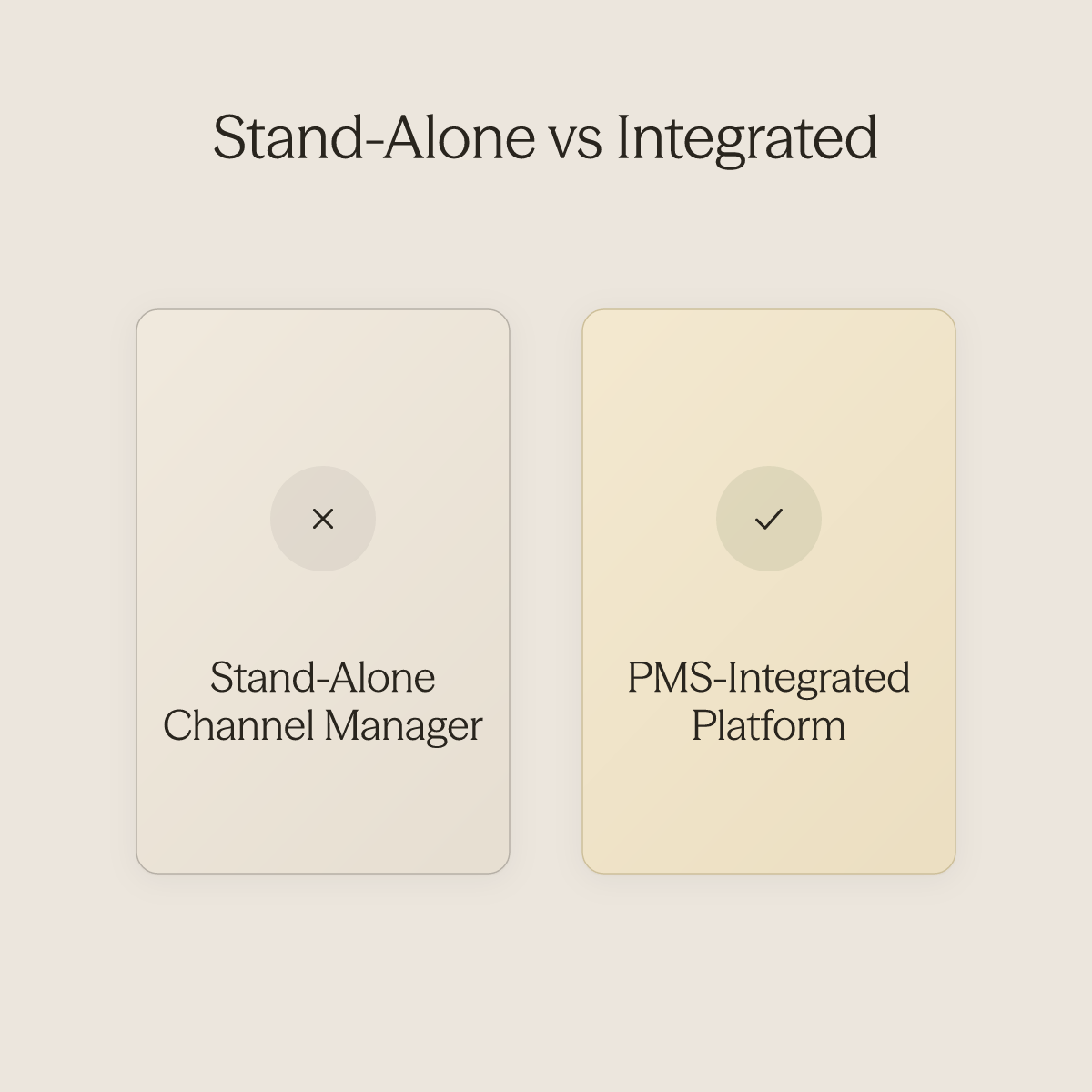
The stand-alone-vs-integrated debate is one of the most consequential architecture decisions a VP of Operations makes, and most operators frame it wrong from the start. The real question is not which platform has the better channel manager module. It is whether reservation data, rate changes, and guest profile information move cleanly across system boundaries without a human manually reconciling the gap, and, critically, whether your architecture lets you scale the portfolio without proportionally increasing the headcount required to keep those systems in sync.
Two Architectures, One Data-Flow Problem
The core difference between stand-alone and integrated is where the sync happens. A stand-alone channel manager connects to your PMS via API, meaning two separate systems exchange data across a boundary. An integrated platform keeps both functions inside a single data layer. According to industry data 2025 analysis, sync issues between stand-alone channel managers and PMS platforms, including API timeouts and data mapping mismatches, are a persistent operational risk that produces overbookings and rate errors even when integration is technically in place. The seam is where errors originate, and every error at the seam is a task that lands on a human's desk.
This is where the architecture choice stops being a pure technology question and becomes a headcount question. Operations teams we work with consistently run into the same ceiling: as the portfolio grows, the coordination burden grows with it, not because the business is inefficient, but because stand-alone stacks multiply the number of seams that require human oversight. The goal of any sound architecture decision should be to enable rapid portfolio expansion without proportional growth in support headcount.
Where Stand-Alone Channel Managers Win, and the API Seam Risk They Carry
Stand-alone tools give operators genuine flexibility. You can select the best-in-class PMS for your property type and pair it with the best-in-class channel manager for your OTA mix, without being forced into a vendor's weakest module. This matters most when your portfolio spans property types with genuinely different distribution needs.
Key takeaway: Every API connection is a potential failure point. Multi-property groups running best-of-breed stacks maintain multiple active integrations simultaneously, and data-flow risk at each API seam compounds as portfolio size grows.
As Lean Hotel System's integration research documents, hotel system integration problems frequently stem from data mapping inconsistencies and connectivity failures that are invisible until a guest booking surfaces the error. The practical consequence: scaling the portfolio without scaling coordination headcount becomes structurally harder in a fragmented stack, because each new property adds new seam-monitoring responsibilities that fall to operations or support staff.
Tools like conduit.ai's Integrations feature address one dimension of this problem directly. When the business already uses tools like Notion, Google Drive, or Airbnb, the AI agent can leverage existing content without manual re-entry, reducing the human effort required to keep operational knowledge synchronized across a growing property count. That does not eliminate API seam risk at the PMS-channel manager boundary, but it does remove a category of manual reconciliation work that otherwise scales linearly with portfolio size.
Where PMS-Integrated Platforms Win, and the Vendor Lock-In Trade-Off
An all-in-one platform eliminates the sync gap by design, as Prostay's 2025 research notes. Reservation data and rate changes share the same database, so there is no inter-system latency to produce overbookings. The headcount implication is direct: fewer seams mean fewer humans monitoring those seams, which is the structural condition that allows portfolio expansion without proportional growth in support headcount.
The honest limitation: you are betting on one vendor's roadmap for every function. If the integrated platform's channel management module is weaker than a stand-alone competitor's, you absorb that weakness across every property in your portfolio simultaneously, with no ability to swap in a better-fit tool without rebuilding the entire stack.
The guest communication layer is a useful analogy here. Operations teams managing guest communications across multiple platforms or properties simultaneously face the same consolidation trade-off: a unified inbox reduces coordination overhead, but only if the underlying system is reliable enough to trust across the whole portfolio.
Channel Manager Architecture Decision Matrix
Use this framework before committing to a vendor category:
| Decision Factor | Choose Stand-Alone | Choose PMS-Integrated |
|---|---|---|
| Existing PMS you want to keep | ✅ Yes | ❌ No |
| Portfolio spans multiple property types | ✅ Yes | ⚠️ Evaluate carefully |
| Technical team to manage API integrations | ✅ Yes | ❌ No |
| Want single vendor for support accountability | ❌ No | ✅ Yes |
| Risk tolerance for sync errors at seams | ⚠️ Must mitigate | ✅ Lower by design |
| Budget for best-of-breed per function | ✅ Yes | ❌ No |
| Rapid onboarding priority | ❌ No | ✅ Yes |
| Goal: scale portfolio without scaling coordination headcount | ⚠️ Requires deliberate tooling | ✅ Structural advantage |
Rule of thumb: If you already run a PMS you trust and your OTA mix is complex, stand-alone wins on flexibility, but budget for the tooling and team capacity to monitor every API seam actively. If you are building a stack from scratch or consolidating a fragmented tech environment, integrated wins on data-flow reliability and positions you to scale the portfolio without proportionally increasing the headcount required to keep it running.
Related Reading
- Hotel Budgeting And Forecasting
- Hotel Demand Forecasting
- How To Improve Hotel Operations
- How To Increase Revpar
- Hotel Upselling
- Hotel Revenue Management Strategies
- Automated Hotel Reservation System
- Hotel Guest Messaging
- Hospitality Automation
- Hospitality Operations Management
- Adr Vs Revpar
How Much Do Channel Managers Cost - Pricing Models and What Actually Drives the Number
Subscription fees are the most visible number in a channel manager comparison, but rarely the most important one. The gap between advertised price and actual annual spend is wide enough to flip a vendor decision entirely.
The Four Pricing Models Channel Managers Actually Use
Channel managers price in four main ways. Across the best hotel channel manager software, no single model fits every operator, and the right choice depends on portfolio size and distribution complexity.
- Flat per-room, per-month fee
- A percentage of bookings processed
- Tiered plans based on OTA count or property volume
- Custom enterprise contracts
The incentive signal matters: percentage-of-bookings models align vendor revenue with your occupancy, while flat-fee models give vendors no stake in your yield. Know which model you are buying before you compare quotes.
The Variables That Move Your Quote
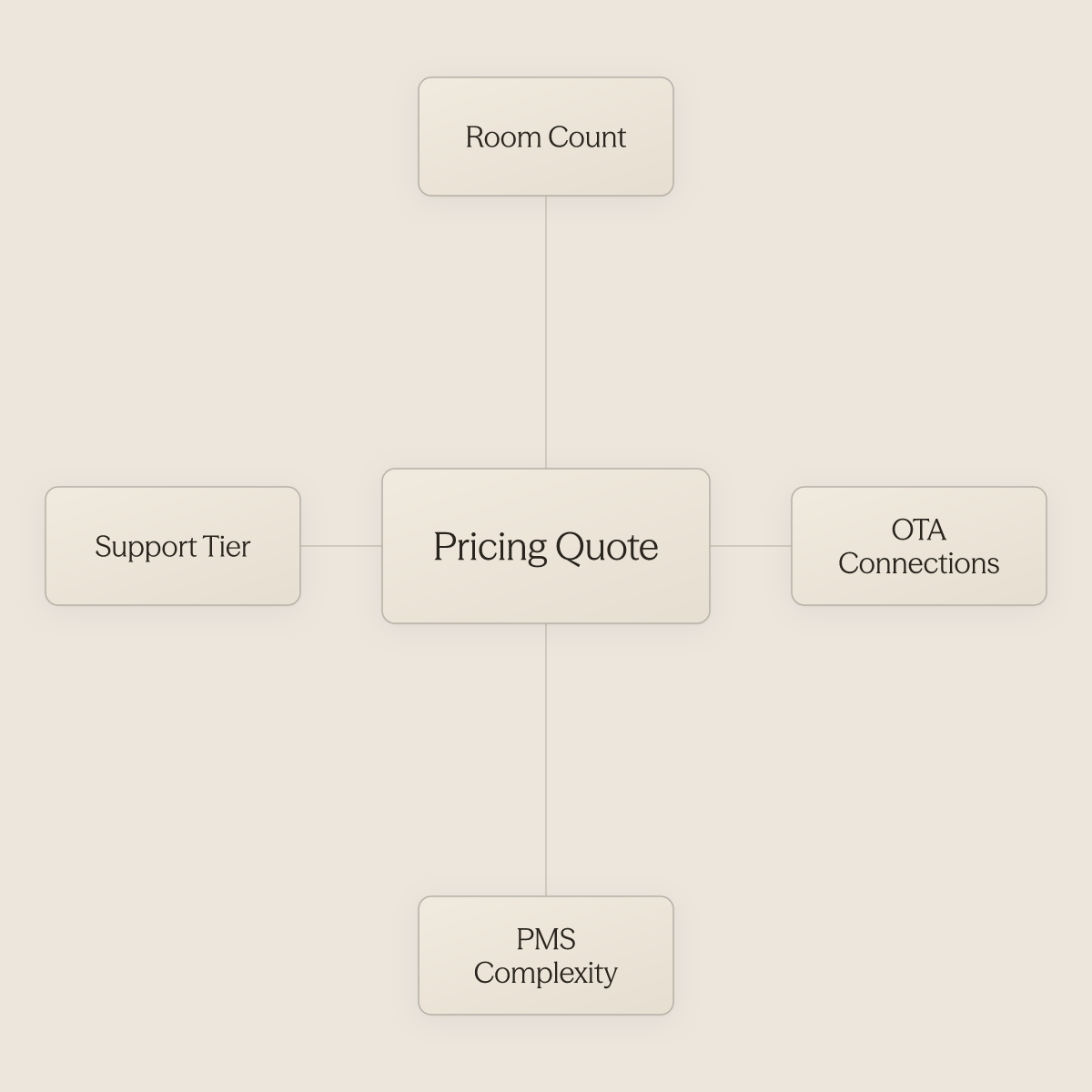
Number of rooms, OTA connections, PMS complexity, and support tier are the four dials vendors turn when building your price. A 12-room boutique connecting to four OTAs through a cloud PMS pays a fundamentally different rate than a 200-room portfolio running a legacy on-premise system across 18 channels. Support tier is the variable operators most often underweight: moving from email-only to dedicated account management can add materially to the base fee, a cost that is rarely surfaced during a demo and worth requesting in writing before signing.
One cost center that compounds quietly alongside your channel manager spend is guest communications. Operators managing properties across multiple OTAs often discover that the same portfolio growth driving their channel manager costs upward is simultaneously inflating their guest support overhead. Noel Poler cycled through multiple support models, including a PMS-bundled call center and third-party hospitality call services, spending significantly on outsourced support each month, yet still faced lengthy guest wait times, mounting refunds, and found himself personally answering guest questions on Slack.
The spend was real; the passive operation he expected was not. At scale, the pattern is even more stark: large portfolio operators running limited automation with minimal knowledge-base configuration often need substantial support teams across multiple shifts to handle check-in questions, lockouts, cleaning issues, and complaints, and every increment of portfolio growth means more messages, more calls, and more hiring. This is the hidden labor cost that sits entirely outside a channel manager comparison but shapes total operational overhead just as decisively.
The Hidden Line Items Most Procurement Checklists Never Capture
Integration setup charges and PMS connector fees sit below the subscription line and above most operators' awareness. Hotel Tech Report's channel manager buyer guidance consistently recommends asking vendors to itemize every fee before signing, because advertised pricing rarely reflects total cost of ownership once integration, support, and renewal fees are included. Before you sign, make sure you have accounted for:
- Onboarding and integration costs (commonly quoted separately from monthly subscription fees and can be substantial at portfolio scale)
- Two-way PMS sync connector fee (often renews annually)
- Support tier upgrade costs (moving from email-only to dedicated account management)
- Renewal fees beyond the initial contract term
The same principle applies when evaluating guest communication tools alongside your channel manager. Conduit's Integrations layer connects directly to tools operators already use, Notion, Google Drive, Airbnb, so the AI agent can leverage existing SOPs, FAQs, and manuals without manual re-entry, eliminating a setup cost that typically gets quoted separately elsewhere. Its AI Agents begin generating automated guest replies within days of connecting your documentation, and the Inbox gives your operations team a single pane to monitor every conversation the agent is handling across all platforms and properties simultaneously.
Configured with Workflows that trigger on booking confirmation, check-in, or detected keywords, the system handles recurring guest touchpoints that would otherwise require manual staff action, directly reducing the operational overhead and labor costs associated with a centralized reservations or guest services team. When you are building a true total-cost-of-ownership comparison, that labor line deserves the same scrutiny as your connector fees.
The Distribution Gap No Channel Manager Closes: and What Multi-Property Operators Do About It
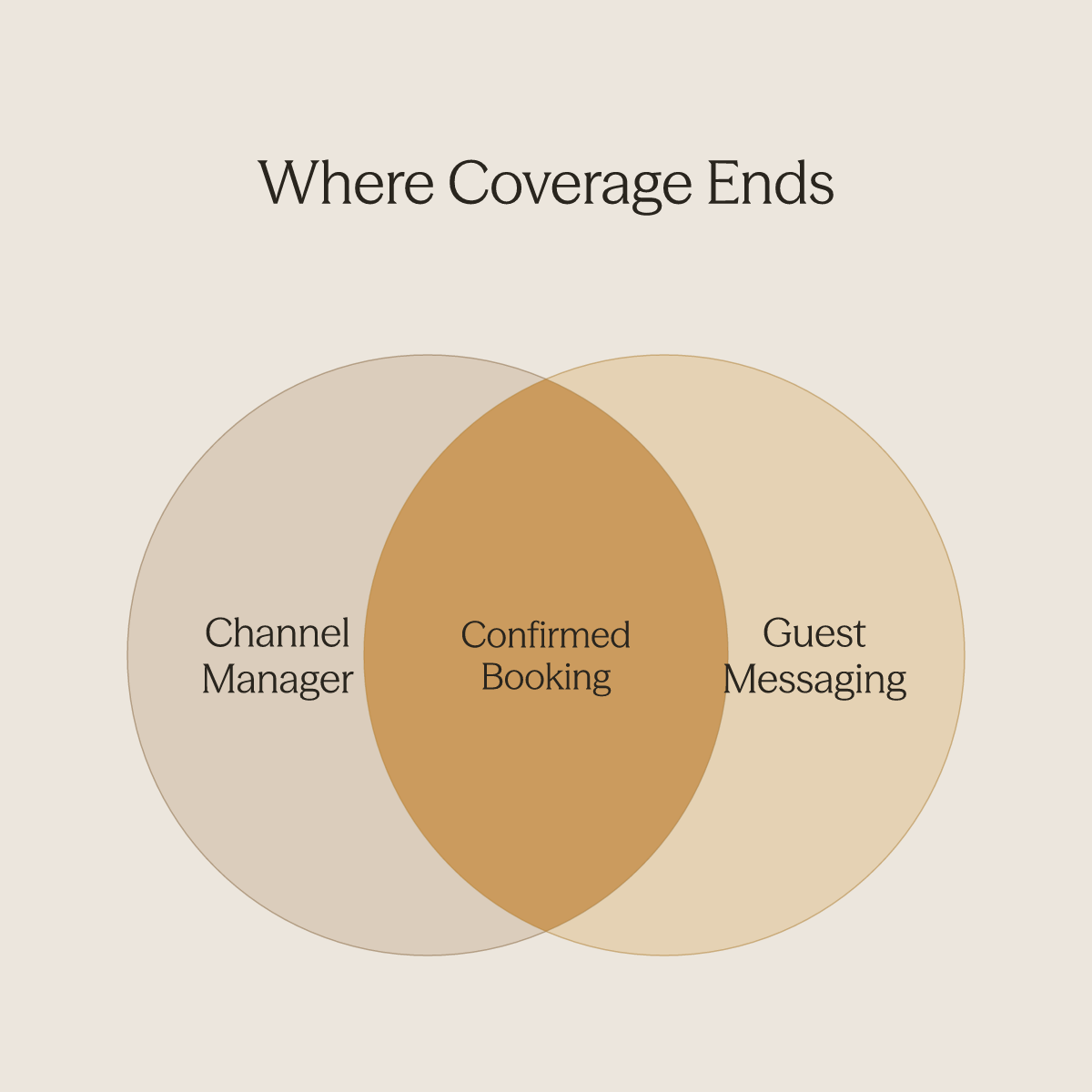
Every confirmed booking a channel manager delivers is the start of a communication sequence the channel manager never touches. Pre-arrival questions, mid-stay requests, late checkout negotiations, post-stay follow-ups: each lands in an inbox waiting on a human already managing the next property's problem. At portfolio scale, that unmanaged layer is where review scores slip, brand voice fractures, and headcount climbs.
Where the Channel Manager's Scope Ends
A channel manager's job is complete the moment reservation data hits your PMS. What follows, the full arc of guest communication from booking confirmation through checkout, is a separate operational layer entirely. According to industry data (2024), the absence of a coordinated guest messaging system, regardless of how well-configured the distribution stack is, produces slower issue resolution, inconsistent communication, and measurably weaker review scores.
The Hidden Headcount Tax
The staffing cost of routing guest messages across a multi-property portfolio rarely appears on a single P&L line, but operators who have counted it describe the same pattern: the majority of inbound volume is low-complexity and repetitive, exactly the kind of work an AI agent handles without delay, freeing the team to focus on the higher-value interactions that actually move guest satisfaction scores and repeat-stay rates.
Key takeaway: Easy BnB was running a large team of virtual assistants to cover that volume before connecting an AI agent layer. The result was significant monthly savings across the portfolio, with zero additional hires.
The labor cost was not a staffing failure.
It was a structural one.
Verified Operator Results
Wynwood House, operating across multiple countries in Latin America and Europe, faced agents spending far too long on each guest resolution, shift handoffs requiring full conversation-history reviews, and sentiment tracking living in inconsistent spreadsheets. After routing all guest communication through a single AI agent coordination layer, resolution times dropped dramatically, replacing manual guesswork with a reliable weekly satisfaction KPI.
Operational Leverage, Not OTA Count
Operators who scale without proportional headcount growth are not the ones with the most OTA connections; they are the ones who have systematized what happens after the booking lands. Adding a 12th or 15th OTA produces diminishing occupancy returns; adding a coordinated guest communication layer compounds across every booking the distribution stack already generates.
AI for hospitality platforms like Conduit read directly from knowledge sources operators already maintain, Google Drive, Notion, Airtable, and Airbnb, and push conversation data back to existing systems. No custom code, no re-entry of existing content. The channel manager shortlist in this guide solves the distribution layer. A coordinated guest communication platform closes what comes next.
Related Reading
- Hospitality Chatbot
- Best Revenue Management Software For Hotels
- Siteminder Competitors
- Canary Technologies Competitors
- Cloudbeds Alternatives
- Digital Concierge Software
- Hospitality Conferences
- Hotel Distribution Management
Next steps
If your channel manager is running cleanly but review scores and repeat-stay rates refuse to move, the path forward starts with recognizing that inventory sync and guest communication are two separate operational layers, and solving one does not touch the other.
The post established that channel manager adoption eliminates overbooking but installs a quieter revenue loss in its place, because misconfigured rate strategies and incomplete channel mixes become invisible once operators start measuring success by the absence of complaints. It also established that fast response times drive a 116% lift in booking conversion, and that the entire pre-arrival, in-stay, and post-stay communication sequence runs entirely outside any channel manager's scope. Together, those two findings point to the same next step: add a coordinated communication layer on top of the distribution infrastructure you just finalized.
Start with AI for hospitality to see how Conduit closes the post-booking gap across every OTA your channel manager connects to. The AI agent pulls from knowledge sources your team already maintains, Google Drive, Notion, Airbnb, and begins handling guest inquiries automatically within days, without a separate integration project or manual content re-entry. Every booking your channel manager captures starts generating communication the moment it lands. That communication now has a system behind it.
Frequently Asked Questions
What's the difference between a channel manager and a PMS?
A channel manager is the distribution layer that keeps room inventory, rates, and availability consistent across every OTA and booking platform a property lists on. A PMS (property management system) handles reservation data internally, a good channel manager pulls confirmed booking data back into the PMS automatically via two-way connectivity, so front desk staff never re-enter bookings by hand. Cloudbeds is an example of a platform that pairs both in a single stack, eliminating the sync risk that API-connected setups can introduce.
Does a channel manager handle guest messages and pre-arrival communication too?
No, and this is the gap the post flags as the most underestimated operational cost. Channel management software handles distribution; it is not architected to touch guest conversations. Every booking a channel manager captures immediately generates communication, pre-arrival questions, mid-stay requests, checkout follow-ups, that land across separate inboxes with no unified routing. Conduit.ai is built specifically to close that gap, consolidating guest communications across every platform and automating responses around the clock from the moment the channel manager's job ends.
Is real-time sync actually necessary, or is a short delay acceptable?
Real-time syncing is described in the post as the baseline requirement for any channel manager worth evaluating. A delay of even a few minutes creates a window for duplicate reservations, and at portfolio scale those windows compound across dozens of properties and hundreds of nightly transactions, the post notes that manual channel management exposes hotels to an estimated 10–15% of potential revenue lost annually through overbookings and reservation errors.
Which channel manager is the best fit for a small independent hotel or boutique property?
The post highlights that independent hotels and boutique properties wanting to consolidate their tech stack without a custom integration project are well served by an all-in-one PMS and channel manager combination, which eliminates the sync risk that separate API-connected setups can introduce. For operators who need the lowest-cost entry point with high configurability, the post also covers a budget-friendly option designed for independent operators and small portfolio managers that can be justified without a formal procurement process.
How many OTAs does a channel manager actually need to connect to in order to make a difference?
According to the post, most bookings across any portfolio still concentrate on three to five OTAs regardless of how many channels a platform connects to, meaning the vendor with 450 connections and the vendor with 200 connections will often produce nearly identical booking outcomes. The real differentiators are integration depth, reporting clarity, and, critically, the officiality of OTA connections, since shallow or unofficial integrations can introduce the very sync gaps that real-time connectivity is supposed to eliminate.
Stay in the loop
Get the latest on AI automation, product updates, and customer stories.


