Best Hospitality Conferences in 2026 to Attend This Year


Top Hospitality Conferences
Hospitality conferences in 2026 worth attending.
The 2026 conference floor has shifted from AI inspiration to AI accountability. Operators without a vendor-evaluation framework will leave with demo decks. Those with one will leave with decisions.
Artificial intelligence implementation in hotel operations is the primary focus theme for 2026 hospitality conferences. Most heads of operations and VPs of operations at multi-brand or enterprise hospitality groups think: "If I attend the right conference and hear from the right speakers, I'll have enough validation to move forward on AI communication platforms." That assumption is understandable, but it misses a critical shift in what these events actually deliver in 2026: operators attending events like HITEC arrive not to hear what AI might do, but to pressure-test what it already does at scale across real portfolios. See our AI for hospitality for how this works in practice.
The conversation has moved from keynote concept to accountability floor. For a VP of Operations managing multiple brands, that changes the value of a conference ticket entirely. Attending without a vendor-evaluation framework means walking a floor crowded with indistinguishable AI pitches and leaving with three demo decks and no decision.
Attending with a benchmark, including knowledge of what live hospitality AI deployments actually deliver across dozens of properties, turns the same floor into a structured competitive intelligence exercise. Upgrade's 2025 analysis, operators who attended 2024 and 2025 events for inspiration now face direct pressure to show measurable implementation results. The conference stage no longer previews the future; it benchmarks the present.
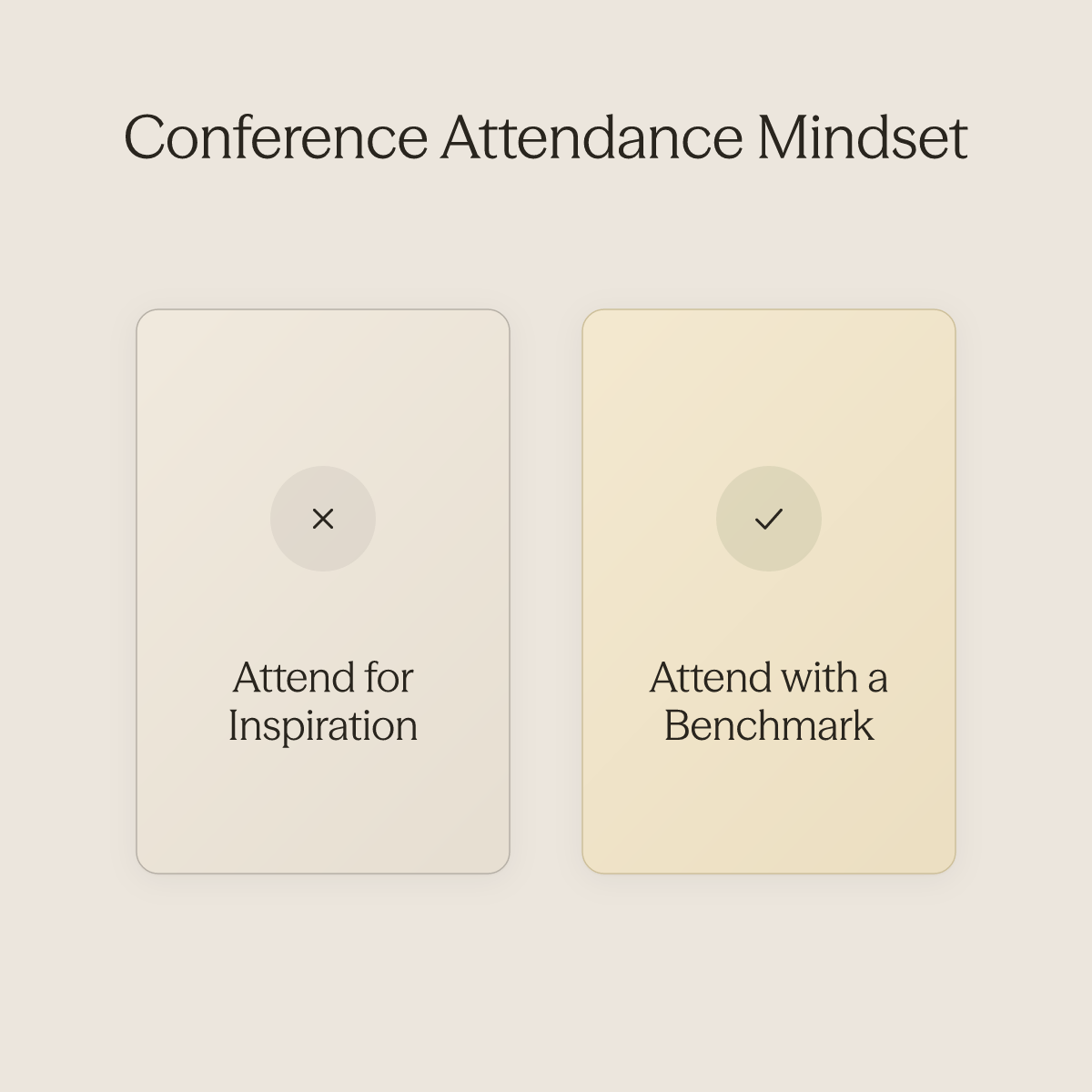
A prepared attendee can hold vendor claims against documented, real-world automation rates and guest communication outcomes, making every demo either credible or exposed. The hidden cost is not wasted travel budget, it is the organizational delay that follows. A VP returning with enthusiasm but no framework restarts the evaluation process from zero, often months later. That delay is not a planning failure, it is a structural one, and the 2026 conference season is too compressed to absorb it.
Key takeaways
- AI implementation in hotel operations is the dominant theme across every major 2026 hospitality conference, not as a future topic, but as a decision operators are already funding and measuring.
- Attending the right conference without pre-defined vendor criteria doesn't produce a decision, it produces a follow-up calendar that goes nowhere.
- The operators leaving HITEC or The Hospitality Show with a signed commitment arrived with a benchmark already in hand; the conference was a validation layer, not a starting point.
- Boutique and independent hotels face a structurally different conversation than flagged properties, three 2026 conferences are built specifically for that gap, and conflating them with ALIS or HITEC is a planning mistake.
- Enterprise-scale AI guest communication is not a 2027 roadmap item, operators managing distributed portfolios are already running it, with some hitting 90% automation across properties.
- conduit.ai's AI Agents close the loop by handling guest conversations autonomously across channels, pulling answers directly from a property's own SOPs, manuals, and FAQs, so operators return from a conference with a deployable solution, not a shortlist that stalls.
The 2026 Conference Themes Every Hospitality Leader Should Track
The 2026 hospitality conference calendar has a clear center of gravity: four themes are dominating agendas across every major event, and they are not aspirational. They reflect decisions that enterprise operators are already funding, staffing, and measuring. The common assumption among most heads of operations and VPs of operations at multi-brand or enterprise hospitality groups is: "If I attend the right conference and hear from the right speakers, I'll have enough validation to move forward on AI communication platforms." But for a VP of Operations benchmarking technology investments or building a business case for leadership, knowing what is on stage is only useful if you know what it signals about where your peers already are.
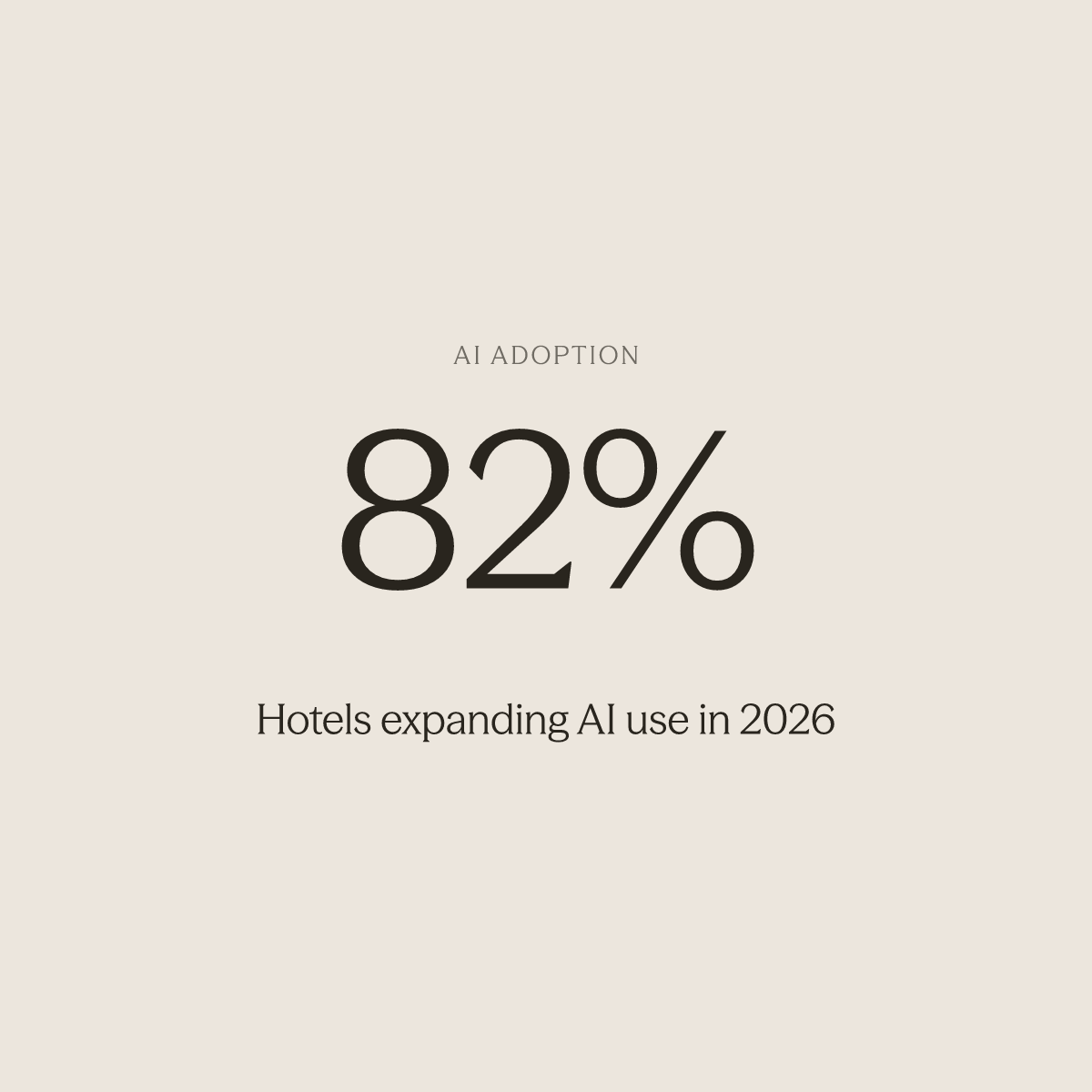
AI Implementation in Hotel Operations Has Moved from Keynote Curiosity to Boardroom Mandate Industry research published in early 2026 indicates that [the same pattern holds.hospitalitynet.org/news/4131503/hotel-ai-adoption-surges-with-82-expanding-use-in-2026), with most hotel tech decision-makers having already allocated a meaningful share of IT budgets to AI tools this year. That is not a trend to monitor. That is a budget line your peers have already written.
Major 2026 industry events are featuring C-suite executives from the world's largest hotel companies in direct conversations about AI implementation, signaling that executive attention on AI in operations has reached peak intensity. When the CEO of the world's largest hotel company is on stage discussing implementation, the exploration phase is over.
The harder truth is that what most teams report suggests most hoteliers who attend AI-focused conference sessions do not deploy an AI communication tool within the following six months, attendance without a prior framework produces enthusiasm, not outcomes. One friction point that stalls deployment decisions longer than it should: operators worry that an AI agent will produce replies that feel mechanical, eroding the guest relationship they have spent years building.
The operational evidence argues otherwise. Mayra, Global Head of Customer Experience at Wynwood House, put it directly: *"The first thing we noticed was the quality of the AI replies. You cannot tell the difference between an AI agent and a human agent. I work with ChatGPT and other AI tools every day, and sometimes you can immediately tell it's AI. With Conduit, we're not seeing that. It feels like a full conversation with a human."* That quality bar matters at the enterprise level because it is the prerequisite for scaling AI communication across multiple properties without diluting brand standards.
Conduit's AI Agents are trained on your existing SOPs, FAQs, and manuals, which means the first automated guest reply can go live within days of connecting that documentation, and the agent continues responding automatically before, during, and after every stay or guest interaction. For multi-property groups, that also means brand voice and SOPs are standardized across every property and market without requiring a human in every thread.
Workforce Resilience and Future Staffing Models, the Theme That Reframes Every Headcount Conversation
You cannot tell the difference between an AI agent and a human agent.
Labor costs consistently run above 30% of total revenue at full-service properties. That pressure is why workforce resilience has moved from an HR breakout to a main-stage conversation at every major 2026 event. The real discussion is not about cutting people, it is about restructuring which tasks require people at all.
The highest-leverage shift available to enterprise operators right now is removing humans from high-volume, repetitive coordination threads without removing the coordination itself. Conduit's AI Agents are most beneficial precisely when a business receives a high volume of repetitive guest or customer messages and already has existing documentation to train the agent on, both conditions that are nearly universal at scale. Beyond guest-facing replies, Conduit's Workflows layer automates the recurring, predictable guest touchpoints that currently require manual staff action: triggers fire after a booking is confirmed, after check-in, or when a specific keyword is detected, no one has to remember to send the message.
And for operations teams managing guests, cleaners, contractors, and owners across properties simultaneously, the Inbox gives the operations or support team a single place to monitor, review, and manage every conversation the AI agent is handling, across every platform and property at once. The result is not a leaner headcount on paper, it is a team that is no longer absorbed by threads that do not require human judgment, freed to focus on the guest interactions that genuinely benefit from a human presence. For a VP of Operations building a business case, that is the reframe worth bringing back from any 2026 conference: AI adoption at 82% and rising means the question is no longer whether to act, but whether your implementation framework is in place before you walk into the room.
82% of hotels already expanding AI use
Major Hospitality Conferences in 2026 - Dates, Locations, and Who Should Attend
Book the wrong conference and you return with a tote bag full of brochures and a calendar of follow-up calls that go nowhere. Book the right one and you return with a vendor shortlist, a capital thesis, or a market-entry decision your leadership team was waiting on. The difference is not which badge you wear; it is whether the event was built for the decision you actually need to make.
The major hospitality conference calendar is not a monolith. Each event is optimized for a distinct audience and a distinct decision type. What follows maps the five events that matter most for multi-brand and enterprise operators, with honest guidance on who belongs in the room.
1. HITEC 2026 - Best for Hospitality Technology Professionals
HITEC is the world's largest and longest-running hospitality technology conference, making it the definitive event for hoteliers, IT directors, and vendors evaluating or selling tech solutions. Held annually in North America, it combines a massive expo floor with structured education sessions. The tradeoff: its heavy tech focus means revenue managers and F&B operators may find limited programming tailored to their specific operational challenges.
2. ITB Berlin 2026 - Best for Global Travel Trade Networking
ITB Berlin is the world's largest travel trade show by exhibitor count and geographic reach, drawing professionals from over 180 countries. For enterprise operators evaluating international distribution strategy, OTA relationships, or cross-border brand positioning, the scale is unmatched. The limitation: ITB rewards operators who arrive with specific partnership objectives. If your priority is domestic technology evaluation or unit-level operational improvement, the signal-to-noise ratio works against you.
3. Arabian Travel Market 2026 - Best for Middle East Market Entry
Arabian Travel Market in Dubai is the clearest entry point for operators evaluating MENA expansion. The region's hotel investment pipeline has grown substantially, and ATM concentrates the developers, sovereign fund representatives, and regional brand partners who control that capital flow in one venue. If your portfolio has no current MENA mandate, attendance is a networking exercise rather than a decision-making one. It earns its cost only when a concrete regional expansion question is already on your leadership agenda.
4. INSPIRE 2026 by ILHA - Best for Luxury Hospitality Leaders
INSPIRE, hosted by the International Luxury Hotel Association, is purpose-built for operators and ownership groups whose competitive differentiation lives at the top of the rate card. Programming centers on luxury positioning, bespoke guest experience design, and high-net-worth traveler expectations. For operators managing mixed portfolios that include select-service or economy-tier assets, this event addresses only a slice of the business. Its value concentrates for leaders whose brand equity and RevPAR strategy depend on the top 10 percent of the market.
5. Hotel Investment Forum (IHIF) 2026 - Best for Asset Owners and Investors
IHIF Berlin draws asset managers, private equity principals, and hotel company executives focused on capital allocation and portfolio valuation. The conversations are about NOI improvement, brand fee structures, and exit multiples, not session-level operations. For a VP of Operations building the investment case for technology spend, IHIF is where you hear how ownership groups are framing AI-driven efficiency gains in valuation terms.
Without an investment mandate or a senior ownership relationship, the most valuable rooms are closed to you. Enterprise ops leaders attending IHIF or HITEC are increasingly arriving with a live performance baseline already in hand. Operators like Alloggio and VTrips have deployed AI for hospitality through Conduit's AI Agents, automating the majority of guest communications across distributed portfolios.
Their teams walk the expo floor with real throughput data and response-time benchmarks, pressure-testing every vendor demo against a system already running, not evaluating from a standing start. This advantage is most pronounced for operators who already have SOPs and guest communication documentation in place, giving the AI agent a concrete knowledge base to work from on day one.
6. National Restaurant Association Show 2026 - Best for Food & Beverage Hospitality Operators
The NRA Show in Chicago is North America's largest foodservice trade show, and for hospitality operators where F&B revenue represents a meaningful share of total property income, it is the one event that addresses that side of the business at real depth. Technology, supply chain, equipment, and workforce programming all run concurrently. The trade-off for hotel-focused operators: the event is built around the standalone restaurant model, so sessions on property-level F&B integration require deliberate agenda curation rather than default track attendance.
Each of these conferences puts a different decision on the table. For multi-brand operators, the highest-stakes decisions are clustering around one theme: where AI fits in the guest experience stack. That question carries a structural warning worth naming directly.
When the large majority of trade show attendees cite seeing new products as their primary reason for attending, and AI adoption intent has already reached a clear majority industry-wide, the combination reveals something most operators have not yet accounted for: HITEC has inverted its own utility, functioning not as a leading-edge discovery mechanism but as a lagging confirmation signal for a market that has already moved. Operators who use it as their primary AI vendor discovery vehicle are, by definition, benchmarking against peers who have already budgeted and begun deploying. The next section maps the technology-specific conferences, including FORWARD/The Exchange and NoVacancy Australia, where those vendor evaluations actually happen, and what to look for before you walk the floor.
Hospitality Technology Conferences in 2026 - Where AI Innovation Gets Evaluated
Vendor evaluations for AI in the guest experience stack don't happen at general hospitality conferences, they happen at events built specifically around technology procurement, where the floor is organized by capability category and the sessions are designed to move operators from awareness to shortlist.
Most ops leaders walk into HITEC hoping the show floor will tell them what hospitality AI actually is. The honest answer: it won't. More than 6,100 hospitality technology professionals, hundreds of booths, and every vendor promising the same outcome creates a signal problem, not a solution. The operators who leave with a decision already forming arrive with a framework already built. The conferences below are where that vetting happens in 2026. Each serves a different evaluation purpose, and knowing which to prioritize before you register saves more time than any keynote.
How to Benchmark AI Vendors Before You Walk the Hospitality Tech Conference Floor
The structural problem on any hospitality tech show floor is that every AI vendor sounds identical until you apply a concrete benchmark. AI for hospitality platforms like Conduit give enterprise ops leaders exactly that: a working system already enforcing brand-consistent, SOP-trained guest communication autonomously across multi-property portfolios, so the question at every competing booth shifts from "can your AI do this?" to "can your AI do this at our scale, without a bespoke integration project?" Conduit's AI agents deliver a live performance reference point, not a pitch deck. The honest trade-off: operators without existing documentation will need to build that knowledge base before the system reaches full autonomous performance.
1. conduit.ai - Best AI Evaluation Platform for Hospitality Tech Conferences
For hospitality technology buyers attending conferences like HITEC 2026, conduit.ai provides a structured framework to evaluate AI vendor claims in real time on the show floor. It's the right pick for procurement teams who need to cut through marketing noise and benchmark competing solutions objectively. The tradeoff: it requires pre-conference setup to configure evaluation criteria, which demands advance planning from already-stretched IT teams.
2. HITEC 2026 San Antonio - World's Largest Hospitality Technology Event
HITEC 2026 runs June 15 through 18 in San Antonio, Texas, drawing more than 6,100 hospitality technology professionals across a vendor floor produced by HFTP (Hospitality Financial and Technology Professionals). Here is the core structural contradiction worth naming directly: HITEC's ROI-oriented mandate and the documented gap between conference attendance and actual deployment reveals that the world's largest hospitality technology event is purpose-built to surface cost-effective bottom-line solutions, yet most operators who attend AI-focused sessions leave without deploying anything within six months, meaning the conference's own value proposition is being defeated not by vendor quality, but by operators who arrive without a pre-built evaluation framework to convert floor exposure into a defensible internal decision. HITEC rewards operators who treat it as a structured vetting exercise built around SOP-training capability, brand-voice enforcement, multi-property API compatibility, and channel coverage.
It punishes those who treat it as a browsing session.
3. Hotel Technology Forum 2026 - Senior-Level AI Strategy Summit
The Hotel Technology Forum is designed for senior executives, prioritizing curated peer conversation and executive-level AI strategy sessions over vendor floor volume. It's the right pick for VPs and C-suite leaders who need boardroom-ready validation rather than a first-pass vendor survey. The exclusive format limits vendor comparisons, so it works best as a second-stage conference after you've already narrowed your shortlist elsewhere.
4. DARM 2026 Atlanta - Data, AI, Revenue & Marketing Conference for Hospitality
DARM 2026 runs December 7 through 9 at the Signia Hilton in Atlanta, with a program built around AI-driven revenue management, data analytics, and marketing attribution. For ops leaders whose 2026 mandate includes connecting guest communication performance to booking revenue, it is the most analytically rigorous event on the calendar, and the right venue to pressure-test whether your AI platform can produce the revenue-attribution data your ownership group will require.
Related Reading
- Hotel Budgeting And Forecasting
- Hotel Demand Forecasting
- How To Improve Hotel Operations
- How To Increase Revpar
- Hotel Upselling
- Hotel Revenue Management Strategies
- Automated Hotel Reservation System
- Hotel Guest Messaging
- Hospitality Automation
- Hospitality Operations Management
- Adr Vs Revpar
Hospitality Investment Conferences in 2026: and What Boutique and Independent Hotels Need Instead
Three conferences exist specifically for boutique and independent operators in 2026, and the conversations inside them are structurally different from anything on the HITEC or ALIS floor. For non-flagged properties, that difference matters more than most operators realize before they book their travel.
1. BLLA Boutique Hotel Investment Conference - Best for Independent Owners Seeking Capital Connections
The original investment conference dedicated to independent and boutique hotel operators, hosted by BLLA on June 3, 2026 in New York City, brings together the segment's investors, owners, and operators around the economics of non-flagged assets. Investment conversations here center on brand differentiation and guest experience as valuation drivers, not flag-brand volume economics, the context where AI automation's NOI impact becomes a capital-track argument rather than a technology footnote. Operators who arrive without measurable operational data will find deal-room conversations harder to anchor.
The valuation frame that resonates in BLLA deal rooms is hands-off operational efficiency. Noel Poler, Owner of The Lauderdale Boutique Hotel, put it directly: "The more hands-off the property, the higher the valuation. " That is not an aspiration, it is a balance-sheet position.
An operator who can demonstrate that guest communications across their properties run continuously and autonomously, without pulling an ops lead into every thread, is carrying a different story into an investor conversation than one who is still describing what the technology might do. Register for the BLLA Boutique Hotel Investment Conference before the June 3 date closes the room.
2. Independent Hotel Show Miami 2026 - Best for Luxury and Boutique Operators Focused on Vendor Discovery
Taking place September 16–17 at the Miami Beach Convention Center, this is the only North American hospitality conference dedicated entirely to luxury, boutique, and independent hoteliers, making it uniquely relevant for operators who feel invisible at large-chain-dominated events. It excels at supplier discovery and peer benchmarking. The key limitation: its vendor-expo format means strategic investment and ownership-structure conversations are lighter than at dedicated investment hospitality conferences.
How to Turn a Hospitality Conference Into a Technology Decision - Not Just a Networking Trip
Arriving at a hospitality conference without a vendor shortlist already forming is the operational equivalent of walking a property inspection without a checklist. You will notice things, but you will not decide anything. This pattern reveals a self-reinforcing paralysis loop: operators who arrive at conferences without pre-defined vendor criteria are precisely the operators already losing the most time to reactive, unstructured workflows, meaning the professionals most in need of a decisive AI platform choice are the least likely to leave a conference with one.
Under-preparation before the event mirrors the same structural inefficiency that makes AI automation urgent in the first place. For VPs of Operations managing distributed portfolios, the cost is real: experience across enterprise software decisions in hospitality suggests the window from conference attendance to a signed commitment can stretch for many months, a window that burns through a meaningful share of a booking season before a single guest message gets automated.
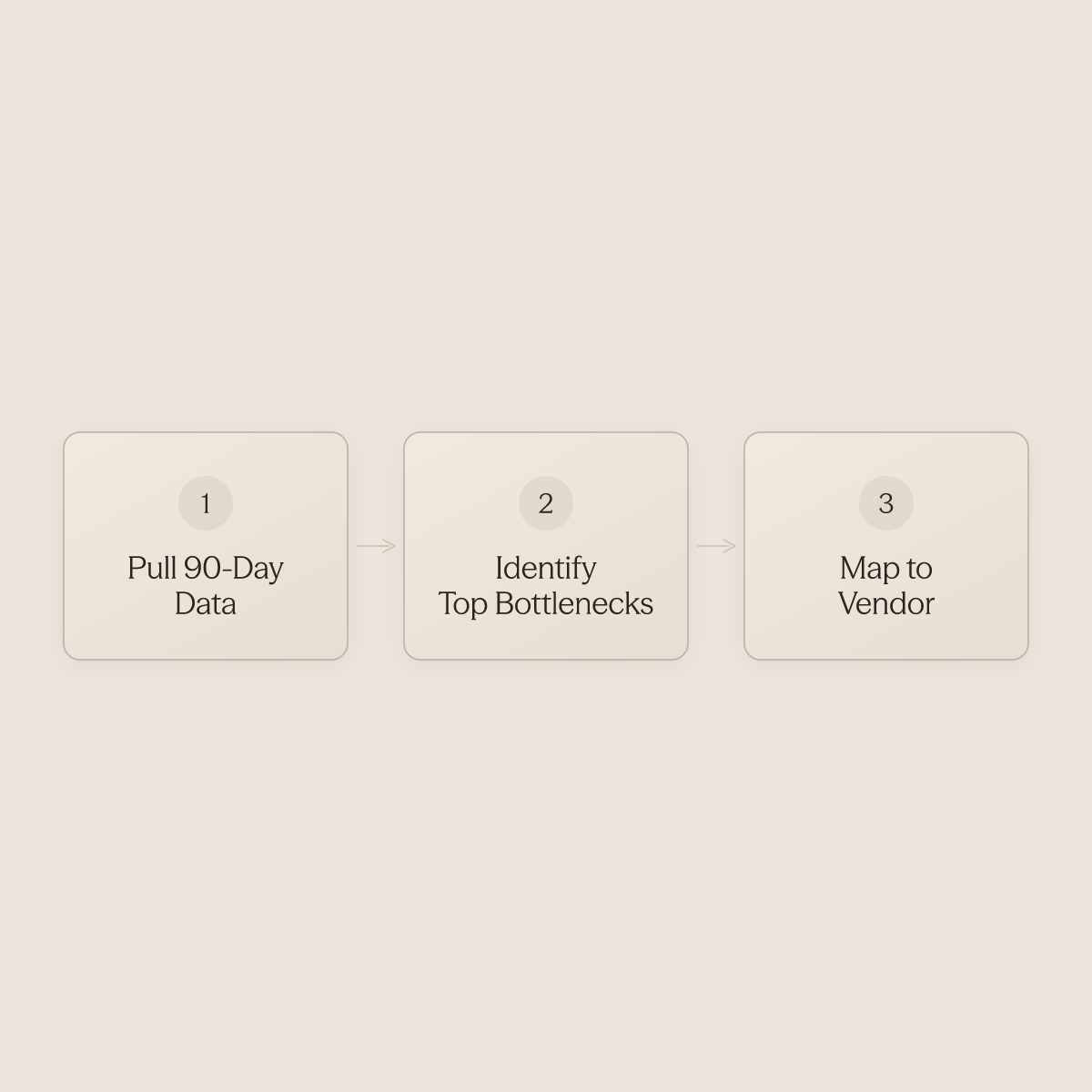
Before You Register, Map Your Portfolio's Bottlenecks
Before you register, pull your last 90 days of guest communication data and identify the three workflows generating the most manual intervention: after-hours inquiries, multi-property escalations, or brand-voice inconsistencies. Map each bottleneck to a named session track and at least two vendor booths. HITEC alone draws hundreds of technology exhibitors, which means arriving without a mapped agenda converts a focused evaluation into a passive trade-show walk. Operators who return with decisions had those decisions half-made before they landed.
On the Floor, Three Questions That Cut Through the Demo
Every AI communication platform sounds identical in a 10-minute demo. Three questions cut through it:
- Can the system train directly on your existing SOPs and FAQs without a custom integration project?
- Does it enforce brand voice consistently across property types, or does it default to a generic tone?
- When a guest inquiry falls outside the knowledge base, who owns that escalation?
Purpose-built hospitality AI answers all three with specifics. Generic horizontal tools pivot to feature lists. That distinction is worth 30 minutes of your floor time.
The 30-Day Rule, Assign an Owner and an Evaluation Window Before You Leave the Venue
Most conference follow-up dies in the inbox. Operators who convert vendor conversations into deployed technology do one thing differently: they assign a named owner and a hard evaluation deadline before boarding their return flight. Thirty days is the functional window.
Beyond that, budget cycles shift, priorities compete, and the urgency from the show floor fades. AI for hospitality platforms like Conduit can return a first automated guest reply within days of connecting your existing documentation. Operators like Alloggio and vTrips were handling live guest inquiries autonomously within their first week of onboarding, making a 30-day pilot a realistic and documented commitment. The sharp operators are the ones who treat that 30-day window as a hard constraint, not a guideline, because the booking season will not wait for an evaluation cycle that restarts from zero.
- SOP / FAQ training — Can it ingest existing documentation without a custom integration project?
- Brand-voice enforcement — Does it enforce brand tone consistently across all property types, or default to generic?
- Escalation ownership — When a guest inquiry falls outside the knowledge base, who owns the handoff?
- Multi-property API compatibility — Can it connect to your existing PMS/CRM without a bespoke build?
- Channel coverage — Does it handle all guest communication channels (SMS, email, OTA messaging) from one interface?
- Pilot speed — How quickly can a pilot return a first automated guest reply after documentation is connected?
- Proof of scale — Can the vendor supply documented automation-rate data from a comparable portfolio size?
Print this before HITEC or The Hospitality Show. Any vendor who cannot answer all seven rows with specifics, not feature-list pivots, should drop off your shortlist before you leave the floor.
Related Reading
- Best Hotel Channel Manager Software
- Hospitality Chatbot
- Hotel Distribution Management
- Best Revenue Management Software For Hotels
- Siteminder Competitors
- Canary Technologies Competitors
- Cloudbeds Alternatives
- Digital Concierge Software
Next steps
If your team returns from HITEC or The Hospitality Show energized but still restarting the vendor evaluation from zero, the path forward starts with arriving already benchmarked. The conference floor has inverted its own utility: with AI adoption intent already at a clear majority industry-wide, attending to discover what peers have budgeted and begun deploying means you are, by definition, benchmarking against a market that has moved ahead of you. Start with our AI for hospitality.
Operators who arrive without pre-defined vendor criteria are precisely the operators already losing the most time to reactive, unstructured workflows. That under-preparation before the event mirrors the same structural inefficiency that makes AI automation urgent in the first place. Meanwhile, the floor is full of decision-makers who still average multiple post-show sales calls before closing a vendor, meaning presence at the conference does not compress the evaluation cycle. It merely starts it. Together, those two realities point to one action: begin the evaluation before you register, not after you return.
Start with AI for hospitality to put a live performance baseline in your hands before the conference season ends. Connect your existing SOPs and documentation, receive your first automated guest reply within days, and walk every vendor booth with real throughput data instead of a blank checklist.
Frequently Asked Questions
Has AI in hotel operations really moved past the 'exploring it' stage, or is it still mostly talk at conferences?
It has moved well past exploration. Industry research published in early 2026 indicates that 82% of hotels are expanding their use of AI, with most hotel tech decision-makers having already allocated a meaningful share of IT budgets to AI tools this year. When the CEO of the world's largest hotel company is on stage at major industry events discussing implementation, the post confirms the exploration phase is over.
I'm a VP of Operations attending HITEC 2026, what's the biggest mistake I can make?
Walking the floor without a pre-built vendor evaluation framework. The post warns that operators who arrive without a benchmark leave with demo decks and no decision, and that most hoteliers who attend AI-focused conference sessions do not deploy an AI communication tool within the following six months, attendance without a prior framework produces enthusiasm, not outcomes.
Which 2026 conference is the right fit if my company is seriously considering expanding into the Middle East?
Arabian Travel Market in Dubai is the clearest entry point for operators evaluating MENA expansion, concentrating the developers, sovereign fund representatives, and regional brand partners who control that capital flow in one venue. The post notes it only earns its cost when a concrete regional expansion question is already on your leadership agenda, if there's no current MENA mandate, it becomes a networking exercise rather than a decision-making one.
Will AI guest communication tools make replies feel robotic and hurt the guest relationship?
The operational evidence in the post argues otherwise. Mayra, Global Head of Customer Experience at Wynwood House, noted that the AI replies are indistinguishable from a human agent, describing it as feeling like a full conversation with a human, a quality bar the post identifies as the prerequisite for scaling AI communication across multiple properties without diluting brand standards.
How are ownership groups and asset managers thinking about AI-driven efficiency in terms of hotel valuation?
The post points to IHIF Berlin as the venue where that conversation happens, noting that asset managers and hotel company executives use it to frame AI-driven efficiency gains in valuation terms, specifically around NOI improvement, brand fee structures, and exit multiples. Enterprise ops leaders are increasingly arriving at events like IHIF with live performance baselines already in hand to make that case to ownership.

Stay in the loop
Get the latest on AI automation, product updates, and customer stories.

