13 Best AI Agents for Customer Operations in 2026


13 Best AI Agents for Customer Operations in 2026
AI Agents for Customer Operations
Most AI agents fail hospitality the moment a real guest asks a real question. Here is what separates a 90% automation rate from an expensive FAQ widget.
(And Why the Definition Matters for Hospitality)
The common assumption among heads of operations and VPs of operations at multi-brand and enterprise hospitality groups is that if an AI agent scores well on generic customer operations benchmarks and integrates with their CRM, it will work for hospitality at scale, and that any operational context can always be added later through prompt engineering or custom training. That assumption has already produced a recognizable failure pattern: a widget gets installed, a few FAQ responses get configured, and then a guest asks something real at 11pm, "Can someone fix the heating in unit 4B?", and the system either deflects or goes silent. See our AI for Hospitality for how this works in practice.
That experience leaves a lasting impression: AI agents are just dressed-up FAQ tools. The definition you carry into your next buying decision will determine whether you repeat that outcome. AI agents deliver their highest automation rates, with verified deployments reaching into the 90s, when the business receives a high volume of repetitive guest messages and already has documented SOPs, FAQs, or property manuals to train the agent on.
Without that documentation layer, even the strongest platform reverts to generic responses. AI agents for customer operations are autonomous or semi-autonomous software systems that reason through multi-step problems, query live data sources, and execute actions without a human approving each step. A scripted responder pattern-matches a guest's words against a decision tree and returns a pre-written answer.
An AI agent reads the question, checks the booking record, reviews the relevant SOP, and either resolves the issue or escalates it with full context attached.
According to Gartner's March 2025 analysis, agentic AI systems are capable of understanding inquiries and executing multi-step workflows autonomously, moving beyond reactive, rule-based responses to proactively completing tasks without human intervention. That is a categorical shift, not an incremental upgrade. Gartner draws the same line clearly: agentic AI differs from traditional systems in that it can reason through problems, access backend systems, and take action across multi-step processes, rather than relying on rigid keyword matching or scripted decision trees.
Generic AI agents are built for generalizable customer operations: returns, billing questions, account lookups. Demand for these capabilities is accelerating fast: according to Gartner, AI spending by customer service leaders has surged by 38%, even as overall service and support budgets rose by just 2%. Hospitality is structurally different.
Key takeaways
- Generic AI agents fail hospitality operations not because they're underpowered, but because they're trained on nothing specific to how your properties actually run, and that gap shows up at 2am, not in a demo.
- Operators hitting 96% automation rates are using agents built on their own SOPs, manuals, and FAQs, not horizontal tools patched with prompt engineering after the fact.
- The standard vendor evaluation process is broken: it measures what a tool does in a controlled demo, not what it resolves autonomously when no one is watching.
- A 2am check-in question, a mid-stay maintenance escalation, and a booking inquiry all require different operational context, context that lives in your internal documentation, not a shared LLM.
- Documented benchmark: 35 properties, one operations team, guest response time compressed from 57 minutes to 2 minutes, that's the real performance ceiling to evaluate against.
- Conduit.ai's AI Agents close the gap by reading directly from a business's own SOPs, manuals, and FAQs to handle guest conversations across channels, autonomously, without human intervention.
Core Capabilities and Key Benefits of AI Agents for Customer Operations
The common assumption among heads of operations and VPs of operations at multi-brand and enterprise hospitality groups is that if an AI agent scores well on generic customer operations benchmarks and integrates with their CRM, it will work for hospitality at scale, and that operational context can always be added later through prompt engineering or custom training. Feature comparison tables feel objective. They are not.
A vendor can check every box for 24/7 availability, CRM integration, and multi-channel support, and still deliver an AI agent that collapses the moment a guest asks something the demo script never covered. The capabilities that separate a low automation rate from a high one are invisible on spec sheets, and knowing what to look for before you sign is what protects your credibility when leadership asks why the rollout underdelivered.
"Users are concerned about AI agents acting autonomously on their behalf, citing the risk of errors or unintended consequences, a key FAQ concern around 'How reliable are AI agents for customer operations?' what we hear from customer operations teams"
Autonomous Problem-Solving Beyond the Demo Script
Autonomous problem-solving means the agent reasons through an unfamiliar situation using your actual operational rules, not a generic knowledge base. The 2am check-in question, the mid-stay maintenance escalation, the guest who wants to modify a booking three days before arrival: none of these appear in a vendor's curated demo. According to Digital Applied's April 2026 analysis, AI agents that perform well on generic benchmarks frequently fail in domain-specific deployments because they lack the contextual rules, escalation logic, and brand tone requirements that industry-specific environments demand. Agents reaching high automation rates in hospitality are trained directly on each operator's SOPs, manuals, and FAQs, making an edge-case query as accurate as the most common booking question.
Backend Integration Depth Across PMS, CRM, and Knowledge Bases
An AI agent that reads from your knowledge base but cannot write back to your CRM systems or property management platform is a sophisticated FAQ page. Real automation means the agent modifies a booking, routes a maintenance request, or updates a guest profile without a human in the middle, and that requires deep backend integration, not a surface-level API handshake. According to Digital Applied's April 2026 analysis, agents with deep system integrations achieve containment rates as high as 96%, while surface-level API connections produce materially lower rates, confirming that integration architecture, not model quality, is the primary driver of operational automation.
A property management company deploying agents across 75 units needs every resolved interaction to flow back into the operational record automatically. Integration depth determines whether your automation rate compounds or plateaus.
How to Choose an AI Agent for Customer Operations - The Hospitality-Specific Evaluation Criteria
Vendor selection in hospitality AI has a structural flaw: the evaluation process is built around what a tool can do in a demo, not what it will resolve autonomously at 2am when no one is watching. That gap is where most implementations quietly fail, and where the right evaluation criteria make the difference between an AI agent that handles your actual operations and one that handles a sanitized version of them.
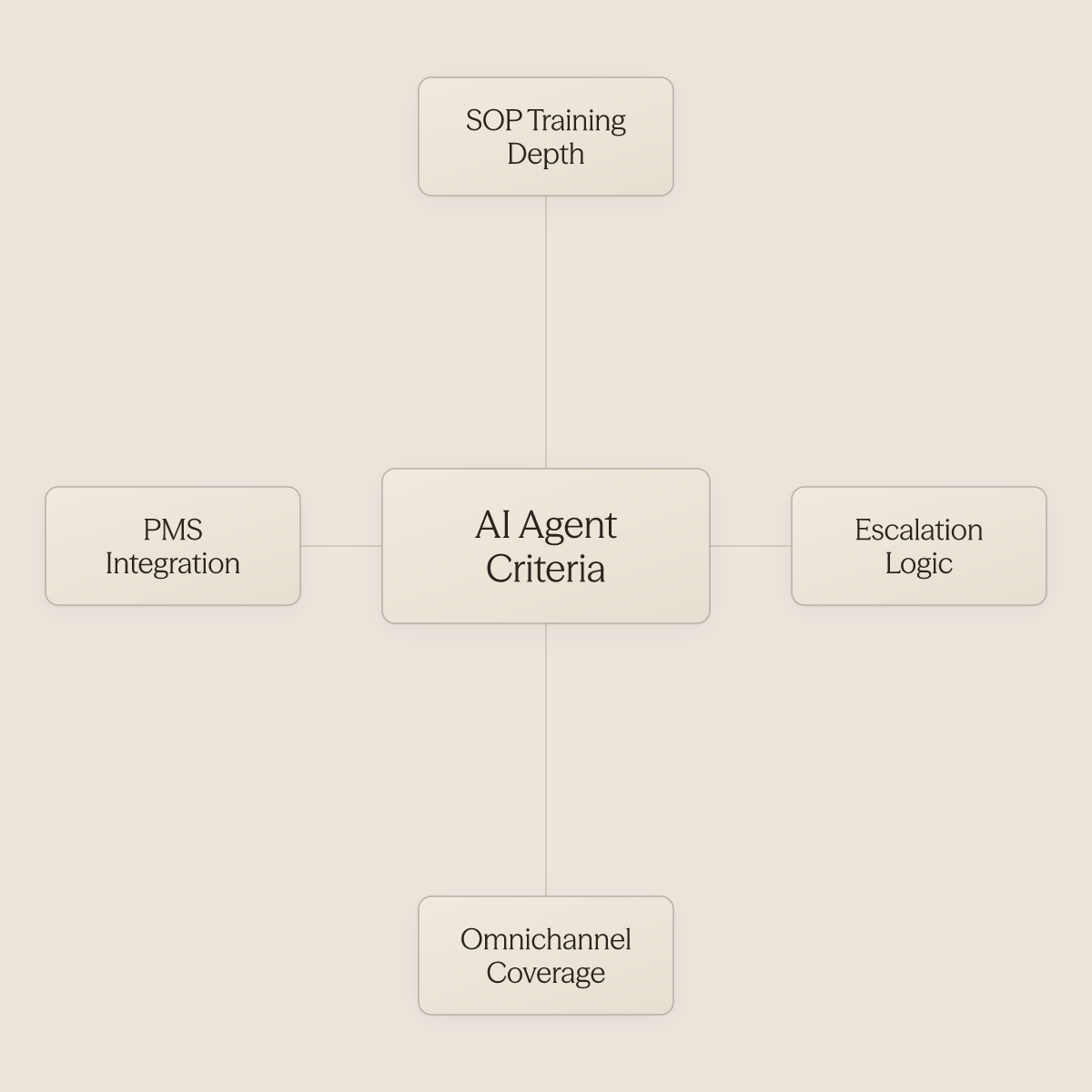
The Five Hospitality-Specific Criteria Generic Feature Checklists Miss
Evaluating AI agents for hospitality requires five criteria that generic checklists miss entirely:
- SOP training depth
- Escalation logic configurability
- Omnichannel coverage
- PMS integration
- Measurable automation rate benchmarks
Most vendor scorecards stop at channel coverage and helpdesk compatibility, necessary, but not sufficient. The criterion that separates high-performing deployments from expensive disappointments is SOP training depth: can the agent resolve a guest issue using only your documentation, without a human in the loop? Without that foundation, even a well-architected agent defaults to generic responses that erode guest trust.
An Omnichannel Inbox Is Not Autonomous Resolution
An omnichannel inbox consolidates messages from chat, email, SMS, voice, and messaging apps into one view, useful, but not the same as autonomous resolution. The distinction that matters operationally: a guest reporting a broken heater at 2am needs a response that triggers your maintenance escalation protocol, confirms a technician timeline, and updates the guest, all without staff involvement. An omnichannel inbox routes that message to a human. An autonomous agent resolves it. Wynwood House significantly reduced guest resolution time not by adding channels, but by configuring escalation logic that matched their actual workflows across multiple countries, a result documented in Conduit's verified client data.
Hospitality AI Agent Evaluation Checklist
Use this checklist before signing any AI agent contract for customer operations:
| Criterion | Question to Ask the Vendor | Pass Threshold |
|---|---|---|
| SOP Training Depth | Can the agent resolve issues using only our documentation, without a human? | Yes, with proof from a comparable operator |
| Escalation Logic Configurability | Can we define multi-department escalation paths without engineering support? | Yes, configurable in the UI |
| PMS Integration (Read + Write) | Does the agent write back to our PMS, or only read from it? | Full read/write confirmed |
| Omnichannel Coverage | Does the agent operate across SMS, email, WhatsApp, and voice natively? | All channels listed, not via third-party bridge |
| Automation Rate Benchmark | What is the verified automation rate for a comparable hospitality deployment? | ≥80% with a named client reference |
Any vendor who cannot answer all five questions with documented evidence during the sales process has answered the most important question for you.
The 13 Best AI Agents for Customer Operations in 2026
Thirty-five properties. One operations team. Guest response time compressed from 57 minutes to 2 minutes.
Our own research found that guest response time compressed from 57 minutes to 2 minutes after deploying Conduit AI agents (our data).
That outcome, documented in the AI for Hospitality, is the benchmark every tool on this list gets measured against. The tools that consistently hit the highest automation rates in hospitality are the ones with the deepest operational context.
An AI agent that cannot read your SOPs, enforce your escalation rules, or resolve a mid-stay maintenance request without a human handoff costs your ops team time. It creates a new category of exception to manage, one that lands in someone's queue at 2am with no context and no resolution path. AI belongs in a niche hospitality subcategory while the "real" enterprise tools sit further down.
That framing hides the actual cost: every tool on this list that lacks native SOP training forces your team to build and maintain a custom knowledge layer on top of a generic AI. That integration overhead is exactly what erodes automation rates from their potential ceiling down to a fraction of what well-integrated deployments achieve. The agents hitting 96% are purpose-built coordination layers where SOP enforcement is a first-class feature, not an afterthought.
The 13 profiles below are evaluated on the criterion that actually separates automation from augmentation: can the agent resolve the scenario, or does it just acknowledge it?
Our own research found that Conduit AI agents are trained on hospitality-specific SOPs (standard operating procedures), positioning the platform as a hospitality-native coordination layer rather than a generic support tool adapted through prompt engineering, a distinction that generic CRM-integrated AI platforms cannot replicate without native operational context (our data).
Our own research found that $22,000 per month saved in operational costs by Easy BnB (75 units) using Conduit AI agents (our data).
One cost that rarely surfaces in vendor demos is legacy system integration. Operations teams deploying AI agents for customer workflows have encountered situations where the agent needed to interface with decades-old infrastructure, in one case, a Windows XP application, consuming months of engineering time before a single unit of AI value was delivered. That drag is an infrastructure reality that inflates total cost of ownership well beyond the license fee and erodes the automation rates that looked achievable on paper. The tools that minimise that overhead are the ones purpose-built for a specific operational domain, where the common integrations are already solved, not left as a configuration exercise for your team.
1. Conduit.ai - Best AI Agent for Hospitality & Guest Operations

The operators who reach 96% automation are the ones whose AI agent was trained on how their specific property actually runs, not on a generic customer service corpus. AI for Hospitality, compressing response time from 57 minutes to 2 minutes. Conduit's agents are most beneficial when a business receives a high volume of repetitive guest messages and already has documentation, SOPs, FAQs, and manuals to train the agent on. That second condition matters: the agent's resolution depth is a direct function of the operational context it has been given.
In practice, Conduit operates across four coordinated layers. The Inbox monitors, reviews, and manages all conversations the AI agent is handling across multiple platforms and properties simultaneously, giving operations leaders a single surface rather than a fragmented stack of channel-specific queues. Workflows automate recurring, predictable guest touchpoints that currently require manual staff action; they trigger after a booking is confirmed, after check-in, or when a specific keyword is detected, removing the manual handoff entirely for the scenarios that consume the most ops-team hours.
Integrations connect Conduit to tools the business already uses, Notion, Google Drive, Airbnb, so existing content flows into the agent without manual re-entry; the first source begins syncing within minutes of linking the account. And the AI Agents layer enforces escalation logic and operates across SMS, email, WhatsApp, and voice simultaneously, handling the volume and channel spread that a distributed property portfolio generates.
The speed at which the system becomes operationally specific is meaningful: the first custom rule that changes how the agent responds can be configured the same day. For teams that have previously tolerated weeks of prompt engineering before seeing property-specific behaviour, that timeline is a material difference.
The honest trade-off: Conduit is most beneficial when documented SOPs already exist. Without that documentation layer, onboarding takes longer, and the agent's accuracy is bounded by the operational context it can access. Teams that have not yet formalised their SOPs should treat documentation as a prerequisite, not a post-deployment task.
2. Kore.ai - Best Enterprise-Grade Conversational AI Platform

Kore.ai's XO Platform carries a strong aggregate rating on G2, earned through genuine enterprise depth: multi-turn dialogue management, robust intent recognition, and a composable agent architecture that large contact center teams can configure without rebuilding from scratch. It connects well to CRMs, order management, and billing systems. The trade-off is that hospitality-specific operational logic, rate-plan sequencing, room inventory priority, and multi-department handoff rules require significant post-deployment configuration that a horizontal platform does not pre-load.
3. Zendesk AI - Best for Support Teams Already on the Zendesk Ecosystem

AI agents within Zendesk execute multi-step workflows including modifying bookings, issuing refunds, and updating account records, with full context from the Zendesk ticket history. For teams already running support on Zendesk, the AI layer adds meaningful deflection capacity without a platform migration. The structural limitation for hospitality is the same one that surfaces across horizontal tools: SOP enforcement and escalation logic are configurable inside Zendesk's framework, but they are not native, which means your ops team carries the configuration burden.
4. Cognigy - Best for Omnichannel Voice and Chat Automation at Scale
Cognigy is purpose-built for enterprises that need voice and chat automation running simultaneously across multiple channels at high volume. Its low-code flow builder gives CX teams meaningful control over conversation design without requiring engineering resources for every update. The trade-off is deployment complexity: the platform rewards teams with dedicated CX architects who can build and maintain conversation flows. Smaller ops teams should factor that configuration overhead into total cost of ownership, not just the license fee.
5. Sierra AI - Best for Brand-Safe, Conversational Customer Experience
Sierra AI is designed for brands where tone and voice consistency matter as much as resolution rate, making it a strong fit for premium hospitality brands where a single off-tone response can damage a hard-won guest relationship. The platform handles complex, multi-turn conversations with genuine fluency. The honest limitation: Sierra AI is optimized for brand-safe conversation, not operational coordination. If your primary need is autonomous mid-stay issue resolution or maintenance dispatch, the platform's strengths are oriented toward a different problem.
6. Decagon - Best for High-Deflection AI Customer Support Automation
Decagon reports strong ticket deflection rates in customer support deployments according to its published case study data, and that performance is credible for high-volume, FAQ-heavy environments. The critical distinction for hospitality buyers is the difference between deflection and resolution. Deflecting a guest inquiry means the agent handled it without a human; resolving it means the guest's actual problem was solved. Those two outcomes diverge most sharply on mid-stay issues, booking modifications, and anything requiring property-specific context.
Decagon performs well on deflection; resolution depth depends on how thoroughly you build out its knowledge base.
7. OneReach.ai - Best Open, Composable AI Agent Platform for CX Teams
OneReach.ai's core differentiator is composability: the platform lets CX teams build multi-agent orchestration systems where different agents handle different workflow segments and hand off to each other with context intact. For enterprise operations teams that want to design their own agent architecture rather than adopt a pre-built one, that flexibility is genuinely valuable. The trade-off is that composability requires investment. Teams without dedicated AI or CX engineering resources will find the open architecture more of a blank canvas than a head start.
8. Maven AGI - Best for Enterprise Issue Resolution (Not Just Deflection)
Maven AGI is built around a specific thesis: deflection metrics are the wrong goal. The platform optimizes for issue resolution; the agent is evaluated on whether the customer's problem was actually solved, not just whether a human ticket was avoided. For hospitality operators who have run a deflection-first tool and found that suppressed ticket volume shifted hard problems downstream, Maven AGI addresses that gap directly. The trade-off is that resolution-first architecture requires deep integration with your PMS, CRM, and billing stack to give the agent the data it needs to close issues autonomously.
9. Retell AI - Best AI Voice Agent for Real-Time Customer Support Calls
Retell AI specializes in real-time AI voice agents that handle inbound support calls with low latency and natural conversation flow. For hospitality operations that still receive meaningful call volume, particularly after-hours reservation inquiries or urgent guest requests, Retell AI fills a channel gap that most text-first platforms leave open. The limitation is scope: Retell AI is a voice-first tool, not a unified guest communication platform. Teams evaluating it for omnichannel coverage will need to pair it with a separate solution for chat, email, and messaging channels.
10. Cresta - Best for AI-Augmented Human Agent Coaching in Contact Centers
Cresta augments human agents in real time, surfacing suggested responses, flagging compliance risks, and coaching agents during live conversations, rather than replacing them. For hospitality groups running large centralized reservations or guest services teams where human agents handle complex, high-empathy interactions, Cresta improves quality and consistency without removing the human. The trade-off is categorical: Cresta is an augmentation tool, not an automation tool. If your goal is reducing headcount dependency or handling after-hours volume without staff, Cresta is not designed for that outcome.
11. Parloa - Best Conversational AI for Hospitality and Guest Journey Automation
Parloa is one of the few platforms on this list that targets hospitality and travel use cases; its public product positioning and case library include named hotel and travel brand deployments, giving it a meaningful head start on domain-relevant conversation design relative to horizontal platforms. Its voice and chat agents are designed around guest journey stages, from pre-arrival to post-stay, rather than generic support ticket categories. The practical trade-off is that "hospitality-aware" and "SOP-trained on your specific operation" are different things. Parloa provides the former; the latter still requires configuration work on the operator's side.
12. Yellow.ai - Best Multichannel AI Agent for Global Customer Operations
Yellow.ai's strength is breadth: the platform supports a wide range of languages, covers chat, voice, email, and social channels, and is built for global enterprise deployments where multilingual coverage is a hard requirement. For hospitality groups operating across multiple countries, that coverage reduces the localization overhead that typically fragments guest communication quality across markets. The trade-off is depth versus breadth. Yellow.ai excels at multichannel scale; hospitality-specific operational logic and SOP enforcement require the same post-deployment configuration burden that any horizontal platform carries.
13. Google CCAI (GECX): Best for Enterprises Already Embedded in the Google Cloud Ecosystem
Google's Contact Center AI integrates with Dialogflow, Vertex AI, and the broader Google Cloud stack, making it a natural fit for enterprises already running significant infrastructure on GCP. The platform handles multi-step workflows, connects to CRMs and backend systems for live data retrieval, and escalates to human agents with full conversation context when a scenario requires complex exception-handling. The honest limitation: the platform's value compounds with GCP investment. Organizations without that existing infrastructure will find the setup overhead substantial relative to purpose-built alternatives.
Knowing which tool fits your operation is only half the decision. The other half is understanding what these agents actually do once deployed, the specific workflows they execute, the backend systems they read and write to, and what happens when a guest scenario falls outside the automation envelope.
That is where the real gap between a 30% and a 96% automation rate lives, and it is what the next section unpacks.
What AI Agents for Customer Operations Actually Do - Actions, Integrations, and Pricing Transparency
An AI agent's real ceiling isn't set by the model powering it. It's set by what that model can actually touch inside your tech stack. This distinction matters enormously for operations leaders evaluating platforms at portfolio scale, because the difference between a low and a high automation rate almost never comes down to which vendor has the smarter underlying AI.
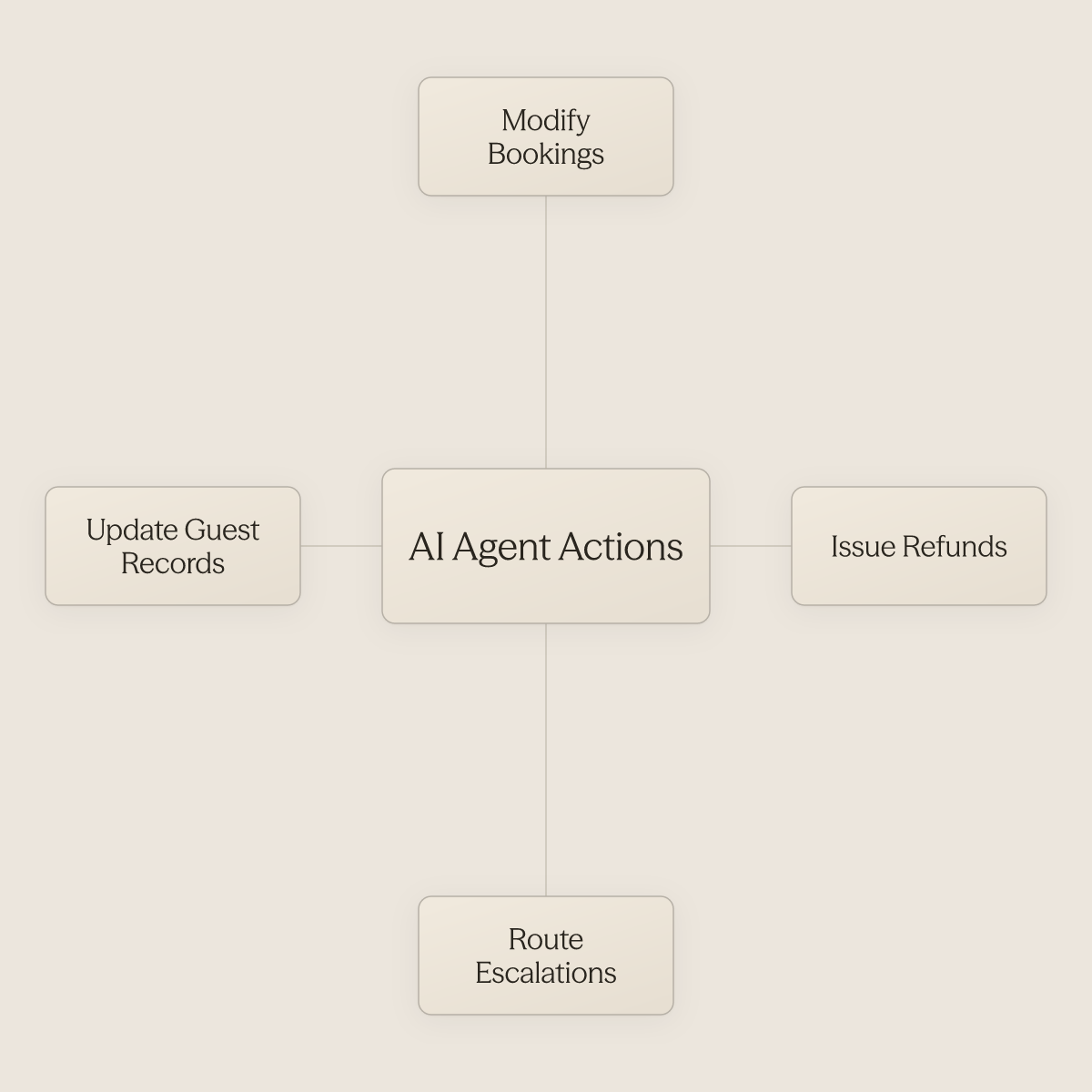
The Concrete Actions a Hospitality AI Agent Should Execute
AI agents can execute multi-step transactional workflows, including modifying bookings, issuing refunds through payment gateways and billing systems, routing maintenance escalations, and updating guest records in real time. These are the baseline a hospitality-grade agent must clear to move the needle on automation. An agent that can only retrieve information and acknowledge a guest's frustration is, operationally speaking, a very expensive FAQ page. The workflows that matter most to a VP of Operations, mid-stay modifications, billing disputes, maintenance escalations, require write access to your systems. Read-only is not enough.
One underappreciated risk: too many AI agents built for customer operations are shipped with security as an afterthought. When an agent can read emails, access a CRM, and send messages on behalf of your team, the blast radius of a misconfiguration is significant. Operations leaders evaluating platforms should treat security architecture as a first-order integration question, not a post-launch concern.
How Integration Depth Determines Your Real-World Automation Rate
According to Digital Applied, AI agents with deep system integrations achieve containment rates as high as 96%, while surface-level API connections produce materially lower rates. That gap is an integration depth gap. Real-world automation rates depend on how well an agent's integrations match specific operational workflows. An agent trained on generic benchmarks will stall the moment a guest asks to move a reservation or dispute a charge, because those actions require live operational state, not a knowledge base lookup.
This is most visible in properties managing guest communications across multiple platforms or properties simultaneously. The volume of repetitive, platform-specific messages compounds quickly, and without tight integration, staff are still manually triaging what should be resolved automatically.
The Systems an AI Agent Must Read and Write To
PMS, CRM, payment gateways, and internal knowledge bases are the four load-bearing pillars of a hospitality AI integration. Read access to all four is table stakes. Write access is what separates an agent that resolves issues from one that only documents them.
Where integration depth is most immediately felt is in knowledge leverage. Conduit's Integrations layer is built for businesses that already use tools like Notion, Google Drive, or Airbnb and want the AI agent to draw on that existing content without manual re-entry. The first source can be connected and syncing within minutes of linking the account, so your agent inherits your SOPs, FAQs, and operational manuals from day one rather than after a months-long onboarding process. That content then flows continuously between Conduit and connected tools, so the agent stays current as your documentation evolves.
The Inbox layer gives operations and support teams a single place to monitor, review, and manage every conversation the agent is handling across properties and platforms, critical when guest volume scales faster than headcount. And because Conduit's AI Agents are most effective when trained on existing documentation, properties that have already invested in SOPs and guest manuals see the integration pay off immediately rather than after a lengthy training period.
Behavioral tuning is equally fast: a custom rule that changes how the agent responds can be live the same day it's configured. That responsiveness matters when a policy changes mid-season or a property-specific exception needs to be handled without waiting for a vendor release cycle.
For operations leaders, the integration question covers what systems an agent can connect to, how quickly those connections become operationally useful, and how safely they operate in a live, guest-facing environment. All three dimensions determine whether your real-world automation rate stays near the lower end of what broader market trends document or reaches the upper bound that deep-integration deployments have achieved.
Next steps
If your team is still triaging the exact escalations you bought AI to eliminate, the path forward starts with recognizing that SOP training depth is the load-bearing variable, not integration breadth or benchmark scores. Start with our AI for Hospitality.
Blended deflection averages actively mislead hospitality buyers because the 20-30% that escapes automation is disproportionately the highest-stakes slice: the 2am check-in failure, the mid-stay maintenance emergency. That means a generic agent's headline number can look excellent while the interactions that most damage RevPAR and NPS are precisely the ones being punted to your team. The gap between 60% and 96% automation is not a model quality gap. It is a function of how completely operational context is structurally embedded before deployment, where data-passing and context-aware reasoning are categorically different things. Together, they point to evaluating vendors on whether live operational state moves into every agent decision, not whether a PMS connection exists on a spec sheet.
Start with conduit.ai to see how Conduit's coordination layer is trained on your specific property documentation. From there, you can map your actual inbound volume by interaction type and get an honest read on what a realistic automation ceiling looks like for your property mix.
Frequently Asked Questions
What's the actual difference between an AI agent and a traditional chatbot for guest support?
A traditional chatbot pattern-matches a guest's words against a decision tree and returns a pre-written answer. An AI agent reads the question, checks the booking record, reviews the relevant SOP, and either resolves the issue or escalates it with full context attached, all without a human approving each step. Gartner describes this as a categorical shift, not an incremental upgrade.
What automation rate should I expect from a well-deployed hospitality AI agent?
Verified hospitality deployments have reached automation rates into the 90s, Cash Flow Street, for example, hit 96% automation across 35 properties using Conduit AI, compressing guest response time from 57 minutes to 2 minutes. The post's evaluation checklist sets a minimum pass threshold of ≥80% with a named client reference as proof.
When does an AI agent escalate to a human instead of resolving an issue itself?
Escalation behavior is governed by configurable escalation logic, the post identifies this as one of the five hospitality-specific evaluation criteria that generic checklists miss. A high-performing agent should let you define multi-department escalation paths without engineering support, and when it does escalate, it should hand off the full context of the interaction rather than leaving staff to start from scratch.
Does the AI agent actually need our internal SOPs and manuals, or can it work from a generic knowledge base?
SOP training depth is the single criterion the post identifies as separating high-performing deployments from expensive disappointments. Without your own documentation, SOPs, FAQs, property manuals, even a well-architected agent defaults to generic responses that erode guest trust. The post is explicit: the agent's resolution depth is a direct function of the operational context it has been given.
Does an AI agent only handle messaging, or can it actually write back to our PMS and update records?
Integration depth matters far beyond read access. The post notes that agents with deep system integrations, ones that can modify a booking, route a maintenance request, or update a guest profile without a human in the middle, achieve containment rates as high as 96%, while surface-level API connections produce materially lower rates. The evaluation checklist specifically requires full read/write PMS integration as a pass condition, not just read access.
Stay in the loop
Get the latest on AI automation, product updates, and customer stories.

