AI Agents for Hospitality: 13 Platforms Compared


AI Agents for Hospitality
13 best AI agents for customer operations
Generic AI agents promise 80% autonomous resolution. For hospitality operators, the other 20% is Tuesday night at 11 PM, and the wrong tool makes it worse.
(And Why the Generic Definition Misses Hospitality)
Property managers evaluating AI tools for guest communication face a definition problem, and most vacation rental property managers and operations leads assume the only solutions are to hire more staff or deploy any highly-rated AI agent, believing that a tool good enough for a SaaS help desk will be good enough for a 35-property short-term rental portfolio. The standard description of an AI agent sounds promising, and for a SaaS help desk, it largely delivers. For a hospitality operation running dozens or hundreds of properties across multiple channels, that same definition quietly skips the part that matters most. See our AI for Hospitality for how this works in practice.
AI agents for customer operations are autonomous software systems that reason through problems, take action, and complete multi-step tasks without predefined decision trees. That's the core distinction from traditional keyword-matching tools, which route conversations based on rigid trigger words and break the moment a guest phrases something unexpectedly. According to Gartner's March 2025 analysis, agentic AI systems differ from rule-based tools precisely because they can reason, act autonomously, and handle multi-step interactions without keyword matching. The same research projects that, in Gartner (2025), agentic AI will autonomously resolve 80% of common customer service issues without human intervention by 2029. That headline figure is real. The word "common" is doing a lot of work in it.
80% of common customer service issues without human intervention : A guest messages asking about check-in time, adds a request for early arrival, then mentions their flight changed and they now need late checkout instead. A keyword-matching tool sees three separate triggers and produces three disconnected responses.
:: An AI agent reads the thread as one evolving conversation and updates its understanding accordingly. This matters at 1am when no one is staffed to catch the handoff failure. Gartner's research confirms that well-designed AI agents know when to escalate, passing cases requiring emotional intelligence or complex exception-handling to human agents with full context intact.
Key takeaways
- Generic AI agents fail hospitality operations the moment a guest asks something property-specific, early check-in windows, lock code resets, parking logistics, because they were trained on SaaS help desk patterns, not SOPs.
- Operators hitting 96% automation rates aren't using better horizontal chatbots, they're running agents trained on their own manuals, channel stacks, and edge cases so the agent executes the operation, not just the reply.
- The standard feature checklist, omnichannel inbox, canned responses, escalation routing, predicts almost nothing about real-world automation rates; vertical depth and integration write-back capability are what actually move the number.
- A 57-minute average response time isn't a staffing problem, it's structural, and it costs you the review before anyone wakes up to respond.
- 60% of guest messages across a typical short-term rental portfolio are repetitive and answerable without a human, the bottleneck is whether your tool knows your operation well enough to answer them.
- Conduit.ai's AI Agents close that gap by reading directly from your SOPs, manuals, and FAQs to handle guest conversations autonomously across every channel, no human intervention required, no generic fallback answers.
Core Capabilities and Key Benefits of AI Agents in Customer Operations
Most operators evaluating AI agents for customer operations are asking the wrong first question. Instead of asking what a tool can do, the more useful question is what it can do autonomously, without stalling, hallucinating, or requiring a human to catch its mistakes at 11 PM on a Tuesday. This section breaks down how properly scoped AI agents actually function in hospitality operations and why the difference between autonomous workflows and glorified scripted replies determines whether the technology helps or quietly creates new problems.
What AI Agents Can Actually Do - Autonomous Workflows, Not Just Scripted Replies
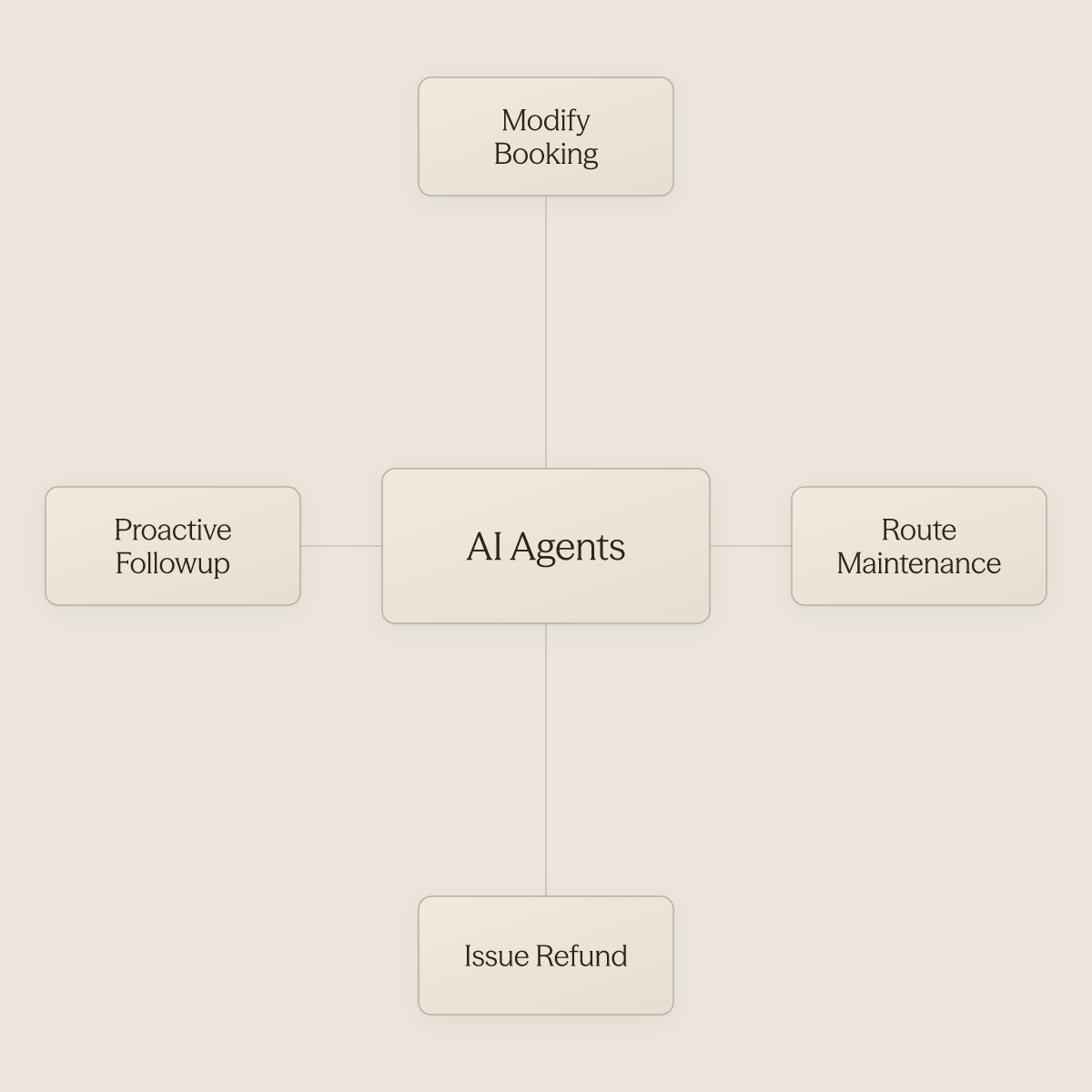
Most vacation rental property managers and operations leads assume the only solutions to guest communication overload are to hire more staff or deploy any highly-rated AI agent, assuming that a tool good enough for a SaaS help desk will be good enough for a 35-property short-term rental portfolio. AI agents for customer service execute multi-step workflows autonomously. A properly configured agent can modify a booking, route a maintenance ticket, issue a partial refund, and send a proactive follow-up, all without a human approving each step. The distinction matters because scripted tools stall the moment a guest's request falls outside a pre-mapped decision tree, which in hospitality happens constantly. Edge cases are not edge cases; they are Tuesday night at 11 PM.
That problem compounds in a specific way operators rarely anticipate: when an AI agent is given too many decisions to make simultaneously, especially during off-hours, it begins to hallucinate, fabricating confident but incorrect answers that cause real operational damage. A guest asking a nuanced question about early check-in at 2 AM does not receive a helpful response; they receive a wrong one delivered with authority. The agents that avoid this failure are scoped deliberately, handling recurring, predictable guest touchpoints that currently require manual staff action, not every conceivable scenario at once.
The benefit materializes most clearly when a business has high volumes of repetitive inbound messages and existing documentation to train the agent on. SOPs, house manuals, and FAQs are the raw material. What operators like Le Roy discovered is that even with SOPs in place, their virtual assistant teams spent their days fielding the same mundane questions: Wi-Fi codes, parking instructions, check-in details.
Higher-value work went untouched. Le Roy found himself micromanaging the team like "the mom," unable to escape the operator role despite having all the right documentation. The documentation existed; what was missing was a system that could act on it automatically, at any hour, without supervision.
Without that system, even a technically capable agent is guessing.
Conduit.ai's Workflows feature is built for exactly this gap. A workflow fires after a trigger event occurs in a conversation or guest lifecycle, after a booking is confirmed, after check-in, or when a specific keyword is detected, and executes the appropriate action without requiring a human to approve each step. It is most beneficial when those guest touchpoints are recurring and predictable, which in short-term rental operations they almost always are.
Omnichannel Operation Solves the Hospitality Scatter Problem, But Only If Threads Stay Unified
Guest conversations scatter across Airbnb, WhatsApp, SMS, and email with no single source of truth. The Wynwood House customer experience team lived this problem directly: agents were forced to constantly switch between platforms to draft messages, translate responses, review guest history, and track performance. The result was guest resolution times stretching across many minutes per interaction, sentiment tracked manually through inconsistent Google Sheets, and shift handoffs that required reading entire conversation histories from scratch. Managers lacked reliable visibility into guest satisfaction at scale because the data was scattered across too many screens to synthesize.
Omnichannel AI agents eliminate that scatter by operating across every channel simultaneously, but only when conversation threads are unified in a single inbox. Channel coverage without thread unification just moves the chaos to a different screen. Conduit.ai's Inbox consolidates every guest conversation into one monitored view, used by the operations or support team on an ongoing basis to review and manage all interactions the AI agent is handling. It is most beneficial when managing guest communications across multiple platforms or properties simultaneously, which is to say, it is built for the exact operational shape most growing short-term rental portfolios take on.
Continuous Learning From Handoffs - Separating Agents That Improve From Ones That Plateau
An AI agent that handles the same escalation the same wrong way for six months is not automation. It is a scheduled failure. The agents that compound in value learn from every human handoff, internalizing why a case was escalated and adjusting future responses accordingly. According to Unthread, ticket complexity, not volume, is the primary driver of resolution cost. An agent that learns to triage complexity more accurately over time directly compresses that cost curve.
This is why the Operator layer in Conduit.ai matters beyond initial setup. The first custom rule that changes how the agent responds can be applied the same day, but the Operator configuration is also used on an ongoing basis, whenever business rules or policies change. It is most beneficial when businesses have specific brand standards, escalation policies, or complex multi-property operations that require differentiated agent behavior. An agent that cannot be retuned after deployment is not learning; it is just running the same playbook against a guest base that is constantly presenting new situations.
Why AI Agents Need Live Backend Access to Your Operational Data
An AI agent with omnichannel reach and autonomous workflow execution still produces broken guest experiences if it pulls from a generic CRM record instead of the property's actual booking data, cleaning schedule, and house manual. According to Unthread, ticket complexity is the primary driver of resolution cost, and complexity spikes precisely when the agent lacks the context to resolve a query accurately on the first attempt, forcing escalation or, worse, delivering a confident wrong answer.
Conduit.ai's Integrations are designed to close this gap without creating new data entry work. The feature is most beneficial when the business already uses tools like Notion, Google Drive, or industry booking platforms and wants the AI agent to leverage existing content without manual re-entry. The agent reads from the sources the team already maintains, house manuals in Notion, booking data from property management systems, SOPs in Google Drive, and acts on live operational data rather than a static snapshot. The practical effect: a guest asking about their specific check-in window at midnight gets an answer drawn from their actual reservation, not a generic policy approximation that may or may not apply to their booking.
How to Choose an AI Agent Platform for Customer Operations - Criteria That Actually Matter
The feature checklist most operators use to compare AI agent platforms, omnichannel inbox, canned responses, escalation routing, CRM connector, tells you almost nothing about whether a tool will actually perform in a hospitality operation. The criteria that predict real-world automation rates are narrower: vertical depth and integration write-back capability.
"We struggle to evaluate the legitimacy of AI agent platforms. Many popular options are just model wrappers with no enterprise support, making it hard to distinguish real platforms from superficial ones. :"
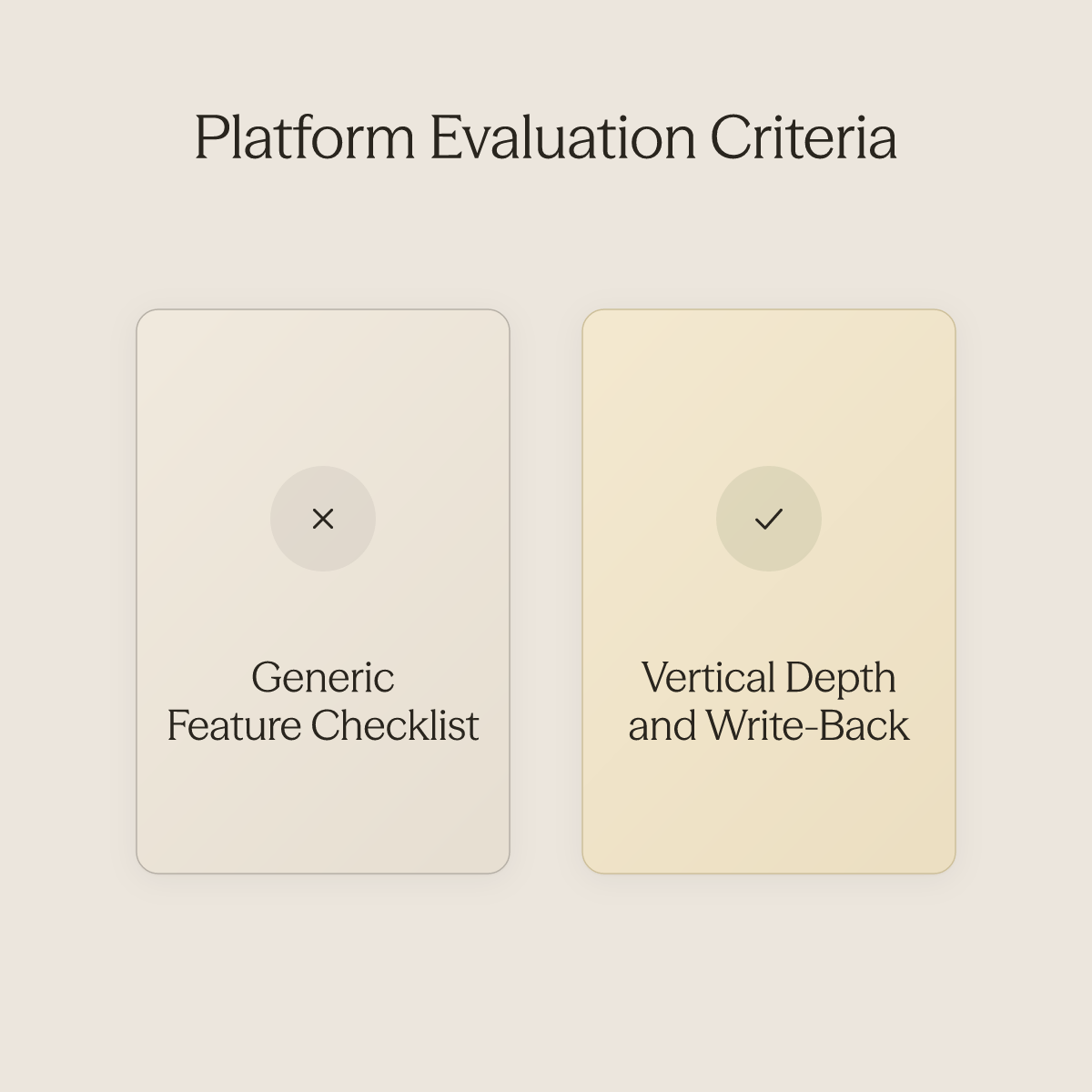
But there's a more fundamental problem with how operators evaluate these platforms. The benchmark metrics most commonly used to filter AI agent tools, ticket deflection rates, CSAT scores, and response time averages drawn from B2B SaaS help-desk environments, are structurally incapable of predicting performance in short-term rental portfolios. The 80% autonomous resolution figure Gartner cites applies only to "common customer service issues" defined by horizontal help-desk contexts, while the cases that matter most to STR operators, 2am lockouts, cleaner coordination failures, jurisdiction-specific compliance questions, fall almost exclusively into the 20% that require human judgment. Operators filtering platforms by G2 or Capterra rankings are therefore optimizing for the wrong problem set entirely.
Vertical Specificity vs. Horizontal Configurability
Vertical specificity answers one question: does the AI already understand check-in windows, OTA policy language, and maintenance triage, or does your team have to build that from scratch? Horizontal platforms like Salesforce and Zendesk are legitimate enterprise tools, but according to Oliv.ai's implementation analysis, Agentforce deployments typically take 9 to 14 months and cost upward of $240,000 before they behave like anything close to a domain-specific operator. That gap matters for a mid-sized portfolio manager who needs production-ready automation now. Purpose-built hospitality AI arrives pre-trained on the context generic platforms require you to construct.
The 13 Best AI Agents for Customer Operations in 2026 - Ranked for Hospitality Operators
That 57-minute average response time isn't a staffing problem; it's a structural one, and it shows up most visibly when a guest messages at midnight about a broken lock code and leaves a one-star review before anyone wakes up. Sixty percent of guest messages across a typical short-term rental portfolio ask the same ten questions, yet manual handling still dominates most operations. The operators closing that gap are running AI agents purpose-built for hospitality, and the performance difference between a horizontal help-desk tool and a hospitality-native one surfaces within the first week of deployment.
Horizontal platforms carry a hidden cost: months of configuration, SOP uploads, and custom workflow builds before they approach the automation depth that purpose-built agents deliver on day one, because the domain knowledge is pre-embedded rather than trained in after the fact. Cash Flow Street encountered exactly that structural gap when switching to Conduit's hospitality-native AI agents; automation reached 96% and response times dropped from 57 minutes to under two minutes without adding headcount. The 13 platforms ranked below are scored on hospitality operational fit rather than general resolution rates, because that's the dimension that predicts whether a tool will handle your portfolio or simply handle your inbox.
Our own research found that Wynwood House reduced guest issue resolution time from 15 minutes to 3 minutes across operations spanning 7 countries using Conduit AI (our data).
1. Conduit.ai - Best Purpose-Built AI Agent for Hospitality Customer Operations
Conduit.ai earns the top position because it's the only platform on this list trained specifically on hospitality SOPs, house manuals, and property-level rules rather than generic help-desk patterns. Cash Flow Street hit 96% automation across 35 properties after switching, and Easy BnB saved approximately $22,000 per month while adding 75 units with zero additional hires. The real tradeoff: Conduit's depth requires operators to have existing documentation, including connections to payment gateways or billing systems, to train the agent on. If your SOPs live in someone's head rather than a shared doc, expect a setup period before the agent reaches full performance.
2. Canary Technologies - Best AI Voice Agent for Hotel Inbound Call Handling
Canary Technologies targets hotel front-desk call volume with an AI voice agent designed to capture bookings and resolve inbound inquiries without routing every call to a live agent. It fits hotel operators who already run Canary's broader guest experience stack and want voice coverage as an extension. The limitation for STR operators is meaningful: Canary's architecture is built around hotel workflows and property management integrations common in branded hospitality, not the multi-channel, multi-property coordination layer that vacation rental portfolios require.
3. Retell AI - Best Configurable AI Phone Agent for Travel and Hospitality Teams
Retell AI is a developer-friendly voice agent platform that lets teams build custom call flows with relatively low infrastructure overhead, covering booking confirmations, reservation changes, and FAQ handling. The honest tradeoff is that "configurable" means "you configure it." Operators without a developer or dedicated ops tech lead will spend more time building the agent than running their portfolio, and hospitality-specific context doesn't come pre-loaded.
4. ASAPP - Best Enterprise AI Agent for Large-Scale Customer Service Resolution
ASAPP is built for enterprise contact centers handling tens of thousands of interactions daily, with particular strength in agent-assist workflows where AI supports human agents in real time. For large hotel groups or multi-brand hospitality companies with existing contact center infrastructure, it's a credible option. For STR operators managing 20 to 200 properties, it's architectural overkill; implementation timelines and contract structures are calibrated for enterprise procurement cycles, not the pace at which a growing property management company needs to move.
5. Fini AI - Best AI Agent for Customer Service Teams Ranked by Autonomous Resolution
Fini AI connects to existing knowledge bases and resolves a meaningful share of tier-one support tickets autonomously, making it a reasonable choice for SaaS companies and digital-first businesses with clean, structured FAQ content. The gap for hospitality operators is the same one that surfaces across horizontal tools: Fini AI doesn't natively understand the coordination layer between guests, cleaning crews, and maintenance vendors, so edge cases requiring operational judgment tend to escalate rather than resolve.
6. Myma.ai - Best AI Communication Platform for Hotel Guest Messaging
Myma.ai focuses on hotel guest messaging with multilingual support and channel consolidation as its core value proposition. For independent hotels managing guest communication across multiple languages and booking platforms, it addresses a real operational pain.
The platform is more narrowly scoped than full AI agent platforms: it handles communication well but doesn't extend into the operational dispatch and internal team coordination that STR operators need when a maintenance ticket requires a vendor call, not just a reply.
7. Chatislav AI - Best Conversational AI Agent for Restaurant Customer Operations
Chatislav AI is purpose-built for restaurant operations, handling reservations, menu questions, and customer inquiries in a conversational format. For vacation rental or hotel operators, it belongs on the radar only if restaurant management is a meaningful part of the property portfolio. As a standalone guest communication tool for STR or hotel operations, its feature set doesn't map cleanly to the use case.
8. Bland AI - Best AI Voice Agent for High-Volume Restaurant and Hospitality Call Automation
Bland AI handles outbound and inbound call automation at scale, with pricing structured for high call volumes. The platform's strength is throughput, not depth: it handles structured, predictable call types efficiently but isn't designed for the nuanced, context-dependent conversations that define STR guest communication, where a single call might involve a lock code issue, a noise complaint, and a checkout extension in the same interaction.
9. Assistents.ai - Best AI Agent Platform for Broad Hospitality Use Case Coverage
Assistents.ai positions itself as a flexible AI agent platform covering a wide range of hospitality use cases, from guest messaging to internal staff workflows. Broad coverage is useful for operators who need one platform to handle multiple functions without stitching together separate tools. The tradeoff is depth versus breadth: platforms that cover many use cases generally require more operator-side configuration to reach the specificity that hospitality edge cases demand, particularly for STR portfolios where property-level rules vary significantly across units.
10. Oracle NetSuite AI - Best AI-Backed Operations Platform for Enterprise Hospitality Groups
Oracle NetSuite AI integrates AI capabilities into NetSuite's enterprise resource planning stack, making it relevant for large hospitality groups that already run NetSuite for finance, inventory, and operations. For property managers evaluating guest communication and front-line automation, NetSuite AI is solving a different problem; it's an operations intelligence tool for enterprise finance and reporting, not a guest-facing AI agent platform built for real-time communication resolution.
11. Cloudbeds Amplify AI - Best AI Marketing and Guest Engagement Agent for Independent Hotels
Cloudbeds Amplify AI extends Cloudbeds' property management system with AI-driven marketing automation and guest engagement tools, targeting independent hotels that want to drive direct bookings and pre-arrival communication without a dedicated marketing team. For operators already on the Cloudbeds PMS, it's a natural extension with low integration friction. The limitation is scope: Amplify AI is strongest in the marketing and pre-arrival phase. Operators looking for an AI agent that handles mid-stay issues, maintenance escalations, and post-checkout follow-up will find it covers only part of the workflow.
12. Duve - Best AI Guest Experience Platform for Upselling and Pre-Arrival Automation
Duve centers its platform on the digital guest journey: pre-arrival communication, digital check-in, upsell offers, and a guest portal that consolidates property information. For hotels focused on revenue per stay and a polished pre-arrival experience, Duve delivers on that specific brief. The tradeoff for STR operators is that the guest portal model assumes guests will engage with a dedicated app or web interface, which adds friction compared to AI agents that meet guests on the channels they're already using, WhatsApp, SMS, and Airbnb messaging.
13. Intercom Fin AI - Best General-Purpose AI Customer Service Agent Adaptable to Hospitality
Intercom's Fin AI posts competitive autonomous resolution rates in general customer service contexts, and its benchmarks show strong performance for SaaS and digital product companies with structured knowledge bases. The honest limitation for hospitality operators: Fin AI resolves what it can find in your documentation, but it doesn't natively understand the operational context of a 1am maintenance escalation or a multi-language guest complaint that requires both a translated reply and a vendor dispatch. Adapting it to that use case is possible; it just takes the time and configuration that purpose-built tools skip.
Choosing the right platform is only half the decision. The other half is knowing exactly what to ask before you sign a contract. The next section answers the questions hospitality operators most commonly get wrong when evaluating AI agents, so you can pressure-test any vendor on this list before committing.
Next steps
If your portfolio keeps stalling because every new property adds another layer of overnight messages, multi-channel scatter, and coordination failures that no one is awake to catch, the path forward starts with matching your AI agent to the operational context it actually needs to run on. Start with our AI for Hospitality.
Generic benchmark metrics like ticket deflection rates and CSAT scores, drawn from horizontal SaaS help-desk environments, are structurally incapable of predicting performance in short-term rental operations. Operators who filter by those numbers are optimizing for the wrong problem set. Separately, deploying a horizontal agent without property-level SOPs, house manuals, and local rules doesn't reduce labor cost. It generates a class of confident-but-wrong responses that human staff must audit and re-send, quietly converting cheap Tier 1 resolutions into expensive Tier 3 escalations. Together, those two realities point to one action: evaluate platforms on hospitality operational fit, not general resolution rates, and choose one pre-trained on your context rather than one you configure from scratch.
Start with Conduit.ai to see how it embeds property-level context at deployment. From there, you can assess whether your current SOPs and house manuals are ready to train an agent that handles the 96% without your team touching it.
Frequently Asked Questions
How do AI agents hand off to human agents without losing context?
Well-designed AI agents escalate cases requiring emotional intelligence or complex exception-handling to human agents with full context intact, the conversation history and relevant guest details transfer with the handoff. The failure mode isn't an agent that escalates too often; it's an agent with no hospitality-specific context that escalates everything because it can't resolve anything on its own.
Can an AI agent actually reduce operational costs for a vacation rental business?
Yes, and the savings can be substantial. Easy BnB saved approximately $22,000 per month while adding 75 units with zero additional hires, and Cash Flow Street hit 96% automation across 35 properties after switching to a hospitality-native AI agent. The cost reduction is most direct when the agent handles high volumes of repetitive inbound messages, Wi-Fi codes, parking instructions, check-in details, that would otherwise require paid staff time.
How do I know if an AI agent is actually performing well for my properties?
The post cautions that standard benchmark metrics like ticket deflection rates, CSAT scores, and response time averages are drawn from B2B SaaS help-desk environments and are structurally incapable of predicting performance in short-term rental portfolios. A more meaningful signal is automation depth on hospitality-specific scenarios, things like 2am lockouts, cleaner coordination failures, and OTA policy questions, since those are the cases that drive real operational cost.
Does an AI agent work around the clock without someone monitoring it?
Yes, autonomous AI agents operate at any hour without requiring a human to approve each step, which is precisely why they're valuable for hospitality. A guest asking about their specific check-in window at midnight gets an answer drawn from their actual reservation, not a generic policy approximation, and maintenance tickets or booking modifications can be executed without waiting for staff to come online.
What existing documentation does my team need before deploying an AI agent?
The agent needs SOPs, house manuals, and FAQs to act on, these are the raw material that allow it to respond accurately rather than guess. Conduit.ai's integrations pull from sources the team already maintains, such as house manuals in Notion, booking data from Airbnb, and SOPs in Google Drive, without requiring manual re-entry. If your SOPs live in someone's head rather than a shared document, expect a setup period before the agent reaches full performance.
Stay in the loop
Get the latest on AI automation, product updates, and customer stories.

