OwnerRez vs Guesty: How They Compare in 2026


OwnerRez vs Guesty
How the two compare in 2026
Most operators pick the wrong battleground. The platform you choose matters far less than who answers your guests at 1am, and no PMS comparison chart has a column for that.
Spend enough time in property management forums and you'll notice a pattern: operators comparing OwnerRez and Guesty obsess over feature matrices, pricing tiers, and channel sync quality. The common assumption is that choosing the right PMS, with better automation features, is what will fix the communication gap: if Guesty's automated messaging or OwnerRez's rule sets were just configured correctly, the problem would be solved. That research isn't wasted, but it answers a narrower question than most operators realize they're asking. See our AI for hospitality for how this works in practice.
The real question, the one that determines whether review scores hold as you cross 20, 30, or 50 units, is who answers the guest at 1am. No PMS comparison chart has a column for that. That gap is where portfolios quietly stall, and it's what hospitality operators scaling with AI are solving before it costs them.
Both OwnerRez and Guesty handle the operational fundamentals competently: calendar sync, channel distribution, owner statements, booking rules. OwnerRez earns respect for financial depth and granular control; Guesty for its polished interface and workflow automation. The feature gap between them is real but narrow enough that the wrong pick is unlikely to break your business.
The standard comparison question is: which platform manages my listings better? The question that determines review scores is: which platform ensures every guest gets a fast, accurate, human-quality response at any hour? Guest communication and responsiveness rank among the top drivers of Airbnb review scores, yet scheduled message templates still leave urgent, late-night issues requiring judgment unanswered. A 35-property operator achieved dramatically higher automation on guest communication without switching PMS platforms, by adding a dedicated AI communication layer on top of the system already in place. That result reframes the whole comparison: the PMS tracks the property; the AI agent handles the conversation.
"The PMS tracks the property; the AI agent handles the conversation."
The real question, the one that determines whether review scores hold as you cross 20, 30, or 50 units, is who answers the guest at 1am.
Key takeaways
- OwnerRez and Guesty solve different problems for different portfolio sizes, OwnerRez concentrates on value and financial control under 30 units; Guesty's pricing reflects the enterprise workflow complexity it is built around.
- Pricing gaps between the two platforms only become real when you model your actual portfolio size, booking volume, and required add-ons, headline numbers mislead in both directions.
- The automation ceiling in both platforms is a messaging ceiling: rule-based triggers and templated sequences break the moment a guest asks something off-script at 1am.
- Neither platform was architected to handle live, unstructured guest conversations, that gap shows up in response lag, 3-star reviews citing slow replies, and ops teams triaging inboxes at midnight.
- A 35-property operator using Conduit hit 96% automation on guest communication, which means the PMS choice matters far less than the AI layer running on top of it.
- Conduit's AI Agents close the communication gap both platforms leave open: they read your SOPs, manuals, and FAQs, then handle guest conversations autonomously across channels, no human intervention, no message queue building overnight.
Platform Overview - What OwnerRez and Guesty Actually Do
OwnerRez and Guesty occupy the same category label without occupying the same market. The platform you choose shapes your workflows, owner reporting, channel sync, and your team's daily rhythm for years, which makes the decision genuinely consequential, not just administratively annoying. The more common mistake, however, is treating these two systems as interchangeable alternatives when they were built for different operators, different scale points, and different operational assumptions from the start.
Before evaluating either platform, operators should understand a structural limitation that applies to both: the review score crisis most property managers attribute to "picky guests" is actually produced by the in-stay communication gap that PMS automation is architecturally incapable of closing, because that gap occurs in real-time, unscripted moments that no scheduled message or rule-based trigger can anticipate. The cost of that gap is not hypothetical. Operations teams managing guest communications across multiple platforms or properties simultaneously face a version of the problem that Wynwood House's customer experience team lived daily: agents forced to constantly switch between platforms to draft messages, translate responses, review guest history, and track performance.
Guest resolution times were lengthy, sentiment was tracked manually via inconsistent spreadsheets, shift handoffs required reading entire conversation histories, and managers had no reliable visibility into guest satisfaction at scale. Operators who reconfigure their PMS templates hoping to improve review scores are optimizing the wrong layer of their stack entirely.
Pros and Cons at a Glance
OwnerRez was built by vacation rental operators who are also software engineers, and that origin story is visible throughout the product. In OwnerRez's own product documentation, the Properties area is described as "a powerful foundation for your rental business," signaling a depth-first design philosophy that rewards operators willing to invest time in configuration.
That investment pays off most for independent managers and small professional firms handling 1 to 50 units who want low overhead and precise financial reporting without enterprise-tier fees. One real constraint worth understanding before committing: OwnerRez's V2 API is read-heavy but write-limited, meaning full lifecycle management actions, such as programmatic booking cancellations, cannot be executed via API. For operators planning to build custom integrations or automate complex workflows programmatically, that boundary matters and should be scoped against your roadmap before you sign.
Guesty at Its Core - Automation-Forward Tooling for Fast-Scaling Agencies
Guesty was architected for growth, with a polished interface, faster onboarding, and workflow automation layered throughout. Management companies adding units quarterly find its unified inbox, task management, and broader channel ecosystem easier to hand off to new team members without deep technical configuration. Guesty has established significant traction among mid-market and enterprise operators globally, reflecting its scale among fast-growing management companies.
The trade-off is real and catches operators off guard with regularity: Guesty's per-module pricing means your bill grows as you unlock more functionality. What looks like a manageable baseline cost at onboarding can expand meaningfully as your operation matures and you need features that sit behind additional paywalls. Operators who scale quickly, adding channels, enabling more automation tiers, or requiring deeper reporting, often find their total cost well above early projections.
That gap between expected and actual spend is one of the most consistent frustrations driving property managers to re-evaluate their stack mid-growth cycle.
Small Portfolio vs. Growing Agency - Which Architecture
The choice between OwnerRez and Guesty ultimately comes down to where your operational complexity lives. OwnerRez rewards operators who want precise control and are willing to invest configuration time upfront; Guesty rewards operators who prioritize speed of onboarding and delegation and who can absorb a pricing model that scales with feature usage. What neither platform resolves is the real-time communication layer, the unscripted, mid-stay moments where guest satisfaction is actually won or lost.
That layer requires tooling built specifically for it: AI agents that respond to guests continuously, before, during, and after a stay, trained on your existing SOPs, FAQs, and manuals without requiring manual re-entry; an inbox that lets your operations team monitor and manage every conversation across multiple platforms simultaneously without switching contexts; and workflows that trigger automatically after booking confirmation, check-in, or keyword detection, handling the recurring, predictable touchpoints that currently consume staff time. The PMS handles your operational infrastructure. The communication layer on top of it determines what guests actually experience.
Pricing Structure for OwnerRez vs. Guesty - What You'll Actually Pay
Headline pricing rarely tells the full story in vacation rental software, and nowhere is that truer than comparing OwnerRez and Guesty. The real cost gap only becomes visible when you model it against your actual portfolio size, booking volume, and the add-ons your operation genuinely needs.
Pros and Cons at a Glance
| ✓ Pros | ✗ Cons |
|---|---|
| Faster onboarding; new hires reach productive first booking cycle quickly | Setup takes several days of focused configuration before system behaves as expected |
| No technical background needed for new staff | Onboarding is not immediately intuitive for most operators |
| Portfolio momentum preserved when staff ramp is fast | Highest-leverage hours spent in configuration menus instead of growing portfolio |
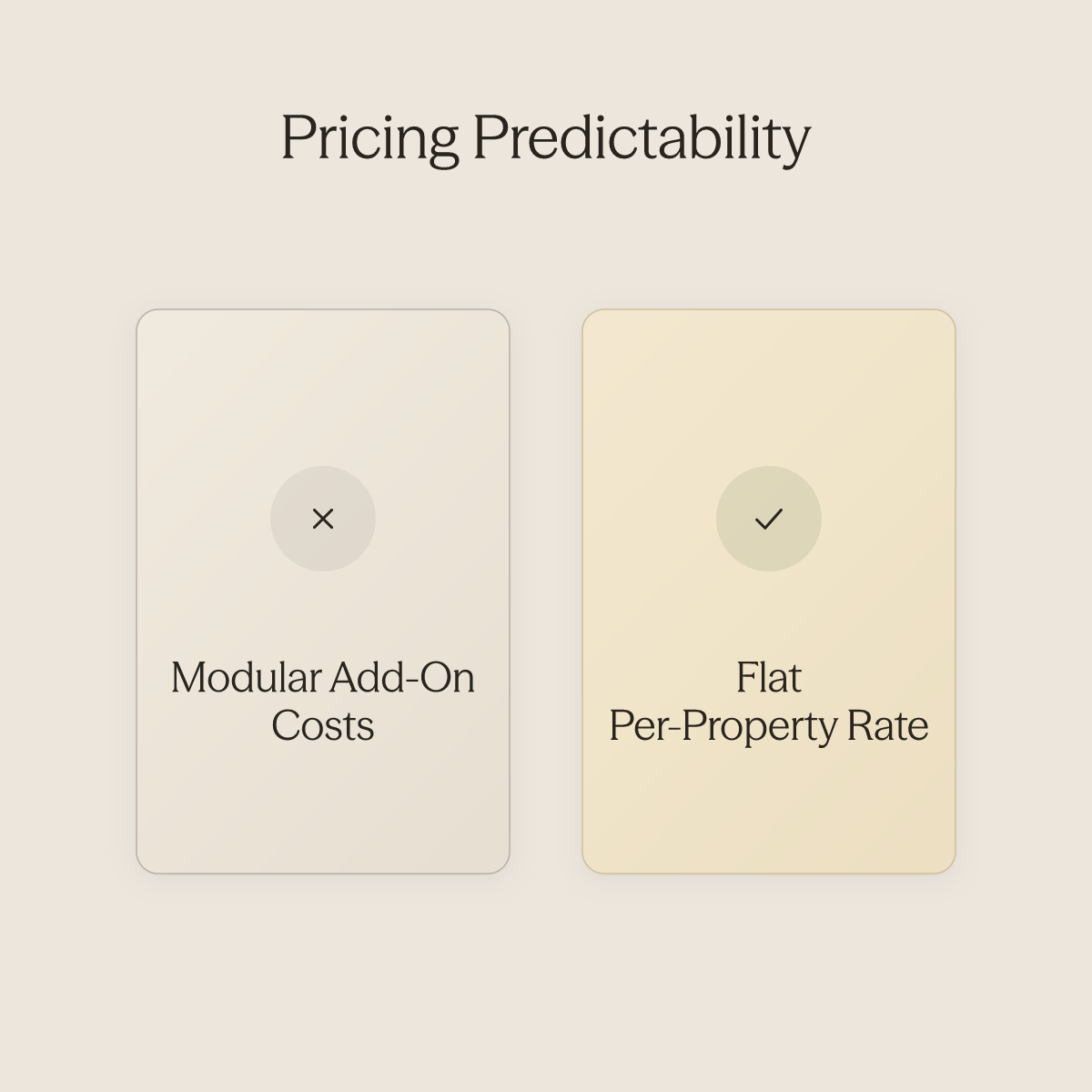
OwnerRez pricing starts at approximately $40/month as a base fee, with the first property adding $15/month, the second adding $5/month, and each additional property costing $2 to $3/month. That structure makes it unusually cost-predictable at smaller portfolio sizes. The catch is modularity.
Channel management, hosted websites, SMS messaging, and QuickBooks integration are each priced separately. An operator at 25 units who wants all four add-ons will pay meaningfully more than the base-plus-per-property math suggests. There are no booking commissions and no long-term contracts, but the full modular stack requires deliberate budgeting to avoid surprises.
Guesty Pricing Model, Custom Quotes and Onboarding Fees
Guesty's pricing operates on a different logic entirely. Above 3 properties, Pro and Enterprise plans shift to custom quotes, often structured as a percentage of booking revenue or a higher per-unit monthly fee, with onboarding fees that can be substantial depending on portfolio size. That onboarding fee is the line item operators most frequently miss when comparing headline costs. It changes the break-even math for operators switching mid-growth. Guesty's broader feature set, including native dynamic pricing and a wide range of direct channel integrations, justifies some of that premium, but only if your operation actually uses those capabilities.
The Hidden Cost Line, Manual Guest Communication
Here is the cost line neither pricing page mentions: operator time spent triaging guest messages. At 30 or more units, that invisible labor, overnight inquiries, repetitive check-in questions, edge-case requests, frequently exceeds the PMS subscription itself in real staff hours.
Ease of Use and Learning Curve - Which Platform Gets Your Team Up and Running Faster?
Setting up a new PMS is rarely as simple as the sales demo suggests. The real question for a growing operation isn't whether OwnerRez or Guesty has the right feature set on paper; it's how quickly your team can actually use it without stalling the properties you're adding right now.
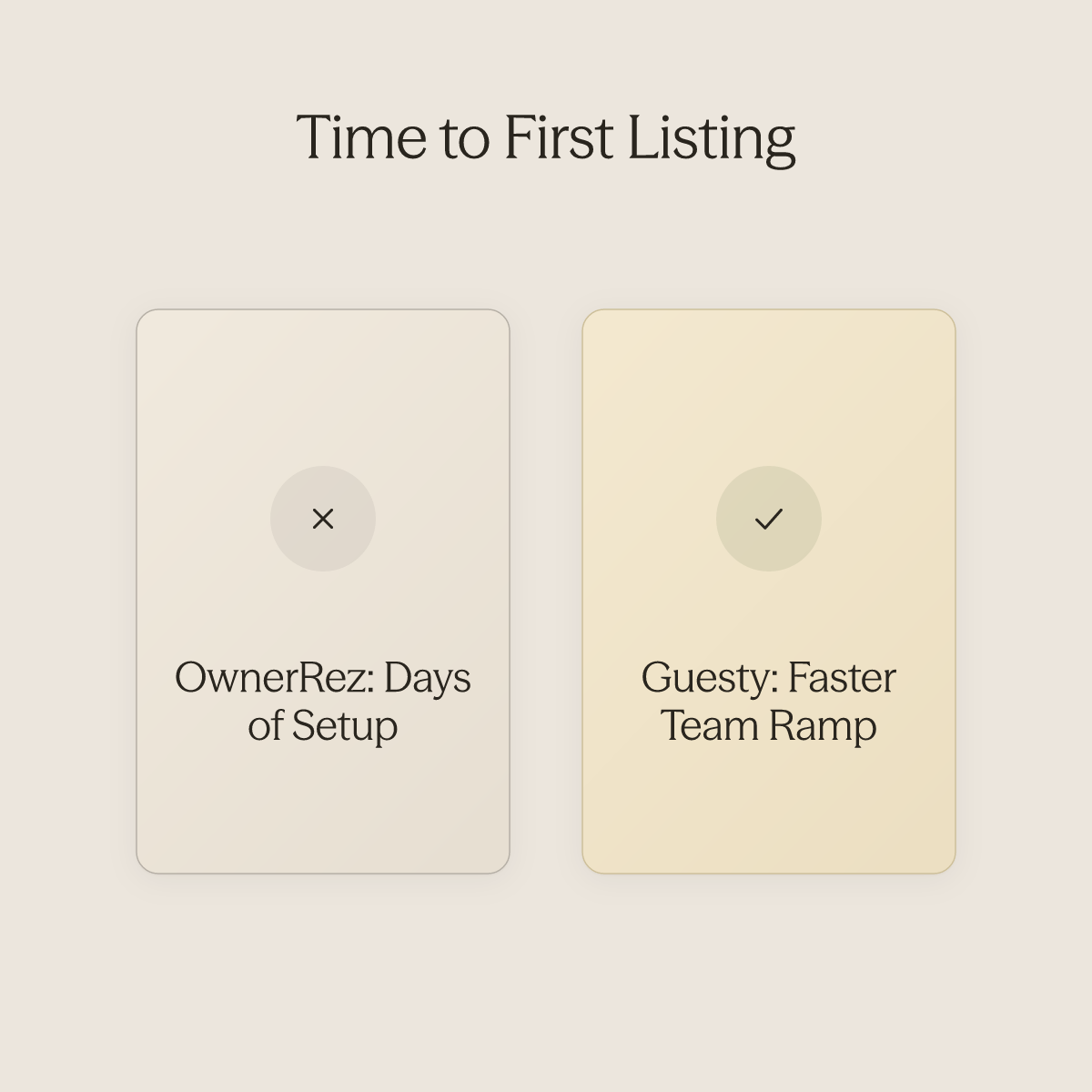
Image: Side-by-side comparison of OwnerRez slow setup versus Guesty faster onboarding ramp
OwnerRez Setup - Hours to Days Before Your First Listing
OwnerRez has a steep vacation rental software onboarding curve, and operators are candid about it. Capterra reviewers consistently describe setup taking several days of focused configuration before the system behaves as expected. One reviewer put it plainly: "It took me several days to get everything set up the way I wanted."
Another host noted it "took some work to learn it" before becoming comfortable, a pattern that plays out repeatedly, because OwnerRez onboarding front-loads configuration. OwnerRez rewards technical operators who invest that time; teams that need to move fast will feel the setup cost. The irony is real: operators who most need operational relief at 20 to 30 units, already overwhelmed by the manual workload of messages, check-ins, and calendar updates, are often spending their highest-leverage hours inside configuration menus instead of growing the portfolio.
For a lean team or solo operator, that misalignment is especially costly, because every hour absorbed by software setup is an hour not spent on the guest experience or the next acquisition.
Guesty's Interface and Faster Team Ramp
Guesty ease of use is a frequently cited differentiator among operators who add staff regularly. Capterra reviewers consistently describe its interface as faster to onboard than OwnerRez, with new hires reaching a productive first booking cycle more quickly and without needing a technical background. For a property manager adding five units per quarter, that compounds: every team member who gets productive in days rather than weeks is portfolio momentum you don't lose.
The Real Cost Is Momentum, Not Hours
The PMS user experience question gets framed as a one-time onboarding tax. It isn't. Every staff addition restarts the clock.
New hires re-learn the same workarounds, listings go live misconfigured, and friction accumulates quietly while the portfolio grows around it. This is where operators running lean, solo or with a small team, tend to find the most relief from layering in an AI-backed operations layer alongside whichever PMS they choose. AI Agents, for example, are most beneficial when the business already has existing documentation like SOPs, FAQs, or manuals, and receives a high volume of repetitive guest messages across multiple platforms or properties simultaneously.
Rather than adding headcount to absorb the communication load that spikes with every new listing, the agent handles guest replies continuously, before, during, and after a stay, with the first automated guest reply typically live within days of connecting your existing documentation. Integrations can pull from that content without manual re-entry, so the ramp to value doesn't require rebuilding your knowledge base from scratch. OwnerRez suits technically oriented operators or lean solo setups where deep customization justifies the setup investment.
Guesty fits growing agencies that add staff frequently and need property management software usability out of the box. Either way, the question is whether your current team has the bandwidth to absorb the onboarding curve without letting operational overhead grow faster than the portfolio, and whether the right AI layer can close that gap before it compounds.
Channel Management and Financial Reporting - Where Each Platform Concentrates on the Fundamentals
Channel breadth is table stakes in 2026. Every credible OTA channel manager connects to Airbnb, Vrbo, and Booking.com. The real question is what each platform does with the booking data once it arrives, and that is where OwnerRez and Guesty reveal genuinely different priorities.
OwnerRez Channel Management - Depth Over Breadth
OwnerRez treats channel connections as a specialized infrastructure layer, not a broad sync utility. Its API-level connections to Airbnb, Vrbo, and Booking.com enable real-time, two-way synchronization of availability, rates, and booking rules at the channel level, according to its own channel integration documentation. That architecture lets property managers enforce platform-specific rules a generic iCal bridge cannot carry, and it matters more than it might first appear.
Calendar sync gaps and glitches are a primary driver of platform switching among property managers, because a single missed availability update can produce a double-booking that damages guest trust and triggers costly cancellations. OwnerRez's API-level Airbnb integration is designed specifically to close those gaps by pushing changes at the channel layer rather than relying on periodic calendar pulls. The trade-off is honest: OwnerRez connects deeply to fewer channels rather than shallowly to many.
Operators running niche OTAs alongside the major three may hit limits here.
Trust Accounting and Owner Statements - OwnerRez's Core Strength
OwnerRez positions vacation rental trust accounting as a native, first-party capability, not a bolt-on. Property managers handling owner-managed properties consistently cite the platform's ability to generate clean monthly owner statements, separate trust ledgers, and channel-level revenue breakdowns as the clearest reason they stay. For a manager running 25 properties across multiple owners, producing an auditable statement without exporting to a spreadsheet is a genuine workflow advantage.
Guesty Channel Integrations - Breadth and Operational Visibility
Guesty's channel integrations strategy runs wider, connecting to a broader set of OTAs and layering operational dashboards on top of that data. Where OwnerRez surfaces financial precision, Guesty surfaces occupancy rates, pipeline metrics, and team task performance across a growing portfolio. For an operator managing 40 units who needs to show a growth dashboard to investors, Guesty's reporting orientation fits that conversation better. The trade-off is accounting depth: trust ledgers and owner statement granularity are less central to Guesty's design philosophy.
Two Philosophies, One Structural Gap
Both platforms surface what happened with a booking. Neither autonomously handles what happens in the minutes after an inquiry lands, and that omission carries a measurable cost. Fast response times boost bookings by 116% for short-term rentals, meaning an unanswered after-hours inquiry is a direct revenue leak, not just a guest experience lapse.
Response time is not just a guest satisfaction variable; it is a direct booking conversion variable. Conduit addresses a gap neither platform was built to fill. Operators running Airbnb, Vrbo, and Booking.com simultaneously face a fragmented inbox problem: messages arrive on different platforms, at different hours, and a delayed reply on any one of them is a lost booking.
Conduit's AI Agents are most beneficial precisely in this scenario, when a business receives a high volume of repetitive guest messages and already has documentation like SOPs, FAQs, or property manuals that can train the agent. The Inbox layer sits above that automation, giving operations and support teams a single place to monitor, review, and manage all conversations the AI agent is handling across properties simultaneously.
Conduit's Integrations surface that existing content directly to the agent, no manual re-entry required. And for the recurring, predictable guest touchpoints that currently burn staff time, post-booking confirmation messages, check-in instructions, mid-stay check-ins, Workflows trigger automatically after a booking is confirmed, after check-in, or when a specific keyword is detected in a conversation. Channel management infrastructure determines whether a booking is captured cleanly.
What happens in the conversation immediately after determines whether the guest actually shows up, and whether they book again.
116% booking boost from fast response times
Related Reading
- Vacation Rental Automation
- Best Pms For Short Term Rentals
- How To Manage A Vacation Rental Property
- Vrbo Smart Pricing
- How To Automate Airbnb Business
- Airbnb Self Check In
- Vrbo Management
- Best Apps For Short Term Rentals
- Best Pms For Airbnb
- Best Accounting Software For Short Term Rentals
Automation and Guest Communication - The Ceiling Neither Platform Can Break on Its Own
Guest communication automation is where the Guesty-versus-OwnerRez debate gets genuinely complicated, because the feature gap between the two platforms is real and measurable. But the common assumption among vacation rental property managers and operations leads is that choosing the right PMS, with better automation features, is what will fix the communication gap: that if Guesty's automated messaging or OwnerRez's rule sets were just configured correctly, the problem would be solved. The more important gap, the one that actually shows up in your review scores, sits below both of them.
Guesty's Automation Advantage - Unified Inbox, WhatsApp, SMS, and AI Messaging
Guesty ships more automated guest messaging out of the box. Its unified inbox consolidates threads across Airbnb, Vrbo, and direct booking channels into a single view. WhatsApp and SMS integration come standard at higher tiers, and the AI-powered messaging layer can draft and send contextual replies without manual input. For a team managing 20-plus units across multiple channels, that reduction in context-switching is a genuine operational gain, not a marketing claim.
OwnerRez Automation - Reliable Triggers, Less Polished Guest Experience
OwnerRez handles PMS automation workflows through a well-built rule-based trigger system. Scheduled messages fire reliably at the right booking stages: confirmation, pre-arrival, checkout. What it does not include is the guest-facing messaging layer Guesty ships with: no native unified inbox at the same level, no built-in WhatsApp, no AI-assisted reply drafting. On either platform, templated sequences can read more like system notifications than conversations, and property managers hear that from guests directly: a message that "feels like a mass email, not a personal message." That is a limitation of template-driven messaging generally rather than of one vendor.
Where Both Platforms Hit the Same Wall - The Off-Script Message
Here is the structural problem neither platform solves. Rule-based triggers handle the predictable majority of vacation rental automation well: booking confirmations, check-in instructions, checkout reminders. The remaining 20 percent is where review scores are won or lost.
A guest messages at 1am asking where the WiFi password is. The automated check-in sequence already fired six hours earlier. No trigger covers this.
The message sits unanswered until morning. The stay was perfect; the review docks it anyway. Fast response times boost bookings by 116% for short-term rentals, which means that unresolved overnight inquiry isn't just a guest experience failure, it is a direct revenue leak.
The operational reality compounds this: hosts managing multiple properties find themselves manually answering the same recurring guest questions constantly, at all hours, across every OTA inbox simultaneously. That manual workload is precisely the bottleneck that structured automation is supposed to eliminate, but trigger-based PMS sequences stop short of solving it.
The Hidden Cost of the Ceiling - Overnight Inquiries and Edge-Case Conversations
The same five questions arrive every week across every property: WiFi, parking, early check-in, the thermostat, the trash schedule. That pattern doesn't change because you upgraded your PMS. It changes when you deploy a dedicated AI agent, and the operators who see the greatest impact are those already receiving a high volume of repetitive guest messages and who have existing documentation (SOPs, FAQs, property manuals) ready to train the agent on.
Without that foundation, even the best AI layer underdelivers. Conduit's AI Agents are built to connect directly to that existing documentation through integrations with tools like:
- Notion
- Google Drive
- Airbnb
The agent can begin handling guest replies without requiring hosts to manually re-enter their property knowledge. The first automated guest reply can go out within days of connecting those materials.
That agent runs continuously, before, during, and after a stay, so the 1am WiFi question gets answered immediately rather than sitting until morning. Darren, Founder of Easy BnB and Bali Luxury Stays, puts the underlying principle plainly: "We all agree that AI first is the best approach." The operational implication is direct: eliminating the around-the-clock communication bottleneck isn't a feature upgrade inside your PMS; it requires a layer that operates independently of trigger logic, across every platform and property simultaneously.
Conduit's Inbox gives operations and support teams a single place to monitor, review, and manage every conversation the AI agent is handling across multiple OTAs and properties at once. Workflows layer on top of that to handle the predictable touchpoints, firing after a booking is confirmed, after check-in, or when a specific keyword is detected, so the structured sequences your PMS already runs don't have to be rebuilt from scratch. The result is timely, consistent communication that reads like a real conversation rather than a system notification, which is what actually moves review scores.
Scaling from 10 to 50+ Units - Which Platform Fits Which Operator: and What Both Are Missing
Choosing between OwnerRez and Guesty is not just a features comparison; it is a decision that compounds over time as your team grows, your unit count climbs, and the operational gaps you tolerate early become expensive later. The right answer depends less on which platform has the longer feature list and more on where your portfolio sits today and how fast it is moving. What follows breaks down which platform fits which operator, where the 20 to 30 unit band creates a genuine decision problem, and the structural limitation that neither platform has solved regardless of portfolio size.
Which Platform Fits Which Portfolio Size
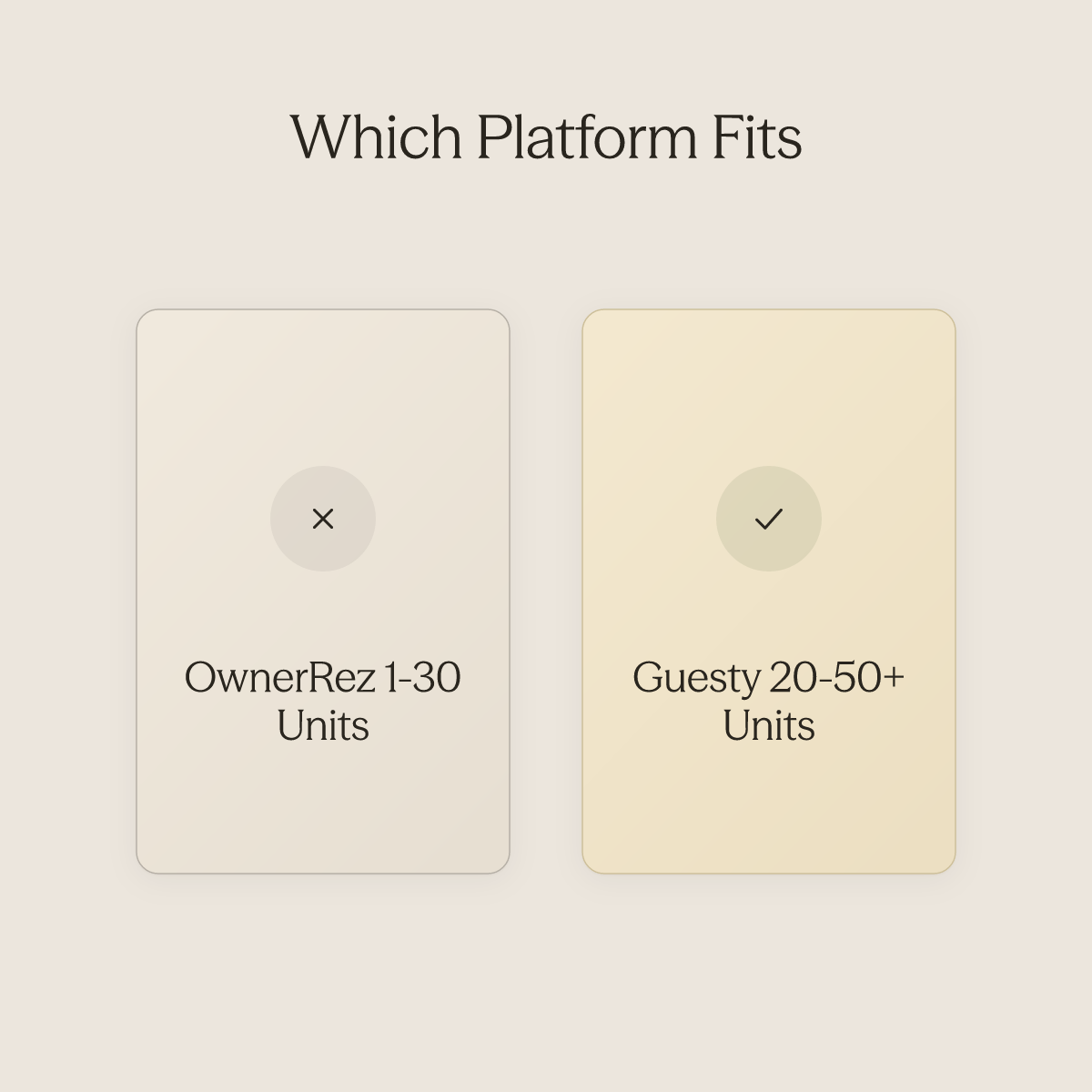
For operators managing 1 to 30 units, OwnerRez lines up well on most practical dimensions: lower cost, granular financial controls, deep channel integration, and configuration depth that rewards operators who want a tight, customized operation. OwnerRez consistently earns higher value-for-money scores among smaller portfolio operators according to third-party review platforms, and its modular pricing keeps costs predictable as listings grow incrementally. For agencies scaling past 20 units toward 50 and beyond, Guesty is built for that stage. The onboarding is smoother, the interface is built for teams rather than solo operators, and the workflow automation is designed around team handoffs. Operators adding staff regularly, managing multiple brands, or running agency-level complexity will find Guesty's tooling worth the higher entry cost.
The 20 to 30 Unit Band
The hardest decision belongs to operators sitting between 20 and 30 units. OwnerRez users in this range get excellent financial reporting but absorb a steeper configuration burden. Guesty users get team tooling built for larger operations but pay for features they may not yet need. Choose based on your team structure, not your unit count. A solo operator with 28 units and deep technical comfort belongs on OwnerRez. A two-person team adding listings monthly belongs on Guesty.
The Structural Gap Both Platforms Share
Here is the insight that reframes the entire comparison. Both OwnerRez and Guesty users at scale report the same complaint: automated messaging templates and rule-based triggers cannot resolve the volume and variability of real guest inquiries. Overnight check-in questions, edge-case maintenance requests, and multi-step conversations about local recommendations fall outside every rule set either platform ships.
Industry observers consistently note that native PMS automation handles the predictable share of guest communication volume, but the remainder, arriving disproportionately at off-hours, drives the reviews that determine your ranking. This is not a configuration problem. It is a structural one.
Migrating from OwnerRez to Guesty, or back, does not close that gap.
Where AI Agents Close the Gap
Operators who have solved this are running a dedicated AI communication layer on top of whichever PMS they already use, reaching significantly higher guest communication automation with no additional headcount.
OwnerRez vs. Guesty, Quick-Decision Framework
Use this criteria table to pick the right platform before layering in an AI communication solution:
| Decision Factor | Choose OwnerRez | Choose Guesty |
|---|---|---|
| Portfolio size | 1–30 units | 20–50+ units |
| Team structure | Solo or small, tech-comfortable | Multi-staff, adding hires regularly |
| Financial reporting need | Trust accounting, owner statements are critical | Operational dashboards and growth metrics are primary |
| Budget priority | Predictable flat + per-unit fees, no commission | Can absorb higher entry cost for smoother onboarding |
| Onboarding bandwidth | Willing to invest days in configuration | Need team productive within hours |
| Channel breadth | Primarily Airbnb, Vrbo, Booking.com | Running 10+ OTAs or niche channels |
| AI communication layer needed? | Yes, add regardless of PMS choice | Yes, add regardless of PMS choice |
Related Reading
- Lodgify Competitors
- Vrbo Automated Messages
- Guesty Vs Hostfully
- Lodgify Vs Smoobu
- Hospitable Vs Hostaway
- Guesty Vs Hostaway
- Guesty Vs Hospitable
- Guesty Alternatives
The PMS Decision Is Step One - The AI Communication Layer Is What Scales You
Pick the right PMS and you've solved roughly half the operational puzzle. The other half lives in every unanswered message sent at 1am, every guest who waited 20 minutes for a WiFi password, and every 3-star review that mentions "slow response." Neither OwnerRez nor Guesty was architected to close that gap, and the operators who've figured that out are scaling faster than the ones still adjusting rule-sets.
Where Both OwnerRez and Guesty Have the Same Limitation
Both platforms handle reservations, rates, and channel sync with genuine competence. What they don't handle is the guest who messages outside business hours with a question your templated check-in sequence never anticipated. Rule-based automations cover the predictable share of guest interactions. The remainder, overnight inquiries, edge-case requests, and multi-step conversations, is exactly what drives review score erosion as a portfolio grows.
Why Guest Communication at Scale Goes Beyond What Either PMS Can Handle
The failure point is structural, not configurational. Response time directly correlates with guest satisfaction scores on Airbnb and Vrbo, and after-hours coverage is where that correlation bites hardest. Adding headcount is the obvious fix, but it re-couples labor costs to growth in a way that caps margins before it caps ambition.
Real Operators, Real Numbers
Cascadia Getaways layered a purpose-built AI communication system on top of their existing PMS and reached 60% automation with a 4.9 guest communications score. Blue Gems hit 65% automation through the same approach. Wynwood House, operating across seven countries, cut guest issue resolution time from 15 minutes to 3 minutes after adding an AI for hospitality layer. None of them switched PMS platforms to get there.
Next steps
If your review scores are slipping even though your PMS dashboard looks clean, the path forward starts with recognizing that the gap is structural, not configurational. Rule-based messaging on either platform handles the predictable majority and leaves the rest unresolved: the overnight inquiry, the edge-case request, the multi-step conversation that no rule set anticipates. Start with our AI for hospitality.
The portfolio-size segmentation insight covered earlier means your PMS choice is real but finite: OwnerRez fits the 1 to 30 unit operator who wants financial depth, Guesty fits the fast-scaling agency that needs polished team tooling. The response-time insight means that every unresolved message after hours is a direct booking conversion leak, not just a guest satisfaction footnote. Together, they point to the same action: choose your PMS, then layer a dedicated AI communication system on top of it.
Cascadia Getaways reached 60% automation and a 4.9 guest communications score that way. Blue Gems hit 65%. Wynwood House cut resolution times from 15 minutes to 3 minutes.
None of them switched platforms to get there.
Start with conduit.ai to see how it sits on top of whichever PMS you already run. Your existing SOPs, FAQs, and property manuals train the agent, the first automated reply goes live within days, and the 1am messages stop waiting until morning.
Frequently Asked Questions
Which platform is easier to get up and running, OwnerRez or Guesty?
Guesty onboards faster. Reviewers consistently describe new hires reaching a productive first booking cycle more quickly and without needing a technical background. OwnerRez, by contrast, typically takes several days of focused configuration before the system behaves as expected, and rewards operators who are willing to invest that setup time upfront.
Is OwnerRez actually cheaper than Guesty for a small portfolio?
At smaller portfolio sizes, OwnerRez is more cost-predictable, it starts at approximately $40/month as a base fee, with low per-property incremental costs and no booking commissions or long-term contracts. However, adding channel management, SMS, a hosted website, and QuickBooks integration each carries a separate fee, so the full modular stack requires deliberate budgeting. Guesty shifts to custom quotes above 3 properties, often as a percentage of booking revenue, plus onboarding fees that operators frequently underestimate.
Can either platform handle the late-night guest messages that affect review scores?
Neither platform fully closes that gap. Both OwnerRez and Guesty leave overnight inquiries, edge-case questions, and multi-step conversations to whoever is on duty, because scheduled message templates and rule-based triggers cannot anticipate real-time, unscripted moments. The post describes this as a structural limitation of PMS architecture, one that a dedicated AI communication layer, sitting on top of whichever PMS you use, is specifically built to solve.
What's the real difference in how the two platforms handle financial reporting?
OwnerRez is built around financial depth. It offers granular control over trust accounting, owner statements, and direct channel connections, reflecting a design philosophy built around precise financial reporting. Guesty is built more around workflow automation and a polished interface for fast-scaling teams, rather than deep financial granularity.
Does it matter which PMS I choose if I'm planning to build custom integrations?
Yes, OwnerRez has a real constraint worth scoping before you commit. Its V2 API is read-heavy but write-limited, meaning full lifecycle management actions like programmatic booking cancellations cannot be executed via API. If your roadmap includes complex programmatic workflows, that boundary matters and should be evaluated against your specific integration plans before signing.
Stay in the loop
Get the latest on AI automation, product updates, and customer stories.