How to Master Airbnb Inventory Management Like a Pro


Airbnb Inventory
Stop losing stars to a missing towel.
Your cleaning team has a checklist. Your supply closet gets restocked. Guests still message at 11pm about missing toilet paper. Here is where the process is actually breaking down.
Most vacation rental property managers and operations leads think that tighter checklists and more diligent manual tracking are the solution, if the cleaning team just checks more carefully and the spreadsheet stays current, inventory problems will stop slipping through. But Airbnb inventory management is one of those operational areas where hosts feel busy and the system keeps failing them anyway. The cleaning team has a checklist.
See our AI for hospitality for how this works in practice. The supply closet gets restocked. Photos document every room.
And yet, a guest still messages at 11pm asking where the toilet paper is. For teams running hospitality operations at scale, that gap between "we have a process" and "the process actually works" is where reviews and revenue quietly disappear. The breakdown almost never lives in the checklist itself.
It lives in what happens after the cleaner finishes and before the next guest checks in. That window is where signals die. Airbnb inventory management is the systematic process of tracking, organizing, and replenishing every item a guest needs across your rental properties so that nothing is discovered missing mid-stay.
It is not a one-time stock-up before a busy season. It is an ongoing operational discipline that connects physical supply levels to the people responsible for maintaining them, on a defined schedule, every single turnover. The distinction matters because most hosts treat inventory as a purchasing problem.
In practice, the failure point is rarely "we forgot to buy it." It is "we bought it, but no one confirmed it made it into the property before the guest arrived." Treating all inventory the same is where most systems break. There are three distinct categories, each demanding a different management rhythm.
Consumables - Items That Deplete Every Stay Consumables include toilet paper, soap, coffee pods, garbage bags, and batteries. These items deplete with every stay, which means their failure mode is predictable and entirely preventable with the right replenishment rhythm. The challenge is not sourcing them, it is confirming they made it into the property before the guest arrived.
A consumables process that ends at the supply closet, rather than at the guest-ready room, is where that 11pm message originates. Linens - Items That Wear Out Over Time Linens, towels, sheets, and pillowcases, wear out over time and require rotation, not just restock. The standard benchmark is two full sets per bed so turnovers never stall waiting on laundry.
Unlike consumables, the failure mode here is slower and easier to miss. A fraying pillowcase or a thin towel does not trigger a reorder alert; it shows up in a guest review. Managing linens well means tracking condition and rotation cycles, not just counting units on a shelf.
Assets - Items That Degrade Without Depleting Assets, appliances, furniture, cookware, and safety equipment, do not deplete but do degrade. Their failures show up in guest reviews, not consumables checklists, which makes them the easiest category to neglect until something goes visibly wrong. Because assets do not trigger a reorder signal the way a missing soap bar does, they require a separate inspection cadence entirely. A wobbly chair and a malfunctioning coffee maker both live outside the standard turnover checklist, and that is precisely where most asset problems quietly accumulate.
Key takeaways
- Airbnb inventory management breaks down as a communication problem, not a counting problem, no one knows what's missing, replaced, or broken until a guest reports it at 11pm.
- Tighter checklists and more careful cleaners don't fix the gap between 'documented' and 'confirmed', they just move the failure point one step later in the turnover.
- PAR level tracking tells you when to reorder; it says nothing about whether the right item is actually on the shelf for the guests checking in this weekend.
- Physical storage organization, labels, bins, photo standards, is the only mechanism that makes a cleaner's report consistent and auditable without a supervisor on-site.
- At ten or more properties, every unresolved inventory signal sits in a human inbox waiting to be read, interpreted, and routed, that wait is where portfolios bleed time and ratings.
- Erwan Le Roy's 35-property operation reached 96% automation and sub-1-minute response times not by counting inventory more carefully, but by removing the human-in-the-middle from routine ops and guest touchpoints.
- Conduit's AI-powered guest communication platform closes that coordination gap, routing signals, responding to guests, and keeping ops moving around the clock without a human relay in between.
The Real Cost of Manual Inventory Tracking Across Multiple Properties
At ten properties, the gap between "we have a system" and "the system is working" becomes expensive. Most vacation rental property managers and operations leads believe that tighter checklists and more diligent manual tracking are the solution, if the cleaning team just checks more carefully and the spreadsheet stays current, inventory problems will stop slipping through. Scale that to ten, fifteen, or thirty properties and the volume of handoffs between cleaners, ops leads, and suppliers multiplies every failure point until no single person can hold the full picture. The same coordination collapse that breaks inventory tracking breaks guest communication, and the two failures compound each other when a guest messages about a missing amenity and the reply falls through the cracks.
Why Manual Tracking Collapses at 10 or 30 Properties
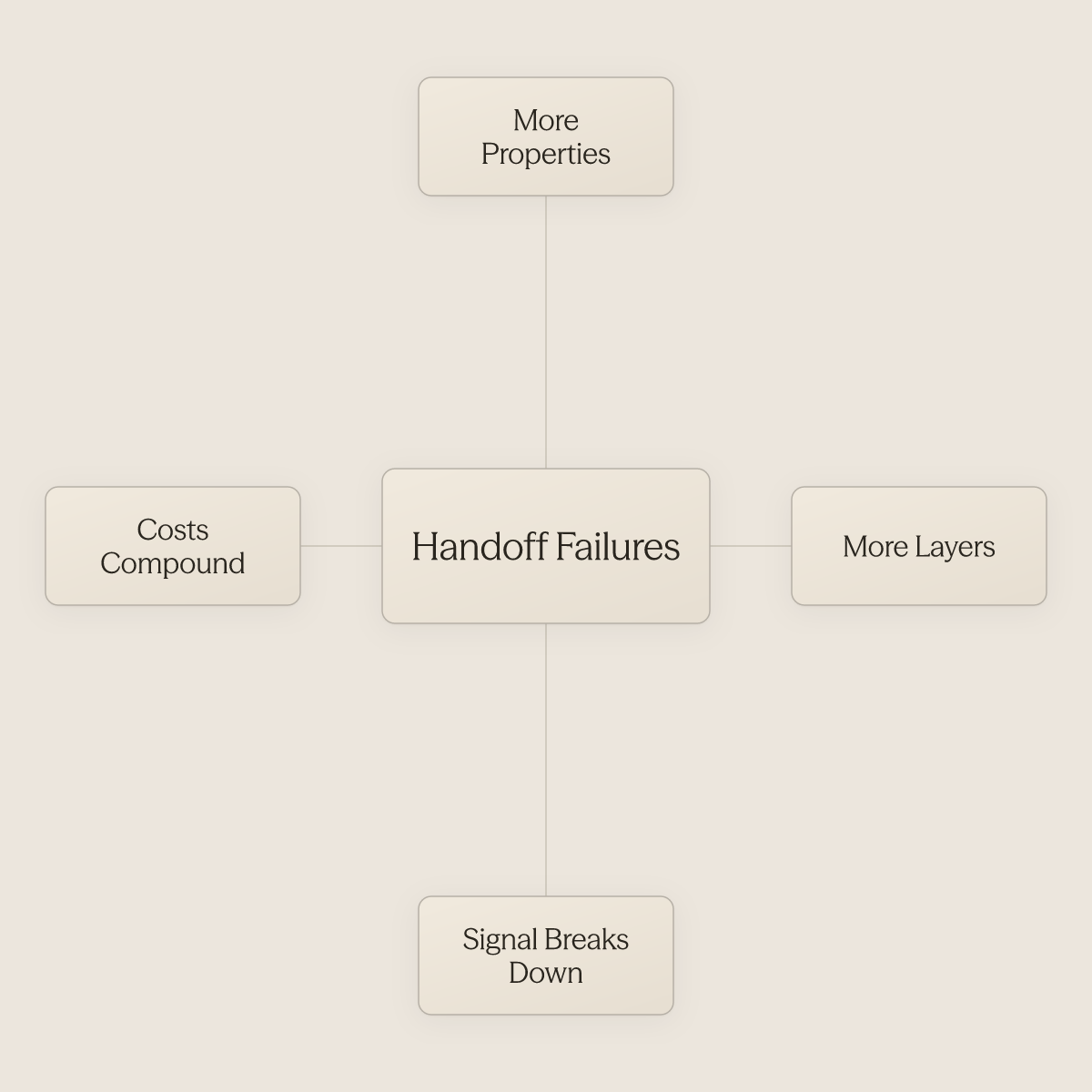
The failure mode is predictable. Each additional property adds another communication layer: a different cleaner, a different supplier contact, a different restock schedule. What worked as a shared mental model at two units becomes a game of telephone at ten.
Checklists don't break because hosts stop caring; they break because the signal that something is missing has to travel through too many handoffs before anyone acts on it. Multi-property inventory management stops being a counting problem and starts being a coordination problem the moment you add your fourth or fifth unit. The same dynamic plays out in guest messaging.
Operations teams managing communications across multiple platforms, Airbnb, direct booking sites, VRBO, find that the volume of incoming messages across ten or more properties makes consistent, timely replies nearly impossible without adding headcount. Conduit's Inbox is most beneficial: when your team is monitoring and managing guest conversations across multiple platforms or properties simultaneously, a single unified view replaces the context-switching that lets messages age unanswered. The operations or support team uses it on an ongoing basis to monitor, review, and manage all conversations the AI agent is handling, meaning nothing requires a human to catch it first before it gets a response.
The Compounding Review Risk Inside Every Missed Restock
A missing roll of toilet paper costs less than a dollar. The review it generates can cost far more. Cleanliness and missing amenities are among the most frequently mentioned categories in negative Airbnb reviews, appearing in a significant share of one- and two-star ratings.
The math is asymmetric: the item is trivial, the reputational exposure is not. A single negative review on a high-performing listing can meaningfully affect booking momentum, turning a trivial supply gap into a measurable revenue event, a risk that compounds the longer the listing carries the lower rating. The review risk doesn't stop at the physical amenity.
A guest who messages mid-stay about a missing item and receives no reply, or a slow, inconsistent one, is far more likely to put that frustration into a public review. Property managers we work with who are scaling past ten units describe exactly this pattern: the inventory problem is the spark, but the unanswered or delayed guest message is what turns it into a one-star rating. Conduit's AI Agents are most beneficial precisely when a business receives a high volume of repetitive guest messages and has existing documentation, SOPs, FAQs, property manuals, to train the agent on.
Once connected to that documentation, the agent begins handling first automated guest replies and then responds continuously, whenever a guest sends a message, before, during, or after a stay. The result is that a mid-stay complaint about a missing amenity gets an immediate, consistent acknowledgment rather than sitting in a queue until an ops lead cycles back to that inbox.
The 80/20 Reality of Inventory Pain
The item is trivial, the reputational exposure is not.
Toilet paper, hand soap, paper towels, coffee supplies, and dish soap follow an 80/20 pattern: a small group of high-velocity consumables drives the bulk of mid-stay complaints and emergency restock runs. These are also the items hosts most under-systematize, because they feel too simple to formalize. Formalizing PAR levels (minimum stock thresholds) for these items is the operational lever, but it only holds if the communication layer around it also scales.
That communication layer is where most growing portfolios leak. Adding a fifteenth property should not require a fifteenth communication queue. Conduit's Workflows are most beneficial when a business has recurring, predictable guest touchpoints that currently require manual staff action, exactly the restock-reminder, check-in confirmation, and post-stay follow-up sequences that pile up as a portfolio grows.
Workflows fire after a trigger event in a conversation or guest lifecycle: after a booking is confirmed, after check-in, or when a specific keyword is detected. Pair that with Integrations that let the AI agent pull from tools your team already uses, Notion, Google Drive, Airbnb, without manual re-entry, and the coordination overhead of each new property shrinks instead of compounding. The promise is straightforward: add properties without adding coordination headcount, and reduce the time spent on the manual, repetitive messaging tasks that currently fill the gap between a guest complaint and a resolved one.
How to Build Your Airbnb Inventory Checklist - Room by Room, Category by Category
The checklist sitting in your property's Google Drive is not the problem. The problem is that a checklist documents what should be there, not what actually is there the moment a guest pulls back the shower curtain at 9pm. That gap between "documented" and "confirmed" is where bad reviews are born, and where a systemized, scalable operation separates itself from one that depends entirely on the owner catching every problem personally.
1. Bedroom Linen Inventory - Track Every Sheet Set, Pillow, and Duvet by Room
Two complete sets of sheets and pillowcases per bed is the industry baseline for short-term rentals, with a third set recommended for properties running same-day turnovers. Track each set by room, not by property total. A property total tells you nothing about whether the right linen is on the right bed right now. A bedroom checklist card pinned inside the linen closet, photographed by the cleaner on every turnover, gives you a timestamped confirmation that the right set is on the right bed.
Without that photo, the checklist is a wish list. Conduit.ai's Integrations pull that content directly so your AI agent can reference current room-level linen standards without manual re-entry, keeping your turnover communication consistent across every property without owner involvement on each check.
2. Bathroom Consumables Inventory - Toiletries, Towels, and Replenishment Thresholds
Missing or insufficient supplies are among the most frequently cited reasons guests leave negative Airbnb reviews, and the bathroom is ground zero. Stock toilet paper, hand soap, shampoo, body wash, and a spare roll minimum per bathroom. Two bath towels and one hand towel per guest covers the standard stay.
Consumables deplete invisibly between turnover photos, so a threshold-based reorder trigger matters more here than anywhere else on your vacation rental essentials list. One pattern worth noting: hosts who feel pressure to over-communicate every item to guests often end up with checkout instructions that run to four pages or more. Guests find that overwhelming, and it signals a host who hasn't separated operational inventory tracking (your internal system) from guest-facing communication (what guests actually need to know).
Keep your consumable thresholds in your internal SOPs; keep guest instructions to what is genuinely reasonable and actionable. Conduit.ai's AI Agents, trained on those internal SOPs and FAQs, handle the guest-facing side, answering supply questions before, during, and after a stay, so the operational detail stays where it belongs and guests never see a four-page wall of requirements.
3. Kitchen Equipment Checklist - Appliances, Cookware, and Utensils by Function
Organize kitchen inventory by function: prep (cutting boards, knives, mixing bowls), cook (pots, pans, baking sheet), and serve (plates, glasses, utensils for guest count plus two). Appliances including the coffee maker, toaster, and microwave deserve their own line items with condition notes, not just a checkmark. In our experience managing active rental properties, appliance replacement is a recurring annual cost, which means your kitchen inventory list needs a separate replacement-budget column, not just a present/absent field.
When a guest messages at 9pm asking why the coffee maker isn't working, that question is repetitive, predictable, and expensive to handle manually across multiple properties. Conduit.ai's AI Agents are most beneficial exactly here, high-volume, repetitive guest messages that your existing documentation can answer, so your operations team monitors outcomes rather than fielding every individual message.
4. Living Room and Common Area Inventory - Furniture, Entertainment, and Comfort Items
Living room inventory is often under-documented because items feel permanent, yet throw blankets, remote controls, board games, and charging cables disappear regularly. A room-by-room checklist should include serial numbers for electronics and condition notes for upholstered furniture. This category matters most for hosts competing on 'home-like feel' rather than price. The tradeoff: logging every small comfort item is time-intensive but prevents the slow inventory bleed that degrades guest experience over months.
5. Outdoor and Patio Inventory - Furniture, Grills, and Seasonal Equipment
Outdoor inventory is the most frequently under-documented category on a room-by-room checklist. Patio furniture, grills, and seasonal items are exposed to weather and, in some markets, have meaningful theft and damage rates that make condition tracking essential. Log each piece by item, condition, and last-inspection date.
Grill accessories (brush, propane level, cover) deserve their own sub-list. Properties that skip outdoor documentation consistently discover damage through guest complaints rather than turnover checks. A scalable operation does not rely on the owner remembering to ask about the patio after every turnover.
Conduit.ai's Workflows trigger automatically after booking confirmation or check-in. Recurring, predictable guest touchpoints that currently require manual staff action are exactly where Workflows add the most value, so the right follow-up happens whether the owner is watching or not.
6. Cleaning Supplies Inventory - Turnover Kits, Restocking Carts, and Cleaner Access
Standardize your turnover kit at the property level, not the cleaner level. When the kit is defined in your SOPs, quantities, product names, storage location, and those SOPs live in a connected system, every cleaner and every automated workflow pulls from the same source of truth. Conduit.ai's Integrations are built for exactly this: if your cleaning SOPs already exist in Google Drive or Notion, your AI agent leverages that content directly without manual re-entry, so your turnover standards scale to every additional property without scaling your personal involvement alongside them.
7. Guest Welcome and Safety Inventory - Starter Packs, Emergency Items, and House Manuals
Welcome and safety inventory covers the items guests notice first and remember longest: a starter toiletry pack, first-aid kit, fire extinguisher, flashlight, and a printed or digital house manual. For mid-term stays of one to two months, hosts must decide between a minimal starter pack and a fully stocked approach, a decision that directly affects both cost and review scores. The key limitation: safety items like smoke detectors and extinguishers require compliance-driven inspection schedules, not just inventory counts.
PAR Level Tracking - How to Set Reorder Points Before You Run Out
PAR levels are genuinely useful, but they only address half of what makes short-term rental inventory management break down. Setting a reorder threshold tells you when to act; it says nothing about whether the item sitting on the shelf right now is the right item, in the right quantity, for the guests checking in this weekend. A property running on PAR levels alone can hit every restock trigger perfectly and still send a family of five into a unit stocked for two, or leave a cleaning crew short on supplies because the threshold was set against average turnover, not a back-to-back booking weekend.
Reactive restocking has a hidden failure rate most operators never measure: by the time a cleaner notices the toilet paper is low, there is often only one stay left before a guest finds none. That gap between observation and action is where stockouts live, and no amount of careful eyeballing closes it across a growing portfolio, especially when you are running a lean team or managing multiple properties solo. Every hour spent chasing a restock is an hour not spent protecting the review scores that keep your calendar full.
PAR Levels Defined - The Minimum Quantity That Triggers a Reorder Signal, Not a Reminder
PAR level tracking means assigning a specific minimum quantity to each stocked item so the reorder signal fires at a threshold, not when someone happens to notice. For consumables, that threshold is calculated from actual consumption data, not intuition. A host running a four-guest cabin stay of three to four nights needs at least four rolls of toilet paper per bathroom to cover the stay comfortably.
Operators who set PAR levels from actual consumption data, tracking how many rolls a four-guest, three-night stay uses rather than defaulting to flat rules, consistently report fewer mid-stay complaints and less emergency restocking than those relying on intuition. The principle is straightforward: a threshold grounded in real usage eliminates the gap between "we stocked it" and "the guest had enough." The PAR level is not a counting exercise; it is a communication protocol that removes the human memory trigger from every routine restock decision.
Conduit's AI Agents and Workflows earn their place in an operations stack. Because Workflows fire after trigger events in the guest lifecycle, after a booking is confirmed, after check-in, or when a specific keyword is detected, an operator can build a trigger that flags a potential inventory shortfall the moment a longer-than-average stay books, prompting the right action before the cleaner ever sets foot in the unit. Critically, the operator or ops lead sets those rules; no IT department is required.
A solo host or lean team can configure the logic once and let it run continuously, protecting review scores by surfacing issues fast enough to resolve them before a guest ever notices. A correctly set PAR level with no verified reset mechanism produces the same failure mode as no PAR level at all, because cleaner accountability for inventory is assumed rather than formally assigned, many cleaners bundle it into turnover implicitly without documentation, meaning the threshold exists on paper but is never reliably checked. Conduit's Inbox consolidates guest and operations communications across multiple platforms and properties simultaneously, so when a cleaner flags a low-stock item mid-turnover, that message surfaces in one monitored place rather than getting lost across a fragmented thread of texts and channel messages.
The AI Agent handles the high-volume, repetitive confirmations, restocking acknowledgments, supply request replies, while the operations team reviews the conversations that actually need human judgment, keeping a lean team genuinely lean.
How to Set PAR Levels for the Three Inventory Categories - Consumables, Linens, and Assets
The formula differs by category. For consumables, multiply average nightly usage by your longest typical stay, then add a 20 percent buffer. For linens, the hospitality industry benchmark is a minimum of two complete sets per bed, one in use, one clean for a same-day turnover without an emergency laundry run.
For assets (coffee makers, hair dryers, extra blankets), PAR is simpler: one working unit per designated use point. Conduit's Integrations: the AI Agent can draw on that existing content directly, without manual re-entry, so the PAR logic you have already written becomes the knowledge base the agent uses to answer supply questions from cleaners, co-hosts, or guests, the moment a message arrives, before, during, or after a stay.
How to Organize Airbnb Inventory Storage - Labels, Bins, and a Dedicated Housekeeping Area
Think of your housekeeping closet as a piece of software. The labels are the interface. The bins are the logic.
The photo standard is the documentation. When any one of those three is missing, the cleaner is left writing their own code on every turnover, and the output is unpredictable. It is the only reliable mechanism for making a shortage visible to a cleaner in under 60 seconds without a supervisor present.
When absence is visually obvious rather than discovered through counting, shortage detection moves from your inbox to the cleaner's eyes at the moment it can still be fixed. The physical system and the digital layer reinforce each other. Conduit's Integrations pull existing content into active operations without manual re-entry.
The housekeeping closet becomes the physical node; the integrated workspace becomes the operational backbone behind it.
1. Color-Coded Bin System - Zone Every Supply Category by Room
Color-coded bins assign a dedicated color to each supply zone (bathroom, kitchen, bedroom, laundry) so a cleaner scanning the shelf knows immediately which category is low without reading a single label. The visual signal works faster than a checklist because it removes interpretation. The real tradeoff: initial bin standardization costs time upfront, and multi-property operations must commit to the same color scheme at every unit or the system creates confusion rather than clarity.
For operators managing guest communications across multiple properties simultaneously, the bin system also reduces the volume of mid-turnover messages that end up in the host's inbox. When the shortage is visible at the shelf, the cleaner resolves it on the spot, and a message that was never sent is a thread that never needs monitoring. Conduit's Inbox is designed for exactly the conversations that do make it through: ongoing monitoring, review, and management of all AI-handled guest threads, most valuable when communications are flowing across multiple platforms or properties at once.
2. Property-Specific Linen Labeling - Iron-On Tags to Prevent Cross-Property Mix-Ups
Iron-on or sewn-in tags with a property code ensure linens that leave in a laundry bag return to the right unit. Linen and supply mis-routing is a recurring operational error for operators managing three or more units, making property-coded tags one of the higher-leverage, lower-cost interventions available to growing portfolios. This method is most valuable when your cleaning team services multiple properties in a single day; for a single-property host, the overhead of tagging rarely justifies the effort.
The same logic that makes property coding valuable in the closet applies to guest communication: when messages arrive from multiple properties across platforms, without a system they blur together. Conduit's AI Agents are most beneficial when a business receives a high volume of repetitive guest messages and has existing documentation, SOPs, FAQs, and supply manuals to train the agent on. Connecting those documents through a tool like Notion or Google Drive means the agent can reference property-specific context rather than returning generic answers, the digital equivalent of the iron-on tag.
3. Dedicated Housekeeping Closet with Printed Zone Signs - Hotel-Style Organization at Home
Designating a single locked closet exclusively for housekeeping supplies, stocked with printed zone signs for 'Cleaning Chemicals,' 'Guest Amenities,' and 'Spare Linens', mirrors hotel back-of-house efficiency. This setup dramatically cuts turnover time because cleaners never hunt for supplies. The tradeoff is space: smaller properties or studio rentals may lack a dedicated closet, requiring a rolling cart alternative instead.
4. Par-Level Stocking Method - Set Minimum Quantities Per Bin to Trigger Automatic Reorders
Write the minimum acceptable quantity directly on each bin with a permanent marker or printed label. When the bin visually falls to or below that line, the reorder signal is immediate and requires no counting, no memory, and no supervisor. The par level is the threshold; the label is the alert mechanism.
Conduit's Integrations layer allows the AI agent handling guest and operational messages to reference current supply standards without a staff member manually relaying the information. This is most beneficial when the business already uses those tools and wants the AI agent to leverage existing content without manual re-entry. The par label on the bin and the SOP in the shared drive become two expressions of the same standard: one physical, one digital, both reducing the moment a shortage becomes someone else's problem to solve from scratch.
5. Turnover-Ready Supply Caddy - Pre-Packed Per-Checkout Kit for Cleaners
A pre-packed caddy assembled after each checkout, containing exactly the right quantities of cleaning sprays, microfiber cloths, and guest amenity restocks for one full turnover, means cleaners arrive and start immediately with zero prep time. Best for high-frequency hosts with back-to-back bookings. The tradeoff is that caddy assembly requires a reliable post-checkout inventory check, adding a step that's easy to skip under time pressure.
How to Integrate Inventory Checking Into Your Cleaning Team Turnover Workflow
The cleaner has already left. The host is twenty minutes away. The next guest checks in at 4pm. This is the exact window where inventory gaps become guest complaints, and it closes faster than any manual verification process can move.
Make the Cleaner's Sign-Off Do Double Duty - Clean Property and Confirmed Stock Levels
Integrating inventory verification into the cleaning team turnover workflow is the most reliable way to close that window. Assign the cleaner's sign-off as a two-part confirmation, where marking a property "ready" requires both a clean-space check and a stock-level check in the same step. The two tasks share the same physical moment, the same person, and the same location, so bundling them costs almost no additional time.
The core argument here is worth stating directly: the inventory accountability gap is not caused by negligent cleaners; it is caused by structural role ambiguity that no checklist alone can resolve. Because inventory responsibility gets bundled into turnover implicitly, cleaners operate under an assumed scope the host never confirmed, and hosts operate under an assumed verification the cleaner never performed. This is not a hypothetical edge case.
A recurring concern among short-term rental operators is that inventory and move-out inspection checklists get processed without independent verification, leaving both guests and cleaners in a position where the record of what was checked, and by whom, is disputed after the fact. Adding checklist line items into that ambiguous handoff doesn't fix the gap; it adds compliance surface area to a role boundary that was never drawn. The fix is a non-optional, role-explicit verification trigger embedded in the workflow itself, making the inventory check a discrete, confirmed event rather than an implied byproduct of showing up.
What makes this structurally difficult to solve at scale is the same thing that makes guest communication difficult to solve at scale: volume compounds faster than headcount can absorb it. Jack, CEO of Haven Vacation Rentals, described the inflection point clearly after his team began systematically closing operational gaps: "We added 14 listings in January." That kind of growth-without-proportional-overhead only becomes possible when recurring, predictable touchpoints, including turnover verification, stop requiring a dedicated human decision at every step.
The inventory check is exactly that kind of touchpoint: predictable, recurring, and currently eating labor it doesn't need to. The same dynamic shows up on the guest communication side. At 270 properties, Haven's support model required roughly 25 staff across multiple shifts to handle check-in questions, lockouts, cleaning issues, and complaints.
Before workflows and a properly trained knowledge base were in place, even a partial automation layer wasn't enough to change how the team operated; growth still meant more messages, more calls, and more hiring. Once the operational structure caught up, the difference was measurable. Jack's own account of a Sunday morning check captures it: "I remember looking at my phone, and I'm like, how in the world am I gonna look at all 100 of these problems?
Then on Sunday, I looked, and there was three things. And I was like, oh, this is great." That reduction didn't come from working harder; it came from building workflows that handled the predictable before it became a problem.
Inventory verification sits in exactly that category.
Assign Inventory Zones by Role, Not by Memory - Who Checks What and When
A zone-based assignment removes the ambiguity. Divide the property into discrete areas (bathroom, kitchen, bedroom, utility closet) and assign each zone to a named role with a named trigger. No zone is "done" until its stock confirmation is logged, not just its cleaning tasks.
When a guest messages about missing toiletries, the zone log shows exactly which check was completed and when, protecting the cleaner from unfair blame and giving the ops lead a specific failure point to address. This structure also directly addresses a legitimate concern operators face when disputes arise: without an independently verified, timestamped record of what was checked and by whom, inventory claims become a matter of competing accounts rather than documented fact. A zone-based log with role-explicit sign-offs creates the kind of paper trail that resolves those disputes quickly, and discourages them from forming in the first place.
How to Use Turno to Embed Inventory Checks Into Every Turnover Task Flow
Turno (formerly TurnoverBnB) supports this structure directly through its task template builder. Each cleaning step carries a companion inventory checkbox immediately below it; the cleaner cannot mark the property ready without confirming stock levels in each zone. That confirmation becomes a timestamped record tied to a named role, not a memory, not an assumption, and not an implied byproduct of the turnover visit.
Conduit connects to this at the guest communication layer downstream. When a guest checks in and messages about a missing item, the AI agent, trained on your SOPs, property manuals, and turnover protocols, can cross-reference the zone log context surfaced through your integrations (Google Drive, Notion, or your property management system) and respond immediately, before the question reaches a human queue. Conduit's Workflows trigger on specific keywords or guest lifecycle events, including the check-in window, so a guest message about missing toiletries doesn't sit unanswered while your ops lead is between properties.
The agent handles the first response, routes the exception if it needs human action, and logs the interaction in the unified Inbox where your team monitors all active conversations across every platform and property simultaneously. The inventory verification workflow and the guest communication workflow become a single closed loop: the turnover confirms the stock, the AI agent handles the guest if something was missed, and your team sees only the exceptions that genuinely require them.
Related Reading
- Vrbo Management
- Airbnb Self Check In
- Vacation Rental Automation
- Best Apps For Short Term Rentals
- Best Pms For Airbnb
- Best Pms For Short Term Rentals
- Best Accounting Software For Short Term Rentals
- How To Manage A Vacation Rental Property
- Vrbo Smart Pricing
- How To Automate Airbnb Business
Automate Airbnb Inventory Tracking with Software - Tools That Remove the Manual Middle Layer
Turning a cleaner's report into an automatic purchasing action requires software that does more than flag a threshold. Mobile apps and vacation rental inventory software can automate low-stock detection and restock alerts, sending notifications directly to cleaners or ops leads the moment a threshold is crossed, without a manual audit triggering the process. Property management systems like Guesty and Hostaway include native inventory tracking features that tie stock visibility to booking data, so the right signal fires at the right time in the turnover cycle.
The problem most operators hit is not a shortage of tools. Every tool still routes its signal to a human inbox, and someone has to act on it. The software detects the gap; a person reads the alert, messages the cleaner, confirms the restock, and updates the guest if check-in is affected.
At three properties, that chain is manageable. At fifteen, it is a part-time job nobody officially owns. That bottleneck is sharpest for hosts who started out tracking linens, supplies, and bookings in Excel or iCal.
iCal syncs dates but carries zero inventory state. It cannot record that you have five units of one room type running low on towels and ten of another running fine. When the tracking layer is a spreadsheet and the alert layer is a mental note, unexpected stockouts become a recurring cost of doing business rather than an edge case. Hosts scaling past their first few properties feel this most acutely: the manual touchpoints that were manageable at two units compound into a fragmented ops burden at ten.
Conduit fits into this picture at the communication layer that sits downstream of every inventory alert. Once a restock flag fires, from Turno, Breezeway, Hostaway, or any other tool, someone still has to field the guest message if check-in timing is affected, answer the cleaner's follow-up question, or confirm whether the issue was resolved before the next booking. AI Agents are most beneficial when a business receives a high volume of repetitive guest messages and already has documentation, SOPs, FAQs, and supply checklists it can connect without manual re-entry.
Because the agent pulls from tools like Notion, Google Drive, or Airbnb that operators already use, the existing content becomes the agent's knowledge base the moment the integration is live. The first automated guest reply typically goes out within days of connecting your SOPs or manuals. AI Workflows fire after the trigger event occurs rather than waiting for a staff member to open their inbox. Custom rules that change how the agent responds can be configured the same day, so the communication layer adapts as fast as the ops situation changes.
The result is that the human work that remains, judgment calls, vendor relationships, purchasing decisions, stays with the people who should own it, while the repeatable message-and-confirm loop that buries ops leads at scale runs without a human in the middle.
1. Conduit.ai - Best All-in-One Airbnb Inventory Management Automation
Conduit.ai sits at the center of Airbnb inventory management by connecting supply tracking, reorder triggers, and cleaner task assignments into a single automated workflow. It's the right pick for multi-property hosts who are tired of spreadsheets and missed restocks. The one real tradeoff: the AI-driven setup requires an onboarding period before automation rules are tuned to your specific property cadence.
2. Turno - Best for Cleaner-Linked Supply Tracking and Low-Stock Alerts
Turno embeds inventory checks directly into the post-turnover workflow, so low-stock flags fire as a byproduct of the clean rather than a separate manual audit. Cleaners log supply levels during the turnover; the platform alerts the host automatically when an item drops below threshold. The tradeoff: Turno's strength is the cleaner-to-host signal chain, not downstream ops routing. Once the alert lands, a human still owns the follow-through, and for multi-property operators fielding those alerts across several inboxes simultaneously, pairing Turno's detection layer with an automated communication layer is where the time savings compound.
3. Breezeway - Best for Operations-Level Inventory Auditing Across Large Portfolios
Breezeway embeds property condition and supply checks into structured inspection workflows, making it a strong fit for portfolios above 20 units where ad-hoc auditing collapses under volume. Operators who implement structured inspection workflows, the model Breezeway's platform is built around, generally report cleaner audit trails and fewer ambiguous post-checkout disputes than those relying on unstructured cleaner notes, a pattern consistent with how formalized verification reduces gap-in-memory conflicts. Ops leads get a consistent audit trail across every property, not just the ones a cleaner happened to flag. The limitation is setup overhead: standardizing inspection templates across a large portfolio takes real configuration time before the system pays back.
4. Hostaway - Best for PMS-Native Inventory Visibility Tied to Booking Data
Hostaway surfaces inventory flags inside the same dashboard that manages bookings and channel distribution, so high-occupancy windows can trigger restock prompts automatically based on booking density rather than a cleaner's manual note. For teams already managing guest communications across multiple platforms, connecting Hostaway's booking signals to an AI tool means the downstream guest communication, the check-in update, the delay notice, the confirmation message, can be handled by an AI agent pulling from the same SOPs the ops team already maintains, without manual re-entry. The tradeoff: PMS-native inventory features cover the basics well but lack the granular audit trails a dedicated ops platform provides.
5. WaspBarcode - Best for Barcode-Scanned Physical Asset Tracking in Vacation Rentals
WaspBarcode applies warehouse-grade barcode scanning to physical asset tracking, making it the strongest fit for operators who need to account for durable goods, furniture, appliances, equipment, across multiple properties rather than consumable supplies alone. The tradeoff is context: WaspBarcode is purpose-built for asset management, not the vacation rental turnover cycle, so it works best as a complement to a rental-native ops tool rather than a standalone solution.
Why Inventory Management at Scale Is Really a Communication Problem: and How AI Agents Solve It
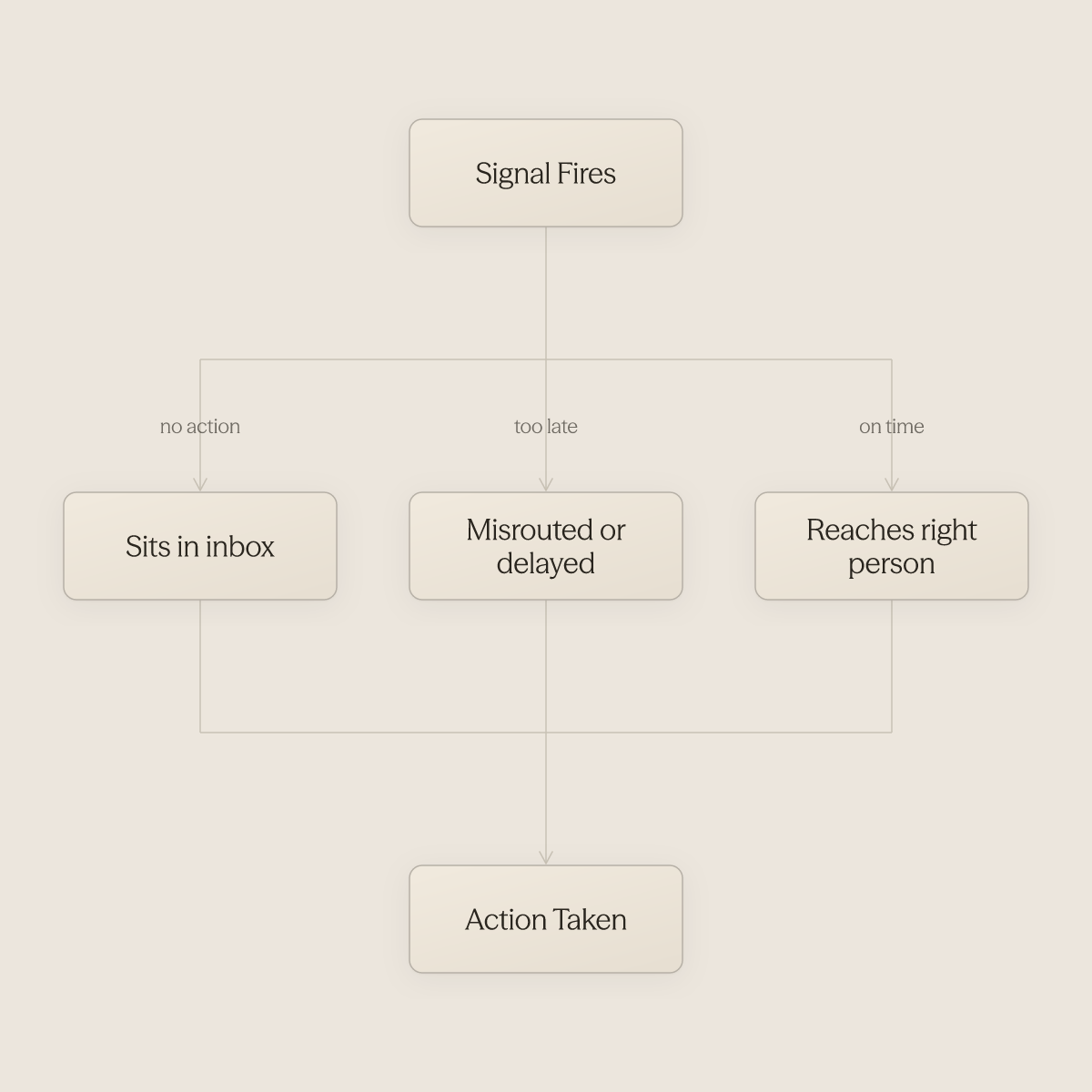
Every tool in your inventory stack, from the PAR-level spreadsheet to the low-stock alert in your PMS, was built to solve a detection problem. What most multi-property operators discover too late is that detection was never the hard part. The hard part is what happens after the signal fires, when it sits in a human inbox waiting for someone to read it, interpret it, and route it to the right person before the next guest checks in.
Why Every Inventory Tool Still Depends on a Human to Act on the Signal
Every software layer still terminates at a human router. Someone has to receive the low-stock notification, decide whether it is urgent, and contact the supplier or cleaner. That step, quiet and invisible, is where inventory failures actually live. The tool moved the failure point; it did not remove it.
The Human Router Is the Bottleneck
A cleaner flags low shampoo at checkout. That flag becomes a text, which becomes a missed call, which becomes a note buried before the next turnover. The signal existed, the tool captured it, and the gap still showed up in a guest review. The bottleneck was never the checklist. It was the handoff.
How One 35-Property Operator Eliminated Inventory Routing Failures
Cash Flow Street, Erwan Le Roy's 35-property short-term rental operation, did not reach 96% automation by tightening its inventory counts. According to Conduit's published case study, the operation achieved sub-1-minute AI response times around the clock by removing the human router from every routine ops touchpoint entirely. The inventory signal no longer waited for a person to process it. That structural change, not a better spreadsheet, produced the outcome.
The Broader Pattern Across Larger Portfolios
One operator managing 270 properties reduced active support staffing from roughly 25 people across multiple shifts down to 2 per shift after moving from 40% to 90% automation through Conduit's AI for hospitality platform. Conduit's published case study for Easy BnB documents the operation scaling by 75 units while holding staffing flat, with monthly coordination cost savings that made the expansion economically viable without proportional headcount growth. Cascadia Getaways maintained a 4.9 communication score through the same transition, directly addressing the most common objection that removing human routers degrades the guest experience. In our reading of these published outcomes, the pattern points in the opposite direction.
How AI Agents Replace the Human Router in Your Inventory Workflow. The hidden cost of routing inventory signals through an ops lead is not the salary; it is the latency.
Next steps
If your properties keep surfacing inventory gaps through guest complaints rather than turnover checks, the path forward starts with removing the human router from the signal chain. A checklist documents what should be there. A communication trigger confirms what actually is there, before check-in, not after a one-star review. Start with our AI for hospitality.
The evidence from the body makes the sequence clear. A correctly set PAR level with no verified reset mechanism produces the same failure mode as no PAR level at all, because cleaner accountability is assumed rather than formally assigned. And at scale, every low-stock alert, every Turno flag, every Breezeway inspection still terminates at a human inbox where latency lives. Together, those two realities point to one action: wire the inventory signal directly into an automated coordination layer so no ops lead has to catch and route it first.
Start with conduit.ai to see how Conduit closes that loop across your portfolio. Connect your existing SOPs, train the agent on your property documentation, and the first automated response goes out within days, not weeks.
Frequently Asked Questions
Why does inventory management actually matter for Airbnb hosts?
A missing consumable like toilet paper costs less than a dollar, but the negative review it generates can measurably affect booking momentum and revenue. The deeper issue is that inventory failures compound with guest communication failures, when a guest messages about a missing item and gets no reply, that combination is what turns a minor supply gap into a one-star rating.
What are PAR levels and how do I set them for my rental?
A PAR level is a specific minimum quantity assigned to each stocked item so a reorder signal fires at a threshold rather than when someone happens to notice the shelf is low. Set them from actual consumption data, not intuition, for example, a four-guest stay of three to four nights needs at least four rolls of toilet paper per bathroom to cover the stay comfortably.
How many sets of sheets and towels should I keep per property?
The industry baseline is two complete sets of sheets and pillowcases per bed, with a third set recommended for properties running same-day turnovers. For towels, two bath towels and one hand towel per guest is the standard, and linen sets should be tracked by room, not by property total, so you always know the right linen is on the right bed.
How do I standardize supplies when I'm scaling to multiple properties?
Define your turnover kit at the property level, specific quantities, product names, and storage locations, inside your SOPs rather than leaving it to individual cleaners to interpret. When those SOPs live in a connected system, every cleaner and every automated workflow pulls from the same source of truth, so your turnover standards scale to each additional property without scaling your personal involvement alongside them.
At what point does manual inventory tracking stop working as I grow?
Multi-property inventory management stops being a counting problem and starts being a coordination problem around your fourth or fifth unit. Each additional property adds another communication layer, a different cleaner, a different supplier contact, a different restock schedule, and the signal that something is missing has to travel through too many handoffs before anyone acts on it.
Stay in the loop
Get the latest on AI automation, product updates, and customer stories.
