13 Best Hotel Management Software Picks for 2026


Hotel Software
13 picks ranked for ops leaders.
Your PMS knows which room is clean. It has no idea a guest sent three unanswered messages at 2 a.m. Here is where every layer of the modern hotel stack ends, and what actually fills the gap.
A property management system is the operational backbone of any hotel. It tracks who booked, which room they're in, whether housekeeping has turned it, and what they owe at checkout. For decades, that definition was complete enough.
In 2026, it leaves a critical gap exposed, most sharply felt by operators managing 20, 50, or 100 properties where guest expectations don't pause at midnight. The common assumption among heads of operations and VPs of operations at multi-brand and enterprise hospitality groups is that standardizing guest communication at scale requires either a massive centralized reservations team or an expensive enterprise software layer, and that today's AI tools are too generic to trust with real guest interactions.
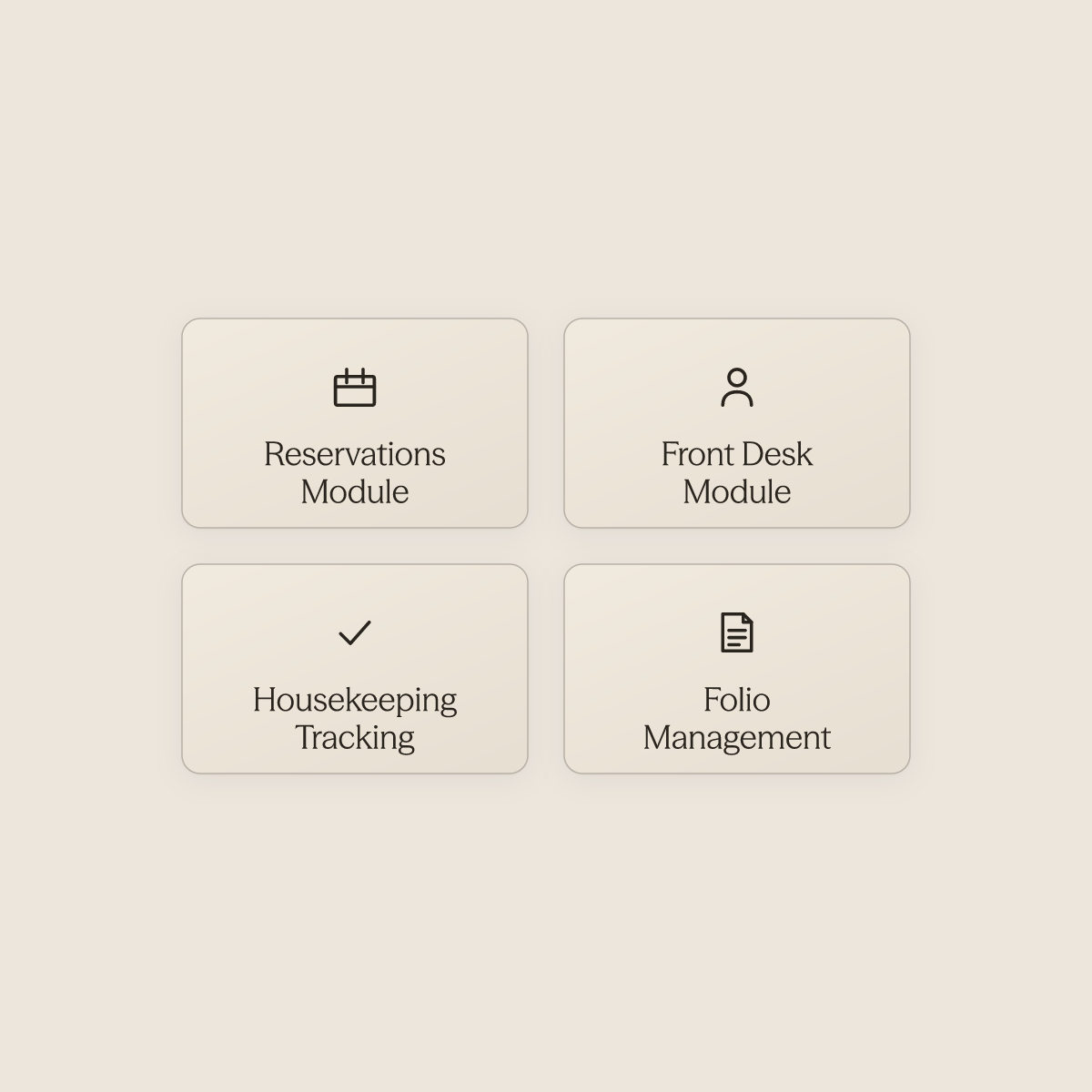
See our AI for hospitality for how this works in practice. Understanding what each layer of the stack actually covers, and where its jurisdiction ends, is the prerequisite for a defensible buying decision. A hotel PMS handles the transactional record of a stay. Reservations modules manage availability, rate plans, and booking confirmations. Front desk modules process check-in and check-out, room assignments, and folio management. Cloud-based and cloud-native are not the same thing.
A cloud-native PMS was built from the ground up for multi-tenant, API-first environments. For a VP of Operations standardizing across a distributed portfolio, the distinction is practical: cloud-native systems expose cleaner integration points, update continuously without scheduled downtime, and support the open API connections that modern guest communication layers depend on. PMS platforms were architected as systems of record. They log what happened; they were never designed to handle conversation throughput. The pattern is consistent across multi-property operations: calendar syncing, maintenance coordination, and OTA rate management get systematized, but guest communication remains manual by default, the one workflow the PMS was never designed to absorb.
"Hotel venue management software can drive a surge in request volume (e.g., QR-code cabana ordering) that outpaces available staff, creating operational bottlenecks during peak seasons, a gap most stacks don't proactively solve."
$8.403 billion Projected PMS market size by 2032
$2.878 billion Global hotel PMS market value in 2025
Key takeaways
- A PMS tracks rooms, folios, and reservations, it was never built to handle the 40 guest questions your team answers every shift, and that gap widens fast across 20 or 50 properties.
- Operators hitting 90% automation rates and sub-one-minute response times aren't using AI as a feature checkbox, they've made it the operating layer the entire team runs on top of.
- Property size determines which software category can actually solve your dominant problem; for small hotels, bundled simplicity beats feature depth, while enterprise groups need a standardization layer their PMS was never designed to provide.
- The real ROI calculation isn't the subscription fee, it's the cost of every guest question that required a human to resolve, multiplied across every property, every overnight shift, every time zone.
- Rankings sorted by peer ratings and feature counts made sense when fragmented data was the core problem; the operators posting the strongest NOI gains now sort by which platform eliminates the most human-in-the-middle steps per dollar spent.
- conduit.ai's AI Agents close the gap by reading directly from a property's own SOPs, manuals, and FAQs to handle guest conversations across channels, no human intervention required, at 2 a.m. or any other hour.
Key Features of Hotel Management Software That Actually Move the Needle in 2026
Not every feature that appears on a comparison grid actually changes how your operation runs, and the gap between "AI-powered" and "autonomously resolves guest inquiries" is where most enterprise buyers get burned post-contract. The features worth evaluating in 2026 are the ones you can benchmark before you sign, not after. That distinction sits at the center of what this section covers.
1. Conduit.ai - Best All-in-One AI Engine for Hospitality Management
Most heads of operations and VPs of operations at multi-brand or enterprise hospitality groups believe that standardizing guest communication at scale requires either a massive centralized reservations team or an expensive enterprise software layer, and that today's AI tools are too generic to trust with real guest interactions. Many enterprise ops leaders have already purchased at least one platform marketed as AI-powered, only to find that a meaningful portion of guest messages still routes to a human queue, a shortfall that typically only becomes visible post-contract. Industry pilots consistently show a meaningful gap between platforms that claim AI-powered routing and those that actually resolve guest inquiries autonomously, a difference that rarely surfaces on a feature comparison grid.
Conduit's Automation Readiness Quotient reframes the evaluation entirely. Instead of asking whether a platform has AI, it asks what percentage of guest interactions resolve autonomously, across which channels, and against whose SOPs, giving a VP of Operations a concrete pre-purchase benchmark rather than a post-contract surprise. Most beneficial when your team receives high volumes of repetitive guest messages and already has SOPs or FAQs to train the agent on, Conduit's AI agents can deliver a first automated reply within days of connecting your documentation, with no IT project required.
2. AI-Powered Predictive Maintenance - Cut Downtime Before It Hits the Guest
The failure point in most maintenance workflows is not the repair itself; it is the gap between when a problem starts and when a staff member notices it. IoT-integrated predictive maintenance closes that gap by monitoring equipment continuously and flagging anomalies before they become guest-facing failures. Some hospitality IoT deployments have documented strong ROI figures when factoring in avoided emergency repair costs and prevented room-night losses, with the value highest in full-service properties where HVAC, elevator, and plumbing failures carry the steepest guest experience cost.
3. Dynamic AI Pricing Engine - Maximize RevPAR Across Every Demand Signal
Dynamic pricing engines connected to real-time demand signals, competitor rate feeds, and local event calendars consistently outperform static rate strategies. Independent research on revenue management deployments has documented meaningful RevPAR improvements when algorithmic pricing replaces manual rate setting, with the strongest gains during shoulder periods where human rate managers tend to underestimate demand elasticity. The honest trade-off: these tools require clean historical data and clearly defined rate floors to avoid volatility.
4. Multi-Channel Distribution Manager - Eliminate Overbooking Across Every OTA
A robust channel manager synchronizes inventory across Booking.com, Expedia, Airbnb, and direct booking engines in under two seconds, making it a non-negotiable feature in any serious hospitality management software stack. It's essential for properties managing 50+ rooms across five or more channels. The key limitation: cheaper channel managers use batch updates rather than live sync, leaving a window where overbooking can still occur during peak demand spikes.
5. Automated Housekeeping Suite - Real-Time Room Status Without Radio Chaos
Digital housekeeping management replaces walkie-talkies and paper checklists with mobile task assignment, real-time room status updates, and inspector sign-off workflows. This feature directly reduces check-in wait times and improves staff accountability, making it critical for properties with high turnover rates. The tradeoff: staff adoption resistance is common, and properties without a structured change management plan see slow ROI in the first 90 days.
6. CRM-Driven Upsell Automation - Turn Reservation Data Into Pre-Arrival Revenue
The best hospitality management software platforms embed CRM logic that triggers personalized upsell offers, room upgrades, spa packages, early check-in, based on guest history, booking source, and stay purpose. This pre-arrival revenue layer consistently outperforms front-desk verbal upselling. The limitation: effectiveness degrades sharply when guest profile data is thin, meaning new properties or those migrating from legacy PMS systems see slower initial lift.
7. Automated Back-Office Accounting Integration - Close the Books Without Manual Reconciliation
Native accounting automation within hospitality management software eliminates manual night audit reconciliation, folio posting errors, and end-of-month close delays by syncing PMS transactions directly to accounting platforms like QuickBooks or NetSuite. This is the right feature priority for hotel controllers and CFOs managing multi-property portfolios. The tradeoff: deep accounting integrations often require custom API work, adding implementation time and cost for properties on non-standard GL structures.
How Property Size Affects Which Hotel Management Software Is the Right Fit
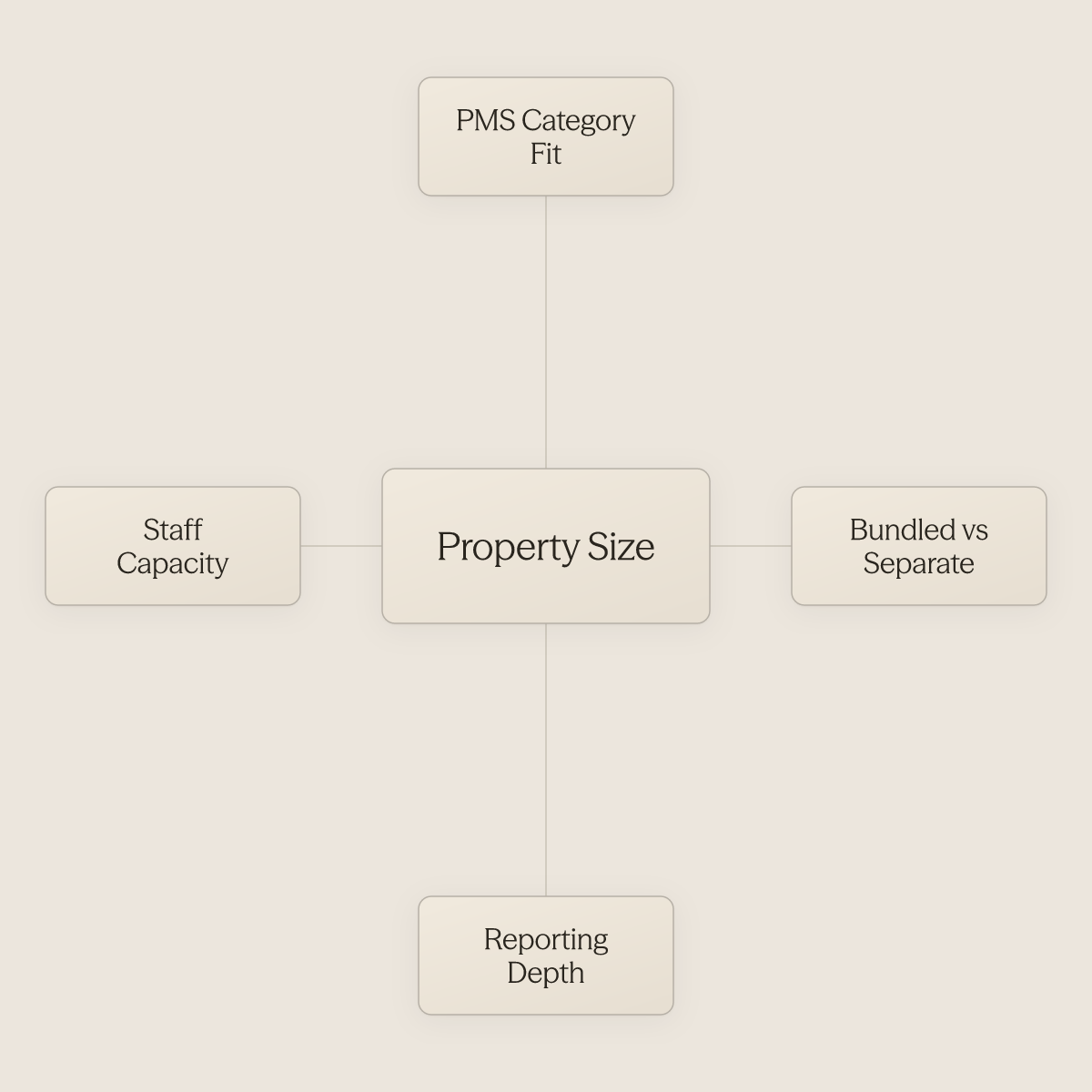
Property size determines more than your PMS price tier. It determines whether the PMS category can solve your dominant operational problem at all.
Pros and cons at a glance
Small hotels under 50 rooms are best served by Cloudbeds, Mews, ThinkReservations, Little Hotelier, and RoomMaster. A double-booking on Booking.com or Expedia caused by a slow sync can wipe out a week's margin for a 30-room inn. Operators consistently report that managing three separate tools (PMS, channel manager, booking engine) creates more failure points than it solves.
Bundled platforms that consolidate all three into one interface eliminate that fragmentation without requiring a dedicated IT resource. The honest trade-off: these platforms sacrifice deep reporting and group booking logic, which becomes a real cost above 50 rooms. Where small-hotel operators consistently lose ground isn't just in reservations technology; it's in the volume of repetitive guest messages that arrive before, during, and after a stay.
A 30-room inn with two front-desk staff cannot realistically answer every pre-arrival inquiry, breakfast question, and late-checkout request at the speed guests now expect. Industry research makes clear that slow replies directly erode satisfaction and repeat-booking rates. This is precisely what AI Agents are built for: once your existing SOPs, FAQs, or manuals are connected, the agent begins handling high-volume, repetitive guest messages automatically, before, during, or after a stay, without adding headcount. Integrations pull that content directly, so there is no manual re-entry step between "we have an SOP" and "the agent knows the answer."
Mid-Sized Hotels (50–99 Rooms): Reporting Gaps and Group Booking Costs
Mid-sized hotels between 50 and 99 rooms benefit most from Mews, Oracle Hospitality, and HOTELTIME. At this scale, the failure mode shifts from channel conflicts to reporting blind spots. A 75-room independent that can't segment revenue by room type, booking channel, or guest segment is leaving yield management to instinct.
Group booking logic also becomes critical: a single corporate account or wedding block can represent 30% of a month's occupancy, and platforms that can't handle rooming lists, billing splits, or attrition clauses create real revenue leakage. Mews handles this tier well with a modern API architecture that connects cleanly to revenue management tools. HOTELTIME is worth evaluating for European mid-market properties with complex tax and folio requirements.
At the 50–99 room tier, guest communication volume grows faster than most operators anticipate, and the gap between a consistent brand voice and a staff-dependent one becomes measurable in reviews and revenue. The Revinate Hospitality Benchmark Report ties guest satisfaction directly to occupancy outcomes, meaning the quality and speed of every guest touchpoint carries a revenue consequence, not just a service one. Workflows that fire automatically after trigger events in the guest lifecycle, booking confirmation, check-in, a detected keyword, standardize the touchpoints that currently require manual staff action and ensure brand voice holds across every interaction. AI Agents are most beneficial when that complexity is codified: specific brand standards and escalation rules become agent behavior, not tribal knowledge.
Large Hotels (100 to 499 Rooms): Deep Integration APIs Are Non-Negotiable
Large hotels between 100 and 499 rooms should shortlist Oracle Hospitality, Mews, and Cloudbeds. At this scale, the best hotel management software is defined less by its native feature set and more by how cleanly it integrates with adjacent systems: spa POS, F&B, loyalty programs, and revenue management engines. Oracle Hospitality's OPERA Cloud leads on integration breadth, though it carries meaningful implementation complexity. StayNTouch is also worth evaluating at this tier for properties that prioritize a mobile-first front-desk experience alongside strong API connectivity.
The same integration logic applies to guest communications at this scale. A 200-room property running conversations across Airbnb, a direct booking engine, email, and OTA messaging platforms faces a coordination problem that no inbox-checking rota can reliably solve. A unified Inbox gives operations and support teams a single surface to monitor, review, and manage every conversation the AI agent is handling across those platforms simultaneously, a meaningful operational gain when the alternative is staff context-switching between disconnected tools.
The underlying goal the Revinate Hospitality Benchmark Report surfaces, maximizing revenue per property by improving both occupancy and guest satisfaction, is only achievable at this room count when the systems handling guest communication are as integrated and auditable as the systems handling reservations.
Related Reading
- How To Improve Hotel Operations
- Hotel Demand Forecasting
- Hospitality Operations Management
- How To Increase Revpar
- Hotel Revenue Management Strategies
- Automated Hotel Reservation System
- Hotel Upselling
- Hotel Budgeting And Forecasting
- Hotel Guest Messaging
- Hospitality Automation
- Adr Vs Revpar
The 13 Best Hotel Management Software Picks for 2026 - Ranked by Operational Leverage
The most-cited hotel management software rankings in 2026 still sort by peer rating scores and feature counts. That method made sense when fragmented data was the core problem. It is no longer the core problem.
Operators reporting the strongest NOI improvements in recent cycles tend to sort by a different question: which platform eliminates the most human-in-the-middle steps per dollar spent? Ranked through that lens, the list looks nothing like the standard leaderboards. The five that matter: Conduit.ai, Cloudbeds, Mews, Oracle OPERA Cloud, and Stayntouch.
Each earns its position not by feature count but by how much operational overhead it removes from a real team running real properties at scale. One reframe worth carrying into every item below: the celebrated "all-in-one" PMS platforms dominating buyer reviews have largely solved yesterday's bottleneck. Real-time OTA sync, consolidated reporting, and automated billing are now table stakes. No PMS was architected to solve that, which means ranking hotel management software purely on PMS-plus-channel-manager capability systematically misleads multi-property buyers about where their next dollar of operational leverage actually comes from. That gap is where the first item on this list lives.
1. Conduit.ai - Best AI-Powered Guest Communication Platform for Hospitality
Conduit.ai earns the top slot because it targets the constraint every PMS leaves open: the 24/7 guest communication gap that costs teams either staff hours or guest satisfaction scores. Its AI agents are trained on each operator's own SOPs and manuals, so every reply is on-brand and on-spec without a human in the middle. Cash Flow Street reached high automation rates across a substantial portfolio of properties.
Wynwood House documented sharply reduced resolution times across its international portfolio. Easy BnB documented substantial monthly labor cost reductions while expanding its portfolio with zero additional hires. The honest trade-off: benefit materializes most when a property already has documented SOPs and receives high message volume, a single-unit operator with light inquiry traffic will see less return than a multi-property group where repetitive guest questions consume staff hours around the clock.
For VP-level ops leaders standardizing communication quality across a distributed portfolio, this hospitality AI platform is the layer that makes every other PMS on this list perform closer to its ceiling.
2. Cloudbeds - Best All-in-One PMS + Channel Manager for Independent Hotels
Cloudbeds is the right call for independent hotels that want a single platform covering reservations, distribution, payments, and reporting without stitching together separate tools. Its channel manager connects to 450+ OTAs with zero added commissions, per Cloudbeds' own published specs, and the platform holds a 4.5 out of 5 aggregate rating across 1,440 verified hotelier reviews on Hotel Tech Report (2026). One verified reviewer described it as "solid, scalable, and highly recommended" with integrations that "expand hotel control and enhance profitability regardless of size." The real trade-off for multi-property groups: Cloudbeds was built for independent operators, not enterprise chains, so consolidating reporting across 20-plus properties requires more configuration than purpose-built enterprise systems offer out of the box.
3. Mews - Best Modern Cloud PMS for Design-Forward and Lifestyle Hotels
Mews is the pick for lifestyle and boutique operators who want a modern UI, strong automation defaults, and an extensive integration marketplace. Its open API architecture makes it genuinely automation-friendly, and contactless check-in is a native workflow rather than a bolt-on. The interface reduces front-desk training time meaningfully compared to legacy on-premise systems, which matters when staff turnover is high. The limitation worth naming: Mews pricing scales with property complexity, and operators running a mix of full-service and limited-service flags may find configuration overhead increases faster than expected as the portfolio grows.
4. Stayntouch - Best Guest-Profile-Driven PMS for Boutique and Upscale Properties
Stayntouch centers its architecture on the guest profile rather than the room record, which translates directly into faster upsell execution and more personalized service recovery. Mobile-first check-in and checkout are core, not optional, making it well-suited for properties where front-desk-free arrivals are a brand differentiator. The honest limitation: Stayntouch's strength is guest-facing workflow elegance, not deep back-office financial reporting. Properties that need complex group billing or multi-entity accounting will likely need a supplemental tool.
5. Oracle Hospitality OPERA Cloud - Best Enterprise PMS for Full-Service and Chain Hotels
Oracle OPERA Cloud is the standard-bearer for large hotels and chains that require global compliance, multi-brand configuration, and an integration ecosystem built for enterprise scale. It powers properties ranging from independent full-service hotels to 2,000-room chain assets, with role-based access controls and audit trails that satisfy procurement and legal requirements at the enterprise level. The trade-off is scope: OPERA Cloud implementations are significant undertakings in both time and cost, and the platform's depth can feel like overhead for properties below roughly 150 rooms. It is the right choice when compliance complexity, multi-flag configuration, and enterprise IT governance are non-negotiable requirements.
6. Infor HMS - Best Revenue Management-Integrated PMS for Mid-Scale Hotel Groups
Infor HMS earns its place for mid-scale groups that want revenue management logic embedded in the PMS rather than managed through a separate tool. The native integration between rate strategy and operational data reduces the manual handoff that typically lives between a revenue manager and a front-desk system, meaningfully tightening rate decision cycles for groups running 5 to 20 properties. The limitation: Infor's implementation and support model is enterprise-oriented, which can feel slow and expensive for operators who want to move quickly or make configuration changes without opening a support ticket.
7. InnRoad - Best Cloud PMS for Small Independent Hotels Seeking Simplicity
InnRoad targets small independent hotels that need a cloud PMS without the configuration overhead of enterprise platforms. Onboarding is straightforward, and the interface is designed for non-technically sophisticated staff, reducing training time compared to legacy on-premise systems. The trade-off: its simplicity is also its ceiling. Properties that anticipate growing into multi-property management or need advanced revenue management logic will outgrow InnRoad faster than expected.
8. Little Hotelier - Best All-in-One Platform for Micro-Properties and B&Bs
Little Hotelier is built specifically for properties with fewer than 20 rooms, bed-and-breakfasts, guesthouses, and small inns where the operator is often also the front desk, housekeeper, and revenue manager. The bundled channel manager, booking engine, and PMS reduce the number of logins and vendor relationships a solo or two-person operation has to manage. The honest limitation for multi-property readers: Little Hotelier is not designed for portfolio management, and attempting to run more than a handful of properties through it creates reporting gaps that become operationally painful quickly.
9. Sirvoy - Best Budget-Friendly PMS for Cost-Conscious Independent Operators
Sirvoy competes on price transparency in a category where most vendors require a demo before disclosing any number, reducing procurement friction for cost-conscious independent operators. The platform covers core PMS functions, a booking engine, and basic channel connectivity at a price point that makes sense where software budget is genuinely constrained. The trade-off: operator feedback across hospitality forums consistently notes that Sirvoy's reporting and automation capabilities are lighter compared to mid-market platforms, and implementation and configuration costs can narrow the headline price advantage faster than the initial quote suggests.
10. Hostaway - Best Vacation Rental and Boutique Hotel Hybrid Management Platform
Hostaway is the strongest option for operators managing a mix of vacation rental units and boutique hotel inventory under one roof, a portfolio structure that breaks most pure-play PMS platforms. Its channel management covers both OTA categories effectively, and the unified inbox reduces the context-switching that plagues hybrid operators. For property managers expanding from short-term rentals into boutique hotel flags, Hostaway provides a bridge without forcing a full platform migration. The limitation: its PMS depth on the hotel side is lighter than dedicated hotel platforms, so full-service operations with complex group bookings will feel the gap.
11. Yanolja Cloud Solution - Best PMS for Asia-Pacific and Emerging Market Hotel Operators
Yanolja Cloud Solution is the operationally relevant pick for hotel groups with significant footprints in Asia-Pacific or emerging markets where localization, local payment rail support, and regional OTA connectivity matter more than Western platform brand recognition. Its distribution network and compliance defaults are built for markets where global platforms often underperform. The trade-off for international groups using it alongside a Western-market PMS: integration complexity increases, and support response times can vary significantly depending on the operator's geography relative to Yanolja's core support infrastructure.
12. eviivo - Best PMS for Independent Properties Selling Direct and Through OTAs Simultaneously
Eviivo is purpose-built for independent properties that want to grow direct bookings without abandoning OTA distribution. Its booking engine and channel manager are tightly integrated, with tools for managing promotions and rate parity across channels from a single interface, reducing the daily overhead of keeping rates consistent for owner-operators actively managing distribution strategy. The limitation: eviivo's multi-property reporting is limited, making it a poor fit for any operator managing more than a handful of properties who needs consolidated performance visibility.
Lynx, Best Guest Experience Automation Platform for Tech-Forward Hotel Operators. Lynx focuses on the physical guest experience layer: smart locks, thermostat control, noise monitoring, and automated check-in flows tied to device access.
13. Lynx - Best Guest Experience Automation Platform for Tech-Forward Hotel Operators
Lynx focuses on the guest-facing layer of hotel operations, self check-in, smart room controls, digital guidebooks, upsells, and a guest app, making it the strongest pick for tech-forward operators who want to differentiate on experience rather than just operational efficiency. It integrates with existing PMS systems rather than replacing them. The tradeoff: Lynx requires a compatible PMS already in place and adds cost as a supplementary layer.
How Hotel Software Improves Guest Experience: and What the Automation Numbers Actually Mean
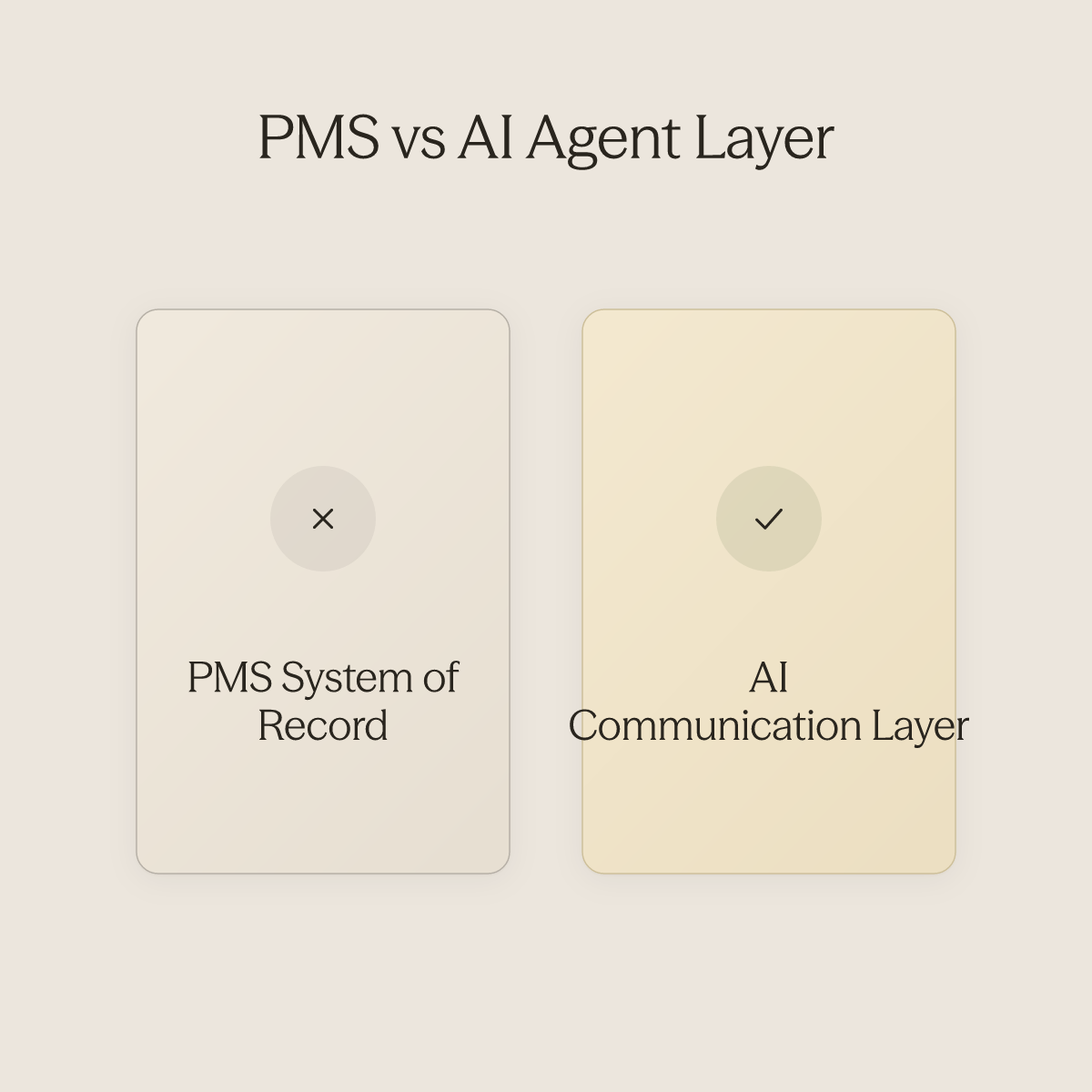
For tech-forward operators running short-term rentals or limited-service hotels, Lynx handles the operational layer that sits between a reservation confirmation and a guest walking through the door: smart access, environmental controls, and automated pre-arrival flows that reduce front-desk dependency without sacrificing the guest experience. Yet operators who have spent years optimizing PMS configurations know the frustration: the dashboard looks clean, the folio is accurate, check-in runs in under three minutes, yet guest satisfaction scores still plateau. The reason is structural. A PMS is a system of record; it captures what happened. The AI communication layer determines what the guest experiences between those recorded events, and that gap is where satisfaction is won or lost at scale.
What PMS Actually Controls vs. What the AI Agent Layer Controls
The PMS owns reservations, billing, housekeeping task routing, and front-desk workflows. Across the market, automating check-in speed and billing accuracy reduces friction, yet incremental satisfaction gains from further PMS refinement shrink quickly once the basics are reliable.
A PMS cannot answer a parking question, enforce consistent brand tone across 40 properties, or personalize a pre-arrival message from booking history. That is the AI agent layer's job. Conflating the two is how portfolios end up over-invested in PMS polish and under-invested in the communication layer guests actually feel.
This gap is particularly acute for operators managing guest communications across multiple platforms simultaneously, Airbnb, direct booking engines, OTA inboxes, where message volume becomes unmanageable without a unified layer. Conduit's Inbox was built for exactly this context: it consolidates every conversation the AI agent is handling so the operations or support team can monitor, review, and intervene from a single surface rather than toggling between disconnected threads. When that unified visibility is paired with AI Agents trained on a property's own SOPs, FAQs, and manuals, the first automated guest reply can go live within days of connecting those documents, not months.
For operators already using Notion, Google Drive, or Airbnb to store operational content, Conduit's Integrations surface that existing knowledge directly, so there is no manual re-entry step slowing deployment.
The Two Metrics That Predict Guest Satisfaction - Automation Rate and Response Latency
Broader industry trends consistently show average hotel guest message response times that leave guests waiting long enough to form a negative impression. Guests who wait that long have already formed an opinion. As what most teams report on guest satisfaction management confirms, timely and consistent communication is one of the highest-leverage levers available for improving both guest experience and review scores, outcomes that compound directly into repeat bookings and rating-driven visibility.
Operators seeing the sharpest satisfaction gains consistently hit near-instant response times across every channel, at every hour, without adding overnight staff. When the large majority of inbound messages resolve without a human in the middle, response latency drops structurally, not situationally. These two numbers predict guest satisfaction outcomes more reliably than any feature checklist because they reflect what the guest actually experiences.
The businesses that benefit most from this model share a recognizable profile: high volumes of repetitive inbound questions, parking, check-in codes, Wi-Fi, early checkout, and existing documentation they have never fully operationalized. Conduit's AI Agents are most effective precisely in this scenario, because the training material already exists. The agent works continuously, before, during, and after a stay, responding whenever a guest sends a message regardless of hour. That consistency is what moves review scores at scale in ways that sporadic staff training cannot replicate.
Real Operator Numbers - Automation, Response Times, and NOI
The financial logic compounds quickly, and it is straightforward: a meaningful improvement in annual NOI, driven by reduced overnight staffing costs and improved upsell capture, translates directly into asset valuation upside at any standard cap rate. Easy BnB documented substantial monthly savings after deploying an AI guest communication layer across a significantly expanded portfolio, with zero additional hires.
That is a calculable change in what the asset is worth. Revenue managers at smaller properties, the 55-to-80-room segment in particular, face a compounding version of this problem. Forecasting error beyond two weeks undermines pricing decisions and erodes ownership trust in ways that no PMS report can fully repair.
That trust gap widens when the same team is also fielding manual guest messages at all hours, because staff attention cannot simultaneously serve guests well and produce the clean, consistent data that pricing models depend on. Automating the communication layer through Conduit's Workflows, triggered after booking confirmation, at check-in, or when specific guest keywords are detected, removes that attention tax from the equation. The operations team stops firefighting inbound volume and starts managing by exception, with the Inbox as the oversight layer rather than the primary response surface.
The automation metrics hospitality vendors publish, open rates, response times, check-in deflection rates, systematically understate AI's actual impact because they measure communication efficiency rather than revenue yield. The core synthesis here is this: when the well-documented finding that segmented, personalized guest communications outperform generic blasts is combined with the structural reality that PMS platforms generate transactional data but were never designed to act on it conversationally, the gap Conduit fills becomes a revenue story, not just an efficiency one. The pattern holds consistently across the hospitality space: guest satisfaction management is not a front-desk problem; it is a communication consistency problem, and consistency at scale requires automation that a PMS was never architected to provide.
Related Reading
- Best Revenue Management Software For Hotels
- Siteminder Competitors
- Digital Concierge Software
- Hospitality Conferences
- Hotel Distribution Management
- Best Hotel Channel Manager Software
- Canary Technologies Competitors
- Cloudbeds Alternatives
- Hospitality Chatbot
Hotel Management Software Pricing - What to Expect and How to Build the Real Business Case
Subscription fees are the line item that gets screenshotted and forwarded to the CFO. They are rarely the number that determines whether a hotel technology investment actually pays off. The real business case lives in a different calculation: what does it cost your operation every time a guest question requires a human to resolve it, across every property, every overnight shift, every time zone in your portfolio?
Consider what that math looked like for Easy BnB before they changed their model: a large team of virtual assistants deployed just to maintain 24/7 guest coverage, with routine, low-value inquiries consuming the overwhelming majority of total communication volume. Staff reliability was a chronic drag, missed overnight shifts, undisclosed second jobs, and the business could not grow its property portfolio without adding headcount, which directly capped its exit valuation multiplier. The labor structure wasn't a staffing problem.
It was a unit economics problem with a compounding ceiling.
Demo-Required Pricing - What to Demand Before the Call
Most enterprise hospitality platforms price on request because the variables are genuinely complex: property count, channel mix, integration depth, and support tier all move the number. Before the call, pull three numbers: your current fully-loaded guest services cost per staff hour, your average monthly guest inquiry volume per property, and your existing PMS contract's integration fee schedule. Those inputs let you model cost-per-interaction before a vendor quote shapes your thinking.
AI is most beneficial when your business already receives a high volume of repetitive guest or customer messages and has existing documentation, SOPs, FAQs, property manuals, that can be used to train the agent. If those two conditions are true, you have the raw material to go live fast: operators typically see their first automated guest reply within days of connecting their SOPs and manuals. AI also integrates directly with tools your team already uses, Notion, Google Drive, Airbnb, so the AI agent draws on existing content without requiring manual re-entry, removing a common reason automation projects stall before they start.
The Metric That Actually Matters - Cost per Interaction vs. Cost per Hour
The ROI case for AI-powered guest communication is not primarily a guest experience argument; it is a labor arbitrage argument with a measurable per-interaction cost structure. When you align broader industry labor cost benchmarks for fully-loaded front-desk staff against your actual monthly guest inquiry volume and the CPOR framework operators already use, each guest communication event carries a calculable labor cost that AI can meaningfully reduce. The automation ROI case should be built in that same unit economics language operators already use to justify staffing decisions, not in NPS points.
The Easy BnB case illustrates the structural issue precisely: when 80% of your communication volume is routine and repetitive, you are paying fully-loaded human labor rates to answer questions your own SOPs already answer. That is not a hospitality problem; it is a document-retrieval problem wearing a hospitality uniform. What most operators who have run the numbers find is that the cost-per-automated-interaction for AI-handled guest inquiries is typically a fraction of a fully-loaded front-desk staff hour, a unit economics argument that translates directly into the CPOR and NOI frameworks hospitality operators already use to justify staffing decisions.
The operational posture this creates is the point operators in this category consistently return to: get off the 24/7 on-call treadmill and back to growing the business. Based on our market understanding, AI inbox tools give operations teams a single place to monitor, review, and manage every conversation the AI agent is handling, across multiple platforms and properties simultaneously, so oversight does not require headcount to scale with volume. Workflows trigger automatically after booking confirmations, check-ins, or keyword detection, replacing the manual staff actions that were consuming hours without adding margin.
The businesses we work with that see the clearest ROI are the ones that stop trying to build or manage this infrastructure themselves. As one operator put it directly: "We all agree that AI first is the best approach." That is not a technology opinion; it is a capital allocation decision with a direct line to EBITDA.
Next steps
If your portfolio is absorbing the cost of manual guest communication across every overnight shift and every property, the path forward starts with treating each unanswered or delayed guest message as a revenue event, not a service ticket. Start with our AI for hospitality.
The insight that PMS platforms generate guest data but were never designed to act on it conversationally means every un-personalized, delayed message is a quantifiable revenue leak, not just a satisfaction gap. The insight that all-in-one PMS platforms have solved yesterday's bottleneck (OTA sync, consolidated reporting) but were never architected for brand voice consistency and response SLA enforcement at 2 a.m. means the next dollar of operational leverage does not come from a better PMS configuration. Together, they point to deploying a hospitality-specific AI communication layer trained on your own SOPs, so every property responds on-brand, on-spec, and within minutes, without adding headcount.
Start with conduit.ai to see how Conduit's agents ingest your existing SOPs and FAQs and begin resolving guest inquiries automatically, typically within days of connecting your documentation, not months into an IT project.
Frequently Asked Questions
Which hotel management software is the right fit for my property size?
It depends on your room count and dominant operational problem. Small hotels under 50 rooms are best served by bundled platforms that consolidate PMS, channel manager, and booking engine to eliminate OTA channel conflict. Mid-sized hotels between 50 and 99 rooms need stronger reporting and group booking logic to avoid revenue leakage. Large hotels between 100 and 499 rooms should prioritize clean, open API integrations with adjacent systems like spa POS, F&B, and revenue management engines, a closed API at that scale is a ceiling on operational efficiency, not just an inconvenience.
My PMS already claims to have AI, why are guest messages still ending up in a human queue?
There is a consistent gap between platforms that claim AI-powered routing and those that actually resolve guest inquiries autonomously, and that difference rarely surfaces on a feature comparison grid. The right question to ask before purchasing is not whether a platform has AI, but what percentage of guest interactions resolve autonomously, across which channels, and against whose SOPs, a benchmark conduit.ai's Automation Readiness Quotient is specifically designed to surface before you sign a contract, not after.
What's the difference between a cloud-based and a cloud-native PMS, and does it actually matter?
Cloud-based and cloud-native are not the same thing. A cloud-native PMS was built from the ground up for multi-tenant, API-first environments, which means cleaner integration points, continuous updates without scheduled downtime, and the open API connections that modern guest communication layers depend on. For a VP of Operations standardizing across a distributed portfolio, that distinction is practical, not just technical.
How quickly can an AI guest communication tool actually be up and running?
With conduit.ai, once your existing SOPs, FAQs, or manuals are connected, the agent can deliver a first automated reply within days, with no IT project required. If that documentation already lives in Notion or Google Drive, conduit.ai's integrations pull it directly, so there is no manual re-entry step between having an SOP and the agent knowing the answer.
Does a PMS handle guest messaging, or do I need a separate tool for that?
A PMS was architected as a system of record, it logs what happened but was never designed to handle conversation throughput. The pattern is consistent across multi-property operations: calendar syncing, maintenance coordination, and OTA rate management get systematized, but guest communication remains manual by default because it is the one workflow the PMS was never designed to absorb.
Stay in the loop
Get the latest on AI automation, product updates, and customer stories.

