13 Best PMS for Airbnb Hosts to Manage More in 2026


Best PMS for Airbnb Hosts
Find the best PMS for Airbnb hosts in 2026
Every PMS promises scale. Most stop working the moment a guest goes off-script. Here is what to look for, what to ignore, and the gap no calendar sync will ever close.
A property manager juggling five listings can survive on Airbnb's native tools, a shared inbox, and a lot of caffeine. Add ten more and the math changes fast: calendars multiply, cleaning crews need coordination, and guest messages arrive at hours no one planned to work. Most vacation rental property managers and operations leads think that if they pick the right PMS with the best built-in messaging automation, they can scale their portfolio without hiring more staff or burning out their current team.
That's the moment most operators start researching Airbnb property management software, and the moment the category's real limits start to matter. Understanding what a PMS actually does, and where it stops, is the decision that separates operators who scale cleanly from those who scale into chaos. An Airbnb PMS is a centralized operations hub.
See our AI for hospitality for how this works in practice.
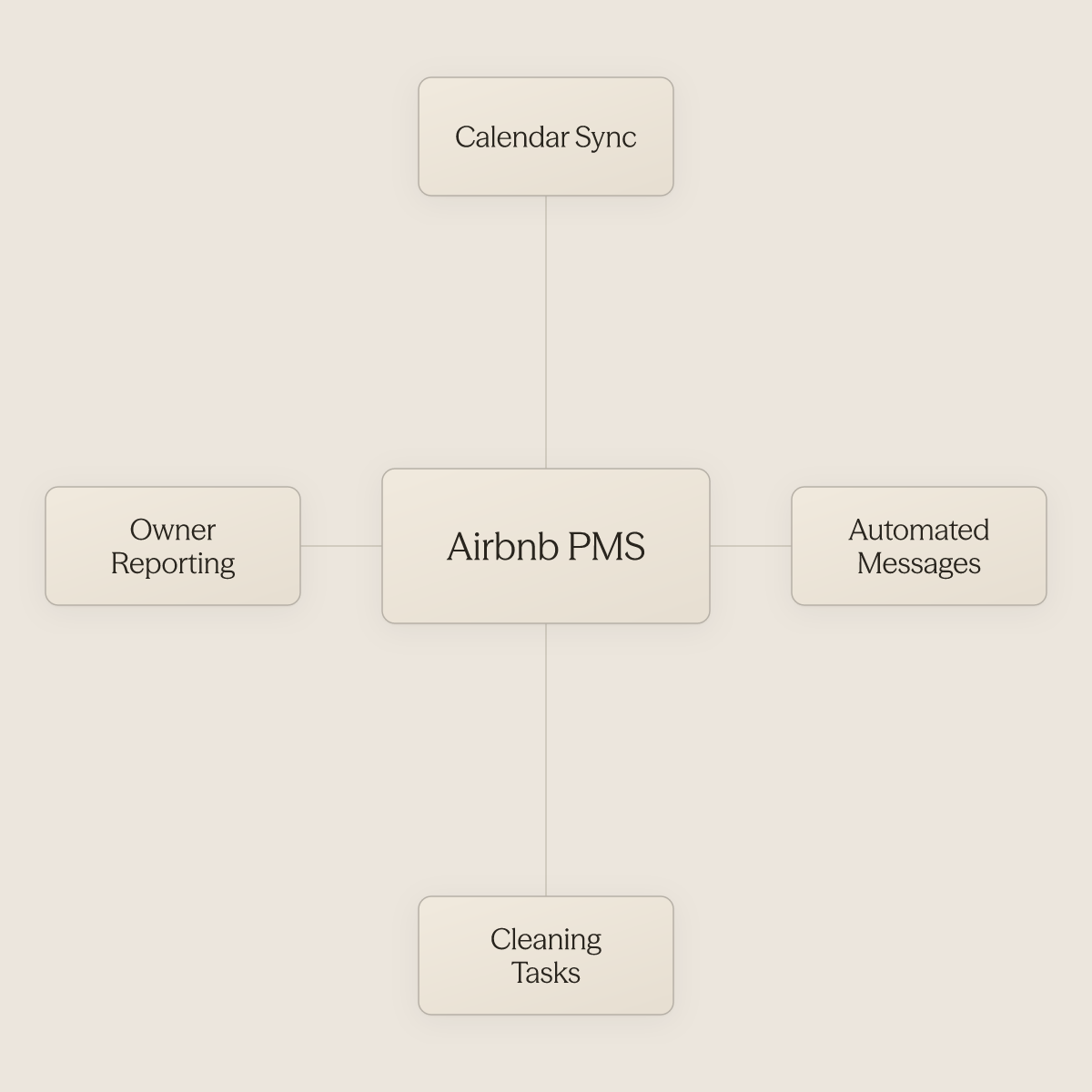
It consolidates calendars, automates scheduled messages, triggers cleaning tasks, and tracks owner reporting across every listing in one dashboard. According to industry research, property management companies oversee an average of 497 units per company, which makes a centralized system a structural necessity, not a luxury. Without one, coordination overhead alone consumes the margin. What a PMS was never designed to do is hold an unscripted conversation. When a guest asks whether the parking space fits an oversized truck, or reports a broken heater mid-stay, the PMS delivers that message to an inbox, then waits.
Resolution still depends on a human reading, deciding, and typing a reply. The essential features of an Airbnb PMS are:
- Unified inbox (all OTA messages in one place)
- Automated scheduled messaging (check-in instructions, review requests, departure reminders)
- Calendar and channel sync
- Cleaning and maintenance task triggers
- Owner reporting
Airbnb's own Software Partners program lists vetted PMS integrations meeting its API standards, a useful starting filter when evaluating platforms. These five features eliminate the coordination overhead that otherwise eats team hours. They handle everything predictable: known touchpoints, fixed sequences, scheduled workflows.
497 average units managed per property company
Key takeaways
- A PMS organizes your calendar, coordinates your cleaners, and fires scheduled templates, it does not hold a live conversation with a guest locked out at 11 PM.
- Every serious PMS on this list syncs calendars, unifies your inbox, and automates pre-arrival messages, the feature lists blur fast, and the real differentiator is what breaks first when your portfolio doubles.
- Automated check-in and checkout messages quiet the inbox at scale, but unscripted mid-stay questions arrive outside every template sequence, often overnight, and that gap is where review scores actually move.
- A 35-property operator hit 96% AI automation with guest response times under one minute, not by switching PMS platforms, but by adding a communication layer on top of one.
- Portfolio size tells you which PMS tier to start on; it doesn't tell you what breaks first when message volume stops being manageable by one person on a good night's sleep.
- conduit.ai's AI Agents close the communication gap by reading directly from your SOPs, manuals, and FAQs to handle unscripted guest conversations across every channel, no human intervention required, no matter the hour.
Why Manual Guest Messaging Breaks Down as Your Airbnb Portfolio Grows
Turning on automated check-in and checkout messages feels like solving the communication problem. Most vacation rental property managers and operations leads think: "If I pick the right PMS with the best built-in messaging automation, I can scale my portfolio without hiring more staff or burning out my current team." The inbox quiets down, the templates fire on schedule, and the operation looks manageable, until the portfolio grows past a handful of properties and the gaps between those templates start filling with questions no sequence was ever built to answer.
The reality is more specific than "message volume gets high." Hosts managing even a single property face a constant stream of guest questions, many asking about information already covered in the listing or arrival guide. As the portfolio grows, that stream becomes a flood no manual process can reliably absorb.
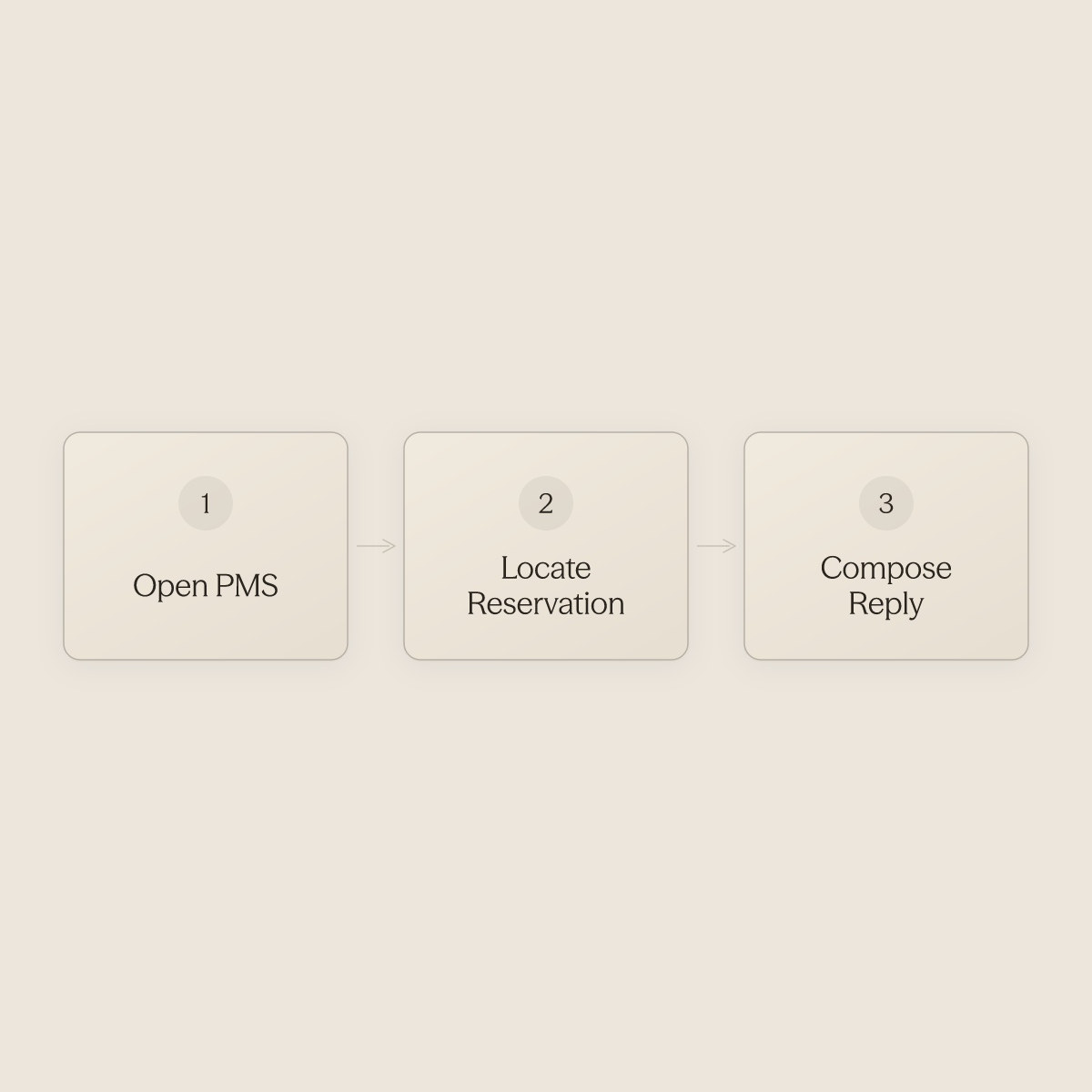
What makes it worse is the friction baked into every response: staff open the PMS, locate the reservation, then compose a reply, a multi-step process slower than a phone call for something as simple as confirming a checkout time. The process defeats the purpose of messaging entirely. Conduit Agents are most beneficial: businesses receiving a high volume of repetitive guest messages that already have existing documentation, SOPs, FAQs, property manuals, ready to train an agent on.
"Manual messaging consumed 20+ minutes per booking, a burden that compounds significantly as my portfolio size grows."
Each New Listing Compounds Message Volume Faster Than Headcount Can Keep Up
The math is straightforward and brutal. A single vacation rental booking generates multiple guest touchpoints across the stay arc: pre-arrival questions, mid-stay requests, and post-checkout follow-ups. Multiply that across 15 or 20 listings and the daily message volume stops being a communication task and starts being a full-time job.
Operators who have managed this manually describe spending 20 or more minutes per booking just on routine exchanges, WiFi passwords, early check-in requests, parking instructions. These are not novel questions; they are the same questions repeated for every guest, across every property, on every booking. The cycle is draining by design, and it compounds directly with booking volume.
Adding a property means adding message volume immediately; adding a team member means weeks of hiring and onboarding. The gap between those two timelines is where response quality quietly erodes, and where missed messages between guests and cleaning staff begin to slip through, a problem that grows more acute with every listing added. Conduit's AI Agents are designed to close that gap.
Once connected to your existing SOPs and property manuals, without requiring manual re-entry if your documentation already lives in tools like Notion or Google Drive, the agent can deliver its first automated guest reply within days. The operations team then uses the Inbox to monitor, review, and manage all conversations the AI agent is handling on an ongoing basis, maintaining visibility without being the first line of response for every routine inquiry.
The Overnight Gap - How Response Times Drain Review Scores and Booking Conversion
Airbnb requires hosts to maintain a 90% or higher response rate within 24 hours to qualify for Superhost status. That threshold is achievable at five properties with a disciplined team. At 20 properties, it demands someone watching the inbox at 2 a.m. on a Tuesday. Airbnb's guidance also confirms that response time directly affects search ranking and booking conversion, meaning the overnight gap is not just a guest experience problem, it is a revenue problem that compounds silently, booking by booking, until the review score reflects it.
The overnight gap is not just a guest experience problem, it is a revenue problem that compounds silently, booking by booking, until the review score reflects it.
90% Airbnb response rate needed for Superhost
Key takeaway: The overnight gap is not just a guest experience problem, it is a revenue problem that compounds silently, booking by booking, until the review score reflects it.
Conduit.ai Agents respond continuously, before, during, or after a stay, whenever a guest sends a message. That coverage is not limited to business hours or staffed shifts. It is the specific capability that closes the overnight gap without requiring a team member to be on call, and it addresses the core Airbnb compliance risk that grows harder to manage manually as portfolio size increases.
Inconsistent Reply Quality Across Listings Is What Triggers Negative Reviews
The review risk is not slow replies alone, it is inconsistent replies. A guest at one property receives a prompt, detailed reply from an operations lead who knows the unit well; a guest at another property sends the same question on a busy night and waits three hours. Airbnb guests leave star ratings based on that experience, and inconsistent reply quality across a growing portfolio is one of the clearest predictors of review score variance that operators cannot see until the damage is done.
Conduit is built to deliver. When every guest message, regardless of property, platform, or time of day, is handled by an agent trained on the same SOPs and documentation, the variability that drives review score drift is removed at the source. The operations team monitors conversations through the Inbox and retains control; the AI handles the volume.
That combination, reduced time spent on manual, repetitive messaging tasks paired with consistent quality at scale, is what makes the communication problem genuinely solvable as the portfolio grows.
Essential Features to Look for in an Airbnb PMS: and the One Most Hosts Underweight
That structural gap is exactly where PMS platforms separate. Two systems can look identical on a spec sheet and perform identically across a portfolio of three or four properties, then diverge sharply the moment listings multiply and message volume stops being manageable by one person on a good night's sleep.
Channel Manager - Real-Time Calendar Sync
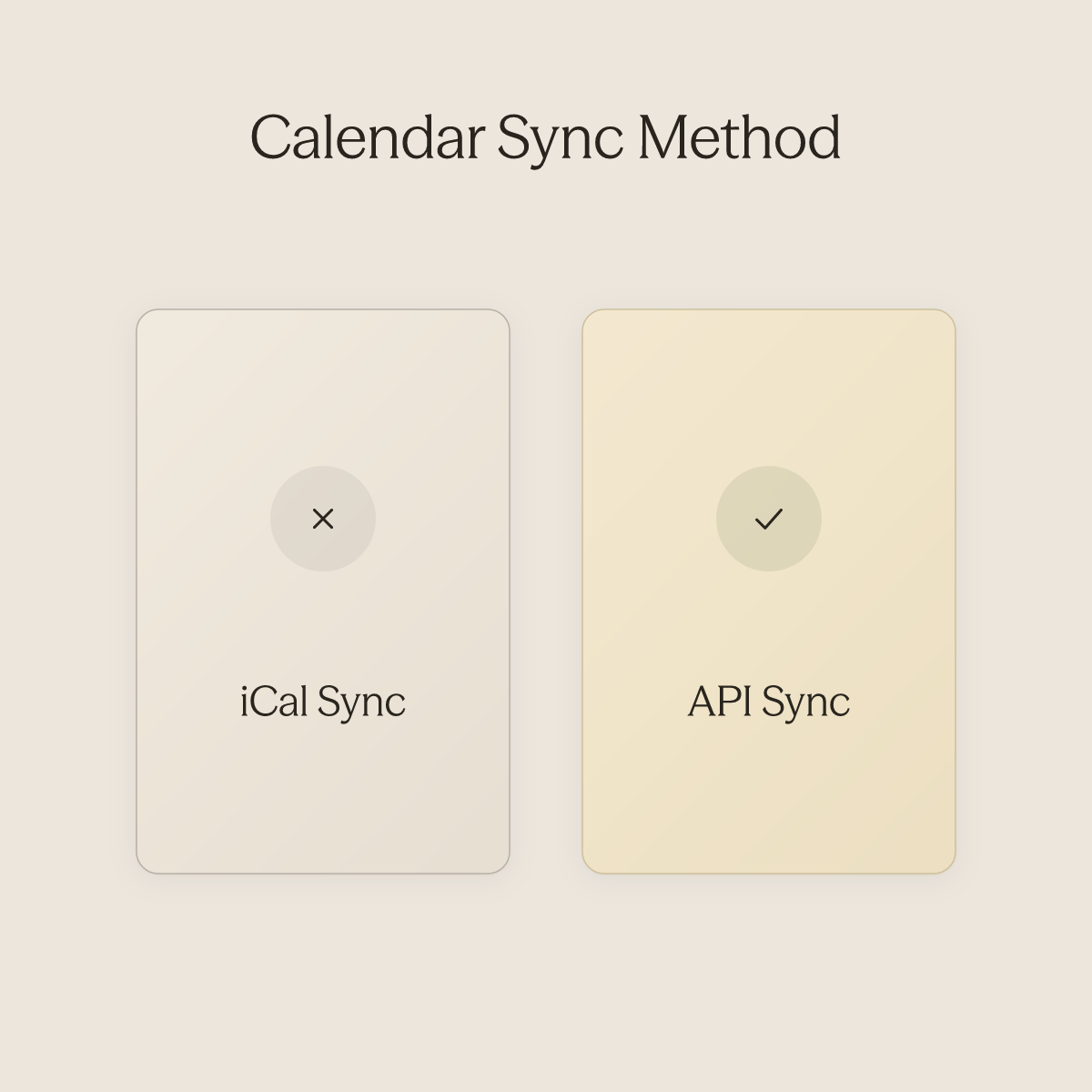
A channel manager keeps your calendars across Airbnb, Vrbo, and Booking.com synchronized in real time so that a confirmed booking on one platform immediately blocks those dates everywhere else. Without it, the gap between a booking confirmation and the next iCal refresh is exactly where double bookings happen. A double booking doesn't just inconvenience hosts; it triggers automatic negative reviews, financial penalties, and potential account suspension.
API-connected channel managers close that window entirely. iCal-based syncs do not. One pricing reality worth naming alongside calendar sync: hosts using a PMS are subject to Airbnb's fee model on their own terms.
When a guest extends a reservation directly on Airbnb, the platform applies its own fee structure regardless of any markup a host has baked into their PMS-adjusted rates, meaning hosts can absorb Airbnb's cut out of their own earnings without ever choosing to. That silent financial loss compounds across a growing portfolio, and it's one more reason the architecture of your channel integration matters as much as whether sync is happening at all.
Unified Inbox - One Dashboard for Every Guest Message
A unified inbox pulls messages from Airbnb, Vrbo, Booking.com, and direct channels into a single dashboard, so your team stops toggling between browser tabs to track who asked what. The operational benefit materializes most clearly at five or more properties, the point at which managing guest communications across multiple platforms simultaneously shifts from inconvenient to genuinely risky. A single missed thread at that scale turns into a 3-star review.
Response time connects directly to Superhost status; Airbnb measures it precisely, and guests notice the difference between a ten-minute reply and one that arrives the next morning. This is where Conduit's Inbox is most beneficial: when your operation has scaled to the point where no single person can monitor every channel in real time. The Inbox gives your operations or support team one place to monitor, review, and manage all conversations, including the ones the AI agent is handling, so nothing falls through the gap between platforms.
Dynamic Pricing Integration - Connecting Your PMS to Tools Like PriceLabs
A PMS with native dynamic pricing integration connects to tools like PriceLabs so that rates adjust automatically based on demand signals, local events, and competitor availability. The trade-off worth naming: dynamic pricing tools require a calibration period, and operators who walk away in the first 30 days often leave money on the table before the algorithm has enough local data to work well.
Pros and cons at a glance
| ✓ Pros | ✗ Cons |
|---|---|
| Rates adjust automatically based on demand signals and local events | Requires a calibration period before performing well |
| Connects PMS to tools like PriceLabs for dynamic pricing | Operators who leave in the first 30 days often leave money on the table |
Template-based automation and autonomous communication are not the same thing, and conflating them is the most expensive evaluation mistake a scaling operator makes. Scheduled templates handle anticipated messages, check-in instructions, WiFi codes, checkout reminders, and go silent the moment a guest sends something outside the queue. The most consequential PMS feature most hosts never evaluate is open API access to the messaging layer, not because it unlocks more templates, but because it determines whether an AI agent layer can ever be stacked on top.
The real scaling question is whether the platform's architecture allows a purpose-built AI to inherit context, read SOPs, and resolve unscripted conversations that templates structurally cannot touch. Conduit's AI Agents are designed specifically for this layer. They are most beneficial when your business receives a high volume of repetitive guest messages and already has existing documentation, SOPs, FAQs, property manuals, to train the agent on.
Critically, if that documentation already lives in tools like Notion or Google Drive, Conduit's Integrations pull from those sources directly, so there is no manual re-entry of content you have already written. Once connected, the AI agent delivers its first automated guest reply within days. From that point forward, it responds continuously, before, during, and after a stay, every time a guest sends a message, including the ones that land overnight or after hours when no one on your team is awake to catch them.
Conduit's Workflows layer on top of that, triggering automated guest touchpoints after booking confirmation, check-in, or when a specific keyword is detected, so the predictable moments in a guest lifecycle stop requiring manual staff action entirely. The result is a communication architecture that scales with your portfolio rather than against it.
13 Best PMS for Airbnb Hosts to Manage More in 2026
Six platforms into a PMS comparison, most operators realize the feature lists start to blur. Calendar sync, unified inbox, automated templates, every serious tool on this list does those things. The real question is which platform fits your portfolio size today, your growth trajectory in 12 months, and the communication gaps that surface at 3 AM when no one is watching the inbox. The 13 picks below are organized around that decision, not a spec sheet. Each is here for a specific operator profile. Read the tradeoff for each; that is where the real selection signal lives.
1. Conduit.ai - Best AI Guest Communication Layer for Airbnb Hosts
The gap every PMS leaves open is not calendar sync or owner reporting, it is the unscripted mid-stay conversation that no template sequence was built to handle. Most operators running 15 or more properties discover this six months after their PMS goes live: the unified inbox is full, templates are firing on schedule, and the operations lead is still fielding 40 guest messages a day. Conduit's hospitality-specific AI agents sit on top of whichever PMS you already use, reading your own SOPs and FAQs to handle those conversations end-to-end.
That is how Cash Flow Street, a 35-property portfolio, reached AI for hospitality, not by switching PMS platforms, but by adding the communication layer the PMS was never designed to replace. The AI agent layer earns its seat fastest when two conditions are both true:
- The portfolio already receives a high volume of repetitive guest messages.
- The operator has existing documentation, SOPs, FAQs, or property manuals, the agent can train on.
Without that documentation as a ground-truth source, the agent cannot generate contextually accurate replies and the automation rate will be materially lower.
2. Guesty - Best Enterprise-Grade PMS for Scaling Airbnb Portfolios
For large portfolios, typically 10 or more properties, Guesty delivers the most comprehensive all-in-one automation on this list. Its capabilities include:
- Multi-unit calendar management
- Owner financial reporting
- A robust open API
- Deep OTA integrations under one roof
The tradeoff is cost and minimum commitment; the per-listing fees are scoped to portfolios with the booking revenue behind them. Pick Guesty when your portfolio is already at scale, your team needs enterprise-grade reporting, and you can absorb a premium price in exchange for not stitching together five separate tools.
3. Hostaway - Best All-in-One PMS for Mid-Size Airbnb Operators
Hostaway is a preferred software partner with Airbnb, Vrbo, and Booking.com, which translates to deeper OTA integrations and faster sync reliability than most mid-market alternatives. For growth-focused operators scaling from 5 to 50 properties, that partnership tier matters: rate updates push faster, calendar blocks resolve cleaner, and channel-specific promotions are easier to manage. The platform covers automated messaging, task management, and a direct booking website in one subscription. The honest limitation is that Hostaway's messaging automation relies on scheduled templates, it handles known touchpoints well but hands unscripted guest conversations back to your team.
4. Hospitable - Best Beginner-Friendly PMS for New Airbnb Hosts
For the 1-to-3-property host who wants automation without a steep learning curve, Hospitable (formerly Smartbnb) is the clearest starting point. Its guest messaging automation is designed for Superhosts prioritizing fast response times and consistent communication quality, two factors Airbnb directly ties to Superhost status and search ranking. (Note: independent head-to-head benchmarks comparing Hospitable's response speed against alternatives are not publicly available; the response-time reputation rests largely on operator community feedback rather than verified third-party data, so testing during the trial period is the most reliable evaluation method.) The scope tops out around 10 properties, when the need for owner reporting, multi-channel distribution, and team task management moves past what Hospitable was designed to do.
5. OwnerRez - Best PMS for Airbnb Hosts Who Want Deep Reporting and Direct Bookings
OwnerRez is the power-user pick: direct booking website functionality, granular owner financial reporting, and workflow customization that experienced operators genuinely use. Hosts who have outgrown simpler tools and want to reduce OTA dependency find OwnerRez gives them the infrastructure to do it without hiring a developer. The tradeoff is a steeper setup curve: it rewards operators who invest time in configuration and asks more of those who want plug-and-play. If deep customization matters more than fast onboarding, this is the fit.
6. Hostfully - Best PMS for Versatile Property Managers Across Portfolio Sizes
Hostfully occupies a useful middle ground: built for operators at 10 to 30 properties, and priced for that band rather than for enterprise portfolios. Its digital guidebook feature is a genuine differentiator, reducing repetitive pre-arrival guest questions by surfacing property information before guests ask. The platform covers channel management, automated messaging, and owner reporting in a single interface. Operators who need highly customized reporting or complex multi-brand setups will need more than that band is scoped for.
7. Lodgify - Best Website-First PMS for Airbnb Hosts Building Direct Booking Channels
Lodgify is the clearest choice when reducing Airbnb fee exposure is the primary goal. Its direct booking website builder is purpose-built for operators who want a guest-facing brand presence, SEO control, and a commission-free reservation channel alongside their OTA listings, a focus that shapes where the platform invests its roadmap, though operators should verify current feature depth through the trial period before committing. The PMS layer covers calendar sync and basic automation, but Lodgify's real value is in the booking engine and website, not operational depth. Operators who need both will likely need a second tool.
8. Enso Connect - Best PMS Add-On for Centralizing Guest Messaging and Driving Upsells
Enso Connect is a guest experience layer rather than a full PMS replacement, and it is most useful when stacked on top of an existing operational system. Its guest portal centralizes messaging, digital check-in, and upsell opportunities, early check-out fees, mid-stay add-ons, local experience packages, in a single guest-facing interface. Its messaging AI handles FAQ-style interactions well but does not autonomously resolve complex mid-stay requests or maintenance escalations without a human in the loop. It is a strong upsell and check-in tool; it is not a full communication automation solution.
9. PriceLabs - Best Dynamic Pricing Engine for Airbnb Revenue Optimization
PriceLabs is not a PMS. It belongs on this list because no PMS's native pricing engine matches what a dedicated dynamic pricing tool delivers at scale. PriceLabs reads local demand signals, competitor rates, seasonality, and lead time to adjust nightly rates automatically, a function that materially affects revenue per available night for any portfolio above three properties. It integrates cleanly with Guesty, Hostaway, Hospitable, Uplisting, and most other platforms on this list. Operators who do not invest time in initial setup often leave the most impactful customizations unused.
10. Turno - Best Cleaning Operations Platform Integrated with Airbnb PMS Workflows
Guest communication quality depends partly on what happens between checkouts. Turno (formerly TurnoverBnB) automates cleaner scheduling, sends photo checklists, and syncs turnover tasks directly with Airbnb reservation calendars, removing the manual coordination that causes delayed check-ins and the negative reviews that follow. For operators managing 5 or more properties with rotating cleaning teams, Turno reduces the coordination overhead that otherwise falls on the operations lead. It is not a PMS; it is the operations layer that keeps the physical property ready so the guest communication layer has nothing to apologize for.
11. Tokeet - Best Budget-Friendly PMS for Multi-Channel Airbnb Hosts on a Tight Margin
Tokeet's pricing is its headline advantage: one of the most affordable multi-channel PMS options for hosts managing several properties across Airbnb, Vrbo, and Booking.com simultaneously. For operators who need calendar sync and a unified inbox without a large monthly commitment, Tokeet delivers the core functionality. The caution worth surfacing: support and plan changes are largely self-serve, which suits some operators and not others. If budget is the primary constraint and a self-serve support experience works for your team, Tokeet is a reasonable starting point, but test it thoroughly before committing to an annual plan.
12. iGMS - Best Automation-Focused PMS for Airbnb Superhosts Managing Multiple Accounts
Superhosts who have split listings across separate Airbnb profiles, for different brand identities, co-hosting arrangements, or ownership structures, find iGMS handles the consolidation cleanly. Its automated messaging and task management cover the core PMS functions, and the multi-account architecture is genuinely useful for operators in that situation. The platform is less competitive on owner financial reporting and direct booking infrastructure compared to OwnerRez or Hostfully.
13. Rentals United - Best Channel Manager for Airbnb Hosts Distributing Across 60+ OTAs
Rentals United is the right tool when distribution breadth is the constraint, not operational management. Connecting inventory to a large number of OTAs simultaneously, including niche channels most full-service PMS platforms do not reach natively, is Rentals United's primary differentiator; operators targeting specialty booking platforms or global markets should verify current channel availability directly with the vendor, as integration counts change with platform updates. For operators building occupancy across global markets or targeting specialty booking platforms alongside Airbnb, the channel reach justifies the added subscription.
Most operators using it pair it with a separate PMS, such as Smoobu or OwnerRez, for task management, owner reporting, and guest communication. Every platform above solves a different slice of the operational puzzle, but knowing which one fits your portfolio today is only half the decision. The other half is knowing which combination of tools will still hold as you add your next ten properties, which is exactly what the next section maps out.
Related Reading
- Vacation Rental Automation
- Best Pms For Short Term Rentals
- Best Accounting Software For Short Term Rentals
- How To Manage A Vacation Rental Property
- Vrbo Smart Pricing
- How To Automate Airbnb Business
- Airbnb Self Check In
- Vrbo Management
- Best Apps For Short Term Rentals
How to Choose the Right Airbnb PMS for Your Portfolio Size and Growth Stage
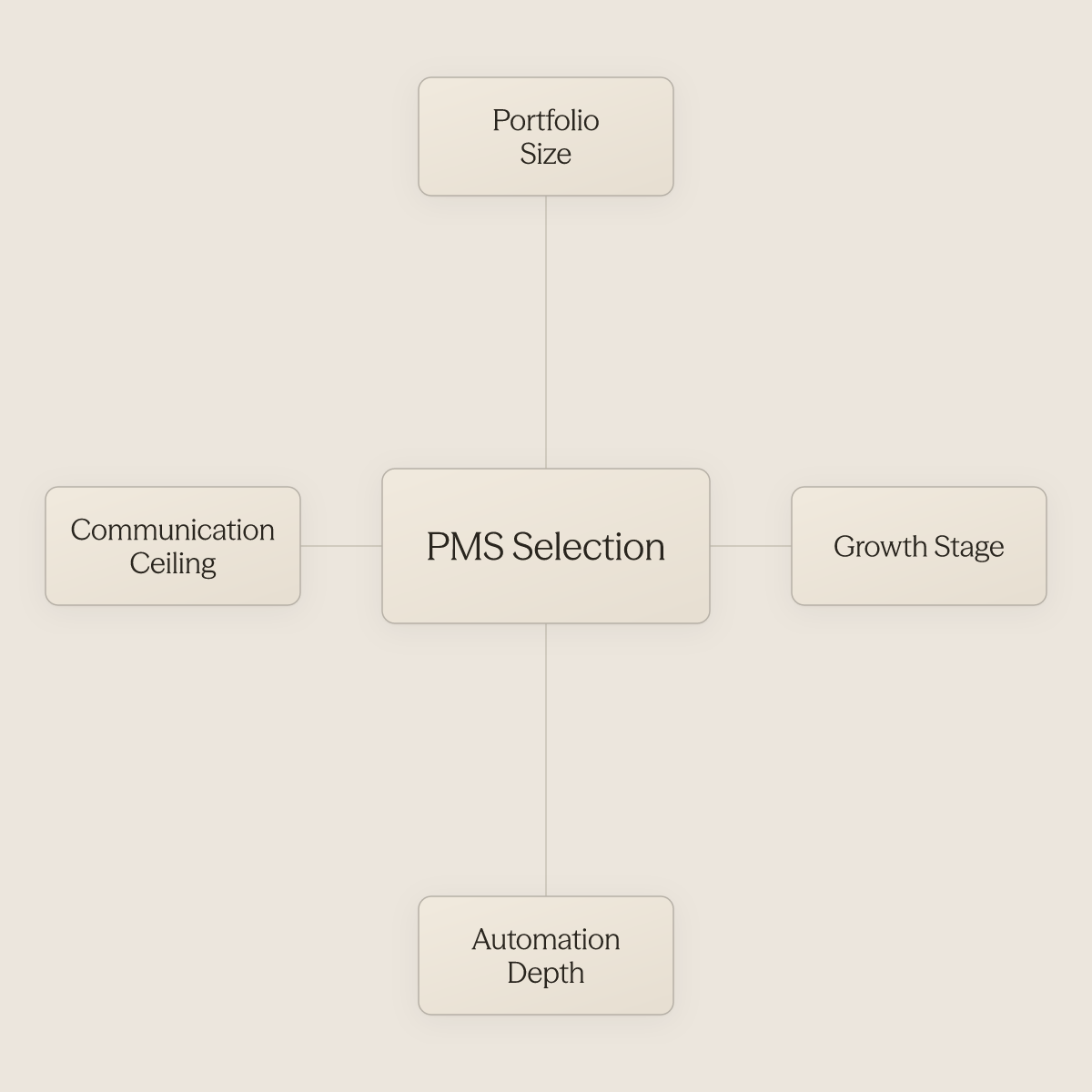
Choosing the right property management software depends on more than feature lists, portfolio size and growth stage together determine which platform will serve you now and which will become a ceiling later.
Airbnb PMS - Choosing by Portfolio Size and Growth Stage
Portfolio size tells you which PMS tier to start on. It doesn't tell you when you'll outgrow it, or what breaks first when you do. The sharpest operators treat portfolio size as one variable in a two-part equation, with the second variable being the communication ceiling their chosen platform will eventually hit.
Tier 1 (1 to 3 Properties): Prioritize Simplicity and Automation Depth
Feature count is a distraction at this stage. What matters is how deeply the platform automates the touchpoints you actually send every booking: pre-arrival instructions, check-in codes, checkout reminders, and review requests. A tool that executes those sequences reliably, without manual intervention, is worth more than one with forty integrations you won't use for two years.
Complexity at this tier creates maintenance overhead solo operators can't absorb. One thing beginners consistently underestimate: when Airbnb adjusts its fee model, most PMS setups offer no automatic recalibration of pricing strategy. Hosts are left manually reconciling platform fee changes against their listed rates, a gap that quietly erodes competitiveness.
This is a solvable problem, but only if the tools you choose from the start are designed to connect to existing content and platforms without manual re-entry. Conduit's Integrations layer addresses this directly: if you're already working out of Notion, Google Drive, or Airbnb itself, the AI agent pulls from that content without requiring you to rebuild anything from scratch.
Tier 2 (5 to 20 Properties): Evaluate Growth Platforms on API Openness, Not Just Channel Count
The failure point at this tier is almost never channel coverage; it's integration flexibility. An operator projecting 25 properties in 18 months who locks into a closed platform discovers too late that adding dynamic pricing or a guest communication layer requires an enterprise upgrade or a full migration. Before signing, ask specifically whether the API supports read and write access for guest message threads, not just calendar data.
This is also the tier where communication volume begins compounding faster than headcount can absorb it. The experience of operators like Easy BnB is instructive: 14 virtual assistants running 24/7 guest coverage, with 80% of that communication volume consisting of low-value, repetitive exchanges, questions about check-in, WiFi, and checkout timing. That labor model dragged margins and capped EBITDA, directly limiting exit valuation.
Staff reliability issues compounded the problem. The lesson isn't that you need more staff at Tier 2. It's that locking into a PMS without a clear path to an AI communication layer means you're building toward that same labor trap.
Conduit's AI Agents are most beneficial precisely at this inflection point: when incoming message volume is high, repetitive, and documentable, and when you have SOPs or FAQs that can train the agent within days of connecting your materials.
Tier 3 (20 Plus Properties): Enterprise PMS Criteria
Per-property pricing that looks reasonable at 10 listings can become a structural cost problem at 50. Operators who don't model the per-unit cost gap before signing annual contracts often face a renegotiation they weren't budgeting for. Annual lock-in before volume testing is one of the most common regret patterns among operators who scale past 20 properties.
Demand monthly billing or a volume-step pricing schedule before committing. At this scale, the staffing math becomes existential. Enabling rapid portfolio expansion without proportional growth in support headcount isn't a nice-to-have; it's the difference between a scalable business and one that's permanently labor-constrained.
The short-term rental market has grown significantly, and operators who reach 20-plus listings without solving the communication throughput problem find themselves unable to grow further without adding costly headcount at every step. Conduit's Inbox gives operations and support teams a single surface to monitor, review, and manage all conversations the AI agent is handling across every property and platform simultaneously, without scaling the team in proportion to the portfolio.
Does Your PMS Support an AI Communication Layer?
Every PMS tier was architected to reduce calendar, scheduling, and operational friction. None were designed to eliminate the human in the loop on guest communication. When a host crosses roughly 15 listings, two crises compound simultaneously: a PMS migration event and a communication throughput problem the new platform's native automation still cannot solve.
Hosts at this inflection point frequently misdiagnose the staffing problem as a PMS selection problem, switching platforms without fixing the actual bottleneck. The right framing, articulated clearly by operators who've been through this: AI-first is the right approach. The operators who try to build bespoke communication tooling on top of a PMS, or who rely on VA networks to fill the gap, consistently discover that purpose-built AI does it better, at lower marginal cost, and without the reliability risk of human shift coverage.
Conduit's Workflows layer is designed for exactly the recurring, predictable touchpoints that currently require manual staff action: triggered automatically after a booking is confirmed, after check-in, or when a specific keyword surfaces in a guest conversation. The first automated guest reply goes live days after connecting your existing SOPs and manuals, not weeks, and not after a lengthy onboarding process.
Red Flags That Signal a PMS Isn't Built to Scale With You
Use this checklist before signing any annual PMS contract:
| Signal | What It Means |
|---|---|
| No API write-access to guest message threads | You cannot stack an AI communication layer later without a full migration |
| iCal-only channel sync (no API connection) | Double-booking risk remains open; API sync is required for real-time reliability |
| Per-property pricing with no volume tiers | Cost compounds faster than revenue as you scale past 20 listings |
| No monthly billing option before annual commit | You are absorbing volume risk the vendor should share |
| Messaging automation limited to scheduled templates only | Unscripted guest conversations will always require a human in the loop |
| No native or partner dynamic pricing integration | Revenue optimization requires a separate tool and a manual sync |
If two or more of these apply to a platform you are evaluating, treat it as a signal to test a shorter billing cycle before committing. The growth trajectory of the Airbnb market means the operators who solve the communication ceiling problem early, rather than retrofitting a fix after a painful migration, are the ones positioned to scale the portfolio without proportionally increasing headcount.
The Communication Layer Your PMS Can't Replace: and How AI Agents Fill It
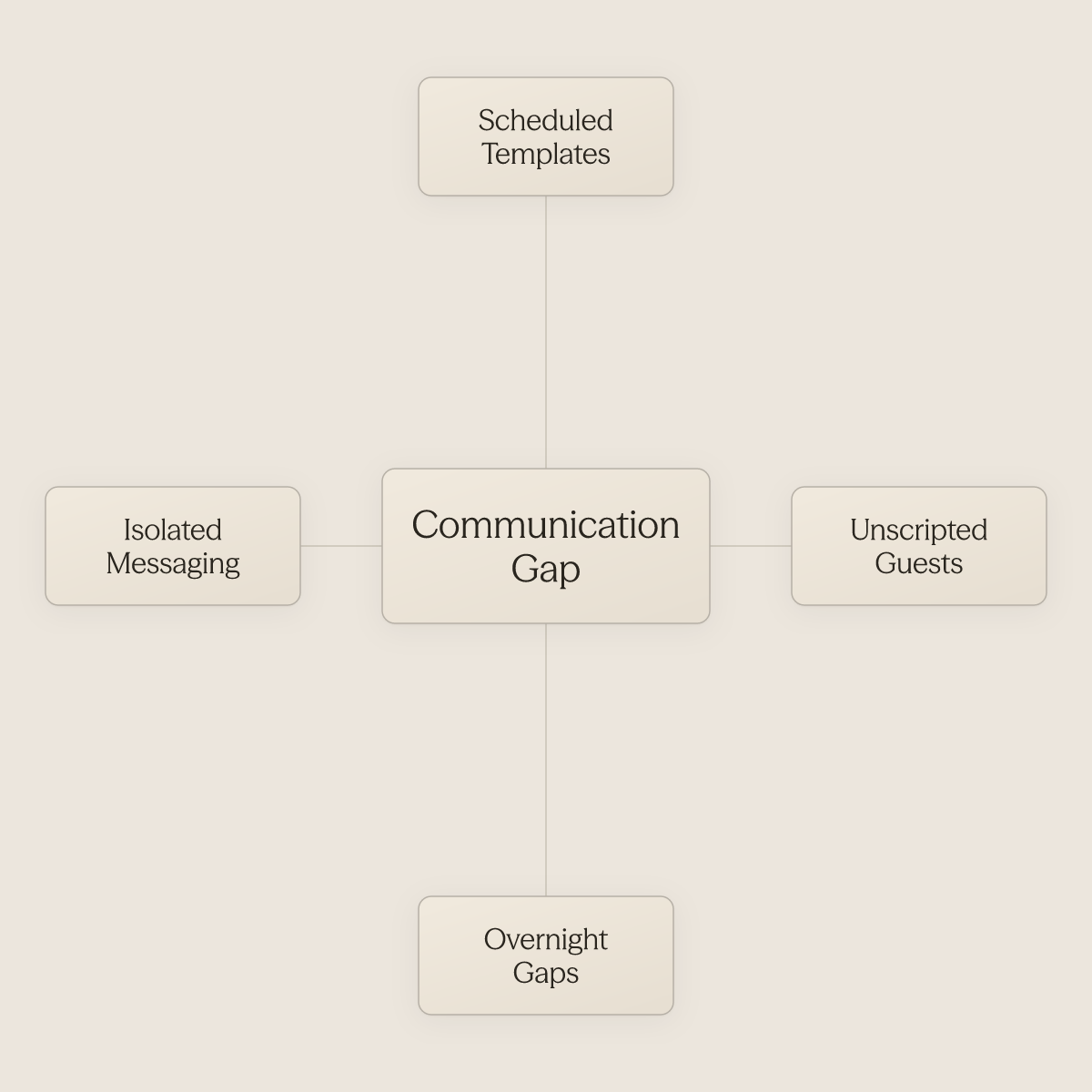
Every PMS in this comparison organizes the predictable moments. Check-in instructions go out on schedule. Review requests fire automatically. Pre-arrival reminders land without anyone touching a keyboard. But the conversations that actually move your review score, a guest locked out at 11 PM, a mid-stay noise complaint, an unscripted parking question, arrive outside every template sequence, often overnight, and sit unanswered until someone wakes up.
Why Scheduled Templates Break Down on Unscripted Conversations
The gap isn't a flaw in the PMS you chose. It's structural. Scheduled automation is built for known moments; it cannot read a guest's context, interpret an ambiguous request, or pull from your house manual to answer something it wasn't pre-programmed for.
Operators managing 15 or more properties consistently find that the inbox goes quiet on templates and loud on everything else, and that "everything else" is exactly what Airbnb guests remember when they leave a star rating. There is a second, less-discussed failure mode: PMS platforms handle guest messaging in isolation. An AI layer that only replies to guests without connecting to operational workflows, cleaning tasks, channel updates, or owner reporting is effectively disconnected from the business it is supposed to support.
Operators who have experienced this describe the communication layer as little more than a wrapper, useful for surface-level replies but unable to act on the operational context that makes a response genuinely helpful. This is the bottleneck Conduit is built to eliminate, not just by automating guest communication across multiple properties, but by connecting that communication to the workflows and documentation your operation already runs on.
What an AI Agent Does That a Template Sequence Cannot
A hospitality AI agent doesn't fire on a schedule. It reads the guest's actual words, cross-references the operator's SOPs and FAQs, and responds with a contextually accurate reply, in under a minute, at 2 AM, across SMS, WhatsApp, and email simultaneously. The critical condition: this only works when the operator already has documented SOPs, manuals, or FAQs the agent can train on.
Without that documentation, the agent has no ground truth to draw from. Conduit's AI Agents are most beneficial when a business receives a high volume of repetitive guest messages and already has existing documentation, SOPs, FAQs, property manuals, to train the agent on. Once those materials are connected, operators typically see their first automated guest reply within days of onboarding.
From that point forward, the agent responds continuously, whenever a guest sends a message, whether before, during, or after a stay. For operations with specific brand standards, escalation policies, or complex multi-property setups that require differentiated agent behavior, this is where the compounding value becomes most visible: the agent isn't applying a generic script; it's operating from your documented standards at scale. Conduit's Integrations component directly addresses the isolation problem.
Businesses that already use tools like Notion, Google Drive, or Airbnb can connect existing content without manual re-entry, so the agent draws on accurate, up-to-date operational context rather than a static knowledge base that drifts out of sync. Meanwhile, Conduit's Inbox gives the operations or support team a single place to monitor, review, and manage every conversation the AI agent is handling across multiple platforms and properties simultaneously, making it practical to maintain oversight without restoring the manual workload automation was meant to eliminate.
Real Operator Numbers
Three operator outcomes illustrate what the AI communication layer delivers at scale:
- AI for hospitality using Conduit's AI agent layer stacked on their existing PMS, without adding headcount.
- Wynwood House reported reducing guest resolution time from 15 minutes to 3 minutes across 7 countries; their Global Head of Customer Experience noted internally that guests rarely flagged replies as automated, an outcome worth validating through your own trial period, since voice-matching depends heavily on the quality of SOPs the agent is trained on.
- Easy BnB reported $22,000 per month in avoided labor costs across 75 units with zero new hires after shifting overnight and daytime messaging to the AI layer.
When an AI Communication Layer Delivers ROI, and When It Doesn't
The Cash Flow Street and Easy BnB outcomes point to a specific insight that no PMS vendor will surface in their own marketing: at 35 or more properties, an AI agent layer stacked on top of a PMS delivers compounding returns, faster guest resolution, higher review scores, recovered revenue from overnight inquiries that would otherwise go unanswered, and a meaningful reduction in operational overhead. Conduit's Workflows component handles the recurring, predictable touchpoints, firing after a booking is confirmed, after check-in, or when a specific keyword is detected, so that the AI Agents layer can focus on the unscripted, high-stakes moments that templates were never designed to catch. But the ROI is conditional.
It materializes only when the PMS beneath the agent provides the API access, SOP-ingestion capability, and real-time messaging hooks the agent needs to operate with accurate context, and only when the operator has documented the brand standards, escalation policies, and property-specific rules the agent must reflect. Conduit is most beneficial for businesses with complex multi-property operations that require differentiated agent behavior precisely because those operations have the documentation depth to unlock the full automation rate. Without that foundation, the automation rate drops and the guest experience gains disappear with it.
Related Reading
- Lodgify Competitors
- Vrbo Automated Messages
- Guesty Alternatives
- Lodgify Vs Smoobu
- Guesty Vs Hostfully
- Ownerrez Vs Guesty
- Hospitable Vs Hostaway
- Guesty Vs Hostaway
- Guesty Vs Hospitable
Next steps
If your inbox fills faster than your team can clear it as you add properties, the path forward starts with separating what your PMS was built to do from what it was never designed to handle. Scheduled templates cover the predictable moments. They go silent on everything else.
Open API access to the messaging layer determines whether an AI agent can ever sit on top of your PMS and inherit the context it needs to resolve unscripted conversations, which means selecting a PMS based on native automation quality sets a ceiling, not a floor. And as the Cash Flow Street and Easy BnB outcomes show, the ROI from an AI agent layer only materializes when the PMS beneath it provides real-time messaging hooks and the operator already has documented SOPs to train on. Together, those two conditions point to one concrete next step: mapping an AI communication layer to the PMS you have already chosen, using the documentation you have already written.
Start by exploring AI for hospitality at conduit.ai, where Conduit's agents connect to your existing SOPs, FAQs, and property manuals to handle unscripted guest conversations end-to-end, across every channel, without adding headcount or switching platforms.
Frequently Asked Questions
Does a PMS actually handle guest messages automatically, or does someone still have to reply?
A PMS automates scheduled, predictable messages, check-in instructions, WiFi codes, checkout reminders, but goes silent the moment a guest sends something outside those templates. Unscripted questions, mid-stay issues, and overnight messages still land in an inbox waiting for a human to read and reply. An AI agent layer like conduit.ai sits on top of your existing PMS to handle those open-ended conversations end-to-end, including ones that arrive at 2 a.m.
How does dynamic pricing actually work inside a PMS, and is there a catch?
A PMS with dynamic pricing integration connects to tools like PriceLabs so that rates adjust automatically based on demand signals, local events, and competitor availability. The catch the post flags is a required calibration period, operators who disconnect within the first 30 days often leave money on the table before the algorithm has enough local data to perform well.
At what portfolio size does managing guest messages manually actually break down?
The post points to five or more properties as the threshold where a unified inbox stops being convenient and starts being operationally critical, a single missed thread at that scale can turn into a 3-star review. By 15 to 20 listings, daily message volume stops being a communication task and becomes a full-time job, with operators spending 20 or more minutes per booking on routine exchanges like WiFi passwords and parking instructions.
Why does slow or inconsistent guest messaging hurt my Airbnb ranking, not just my reviews?
Airbnb requires a 90% or higher response rate within 24 hours to qualify for Superhost status, and its guidance confirms that response time directly affects search ranking and booking conversion. The post describes this as a revenue problem that compounds silently, booking by booking, until the review score reflects it, meaning the overnight gap costs money even when no guest explicitly complains.
What should I actually check when evaluating whether a PMS can support AI-powered guest communication later?
The post identifies open API access to the messaging layer as the most consequential feature most hosts never evaluate, not because it unlocks more templates, but because it determines whether an AI agent can ever be stacked on top. The architecture question is whether the platform allows a purpose-built AI to inherit context, read your SOPs, and resolve unscripted conversations that templates structurally cannot touch.
Stay in the loop
Get the latest on AI automation, product updates, and customer stories.


