13 Best PMS for Short Term Rentals in 2026


PMS for Short Term Rentals
Compare the best PMS for short term rentals
Picking the wrong PMS doesn't just slow you down, it traps you. Here is how to match your platform to your portfolio size before the switching costs make the decision for you.
A property management system (PMS) is the operational skeleton of a short-term rental business. It connects bookings, guest data, calendars, task triggers, and owner reporting inside one platform. Most vacation rental property managers and operations leads think the solution to messaging complexity is choosing a PMS with better native automation, smarter templates, more triggers, or a slightly fancier unified inbox, because all messaging complexity should be solvable inside one platform. See our AI for hospitality for how this works in practice.
Understanding the gap between what a PMS does and where its capabilities stop is the prerequisite for every platform decision that follows. The vacation rental software market is growing, driven by operators who need booking management, channel distribution, guest communication, and reporting unified in one system rather than spread across disconnected point solutions. A 5-property operator running a basic channel manager alongside manual spreadsheets illustrates the gap: the channel manager prevents double bookings, but it cannot trigger a cleaning schedule after checkout, generate an owner statement at month-end, or centralize guest messages from three OTAs into one view.
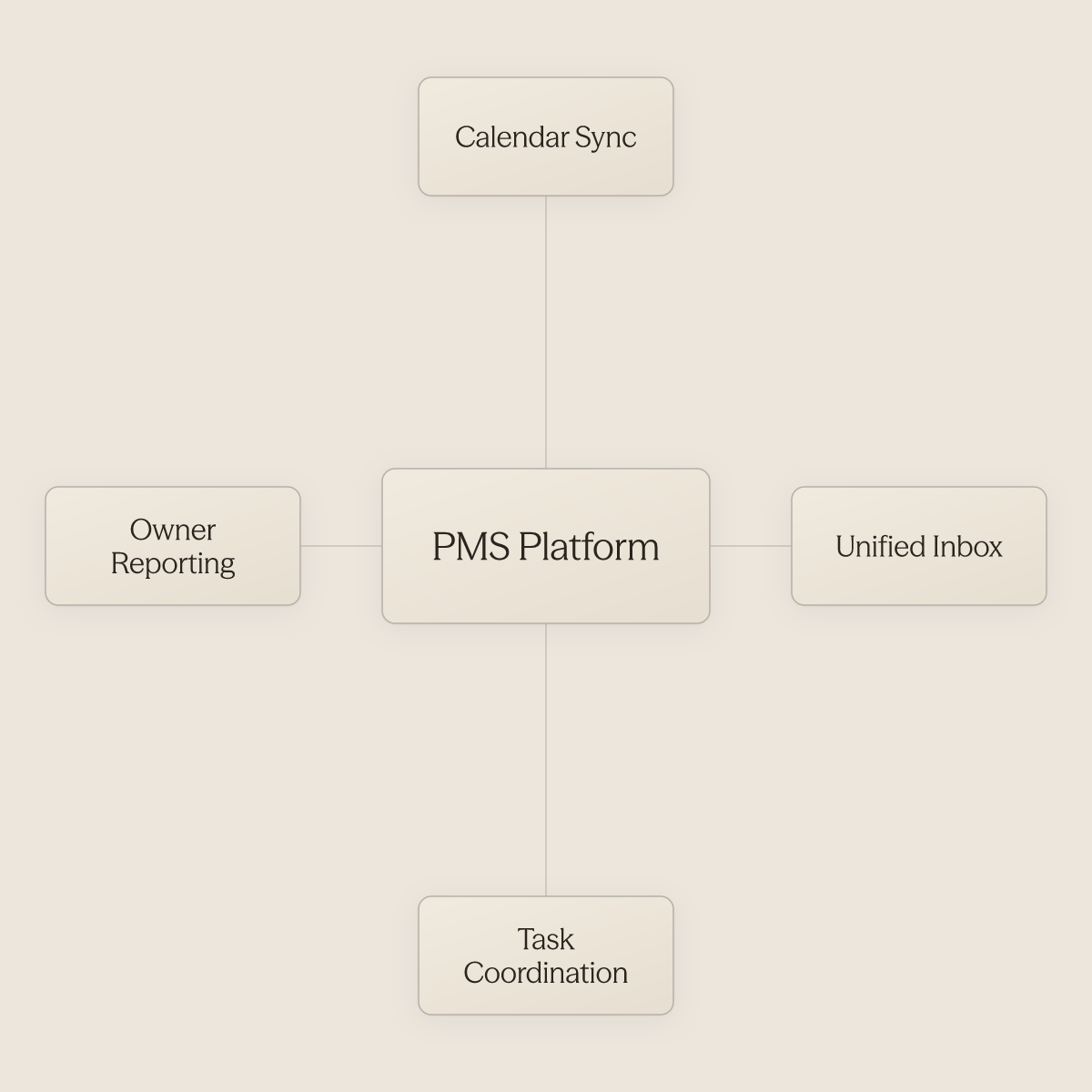
That gap is exactly where a full PMS earns its place. A well-built PMS handles five distinct operational functions: real-time calendar and booking sync across every channel; a unified inbox so no inquiry gets missed; task coordination that triggers cleaning assignments at checkout without manual handoff; automated owner statements that remove the monthly spreadsheet scramble; and direct booking support that captures reservations outside the OTA fee structure. Each function compounds.
An operator running 10 or more properties without all five in place is carrying invisible operational debt. Most operators, including those managing Airbnb listings alongside other channels, accept the PMS as the ceiling of their automation stack. The PMS delivers the operational data layer.
11.1% Annual growth rate of vacation rental software market
Key takeaways
- A PMS is the operational skeleton of an STR business, bookings, calendars, task triggers, owner reporting, but it is not the ceiling. The ceiling is what happens when a guest messages at 11pm and the platform goes quiet.
- Portfolio size is the wrong primary filter for PMS selection. The real calculation is operational risk: which platform breaks down first as unit count climbs, and what does that breakdown cost in staff time and guest experience?
- Every serious PMS in 2026 ships a unified inbox, real-time two-way channel sync, calendar management, and automated messaging. The question is whether those features hold under load or collapse into workarounds at scale.
- Pricing models, per-unit, flat fee, booking percentage, are built around predictable inputs. They cannot price in the operational drag that accumulates when a platform's limitations require manual compensation.
- Dynamic pricing, cleaning coordination, smart access, and accounting integrations are what turn a PMS from a static skeleton into a running operation. Operators who skip that wiring usually discover the cost after they've grown past five or six properties.
- PMS automated messaging is a scheduling tool, not a communication layer. It fires templates on triggers. It cannot read context, handle edge cases, or respond to a panicked guest mid-stay without a human in the loop.
- Conduit's AI Agents close that gap by reading directly from a host's SOPs, manuals, and FAQs to handle guest conversations across channels, autonomously, without human intervention. Erwan Le Roy's 35-property operation hit a 96% AI automation rate and sub-1-minute response times after 18 months, without adding headcount.
How to Choose the Right PMS Based on Portfolio Size: 1–3 Properties vs. 20+ vs. 100+
Choosing the Right PMS by Portfolio Size
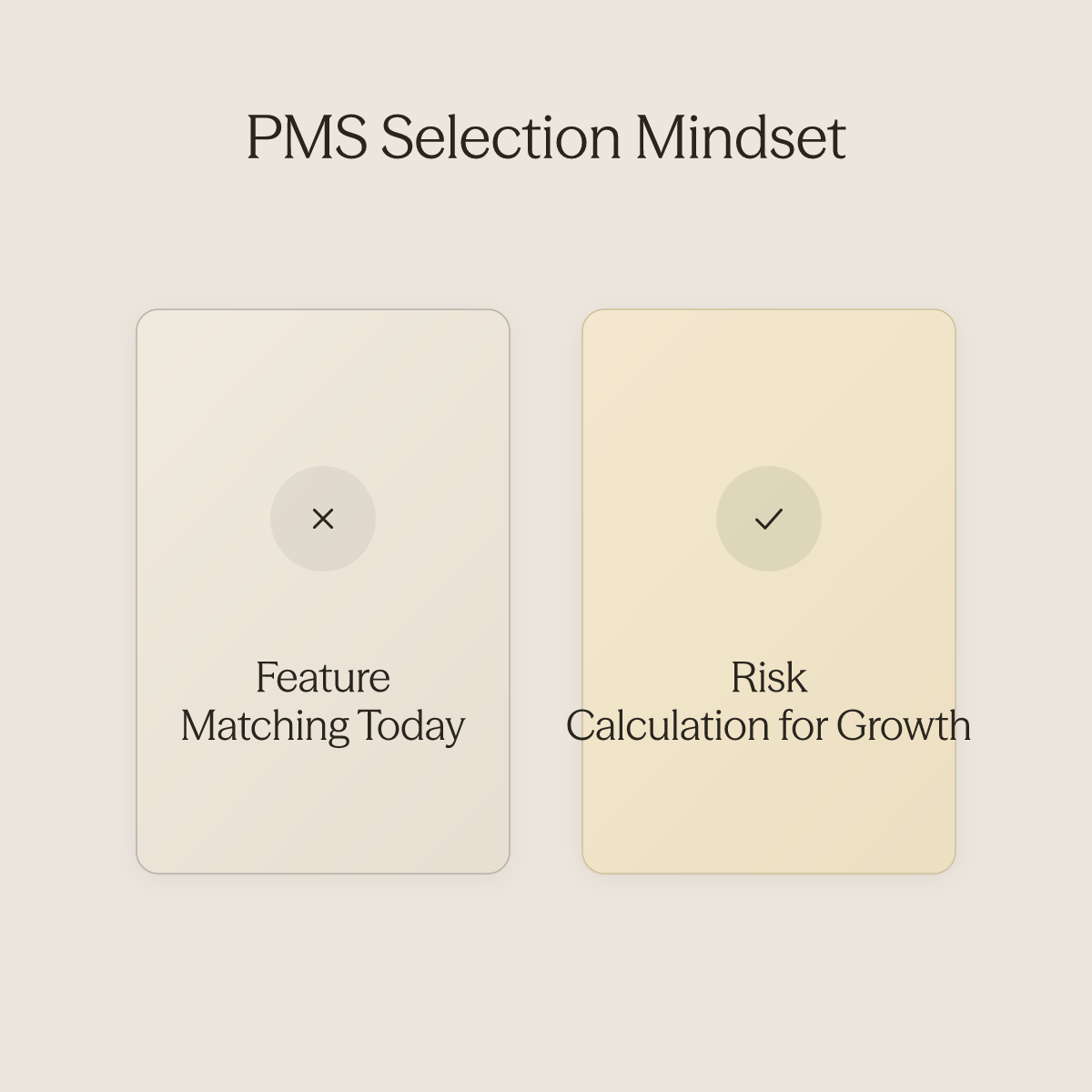
Portfolio size shapes every meaningful PMS decision, from pricing structure and automation depth to the cost of switching when you outgrow a platform. Most vacation rental property managers and operations leads believe that portfolio size is the primary factor determining which PMS fits their operation, and they treat the selection process as a feature-matching exercise rather than a risk calculation. The real question is not "what do I need today" but "what will it cost me when I outgrow this platform in 18 months." That cost calculation now has a second dimension that did not exist three years ago: whether your operation runs on AI or runs against it.
As Erwan Le Roy of Cash Flow Street puts it, "Right now you don't have an option anymore. We see a divergence of hosts now: the hosts that use AI and the hosts that don't use AI. If you compete human versus AI, I'm sorry, you lost the game.
It's not an option anymore." PMS selection, then, is not just about features; it is about whether the platform you choose positions you on the right side of that divide.
If you compete human versus AI, I'm sorry, you lost the game. It's not an option anymore.
1–3 Properties - Simplicity, Low Cost, Exit in Mind
For operators at this stage, the right PMS is the one you will actually use. Entry-level platforms with clean interfaces, basic channel sync, and flat pricing make sense here. The trap is treating simplicity as permanent.
They feel fine at three properties and become a liability at twelve. Choose a platform that exports your data cleanly, because you will eventually need to move it somewhere else. The friction starts earlier than most operators expect.
Small landlords at this stage typically begin with makeshift tools, Google Sheets, shared Drive folders, a color-coded calendar, and those systems feel adequate until the second or third property exposes every seam. A missed cleaning trigger, a double-booking, a guest message that slipped through a tab: these are not random failures; they are structural ones baked into tools that were never built for hospitality operations. AI earns its keep even at small scale.
AI Agents are most beneficial when a business has existing documentation, SOPs, FAQs, check-in manuals, and wants to stop re-answering the same questions manually. Connecting those documents takes days, not months, and the first automated guest reply follows shortly after. At one to three properties, that is not a luxury; it is the foundation that keeps your informal systems from becoming a liability the moment you sign a third management agreement.
10–30 Properties - Automation Depth and Owner Management
At this tier, the feature gaps that seemed minor become operational bottlenecks. Owner statements, automated task triggers, and multi-property reporting are no longer nice-to-have. Operators scaling past 20 units need reliable automation depth and owner-management capabilities, not simply more messaging templates.
The deeper problem at this tier is coordination headcount. The instinct is to hire, another operations coordinator, another guest-communications specialist, but headcount scales linearly while revenue does not.
The operators who avoid that trap are the ones who add properties without adding coordination headcount, scaling the portfolio without proportionally increasing the staff required to run it. AI Workflows are built for exactly this inflection point: they fire automatically after trigger events, a booking confirmed, a check-in completed, a specific keyword detected in a guest message, so the recurring, predictable touchpoints that currently require a staff member to act on them simply happen. The Inbox layer sits on top, giving your operations or support team a single place to monitor and manage every conversation the AI agent is handling across all properties simultaneously, without toggling between platforms.
100+ Properties - Enterprise Channel Coverage and API Flexibility
Enterprise-scale operators need API access, webhook support, and custom reporting pipelines that mid-market tools do not offer. What separates enterprise PMS from mid-market tools is not the number of integrations listed on a features page; it is whether those integrations hold under volume without manual intervention. At this scale, portfolios run across Airbnb, Vrbo, Booking.com, and direct-booking channels simultaneously, and the only way to maintain response quality without a proportionally larger team is to let AI handle the first layer of every conversation.
AI integrations are most beneficial precisely here: when the business already uses tools like Notion, Google Drive, or Airbnb and wants the AI agent to draw on that existing content without requiring manual re-entry every time a policy changes or a new property is onboarded. The portfolio scales; the coordination headcount does not have to.
The Switching-Cost Trap
Migration fear keeps operators locked into the wrong platform longer than any contract clause does.
The RentalReady switching guide and Hostaway's migration analysis both document the same pattern: operators know the platform is wrong for their current scale, but the prospect of rebuilding automations, re-entering property data, and re-syncing OTA listings mid-season keeps them frozen. Every month they delay, the migration grows more complex.
Key takeaway: A platform that traps your guest-communication history, your SOP documentation, and your automation logic in a proprietary format is not just an operational inconvenience; it is a competitive liability in an industry where hosts running AI-assisted operations are pulling ahead of those running human-only ones.
Choose infrastructure that lets you add properties without rebuilding your communication stack from scratch each time the portfolio outgrows another tier.
Non-Negotiable Core Features Every Short-Term Rental PMS Must Have in 2026
Four features separate a PMS worth buying from one that creates new problems as your portfolio grows. Every serious platform ships all four. The question is whether those features are built to the standard your operation requires, or whether they're checkbox items that break down once you're managing 15 or more properties across three OTAs simultaneously. The four features are:
"Manually coordinating guest messaging, cleaning tasks, and calendar updates across platforms eats up several hours per week, a core operational burden a PMS must eliminate."
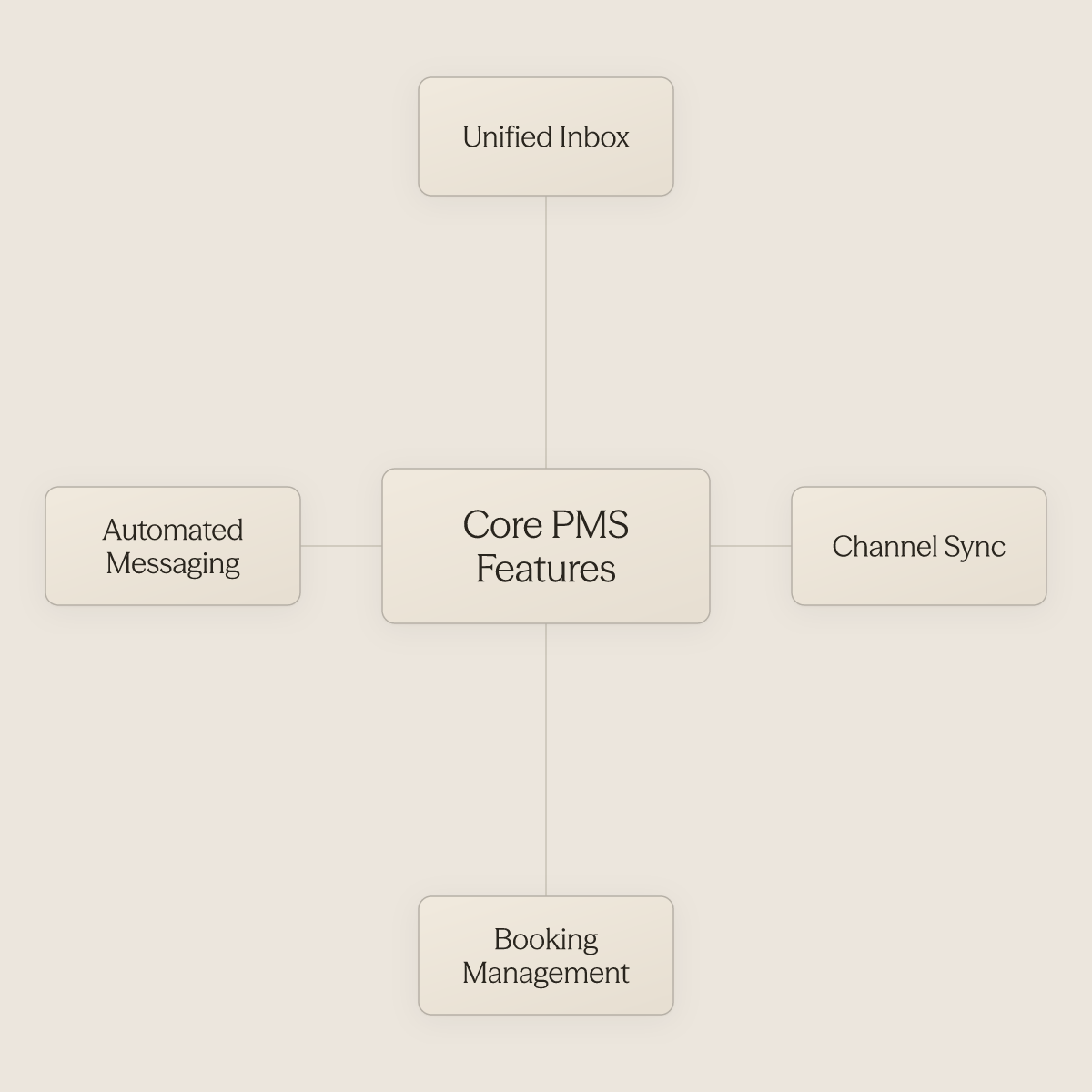
- A unified inbox
- Real-time two-way channel sync
- Booking and calendar management
- Automated messaging
A Unified Inbox, and What "Unified" Must Actually Mean
A unified inbox for vacation rentals is non-negotiable, but the word "unified" does real work here. It means every message from every OTA, Airbnb, Vrbo, and Booking.com, lands in one interface with full conversation history, guest details, and booking context attached. Anyone who has managed five properties across separate dashboards knows the alternative: triple-checking three apps per inquiry, losing context mid-conversation, and watching response times slip. Platforms like Conduit's guest communication layer are built specifically around this consolidation need, pulling context into a single view rather than forcing your team to reconstruct it each time.
Real-Time Two-Way Channel Sync: the Only Acceptable Standard
Real-time two-way channel sync is the feature that prevents double bookings, and "real-time" is the operative phrase. OTA growth is accelerating again, meaning operators distributing across multiple channels face increasing synchronization complexity. iCal-based sync, which many platforms still use as a fallback, introduces lag measured in hours. It may not block the Vrbo calendar until morning, and that gap is where double bookings happen, one of the most damaging failures a growing portfolio can suffer. The standard for calendar management in 2026 is API-level, two-way sync with each major OTA.
As Lighthouse's research notes, capitalizing on OTA demand signals requires adjusting availability, pricing, and minimum-stay rules in real time across channels, impossible through a sync method that polls on a delay. Relying on iCal at any meaningful portfolio size is a structural risk.
Automated Messaging, What It Solves, and Where It Stops. Template-based systems handle predictable moments well:
- Pre-arrival instructions
- Check-in codes
- Checkout reminders
- Post-stay review requests
The 13 Best PMS for Short-Term Rentals in 2026 - Ranked by Who They're Actually Built For
Most operators fixate on the export file when they start evaluating a new PMS: how cleanly the reservation history moves, whether the rate plans transfer without manual rebuilding, how long the calendar stays dark during cutover. That anxiety is legitimate but misplaced. Data migrations, even messy ones, resolve in days or weeks. The cost that lingers for months, sometimes years, is the one nobody quotes in the sales call: the retraining load on your staff, the muscle memory your team built around a specific workflow, and the guest-facing disruption.
Channel sync is table stakes. It connects to Booking.com, pushes availability in real time, and prevents double bookings. The real question is what happens after the booking lands: who answers the guest at 11pm asking for the WiFi password, what happens when a check-in question comes in on Christmas morning, and how many of those conversations your team is still handling manually at property number 25.
The six platforms most frequently cited in industry operator comparisons each solve a distinct version of that problem. Guesty is best for large portfolios (100+ properties) and scaling operations; Hostaway is best for growing property managers who need robust channel management; OwnerRez is best for flexibility and detailed reporting; Hospitable is best for automation-first small-to-mid-sized hosts; Lodgify is best for building direct booking websites with branding control; and Smoobu is best for smaller hosts who want simple, fixed-price software. Every platform entry below closes with a communication ceiling note: the portfolio size at which PMS-native messaging typically stops being enough.
Before evaluating any platform on this list, one structural insight should reframe how you read every feature comparison that follows. Migration lock-in, the fear of switching PMS platforms that keeps operators on tools they have outgrown, is not primarily a data-migration risk; it is a false constraint manufactured by treating the PMS as the system of record for guest communication. Operators who treat a purpose-built AI coordination layer as the primary home for guest communication logic, rather than rebuilding that logic inside each PMS they migrate to, carry far less switching risk, because automation rules, SOP training, and conversation context live in the communication layer rather than inside the PMS.
The PMS still owns its core function as the operational data layer; the point is that the two layers can now evolve independently. That reframe matters for every platform comparison below: the question is not which PMS you can afford to be locked into, but which PMS best serves your operational data needs once communication is handled elsewhere.
1. Conduit.ai - Best AI Guest Communication Layer for Any STR Stack
Conduit.ai appears in this list not as a PMS replacement but as the communication layer designed to address the messaging ceiling every other platform on this list eventually encounters. Its AI for hospitality platform deploys autonomous AI agents that read your SOPs, FAQs, and property manuals to answer guests accurately, across channels, around the clock, without routing every edge case to a human. The benefit is most pronounced once a portfolio exceeds 15 properties and incoming message volume starts consuming team bandwidth on routine inquiries.
One operator reduced guest resolution time from 15 minutes to 3 minutes after consolidating communication into Conduit's unified inbox; another pushed the vast majority of overnight messaging to Conduit's AI without adding a single hire. The honest trade-off: setup requires existing documentation (SOPs, FAQs, property guides) to train the agent on, so operators without structured internal docs will need to build that foundation first. Communication ceiling: none, by design.
2. Guesty - Best Enterprise PMS for Scaling Multi-Property Operators
Guesty connects to Booking.com through direct integrations that, for most portfolios at this scale, eliminate the need for a separate standalone channel manager. Its tiered structure is deliberate: Guesty Lite covers 1–3 listings, Guesty Pro covers 4–199, and Guesty Enterprise is built for 200+ unit operations. The AI-powered guest messaging suite and native payment processing make it a genuinely all-in-one stack for large operators.
The real trade-off is onboarding complexity and cost: operators coming from simpler tools report a longer learning curve, and pricing scales with portfolio size. Guesty is built for operators who need enterprise-grade channel coverage and API flexibility; under 30 units, that depth is usually more than the operation calls for. Communication ceiling: Guesty's AI messaging handles templated sequences well, but autonomous resolution of unscripted guest inquiries typically requires a dedicated communication layer past the 30-property mark.
3 min Guest resolution time after switching to Conduit
3. Hostaway - Best All-in-One PMS for Growing Mid-Size Portfolios
Hostaway is the platform operators most often land on when they have outgrown a simpler tool and are not yet ready for Guesty's complexity or price point. Its all-in-one structure combines channel management, automated guest communication with customizable templates, and a direct booking engine, with a well-documented open API that supports deep PriceLabs integration for dynamic pricing across 40+ units. The platform's strength is breadth: it handles the 10–100 property range without requiring operators to stitch together multiple point solutions.
The honest limitation is that Hostaway's automated messaging is template-driven; it handles predictable sequences well but cannot resolve novel guest questions without human review. Communication ceiling: template automation starts showing strain around 20 properties, when inquiry variety outpaces what pre-built triggers can cover.
4. Hospitable - Best Beginner-Friendly PMS for Solo Hosts and Small Portfolios
Hospitable is built for the operator who wants automation without configuration overhead: connect your listings, set your message templates, and the platform handles the routine communication sequence from booking confirmation through review request. Its AI-powered messaging automation is genuinely strong for 1–10 listings, and the interface is built to be approachable for first-time PMS users. The ceiling is structural rather than a flaw.
Operators who grow past 15–20 properties consistently report hitting limits in owner management, financial reporting depth, and the ability to handle the volume and variety of guest inquiries a larger portfolio generates. The platform that felt like a relief at 8 properties starts to feel constraining at 18, particularly around owner statements and multi-property reporting. Communication ceiling: approximately 15 properties, after which message variety and owner-management complexity typically push operators toward a more configurable platform.
5. OwnerRez - Best PMS for Data-Driven Operators Who Need Deep Reporting
OwnerRez earns consistent praise from operators who care about financial control: owner statements, trust accounting, detailed booking reports, and property-level performance tracking. It is the platform independent managers most often choose when managing properties on behalf of owners and needing audit-ready reporting. The trade-off is that OwnerRez lacks a native pricing engine and built-in payment processor, so operators need to integrate PriceLabs or Wheelhouse for dynamic pricing and connect a payment solution separately.
Real operator reviews highlight that OwnerRez's communication tools are adequate for straightforward sequences but require manual handling for anything outside the template logic. Best for operators in the 5–50 property range who prioritize financial transparency over communication automation. Communication ceiling: the messaging layer typically requires augmentation past 20 properties.
6. Hostfully - Best PMS for Versatile Mid-to-Large Portfolio Management
Hostfully combines property management operations with guest experience tools, including digital guidebooks that reduce inbound questions before they become support tickets. For operators in the 10–100 property range who want a single platform covering operations, guest communication sequences, and owner reporting without enterprise-level complexity, Hostfully is a credible option. Like most platforms on this list, its messaging workflows are template-driven rather than contextually aware.
The limitation operators most frequently cite is that automation depth is solid for mid-size portfolios but starts to feel rigid when inquiry volume grows and guest questions move outside the pre-built sequence logic. Communication ceiling: template-based messaging holds up to roughly 20 properties; past that, the gap between what guests ask and what the automation can answer widens noticeably.
7. Lodgify - Best PMS for Operators Who Want a Built-In Direct Booking Website
Lodgify's core differentiation is its built-in website builder: operators get a direct booking site with integrated reservation management, calendar sync, and OTA connectivity in one package, reducing reliance on OTA commissions from day one. For operators building a brand around their portfolio rather than purely listing on OTAs, that bundling is a head start. The honest trade-off is that Lodgify has no native pricing engine, so dynamic pricing requires a third-party integration, and the communication automation is scoped for smaller portfolios rather than deep custom logic.
It is the right pick for operators who want branding control and direct booking capability without enterprise complexity; it is not the right pick for operators whose primary goal is deep automation across a large multi-channel portfolio. Communication ceiling: messaging automation is adequate for portfolios up to around 15 properties; past that, the lack of configurable communication logic becomes a friction point.
8. Avantio - Best PMS for European and International Vacation Rental Markets
Avantio connects to Booking.com (where it holds Premier Connectivity Partner status for 2025), Vrbo, and Home and Villas by Marriott Bonvoy. Its multilingual support, multi-market availability management, and owner and guest portals make it the option on this list built for international operators who need a platform designed around non-English markets. The trade-off is that Avantio's depth is most valuable for operators with genuine international complexity; for a 10-property domestic portfolio, the platform's breadth exceeds what the operation actually needs.
Communication ceiling: standard booking communication sequences are handled well, but autonomous resolution of multilingual guest inquiries at scale typically requires a dedicated communication layer past 25 properties.
9. Doorloop - Best PMS for Operators Managing Mixed Short-Term and Long-Term Portfolios
Doorloop is the only platform on this list built to handle both short-term rental and long-term lease management in a single interface, making it the natural choice for operators whose portfolio includes a mix of nightly bookings and annual tenants. The platform covers maintenance tracking, owner reporting, and lease management alongside STR reservation management, reducing the need for separate tools for different property types. The trade-off is focus: Doorloop's STR-specific automation (OTA channel depth, guest communication sequencing, dynamic pricing integration) is less mature than platforms built exclusively for short-term rentals.
Operators running a pure STR portfolio will find more communication automation depth in Guesty or Hostaway; Doorloop earns its place specifically when the mixed-portfolio use case is real. Communication ceiling: STR-specific messaging automation is functional but limited; operators with more than 15 short-term units typically need additional tooling for guest communication.
10. Tokeet - Best Budget-Friendly PMS for Cost-Conscious Independent Hosts
Tokeet is the most accessible price point on this list for independent hosts who need multi-channel calendar sync, a unified inbox, and basic automated messaging without paying for enterprise features they will not use. It connects to major OTAs, handles iCal sync, and supports template-based guest communication sequences covering the standard pre-arrival and post-checkout workflow. The limitation is ceiling, not starting point: Tokeet's reporting depth, owner management tools, and communication automation are designed for the 1–30 property range, and operators who grow past that consistently find themselves shopping for a replacement. Communication ceiling: basic template automation works to around 10 properties; past that, the gap between guest expectations and what the automation delivers becomes operationally costly.
11. iGMS - Best PMS for Airbnb-First Hosts Expanding to Multiple Channels
For hosts in the 1–30 property range who are primarily Airbnb-dependent and beginning to expand to Vrbo or Booking.com, iGMS provides a manageable on-ramp to multi-channel operations without enterprise PMS complexity. The honest trade-off is that iGMS's multi-channel depth and communication automation are less configurable than Hostaway or Guesty, and operator feedback consistently notes that reporting and owner management tools are less developed than those found in Hostaway or Guesty, making iGMS a better fit for hosts whose primary complexity is Airbnb channel depth rather than multi-owner financial reporting.
12. Uplisting - Best PMS for Property Managers Who Prioritize Channel Reliability and Uptime
Uplisting has built a reputation among professional property managers for rock-solid channel synchronization with minimal double-booking incidents, a critical reliability factor for operators managing high booking volumes across Airbnb, Vrbo, and Booking.com simultaneously. Its clean interface and responsive support make it a dependable workhorse. The tradeoff: it lacks the deep financial reporting and owner portal features that larger property management companies typically require.
Related Reading
- Vacation Rental Automation
- How To Manage A Vacation Rental Property
- Vrbo Smart Pricing
- How To Automate Airbnb Business
- Airbnb Self Check In
- Vrbo Management
- Best Apps For Short Term Rentals
- Best Pms For Airbnb
- Best Accounting Software For Short Term Rentals
PMS Pricing Models Explained - Per-Unit vs. Flat Fee and What Each Costs You at Scale
Pricing models, whether flat monthly fees, per-property tiers, or booking-based percentages, are designed around predictable inputs: unit count, reservation volume, feature access. What they cannot account for is the operational drag that accumulates when a platform's limitations require manual workarounds, staff time spent compensating for absent automation, or the delayed decision-making that follows from weak reporting. For growing operators, that drag is a real cost, and it rarely appears on any invoice.
Consider what that drag looks like in practice. Easy BnB relied on 14 virtual assistants to maintain 24/7 guest coverage, a staffing model that created a heavy labor drag on EBITDA margins. Routine, low-value inquiries consumed 80% of communication volume, staff reliability was poor, and the business could not scale its property portfolio without adding costly headcount.
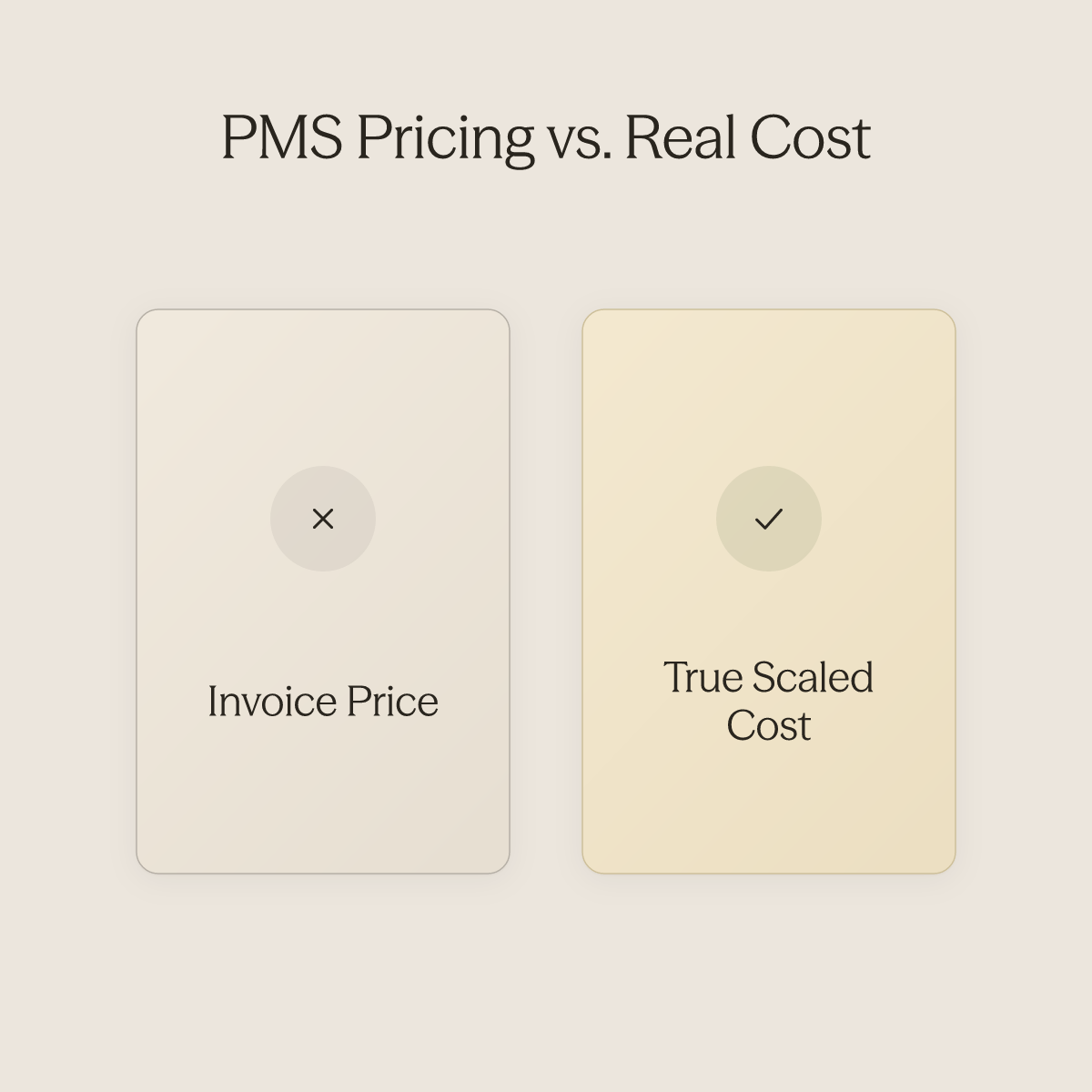
That last point matters most: the inability to grow the communication layer without growing the payroll directly capped the business's exit valuation multiplier. No line item on a PMS invoice reflected that cost. It lived entirely in labor overhead and constrained growth.
Short-term rental operators shopping for a PMS almost always start with a monthly price tag. They find a per-unit rate that looks manageable at their current portfolio size, multiply it by their property count, and call it a budget line. The problem is that math only holds at the size you are today, not the size you are building toward. Pricing model architecture, not the headline rate, determines your actual cost of ownership at scale, and choosing the wrong model at 5 properties can quietly triple your monthly spend by the time you hit 30.
But there is a more consequential cost that every pricing model, per-unit, flat-fee, and percentage-of-revenue alike, is structurally designed to ignore: because both Guesty's per-unit model and Lodgify's tiered flat-fee structure price against property count rather than guest communication outcomes, neither model creates any economic incentive for the PMS vendor to optimize messaging performance. Operators at every price tier are therefore systematically underinvesting in the communication layer that most consistently determines occupancy and guest satisfaction, the two variables that most directly drive revenue per property.
Conduit addresses a gap the PMS invoice never captures. Conduit's AI Agents are designed specifically for businesses that receive a high volume of repetitive guest messages and already have documentation, SOPs, FAQs, property manuals, they can use to train the agent. Rather than routing those routine, low-value inquiries to a human on shift, the AI agent handles them continuously: before, during, and after a stay, whenever a guest sends a message.
The first automated guest reply goes live days after connecting your existing documentation, not after a months-long implementation. The Inbox layer then gives the operations or support team a single place to monitor, review, and manage every conversation the AI agent is handling across multiple properties and platforms simultaneously, eliminating the coordination overhead that grows linearly with property count under a pure-headcount model. Workflows extend that further: triggered automatically after a booking is confirmed, after check-in, or when a specific keyword is detected, they replace the recurring manual staff actions that accumulate into the kind of labor drag the Easy BnB model illustrates.
And because Integrations allow the AI agent to pull from tools operators already use, Notion, Google Drive, Airbnb, the setup does not require re-entering content that already exists. The economic implication is direct: reducing the headcount required to maintain 24/7 guest coverage lowers the labor cost that PMS pricing never accounts for, and improving response consistency across all hours raises the occupancy and satisfaction outcomes that determine whether a portfolio is worth scaling at all.
Per-Unit Pricing, The Cost Curve Past 15 Properties
Per-unit pricing charges a fixed monthly fee for each listing. Guesty operates on this model, with costs scaling directly as operators add properties. Past 15 properties, the math turns.
Operators managing 20-plus units on per-unit platforms frequently describe the moment their monthly bill crossed a threshold that felt disconnected from any new value the platform was delivering. The cost compounds without the capability growing proportionally. What compounds alongside it, invisibly, is the guest communication overhead: more properties mean more concurrent guest conversations, and without an automated layer handling the high-volume, repetitive inquiries that make up the majority of that communication load, staffing costs scale with the property count just as reliably as the per-unit fee does.
Flat-Fee Pricing, Structural Advantage and Hidden Costs
Flat-fee platforms like Smoobu offer fixed monthly plans that do not change as you add properties, creating genuine cost predictability for a growing portfolio. A portfolio scaling from 5 to 20 units pays the same monthly rate at unit 20 as it did at unit 5. The honest trade-off: flat-fee plans sometimes carry add-on costs for channel manager access or booking engine features that function as a secondary per-unit charge in practice. Review the full plan terms before assuming "flat" means truly unlimited. The more consistent hidden cost, however, is the labor model required to keep guest communication functional as the property count grows, a cost that does not appear on the platform invoice at all, and that flat-fee pricing does nothing to resolve.
Percentage-of-Revenue Models, When They Hurt Most
Some platforms charge a percentage of booking revenue rather than a fixed fee. For operators running high average daily rates or properties in peak seasonal markets, this model is the most expensive of the three.
Key takeaway: A platform taking 1–2% of revenue on a portfolio generating $500,000 annually costs $5,000–$10,000 per year, before any add-on fees, making it the most expensive pricing model for operators in high-ADR markets or with strong seasonal performance.
Operators in that bracket should model their actual reservation revenue against the percentage rate before committing, rather than anchoring on a per-booking fee that looks small at low volume. At that revenue scale, the operational overhead of maintaining adequate guest communication coverage also reaches a level where the labor cost of a human-staffed model rivals or exceeds the platform fee itself, which is precisely the environment where an AI agent handling routine, repetitive inquiries before, during, and after every stay produces the most measurable return.
Essential PMS Integrations for Short-Term Rentals - Dynamic Pricing, Cleaning, Smart Locks, and Accounting
Think of your PMS as a skeleton: it holds everything together, but it cannot move on its own. The integrations you wire to it, dynamic pricing, cleaning coordination, smart access, and accounting, are what turn that skeleton into an operation that actually runs. Operators who skip this wiring often discover the cost only after their portfolio grows past five or six properties, when manual workarounds start consuming hours every week.
One friction point worth naming early: hosts who spent years relying entirely on Airbnb as their full software stack, for payments, calendars, messaging, and pricing, often underestimate how much operational restructuring a PMS migration requires. Every integration decision below compounds that restructuring. Getting each connection right the first time matters, which is why the practical bar for setup effort is relevant: with conduit.ai, linking accounts requires no IT team or developer, and the first source is typically syncing within minutes of connecting.
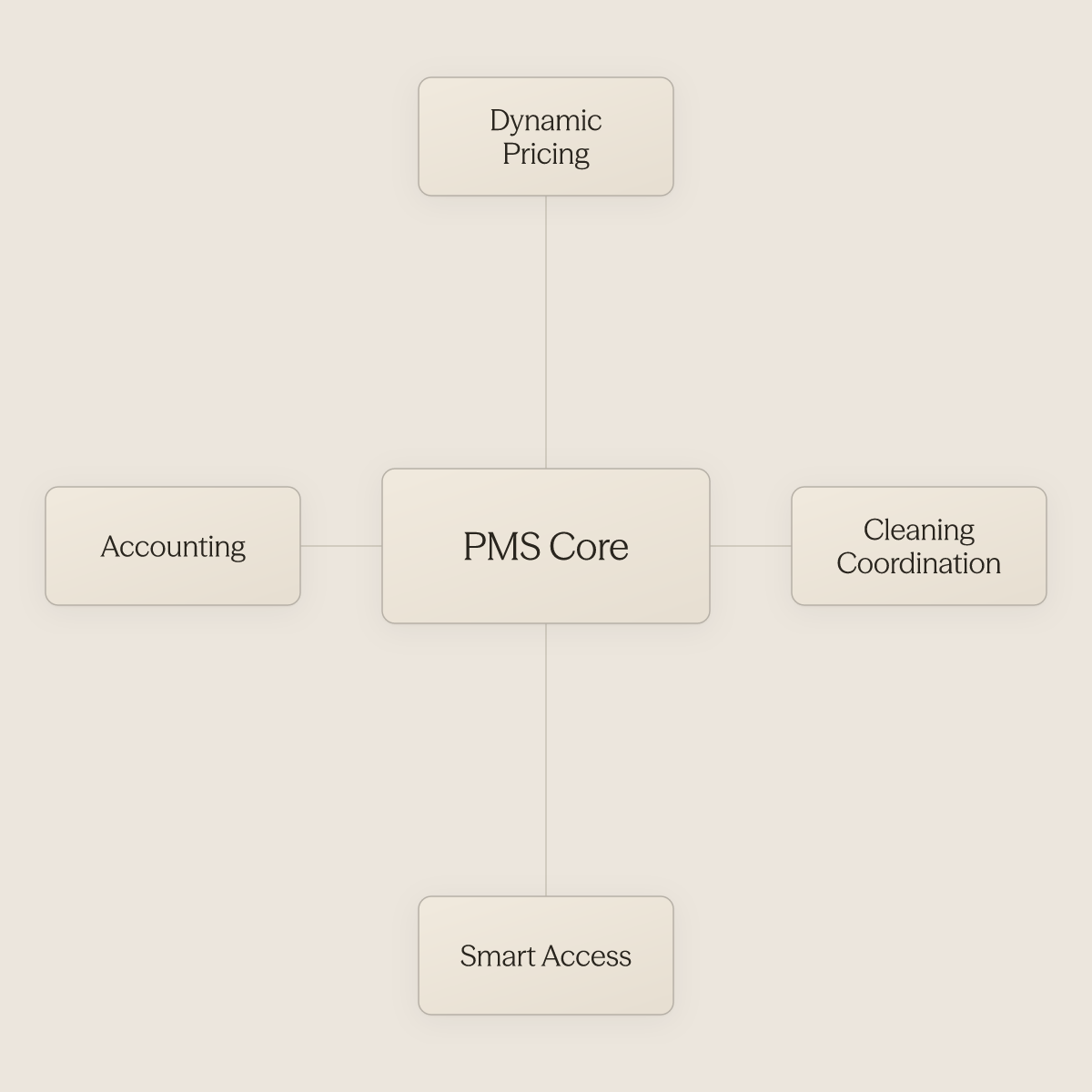
Dynamic Pricing Integrations - PriceLabs and Wheelhouse
Past five properties, adjusting nightly rates by hand means you are always reacting to demand signals you spotted too late. PriceLabs connects to your PMS via API and pushes updated rates to every connected channel automatically, pulling in local demand data, competitor pricing, and booking pace. Across the market, operators who replace manual pricing with data-driven dynamic rules consistently capture revenue that flat-rate strategies leave behind.
What most teams report is that the gains compound across markets with different seasonal patterns, exactly the scenario where hand-pricing breaks down fastest. Wheelhouse takes a similar approach with a heavier emphasis on market benchmarking. Both tools are most valuable when your portfolio spans multiple markets with different seasonal patterns.
A related struggle that catches many operators off guard: it is nearly impossible to evaluate a PMS's true usability, or how cleanly its pricing integrations actually function, until you are already onboarded. Switching platforms mid-growth because a pricing sync was clunkier than advertised wastes weeks of setup time and disrupts live bookings. Vetting the integration layer before committing to a PMS is worth the extra diligence upfront.
Cleaning and Maintenance Coordination - Turno and Breezeway
Turno and Breezeway both auto-trigger task assignments the moment a checkout event fires in your PMS. The two tools serve different scales and needs:
| Tool | Core function | Best fit |
|---|---|---|
| Turno | Auto-triggers cleaner assignments with job details and access window | Smaller portfolios |
| Breezeway | Auto-triggers assignments plus logs inspection results and flags repairs | Operators needing documented inspection records and contractor management at scale |
A cleaner receives the job, the access window, and any property-specific notes without a single manual message from your team. Professional hosts managing multiple properties face tight turnover windows and high occupancy demands; a single missed trigger between the PMS and the cleaning tool means a unit isn't ready, and that failure is visible to the guest immediately. Integrations that require manual hand-holding to stay in sync are a liability at volume, not a minor inconvenience.
Smart Lock and Keyless Entry
Integrating your PMS with smart locks means access codes generate and deliver automatically at booking confirmation and expire at checkout. Keyless entry has become a standard expectation among guests at professionally managed properties, and most operators managing more than a handful of units have moved away from physical key handoffs in favor of code-based or app-based access. Most major PMS platforms support direct integrations with Yale, Schlage, and similar hardware through middleware like Lynx or RemoteLock, which is most beneficial when properties are geographically spread and self-check-in is the default.
Guest communication around access, code delivery confirmations, check-in instructions, troubleshooting messages, is where conduit.ai's AI Agents slot in directly. When a guest sends a question about their code before arrival, the agent handles it continuously, before, during, or after a stay, without requiring a staff member to be monitoring the inbox in real time. That capability is most valuable when the business receives a high volume of repetitive access-related messages and already has SOPs or check-in manuals the agent can be trained on.
Owner Accounting and Trust Reporting - Native vs. Bridge
How you integrate your PMS with vacation rental accounting software depends almost entirely on whether your PMS handles trust accounting natively. The choice maps cleanly to two scenarios:
| PMS approach | Example platform | What it means for you |
|---|---|---|
| Trust accounting built in natively | OwnerRez | Owner statements, trust ledgers, and commission tracking built directly into the platform, audit-ready reporting without a third-party bridge |
| Requires a third-party accounting bridge | Guesty, Hostaway | Connection to QuickBooks or a dedicated tool like Ximplifi needed for full accrual-based reporting and multi-owner trust accounting |
For operators whose PMS does not handle this natively, a dedicated STR accounting bridge is a necessary line item in the integration budget, not an optional add-on. The cost pressure here is real. Established PMS platforms carry meaningful recurring fees, and when accounting tools stack on top, some operators consider building their own solutions from scratch to avoid compounding subscription costs. That path trades monthly fees for ongoing maintenance overhead that typically costs more in operator time than the software it replaced. Evaluating the full integration stack, PMS plus pricing plus cleaning plus accounting, as a bundled cost before committing to any single tool is the more durable approach.
The Guest Communication Ceiling Every PMS Hits: and the AI Coordination Layer That Breaks Through It
At some point, every growing STR operation hits the same wall. The PMS is configured, templates are live, check-in instructions fire at T-minus 24 hours, and checkout reminders go out at 8am. Then a guest messages at 11pm asking why the AC isn't working, and the whole system goes quiet. That silence is not a configuration problem. It is an architectural one.
Why PMS Automated Messaging Is a Scheduler, Not a Guest Communication System
PMS-native messaging operates on a clock, not on context. It sends pre-written sequences at fixed intervals tied to booking events. What it cannot do is read an inbound message, interpret what the guest needs, and respond accurately without a human stepping in.
According to industry research on response times in hospitality, fast response times boost bookings by 116% for short-term rentals, a result that pre-scheduled templates cannot reliably deliver at all hours. Guest expectations for response speed have been shaped by on-demand consumer experiences outside hospitality, compressing the window operators have to reply before a guest moves on or leaves a frustrated review. The acceptable response window has collapsed well below what any human-routed or template-triggered system can sustain consistently, especially overnight or on weekends.
The Operational Ceiling That Appears Around 15 to 20 Properties
The ceiling is almost always communication. At five properties, an operator can personally cover the gaps the PMS leaves. ", "The parking instructions don't match the app", consumes the entire team's bandwidth.
The PMS inbox consolidates those messages into one view, but it cannot resolve them. Operators who scale past twenty properties without addressing this layer end up with one of two outcomes: they hire more staff and watch margins compress, or response times slip and review scores follow. No amount of template tuning closes it.
The ceiling is structural.
Two Distinct Layers - What the PMS Owns vs. What the AI Coordination Layer Owns
The PMS owns operations: calendar sync, booking data, channel distribution, cleaning triggers, and owner reporting. What it does not own, and was never designed to own, is dynamic, context-aware guest communication. A purpose-built AI coordination layer sits above the PMS, pulls normalized data across OTA sources, and handles inbound guest messages autonomously. OTA platforms often withhold or delay guest contact data at different points in the booking lifecycle, meaning no PMS inbox ever has full context when a message arrives. An AI coordination layer built to normalize that data across channels closes the gap the PMS structurally cannot.
Related Reading
- Lodgify Competitors
- Vrbo Automated Messages
- Guesty Vs Hostfully
- Lodgify Vs Smoobu
- Ownerrez Vs Guesty
- Hospitable Vs Hostaway
- Guesty Vs Hostaway
- Guesty Vs Hospitable
- Guesty Alternatives
Next steps
If your team is still fielding guest messages at 1am while your PMS fires pre-scheduled templates into the void, the path forward starts with treating guest communication as a separate operational layer, not a feature your PMS will eventually get right. Start with our AI for hospitality.
The structural reality is this: PMS vendors price against property count, not communication outcomes, which means no per-unit or flat-fee model creates any incentive to close the messaging gap your operation actually feels at 20 or 30 properties. Separately, the STR industry already validated the composable-stack model when it accepted PriceLabs sitting above the PMS for dynamic pricing. The same architectural logic applies to guest communication. Those two facts together point to one obvious next step: deploy a purpose-built AI coordination layer above whichever PMS you choose, rather than waiting for a better unified inbox to solve a problem it was never designed to solve.
Start by exploring conduit.ai to see how Conduit's AI agents connect to your existing PMS, ingest your SOPs and property documentation, and handle routine guest inquiries autonomously across channels around the clock. Operators who have made this move report sub-1-minute response times at 35 properties with zero added communication staff, and resolution times dropping from 15 minutes per interaction to under 3. The PMS you chose handles your operational skeleton. This handles everything guests actually experience after the booking lands.
Frequently Asked Questions
How do I actually prevent double bookings across Airbnb, Vrbo, and Booking.com?
The only reliable standard is API-level, two-way calendar sync with each major OTA. iCal-based sync, which many platforms still use as a fallback, introduces lag measured in hours, meaning a booking confirmed on Airbnb at 11 p.m. may not block your Vrbo calendar until morning, and that gap is exactly where double bookings happen.
Can my PMS handle cleaning scheduling automatically, or do I need a separate tool for that?
A full PMS can trigger cleaning assignments at checkout without manual handoff, and that task-coordination capability is one of the five core operational functions a well-built PMS should handle. A basic channel manager, by contrast, prevents double bookings but cannot trigger a cleaning schedule after checkout, that gap is precisely where a full PMS earns its place.
What's the difference between a PMS handling guest messages and an AI communication layer, aren't they the same thing?
They are not the same. PMS-native messaging is rule-based: it sends a pre-scheduled check-in message but cannot read context, interpret a nuanced early-arrival question, or resolve a maintenance issue reported at 2 a.m. An AI communication layer like Conduit.ai sits on top of the PMS data layer and handles those edge cases, so the two layers can evolve independently without rebuilding your communication logic every time you migrate platforms.
Does my PMS give me owner statements and financial reporting automatically?
A well-built PMS should generate automated owner statements and remove the monthly spreadsheet scramble, that is listed as one of the five distinct operational functions a full PMS must handle. Operators scaling past 10 properties without this in place are described in the post as carrying invisible operational debt.
How do I build my STR software stack so I'm not locked in if I need to switch PMS platforms later?
The key is treating a purpose-built AI coordination layer, not the PMS, as the primary home for your guest communication logic, SOP documentation, and automation rules. When that logic lives in the communication layer rather than inside the PMS, switching platforms means migrating operational data (which resolves in days or weeks) without also rebuilding your entire communication stack, which is the cost that lingers for months.
Stay in the loop
Get the latest on AI automation, product updates, and customer stories.

