63 Best Short Term Rental Channel Managers for 2026


63 Channel Managers
Ranked for short-term rentals.
Most operators pick a channel manager to stop double bookings. That solves one problem and quietly creates three more. Here is how to choose the right tool before scale exposes the gap.
A channel manager (also called a vacation rental channel manager or short-term rental channel manager) is software that synchronizes your availability calendars, rates, and listing content across multiple OTAs in real time, acting as a single source of truth for your entire distribution stack. The gap between what a channel manager actually does and what most operators assume it does is where portfolios quietly fall apart. Operators who build their tech stack with a clear-eyed view of this distinction scale more cleanly than those who discover the limits of calendar sync at 25 properties and have to rebuild workflows mid-growth. See our AI for hospitality for how this works in practice.
A channel manager connects your property listings to OTAs and pushes availability, rates, and content changes across all of them simultaneously. It does not handle what happens after a reservation confirms. Guest communication, check-in instructions, and follow-up messages exist entirely outside its scope.
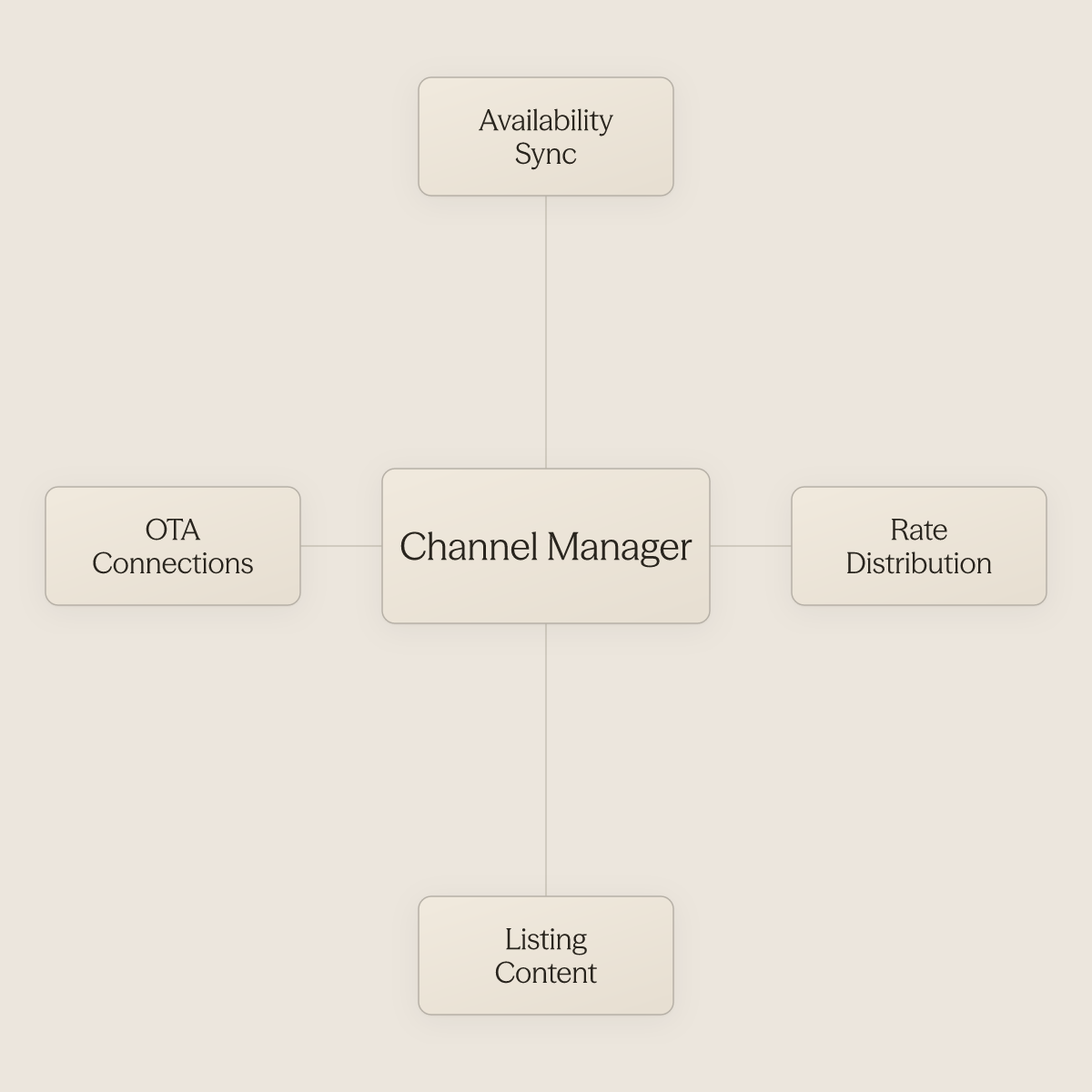
Double booking prevention is the reason most operators first look at a channel manager, but it is the floor, not the ceiling. Industry channel management analysis consistently identifies manual availability updates as the primary source of cross-platform booking conflicts; each manual change on one OTA leaves every other connected platform exposed until the update propagates. Operators who stop evaluating once that box is checked miss the deeper operational gaps a channel manager was never designed to close.
The two functions that genuinely move the needle are real-time calendar sync and centralized rate management. Sync keeps availability accurate across every OTA simultaneously. Rate management lets you set base prices, apply per-platform adjustments, and push pricing changes in a single action.
Without centralized rate management, rate drift compounds silently as portfolios grow, eroding revenue integrity across every channel. The most costly assumption operators make is that a channel manager handles distribution and the guest experience. It handles distribution only.
Distribution infrastructure and guest communication are structurally separate problems, and conflating them is why operators who "have a channel manager" still feel overwhelmed at 20-plus properties. A unified guest communication platform picks up exactly where the channel manager stops, consolidating every post-booking conversation so no message falls through the gap between platforms.
Key takeaways
- A channel manager is a distribution tool, it keeps calendars, rates, and listings in sync across OTAs, not an operations platform, and conflating the two is where most scaling problems start.
- API connections and iCal scrapes are not equivalent: iCal polling introduces sync delays that turn into double bookings at volume, and the difference matters more as portfolio size grows.
- Portfolio size is the right first filter when comparing channel managers, applying it before any feature comparison collapses 63 options to a realistic shortlist of five to eight.
- Choosing a channel manager built for the wrong tier is one of the most common and expensive mistakes operators make; the mismatch usually doesn't surface until the portfolio is already mid-scale.
- The communication gap channel managers leave isn't double bookings, it's the unanswered guest message that arrives at 1am after a booking confirms, and no channel manager on this list was built to fill it.
- A 35-property operator reached 96% AI automation by layering a communication tool on top of their channel manager, calendar sync was table stakes; what scaled the portfolio was what happened after the reservation landed.
- Conduit's unified Inbox closes that gap by consolidating every guest conversation from every channel into one place, giving teams full visibility and the ability to step in when automation hands off, without switching between platforms.
What Key Features Should You Look for in a Short-Term Rental Channel Manager (Connectivity, Automation, Pricing)?
The channel manager you choose is only as good as the infrastructure underneath it, and the gap between a tool that prevents double bookings and one that creates them often comes down to a single technical decision made at setup. How your availability syncs, how your rates move across platforms, and how much of that coordination happens automatically determines whether you're running a scalable operation or manually patching gaps across every OTA you list on. The features below cut through the marketing language and focus on the connectivity and automation mechanics that actually protect your calendar and your revenue.
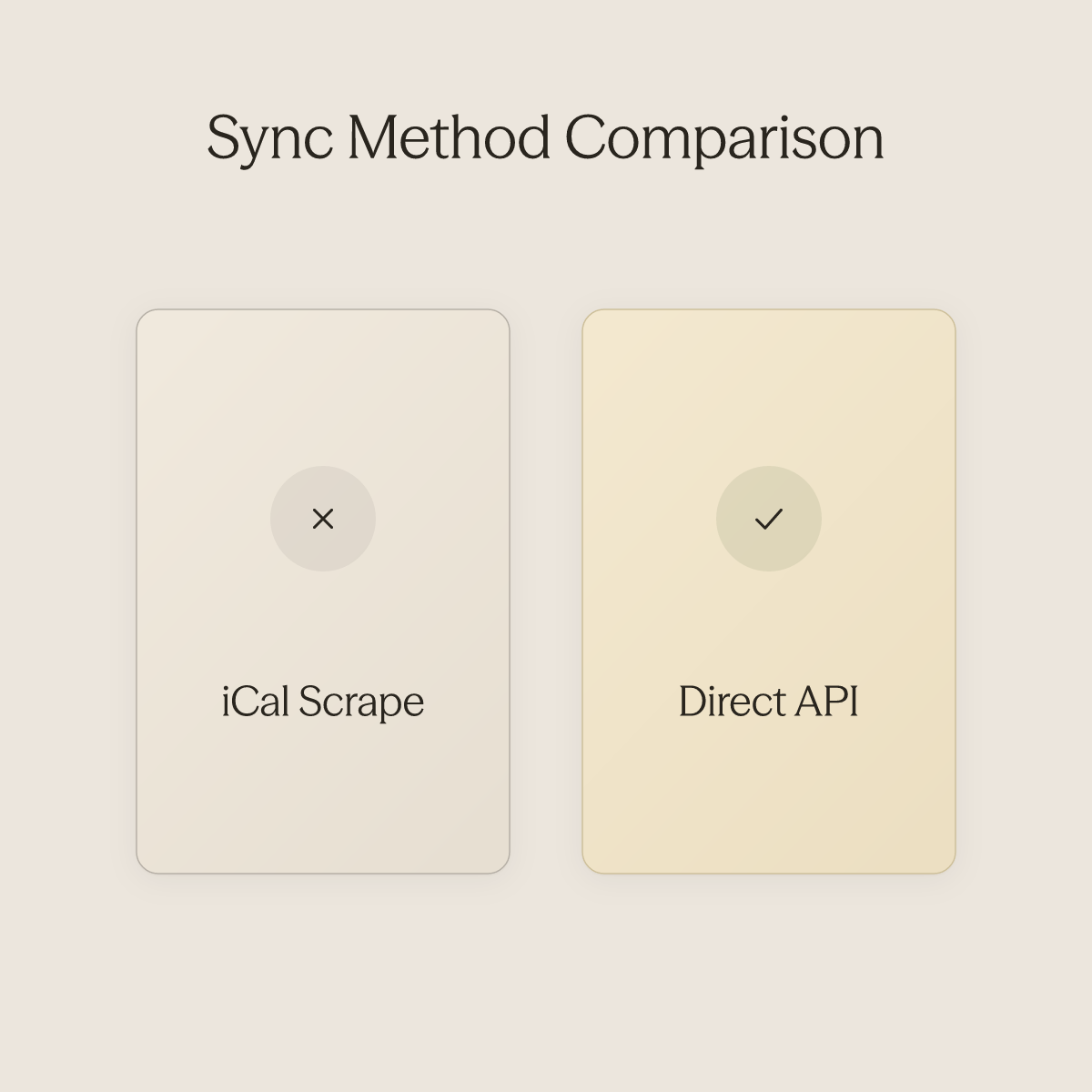
API Connections vs. iCal Scrapes - Why the Sync Method Determines Your Double-Booking Risk
ICal sync works by polling a calendar file at intervals, creating a lag window between when a booking lands on one OTA and when that availability closes elsewhere. API connections push updates in real time, bidirectionally, across every connected platform simultaneously. iCal is a calendar-only format: it carries availability data and nothing else, meaning rate rules and reservation details are absent from the feed entirely, a technical constraint documented consistently across every iCal-based integration in the field.
Any channel manager that relies on iCal rather than a direct API connection cannot push centralized pricing changes to OTAs, and that lag window is where double bookings are born. What makes this sting hardest for growing operators is that the manual work compounds in every direction at once: calendars need updating, guests need messaging, and cleaners need coordinating, all simultaneously, across platforms that don't talk to each other natively. The sync method you choose at setup determines how much of that burden you can actually automate later.
Centralized Rate Management by Channel - The Feature That Protects Revenue Integrity Across Every OTA
Industry data shows the average short-term rental operator actively lists on three to five OTAs simultaneously. Centralized rate management by channel lets you set base rates, per-platform markups, and seasonal rules from one dashboard, then push them outward. Without it, a rate change never syncs to Booking.com and every other active channel, and that window between updates is a direct revenue leak.
Managing pricing updates across multiple channels manually becomes unmanageable as a portfolio scales. What starts as a ten-minute task at two properties becomes a structural inefficiency at ten, and by the time a portfolio reaches twenty or more listings, the compounding cost of inconsistent rates across channels is a measurable revenue problem, not just an annoyance. Most credible channel managers clear the centralized rate management bar, but implementation quality varies: look for per-channel override capability, not just a global rate multiplier.
Pricing Models Decoded - Per-Property Flat Fee vs. Revenue Percentage vs. Tiered Subscription
Channel manager pricing flips at roughly 20 units. Below that threshold, a revenue-share model (typically 1 to 3 percent of booking revenue) often costs less than a flat per-property fee. Above 20 units, that percentage compounds fast. A portfolio generating $600,000 annually at a 2% revenue-share rate pays $12,000 per year in platform fees before a single feature is weighed, a figure that compounds as revenue grows. By contrast, a flat per-property model at a common market rate of around $10 per unit per month across 25 properties runs roughly $3,000 annually. These figures are illustrative; actual pricing varies by vendor and contract, so running the math against your own revenue and the specific pricing tiers of shortlisted tools is essential before comparing feature sets.
The Unified Inbox - Table Stakes Feature, Hidden Operational Trap
Every channel manager on this list ships a unified inbox, and the relief operators feel when messages finally appear in one place is real. The hidden cost surfaces fast. The experience Wynwood House's customer experience team lived before consolidating their stack is a precise illustration of what scale looks like without the right layer on top: agents constantly switching between platforms to draft messages, translate responses, review guest history, and track performance.
Guest resolution times averaged 15 minutes per conversation. Sentiment was tracked manually in inconsistent Google Sheets. Shift handoffs required reading entire conversation histories.
Managers had no reliable visibility into guest satisfaction at scale. A unified inbox tells you where the message landed. It does not resolve the conversation, and at scale, the gap between those two things is where response times slip and review scores follow.
This is where an AI-first approach to guest communications becomes operationally significant rather than aspirational. As Darren, Founder of Easy BnB / Bali Luxury Stays, put it directly: "We all agree that AI first is the best approach."
Pros and cons at a glance
Conduit's AI Agents layer sits on top of the unified inbox and is most valuable precisely when message volume is high and the questions are repetitive, the exact conditions any multi-property operator creates. Connect your existing SOPs, FAQs, or guest manuals, and the agent begins handling automated guest replies within days, not weeks. It captures every guest inquiry across channels, day or night, without leaking revenue to slow response times.
Workflows extend this further: after a trigger event, a booking confirmed, a check-in completed, a keyword detected, automated touchpoints fire without staff intervention. The inbox remains available for the operations or support team to monitor and review what the AI agent is handling, so human oversight stays intact without human bottlenecks defining response speed. For operators already using tools like Notion, Google Drive, or Airbnb, the Integrations layer pulls existing content directly into the agent's knowledge base, no manual re-entry required.
How to Choose a Short-Term Rental Channel Manager Based on Portfolio Size (1–3, 4–20, 20+ Properties)
Portfolio size is the single most decisive filter when choosing a short-term rental channel manager, and applying it first collapses 63 realistic options down to 5 to 8 candidates before a single feature gets compared. Operator experience across the short-term rental management community consistently surfaces the same pattern: choosing a channel manager at the wrong tier typically triggers a disruptive migration within six to twelve months, making the initial tier-match more consequential than any individual feature comparison.
1. Conduit.ai - Best Short Term Rental Channel Manager for Solo Hosts with 1–3 Properties
For hosts managing one to three short-term rentals, Conduit.ai delivers real-time calendar sync across Airbnb, Booking.com, and VRBO without the steep learning curve of enterprise tools. Its AI-driven automation handles messaging and rate updates, making it ideal for owner-operators who lack dedicated staff. The key tradeoff: its reporting depth is limited compared to mid-market platforms, which matters less at this portfolio size.
2. Hostaway - Best Short Term Rental Channel Manager for Growing Managers with 4–20 Properties
Hostaway is the go-to best short term rental channel manager for property managers scaling from a handful of units into a mid-size portfolio. Its unified inbox, task automation, and 100-plus OTA integrations reduce operational drag as team complexity grows. The platform's pricing scales per property, which keeps costs predictable during growth phases. The tradeoff is that advanced revenue management requires third-party dynamic pricing tools rather than native functionality.
3. Rentals United - Best Short Term Rental Channel Manager for Enterprise Operators with 20+ Properties
Rentals United is purpose-built for large-scale vacation rental operators who need distribution across 60-plus channels simultaneously, including niche OTAs that smaller tools ignore. Its bulk listing management, API-first architecture, and owner reporting dashboards make it the strongest fit for property management companies with 20 or more units. The primary limitation is onboarding complexity, implementation typically requires dedicated support time and is not suited for first-time hosts.
63 Best Short-Term Rental Channel Managers for 2026 - Ranked and Reviewed
That tier-mismatch problem runs deeper than any single platform decision. Across 63 channel managers now competing for short-term rental operators, the gap between what a tool promises and what a portfolio actually needs has never been wider, or more expensive to get wrong. This comparison ranks every option available heading into 2026, covering pricing, integration depth, automation capability, and the portfolio profiles each tool genuinely serves.
The field is bigger than any top-10 list admits. Based on our review of software directories and market trackers, the number of viable short-term rental channel managers sits above 60 distinct tools in 2025, yet most comparison articles cover 8 to 12 and call it comprehensive. That gap matters because the tool that earns "best overall" for a 200-property management company in North America is actively the wrong choice for a 5-property B&B operator in Croatia.
Portfolio size, geographic focus, and operational model collapse this field to 5 to 8 realistic candidates faster than any feature matrix. What follows is the full ranked list of 63 tools, structured so you can scan, filter by your situation, and shortlist in under five minutes. One honest framing before the list: every channel manager below solves the distribution problem, calendars sync, rates push, double bookings drop.
What none of them solve is what happens between a booking confirmation and a guest's first question. Capterra's evaluation criteria for channel management software do not surface response-time performance, upsell conversion, or mid-stay resolution speed as review dimensions, meaning the most-reviewed platform in the category earns its score on the exact capabilities that leave the guest experience layer untouched. Most operators running 10 to 50 properties discover this the hard way.
The unified inbox that ships with most channel managers consolidates where messages land; it does not handle what happens next. Teams report spending a significant share of their communication time on high-frequency, predictable inquiries, WiFi passwords, check-in instructions, early checkout requests arriving at 11pm. These are not failures of the people handling them; they are structural repetition that any capable team member gets pulled into when the right automation layer is absent.
Naming that before investing in distribution infrastructure is what keeps growth from becoming a headcount equation. With that context clear, here are all 63.
1. Conduit.ai - Best AI-Powered Guest Communication Layer for STR Operators
Conduit.ai is not a channel manager. It is the layer that sits above your channel manager and handles everything that fires after a booking confirms. Where channel managers stop at syncing calendars and pushing rates, Conduit's AI for hospitality autonomously handles guest inquiries, check-in instructions, maintenance coordination, and mid-stay requests across every OTA inbox simultaneously. It turns a consolidated message view into a resolved conversation before your team clocks in. The honest tradeoff: it requires a channel manager underneath it and is purpose-built for hospitality operators, not a general-purpose tool.
2. Hostaway - Best All-in-One Channel Manager for Scaling Property Managers
Hostaway is the answer to "which channel manager is best overall for short-term rentals in 2026." It holds a 4.8/5 rating across more than 1,500 verified reviews on Capterra, with 26+ OTA integrations via direct API connections rather than iCal scrapes, meaning rate and availability changes push in minutes, not hours. Hostaway earns its position through premium onboarding support, a unified inbox, and a marketplace of add-on integrations. The real tradeoff is cost: it prices at the higher end of the field, making it overkill for operators managing fewer than 10 properties.
3. Cloudbeds - Best Channel Manager for Boutique Hotels Crossing into STR
Cloudbeds targets the operator running a boutique hotel or inn who also manages short-term rental units and needs one system to cover both. Its channel manager connects to a wide OTA set and pairs with a front-desk PMS, genuinely useful when your operation blurs the line between hotel and vacation rental. The tradeoff is that its STR-specific features are less mature than pure-play vacation rental tools, and its pricing reflects hotel-grade software budgets. Best fit for mixed-use portfolios that need one platform, not two.
4. Guesty - Best Enterprise-Grade Channel Manager for Large Property Portfolios
Guesty is the answer to "which channel manager is best for enterprise-scale operations." It serves property managers operating hundreds to thousands of units, with reported reach across hundreds of thousands of listings globally. Its feature set covers multi-unit owner accounting, revenue management, open API access, and dedicated account management that smaller tools do not offer. The tradeoff is that Guesty's pricing and onboarding complexity make it a poor fit for operators under 20 properties. Pick it when your portfolio size demands enterprise-grade infrastructure and you have the operational team to configure it.
5. Hostfully - Best Channel Manager with Built-In Digital Guidebooks
Hostfully's competitive edge is its native digital guidebook product, which delivers property information, local recommendations, and check-in instructions through a branded guest portal without a third-party integration. That built-in layer reduces repetitive pre-arrival questions for operators who compete on guest experience. The tradeoff is that Hostfully's channel connectivity is narrower than Hostaway or Rentals United, making it less compelling if raw OTA distribution reach is the primary goal. Best fit for operators with 5 to 30 properties who differentiate on guest experience quality.
6. Lodgify - Best Channel Manager for Hosts Who Want a Direct Booking Website
Lodgify bundles a channel manager with a direct booking website builder, a meaningful combination for operators reducing OTA commission dependency. The tradeoff is mid-tier channel connectivity: strong on Airbnb, Vrbo, and Booking.com, but thinner on niche OTAs. Most beneficial when your strategic goal is building a direct booking channel alongside OTA distribution, rather than maximizing OTA reach.
7. Rentals United - Best Channel Manager for Maximum OTA Distribution Reach
Rentals United is the answer to "which channel manager offers the most OTA connections." It connects to 90+ distribution channels via API-driven integrations, the largest verified connection count in this field, purpose-built for professional property managers who need listings on niche OTAs, regional booking platforms, and corporate travel channels beyond the Airbnb-Vrbo-Booking.com core. The tradeoff is that Rentals United is distribution-first: its property management and guest communication features are minimal. Pair it with a PMS or guest communication layer if you need operational depth alongside distribution breadth.
8. iGMS - Best Channel Manager with Native Dynamic Pricing Integration
The tradeoff is that its dynamic pricing engine is less sophisticated than dedicated tools like PriceLabs or Beyond, and its OTA connectivity is narrower than top-tier options. Best fit for operators managing 5 to 30 properties who want a single subscription covering channel management and basic pricing automation.
9. Hostex - Best Lightweight Channel Manager for Budget-Conscious Hosts
Hostex is the entry point for solo hosts and small operators who need basic channel sync across Airbnb, Vrbo, and Booking.com without paying for features they will not use. Its pricing sits at the low end of the field, and operators report getting set up without dedicated onboarding support. The tradeoff is that Hostex is a starter tool: operators managing more than 10 properties, or those needing advanced owner accounting or multi-user team access, consistently report outgrowing it within 12 to 18 months.
10. Eviivo - Best Channel Manager for Independent B&Bs and Small Inns
Eviivo is built for the independent B&B, small inn, or guesthouse operator who needs comprehensive OTA synchronization without enterprise-grade complexity. It covers Airbnb, Booking.com, Expedia, and a wide set of niche channels, with automation handling confirmation emails and basic guest communication triggers. The tradeoff is that Eviivo's reporting and owner accounting features are less developed than tools like Ciirus or OwnerRez. Most beneficial for operators running 1 to 20 rooms who want reliable OTA sync without a steep learning curve.
11. PriceLabs - Best Dynamic Pricing Engine to Pair with Any Channel Manager
PriceLabs is not a channel manager. It connects to your existing channel manager and pushes dynamically adjusted rates based on demand, seasonality, and competitor pricing signals. Operators who treat pricing as a static exercise leave measurable revenue on the table, and PriceLabs is the most widely adopted standalone pricing engine in the STR field. The tradeoff is that it requires a channel manager underneath it and adds a second subscription. Most beneficial when your portfolio exceeds 5 properties and pricing decisions currently consume manual time each week.
12. Wheelhouse - Best Dynamic Pricing Tool for Data-Driven STR Revenue Management
Wheelhouse competes directly with PriceLabs and differentiates on its data visualization and market intelligence dashboards. Operators who want to understand why rates are moving, not just accept automated recommendations, tend to prefer Wheelhouse's reporting interface. The tradeoff is price: Wheelhouse's subscription cost is higher than competing pricing tools, which affects ROI for smaller portfolios. Best fit for operators managing 15 or more properties who treat revenue management as a core competency and want data depth alongside automation.
13. Tokeet - Best Channel Manager for Tech-Savvy Operators Who Want API Access
Tokeet offers open API access that lets operators build custom integrations, automate workflows, and connect tools outside its native marketplace. The tradeoff is that Tokeet's out-of-the-box experience is less polished than Hostaway or Lodgify, and operators without technical resources report a steeper setup curve. Pick it when your operation has specific workflow requirements that no packaged tool covers off the shelf.
14. Smoobu - Best Channel Manager for European STR Operators
Smoobu's OTA connectivity skews toward European booking platforms, including regional channels that North American-focused tools often miss. Its interface is available in multiple European languages and its pricing is competitive for the European market. The tradeoff is mid-tier feature depth: it covers channel sync, a basic unified inbox, and guest communication automation, but falls short of enterprise tools on owner accounting and reporting. Most beneficial for operators based in Germany, France, Spain, or the broader European market who want solid regional OTA coverage without paying for North American-centric features.
15. Beds24 - Best Highly Configurable Channel Manager for Power Users
Beds24 is the most configurable channel manager on this list, with a rule-based automation engine covering pricing, messaging, task triggers, and channel-specific settings. The tradeoff is a steep learning curve: operators without a technical background or dedicated setup time consistently report frustration during onboarding. Most beneficial when your operation has non-standard requirements that packaged tools cannot accommodate and you have the patience to configure a system from the ground up.
16. Avantio - Best Channel Manager for Large Vacation Rental Agencies
Avantio targets vacation rental agencies managing large, distributed portfolios across multiple destinations, with channel management, owner portals, CRM, and website building in one platform. Its European roots give it strong OTA connectivity for Mediterranean and Southern European markets. The tradeoff is that its pricing and onboarding complexity are calibrated for agencies: solo hosts and small teams report that the platform's depth becomes overhead rather than value. Best fit for agencies managing 50 or more properties across multiple markets.
17. Kigo - Best Channel Manager for Mid-Size Vacation Rental Companies
Kigo sits in the mid-market tier, targeting vacation rental companies that have outgrown entry-level tools but are not yet at the scale where Guesty or Avantio make sense. It covers channel management, a booking engine, owner accounting, and basic revenue management in one subscription. The tradeoff is that Kigo's OTA connectivity is narrower than top-tier distribution-focused tools, and its development pace has been slower than some competitors. Most beneficial for operators managing 20 to 100 properties who want a single platform covering the core operational stack without enterprise-grade pricing.
18. BookingSync - Best Channel Manager for Vacation Rental Professionals in Europe
BookingSync is a France-based platform with strong OTA connectivity across European booking channels, owner accounting, and season-based pricing rules. Its open API makes it a reasonable base for operators who want to build custom integrations. The tradeoff is that BookingSync's North American OTA coverage is thinner than its European connectivity, and its interface has not kept pace with newer platforms on UX design. Best fit for European operators who need regional channel depth and are comfortable with a utilitarian interface.
19. Streamline VRS - Best Channel Manager for Resort and Condo Management Companies
Streamline VRS is purpose-built for resort communities, condo hotels, and managed vacation rental programs where owner accounting, trust accounting compliance, and complex fee structures are non-negotiable. Its real differentiation is on the back-office side: owner statements, maintenance work orders, and housekeeping management built into the core product. The tradeoff is that Streamline's interface is complex and its pricing reflects enterprise software budgets. Pick it when trust accounting and owner reporting are as important as OTA distribution.
20. LiveRez - Best Channel Manager for Independent Vacation Rental Managers in North America
LiveRez targets independent vacation rental managers in North America who need a full PMS alongside channel management, including owner portals, trust accounting, and a direct booking website. Its customer support reputation is a consistent differentiator in operator discussions. The tradeoff is that LiveRez's OTA connectivity, while covering the major platforms, is narrower than distribution-first tools like Rentals United. Most beneficial for independent managers running 20 to 150 properties in North America who want a single vendor covering the full operational stack with responsive support.
21. Escapia - Best Channel Manager for HomeAway/Vrbo-Centric Operators
Escapia is a Vrbo-affiliated platform with deep native integration with the Vrbo/HomeAway distribution network. For operators whose primary channel is Vrbo, that native connection is a genuine advantage. The tradeoff is platform dependency: operators who want to diversify aggressively across Airbnb and Booking.com may find its connectivity on those channels less seamless. Best fit for North American operators whose guest mix skews heavily toward the Vrbo traveler demographic.
22. Uplisting - Best Channel Manager for Airbnb-First Operators Expanding to Other Channels
Uplisting is built for operators who started on Airbnb and are now adding Vrbo, Booking.com, and direct bookings to their distribution mix. Its interface is clean and its onboarding is faster than most mid-tier tools, which matters when making the transition from single-channel to multi-channel without a dedicated operations team. The tradeoff is that Uplisting's feature depth on owner accounting and complex pricing rules is limited compared to tools like OwnerRez or Streamline. Most beneficial for operators managing 5 to 40 properties who are diversifying beyond Airbnb for the first time.
23. Ownerrez - Best Channel Manager for Independent Hosts Who Want Direct Booking Control
OwnerRez is the answer to "which channel manager is best for direct bookings and reducing OTA commissions." It combines channel management with a direct booking engine, a property website, and built-in accounting tools that track owner payouts, expenses, and tax reporting in one platform. User-reported outcomes consistently highlight its accounting integration as the strongest in its price tier. The tradeoff is a steeper learning curve than simpler tools, and its guest communication features are basic. Most beneficial for independent operators managing 1 to 50 properties who want to build a direct booking channel and handle owner accounting without a separate tool.
24. Zeevou - Best Channel Manager with Built-In Direct Booking and Franchise Tools
Zeevou differentiates with a built-in franchise management layer that lets operators create branded booking portals for multiple property brands or client accounts under one platform, a capability rare in the mid-market. The tradeoff is that Zeevou's OTA connectivity is narrower than top-tier tools and its smaller user base means fewer community resources and third-party integrations. Pick it when multi-brand management is a core requirement, not a nice-to-have.
25. Lodgix - Best Channel Manager for Vacation Rental Operators on a Tight Budget
Lodgix is a budget-tier channel manager with a flat monthly pricing model that does not scale with revenue, making it predictable for operators watching margins closely. It covers the major OTAs, a direct booking website, and basic owner accounting. The tradeoff is slow development pace: its interface feels dated compared to newer entrants, and operators who grow past 20 to 30 properties consistently report that its reporting and automation features become limiting. Most beneficial for operators managing under 20 properties who need a reliable, low-cost platform.
26. Rentlio - Best Channel Manager for Adriatic and Mediterranean STR Markets
Rentlio is a Croatia-based platform with OTA connectivity and pricing tools calibrated for the Adriatic coast, Mediterranean islands, and Southern European vacation rental markets, including platforms that global tools miss.
27. Supercontrol - Best Channel Manager for UK and Irish Vacation Rental Operators
Supercontrol is a UK-built platform offering channel management, online booking, and property management tools tailored for the UK and Irish self-catering market. It connects to major OTAs and UK-specific platforms like Sykes Cottages and Hoseasons. Tradeoff: its geographic focus means operators outside the UK and Ireland will find limited OTA coverage and less relevant support, making it a poor fit for international distribution strategies.
28. Ciirus - Best Channel Manager for Vacation Rental Managers with Complex Owner Accounting
Ciirus combines channel management with sophisticated owner accounting, trust accounting, and owner portal tools, making it a strong choice for professional property managers who handle owner funds and need detailed financial reporting. It covers major OTAs and includes housekeeping and maintenance management. Tradeoff: the platform's interface is less intuitive than modern competitors, and the learning curve for new users is steeper than average.
29. Hostify - Best Channel Manager for Mid-Size Operators Wanting Unified Inbox
Hostify offers a clean, modern channel management platform with a unified inbox that consolidates guest messages from all OTAs into a single interface. It's well-suited for mid-size operators managing 10–50 properties who want to streamline guest communication alongside channel sync. Tradeoff: its reporting and owner management tools are less developed than enterprise platforms, limiting its appeal for large professional management companies.
30. Jurny - Best AI-Driven Channel Manager for Urban Apartment Operators
Jurny is an AI-powered hospitality platform targeting urban apartment operators and boutique hotels, combining channel management with automated check-in, smart lock integration, and AI-driven guest communication. It's built for the tech-forward operator who wants to run a largely automated property. Tradeoff: its urban apartment focus means it's less optimized for traditional vacation rental properties in resort or rural markets.
31. Apaleo - Best Open-Platform Channel Manager for Hotel Tech Stack Builders
Apaleo is an open-platform PMS and channel manager built on a modern API-first architecture, designed for hotel and aparthotel operators who want to build a custom tech stack by connecting best-in-class tools. It's the right pick for tech-forward operators who prioritize flexibility over out-of-the-box functionality. Tradeoff: the open-platform approach requires technical resources to implement and maintain, making it unsuitable for operators without dedicated IT support.
32. SiteMinder - Best Channel Manager for Hotels Wanting Maximum OTA Reach
SiteMinder is one of the world's largest hotel channel managers, connecting to 450+ distribution channels and offering real-time rate and availability updates across all connected OTAs. It's the dominant choice for hotels and larger accommodation providers who need maximum global distribution. Tradeoff: its hotel-first design means vacation rental-specific features like owner management and housekeeping tools are absent, requiring additional software for full STR operations.
33. RMS Cloud - Best Channel Manager for Caravan Parks and Camping Operators
RMS Cloud is a property management and channel management platform with specialized features for caravan parks, camping grounds, and mixed-accommodation operators. It handles site management, seasonal pricing, and OTA distribution for accommodation types that most vacation rental platforms ignore. Tradeoff: its niche focus means it's over-engineered for standard vacation rental operators and lacks the STR-specific features that Airbnb-centric managers need.
34. Little Hotelier - Best Channel Manager for Very Small Hotels and B&Bs
Little Hotelier is a SiteMinder product designed specifically for very small accommodation providers, typically 1–20 rooms, offering a simplified channel manager, front desk system, and booking engine in one affordable package. It's the right pick for small B&B owners who need OTA distribution without enterprise complexity. Tradeoff: it's designed for traditional hotel-style accommodations and lacks the vacation rental-specific tools like owner portals and trust accounting.
35. Channex - Best Channel Manager API for Software Developers Building STR Tools
Channex is a channel management API platform designed for software developers and technology companies building vacation rental or hospitality applications. It provides the distribution infrastructure, OTA connections, rate management, availability sync, that developers can embed into their own products. Tradeoff: it's not a consumer-facing product and requires significant technical expertise to implement, making it irrelevant for property managers who need a ready-to-use solution.
36. Octorate - Best Channel Manager for Italian and Southern European STR Markets
Octorate is an Italian-built channel manager with strong coverage of Italian and Southern European OTAs, including local platforms that global tools miss. It offers channel sync, a booking engine, and invoicing tools compliant with Italian fiscal regulations. Tradeoff: outside of Italy and Southern Europe, its OTA coverage and customer support are significantly weaker, limiting its usefulness for operators targeting broader international markets.
37. Hosttools - Best Lightweight Automation Tool for Airbnb Solo Hosts
Hosttools is a lightweight automation platform for solo Airbnb hosts who want automated messaging, review management, and basic pricing tools without the cost or complexity of a full channel manager. It's ideal for hosts managing 1–3 properties who want to save time on repetitive tasks. Tradeoff: it lacks true multi-channel distribution capabilities, making it unsuitable for operators who list on multiple OTAs beyond Airbnb.
38. Hospitable - Best Channel Manager for Hosts Who Prioritize Automated Guest Messaging
Hospitable (formerly Smartbnb) built its reputation on best-in-class automated guest messaging before expanding into full channel management. It's the right pick for hosts who want sophisticated, personalized automated communication across Airbnb, Vrbo, and Booking.com. Tradeoff: while its messaging automation is industry-leading, its channel management and reporting features are less developed than dedicated channel management platforms.
39. Properly - Best Channel Manager Add-On for Housekeeping and Turnover Management
Properly focuses on the operational side of short-term rentals, specifically housekeeping scheduling, turnover checklists, and cleaner management, integrating with major channel managers to trigger cleaning tasks automatically after checkouts. It's the right add-on for operators whose biggest operational pain point is property turnover. Tradeoff: it's not a standalone channel manager and must be paired with a primary platform, adding cost and integration complexity.
40. Turno - Best Marketplace for Finding and Managing STR Cleaning Teams
Turno (formerly TurnoverBnB) is a marketplace and scheduling platform that connects STR operators with local cleaning professionals and automates turnover scheduling based on booking data from connected channel managers. It's ideal for operators who struggle to find reliable cleaners or manage complex turnover schedules. Tradeoff: it's a specialized operational tool, not a channel manager, and requires integration with a separate primary platform for full functionality.
41. Beyond - Best Revenue Management Tool for STR Operators Focused on RevPAR Growth
Beyond (formerly Beyond Pricing) is a revenue management platform that uses market data and demand signals to optimize STR pricing for maximum RevPAR growth. It integrates with major channel managers and offers portfolio-level analytics for professional operators. Tradeoff: its pricing is higher than competitors like PriceLabs, and some operators find its automated pricing recommendations less customizable than manual rule-based systems.
42. Airbnb - Best Direct Listing Platform for Hosts Starting Their STR Journey
Airbnb remains the world's largest STR marketplace and the starting point for most new hosts. Its built-in tools, pricing suggestions, smart calendar, and automated messaging, provide basic channel management functionality for hosts who list exclusively on Airbnb. Tradeoff: relying solely on Airbnb creates platform dependency risk, and its native tools lack the sophistication of dedicated channel managers for operators managing multiple properties or channels.
43. Vrbo - Best OTA for Family-Focused Whole-Home Vacation Rental Listings
Vrbo specializes in whole-home vacation rentals targeting family travelers, offering operators access to a high-intent booking audience distinct from Airbnb's broader demographic. Its integration with the Expedia Group ecosystem provides additional distribution reach. Tradeoff: Vrbo's no-shared-space policy means operators with room rentals or shared accommodations cannot list, and its standalone management tools are basic compared to dedicated channel managers.
44. Booking.com - Best OTA for International STR Distribution and Last-Minute Bookings
Booking.com's massive global audience and strong last-minute booking demand make it an essential distribution channel for STR operators targeting international travelers. Its extranet provides basic listing management, but most professional operators connect via a channel manager. Tradeoff: Booking.com's commission rates are among the highest in the industry, and its guest demographic skews toward price-sensitive travelers, which can affect average booking value.
45. Tripadvisor Rentals - Best OTA for STR Operators Targeting Review-Driven Travelers
Tripadvisor Rentals connects STR operators to Tripadvisor's massive review-driven travel audience, where social proof and property ratings heavily influence booking decisions. It's a strong supplementary channel for operators with strong review profiles. Tradeoff: Tripadvisor Rentals has lower booking volume than Airbnb or Vrbo for most markets, making it a secondary rather than primary distribution channel for most operators.
46. Vacasa - Best Full-Service STR Management Company for Hands-Off Property Owners
Vacasa is North America's largest full-service vacation rental management company, handling everything from channel distribution and dynamic pricing to housekeeping and guest communication on behalf of property owners. It's the right pick for owners who want passive income without operational involvement. Tradeoff: Vacasa's management fees are among the highest in the industry, and owners have limited control over pricing decisions and property policies.
47. Evolve - Best Hybrid STR Management Service for Cost-Conscious Property Owners
Evolve offers a hybrid model between full-service management and DIY hosting, handling channel distribution, listing optimization, and guest communication while owners manage their own cleaning and maintenance. Its 10% management fee is significantly lower than full-service competitors. Tradeoff: owners must coordinate their own housekeeping and maintenance, which requires more involvement than a fully managed service and can create operational challenges.
48. Mews - Best Channel Manager for Aparthotels and Hybrid Hotel-STR Operations
Mews is a modern cloud-based PMS and channel manager designed for aparthotels, hybrid hotel-STR operations, and innovative accommodation providers. Its open API and marketplace of integrations make it highly extensible for tech-forward operators. Tradeoff: Mews is priced for hotel-scale operations and is cost-prohibitive for independent STR hosts or small property managers managing fewer than 20 units.
49. Oracle OPERA Cloud - Best Enterprise Channel Manager for Large Hotel Groups with STR Units
Oracle OPERA Cloud is the enterprise-grade PMS and channel management solution used by major hotel chains and large hospitality groups. For large operators managing both traditional hotel inventory and STR units under one brand, OPERA Cloud provides the scale and reliability required. Tradeoff: implementation costs, licensing fees, and complexity make it entirely inaccessible for independent STR operators or small property management companies.
50. Rentberry - Best Channel Manager with Long-Term Rental Crossover Capabilities
Rentberry bridges the gap between short-term and long-term rental management, offering channel distribution for STR listings alongside tools for managing longer-term tenancies. It's a practical choice for operators who flex between short-term and medium-term rental strategies depending on market conditions. Tradeoff: its STR channel management features are less developed than dedicated STR platforms, making it a compromise solution rather than best-in-class for either rental type.
51. Hostnet - Best Channel Manager for Scandinavian STR Operators
Hostnet is a Scandinavian-focused channel management platform with strong connections to Nordic OTAs and booking platforms that global tools frequently overlook. It's the right pick for operators in Norway, Sweden, Denmark, and Finland who need localized support and regional channel expertise. Tradeoff: outside of Scandinavia, its OTA coverage and customer support resources are minimal, making it unsuitable for operators targeting broader European or global markets.
52. Staah - Best Channel Manager for Asia-Pacific STR and Hotel Operators
Staah is a New Zealand-based channel management platform with strong coverage of Asia-Pacific OTAs and booking channels, including regional platforms like Agoda, Ctrip, and local market-specific channels. It's the right pick for operators in Australia, New Zealand, Southeast Asia, and the broader APAC region. Tradeoff: its APAC focus means operators in North American or European markets will find weaker OTA coverage and less relevant support resources.
53. Hostme - Best Channel Manager for Restaurant and Hospitality Hybrid Operators
Hostme offers a unique combination of STR channel management and restaurant reservation management, making it a niche but valuable tool for hospitality operators who run both accommodation and dining services under one brand. Tradeoff: the dual-focus design means neither the channel management nor the restaurant management features are as deep as dedicated single-purpose platforms, requiring compromises on both sides.
54. Resly - Best Channel Manager for Australian Motel and STR Operators
Resly is an Australian-built channel management and PMS platform designed for motels, holiday parks, and vacation rental operators in the Australian market. It includes channel sync, a booking engine, and front desk tools tailored to Australian accommodation standards. Tradeoff: its Australian market focus means limited OTA coverage and support for operators outside Australia, and its feature set lags behind global platforms for international distribution.
55. Newbook - Best Channel Manager for Holiday Parks and Caravan Resorts
Newbook is a specialized property management and channel management platform for holiday parks, caravan resorts, and mixed-accommodation venues. It handles site management, seasonal pricing, and OTA distribution for accommodation types that standard vacation rental platforms don't support. Tradeoff: its holiday park specialization makes it irrelevant for standard vacation rental operators, and its OTA connections for traditional STR channels are less comprehensive than dedicated platforms.
56. Preno - Best Channel Manager for New Zealand and Australian Boutique Accommodation
Preno is a New Zealand-built PMS and channel manager designed for boutique hotels, B&Bs, and small accommodation providers in New Zealand and Australia. It offers a clean, intuitive interface with Xero accounting integration and covers major OTAs. Tradeoff: its geographic focus and small-accommodation design mean it lacks the scale and feature depth needed by large property management companies or operators targeting global markets.
57. Hotelogix - Best Cloud Channel Manager for Budget Hotels in Emerging Markets
Hotelogix is a cloud-based PMS and channel manager designed for budget hotels and small accommodation providers in emerging markets across Asia, Africa, and Latin America. It offers affordable pricing, multi-language support, and connections to major global OTAs. Tradeoff: its budget-hotel focus means it lacks the vacation rental-specific features that STR operators need, and its reporting capabilities are less sophisticated than mid-market competitors.
Related Reading
- Vacation Rental Automation
- Best Pms For Short Term Rentals
- How To Manage A Vacation Rental Property
- Vrbo Smart Pricing
- How To Automate Airbnb Business
- Airbnb Self Check In
- Vrbo Management
- Best Apps For Short Term Rentals
- Best Pms For Airbnb
- Best Accounting Software For Short Term Rentals
The Communication Layer Channel Managers Don't Cover: and How Operators at Scale Close the Gap
Newbook handles the operational complexity that makes holiday parks and caravan resorts a category apart, but even the most capable channel manager reaches a hard boundary the moment a reservation is confirmed. Channel managers are purpose-built for one job: keeping availability, rates, and listing content consistent across platforms. What they are not built for is the conversation that starts the second a guest gets their confirmation email. Check-in questions, early arrival requests, WiFi troubleshooting, late-checkout negotiations, that thread opens immediately and runs until checkout. No channel manager feature roadmap covers it, because it was never the product's scope.
The 1am Message Problem - Quantifying the Post-Booking Communication Gap
"Automated guest messaging is frequently ignored or skimmed, meaning the communication layer that channel managers rely on by default is fundamentally broken at scale."
The failure point is usually invisible until the review lands. A guest messages at 1am about a lockbox code. Nobody answers until 8am.
The stay is fine, but the four-star review mentions "slow communication," and that single line costs you ranking position on the next 200 searches. Across the market, response speed is consistently linked to booking conversion. Operators who respond quickly to guest inquiries see materially higher booking rates than those with slower turnaround, a pattern Vrbo has begun surfacing as a public-facing metric visible to guests during their search. Vrbo is now moving to surface response speed as a public-facing guest metric, which means the communication variable your channel manager was never built to control is becoming a visible competitive signal on the very platforms it connects you to.
Verified Operator Outcomes: 96% Automation, $22K Saved, Resolutions Cut to 3 Minutes
96% of guest messages are now handled autonomously
Operators who layered AI guest communication on top of their channel manager report outcomes specific enough to quote directly. Erwan Le Roy of Cash Flow Street runs 35 properties with Conduit layered on Hostaway and reports that 96% of guest messages are now handled autonomously, with no additional hire as the portfolio grew. Easy BnB reports adding 75 units and saving roughly $22,000 per month in labor costs without a single new team member.
These are customer-reported outcomes, and individual results will vary based on portfolio size, market, and operational setup. These are outcomes from removing the structural bottleneck: the human-in-the-middle answering the same parking question for the fourth time that week.
The Two-Layer Stack - Channel Manager for Distribution, AI Coordination Layer for Everything After
The clearest mental model for operators past 20 properties is a two-layer stack. Layer one is your channel manager: distribution, calendar sync, rate management, OTA connectivity. Layer two is the coordination intelligence that fires after the reservation lands: post-booking messaging, check-in guidance, overnight inquiries, multilingual responses, shift handoffs.
These are structurally different problems requiring structurally different tools. Solving layer two by hiring proportionally more staff is what keeps the staffing curve linear when the portfolio curve is exponential. AI for hospitality platforms like Conduit resolve this by consolidating every guest conversation into a single unified inbox, where AI agents handle routine communication autonomously and surface only the exceptions that genuinely need a human decision.
The channel manager you choose will handle distribution, the foundation your guest communication layer builds on. The question past 20 properties is not whether to have both, but how quickly closing the gap between a confirmed reservation and a resolved guest conversation starts showing up in your review scores.
Next steps
If your portfolio has outgrown the pace at which your team can answer guest messages, the path forward starts with recognizing that calendar sync and guest communication are structurally separate problems requiring separate tools.
Capterra's evaluation criteria for channel management software don't surface response-time performance as a review dimension, which means the most-reviewed platforms earn their scores on the exact capabilities that leave the guest experience layer untouched. At the same time, Vrbo is now moving to surface response speed as a public-facing guest metric, meaning the communication variable your channel manager was never built to control is becoming a visible competitive signal on the platforms it connects you to. Together, they point to building the two-layer stack: a channel manager for distribution, and a purpose-built AI coordination layer for everything that fires after a reservation confirms.
Start with AI for hospitality to see how Conduit layers on top of whichever channel manager you've chosen. Operators like Erwan Le Roy of Cash Flow Street, running 35 properties on Hostaway, report 96% of guest messages handled autonomously with no additional hire. Easy BnB added 75 units and documented roughly $22,000 in monthly savings without growing their communication team. Your channel manager is already handling distribution. The question is how quickly closing the post-booking communication gap shows up in your review scores.
Frequently Asked Questions
What's the real difference between iCal sync and an API connection in a channel manager?
ICal sync works by polling a calendar file at intervals, creating a lag window between when a booking lands on one OTA and when that availability closes elsewhere, and because iCal is a calendar-only format, it carries no rate or reservation detail data at all. API connections push updates in real time, bidirectionally, across every connected platform simultaneously. That lag window in iCal is where double bookings are born, so the sync method you choose at setup determines how much of your operation you can actually automate later.
How do I figure out which channel manager is the right fit for how many properties I have?
Portfolio size is the single most decisive filter: applying it first collapses 63 realistic options down to 5 to 8 candidates before a single feature gets compared. Tools like Smoobu and Hospitable are purpose-built for solo hosts with 1 to 3 properties, Uplisting and OwnerRez are strong fits for growing managers with 4 to 20, and enterprise operators with 20-plus need tools like Hostaway or Guesty that offer deeper API connectivity and dedicated onboarding. Choosing a tool at the wrong tier typically triggers a disruptive migration within six to twelve months.
How does pricing work across different channel managers, and at what point does a revenue-share model stop making sense?
Channel manager pricing flips at roughly 20 units. Below that threshold, a revenue-share model, typically 1 to 3 percent of booking revenue, often costs less than a flat per-property fee, but above 20 units that percentage compounds fast. As an illustration, a portfolio generating $600,000 annually at a 2% revenue-share rate pays $12,000 per year in platform fees, compared to roughly $3,000 annually under a flat per-property model at around $10 per unit per month across 25 properties.
My channel manager has a unified inbox, why does guest communication still feel chaotic as I add more properties?
A unified inbox tells you where the message landed, but it does not resolve the conversation. At scale, the gap between those two things is where response times slip and review scores follow, since teams still spend significant time on high-frequency, predictable inquiries like WiFi passwords, check-in instructions, and late-night early checkout requests. Conduit.ai's AI Agents sit on top of the unified inbox and autonomously handle exactly those repetitive post-booking conversations across every OTA inbox, closing the communication gap without adding headcount.
Does a channel manager handle anything beyond calendar availability, like rates or listing content?
Yes, a channel manager synchronizes availability calendars, rates, and listing content across multiple OTAs in real time from a single dashboard. Centralized rate management lets you set base prices, apply per-platform adjustments, and push pricing changes in one action, preventing the rate drift that compounds silently as portfolios grow. What a channel manager does not handle is anything that happens after a reservation confirms, including guest communication, check-in instructions, and follow-up messages.
Stay in the loop
Get the latest on AI automation, product updates, and customer stories.

