Guesty vs Hostaway: How They Compare in 2026


Guesty vs Hostaway
How the two compare
Both platforms handle channels and calendar sync well. Neither solves the guest messaging overload that actually breaks growing operations. Here is what the comparison leaves out.
At some point in the growth of almost every short-term rental operation, a specific search gets typed into Google: "Guesty vs Hostaway." The common assumption driving that search is that the right PMS will solve their communication and operations scaling problem, that if they pick the platform with the best automation workflows and most channel integrations, the staffing and responsiveness issues will resolve themselves. The operator running it usually manages somewhere between 10 and 50 properties, has outgrown spreadsheets and iCal workarounds, and is ready to commit to a real property management system. See our AI for hospitality for how this works in practice.
The search feels decisive. It feels like progress. What it actually signals is something more complicated.
According to industry research, operators at growth inflection points are treating PMS selection as a core lever for scaling without proportionally growing headcount. That framing is right. But it's incomplete.
Guesty and Hostaway dominate this comparison window for a straightforward reason: they are the two most visible, most discussed short-term rental software platforms built for operators who have moved past hobbyist tools. Both handle multi-channel distribution, calendar sync, and booking management at a level smaller tools cannot match. The real signal behind the vacation rental PMS search is a communication load problem wearing infrastructure clothing.
Both Guesty and Hostaway solve the channel and calendar layer well. Neither was designed to autonomously handle the guest messaging layer that consumes the most staff hours at scale, the WiFi questions, the early check-in requests, the "is the hot tub heated?" texts arriving at 10pm across 35 properties simultaneously.
The real signal behind the vacation rental PMS search is a communication load problem wearing infrastructure clothing.
Key takeaways
- Guesty connects to 60+ channels; Hostaway connects to 32+, but most operators only actively use the same handful of major OTAs, so channel count rarely decides the outcome.
- Pricing comparisons that stop at the monthly subscription miss two bigger line items: onboarding fees (Guesty starts at $1,500+) and the staffing cost that arrives once the platform's automation ceiling is hit.
- Hostaway scores higher than Guesty on support ratings across G2 and Capterra, but those scores measure platform support, not whether your guests get answered at 11 PM.
- The standard framework, Hostaway for smaller portfolios, Guesty for larger ones, holds roughly true on features, but breaks down on the communication layer both platforms leave unresolved.
- Neither PMS was built to autonomously resolve guest conversations; they route and template, which is not the same as handling an inquiry end-to-end without a human.
- A 35-property operator reached 96% guest communication automation not by switching PMS platforms, but by adding a purpose-built AI layer on top of the one they already had.
- conduit.ai's AI Agents close that gap directly, reading from your SOPs, manuals, and FAQs to handle guest conversations across channels without human intervention, regardless of which PMS sits underneath.
Guesty vs Hostaway Feature Comparison - What Each Platform Actually Does
Channel count, sync speed, and pricing structure look like technical details until you're managing 40 properties and a 30-minute calendar lag turns into a double-booking. The differences between Guesty and Hostaway are real, but whether they're decisive depends heavily on the scale you're operating at and the markets you're in. What follows breaks down exactly where each platform pulls ahead and where the gap is smaller than the headline numbers suggest.
Channel Count Is Not the Whole Story, But It Still Matters
com, and a long tail of regional OTAs. Hostaway connects to 32+ channels, covering the major platforms most operators actually use. According to the Pinnacle Path 2026 channel manager analysis, the gap is real but not always decisive for operators whose bookings concentrate on three or four platforms.
Where it matters most is in markets with strong regional OTA presence, where Guesty's broader reach captures distribution Hostaway simply doesn't touch. That said, cost is a real friction point. Guesty is widely perceived as expensive, a genuine barrier for hosts managing a small portfolio who aren't yet running the volume that justifies the investment.
The channel count advantage only compounds in value when you're actually filling those channels with reservations at scale.
Real-Time Sync vs. Up-to-30-Minute Delays
60+ Guesty native channel connections vs Hostaway's 32+
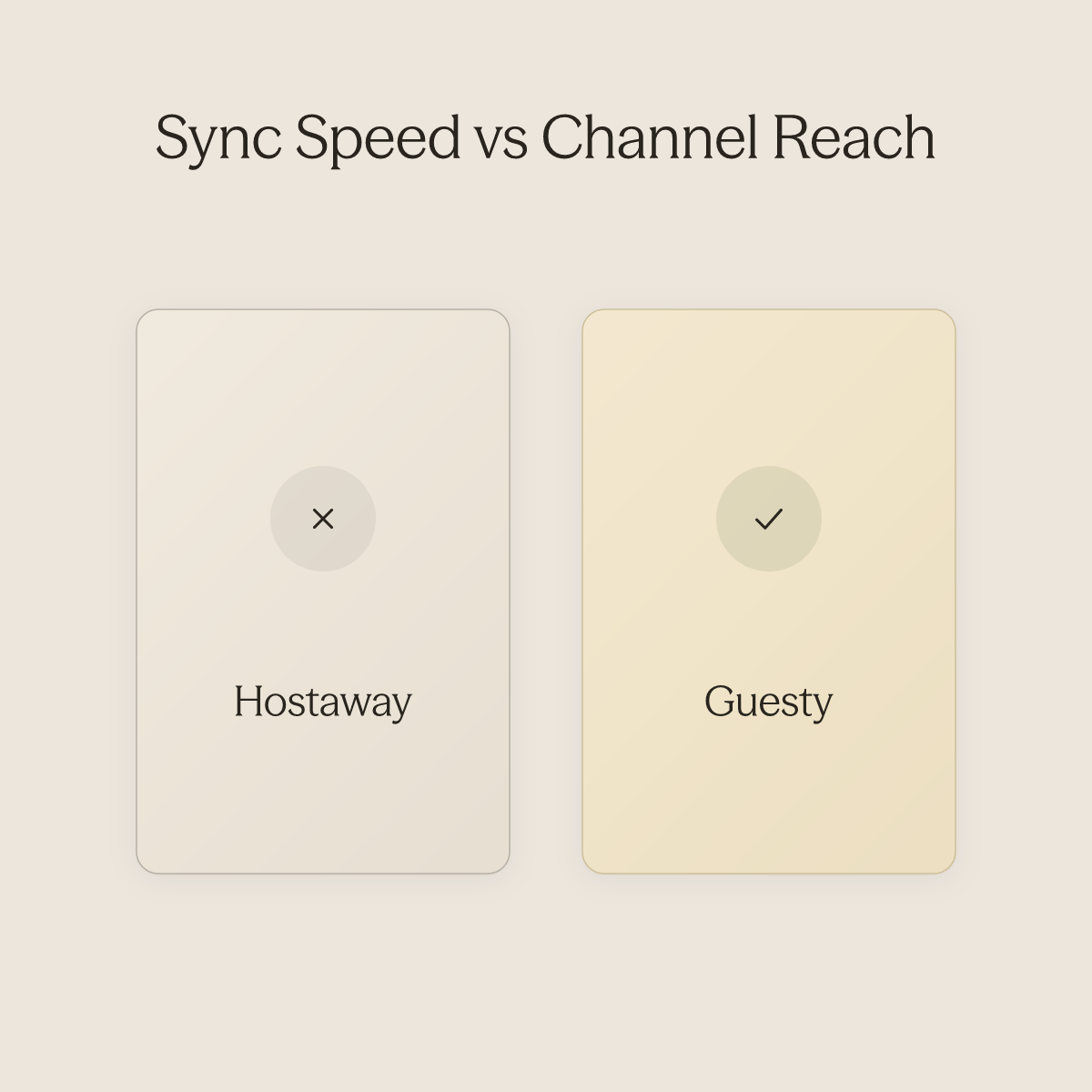
Sync speed is where channel count stops being theoretical. Guesty runs real-time calendar synchronization across all connected channels. Hostaway's sync can lag by up to 30 minutes, according to the same 2026 Pinnacle Path comparison. At five properties, that window is manageable. At 40, a 30-minute gap between a booking confirmation and a calendar update is a double-booking waiting to happen, a review-score event and a guest relationship problem, not just an inconvenience.
Native vs. Bolted-On
Guesty includes trust accounting, a native CRM, and dynamic pricing built directly into the platform. Hostaway's approach is different by design: a large marketplace of third-party integrations, with flexibility as the feature. The trade-off is that Hostaway operators building toward trust accounting or advanced dynamic pricing configure and maintain those connections themselves. Guesty operators pay for native depth upfront, which is part of why Guesty's cost structure skews higher.
Automation Depth and Where Each Platform Stops
Guesty's native workflow engine handles automated messaging, task triggers, and reservation-based rules with more configurability than Hostaway's out-of-the-box automation. Operators who've pushed both platforms find that ceiling becoming visible around 20 to 30 properties, when rule complexity starts requiring workarounds or third-party tools to fill the gap, a pattern the Pinnacle Path channel manager analysis corroborates, noting Guesty's workflow configurability as a differentiator at scale. The goal both platforms gesture toward is a systemized, scalable business that does not depend entirely on owner involvement.
Native automation depth is one lever toward that. But workflow automation and channel sync are infrastructure, they move reservations cleanly. They don't, on their own, resolve what happens inside the guest conversation layer.
Side-by-Side Feature Matrix
| Capability | Guesty | Hostaway |
|---|---|---|
| Channel connections | 60+ (native) | 32+ (native) |
| Calendar sync speed | Real-time | Up to 30-min delay |
| Trust accounting | Native | Third-party integration |
| CRM | Native | Limited native; third-party |
| Dynamic pricing | Native | Third-party integration |
| Automation workflows | Advanced native | Moderate native; extensible |
| Integration marketplace | Moderate | Large (primary strength) |
Where Both Platforms Go Quiet - The Guest Communication Layer
Both platforms automate reservations, channel distribution, and operational triggers. Neither solves the problem that scales hardest with portfolio growth: managing the actual back-and-forth with guests across every channel simultaneously, without the response quality degrading or the team drowning in tab-switching. The operational reality at scale looks like what Wynwood House's customer experience team lived before addressing it directly: agents constantly switching between platforms to draft messages, translate responses, review guest history, and track performance.
Guest resolution times averaged 15 minutes per issue. Sentiment was tracked manually in inconsistent Google Sheets. Shift handoffs required reading entire conversation histories.
Managers had no reliable visibility into guest satisfaction across the portfolio. ai's AI Agents and Inbox are most beneficial, specifically when a business is managing guest communications across multiple platforms or properties simultaneously and receives a high volume of repetitive guest messages. AI Agents can be trained on existing SOPs, FAQs, and operational manuals, and begin handling automated guest replies within days of connecting that documentation.
The Inbox gives operations teams a single surface to monitor, review, and manage every conversation the AI agent is handling, ongoing, across all channels, so managers gain reliable visibility without reconstructing context from scratch on every shift. Conduit can initiate the right communication automatically, replacing the manual staff action that currently fills that gap. And through Integrations with tools operators already use, like Notion, Google Drive, or Airbnb, the AI agent pulls from existing content without requiring manual re-entry into a new system.
The channel manager debate, Guesty's 60+ connections and real-time sync against Hostaway's integration flexibility, matters enormously for distribution. But distribution infrastructure and guest experience infrastructure are solving different problems. According to the Pinnacle Path analysis, the channel manager decision often comes down to portfolio size, regional OTA presence, and budget tolerance.
The guest communication layer is the variable neither platform fully owns, and the one that most directly determines whether scale becomes sustainable or simply louder.
Pricing Comparison - What Guesty and Hostaway Actually Cost in 2026
Pricing comparisons between Guesty and Hostaway usually start with the monthly subscription number. That instinct is understandable, but the subscription line is only one of three real cost variables. Operators who evaluate these platforms on subscription cost alone get surprised twice: once at onboarding, and once when the staffing bill arrives.
Guesty Onboarding Fee Starts at $1,500+, Hostaway Runs Around $500
Guesty's onboarding fee starts at $1,500 for its Pro and Enterprise tiers, according to a 2026 pricing analysis from rakidzich.com. Hostaway's onboarding cost runs approximately $500. For a 15-property operator, that gap is a material upfront commitment that arrives before a single booking routes through the new system. The two platforms price onboarding for different buyers, so the figure worth modelling is not the headline gap but what your first year costs on each once your unit count and required modules are plugged in.
Per-Property Subscription Costs, Predictable vs. Custom-Quoted
Hostaway offers per-property pricing operators can model in a spreadsheet. Guesty does not publish a public price sheet for its Pro or Enterprise tiers. Its custom-quoted model creates real forecast uncertainty for operators running 5 to 50 units: the number negotiated today is not necessarily the renewal number. Hostaway's predictable per-listing model removes that variable, which matters when presenting a cost case to a business partner or preparing for a portfolio acquisition.
Total Cost of Ownership Includes a Line Item Neither Pricing Page Shows
The cost both pricing pages leave off entirely is guest communication staffing. Neither Guesty nor Hostaway automates the human-in-the-middle fielding of routine guest inquiries across a growing portfolio. Operators spend significant hours per week on repetitive guest messaging, overhead that compounds with each new property.
The subscription delta between the two platforms shrinks considerably once you account for the coordinator, VA, or part-time staff handling that volume. Operators who have added a hospitality AI layer on top of their PMS, whether Guesty or Hostaway, are removing that staffing line item by deploying AI agents trained on their own SOPs and FAQs to handle guest communication autonomously. The real ROI question is not which subscription is cheaper.
It is which PMS pairs most cleanly with the communication layer that eliminates the cost neither pricing page acknowledges. Subscription cost and onboarding fees only tell you what the platform costs today. The next section maps which portfolio size each platform was built for, and where the growth math starts to break down.
$1,500+ Guesty onboarding fee vs Hostaway's ~$500
What Portfolio Size Is Each Platform Best Suited For: and Why It Matters
The platform that fits your operation at 12 units can quietly become a trap at 35. Not because the software breaks, but because the operational complexity that emerges between 20 and 50 units, trust accounting, deeper channel requirements, automation ceilings, was invisible at sign-up and only becomes painful once you're already embedded. The industry's standard framework, Hostaway for smaller operators and Guesty for enterprise, creates a false scaling ceiling. Operators who reach the 20–50 unit threshold and migrate to Guesty expecting enterprise-grade automation still hit the same guest communication staffing wall, because the actual scaling inflection point is not PMS sophistication but whether a dedicated AI communication layer exists above the PMS.
Hostaway for Mid-Sized Operators
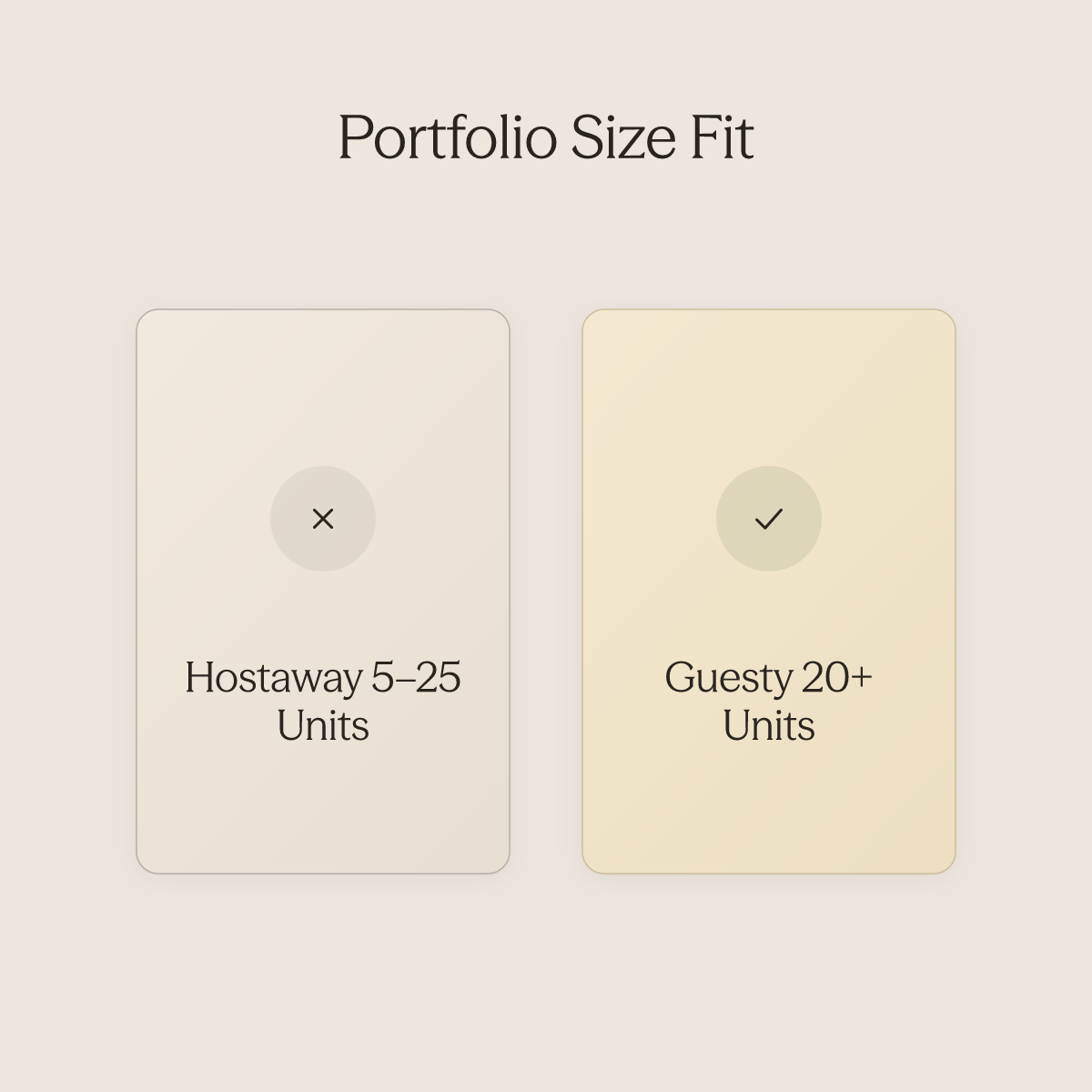
Hostaway is best suited for operators managing roughly 5 to 25 properties who want a capable, flexible PMS without the overhead of an enterprise contract. The platform's strength is its large integration marketplace, predictable per-property pricing, and an onboarding experience that doesn't require a dedicated implementation team. The honest trade-off: Hostaway's native automation workflows have a ceiling. Operators approaching 25 to 30 units often find themselves stitching together third-party tools to cover gaps that Guesty handles natively. That patchwork works until it doesn't.
Guesty for Large Portfolios
Guesty is best suited for portfolios of 20 or more units where native trust accounting, advanced CRM, and deeper channel coverage justify the higher entry cost and onboarding investment. The platform's architecture was designed for operational complexity at scale, so operators who need those capabilities built in rather than bolted on are buying a different thing than operators optimising for a low monthly rate.
The 10 to 50 Unit Danger Zone
The real risk sits in the middle. Operators between 10 and 50 units are too large for Hostaway's ceiling in some workflows and too small to justify Guesty's cost structure. This is where switching costs become concrete: industry estimates put a full PMS migration at several weeks of operational disruption and thousands of dollars in retraining and data transfer.
Portfolio-Fit Decision Table
| Portfolio Size | Recommended Fit | Key Reason | Watch-Out |
|---|---|---|---|
| Under 10 units | Hostaway | Low onboarding cost (~$500); predictable per-listing pricing | Native automation ceiling hits ~15–20 units |
| 10–25 units | Hostaway (with AI layer) | Flexible marketplace integrations; strong 24/7 support | May need third-party tools for trust accounting and dynamic pricing |
| 25–50 units | Evaluate both; add AI comms layer | Guesty native toolset starts earning cost; communication volume exceeds PMS automation at this range | Migration risk: several weeks disruption, thousands in retraining |
| 50+ units | Guesty | Native trust accounting, advanced CRM, 60+ channel real-time sync | Higher entry cost ($1,500+ onboarding); custom-quoted renewals add forecast uncertainty |
Quick decision checklist before you commit:
- Do your bookings concentrate on 3–4 major OTAs, or do you rely on regional OTAs where channel breadth is a revenue variable?
- Do you need trust accounting built in (Guesty) or are you comfortable managing a third-party integration (Hostaway)?
- Is your team fielding repetitive guest messages manually? If yes, budget for a communication layer, neither PMS eliminates this cost.
- Can you absorb Guesty's $1,500+ onboarding and custom-quoted renewal model, or does Hostaway's predictable per-listing pricing fit your forecasting needs better?
- Do you have documented SOPs and FAQs? If not, build them before evaluating any AI guest-communication add-on.
Customer Support and Ratings - Where Guesty and Hostaway Actually Differ
Review scores feel like a shortcut to certainty, and when one platform consistently outranks another on G2 and Capterra, it's tempting to treat that gap as the decision made. But those scores measure something more specific than most operators realize, and they say nothing about the operational layer beneath the PMS that determines whether your team actually scales.
Support Availability: Two Different Models
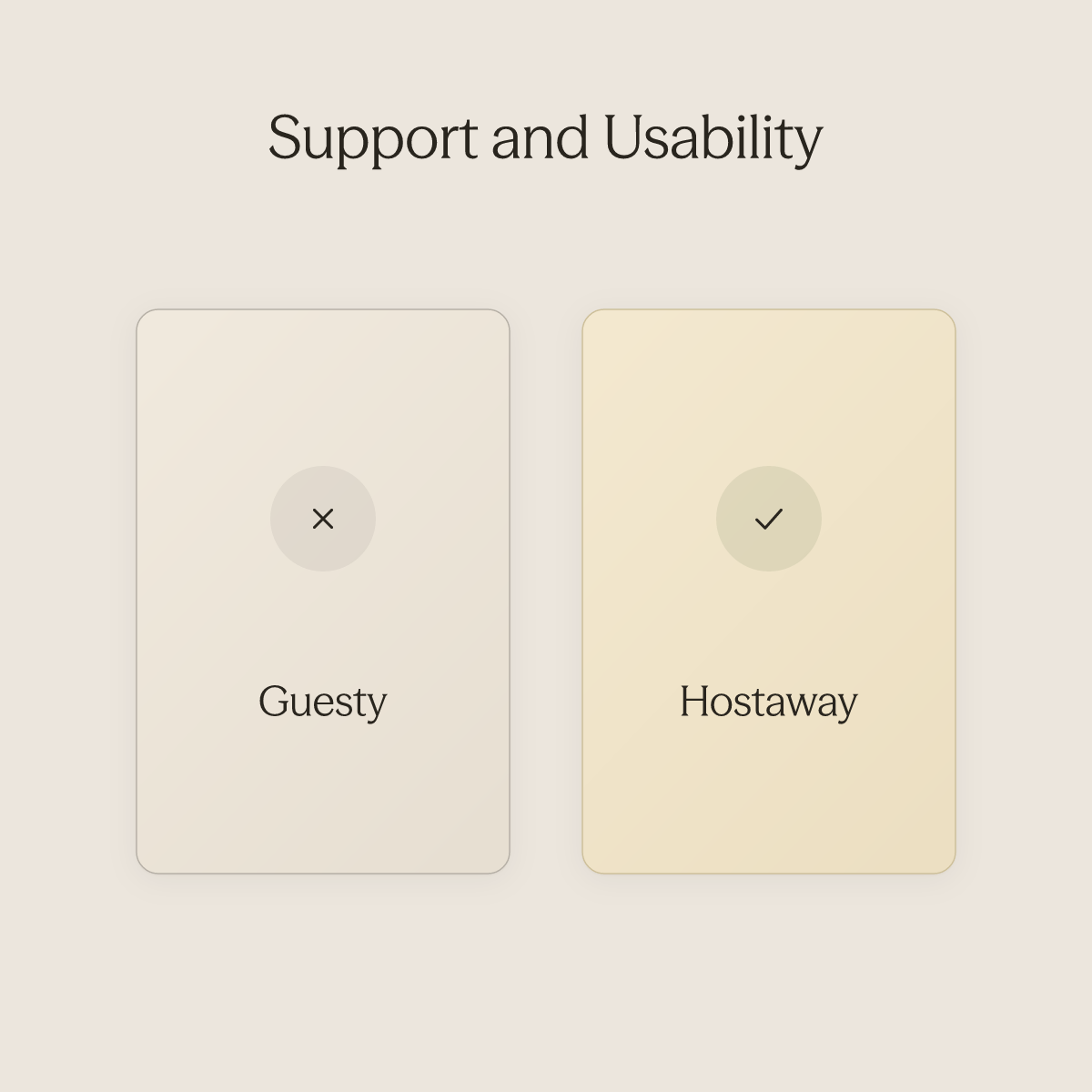
Hostaway offers 24/7 customer support across phone, chat, and email. Guesty's support access is tiered, meaning the depth of help you receive depends on which plan you're paying for. For an operator managing 20 or 30 properties, that distinction matters most at the worst moments: a sync failure at 10pm on a Friday, a double-booking flagged at checkout, a payment discrepancy before the guest's next stay. Operators who need round-the-clock resolution on PMS-layer problems should weigh Hostaway's always-on model against the plan tier they would need on Guesty to reach equivalent coverage.
What Review Site Scores Actually Signal
Third-party review platforms scored Hostaway higher than Guesty on G2 and Capterra across 2024–2025, though those scores skew toward the portfolio sizes each platform serves most. Guesty's depth comes with a longer learning curve, which operators running smaller portfolios feel more acutely than the larger teams its feature set was designed around. That is a question of fit rather than quality: the same configuration surface that feels heavy at 10 units is precisely what bigger operations are paying for.
Guesty's feature depth creates real operational overhead for teams not yet at scale. That's not a knock on Guesty's engineering; it's an honest signal about fit. It's also worth noting that trust in those review scores themselves is not universal.
A recurring concern among operators evaluating both platforms is whether a meaningful share of glowing reviews on aggregate sites reflect genuine independent operators or incentivized accounts, which makes first-party comparison pages like Hostaway's own breakdown useful as a structural reference, provided you read them knowing they carry a perspective.
Pros and Cons at a Glance
Guesty offers feature depth at the cost of complexity. Operators under 20 properties often find Hostaway's support model reduces friction. Operators running larger, multi-channel portfolios with trust accounting needs often find Guesty's native toolset worth the learning curve.
But whichever PMS sits beneath your operation, there is a cost neither platform's review score captures: the volume of repetitive guest messages your team handles manually, shift after shift. The support rating measures how well a vendor takes care of you. It says nothing about how well your operation takes care of guests at 2am across 30 properties, before, during, and after their stay.
Why Support Ratings Only Tell Part of the Story
Consider what scale actually demands. At 270 properties, Haven needed roughly 25 support staff across multiple shifts just to cover check-in questions, lockouts, cleaning issues, and complaints. Even after installing Conduit, with no structured workflows and a minimal knowledge base in place, automation reached only 40%, enough to reduce volume, but not enough to change how the team operated.
Every new property added more messages, more calls, and more headcount. That trajectory is the real benchmark missing from any G2 score. Conduit's AI Agents change that equation through the setup conditions most operators already have: if your business handles a high volume of repetitive guest messages and you have existing documentation, SOPs, FAQs, or property manuals, the agent can deliver its first automated guest reply within days of connecting those materials.
Workflows then extend that further, triggering automated guest touchpoints after booking confirmation, check-in, or keyword detection, without requiring manual staff action on each one. The Inbox gives your operations team a single place to monitor every conversation the agent is handling across all properties and platforms simultaneously, so oversight doesn't require more headcount as the portfolio grows. And because Conduit integrates directly with tools like Notion, Google Drive, and Airbnb, the knowledge base your agent draws on stays current without manual re-entry.
A strong support rating means someone answered your ticket. It doesn't mean your guests got a response at 2am, your team avoided a hire, or your operation became less dependent on shift coverage to hold together at volume. That's the gap the PMS comparison doesn't close, and where the layer above the PMS does the work.
Related Reading
- How To Automate Airbnb Business
- Vrbo Management
- Airbnb Self Check In
- Vacation Rental Automation
- Best Apps For Short Term Rentals
- Best Pms For Airbnb
- Best Pms For Short Term Rentals
- Best Accounting Software For Short Term Rentals
- How To Manage A Vacation Rental Property
- Vrbo Smart Pricing
The Guest Communication Gap Neither PMS Solves: and Why It's the Real Scaling Variable
That structural gap shapes how operators experience their PMS choice in practice, because most vacation rental property managers and operations leads go into the selection process believing the right platform will solve their communication and operations scaling problem, that the best automation workflows and most channel integrations will eventually resolve the staffing and responsiveness issues on their own. You connect your channels, set up your automated messages, and watch the calendar sync in real time. But operators managing 20, 30, or 40 properties quickly discover a second layer nobody mentions on the sales call: the relentless, high-stakes conversation volume that lands in your inbox at 11 PM and doesn't care which software you chose.
Both Platforms Automate Channels, Not Conversations
"Automated guest messages are frequently ignored or skimmed, meaning critical information fails to reach guests despite being sent, a direct communication gap that PMS automation does not resolve."
Guesty and Hostaway both handle channel distribution well. Calendar sync, rate updates, reservation management, solved problems on either platform. What neither solves is the guest asking for the WiFi password, early check-in approval, or a noise complaint resolution at midnight.
Automated pre-arrival messages get sent; they also get skimmed, ignored, or misread. That last part is a structural failure, not a content problem: when critical information is buried in a template, the follow-up question still lands in the queue, and someone still has to answer it. The message was sent; the communication never happened.
There's a compounding problem operators running multiple platforms know well: when a guest messaging tool doesn't integrate with the PMS, staff have to manually pull up reservation data every time a message comes in, unit number, check-in date, booking source, special notes. That multi-step lookup defeats the purpose of having a messaging system at all. It turns every guest reply into a small research project.
Conduit's Inbox and AI Agents are built specifically for this layer. The Inbox gives the operations or support team a single place to monitor, review, and manage every conversation the AI agent is handling across properties and platforms simultaneously, without tab-switching or manual lookups. The AI Agents themselves are trained on existing SOPs, FAQs, and manuals, so the answers they surface are grounded in the operator's own documentation, not generic responses.
Because the agent connects to tools operators already use, Notion, Google Drive, Airbnb, there's no manual re-entry of content that already exists.
The Staffing Math That Breaks at 20-Plus Properties
Communication load scales with every property you add. A team that handles 15 units reasonably well starts drowning at 25, not because the PMS failed, but because manual guest messaging volume grew proportionally and the platform was never designed to absorb it. Operators managing guest replies by hand spend 20 or more minutes per booking on messaging alone.
Across a growing portfolio, that time doesn't compress; it multiplies. The only visible fix starts to look like another hire, a cost Conduit is designed to eliminate.
AI Agents are most beneficial precisely when a business receives a high volume of repetitive guest messages and already has documentation to train on, the exact situation operators face at scale. Once SOPs and manuals are connected, the first automated guest reply goes live within days. After that, the agent responds continuously, before, during, and after every stay, without the volume ceiling a human team hits.
As Noel Poler, Owner of The Lauderdale Boutique Hotel, put it directly: "The more hands-off the property, the higher the valuation. We designed and built for that."
Workflows extend this further: triggered automatically after a booking is confirmed, after check-in, or when a specific keyword appears in a conversation, they handle the recurring, predictable guest touchpoints that currently require manual staff action, without anyone on the team initiating them.
Response Time and Consistency as Review-Score Variables
According to industry research on response times in hospitality, hosts who respond quickly see up to 116% more bookings than those with slower response times. Booking platforms factor response speed into listing visibility algorithmically, meaning a slow reply doesn't just frustrate a guest, it suppresses your ranking. Neither Guesty nor Hostaway controls how fast your team actually responds.
That variable lives entirely in the communication layer. Timely, consistent communication isn't a hospitality nicety; it is a direct input into review scores and search placement. Conduit's AI Agents respond to every guest message the moment it arrives, before, during, or after a stay, which means the response-time variable that neither PMS controls is no longer dependent on when a team member happens to check the inbox.
Why the Guesty vs. Hostaway Debate Misses the Real Problem
Operators who've done everything right, solid PMS, clean channel stack, automated templates, still find their team fielding the same repetitive questions across 40 threads every morning. The structural gap both platforms share isn't a feature they're missing; it's a layer they were never designed to own. Channel management and guest communication are adjacent problems that require different architectures to solve. The PMS manages the reservation. The communication layer manages the relationship, and at volume, that relationship work is what determines whether a guest leaves a five-star review, books again, or complains about a slow response on a platform that's already watching your reply rate.
How Operators Are Adding an AI Layer on Top of Their PMS to Break the Staffing Ceiling
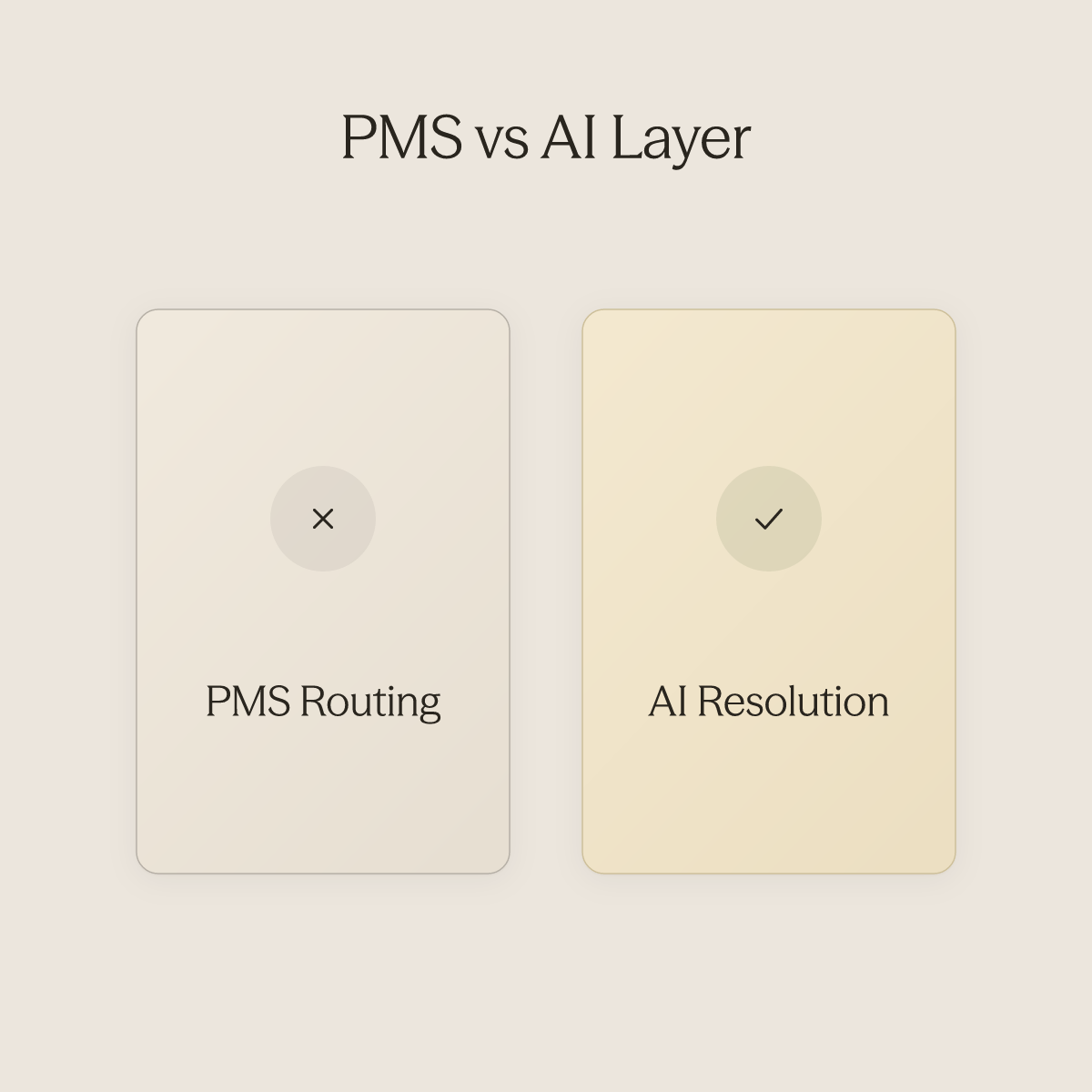
Every operator who has invested in Guesty or Hostaway knows the feeling: you've built the inbox, set up the templates, configured the auto-messages, and your team is still fielding guest questions at 9 PM. The PMS did exactly what it was designed to do. The problem is that "routing messages faster" and "resolving conversations autonomously" are two entirely different capabilities, and only one of them removes a person from the loop.
Why the PMS Inbox Is a Routing Tool, Not a Resolution Engine
Guesty and Hostaway both offer unified inboxes and rule-based auto-messaging. What they don't offer is contextual judgment. A guest who asks "Can we check in an hour early, and also, is the parking covered?" needs an answer that cross-references your availability calendar, your parking policy, and your upsell pricing. A template fires a pre-written reply. A routing rule sends the thread to whoever is on shift.
Neither resolves the conversation. The deeper operational trap is this: traditional PMS platforms rely on strict If/Then rule-based automation that operators must manually set up and maintain. Every new property, seasonal policy change, or platform quirk means someone on your team rebuilds the rules.
That creates ongoing operational overhead and a staffing bottleneck that compounds as you scale. Operators managing 30 or more properties receive hundreds of guest messages per month per property cluster, and volume grows faster than any inbox optimization can absorb. Broader industry trends make this clear: the short-term rental market continues to expand, which means that message volume problem only gets worse over time.
Cash Flow Street: 96% Automation Across 35 Properties
One operator running 35 properties achieved 96% guest communication automation by adding a purpose-built AI communication layer on top of their existing PMS. That figure does not mean 96% of messages received a canned reply. It means 96% of guest conversations reached full resolution without a human writing a single word.
The remaining 4%, edge cases requiring genuine operational judgment, were escalated cleanly. The PMS stayed in place, handling reservations and channel sync. The AI layer sat above it, handling the conversation.
This kind of setup is most beneficial when guest touchpoints are recurring and predictable: WiFi questions, early check-in requests, parking policies, noise guidelines. When those touchpoints are documented in SOPs, FAQs, or property manuals, a purpose-built AI agent can be trained on that content and begin firing its first automated guest reply within days of connecting those materials, without IT involvement. The operator or ops lead sets the rules; no engineering resources required.
Easy BnB: $22K in Labor Savings Across 75 Units, Zero New Hires
Darren, founder of Easy BnB, scaled to 75 units without adding a single new hire and cut approximately $22,000 in monthly labor costs after deploying AI guest communication across his portfolio. His previous model relied on 14 virtual assistants for 24/7 coverage, with roughly 80% of that volume routine, repetitive, and resolvable without human input. His summary of the shift captures the calculus that many operators eventually reach: "We all agree that AI first is the best approach. I've just got to stop investing in building our own stuff because these guys are going to do it better."
The honest trade-off remains: this model works best when your operation receives a high volume of repetitive guest messages AND you have existing documentation the AI can train on. Operators without that documented foundation must build it first; without both conditions in place, the automation payoff will not fully materialize. Across the market, guest communication volume is one of the fastest-growing operational challenges for multi-property managers, making the case for a scalable resolution layer, not just a routing layer, more urgent each year.
How SOP-Trained AI Agents Handle What PMS Automation Can't
Generic helpdesk tools answer from a fixed knowledge base and cannot cross-reference a specific property's availability calendar, upsell pricing, or custom house rules. Purpose-built, SOP-trained AI agents handle exactly that by design, and they do it continuously, responding to every guest message before, during, or after a stay without requiring a human in the loop for routine interactions. Equally important is what happens after a trigger event: a booking confirmation, a check-in, a keyword detected mid-conversation.
Workflows fire automatically at those moments, sending the right message to the right guest at the right time, while the operator's Inbox gives the ops or support team a single place to monitor, review, and step in on the conversations the AI is managing across every platform and property simultaneously. For operators already using tools like Notion, Google Drive, or Airbnb, native integrations mean that existing content, house manuals, SOPs, local guides, feeds the AI agent directly, without manual re-entry. The result is a system where adding properties does not mean adding coordination headcount; it means the AI absorbs the volume that would otherwise land on a person at 9 PM.
Guesty vs Hostaway - FAQ on the Differences That Actually Matter
Searching any Guesty vs Hostaway FAQ feels productive until you realize the answers are incomplete. Each question resolves cleanly on paper, but the operational problem underneath stays open, because the FAQ format addresses platform variables while the variable most directly affecting your reviews and revenue sits outside both platforms entirely. The comparison below is built on what operators actually run into day to day, rather than on feature lists alone.
Under 20 Properties vs 40 - Does the Answer Change?
For operators under 20 properties, Hostaway is the more common fit. Per-property pricing scales more predictably at smaller portfolios. Guesty's native toolset, trust accounting, advanced CRM, is genuinely useful but carries real weight before your operation needs enterprise-grade complexity.
Smaller operators we work with consistently find that Guesty's rigidity creates friction in day-to-day workflows long before its advanced features become relevant. At four listings, the configuration overhead alone can cost more in time than the features return in efficiency. At 40 properties, the calculus shifts.
Guesty's automation workflows and broader channel coverage start earning their cost. Even so, the platform you choose at 40 units doesn't resolve the same pressure point: guest communication volume scales with the portfolio, and neither PMS was built to absorb that load autonomously. This is where operators with specific brand standards, escalation policies, or differentiated rules across properties hit a structural ceiling, the PMS manages reservations, but no one is staffed to handle the message volume that comes with them at scale.
What Both Platforms Leave Unresolved - Guest Communication at Scale
Neither Guesty nor Hostaway was architected to handle the conversational layer of short-term rental operations. Both platforms offer inbox consolidation and templated auto-replies, and both are frequently described in marketing materials as solving guest communication. They don't. They centralize it, which is a different thing entirely.
Centralization means your messages from Airbnb, Vrbo, Booking.com, and direct channels arrive in one place. It does not mean those messages get answered accurately, at 2 a.m., in the guest's language, with awareness of the specific property's quirks, your escalation policy, and the context of what that guest asked three hours earlier. That gap, between message consolidation and genuine communication management, is where reviews are won or lost, and where operator time disappears.
The operators who feel most frustrated by both platforms are typically the ones who built their evaluation around channel integrations and pricing engine depth, got the PMS decision right for their portfolio size, and then discovered six months in that the communication problem hadn't moved. Response times are still inconsistent. Guests are still asking questions the auto-replies don't cover. Team members are still manually triaging the inbox at hours that don't scale. The PMS made the reservation layer manageable. It left the relationship layer entirely exposed.
This is the structural gap that a purpose-built guest communication layer addresses, sitting between your PMS and your guests, handling the message volume your team can't absorb, maintaining brand voice and property-specific accuracy, and escalating only what genuinely requires human judgment. Whether your portfolio runs on Guesty or Hostaway becomes largely irrelevant to this problem, because the problem exists independent of which platform holds your reservations. Solving the PMS question first is correct. Treating it as the complete answer is where operators consistently stall.
Related Reading
- Lodgify Competitors
- Vrbo Automated Messages
- Guesty Alternatives
- Lodgify Vs Smoobu
- Guesty Vs Hostfully
- Guesty Vs Hospitable
- Ownerrez Vs Guesty
- Hospitable Vs Hostaway
Next steps
If your team is still fielding WiFi passwords and early check-in requests at 11pm across 30 properties, the path forward starts with recognizing that the PMS comparison you just completed solved the wrong problem. Choosing between Guesty and Hostaway resolves your channel and calendar layer. It does not resolve the communication volume that scales linearly with every property you add. Start with our AI for hospitality.
The insight that operators in the 20-to-50 unit range hit the same staffing wall regardless of which platform they chose means that migrating to a more sophisticated PMS is not the lever. The insight that neither platform's pricing page includes the guest communication staffing line means the true cost difference between Guesty and Hostaway is far smaller than the subscription delta suggests. Together, they point to the same next step: adding a purpose-built AI communication layer on top of whichever PMS already runs your operation.
Start with conduit.ai to see how its AI Agents, trained on your existing SOPs and FAQs, handle the overnight inbox your PMS was never designed to own.
Frequently Asked Questions
Does Guesty or Hostaway actually handle guest messages automatically, or do I still need staff for that?
Neither platform fully solves the guest communication layer. Both automate reservations and channel distribution, but the back-and-forth with guests, WiFi questions, early check-in requests, late-night inquiries across dozens of properties, still requires manual staff time on both platforms. That gap is where an AI communication layer like conduit.ai's AI Agents and Inbox sits above the PMS, handling automated guest replies and giving operations teams a single surface to monitor every conversation across all channels.
Is the channel count difference between Guesty and Hostaway actually important?
It depends on your market. Guesty connects to 60+ channels natively versus Hostaway's 32+, but the gap is not always decisive if your bookings concentrate on three or four major platforms. The difference matters most in markets with strong regional OTA presence, where Guesty's broader reach captures distribution Hostaway doesn't touch.
How much does it cost to get started with each platform, beyond the monthly subscription?
Guesty's onboarding fee starts at $1,500 for its Pro and Enterprise tiers, while Hostaway's onboarding cost runs approximately $500. On top of that, neither platform's pricing page accounts for the guest communication staffing cost, the coordinator or VA fielding routine guest inquiries, which compounds with every new property added to the portfolio.
Does Guesty or Hostaway include dynamic pricing and accounting built in, or do I need extra tools?
Guesty includes dynamic pricing and trust accounting natively, built directly into the platform. Hostaway takes a different approach, operators configure and maintain those capabilities through third-party integrations from its marketplace, which offers flexibility but requires managing those connections yourself.
Which platform fits an operator managing somewhere between 10 and 50 properties?
The post describes this range as a genuine "danger zone", operators here are often too large for Hostaway's automation ceiling in some workflows but too small to easily justify Guesty's cost structure and $1,500+ onboarding. The more decisive variable at this scale isn't which PMS you choose, but whether you add a dedicated AI communication layer above it, since guest message volume at 20–50 units exceeds what either platform's native automation can handle.
Stay in the loop
Get the latest on AI automation, product updates, and customer stories.