Hospitable vs Hostaway: How They Compare for Hosts


Hospitable vs Hostaway
How the two compare for hosts
You're not searching this at a calm moment. Here's why switching platforms won't fix the problem that's actually breaking your operation as you grow.
Most vacation rental property managers and operations leads think the solution is picking the channel manager with the best built-in automation, whether that's Hospitable's AI messaging or Hostaway's workflow rules, and that those tools will handle the communication load at scale. But most operators searching "Hospitable vs Hostaway" aren't doing it from a place of calm, strategic planning. They're doing it at 11pm after a double-booking scare, or the morning after a guest complaint went unanswered for six hours.
The search is a distress signal dressed up as a feature comparison. The trigger is almost always a specific moment. An operator managing eight properties on Hospitable signs their twelfth listing and realizes Airbnb message threads are stacking up overnight with no one to answer them.
Or a team running Hostaway hits five active channels and finds the workflow rules they built for three properties are buckling under thirty. Across the vacation rental industry, operators consistently find that the platform decision at growth inflection points is fundamentally about operational architecture, not feature selection, a pattern reflected in community discussions on forums like BiggerPockets and STR Facebook groups, where hosts report that the right tool at twenty properties often breaks down structurally at fifty.
Hosts at the four-to-six property threshold hit a wall that feels like a software problem but is actually a coordination problem. The question "am I on the right platform?" becomes urgent precisely because the operational cost of being wrong rises with every new booking.
The assumption driving most of these searches is that picking the right platform will absorb the operational drag. It rarely does. Switching channel managers solves distribution.
It does not solve the communication burden scaling invisibly in the background with every property added. That burden grows for three reasons:
- Each new property multiplies guest touchpoints across every active channel, not just the one where the listing was added.
- Workflow rules and message templates built for a smaller portfolio rarely account for the edge cases that appear at scale.
- Neither platform restructures the underlying coordination model as headcount and listing count diverge.
Key takeaways
- Hospitable and Hostaway solve the same core problem, syncing calendars and listings across Airbnb, Vrbo, and Booking.com, and their feature overlap is wider than most comparison posts admit.
- Hospitable fits small portfolios that need a gentle setup curve; Hostaway fits operators running 40-plus units who need deep channel breadth and are willing to pay the configuration cost upfront.
- Neither platform was built to handle what breaks teams at scale: the continuous flood of guest messages that arrives after the booking is confirmed.
- Operators who switched platforms to escape the communication burden report the messages kept coming regardless, the bottleneck is structural, not a feature gap that switching PMS fixes.
- At 30-plus properties, response time and message volume become the actual operational constraint, not OTA sync quality.
- Erwan Le Roy hit 96% automation and sub-1-minute response times across 35 properties, not by switching channel managers, but by layering purpose-built AI on top of the one already in place.
- conduit.ai's AI Agents close that gap by handling guest conversations autonomously, pulling answers directly from your SOPs, manuals, and FAQs across every channel, no human intervention required.
What the Hospitable vs Hostaway Comparison Always Misses - The Communication Ceiling
The common assumption among vacation rental property managers and operations leads is that the solution is picking the channel manager with the best built-in automation, whether that's Hospitable's AI messaging or Hostaway's workflow rules, and that those tools will handle the communication load at scale. The conversation around channel managers follows a familiar pattern: which platform syncs listings faster, which has better OTA coverage, which pricing rules are more flexible. Real questions, worth answering. But they share a consistent blind spot: neither Hospitable nor Hostaway was built to solve the problem that actually breaks operators at scale, the continuous, unscripted, around-the-clock guest communication that lands in your inbox the moment a booking is confirmed.
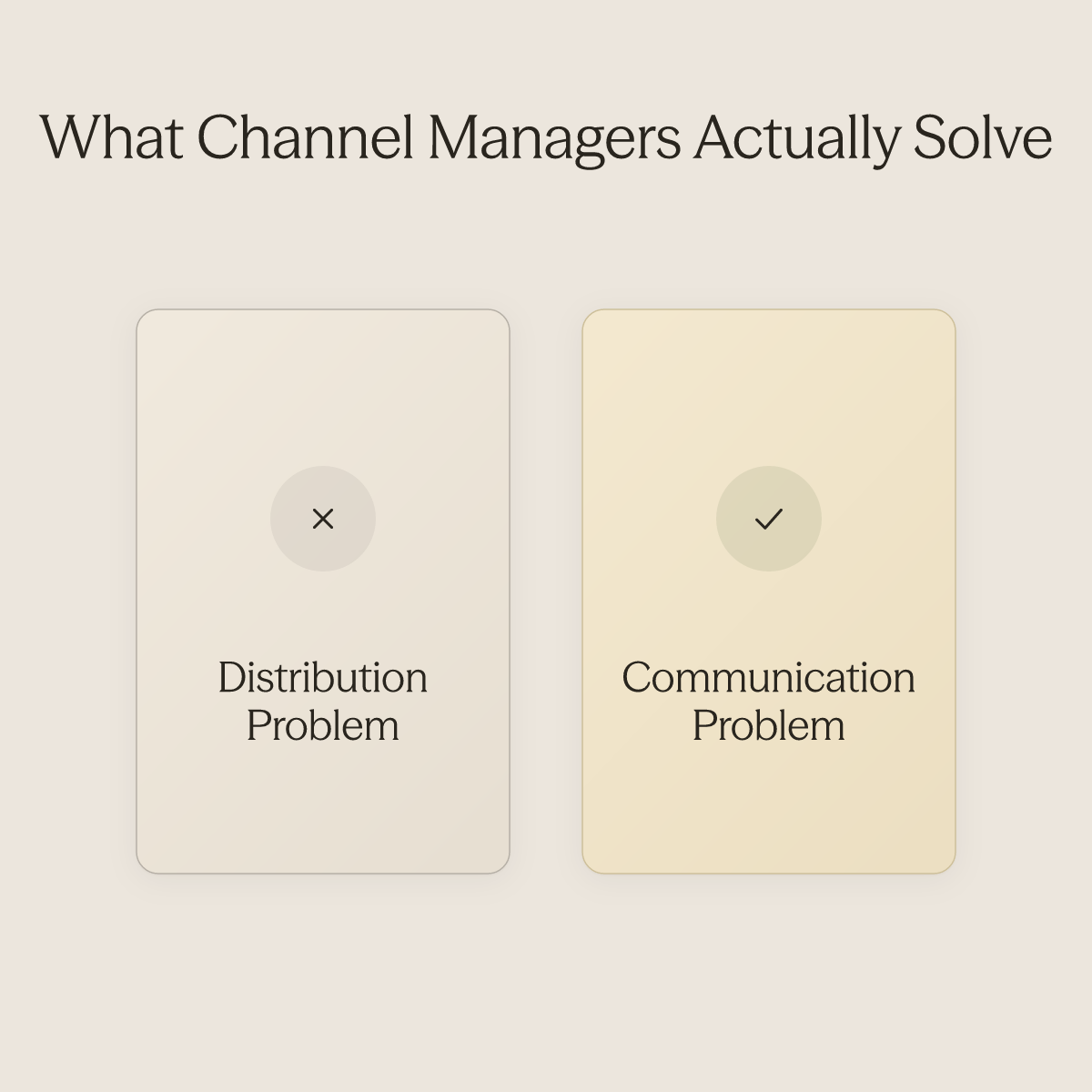
The Distribution Problem vs. The Communication Problem
Channel managers solve a specific problem: getting your listing in front of guests on multiple platforms without double-bookings or manual rate updates. But the moment a guest books, a different problem begins. They message at 11pm about the WiFi password. They ask for a late checkout on a Saturday morning when your cleaner is already scheduled. These are not distribution problems. No amount of OTA sync fixes them.
How Guest Message Volume Scales With Every Property You Add
The math is unforgiving. A standard booking lifecycle generates multiple scheduled touchpoint messages, welcome notes, check-in instructions, mid-stay check-ins, and review requests, before a single unscripted question arrives. At 50 bookings a month, that is 250 to 300 outbound messages before a single unscripted question arrives. Add ten properties and you have a small call center's worth of daily communication sitting inside a platform designed to sync calendars, not hold conversations.
The Shared Blind Spot
Both platforms automate the scripted, scheduled layer of guest communication. The reactive, conversational layer remains a human responsibility. Response time directly affects Airbnb ranking and review scores, meaning every unanswered late-night message carries a measurable revenue consequence. AI for hospitality platforms like Conduit address exactly this gap, handling the reactive, conversational layer that channel managers were never designed to absorb, so operators aren't forced to choose between response speed and sleep.
What Is Hospitable Best For? Small Portfolios, AI Messaging, and a Gentle Learning Curve
Small Portfolios, AI Messaging, and a Gentle Learning Curve
Hospitable earns genuine loyalty from hosts who want operational clarity without a steep learning curve, a pattern consistently reflected in G2 and Capterra reviewer sentiment, where ease-of-setup is the most frequently cited strength across independent host reviews. For operators managing a handful of properties across Airbnb, Vrbo, and Booking.com, the platform delivers real value: clean calendar management, reliable OTA sync, and a messaging layer that handles predictable, scheduled touchpoints. The honest question is where that value starts to thin out.
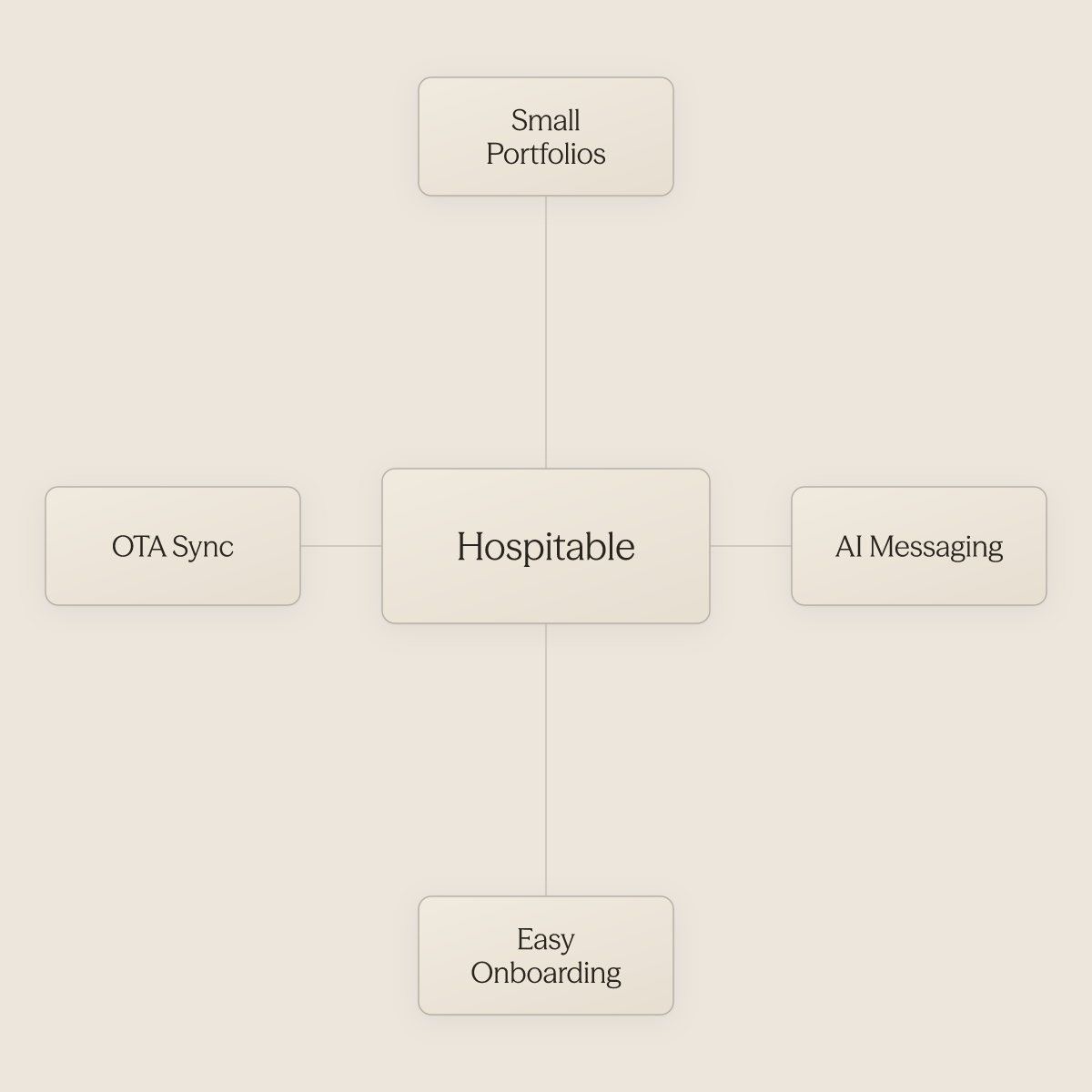
Hospitable's Sweet Spot: 1 to 20 Properties, Where Simplicity Is the Point
Hospitable is purpose-built for small portfolio operators, and that focus shows in every design decision. The interface is self-explanatory, OTA connections are stable, and the workflow logic is built around a host managing five to fifteen properties without a dedicated operations team. A host with five Airbnb listings who wants automated welcome messages and a clean calendar view can be fully operational without a single onboarding call. Hospitable's documented self-serve onboarding is measured in hours, a meaningful contrast to Hostaway's two-to-eight hour guided setup.
That accessibility is a genuine competitive strength, not a consolation prize. The trade-off is structural, and it runs deeper than feature gaps. One of the most persistent challenges independent hosts face as they grow is the assumption that adding properties means adding headcount: more listings create more guest touchpoints, more mid-stay requests, more post-checkout follow-ups, and more coordination overhead that quickly exceeds what one person can absorb.
Operators who push past twenty properties start hitting friction points the platform was never built to absorb: reporting becomes thin, integration options narrow, and the communication layer stops keeping pace with guest inquiry volume and complexity. The core problem, scaling the portfolio without proportionally increasing headcount, remains unsolved at that inflection point.
Pros and cons at a glance
| ✓ Pros | ✗ Cons |
|---|---|
| Clean calendar management and reliable OTA sync | Reporting becomes thin past twenty properties |
| Self-explanatory interface with no onboarding call needed | Integration options narrow at higher property counts |
| Fully operational in hours via self-serve onboarding | Smarty hands off to human for any unscripted inquiry |
| Flat-fee pricing with no percentage-of-revenue cuts | Automation ceiling and pricing ceiling arrive at the same portfolio size |
| Smarty automates recurring, predictable guest touchpoints | Communication layer stops keeping pace with inquiry volume at scale |
Hospitable pricing is structured around flat monthly fees, starting with a free Essentials tier at $0 per month and scaling to paid plans. Hospitable's pricing page shows flat monthly rates that vary by role (individual host, co-host, property manager) and portfolio size, not a simple per-property line item; operators should verify current tiers directly, as plan structures update periodically. There are no percentage-of-revenue cuts, no hidden booking fees, and no enterprise contract requirements. Plans are differentiated by role rather than by feature depth, signaling a product optimized for accessibility over operational complexity. That clarity aids self-selection, but it also means the pricing ceiling and the automation ceiling arrive at roughly the same portfolio size.
Smarty, Hospitable's AI Messaging Engine - What It Automates and Where It Stops
Smarty, Hospitable's built-in AI messaging feature, handles trigger-based, templated communication reliably. Check-in instructions, review requests, pre-arrival reminders, and post-checkout follow-ups all run on schedule without manual intervention, covering the recurring, predictable guest touchpoints that currently require the most manual staff action. For hosts whose primary goal is reducing time spent on manual, repetitive messaging tasks, Smarty delivers meaningfully within that defined scope.
The ceiling appears when guests ask questions outside the pre-set template library, a mid-stay request to adjust checkout, a late-night question about parking, or any inquiry that requires reading the context of the conversation rather than matching a trigger keyword. At that point, Smarty hands off to a human, and the automation advantage narrows. For operators managing guest communications simultaneously across multiple platforms or properties, this handoff pattern compounds quickly: the inbox fills with edge-case conversations that the rule-based layer was never designed to resolve, and the coordination headcount that scaling was supposed to avoid starts creeping back in.
That gap, between what scheduled triggers can handle and what a genuinely conversational guest inquiry demands, is precisely where Hospitable's architecture reaches its structural limit.
What Is Hostaway Best For? Scaling Portfolios, Channel Depth, and Enterprise Complexity
Hostaway is built for scale. Property managers running 40, 60, or 100-plus units across multiple OTAs need a platform built for that complexity, and Hostaway was designed precisely for that operator. The trade-off is real: the same features that serve scale also make it slower to configure, carry a higher starting cost, and ask more of your team's time before the first operational benefit lands.
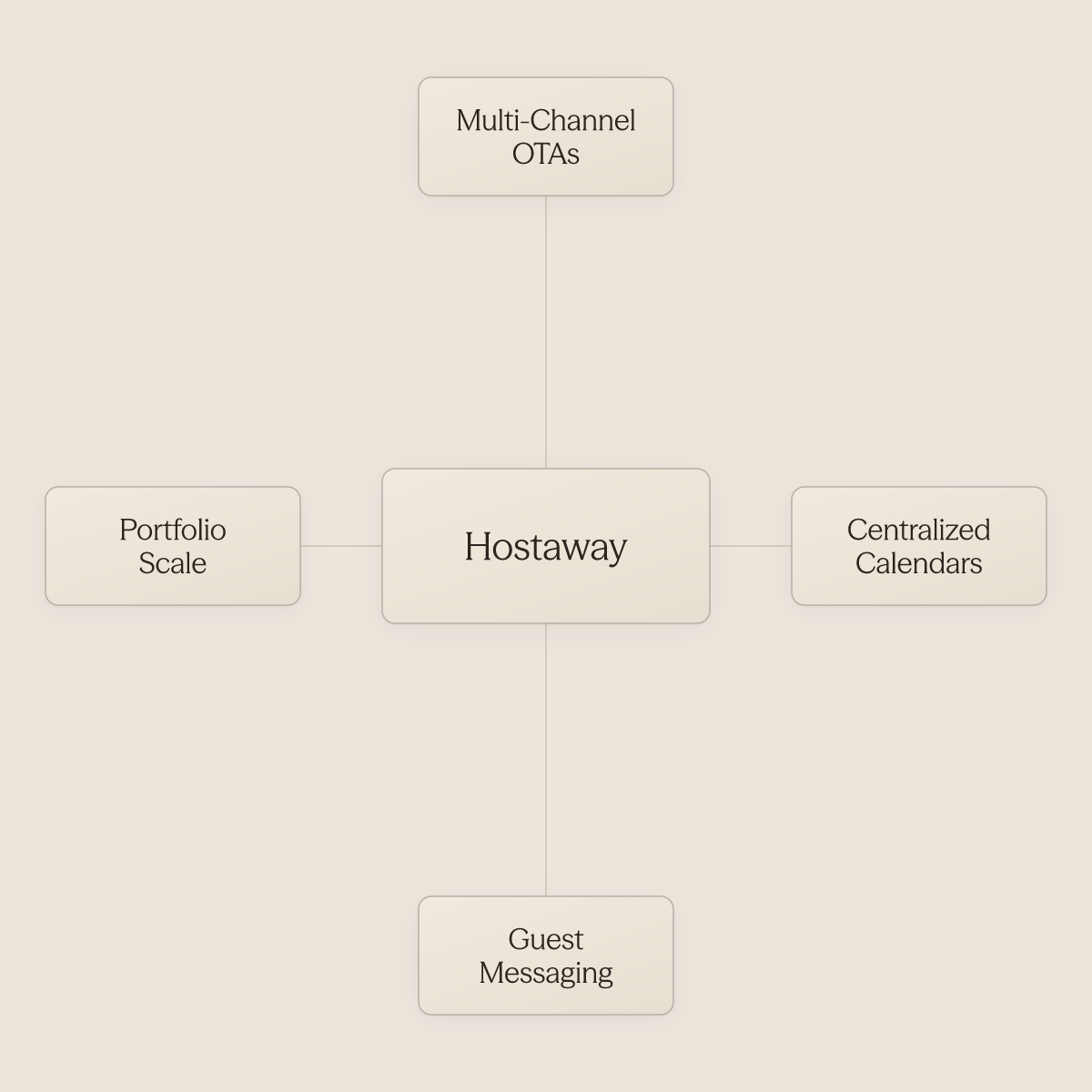
Built for the 10-to-100 Plus Property Operator Who Needs Distribution Muscle
"Users report intermittent glitchiness with calendar sync, which can disrupt multi-channel booking management at scale."
Pros and cons at a glance (What Is Hostaway Best For?
Scaling Portfolios, Channel Depth, and Enterprise Complexity)
Hostaway is best suited for scaling property managers who need serious distribution reach. The platform targets operators in the 10-to-100-plus property range coordinating listings across multiple OTAs, managing centralized calendars, and running operations that have outgrown spreadsheets or entry-level tools. The value proposition is clear: one platform that consolidates channel management, reservations, and guest conversations without requiring a separate tool for each function.
That said, operators at the lower end of that range, managing 10 to 40 units, often find Hostaway feels over-engineered for where they currently sit. The configuration overhead and annual contract structure can create friction before a smaller portfolio generates the volume that justifies it. The platform's reputation at the 40-plus-unit tier is well-documented; below that threshold, the fit is less obvious, and the ramp cost hits harder relative to revenue.
100 Plus Platform Integrations and 32 Plus Direct API Connections According to Hostaway's channel manager documentation, the platform connects to 100-plus distribution channels and maintains 32-plus direct API integrations. That list includes premium placement partners like Marriott Homes and Villas and Google Vacation Rentals, which most mid-tier property management systems do not reach. For an operator at 40 units who needs Marriott-level distribution and a dedicated account manager, that depth is difficult to replicate in mid-tier PMS platforms.
More distribution connections, however, mean more booking touchpoints, and more unscripted guest inquiries arriving across all of them, at all hours. Every new channel you activate in Hostaway creates a new surface for guests to ask questions before arrival, flag issues during a stay, or request something your workflow rules were never trained to handle. The hidden cost of distribution depth is communication volume, and that volume scales in direct proportion to the reach you just paid to unlock.
Operators who have pushed Hostaway's channel manager to its limits also report intermittent calendar sync glitchiness, a meaningful operational risk when a double-booking or missed availability update touches a Marriott Homes and Villas listing.
Custom Enterprise Pricing, a Setup Fee Around $500, and Annual Contracts
Hostaway pricing is custom-quoted, with no published per-unit rate on the website. Third-party review platforms including G2 and Capterra consistently cite a one-time setup fee in the range of $500, alongside annual contract requirements. That structure rewards long-term commitment but creates real budget exposure for anyone still in the evaluation phase. Budget for the ramp cost, not just the subscription line item.
What Hostaway's Depth Asks of Your Team
Every new channel you activate in Hostaway creates a new surface for unscripted guest communication to arrive.
Hostaway's workflow rules handle structured triggers well, post-booking confirmations, check-in instructions sent after a trigger event, keyword-detected escalations, but dynamic, context-sensitive guest conversations still land in a human inbox. The hidden cost is not the subscription fee; it is the communication volume that scales in proportion to the distribution depth you just paid to unlock. This is where Conduit's AI Agents layer becomes operationally relevant.
An AI Agent trained on your existing SOPs, FAQs, and property manuals begins handling repetitive guest inquiries automatically, before, during, and after a stay, without adding headcount as your portfolio grows. The Inbox surfaces every guest conversation across all connected channels in one place, so your operations team can monitor, review, and step in on the edge cases that genuinely require a human. Workflows fire after the trigger events your team would otherwise track manually: a booking confirmation, a check-in, a specific keyword in a guest message.
Conduit integrates with tools like Notion, Google Drive, and Airbnb directly, your AI Agent draws on documentation your team has already written, no manual re-entry required. The result is the ability to expand a portfolio without a proportional increase in support headcount, maintain a consistent brand voice across every channel and property, and capture every guest inquiry around the clock, closing the revenue leak that opens the moment a guest sends a message at midnight that no one sees until morning.
Head-to-Head Feature Comparison - Channel Management, OTA Support, and What Both Platforms Share
Feature grids make both platforms look comprehensive. Hospitable and Hostaway share more common ground than most comparison posts admit, and where they genuinely diverge is narrower than operators expect when they start the evaluation.
Both Platforms Cover the Core OTA Trio, Where Channel Depth Actually Diverges
Both Hospitable and Hostaway natively support Airbnb, Vrbo, and Booking.com, the three channels that drive the majority of short-term rental revenue for most portfolios. That baseline is table stakes. Where the platforms separate is extended channel reach. Hostaway's documented channel connections include Expedia alongside the core trio, reflecting a distribution architecture built for operators who want to cast a wider net. Hospitable's channel list is tighter, centered on the major three, which suits hosts whose revenue is already concentrated there.
Hospitable's Self-Serve Onboarding vs. Hostaway's Guided Start, What Setup Really Costs You
Hospitable is designed to be live within hours: connect listings, configure automated message sequences, and sync calendars without touching a support queue. Hostaway's guided onboarding carries a setup fee in the range of $500, covers the platform's pricing structure, and typically runs two to eight hours of structured configuration. The honest trade-off: Hospitable gets you moving faster; Hostaway's front-loaded setup pays off at higher property counts where channel configuration complexity compounds.
The Feature Floor They Share, What Neither Platform Offers Natively
Both platforms handle calendar sync, rate management, and scheduled message sequences well. What neither offers natively is trust accounting, the financial segregation layer that property managers holding owner funds are often legally required to maintain. Operators with owner-managed portfolios consistently route around this gap using standalone accounting software.
The Shared Blind Spot the Feature Grid Doesn't Show
Both platforms automate predictable, pre-timed touchpoints, not the mid-stay question about a broken thermostat that falls outside any pre-written sequence.
That gap is where team hours actually go. At 10 properties it is manageable. At 30 it becomes a staffing decision.
Operators who have scaled past that threshold without adding headcount did it by layering purpose-built AI agents on top of their existing PMS, handling the reactive, unscripted communication layer while the channel manager continues doing what it was built for: keeping calendars clean and listings live.
Related Reading
- How To Automate Airbnb Business
- Vrbo Management
- Airbnb Self Check In
- Vacation Rental Automation
- Best Apps For Short Term Rentals
- Best Pms For Airbnb
- Best Pms For Short Term Rentals
- Best Accounting Software For Short Term Rentals
- How To Manage A Vacation Rental Property
- Vrbo Smart Pricing
The Third Option Neither Comparison Mentions - An AI Coordination Layer That Handles What Both Platforms Can't
That gap is the guest communication flood, and it does not care which PMS sits underneath it. Operators who have scaled past 30 properties consistently report something comparison guides never mention: switching platforms did not solve the problem actually breaking their team. The messages kept coming regardless of whether Hospitable or Hostaway was handling the calendar sync.
Why 30-Plus Properties Exposes the Ceiling Both Platforms Share
Most property managers handle early growth by leaning harder on templates and scheduled messages. That works up to a point.
Guest volume, asking about the Wi-Fi password, parking, or late checkout, outpaces what any template library can absorb. Response rate and response time are confirmed ranking signals in Airbnb's and VRBO's search algorithms, meaning every delayed reply carries a measurable placement cost, not just a guest satisfaction cost. That placement cost compounds across every listing in a portfolio, which is precisely why the ceiling becomes structural at scale.
Switching channel managers does not lower it. There is also a triage problem that neither templates nor a channel manager swap resolves. Property managers who reach this stage are typically forced to choose between existing AI receptionist tools or human-hybrid services, but neither option fully handles the triage-to-workflow handoff without manual re-entry of data.
Someone still has to read the escalated conversation, decide what it requires, open the relevant tool, and act. That manual re-entry step is where response times slip and where coordinators burn out. A purpose-built AI coordination layer eliminates that handoff gap by connecting the conversation directly to the workflow, no copy-paste, no context switching.
What a Purpose-Built AI Coordination Layer Actually Does Differently
Note: An AI agent layer delivers its greatest ROI when your operation receives a high volume of repetitive guest or customer messages and you already have documented SOPs, FAQs, or property manuals to train the agent on. Without that documentation foundation, the agent has no source of truth to draw from and the benefit is significantly reduced.
Template automation is sequential and predictable: it fires a check-in message at T-minus-24 hours and a review request at checkout. What it cannot do is read a mid-stay question, cross-reference property-specific SOPs, and reply accurately in under a minute without a human in the loop. Conduit's AI Agents are trained directly on each operator's own manuals, FAQs, and SOPs, meaning the agent answers from the same source of truth a trained staff member would use, and operators typically see their first automated guest reply within days of connecting that documentation.
The reply quality matters as much as the speed. Mayra, Global Head of Customer Experience at Wynwood House, put it plainly: "The first thing we noticed was the quality of the AI replies. You cannot tell the difference between an AI agent and a human agent.
I work with ChatGPT and other AI tools every day, and sometimes you can immediately tell it's AI. With Conduit, we're not seeing that." That distinction is operationally significant: a reply that reads like a template erodes guest confidence; a reply that reads like a knowledgeable human builds it.
Conduit's Integrations layer reinforces this by pulling from tools operators already use, Notion, Google Drive, Airbnb, so the agent draws on existing content without requiring manual re-entry of information that already lives somewhere in the business. The Inbox sits on top, giving the operations or support team a single place to monitor, review, and manage every conversation the AI agent is handling across multiple platforms and properties simultaneously. And when the agent's behavior needs to change, a new house rule, a seasonal policy update, operators can write their first custom rule and see the agent respond to it the same day.
The architecture also makes it possible to add properties without adding coordination headcount. That is the structural unlock templates and channel managers cannot provide: the ability to grow the portfolio without growing the team in proportion to it, and without creating a business that depends entirely on owner involvement to keep guest communication running.
Cash Flow Street: 35 Properties, 96% Automation, Sub-1-Minute Response Times
Erwan Le Roy runs 35 properties through Cash Flow Street. After deploying Conduit, the operation reached 96% guest message automation with response times under one minute. Paired with the documented AI for hospitality, that benchmark translates directly into search visibility and booking conversion.
No channel manager switch produced that result. The 96% automation and sub-one-minute response benchmark is specific to Cash Flow Street's deployment of Conduit AI agents across 35 properties, as reported by the operator (2025). The architecture: distribution handled by the PMS, reactive guest communication handled by AI agents on top.
Easy BnB: $22K Saved Without a Single Additional Hire
Darren, founder of Easy BnB, was running 14 virtual assistants to cover 24/7 guest communication. After deploying Conduit's AI agents, Easy BnB added 75 units without a single additional hire, maintaining 24/7 guest coverage and consistent response quality at scale while reducing the staffing overhead that had been required to deliver it, with the operation reporting approximately $22,000 per month in recaptured labor cost. Darren's assessment: the shift wasn't about cutting people; it was about removing the structural bottleneck that was forcing his team to spend most of their time on repetitive, low-complexity messages instead of the guest situations that actually require human judgment.
The result is the kind of systemized, scalable business that does not depend entirely on owner involvement, one where growth in unit count does not automatically mean growth in coordination cost.
Related Reading
- Lodgify Competitors
- Vrbo Automated Messages
- Guesty Alternatives
- Guesty Vs Hostaway
- Lodgify Vs Smoobu
- Guesty Vs Hostfully
- Guesty Vs Hospitable
- Ownerrez Vs Guesty
Next steps
If your guest inbox keeps growing with every property you add, the path forward starts with accepting that neither Hospitable nor Hostaway was architected to solve that problem. Switching platforms reorganizes your distribution layer. It does not touch the reactive, unscripted communication that lands at 11 p.m. regardless of which calendar sync tool sits underneath it. Start with our AI for hospitality.
Hospitable's messaging scope and its pricing tiers top out at roughly the same portfolio size, so the cost advantage narrows precisely when unscripted guest inquiries start requiring human fallback hours. Hostaway's 100-plus channel depth multiplies booking surfaces and guest touchpoints in direct proportion to the distribution reach you paid to unlock, meaning more channels create more of the exact communication load its native workflow automation was never designed to absorb. Together, they point to the same next step: treating your PMS as the distribution and calendar layer, and adding a purpose-built AI communication system on top to handle the reactive guest conversation surface that no channel manager covers.
Start by exploring conduit.ai to see how operators like Cash Flow Street reached 96 percent guest message automation across 35 properties without a platform switch.
Frequently Asked Questions
How long does it take to get set up on Hospitable vs Hostaway?
Hospitable's self-serve onboarding is measured in hours, with no onboarding call required. Hostaway's guided setup is documented at two to eight hours and includes a setup fee around $500, so budget for the ramp cost before you see any operational benefit.
At what portfolio size does Hospitable start to break down?
Operators who push past twenty properties typically move outside the range Hospitable is scoped for: reporting and integration options are lighter than a professional manager at that size tends to need, and guest inquiry volume outpaces the messaging layer. The automation ceiling and the pricing ceiling arrive at roughly the same portfolio size.
Does switching from Hospitable to Hostaway actually solve the guest messaging problem?
No, switching channel managers solves distribution, not communication volume. Both Hospitable and Hostaway automate scripted, scheduled guest touchpoints, but dynamic, context-sensitive guest conversations still land in a human inbox regardless of which platform you're on. That gap is where an AI layer like Conduit becomes operationally relevant, handling reactive guest inquiries before, during, and after a stay without adding headcount.
Does Hostaway connect to Vrbo and Expedia?
Hostaway connects to 100-plus distribution channels with 32-plus direct API integrations, including premium partners like Marriott Homes and Villas and Google Vacation Rentals. The post notes that more distribution connections directly increase unscripted guest communication volume across all those channels.
What happens when Hospitable's AI messaging tool, Smarty, can't answer a guest's question?
Smarty hands the conversation off to a human whenever a guest asks something outside the pre-set template library, a mid-stay checkout adjustment request, a late-night parking question, or anything requiring conversational context rather than a trigger keyword match. For operators managing multiple properties simultaneously, this handoff pattern compounds quickly and the coordination headcount that scaling was supposed to avoid starts creeping back in.
Stay in the loop
Get the latest on AI automation, product updates, and customer stories.

