11 Hotel Automation Benefits and Strategies with Examples


Hospitality Automation
Benefits and Strategies
Automation isn't replacing your team. It's replacing the invisible routing layer that's quietly capping your growth, costing you reviews, and keeping you one bad night away from a missed booking.
(And Why It's Not What Most Operators Think)
Most vacation rental property managers and operations leads believe the only solution to communication volume at scale is hiring more staff or accepting slower response times overnight, because no tool can handle the nuance and context that real guest messages require. That mental model explains why so many early automation experiments in hospitality failed. The actual definition is simpler and more consequential than the caricature suggests.
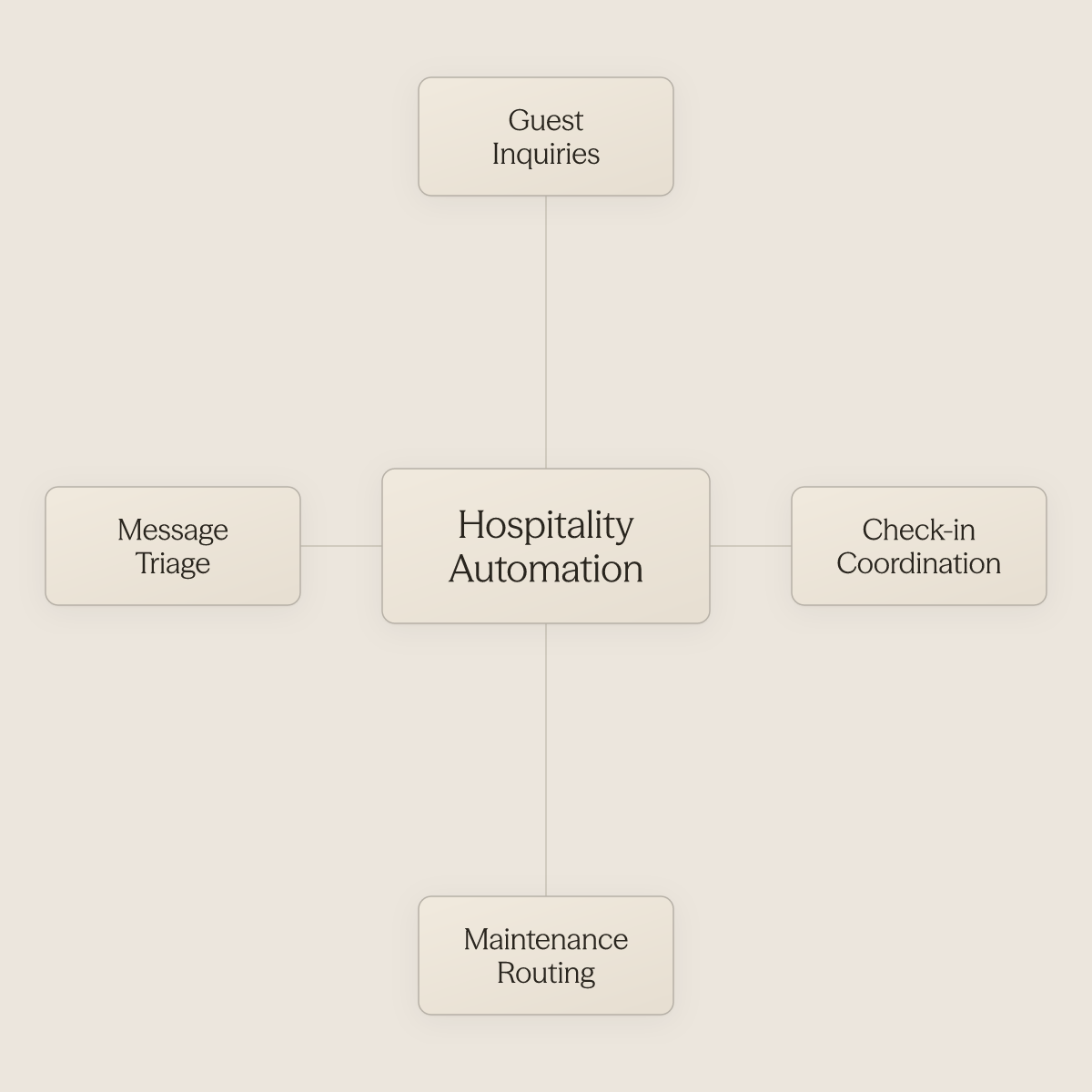
Think of a 35-property vacation rental operation fielding 200-plus guest messages every night with a two-person team. The bottleneck is never the people. It's the invisible routing layer sitting between an incoming message and the right answer.
Hospitality AI platforms exist to remove that layer, not the team behind it. Hospitality automation handles routine hotel and short-term rental operations with minimal human intervention, covering guest inquiry responses, check-in coordination, and maintenance routing. Industry research covering the conversational AI segment identifies booking assistance, AI concierge functions, and real-time guest communication across multiple operational touchpoints as its core use cases.
See our AI for hospitality for how this works in practice. What automation replaces is not staff judgment, it replaces the repetitive act of a human reading a message, deciding where it belongs, and forwarding it manually, a process that consumes capacity at every scale. Automation types fall along a spectrum.
Fixed automation executes one task identically every time (a keypad code sent at booking confirmation). Programmable automation follows conditional logic (a different check-out reminder if the guest booked a late departure). Flexible automation pulls from a knowledge base to answer variable questions.
Intelligent automation, powered by AI agents trained on a property's own SOPs and FAQs, handles open-ended conversations and learns from each interaction. IoT-connected devices, smart locks, thermostats, and sensors, extend this layer further by feeding real-time property data directly into automated workflows.
The payoff scales with intelligence: the more context the system carries, the fewer messages need a human hand. Operators burned by generic AI tools share a common story: the system confidently answered the wrong question, or gave a guest a policy that applied to a different property. That was not a failure of automation, it was a failure of implementation. Generic tools trained on no specific property context will surface generic answers. The shift to property-specific AI agents, trained on an individual operation's own SOPs, FAQs, and manuals, is what separates that early frustration from the performance that modern intelligent automation actually delivers.
Key takeaways
- Hospitality automation fails when operators treat it as a staffing substitute, it works when it removes the structural bottleneck that prevents staff from focusing on high-value guest moments.
- Erwan Le Roy's 35-property operation hit a 96% AI automation rate with every guest inquiry answered within one minute, 24/7, that's a systems result, not a headcount result.
- Scaling past 10 properties doesn't break operations because of complexity; it breaks because manual communication volume grows faster than any team can absorb.
- The gap between 'thinking about automation' and 'handling 80% of overnight messages automatically' is almost always documentation quality, operators with SOPs and property manuals in Google Drive are closer to live than they think.
- Automation investments that compound are built on accurate, property-specific responses, generic chatbot replies erode guest trust faster than slow human ones.
- Conduit's AI Agents close that loop by reading directly from your own SOPs, manuals, and FAQs to handle guest conversations autonomously across channels, no human intervention required, no generic scripting.
The Real Cost of Manual Hotel Operations: and What Keeps Operators Stuck
Scaling a vacation rental portfolio past 10 properties feels like a milestone until the communication volume hits. Most vacation rental property managers and operations leads think the only solution to communication volume at scale is hiring more staff or accepting slower response times overnight, because no tool can handle the nuance and context that real guest messages require. The same workflows that worked at five units are suddenly consuming hours every day, and the instinct is to hire another coordinator or switch to a more capable PMS. Both moves feel logical. Both miss the actual problem.
The Staffing Math Breaks Down Past 10 to 15 Properties
"Registration (reg) cards are still a pain point in day-to-day hotel operations, suggesting manual, paper-based check-in processes persist despite available technology."
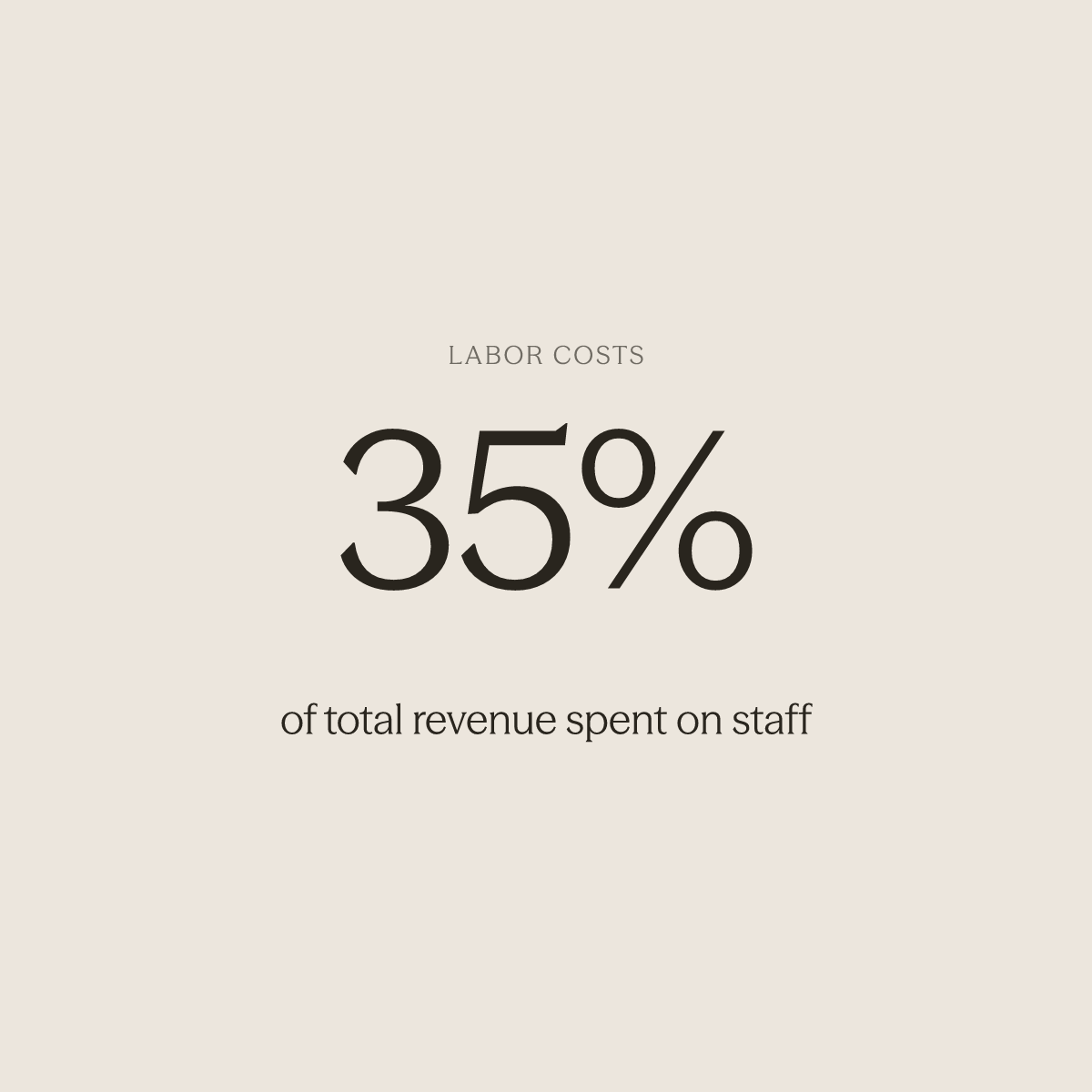
Labor costs in hospitality already account for 30 to 35% of total revenue, and as properties scale, staffing expenses grow disproportionately faster than revenue when workflows remain manual. Add manual guest communication at scale, and each new property triggers incremental headcount, because someone still has to read, triage, and respond to every message. Benefits, payroll taxes, and overtime stack on top of base wages, meaningfully inflating the true cost of each hire well beyond the visible wage line. The math erodes margin faster than new bookings can recover it.
The Overnight Blind Spot - Missed Messages Become Lost Bookings
A guest sends a check-in question at 2 a.m. and gets an answer in under a minute, not because someone is awake, but because the routing layer has already handled it. That single shift in response architecture is what separates a 4.9 guest communications score from a missed message that turns into a cancelled booking. Overnight coverage has historically been among the most expensive and least scalable staffing categories in hospitality operations, per Altametrics. The opportunity is structural: solve the routing layer, and coverage quality becomes a systems question rather than a scheduling one.
The Real Culprit Is the Routing Layer
The hidden cost operators rarely name is the decision point itself. Every guest message, regardless of how routine, still routes through a human before anything happens. That single chokepoint creates the ceiling on scale. Platforms like Conduit's AI for hospitality replace that routing layer with AI agents trained on a property's own SOPs, FAQs, and property manuals, resolving the majority of routine guest inquiries autonomously, at any hour, without adding headcount.
11 Hotel Automation Benefits and Strategies (With Real Examples)
Ninety-six percent of guest inquiries handled autonomously, across 35 properties, with every message answered inside one minute. That is not a staffing achievement. It is a systems achievement, and the difference matters for every operator trying to figure out which automation investments actually compound.
The operators capturing the highest ROI from hospitality automation are not the ones with the longest tool stack. They are the ones who connected their tools through a coordination layer so each automated system informs the next. A check-in kiosk that cannot notify housekeeping, a dynamic pricing engine that cannot trigger a guest communication, a channel manager that cannot flag an overbooking risk in real time: each is useful in isolation, and each recreates the manual routing bottleneck automation was supposed to eliminate.
What follows is not a feature list. Each of the eleven strategies below is structured as benefit, then execution approach, then a real proof point, so you leave with a decision-ready action rather than a vague aspiration.
Housekeeping Software for Hotels and Vacation Rentals - How to Choose the Right Platform
Actabl, Flexkeeping, and hotelkit represent three distinct philosophies in housekeeping automation, and choosing the wrong one for your operational model adds complexity without payoff. Actabl skews toward data-heavy hotel groups that want performance analytics layered on top of task management. Flexkeeping is purpose-built for operational simplicity and integrates cleanly with most PMS platforms, making it a straightforward path to value for independent operators who prioritize speed of setup over analytics depth. hotelkit adds an internal communication layer that suits properties where housekeeping, maintenance, and front-of-house coordination happen in the same workflow. The decision hinges on whether you need analytics depth, integration breadth, or team communication, not all three at once.
1. Contactless Self Check-In - Eliminate Front Desk Queues Instantly
Contactless self check-in converts the highest-friction guest arrival moment into a fully automated touchpoint. Guests receive a pre-arrival message via mobile app with a digital key or access code, bypassing the front desk entirely. The contactless check-in hotel market is projected to grow from $4.48 billion in 2025 to $25 billion by 2035, signaling that guest expectation is shifting fast. The real tradeoff: properties with irregular layouts or older lock hardware face a non-trivial retrofit cost before this benefit materializes.
2. Self-Service Kiosk Check-In - Hardware-Backed Automation for High-Volume Properties
Self-service kiosks are the right pick when your property handles high walk-in volume and a mobile-only solution leaves a meaningful share of guests stranded. Kiosks handle ID verification, payment capture, and key issuance without front desk staff, compressing check-in queues during peak arrival windows. The limitation operators underestimate: kiosks require physical maintenance, software updates, and a clear escalation path when hardware fails. For a lean team managing multiple properties remotely, that maintenance overhead can quietly offset the labor savings if not factored into the total cost model upfront.
3. AI Hotel Chatbot: 24/7 Guest Communication Without Adding Headcount
AI-powered guest communication directly answers the overnight blind spot that costs operators reviews before anyone on the team sees the message. Automated AI chatbots resolve the majority of routine inquiries, including WiFi credentials, check-out times, and local recommendations, without human intervention and without the response-time degradation that happens after 10 p.m. Faster response times correlate with measurable lifts in guest satisfaction scores. The honest caveat: an AI chatbot is only as accurate as the documentation it is trained on. If your SOPs are incomplete or outdated, the agent will surface that gap in front of guests.
4. Automated Housekeeping Management Software - Smarter Room Turnover Scheduling
Automated housekeeping management software eliminates the manual dispatch loop that burns coordinator time between checkout and the next check-in. The system reads live occupancy data, prioritizes rooms by next arrival time, and pushes task assignments directly to housekeeping staff via mobile. For operators managing 20-plus units, the compounding benefit is real: fewer missed turnovers, fewer guest complaints about room readiness, and a clean data trail for performance management. The tradeoff is adoption friction; teams accustomed to paper checklists or verbal briefings need a structured onboarding period before the efficiency gains show up in the numbers.
5. Hotel Housekeeping Software Comparison - Choosing the Right Platform (Actabl vs. Flexkeeping vs. hotelkit)
Evaluating housekeeping platforms is a critical step in any hospitality automation roadmap. Actabl leads for data-rich operations teams, Flexkeeping excels in task communication, and hotelkit suits properties prioritizing team collaboration. The key tradeoff across all three is integration depth with legacy PMS systems, properties on older infrastructure may face significant API customization costs before realizing efficiency gains.
6. Automated Revenue Management - Dynamic Pricing Without a Dedicated Revenue Manager
Dynamic pricing tools and revenue management systems analyze competitor rates, demand signals, and occupancy patterns to adjust room rates automatically, removing the manual repricing cycle that leaves money on the table during high-demand windows. Industry research and operator-reported outcomes consistently show meaningful revenue lifts for properties that shift from static to dynamic pricing, as automated engines capture demand-driven rate opportunities that manual repricing cycles routinely miss. The limitation worth naming: automated pricing engines optimize for rate, not relationship. For properties where repeat guests expect rate consistency, a hybrid rule set that protects loyalty segments is worth configuring from day one.
7. AI-Driven Full-Stack Hotel Automation - The StayGrid Approach for 50-Room Properties
Full-stack automation platforms designed for mid-scale independent hotels integrate PMS, channel management, housekeeping dispatch, and guest messaging into a single operational layer. Mid-scale independent properties in the 40-to-75-room range demonstrate what happens when coordination overhead between systems is removed: staff spend less time on inter-system data entry and more time on guest-facing moments, a pattern consistently reported by operators who move from point-solution stacks to integrated platforms. The honest limitation is scope: full-stack platforms require a longer implementation runway and higher tolerance for change management than point solutions.
They are not the right starting point for an operator who has not yet documented core workflows, because the platform will automate whatever process exists, including a broken one.
8. Smart Hotel Channel Manager Automation - Eliminate OTA Overbooking and Rate Parity Errors
Channel manager automation keeps inventory, rates, and availability synchronized across every OTA in real time, eliminating the overbooking and rate parity errors that generate guest complaints and OTA penalties. For operators managing direct booking channels alongside Airbnb, Vrbo, and Booking.com simultaneously, the manual update cycle is a genuine liability; a single missed update during a high-demand weekend can trigger a cancellation that costs more in lost revenue and review damage than the tool's annual subscription. The tradeoff: channel managers that connect deeply to your PMS deliver the most value; those running as standalone tools with manual PMS sync recreate the data-gap problem in a different place.
9. Smart Room Energy Management - IoT Automation That Cuts Utility Costs by Up to 30%
Smart room energy management uses IoT-connected smart thermostats, smart lighting, and occupancy sensors to reduce energy consumption automatically when rooms are unoccupied and restore guest-preferred settings before arrival. Industry research supports meaningful utility cost reductions for properties that implement IoT-based energy management at scale. Beyond cost, this is an increasingly visible ESG signal for operators pitching to corporate travel buyers who require sustainability reporting. The practical tradeoff: sensor installation requires per-room hardware investment and, in older properties, may involve electrical work that extends the payback period beyond a single season.
10. Automated Guest Feedback and Reputation Management - Trigger Post-Stay Reviews at Scale
Automated post-stay feedback systems send review requests at the moment guest sentiment is highest, typically within two hours of checkout, rather than relying on a team member to remember the follow-up days later. Review response rates drop sharply as the gap between checkout and outreach widens. For operators managing 20-plus properties, consistent, well-timed review requests represent one of the highest-ROI automation investments relative to implementation cost. The limitation: generic survey prompts produce lower engagement than messages personalized to the specific stay. Operators who invest in customizing the outreach template see meaningfully better conversion.
Related Reading
- Hotel Budgeting And Forecasting
- Hotel Demand Forecasting
- How To Improve Hotel Operations
- Hospitality Operations Management
- Hotel Guest Messaging
- Adr Vs Revpar
- How To Increase Revpar
- Hotel Upselling
- Hotel Revenue Management Strategies
- Automated Hotel Reservation System
Getting Started with Hotel Automation - A Practical Implementation Path
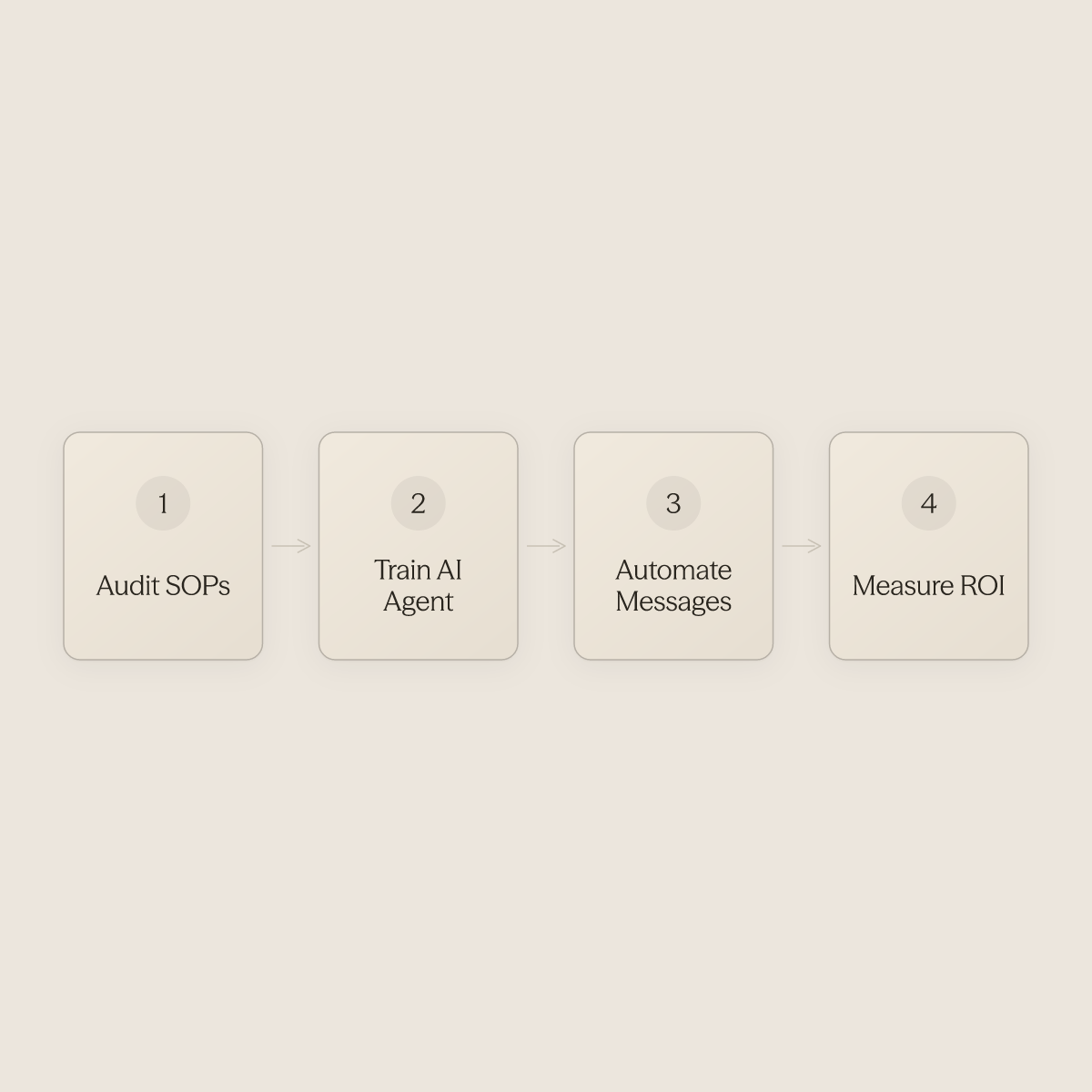
The fastest path to hotel automation isn't a technology decision, it's a documentation audit. Operators with check-in SOPs, FAQ documents, and property manuals in Google Drive are closer to live automation than they realize. The gap between "we're thinking about it" and "it's handling 80% of overnight messages" is almost always documentation quality, not software complexity.
Sequence by Volume, Not by Ambition
Across high-volume hospitality operations, the same pattern holds: guest communication drives the highest message volume, not IoT sensors or robotic concierges. The highest-volume, lowest-complexity messages arrive overnight, when staffing is thinnest and errors are costliest, check-in instructions, WiFi passwords, early-checkout confirmations. These aren't edge cases; they're the majority of your inbound queue. Automating them first produces measurable ROI before you've touched a single piece of physical infrastructure.
Your SOPs Are the Real Automation Engine
Automation quality is directly tied to documentation quality. Hotels with well-maintained SOPs and FAQs see significantly better AI outcomes because the AI resolves inquiries only as accurately as the information it's trained on. The same materials used to onboard staff are exactly what AI for hospitality platforms like Conduit's AI Agents ingest to handle guest communications autonomously, with no IT team required.
The Personal-Touch Objection, Resolved
The real question isn't whether AI can handle guest messages, it's which messages it should handle. AI resolves repetitive, time-sensitive requests with speed and consistency that overnight human shifts structurally cannot sustain. What humans must own: escalations, complaints with emotional weight, and relationship moments that move reviews. Erwan Le Roy's operation achieved a high AI automation rate, with guest inquiries answered in under one minute, a response standard no rotating overnight shift had achieved before automation was in place.
Automation Sequencing Checklist - Where to Start
Use this checklist to identify your highest-leverage starting point before touching any new software.
- Documentation audit complete, Check-in SOPs, FAQ doc, and property manuals exist in a single accessible location (Google Drive, Notion, PMS knowledge base).
- High-volume message types mapped, WiFi password, check-in instructions, early checkout, parking, and local recommendations are documented and ready to train on.
- Escalation path defined, You have a clear rule for which message types must route to a human (complaints, disputes, safety issues).
- Integration readiness checked, Your PMS exports reservation data in a format your target automation tool can ingest.
- Success metric chosen, You have a baseline response-time or automation-rate number to measure against after 30 days.
If you can check the first three boxes today, you have the minimum viable inputs to go live with agentic AI guest communication in under a week.
Related Reading
- Digital Concierge Software
- Best Hotel Channel Manager Software
- Hospitality Chatbot
- Hotel Distribution Management
- Hospitality Conferences
- Best Revenue Management Software For Hotels
- Cloudbeds Alternatives
- Siteminder Competitors
- Canary Technologies Competitors
Next steps
If your portfolio is growing but every new property just adds another round of inbox triage, the path forward starts with treating guest communication as a coordination layer problem, not a headcount problem. Start with our AI for hospitality.
The documentation infrastructure insight from the implementation section makes the sequence clear: operators who skip the SOP audit and jump to platform selection get mediocre results and blame the software, when the actual gap was data quality all along. The overnight window insight compounds that point, because the highest-volume, lowest-complexity messages arrive precisely when staffing is thinnest, meaning the window where AI performs best is the one most operators are leaving unautomated longest. Together, they point to a single logical first action: audit your existing SOPs, FAQs, and property manuals, then connect them to an AI coordination layer that can actually read and act on operational data rather than generate generic replies.
Start with conduit.ai to see how Conduit's agents ingest your existing documentation and handle guest communication autonomously across every property. Operators with documented processes in place typically see their first automated guest reply within days, and the inbox gives the team a single place to monitor every conversation the AI is handling across all properties from that point forward.
Frequently Asked Questions
Will an AI guest communication tool actually handle nuanced or property-specific questions, or will it give guests the wrong answer?
A generic AI tool trained on no specific property context will surface generic, and sometimes wrong, answers, which is why early automation experiments in hospitality failed. The shift that changes performance is training the AI agent on your own SOPs, FAQs, and property manuals, so it carries the context needed to answer property-specific questions accurately. An AI chatbot is only as accurate as the documentation it is trained on, so keeping that documentation complete and up to date is the real implementation requirement.
How does automated revenue management actually work, and what's the catch?
Dynamic pricing tools analyze competitor rates, demand signals, and occupancy patterns to adjust room rates automatically, capturing demand-driven opportunities that manual repricing cycles routinely miss. The limitation worth knowing upfront is that automated pricing engines optimize for rate, not relationship, for properties where repeat guests expect rate consistency, a hybrid rule set that protects loyalty segments is worth configuring from day one.
How does automating housekeeping scheduling actually save time?
Automated housekeeping management software reads live occupancy data, prioritizes rooms by next arrival time, and pushes task assignments directly to housekeeping staff via mobile, eliminating the manual dispatch loop that burns coordinator time between checkout and check-in. For operators managing 20-plus units, the compounding benefit includes fewer missed turnovers, fewer guest complaints about room readiness, and a clean data trail for performance management. The real adoption hurdle is onboarding teams accustomed to paper checklists or verbal briefings, since the efficiency gains don't show up in the numbers until that transition is complete.
What's the biggest hidden cost of keeping guest communications manual as I add more properties?
The hidden cost most operators don't name is the routing decision itself, every guest message, no matter how routine, still passes through a human before anything happens, and that single chokepoint creates a hard ceiling on how far you can scale. Because labor costs in hospitality already account for 30 to 35% of total revenue, each new property that triggers incremental headcount erodes margin faster than new bookings can recover it. Solving the routing layer with AI agents trained on your own SOPs turns coverage quality into a systems question rather than a scheduling one.
When is the right time to invest in a full-stack hotel automation platform versus starting with a single point solution?
Full-stack automation platforms are not the right starting point for an operator who hasn't yet documented core workflows, because the platform will automate whatever process exists, including a broken one. They deliver their real value for mid-scale independent properties in the 40-to-75-room range once coordination overhead between systems is the primary constraint, requiring a longer implementation runway and higher tolerance for change management than point solutions. If your workflows aren't documented yet, starting with a focused tool like an AI guest communication layer that trains on your existing SOPs is a more practical first step.
Stay in the loop
Get the latest on AI automation, product updates, and customer stories.


