Types of Hospitality Operations Management Explained


Hospitality Ops
The types, explained for multi-brand VPs.
The standard definition of hospitality operations management was built for one property. Here is why that blueprint breaks at scale, and what has to replace it.
Most definitions of hospitality operations management were written with a single building in mind. They describe checklists, department heads, and a general manager who holds everything together. That framing works at one property.
It starts breaking down at five. By the time a portfolio reaches 50 or 100 units across multiple brands and markets, it has stopped being useful entirely. That scale demands management frameworks built for distributed complexity, not single-property oversight.
For a VP of Operations running a multi-brand hospitality group across dozens of properties, the definition of operations management is not academic. It is the blueprint the entire organization executes against.
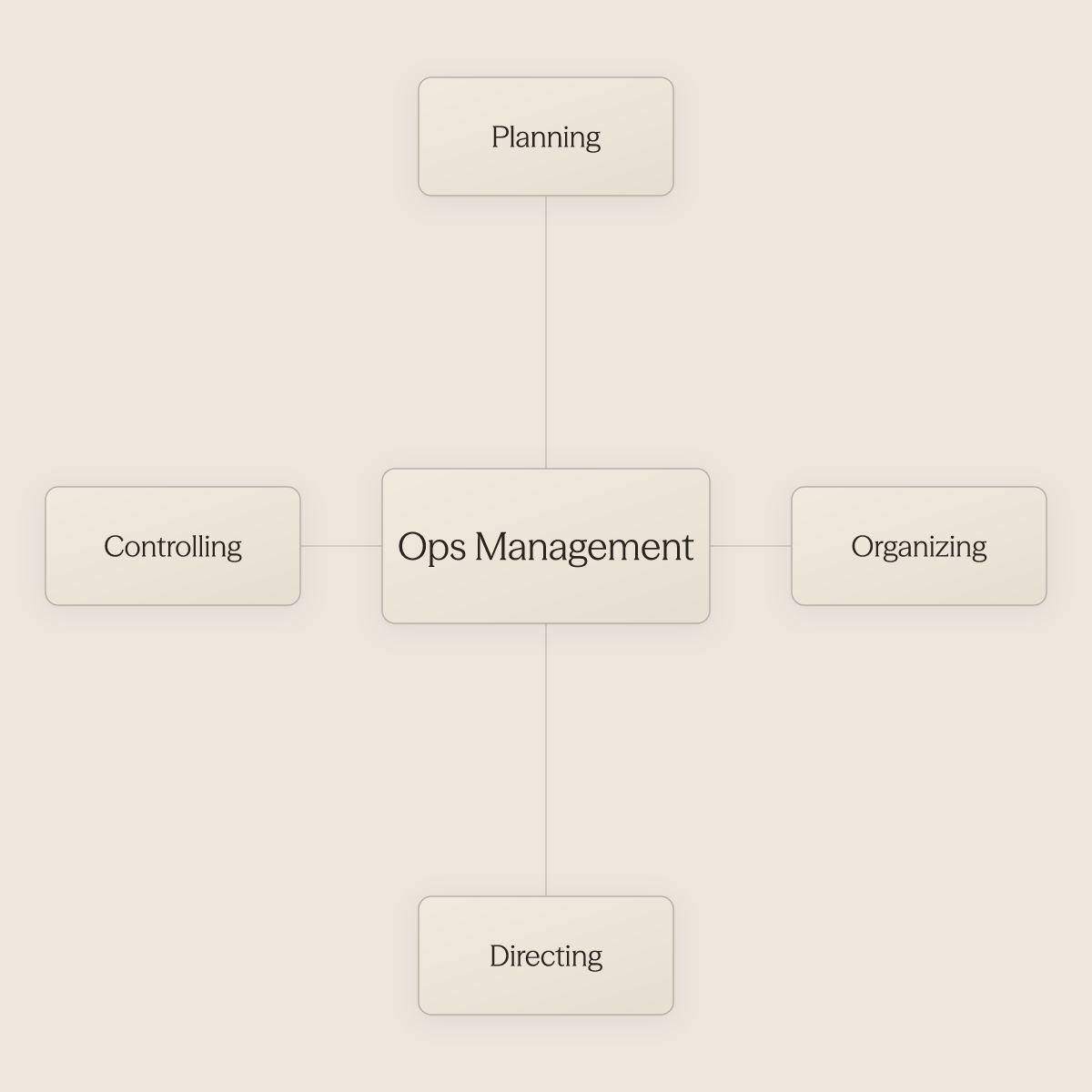
Hospitality operations management is the systematic planning, organizing, directing, and controlling of all operational activities across a hospitality business to ensure efficiency, service quality, and guest satisfaction. That four-part framework, widely cited across industry sources including Cornell's hospitality curriculum, is sound. The problem is the implied scope: most treatments assume one property, one GM, and one set of departments to coordinate. At portfolio scale, each of those four pillars works differently:
- Planning becomes portfolio-wide forecasting.
- Organizing means structuring teams and SOPs that hold across geographies.
- Directing requires consistent brand voice and service standards without a GM physically present at every location.
- Controlling is where most multi-brand operators feel the sharpest pain: how do you verify that standards are actually being met across every shift, at every property, when your coordination layer is a distributed human team?
A VP of Operations managing 12 hotel brands and 300-plus vacation rental units faces a fundamentally different challenge. The job is not running a property. It is designing a system that enforces consistent service quality across every property type, brand, and market simultaneously.
$5.8 trillion Global hospitality industry projected value by 2027
Key takeaways
- Hospitality operations management definitions built around a single property stop being useful the moment a portfolio hits five units, and break entirely at 50 or 100.
- The five core operational departments, guest services, housekeeping, food and beverage, maintenance, and human resources, don't run in parallel; they run through each other, meaning a failure in one silently loads onto the others before leadership spots the source.
- The hospitality operations manager role fractures under portfolio growth before any other position does, because span-of-control limits hit the coordination layer first.
- Revenue management, quality frameworks, and technology integration aren't separate disciplines, they're interdependent layers, and the order you build them in determines whether the structure holds under pressure.
- Operators who replace manual guest-services coordination with AI agents trained on their own SOPs report automation rates climbing from 40% to 90%, the gain isn't speed, it's structural redesign of the support function.
- Review score variance across a portfolio is an operations problem, not a people problem, retraining front-desk staff treats the symptom while the coordination gap stays open.
- conduit.ai's AI Agents close that coordination gap by reading directly from your existing SOPs, manuals, and FAQs to handle guest conversations autonomously across every channel, no human intervention required, and no documentation rebuild needed to get started.
Core Operational Components in Hospitality - The Departments Every Operation Runs On
The five departments inside any hospitality operation do not run in parallel. They run through each other. When one strains, the others absorb the failure, often before anyone in leadership notices where the original break happened. The five core operational components in hospitality operations management are:
- Guest Services & Front Desk
- Housekeeping & Maintenance
- Food and Beverage
- Staff Management
Each owns a distinct function, but the ceiling for the entire operation is set by how well they coordinate, not how well any single one performs in isolation.
1. Front Office Department - The Guest-Facing Command Center
The front office is the first point of contact for every reservation, check-in, and guest request. It sets the tone for the stay and feeds real-time room-status signals to housekeeping. The structural vulnerability here is volume: overnight inquiry spikes and shift-change gaps are where communication breaks down fastest, and those breaks ripple into housekeeping sequencing and F&B timing within hours. For multi-property operators, managing this communication load across platforms simultaneously is where guest communication platforms earn their keep.
2. Food & Beverage Department - Revenue Driver and Guest Experience Multiplier
Food and beverage operations span restaurants, room service, banquets, and bars, making this department one of the most complex and highest-revenue divisions in hospitality operations management. It demands precise inventory control, health compliance, and labor scheduling simultaneously. Operations managers must balance cost-per-cover against guest satisfaction, the primary tradeoff being that quality F&B programs require significant capital investment and skilled culinary leadership that smaller properties often struggle to sustain.
3. Housekeeping Department - The Silent Engine of Quality Standards
Housekeeping is the largest labor cost center in most hotel operations, and it is where cost-cutting surfaces in guest complaints faster than the savings register on the P&L. Across the market, cleanliness ratings are among the strongest predictors of overall review scores on platforms like TripAdvisor. Housekeeping quality is almost entirely dependent on accurate, timely room-status information from the front office. Misdirected updates create sequencing delays that guests experience directly, and those delays show up in review scores before they show up in any internal report.
4. Maintenance & Engineering Department - Uptime as a Competitive Advantage
Maintenance and engineering keeps physical assets, HVAC, plumbing, elevators, electrical systems, operational and compliant, directly preventing revenue loss from out-of-order rooms and safety incidents. For operations managers, a preventive maintenance program is non-negotiable; reactive-only approaches inflate costs and create liability exposure. The key tradeoff is that building a proactive maintenance culture requires upfront investment in CMMS software and skilled technicians that many mid-scale properties underbudget.
5. Human Resources Department - Workforce Stability as an Operational Foundation
According to LinkedIn analysis published in 2026, 70 to 80 percent of hotel industry workers leave within a given year, making staff management a perpetual operational burden rather than a periodic one. High front-desk turnover is particularly costly because it concentrates instability at the first point of contact, the department whose performance sets the coordination signal for every other column in the structure. Recruiting and training cycles are not HR problems in isolation; they are operational risk events that affect guest communication quality, housekeeping accuracy, and F&B timing simultaneously.
Key Responsibilities of Hospitality Operations Managers: and Where the Role Breaks Under Scale
The hospitality operations manager sits at the exact point where all five columns converge, which is precisely why the role fractures under portfolio growth before any other position does. When a single property is running, one manager can hold the coordination signal together through direct oversight and institutional memory. Scale that to three properties, then five, then ten, and the same span-of-control assumptions that worked at the start become the source of the breakdown.
The role does not fail because the manager lacks skill; it fails because the structure was never redesigned to match the load. Most heads of operations and VPs of operations at multi-brand or enterprise hospitality groups believe that maintaining consistent guest communication quality at scale requires either a larger centralized guest-services team or expensive enterprise software with bespoke integration projects, there is no third option. The operations manager role in hospitality is not a headcount problem dressed up as a management problem.
It is a structural one, and understanding why starts with being precise about what the role actually does. The coordination cost is not abstract. Operations and support teams managing guest communications across multiple platforms or properties simultaneously know it concretely: agents switching between platforms to draft messages, translate responses, review guest history, and track performance, each context switch adding minutes and error surface.
At Wynwood House, that friction produced lengthy guest resolution times per interaction, sentiment tracked manually through inconsistent Google Sheets, and shift handoffs that required reading entire conversation histories before an agent could respond. Managers lacked reliable visibility into guest satisfaction at scale. The coordination burden was not a headcount shortage; it was a structural one baked into how the tools were arranged.
The Four Core Responsibilities That Define the Operations Manager Role
Hospitality operations managers carry four core responsibilities: guest satisfaction, financial performance, cross-department coordination, and SOP enforcement. Each one sounds discrete. In practice, they are not.
A housekeeping delay creates a check-in failure, which becomes a guest complaint, which lands in a review, which affects booking conversion, which shows up in the monthly financial report. The operations manager is the connective tissue between all four, which is exactly what makes the role powerful at one property and structurally fragile at twenty. Guest satisfaction management is not a soft metric.
Research consistently links review score variance to measurable revenue loss, with properties experiencing inconsistent service standards seeing lower average daily rates and reduced repeat booking rates. The operations manager owns the system that prevents that variance, not just the response when it occurs. When guest resolution times stretch because agents are toggling between disconnected tools to draft a single reply, that variance is already accumulating, invisibly, across every shift.
General Manager vs. Operations Manager - Who Owns Strategy and Who Owns Execution
The General Manager owns overall business strategy: market positioning, capital decisions, owner relationships, and long-term brand development. The Operations Manager owns day-to-day departmental execution, translating that strategy into repeatable workflows every department head can follow without a one-on-one conversation each morning. Operations managers at growing portfolio companies often absorb strategic responsibilities by default, because the GM is focused on expansion while the ops layer is still running existing properties.
That drift is where role confusion creates coordination gaps. The practical pressure this creates is a false binary: scale the portfolio and proportionally scale the coordination headcount, or watch service quality compress. Neither is sustainable.
The structural answer is a coordination layer that can absorb repetitive, high-volume guest communication without adding headcount, which is precisely where AI agents most benefit operations teams that already have SOPs, FAQs, and manuals they can train on. When that documentation exists, the first automated guest reply can follow within days of connecting those sources, and the agent runs continuously, before, during, and after every stay, without shift handoffs, platform switching, or manual sentiment tracking.
SOPs Are the Operations Manager's Primary Scaling Tool, Until They're Not
Standard Operating Procedures are the operations manager's answer to consistency at scale. The failure mode is well-documented across distributed portfolios: SOP compliance degrades as physical distance from the manager increases. The Hospitality Institute notes that an overstretched span of control becomes a structural bottleneck that degrades coordination quality across departments.
When a single operations manager oversees multiple properties, enforcement becomes reactive. The SOP exists in a shared drive. The deviation gets caught after the guest has already checked out and left a three-star review.
The disconnected-tools problem compounds this. When guest-facing agents must manually consult SOPs, FAQs, and manuals housed in Notion, Google Drive, or Airbnb while simultaneously managing an active conversation, the SOP becomes a reference document rather than an enforced standard. Integrating those existing sources directly into the coordination layer, so the AI agent can leverage that content without manual re-entry, removes the gap between where the standard lives and where it is applied.
The SOP stops being something a manager enforces after the fact and starts being something the system applies in the moment the guest sends a message.
The Coordination Layer Problem - Why the Role Becomes a Bottleneck at Portfolio Scale
Gallup's span-of-control research makes the mechanism explicit: as team size grows, the coordination burden on the manager increases non-linearly. The operations manager is not a single-point solution to a structural coordination problem, Gallup's span-of-control research confirms that as team size grows, coordination burden increases non-linearly, meaning the manager becomes a bottleneck by design, not by failure.
The operations manager is not a single-point solution to a structural coordination problem, Gallup's span-of-control research confirms that as team size grows, coordination burden increases non-linearly, meaning the manager becomes a bottleneck by design, not by failure.
That non-linearity shows up most visibly in guest communications. The inbox, the stream of conversations the operations or support team must monitor, review, and manage across every active guest interaction, becomes unmanageable not because the volume is high, but because every message arrives without context, requiring an agent to reconstruct history before responding. When sentiment is tracked manually via inconsistent spreadsheets and shift handoffs require reading entire conversation threads, the coordination tax compounds with every property added to the portfolio.
The structural answer to this is not adding coordinators at the same rate as properties. It is building a layer that handles the recurring, predictable guest touchpoints, booking confirmations, check-in instructions, post-stay follow-ups, keyword-triggered responses, automatically, triggered by the guest lifecycle event rather than requiring manual staff action. That is what makes it possible to scale the portfolio without proportionally scaling coordination headcount: the automated layer absorbs the volume that currently consumes the manager's attention, and the inbox becomes a place to monitor and review rather than a place to fight through.
Operations Manager Span-of-Control Decision Framework
| Portfolio Size | Recommended Coordination Model | Primary Risk if Unchanged |
|---|---|---|
| 1–3 properties | Single ops manager + direct oversight | Low, direct visibility still viable |
| 4–10 properties | Ops manager + property-level supervisors + shared SOP library | SOP drift as physical distance grows |
| 11–30 properties | Regional ops structure + centralized guest-comms layer | Shift-change failures, inconsistent brand voice |
| 31+ properties | Automated coordination layer (AI agents) + ops oversight | Labor cost compression, review score variance |
Use this table to diagnose whether your current structure matches your portfolio footprint, mismatches at any tier are the most common source of the coordination gaps described in this section. The shift from the 11–30 tier to the 31+ tier is where the manual coordination model, agents switching platforms, managers checking spreadsheets, shift handoffs built on reading conversation history, stops being a management challenge and becomes a structural ceiling. The Gallup research is explicit that no amount of managerial skill resolves a span-of-control problem that the structure itself creates. The Hospitality Institute frames the same issue from the hotel operations side: the bottleneck is the model, not the manager.
Strategic Focus Areas in Modern Hospitality Operations Management
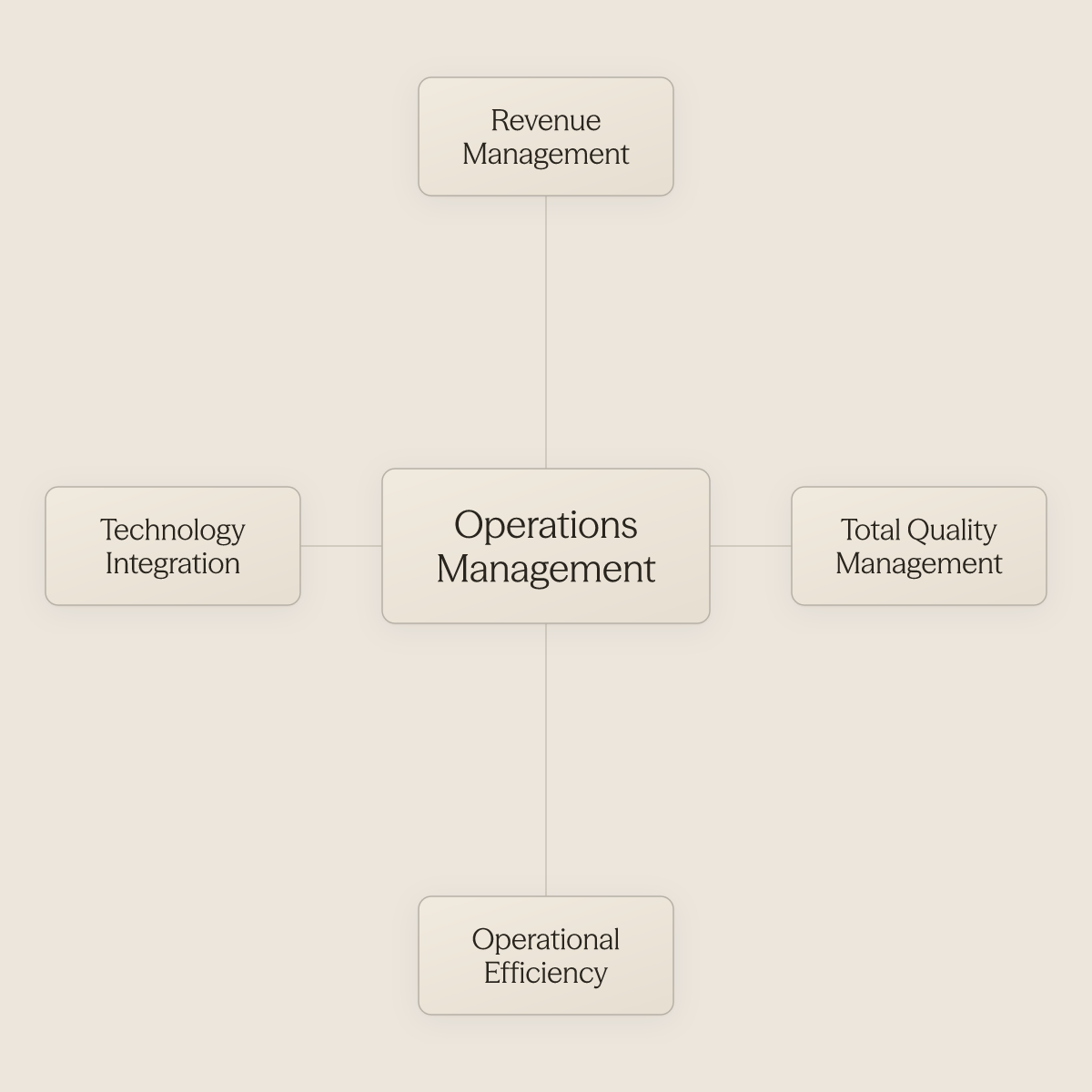
Revenue management, quality frameworks, and technology integration are not separate disciplines a hotel operations leader learns in sequence. They are interdependent layers of a single operating architecture, and the sequence in which they are built determines whether the structure holds under pressure.
Four strategic focus areas define modern hospitality operations management:
- Revenue management
- Total Quality Management (TQM)
- Cross-department operational efficiency
- Technology integration
Most operators treat these as parallel tracks, each with its own team, KPIs, and improvement roadmap. The expensive truth is that all four are downstream outputs of the same root variable: operational consistency. When that consistency breaks down, all four degrade at once.
Revenue Management Is an Operational Discipline, Not Just a Pricing Function
Revenue management in hospitality focuses on pricing strategy, demand forecasting, and online reputation, but its real inputs are operational. Each 1-point gain on a 100-point reputation scale lifts RevPAR by 1.42%. Those numbers are the compounded result of whether housekeeping turns rooms on time, whether front desk resolves complaints before checkout, and whether guest messages get answered at 1am or 9am the next morning.
Review scores function as a pricing lever, not a passive satisfaction metric. Industry research has confirmed that customer ratings on platforms like TripAdvisor produce both signaling effects and long-term reputational effects on revenue. Every operational gap, missed message, or inconsistent service interaction is quietly repricing your inventory downward before your revenue manager touches a single rate.
Direct booking channels face a volume and fragmentation problem that no front desk staffing model fully solves. A single unanswered inquiry at midnight is a missed booking and a depressed review score compounded across hundreds of interactions annually. AI agents purpose-built for guest communications are most beneficial precisely when a business receives a high volume of repetitive guest messages and already holds documentation, SOPs, FAQs, and property manuals that can train the agent.
The first automated guest reply can go live within days of connecting those existing materials, meaning the revenue-protecting response window closes without adding headcount.
Total Quality Management - How Market Tier Calibrates the Standard, Not the System
Total Quality Management (TQM) in hospitality implements quality standards calibrated to market tier, but the underlying system is identical across both luxury and budget: define the standard, enforce it consistently, measure the gap, and close it. The failure point is almost never the standard itself; it is enforcement across shifts, properties, and staff cohorts turning over at 70 to 80 percent annually. This is not a training problem; it is a structural one.
Hospitality's 70–80% annual staff turnover rate means that a workforce replacing itself faster than it can be trained is mathematically incapable of sustaining consistency, which reframes AI coordination not as a productivity tool but as the only stable substrate for institutional knowledge in a human organization that is structurally transient. TQM cycles that depend on human memory and verbal handoffs dissolve the moment a key team member exits, which in hospitality happens roughly every 14 months on average. This structural reality is exactly where AI agents with configurable, brand-standard behavior outperform any onboarding program.
The value compounds most for businesses with specific brand standards, escalation policies, or complex multi-property operations that require differentiated agent behavior, because the standard lives in the agent's configuration, not in the memory of the employee who left last quarter. When a new front-of-house hire joins, the institutional knowledge encoded in SOPs and escalation logic is already operational; the agent doesn't re-learn it each cycle. Integrations with tools like Notion, Google Drive, or property management documentation mean existing content doesn't require manual re-entry every time a policy updates, the agent leverages it directly.
Operational Efficiency as a Cross-Department Coordination Problem
Most waste in hospitality operations does not live inside departments; it lives between them: the gap between housekeeping's room-ready signal and front desk's check-in queue, the lag between a guest complaint and a maintenance dispatch, the shift handoff where context evaporates. Operational efficiency gains only hold when the coordination layer between departments is as reliable as the departments themselves. Automated workflows address this directly by acting on trigger events rather than depending on staff attention.
A booking confirmation, a check-in event, or a keyword detected in a guest message can each initiate a pre-defined action, a maintenance alert, an upsell sequence, a handoff note, without requiring a team member to remember to act. This is most valuable when a business has recurring, predictable guest touchpoints that currently require manual staff action, because it converts institutional process knowledge into reliable system behavior rather than leaving it subject to shift-by-shift execution variance.
Technology's Real Role - The Coordination Layer Between Departments
Technology's role in a hotel operating architecture is not automation for its own sake; it is the creation of a reliable coordination layer that holds information and action continuity across the human gaps that hospitality's structural turnover and multi-platform complexity inevitably create. An inbox that consolidates guest communications across all platforms and properties into a single monitored environment, where the operations or support team can review and manage every conversation the AI agent is handling, on an ongoing basis, is not a convenience feature. It is the mechanism by which management visibility is maintained at scale, and by which the signaling value of guest ratings is protected rather than eroded by the operational gaps that volume and fragmentation create.
24% Profit lift from a 0.1-point Booking.com rise
Related Reading
- Hotel Budgeting And Forecasting
- Hotel Demand Forecasting
- How To Improve Hotel Operations
- Adr Vs Revpar
- How To Increase Revpar
- Hotel Upselling
- Hotel Revenue Management Strategies
- Automated Hotel Reservation System
- Hotel Guest Messaging
- Hospitality Automation
How AI Agents Are Restructuring Guest Services and Staff Management at Scale
Operators report dramatically higher automation rates after replacing manual guest-services coordination with AI agents trained on their own SOPs, and those outcomes are most reliably achieved by operations that already receive a high volume of repetitive guest inquiries and have existing documentation (SOPs, FAQs, house rules) ready to train the agent on. Without that foundation, results will vary and the upfront build effort is longer. What both numbers share matters more than the gap between them: neither required adding a single person to the payroll. For a VP of Operations watching a portfolio grow from 35 units to 75, that is not a statistic about speed. It is a statement about organizational structure.
The SOP Enforcement Gap AI Agents Actually Close
"We face real uncertainty about whether AI agents can realistically be integrated into day-to-day operations at scale, especially in specific regional contexts like Japan where adoption norms may differ."
The familiar approach to SOP enforcement is documentation plus training plus supervision. The hidden cost is that hospitality labor turns over at 73% annually, according to Stealth Agents' 2026 industry research, which means institutional knowledge exits the building faster than it can be re-trained into new hires. At $5,500 per replacement hire, a ten-person guest-services team carries an expected annual replacement cost exceeding $40,000, before productivity loss during onboarding.
AI agents trained on an operator's SOPs, manuals, and FAQs do not turn over. They apply the same cancellation policy at 2am on a Saturday that they apply at 10am on a Tuesday, across every property, in the brand voice the operator specified. And because Conduit's AI Agents connect directly to existing documentation in tools like Notion, Google Drive, or Airbnb, without requiring manual re-entry, that consistency is established days after connecting your materials, not months after a prolonged implementation.
The gap AI agents close is not a speed gap. It is a consistency gap that compounds every time a team member leaves. One perspective that surfaces consistently among hospitality directors who have made the transition: "We all agree that AI first is the best approach." That shift in posture, from building internal coordination infrastructure to deploying purpose-built AI agents, is where the structural benefit begins. Rather than sinking capital into proprietary tooling that still depends on retrained human execution, operators redirect that investment toward a layer that enforces SOPs continuously, without turnover risk.
Deployment Data: 35–75 Property Portfolios After Structural Redesign
Cash Flow Street runs 35 properties at a high rate of automation on guest inquiries. Easy BnB scaled to 75 units and saved significantly on labor costs while adding zero additional staff. Wynwood House, operating across multiple countries, reduced guest resolution time dramatically.
These are not pilot programs. They are the operational baseline those teams now plan against. What made those outcomes achievable in each case was the same precondition: a high volume of repetitive guest messages and existing documentation to train the agent on.
Conduit's AI Agents are most beneficial precisely in that context, handling guest communication across multiple platforms or properties simultaneously, before, during, and after a stay, without a centralized reservations team fielding each message manually. The operations and support team shifts from answering inquiries to monitoring the Inbox: reviewing conversations the AI agent is already handling, stepping in only where judgment calls genuinely require a human. Portfolio growth stopped triggering a hiring conversation.
It became a configuration task: connect the new property's documents, set the brand-voice parameters, and the coordination layer extends to cover it. A concern that hospitality directors reasonably carry into this evaluation, particularly those operating in regions where AI adoption norms are less established, such as Japan or other specific international markets, is whether AI agents can realistically integrate into day-to-day operations at scale without creating new points of failure. The answer is not that the concern is unfounded; it is that the architecture addresses it.
Because Conduit's Integrations pull from tools the team already uses, and the Inbox gives the operations team continuous visibility into every AI-handled conversation, adoption does not require a leap of faith. It requires a documentation audit and a willingness to monitor before fully delegating.
The 1AM Problem - How AI Agents Absorb Shift-Change Failures
Shift changes are where operational consistency breaks down in ways that show up directly in review scores. The outgoing agent summarizes what they remember; the incoming agent reads what they have time to read. The guest who messaged at 12:47am about a broken thermostat is still waiting at 1:15am, the exact moment a four-star review becomes a three-star review.
AI agents absorb that window without a handoff to miss, a summary to misread, or an overnight staffing premium to pay. Conduit's AI Agents respond to every guest message continuously, before, during, or after a stay, because there is no shift to change. This works best for operators who already have SOPs and house rules documented.
Operators without existing documentation will need to build it first, a real upfront investment. But for operations that have that foundation in place, eliminating the 1am gap is not a technology project. It is a configuration step: connect the documents, define the response parameters, and the coverage is immediate.
Guest Experience and Service Quality - The Metric Every Type of Hospitality Operation Is Ultimately Judged By
Guest experience scores are the most visible output of your operation, but the variance between properties rarely traces back to individual staff performance. It traces back to where your SOPs are actually enforced and where communication breaks down when no one is watching. This section examines the operational patterns behind review score inconsistency and the specific failure modes, from overnight response gaps to SOP drift, that quietly erode guest satisfaction across a portfolio.
Review Score Variance Across Properties - An Operations Problem, Not a People Problem
When a property in your portfolio drops half a star on a major review platform, the instinct is to look at the team. Retrain the front desk. Revisit the hiring profile.
Post the brand values somewhere more visible. But the data tells a different story, one that should change how you manage at scale. According to MARA Solutions' 2025 analysis of hotel review data, 48% of guests leave reviews after a bad experience, compared to 40% after an exceptional one.
That asymmetry means a single communication failure, a missed inquiry, a slow response, a reply that contradicts what another property told a guest last week, carries more downside risk than a service win carries upside. Review score variance across a portfolio is not random. It maps to where SOPs are enforced and where they are not.
Communication Gaps and SOP Drift - The Two Silent Killers of Guest Satisfaction
The failure pattern is consistent: a guest sends an inquiry at 11pm. Property A responds in eight minutes with accurate information. The same inquiry hits Property B, where overnight coverage is thin, and the response arrives six hours later with a different answer.
Same brand. Neither team member did anything wrong individually. The system produced two different guest experiences because enforcement depended entirely on who was working.
This is precisely the operations problem that AI Agents trained on your existing SOPs, FAQs, and manuals are designed to close. Rather than relying on staff availability to determine response quality, the agent fires continuously, before, during, and after a stay, whenever a guest sends a message. Properties already using tools like Notion, Google Drive, or Airbnb can connect that documentation directly, so the agent draws from the same source of truth across every property without manual re-entry.
What matters most in that context is not just speed, it is whether the reply reads like a brand-consistent human response. Mayra, Global Head of Customer Experience at Wynwood House, put it directly: *"The first thing we noticed was the quality of the AI replies. You cannot tell the difference between an AI agent and a human agent.
I work with ChatGPT and other AI tools every day, and sometimes you can immediately tell it's AI. With Conduit, we're not seeing that."* That quality distinction matters because guests who receive a reply that feels automated or impersonal are less likely to overlook friction elsewhere, and more likely to document it in a review.
For operations teams managing a distributed portfolio, the Inbox layer adds a second line of defense: it gives the operations or support team a single place to monitor, review, and manage all conversations the AI agent is handling across multiple platforms simultaneously. Communication consistency stops depending on which property a message happened to land at.
The Revenue Consequence of Inconsistent Service Quality
The financial stakes are not abstract. A 1-star increase in brand rating on major online review websites such as Google, Tripadvisor, and Yelp can contribute to a 5–9% increase in revenue, and a 0.1-point increase on Booking.com can raise hotel profits by as much as 24%. Industry research further reinforces that extreme and negative reviews carry disproportionate influence on consumer perception, amplifying the downside when communication breaks down.
Standardizing brand voice and response quality across a large, distributed portfolio is not an HR initiative. It is a margin-protection strategy, and it scales only when the system enforcing that consistency runs independently of shift schedules, staffing levels, and individual judgment calls.
Next steps
If your portfolio is growing faster than your coordination layer can absorb, the path forward starts with recognizing that guest communication consistency is a revenue variable, not a staffing ratio. Start with our AI for hospitality.
The 70-80% annual turnover finding means no centralized guest-services team can structurally encode brand standards at scale, because the workforce replacing itself faster than it can be trained is mathematically incapable of sustaining consistency. The asymmetric review-volume dynamic (48% of guests review after bad experiences versus 40% after exceptional ones) means every communication gap carries outsized downside risk relative to any service win. Together, they point to the same conclusion: the coordination layer enforcing your SOPs cannot depend on human memory and shift continuity to hold.
If you want to go deeper on how AI agents close that gap across distributed portfolios, conduit.ai covers the operational architecture behind what the case studies in this post describe.
Frequently Asked Questions
What are the biggest challenges hotel operations managers face as a portfolio grows?
The core challenge is structural, not a skills gap: as portfolio size increases, the coordination burden on the operations manager grows non-linearly, turning the manager into a bottleneck by design. SOP compliance degrades with physical distance, shift handoffs require agents to read entire conversation histories, and guest sentiment ends up tracked through inconsistent spreadsheets, all before a single property is added to the mix. The post's span-of-control framework shows this breakdown accelerates most sharply once a portfolio crosses 11 properties.
How does high staff turnover actually affect daily operations, not just HR costs?
The post cites LinkedIn analysis showing 70 to 80 percent of hotel workers leave within a year, and the operational damage goes well beyond recruiting costs. High front-desk turnover concentrates instability at the first coordination point in the property, degrading the communication signals that housekeeping and F&B depend on for sequencing and timing, meaning a staffing problem in one department creates service failures in others simultaneously.
Why do SOPs stop working as a consistency tool at larger portfolio sizes?
SOPs degrade because enforcement becomes reactive when a manager is physically distant from the properties they oversee, a deviation gets caught after the guest has checked out and left a three-star review, not before. The problem compounds when guest-facing agents must manually consult SOPs stored in separate tools like Notion or Google Drive while simultaneously managing an active conversation, turning the SOP into a reference document rather than an enforced standard.
How do front office and housekeeping inefficiencies end up affecting each other?
The two departments are tightly coupled through room-status information: housekeeping quality is almost entirely dependent on accurate, timely updates from the front office, and misdirected or delayed updates create sequencing problems that guests experience directly. Those delays show up in review scores before they appear in any internal operational report, meaning the guest has already been affected by the time leadership is aware of the breakdown.
At what portfolio size should an operations team move away from manual guest communication coordination?
According to the span-of-control framework in the post, the shift becomes critical at 31 or more properties, where the primary risks are labor cost compression and review score variance that a manual coordination model cannot contain. The post notes that the 11-to-30 tier is where shift-change failures and inconsistent brand voice first emerge as structural problems, making that range the right point to begin building an automated coordination layer before the ceiling is hit.
Stay in the loop
Get the latest on AI automation, product updates, and customer stories.

