Hotel Demand Forecasting: The Ultimate Guide for 2026


Hotel Demand Forecasting
Improve Revenue Planning
Most hotels forecast demand but never act on it in time. Here is why the gap between prediction and execution is where revenue is actually won or lost.
Hotel demand forecasting gets used constantly in revenue management conversations but rarely defined with enough precision to be operationally useful. The common assumption among heads of operations and VPs of operations at multi-brand or enterprise hospitality groups is that if the demand forecast is accurate enough, the operation will naturally adapt, that the bottleneck is data quality and model precision, not what happens after the forecast is produced. Most working definitions stop at occupancy: how many rooms will be filled on a given night?
That framing is narrow enough to be misleading, and in 2026, the cost of that narrowness is measurable in missed revenue and delayed action across entire portfolios. Published in the International Journal of Hospitality Management, forecasting is the initial component of the entire revenue management cycle, not a standalone prediction. Its accuracy directly determines whether downstream decisions on pricing, inventory, and staffing are optimal or reactive.
See our AI for hospitality for how this works in practice.
For teams managing multiple properties, that understanding is the difference between a coordinated operation and a collection of properties each improvising under pressure. It is not a single number produced once a month. A complete forecast tells you how many rooms will sell, at what rate, to which guest segments (transient leisure, corporate, group), across windows that typically span 30, 60, and 90 days out, with strategic views extending to a full year.
Industry research confirms that advanced booking methods must account for shifting time horizons and booking pace, not static annual volume, which is what separates genuine forecasting from a fixed projection. The budget is a plan built once a year against historical assumptions. The forecast is a living signal that updates as booking pace, cancellation velocity, and market conditions shift.
A property anchors its rate decisions to a budget set in Q4, then watches a corporate account cancel a block in February and never recalibrates. A forecast maintained separately and updated continuously would have flagged that gap weeks earlier and triggered a corrective response. The budget is a target; the forecast is a current read of reality. Hotel GOP% shifted in Q3 2025, with profitability protection becoming a primary operational priority, and that pressure has made the distinction between a budget and a living forecast more consequential than ever for multi-property operators managing thin margins across a distributed portfolio.
Key takeaways
- Hotel demand forecasting fails most operators not at the model level but at the execution layer, accurate forecasts routinely sit in spreadsheets while pricing, staffing, and guest communication run on lag and gut feel.
- The bottleneck in 2026 is not data quality or model precision; it's the gap between when the forecast updates and when the operation actually moves.
- Three data layers drive a useful forecast, historical performance, live booking signals, and external market data, and most properties are only pulling from one.
- Demand forecasts run on three distinct time horizons (short-term operational, tactical, and strategic), and collapsing them into a single rolling view guarantees the wrong team is acting on the wrong signal.
- Raw booking data actively misleads forecasting models, sold-out nights register as flat demand, not peak demand, and unconstrained data correction is the step most teams skip.
- The operators capturing the most revenue in high-demand windows aren't running better models; they've automated what happens the moment the forecast is right.
- conduit.ai's Workflows close that execution gap by triggering automated follow-ups, notifications, and guest communication sequences the instant demand signals shift, no manual handoff, no lag.
Why Hotel Demand Forecasting Matters - Revenue, Staffing, and the Proactive Advantage
Reactive pricing has a measurable price tag, and it shows up long before the quarter-end review. The common assumption among heads of operations and VPs of operations at multi-brand and enterprise hospitality groups is that if the demand forecast is accurate enough, the operation will naturally adapt, and that the bottleneck is data quality and model precision, not what happens after the forecast is produced. According to Hospitalitynet's complete guide to dynamic pricing in hotels, properties that implement data-driven dynamic pricing have seen material RevPAR improvements through automated rate adjustments, with gains varying by property type, market, and implementation quality. The inverse of that figure is what reactive operators leave behind every compression night, soft weekend, and misread shoulder season.
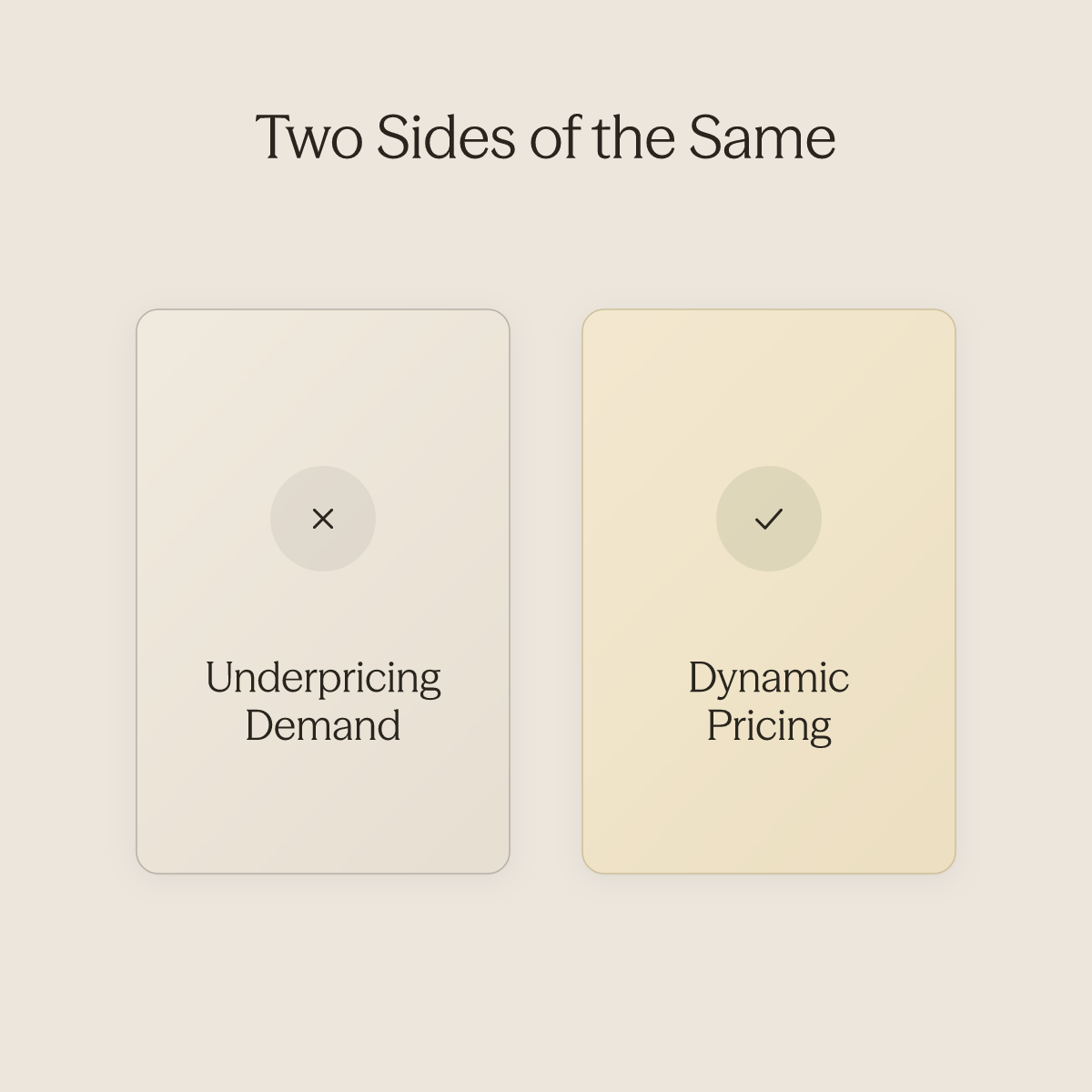
Underpricing and Overpricing - Two Sides of the Same Forecasting Failure
Most revenue managers know, directionally, when demand is building. The problem is the gap between knowing and acting. A room priced well below what the market would have absorbed that night is not a forecasting failure; it is an execution failure.
The same logic runs in reverse during soft periods: a hotel that holds rates too high because no one reviewed the forward-looking pick-up curve loses bookings it could have defended with a targeted promotion launched two weeks earlier. Both scenarios share the same root cause: the forecast existed, but no rate response fired in time. The forecast that sits in a spreadsheet until Thursday's revenue call has already missed Monday's booking window.
Where this execution gap compounds further is in guest communications. Operators managing guest inquiries across multiple platforms simultaneously, OTAs, direct booking engines, email, messaging apps, face a version of the same lag problem: the right response exists, but no one fires it in time. Conduit's AI Agents are most beneficial precisely in this scenario, when a business receives a high volume of repetitive guest or customer messages and has existing documentation, SOPs, FAQs, rate policies, and upsell scripts ready to train on.
The first automated guest reply goes live days after connecting those materials, meaning the communication execution gap closes on the same timeline as the rate response gap, not quarters later.
Unforecasted Demand Spikes - Where Service Scores Go to Die
The operational cost of a missed demand spike is not a single bad night. It compounds. When a property fails to anticipate a high-occupancy weekend, housekeeping is understaffed, the front desk queue backs up, and response times stretch from minutes into hours.
Across the market, service failures during high-occupancy periods generate negative reviews at disproportionately high rates, precisely because guest expectations are highest when a hotel is busiest. The structural bottleneck is not the team; it is the absence of a staffing call made 10 days out, when the forecast first crossed the threshold. The same compression event that strains housekeeping also floods the front desk with repetitive guest inquiries about check-in time, parking, and amenity availability, exactly when staff capacity is thinnest.
Conduit captures every guest inquiry across channels, day or night, without leaking revenue or service quality, because the AI Agent responds continuously whenever a guest sends a message, whether before, during, or after a stay. For multi-property groups, the Inbox gives the operations team a single place to monitor, review, and manage all conversations the AI Agent is handling across every property simultaneously, removing the need to staff up reactive coverage just because occupancy spiked.
The Proactive Operator's Edge
A resort that forecasts a compression event well in advance can pre-adjust rates, pre-staff housekeeping and front-of-house roles, and queue a pre-arrival upsell sequence before a single competitor has reacted, converting the same demand event into meaningfully higher RevPAR and a measurably better guest experience. What most revenue teams report bears this out: proactive rate management, not reactive adjustment, is where the RevPAR delta is captured. Conduit's Workflows operationalize exactly this proactive model on the guest communication side.
Because Workflows trigger after a defined event in the guest lifecycle, a booking confirmation, a check-in, a detected keyword, they are most beneficial when a business has recurring, predictable guest touchpoints that currently require manual staff action. A pre-arrival upsell sequence, a post-check-in satisfaction check, a targeted mid-stay promotion during a soft stretch: each fires automatically at the right moment without a team member manually initiating it. Combined with Integrations that allow the AI Agent to pull from tools the operation already uses, Notion, Google Drive, Airbnb, without manual re-entry, the proactive operator's edge becomes a structural advantage, not a one-time campaign.
The goal is consistent: maximize revenue per property by improving both occupancy and guest satisfaction, not trading one off against the other.
Data Sources for Hotel Demand Forecasting - Historical, Live Signals, and External Market Data
Forecasting accuracy lives or dies on what you feed the model. Historical performance data, live booking signals, and external market inputs each carry different information, operate on different time horizons, and serve different decisions. Understanding that distinction is what separates a forecast that informs strategy from one that actually triggers the right operational action at the right moment.
Hotel demand forecasting runs on three distinct data layers, and the distance between a forecast that captures revenue and one that merely describes the past almost always comes down to which layers a property is actually using.
1. Historical PMS and Reservation Data - The Baseline Foundation
Internal PMS data, past occupancy rates, ADR, booking lead times, and cancellation patterns, forms the essential baseline for hotel demand forecasting. It's the right starting point for any property with at least two years of clean records. The critical tradeoff: historical data is inherently backward-looking and fails to capture sudden market shifts, making it unreliable as a standalone forecasting source during disruptions or post-pandemic recovery periods.
2. Real-Time Booking Pace and Live OTA Signals - The Nowcasting Layer
Live booking velocity, OTA search impressions, and real-time pickup data allow revenue managers to shift from traditional forecasting to nowcasting, understanding demand as it materializes rather than projecting from the past. This approach is ideal for properties in volatile or high-competition markets where conditions change within days. The tradeoff is data infrastructure complexity; smaller independent hotels often lack the RMS integrations needed to operationalize these signals effectively.
3. External Market Data - Competitor Rates, Events, and Macroeconomic Indicators
The third layer is where the largest blind spots live. No amount of internal booking history can surface a competitor dropping rates on a Thursday night or a conference booking out surrounding hotels before a single room on your property moves. Platforms like SiteMinder integrate competitor rate intelligence directly into the demand picture, surfacing external signals before they appear in a property's own pick-up data.
For urban properties especially, what most operators observe across the market is that local events drive material ADR and occupancy uplift that goes entirely uncaptured when this layer is missing. The structural problem for most operators is not access, it is that even when all three layers feed a forecast, the output sits in a dashboard while guest-facing communication runs on a separate, manual track.
40% Booking pace surge, window to act: 72 hours
Hotel Forecasting Time Horizons - Short-Term, Tactical, and Strategic Planning Windows
That decision window determines everything about how a forecast should be built and who should act on it. Hotel demand forecasting runs on three distinct time horizons, and operators who extract the most revenue treat each as a separate instrument with its own data inputs, decision owner, and downstream action. Collapsing them into a single rolling forecast guarantees that short-term operational calls get made with lagging strategic data, and long-range budget assumptions absorb last week's noise.
1. Short-Term Forecasting (0–30 Days): Real-Time Demand Signals for Daily Rate Optimization
The 0–30 day window runs on pickup rate, cancellation velocity, and real-time booking pace relative to prior-year patterns. Across the market, this horizon directly informs front desk upselling, housekeeping scheduling, and last-minute inventory controls. The critical limitation: short-term models built on pre-pandemic booking windows are structurally misaligned with current traveler behavior, where booking compression has shortened the decision cycle further than most legacy models account for.
What compounds this for lean operators and solo managers is the operational drag that runs parallel to the forecasting work itself. When your team is fielding the same guest questions, Wi-Fi codes, parking instructions, check-in details, across every platform, around the clock, across multiple time zones, the bandwidth required to act on a short-term signal simply isn't there. The person who should be adjusting rates or tightening inventory controls is instead micromanaging a communication queue.
As Erwan Le Roy of Cash Flow Street puts it directly: "Right now you don't have an option anymore. We see a divergence of hosts now: the hosts that use AI and the hosts that don't use AI. If you compete human versus AI, I'm sorry, you lost the game."
If you compete human versus AI, I'm sorry, you lost the game. It's not an option anymore.
This is precisely where conduit.ai's AI Agents become operationally relevant at this horizon. For properties receiving a high volume of repetitive guest messages, and virtually every property in the 0–30 day window does, AI Agents handle those conversations continuously, before, during, and after a stay, drawing from existing SOPs, FAQs, and manuals without requiring manual re-entry. The first automated guest reply can go live within days of connecting your documentation. That recovers the human attention short-term forecasting actually requires. This window demands a dedicated owner, not a weekly committee, and it demands that owner's time not be consumed by questions a system can answer.
2. Tactical Forecasting (30–90 Days): Group Block Management and Segment Mix Optimization
The 30–90 day window is where the highest-stakes displacement decisions live. Group versus transient displacement is the defining call in this horizon, and getting it wrong forfeits real revenue, either by holding inventory for group blocks that underperform or by releasing rooms transient demand would have filled at a higher rate. Segment mix analysis, tracking the ratio of business to leisure travelers and their channel behavior, is the core input.
A multi-brand operator managing this across a large portfolio of properties cannot rely on each property manager interpreting the same forecast differently; that inconsistency is where margin quietly disappears. For operators running multiple properties simultaneously, the communication layer across those properties is where consistency breaks down first. conduit.ai's Inbox is most beneficial precisely when managing guest communications across multiple platforms or properties simultaneously, giving the operations or support team a single place to monitor, review, and manage all conversations the AI agent is handling, on an ongoing basis.
That structural consistency at the communications layer mirrors the structural consistency tactical forecasting requires at the revenue layer: both depend on the same inputs being read and acted on the same way, regardless of which property or which team member is involved.
3. Strategic Forecasting (90+ Days): Annual Budget Planning and Capacity Investment Decisions
Strategic forecasting informs seasonal pricing architecture, contracted group rates, and staffing capacity decisions. What most teams report is that long-range budget assumptions carry inherent uncertainty, which is why scenario-based models consistently outperform single-point projections at this horizon. The structural risk is not inaccuracy; it is false precision.
A single-point strategic forecast gives budget committees a number that feels authoritative but breaks the moment a demand pattern shifts. At this horizon, the operational question is whether your workflows can absorb the capacity decisions the forecast produces. Staffing assumptions built in the 90+ day window only hold if the day-to-day communication and guest-touchpoint load is not scaling linearly with property count.
Conduit.ai's Workflows are most beneficial when the business has recurring, predictable guest touchpoints that currently require manual staff action, triggering automatically after a booking is confirmed, after check-in, or when a specific keyword is detected, without incremental labor cost. That means staffing capacity decisions made at the strategic horizon are not immediately eroded by the operational reality of the short-term window. Integrations with tools like Notion, Google Drive, and Airbnb mean the AI agent can leverage existing content without manual re-entry, so the documentation work that supports strategic SOPs feeds directly into the systems handling daily execution.
Knowing which horizon drives which decision, and assigning a dedicated owner, data feed, and the right automation layer to each, is the structural change that separates operators who forecast as a reporting ritual from those who use it as a live revenue instrument.
Forecasting Methods and Models - From Regression Baselines to AI-Powered Demand Intelligence
Upgrade your forecasting model before cleaning your data pipeline, and you've bought a faster engine for a car with no fuel. That sequencing mistake is the single most common reason AI forecasting projects in hospitality fail to deliver on their vendor promises, and it's one both RoomPriceGenie and Cloudbeds surface in their own implementation guidance.
1. Multiple Linear Regression - The Interpretable Baseline Every Revenue Manager Should Master First
Multiple linear regression remains the foundational hotel demand forecasting method because its outputs are fully explainable to ownership and finance teams. It's the right starting point for properties with 2–5 years of clean historical data and limited tech budgets. The core tradeoff: it assumes linear relationships between variables like ADR, seasonality, and occupancy, which breaks down during demand shocks or nonlinear market shifts.
2. ARIMA and SARIMA Time-Series Models - Capturing Seasonality Without Machine Learning Overhead
ARIMA and its seasonal variant SARIMA are purpose-built for the cyclical demand patterns hotels exhibit, weekly booking rhythms, holiday spikes, and shoulder-season troughs. Revenue managers at mid-scale properties favor these models because they require no external data feeds and perform reliably on stationary time series. The key limitation is brittleness: ARIMA degrades quickly when structural breaks occur, such as post-pandemic demand resets or new competitor openings.
3. Booking Curve Clustering via Machine Learning - Segmenting Demand Patterns Before They Materialize
Rather than forecasting a single demand number, booking curve clustering uses unsupervised ML to group historical arrival dates by their pickup trajectory shape. This gives revenue teams early-warning signals about whether a future date is trending like a high-demand event week or a soft leisure period. It's especially powerful for post-disruption environments where pre-COVID baselines are unreliable. The tradeoff is implementation complexity, it requires clean, granular reservation data and data science capability to maintain cluster models.
4. Segmentation-Based Occupancy Forecasting - Building Bottom-Up Demand from Channel and Guest-Type Layers
Segmentation-based forecasting disaggregates hotel demand by booking channel, guest type, and lead time before rolling up to a total occupancy projection. This bottom-up approach outperforms aggregate models when a property has meaningfully different booking behaviors across OTA, direct, corporate, and group segments. It's the preferred method for full-service and upper-upscale hotels managing complex mix. The limitation is maintenance burden, each segment requires its own historical baseline and regular recalibration as mix shifts.
5. AI-Powered Neural Network Ensembles - Real-Time Demand Intelligence Across Hundreds of Market Signals
Deep learning ensembles, combining LSTM recurrent networks, gradient-boosted trees, and attention mechanisms, represent the current frontier of hotel demand forecasting. These models ingest web search trends, competitor rate feeds, event calendars, and macroeconomic indicators simultaneously, producing forecasts that adapt in near real-time. They consistently outperform classical methods in accuracy benchmarks. The critical tradeoff is opacity and cost: outputs are difficult to explain to stakeholders, and deployment requires either a sophisticated RMS vendor or in-house ML engineering resources.
Related Reading
- How To Improve Hotel Operations
- Hotel Budgeting And Forecasting
- How To Increase Revpar
- Hotel Upselling
- Hotel Revenue Management Strategies
- Automated Hotel Reservation System
- Hotel Guest Messaging
- Hospitality Automation
- Hospitality Operations Management
- Adr Vs Revpar
Challenges in Hotel Demand Forecasting: and the Execution Gap Most Guides Don't Mention
The common assumption among heads of operations and VPs of operations at multi-brand and enterprise hospitality groups is that if the demand forecast is accurate enough, the operation will naturally adapt, that the bottleneck is data quality and model precision, not what happens after the forecast is produced. But accurate demand forecasts are more common than they used to be, and the real problem is what happens after the forecast is produced. Most hotel operations teams still rely on manual handoffs between revenue management, staffing, and guest communication, which means a correct forecast can sit untouched while the window to act closes.
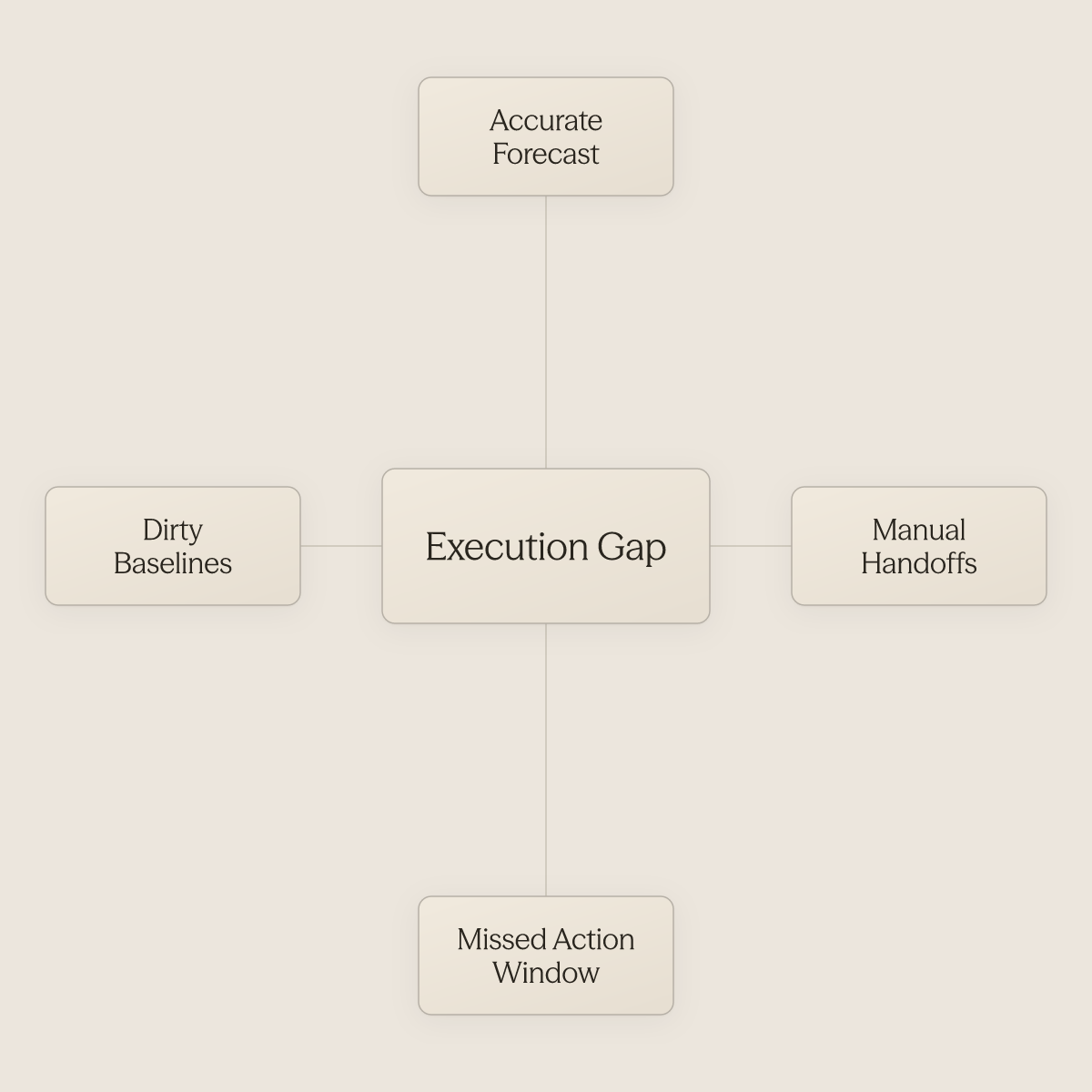
Post-Pandemic Data Poisoning - Why Pre-2020 Baselines Are Still Corrupting 2026 Forecasts
The structural problem with most hotel forecasting models is their foundation. Pre-2020 booking patterns, length-of-stay curves, and segment mix data no longer describe how guests actually behave. Business travel recovery has been uneven, remote work shifted leisure demand to off-peak periods, and group bookings rebounded on a different timeline than transient.
According to a 2026 analysis published by Hospitalitynet, poor PMS data quality, including duplicate records, misclassified segments, and dirty historical entries, corrupts the inputs that demand forecasts rely on, making pre-2020 baselines especially unreliable as post-pandemic patterns continue to diverge. Cleaning the data pipeline is not glamorous, but it is the prerequisite every other forecasting improvement depends on. The same data-quality problem extends downstream into guest communication.
When guest records are duplicated or segments are misclassified, the messages guests receive are mistimed, misaddressed, or simply absent. Operations teams that have existing documentation, SOPs, FAQs, manuals, are best positioned to act immediately once the data pipeline is cleaned, because that documentation can be used to train an AI agent that handles the high volume of repetitive guest messages that accurate forecasts predictably generate. Conduit's AI Agents are most beneficial precisely in this situation: when a business already has structured documentation and needs to convert a surge in forecast-driven guest contacts into consistent, brand-appropriate responses without expanding headcount.
The Multi-Property Consistency Trap - When Each Property Interprets the Same Forecast Differently
A VP of Operations overseeing a multi-property group can produce a technically sound 14-day forecast and still watch revenue leak at the property level, because each property manager reads that forecast through a different operational lens. One property discounts aggressively on a high-demand weekend. Another holds rate but fails to staff up.
A third sends no pre-arrival communication at all. The forecast was accurate; the execution was fragmented. Multi-property revenue management breaks down when the forecast is centralized but the response is decentralized.
Without a standardized layer that translates demand signals into consistent actions across every property, brand voice erodes, guest experience varies, and aggregate portfolio performance falls short of what the forecast predicted. The gap is not analytical. It is structural.
This is exactly where the execution layer matters most. Managing guest communications across multiple platforms or properties simultaneously is the use case where the absence of a consistent response mechanism is most damaging, and most visible to guests. Conduit's Inbox gives operations and support teams a single place to monitor, review, and manage every conversation the AI agent is handling across all properties, so a VP of Operations can see in real time whether brand standards are being applied uniformly or whether one property is going off-script.
Conduit's AI Agents can be configured to reflect the distinct voice and policy rules of each property, ensuring that centralized forecasting is finally matched by a centralized, consistent communication layer. As Hospitalitynet's analysis of hotel data quality makes clear, the inconsistency problem is compounded when bad data means different properties are working from different pictures of the same guest, another reason the operational standardization layer cannot wait.
The Execution Gap - The Challenge Every Other Forecasting Guide on This Page Ignores
According to an analysis cited by Hospitalitynet, 98% of hotels lose revenue from rate misuse every four days, not because their forecasts are wrong, but because the operational layer fails to act on correct pricing signals in time. That statistic reframes the entire forecasting conversation. The problem is not the model.
It is the absence of any mechanism that connects a forecast to coordinated action across pricing, staffing, and guest communication simultaneously. The guest communication component of that coordination gap is the piece most often left entirely unaddressed. When a forecast fires a high-demand signal, the properties that capture the most value are those that reach guests first, with the right pre-arrival message, the right upsell, and the right service framing.
Doing that manually across hundreds of inbound messages, across multiple platforms, at the moment demand peaks, is not operationally realistic. Conduit's Workflows are built for this: they trigger automated guest touchpoints after specific events in the guest lifecycle, after a booking is confirmed, after check-in, or when a keyword is detected, so the response to a forecast signal is not dependent on a staff member noticing it in time. Conduit's Integrations allow the AI agent to draw on existing content without manual re-entry, meaning the first automated guest reply can go out within days of connecting existing SOPs and manuals, not after a months-long implementation.
The execution gap closes fastest when the operational layer is built to respond continuously, whenever a guest sends a message, before, during, or after a stay, not only when a staff member happens to be available.
Best Practices for Hotel Demand Forecasting Accuracy - Including the Automation Layer Most Teams Skip
Six practices separate forecasting teams that produce accurate numbers from those that convert those numbers into coordinated revenue action. The gap is not a data problem. It is an execution architecture problem.
Automate the Execution Layer Downstream of the Forecast
The first five practices sharpen the forecast. This one determines whether it earns its keep. Most enterprise operations teams handle demand signals reactively: a manager reviews the forecast when time allows, then queues an action that fires hours or days after the optimal window has passed.
Automating the execution layer means the forecast itself becomes the trigger: when occupancy crosses a defined threshold, rate adjustments, staffing alerts, and guest communications fire in sequence without waiting for human review. Booking inquiries that arrive overnight or after hours are a direct casualty of this gap. Every inquiry that lands outside staffed hours and sits unanswered until morning is a compression-period conversion lost to a competitor who responded first.
Ai AI Agents, most valuable when a business receives a high volume of repetitive guest messages and has existing documentation such as SOPs, FAQs, or manuals to train the agent on, begin returning automated guest replies within days of connecting that documentation. The result is continuous coverage: the agent responds before, during, and after a stay or interaction, capturing every booking inquiry including the ones that land overnight. That coverage directly reduces the operational overhead and labor costs associated with a centralized reservations or guest services team.
The Workflows layer extends this further. Workflows are most beneficial when the business has recurring, predictable guest touchpoints that currently require manual staff action. They fire after a trigger event occurs in a conversation or guest lifecycle, after a booking is confirmed, after check-in, or when a specific keyword is detected, which means the execution chain downstream of the forecast runs on the same trigger logic the forecast itself produces.
The Inbox provides the operations or support team a single surface to monitor, review, and manage all conversations the AI agent is handling across multiple platforms or properties simultaneously, closing the audit loop that separates genuine execution error from noise. ai Integrations allow the AI agent to pull from tools the team already uses, Notion, Google Drive, Airbnb, existing content informs agent behavior without manual re-entry, so the execution layer stays current as rate strategy evolves.
Hotel Demand Forecasting Best-Practice Checklist
Use this checklist to audit your current forecasting and execution architecture before your next quarterly planning cycle.
| Practice | In Place? | Owner | |
|---|---|---|---|
| 1 | Historical demand data is cleaned and unconstrained for sold-out nights | ☐ Yes / ☐ No | Revenue Manager |
| 2 | Forecasts are segmented by guest type (transient leisure, corporate, group) | ☐ Yes / ☐ No | Revenue Manager |
| 3 | Competitor rate signals are ingested automatically (not via manual rate shop) | ☐ Yes / ☐ No | Revenue / Tech |
| 4 | Variance analysis (MAPE/MAE) runs on a defined weekly cadence | ☐ Yes / ☐ No | Revenue Manager |
| 5 | Forecast error and execution error are tracked as separate metrics | ☐ Yes / ☐ No | VP of Operations |
| 6 | A defined threshold triggers an automated downstream action (rate, staffing, guest comms) | ☐ Yes / ☐ No | VP of Operations / Tech |
| 7 | Pre-pandemic historical baselines have been reviewed and reweighted or removed | ☐ Yes / ☐ No | Revenue Manager |
| 8 | A shared workflow configuration enforces consistent rate-aligned messaging, escalation rules, and upsell logic across all properties | ☐ Yes / ☐ No | VP of Operations | Scoring: 7–8 checks = execution-ready architecture. 4–6 = meaningful revenue leakage risk. Below 4 = the execution gap is actively costing you revenue on every compression event.
1. Integrate Unconstrained Demand Modeling to Remove Sold-Out Distortions
Most hotel demand forecasting models are trained on constrained data, bookings that actually occurred, which systematically underestimates true demand during sold-out periods. Unconstrained demand modeling corrects this by estimating what guests would have booked had inventory been available. It's essential for high-occupancy properties and peak seasons. The tradeoff: it requires clean historical data and statistical expertise that many lean revenue teams lack.
2. Segment Forecasts by Market Segment, Not Just Total Occupancy
Aggregating all booking channels into a single occupancy forecast masks critical behavioral differences between corporate, leisure, OTA, and group segments. Segmented hotel demand forecasting lets revenue managers apply distinct lead-time curves, price elasticity assumptions, and cancellation rates per channel. This is the right approach for full-service and multi-segment properties. The limitation is data volume, smaller hotels may not have enough segment-level history to produce statistically reliable sub-forecasts.
3. Automate Competitor Rate Ingestion to Feed Real-Time Demand Signals
Manual competitor rate checks are a snapshot; automated rate-shopping feeds are a continuous signal. Connecting a rate intelligence tool directly into your forecasting workflow lets demand models detect market compression events, when comp-set rates spike, before your own pickup data reflects the shift. This is the automation layer most revenue teams skip. The tradeoff is cost and integration complexity, particularly for independent hotels without a dedicated tech stack.
4. Apply AI-Driven Pickup Curve Analysis to Sharpen Short-Term Accuracy
Traditional pickup models assume static booking curves, but AI-based methods, including LSTM neural networks and gradient boosting, learn that booking velocity varies by day-of-week, lead time, and external events. For hotels with 12-plus months of reservation data, AI pickup curve analysis consistently outperforms ARIMA and manual methods on short-horizon forecasts. The real limitation is model interpretability: revenue managers often struggle to trust and override outputs they cannot explain.
5. Embed Local Event Calendars as Structured Exogenous Variables
Demand spikes driven by concerts, conventions, sporting events, and public holidays are predictable but invisible to models trained solely on historical booking data. Structuring local event calendars as explicit input variables, flagging event type, expected attendance, and proximity, allows hotel demand forecasting models to anticipate compression periods weeks in advance. This practice is especially high-value for urban and convention-adjacent properties. The tradeoff is the manual curation burden required to keep event data current and accurate.
6. Close the Loop with Variance Analysis to Continuously Recalibrate Forecast Models
Hotel demand forecasting accuracy degrades silently without a formal feedback loop. Systematic variance analysis, comparing forecasted demand against actual pickup at fixed intervals (7-day, 30-day, 90-day), surfaces model drift, seasonal bias, and segment-level blind spots before they compound into revenue leakage. This practice is the discipline most teams skip after initial model deployment. The limitation is that it requires dedicated analyst time and a culture of accountability that many operations-focused hotel teams have not yet built.
From Forecast to Action - How Automated Workflows Close the Revenue Gap in 2026
A demand forecast sitting in a spreadsheet is not a revenue strategy. It is a description of what could happen, waiting for someone to decide what to do next. For most multi-property operators, that gap between signal and action is where revenue upside quietly disappears.
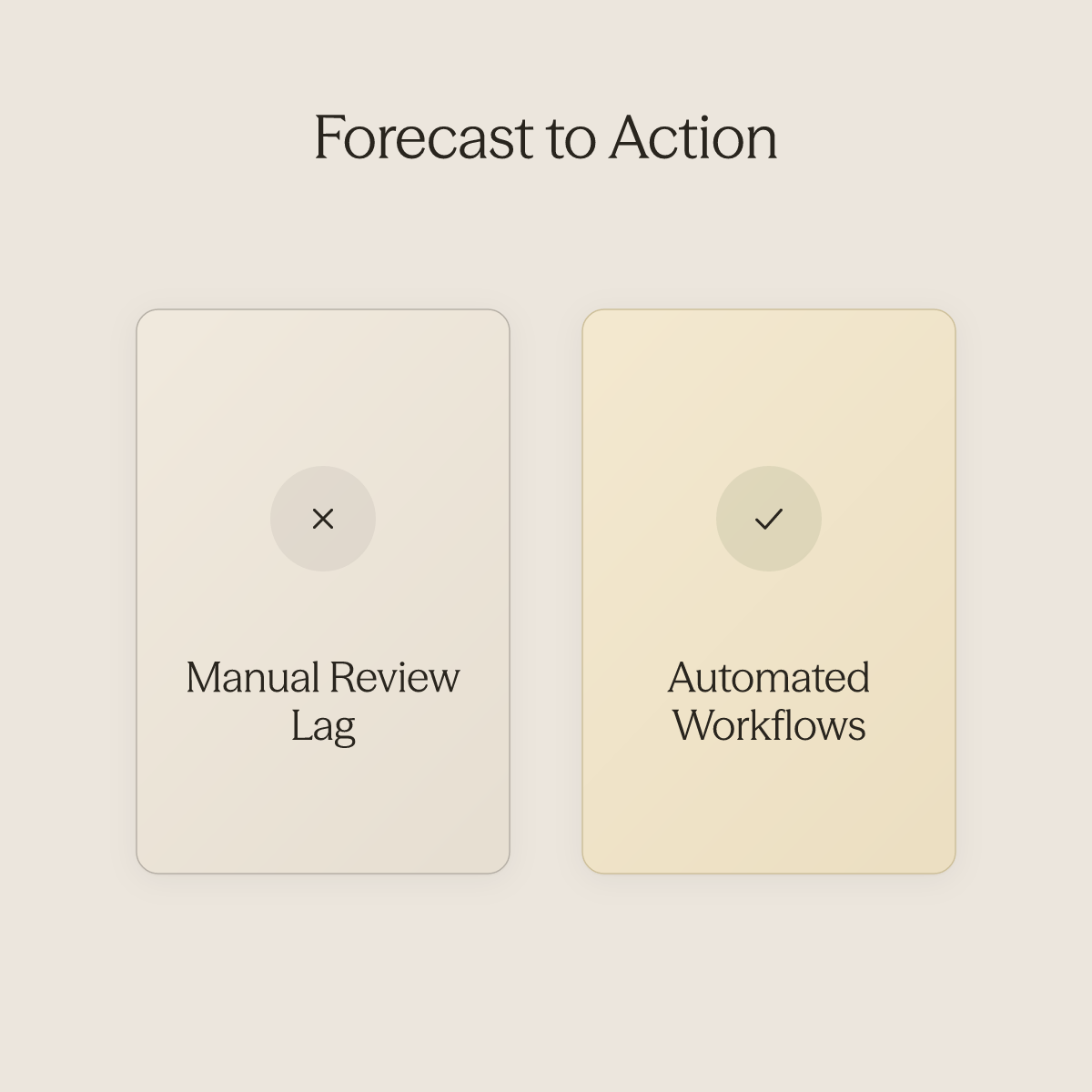
The Execution Gap - Why Accurate Forecasts Still Fail to Capture Revenue
The familiar pattern plays out like this: the revenue management team produces a solid 30-day forecast, a manager reviews it during their next available window, and by the time a rate adjustment or upsell sequence gets queued, the booking window has moved. Industry observations consistently show that the lag between a demand signal being identified and an operational response being executed can be long enough for the most valuable portion of a booking window to close. At peak periods, that lag compounds. Inquiry volume spikes precisely when the guest services team is already at capacity, creating a structural paradox a better forecast cannot solve. The ROI case for automated guest communication is built on preventing missed bookings and review damage at the exact moments when manual routing structurally fails.
Three Workflow Triggers That Turn Forecast Signals Into Coordinated Action
Three documented trigger points close the execution gap. First, when forecast occupancy crosses a defined threshold, a rate adjustment and upsell sequence fires automatically, without waiting for manager review. Second, when a high-demand window is detected, a staffing alert and pre-arrival communication dispatch simultaneously.
Third, when an inquiry spike is detected, an AI agent absorbs the volume and escalates only genuine exceptions to human staff. AI for hospitality platforms like Conduit close the handoff between forecast event and coordinated response without adding coordination headcount. Without that baseline of recurring touchpoints, there is no repeatable trigger for the workflow to fire on.
How a Single Workflow Configuration Enforces Brand Consistency Across a Distributed Portfolio
The execution gap is not just a speed problem; it is a consistency problem. When individual property teams interpret a demand signal independently, brand standards erode at scale. A single Workflows configuration enforces the same rate-aligned messaging, upsell logic, and escalation rules across every property, regardless of which team member is on shift.
Scaling the portfolio without scaling coordination headcount only works if the system, not the person, carries the standard. Multi-brand operators from large hotel groups to independent portfolio operators have consistently found that reducing brand-consistency variance at scale requires the system, not individual property managers, to carry the standard. A single workflow configuration applied across every property ensures that a compression event on a Tuesday night triggers the same calibrated response in property 12 as it does in property 1, regardless of which team member is on shift.
Related Reading
- Best Revenue Management Software For Hotels
- Siteminder Competitors
- Digital Concierge Software
- Hospitality Conferences
- Hotel Distribution Management
- Best Hotel Channel Manager Software
- Canary Technologies Competitors
- Cloudbeds Alternatives
- Hospitality Chatbot
Next steps
If your forecast is firing correctly but your operation is still losing revenue on compression nights, the path forward starts with solving the execution layer, not the model. Accurate predictions are table stakes. The gap that actually costs multi-property operators money is the window between a forecast threshold crossing and a coordinated response reaching pricing, staffing, and guest communication simultaneously. Start with our AI for hospitality.
Live forward-looking signals like pick-up rate and cancellation velocity are the only inputs that operate on the same time horizon as the tactical decisions that must fire before a demand window closes, which means a forecast built without them is operationally inert by design. And as the evidence on execution error confirms, even a technically accurate forecast fails to capture revenue when the handoff to front-line action depends on a manual review step that competes with everything else on a manager's day. Together, these two realities point to one logical next step: an automated execution layer that converts forecast signals into coordinated guest communication, without waiting for human routing.
Start with conduit.ai to see how Conduit connects forecast triggers to automated guest communication workflows across every property in your portfolio. From there, the recurring touchpoints your team currently handles manually, pre-arrival, upsell moments, inquiry spikes during peak load, become the foundation of a system that responds before the booking window closes.
Frequently Asked Questions
Why isn't historical booking data enough on its own for hotel demand forecasting?
Historical data is structurally backward-looking, it tells you what demand looked like under conditions that may never repeat. A model fed only historical data can tell you October will be busy, but it cannot tell you that this Tuesday's pace is running 40% ahead of last year and that the window to act closes in 72 hours, which is where most revenue slips through.
What's the difference between a hotel budget and a hotel demand forecast?
The budget is a plan built once a year against historical assumptions; the forecast is a living signal that updates as booking pace, cancellation velocity, and market conditions shift. A property that anchors rate decisions to a budget and never recalibrates can miss a gap, like a corporate block cancellation in February, for weeks, whereas a continuously updated forecast would flag it and trigger a corrective response much earlier.
How does external market data improve a hotel demand forecast?
External data surfaces blind spots that internal booking history simply cannot, such as a competitor dropping rates on a Thursday night or a conference booking out surrounding hotels before a single room on your property moves. For urban properties especially, local events drive material ADR and occupancy uplift that goes entirely uncaptured when this layer is missing from the forecast.
What are the three time horizons in hotel demand forecasting and why does each matter separately?
The three horizons are short-term (0–30 days), which drives daily rate optimization and staffing calls; tactical (30–90 days), which is where group versus transient displacement decisions live; and strategic (90+ days), which supports annual budget planning. Collapsing them into a single rolling forecast guarantees that short-term operational calls get made with lagging strategic data, and long-range budget assumptions absorb last week's noise.
How does market segmentation fit into hotel demand forecasting?
A complete forecast tracks not just how many rooms will sell but to which guest segments, transient leisure, corporate, and group, and at what rate for each. In the 30–90 day tactical window specifically, segment mix analysis, tracking the ratio of business to leisure travelers and their channel behavior, is the core input for making group versus transient displacement decisions without forfeiting real revenue.
Stay in the loop
Get the latest on AI automation, product updates, and customer stories.


