Hotel Distribution Channels: The Ultimate Guide for 2026


Hotel Distribution
Turn channel demand into revenue.
Your channel mix looks right on paper, yet RevPAR keeps missing projections. The leak is not upstream. It is in the 30 minutes after a guest clicks.
Hotel distribution management is the strategic process of selling hotel rooms through every available channel that can reach a potential guest, from your own website to global OTAs, GDS platforms, and metasearch engines. The goal is straightforward on paper: maximize visibility, occupancy, and revenue across a portfolio. Most heads of operations and VPs of operations at multi-brand or enterprise hospitality groups think the problem, when revenue underperforms, must be upstream: wrong channels, bad rate positioning, or insufficient OTA coverage, and that the fix is always more distribution reach or better pricing technology. See our AI for hospitality for how this works in practice.
Most guides reinforce this assumption, treating distribution as a channel selection problem and leaving the harder question unasked. The harder question is what happens after a guest clicks. Hotel distribution management covers every decision about where, how, and at what price your rooms appear to potential guests.
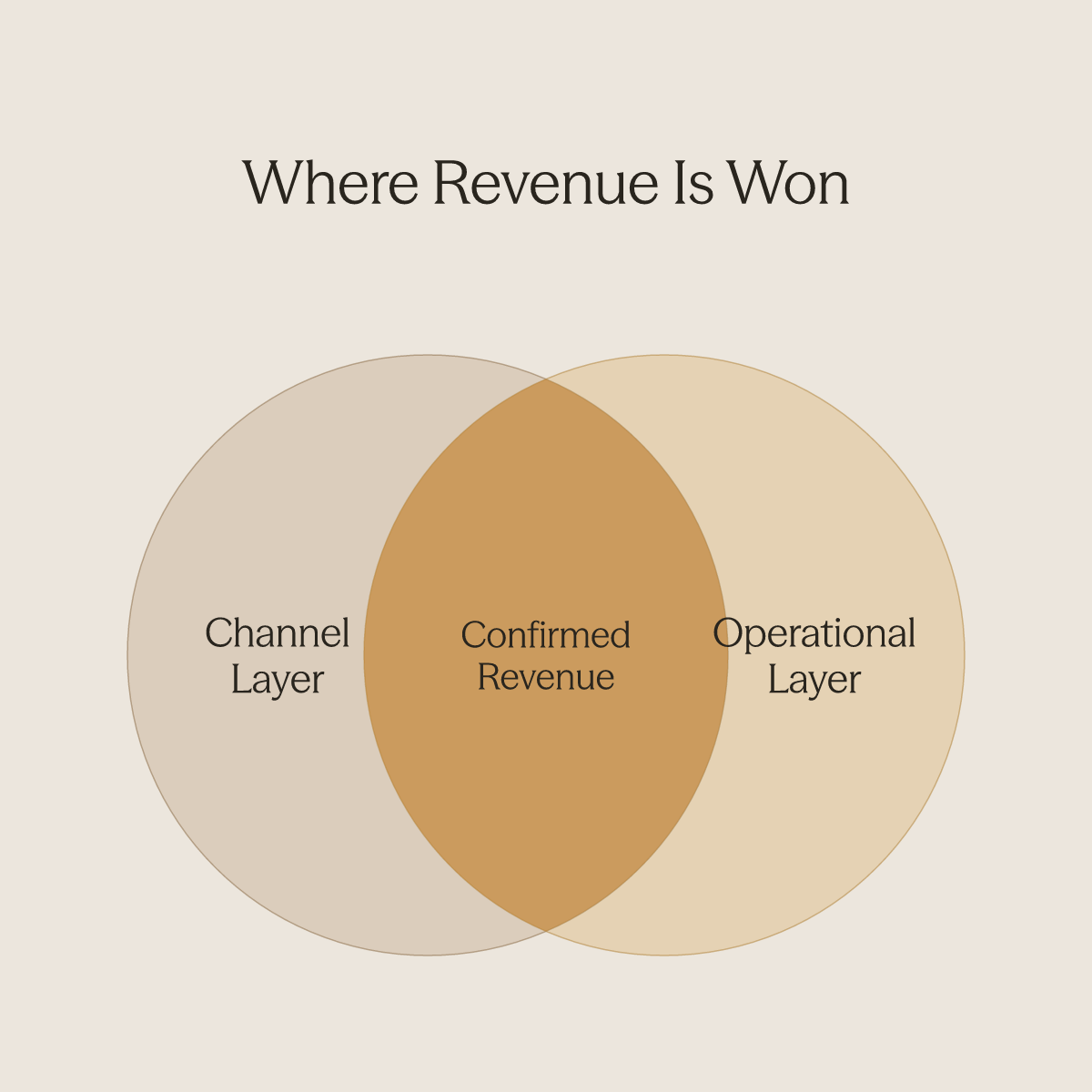
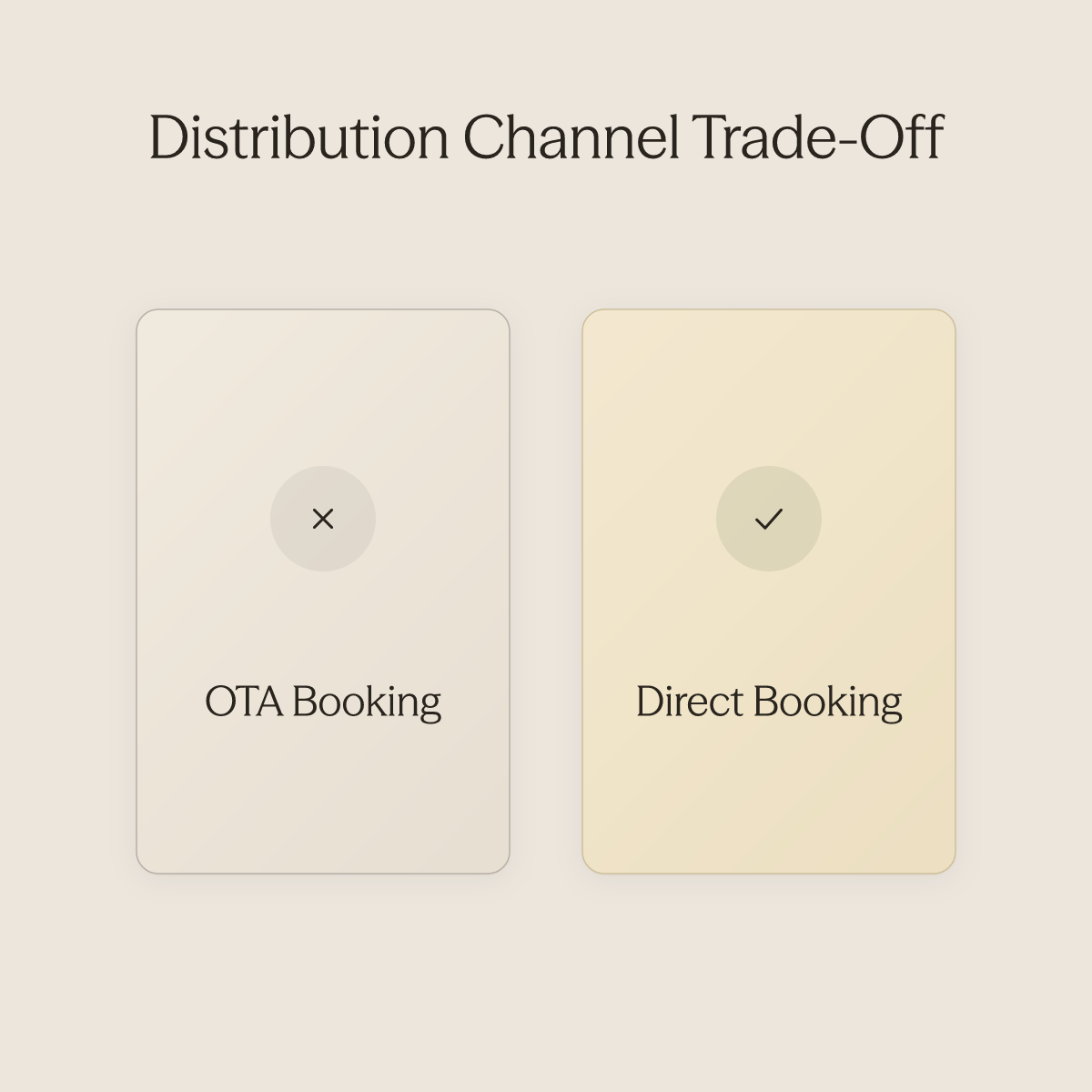
Distribution research consistently surfaces the same structural finding: the channel layer generates demand, but a separate operational layer determines whether that demand closes into confirmed revenue, and most strategies are built entirely around the first layer. This is why RevPAR so often underperforms projections even when channel mix looks right on paper. The foundational trade-off in any hotel distribution strategy is margin from direct bookings versus reach from indirect channels.
Direct bookings carry no third-party commission, keeping more revenue at the property level. OTAs and GDS platforms extend reach into markets a hotel cannot access alone, but their commissions compress net revenue per booking. The objective is not to win one side of that trade-off; it is to hold both in balance, allocating inventory and rate across direct and indirect channels in proportion to what each property's market and capacity actually support.
A guest inquiry on a Friday is not a confirmed booking, it is a time-sensitive opportunity. Industry research consistently finds that response speed is one of the strongest predictors of booking conversion. Operators who reply within minutes capture a structurally higher share of inbound inquiries than those who respond within the hour, a pattern that holds across both short-term rental and hotel contexts.
Key takeaways
- Hotel distribution management is not a channel-selection problem, it's a revenue-capture problem, and most strategies stall at the operational layer, not the channel layer.
- A direct booking on a $200 room nets $200; the same room sold through an OTA nets $150 to $170 after commissions that routinely run 15–25% of booking value.
- OTAs, metasearch, and GDS are structurally different beasts, different billing models, different guest segments, different operational demands, and treating them as one line item on a P&L is how margin disappears quietly.
- Wholesalers and tour operators solve a reach problem no amount of direct marketing spend can fix: non-domestic leisure travelers who book through package pipelines hotels have no direct access to.
- Rate parity enforcement and rate leakage prevention feel like separate problems but trace back to the same root cause, and share the same fix.
- Channel mix optimization is a demand-generation mechanism, not a revenue guarantee; the revenue guarantee lives in how fast your operation responds when that demand arrives.
- The Lauderdale Boutique Hotel cut average guest response time from 57 minutes to 2 minutes after replacing a traditional call center with AI-powered support, that single operational change turned distribution reach into actual revenue capture.
- conduit.ai's AI Agents close the execution gap by handling guest conversations autonomously across every channel, pulling answers directly from a property's own SOPs, manuals, and FAQs, no human intervention required, no lead left waiting long enough to book somewhere else.
Direct vs. Indirect Distribution Channels - How to Read the Margin vs. Reach Trade-Off
Pick any $200-per-night room and the math is immediate: a direct booking through your hotel website nets you $200. The same room sold through an OTA nets you $150 to $170 after commissions that, according to Cloudbeds, typically run 15 to 25 percent of booking value. That spread compounds across thousands of bookings. But treating the direct-vs-indirect decision as purely a margin problem misses a third variable that quietly determines whether the margin you preserve actually lands as revenue.
Direct Channels - High Margin, With a Condition
Direct distribution channels (your hotel website, phone reservations, and loyalty program) carry the highest profit margin because no third-party commission is involved. Book through an OTA instead, and you pay a 15 to 25 percent penalty on demand you already generated and nearly owned. The direct booking advantage materializes only when your systems and team can capture it in real time, day or night, across every channel where guests reach out.
That last qualifier is harder to meet than it sounds. Easy BnB, for example, relied on a large team of virtual assistants to maintain 24/7 guest coverage. The operational drag was severe: routine, low-value inquiries consumed the vast majority of communication volume, staff reliability was poor, missed overnight shifts and undisclosed second jobs were common, and the business could not grow its property portfolio without adding costly headcount, which directly capped its exit valuation multiplier.
The margin advantage of direct bookings existed on paper; the operational model eroded it in practice. ai's AI Agents change the equation. Once trained on your existing SOPs, FAQs, and manuals, and connected through Integrations to tools you already use, like Notion, Google Drive, or your Airbnb account, the agent begins handling guest inquiries automatically, often delivering a first automated reply within days of setup.
It is most valuable precisely when inquiry volume is high and the messages are repetitive: the category that consumed 80 percent of Easy BnB's staff bandwidth. The Inbox gives your operations team a single place to monitor every conversation the AI is managing across multiple platforms or properties simultaneously, so oversight scales with the portfolio rather than headcount. Workflows extend this further, triggering automatic follow-ups after a booking is confirmed, after check-in, or when a specific keyword surfaces, turning what used to be manual staff actions into reliable, timestamped touchpoints.
Indirect Channels - The Reach Reality
Indirect distribution channels (OTAs, GDS platforms, metasearch engines, and wholesalers) trade margin for reach, and that trade is frequently worth making. Independent and boutique properties can see OTAs account for 40 to 60 percent or more of total bookings, according to operator data compiled in 2025, because those platforms put your inventory in front of international travelers who would never find your website through organic search. In non-domestic markets especially, OTA visibility is the only realistic way to reach a leisure traveler booking from a different continent.
For operators at earlier stages of growth, the margin-vs-reach trade-off can feel immediately punishing: paid acquisition across indirect channels is expensive, and without an established conversion baseline it is difficult to know whether the spend is working before the budget runs out. The instinct to retreat entirely to direct channels is understandable, but doing so without the operational capacity to capture direct inquiries at volume simply trades one revenue leak for another.
The Hidden Third Variable - Operational Capacity
The variable most distribution guides omit is operational capacity: your team's ability to convert channel-generated inquiry volume into confirmed revenue before a competitor does. OTA commissions and slow direct-channel response times are not separate problems; they are compounding revenue drains. Every slow response on a direct channel that pushes a guest toward an OTA transforms an operational failure into a self-inflicted margin tax of 15 to 25 percent on demand the hotel already generated and nearly owned.
No rate parity tool or channel manager can recover that loss after the booking is made. Conduit is built around this specific gap: capturing every guest inquiry across channels, day or night, without leaking revenue, and doing it without adding the kind of fragile, headcount-heavy coverage model that capped Easy BnB's growth. Connecting this capability to your Property Management System (PMS) and Customer Relationship Management (CRM) tools ensures that every captured inquiry flows into the systems your team already relies on. The goal is to get ownership teams off the 24/7 on-call treadmill and back to the work that actually grows the business.
Channel Mix as a Portfolio Decision
The right channel mix is a portfolio decision, not a binary. A branded urban hotel with a mature loyalty program can afford to minimize OTA dependency; an independent resort filling international leisure demand cannot. The practical framework: use direct channels as your margin foundation, use indirect channels to extend reach into segments your direct investment cannot, and use AI-powered operations to ensure that every inquiry those channels generate, regardless of the hour or platform, is answered before it becomes someone else's booking.
OTAs, Metasearch, and GDS - The Indirect Channel Ecosystem Every Operator Needs to Understand
Three distinct billing models sit behind what most P&Ls label "indirect channel costs," and conflating them is one of the fastest ways to misread where your margin is actually going. OTAs, metasearch platforms, and GDS networks each charge differently, reach a structurally different guest segment, and demand a different operational response to convert the demand they generate.
1. OTAs - High-Volume Demand Engines With a Commission Cost You Must Budget For
Online travel agencies, including Booking.com, Expedia, and Agoda, are the dominant force in indirect leisure demand. OTA commission rates typically range from 15% to 25% of booking value, a figure consistent across multiple industry sources, making them the most expensive indirect channel on a per-booking basis. That cost is invisible at the top line but corrosive at the net level: the more occupancy you drive through OTAs, the higher your total commission expense climbs, regardless of ADR. OTA guests belong to the platform's loyalty ecosystem, not yours, which limits your ability to shift their next booking to direct.
2. Metasearch - The Price-Comparison Layer That Bridges OTAs and Direct Bookings
Metasearch engines, primarily Google Hotel Ads, TripAdvisor, and Trivago, operate on a fundamentally different model. Instead of taking a commission on completed bookings, they charge on a cost-per-click basis, meaning you pay for the traffic whether or not it converts. The strategic value is real: metasearch sits at the moment a guest is actively comparing rates, and a well-managed bid can redirect that guest from an OTA listing to your direct booking engine, recovering margin on a traveler you would have otherwise paid full OTA commission to acquire. The limitation is that metasearch rewards properties with competitive rate parity and a fast, frictionless direct booking experience. If either condition is missing, the click spend produces OTA bookings anyway.
3. GDS - The Corporate and Travel-Agent Channel That OTAs Simply Cannot Replace
Global distribution systems, primarily Amadeus and Sabre, are the infrastructure layer connecting hotels to corporate travel managers, travel management companies, and travel agents worldwide. The cost model involves flat segment fees rather than percentage commissions, which changes the margin math entirely for higher-ADR corporate bookings.
The critical insight most blended P&Ls obscure is this: each of these three channels generates demand at scale, but the moment an inquiry lands, the channel's job is done. A commission paid to Booking.com or a segment fee paid to Amadeus is lost the moment a slow response window sends that guest back to rebook elsewhere. OTAs, metasearch, and GDS account for the majority of indirect bookings, but they represent only one layer of the indirect ecosystem:
-
OTAs such as Booking.com, Expedia, and Agoda drive high-volume leisure demand at a commission cost that compounds with occupancy.
-
Metasearch platforms including Google Hotel Ads, TripAdvisor, and Trivago charge per click and bridge the gap between OTA listings and direct booking engines.
-
GDS networks, primarily Amadeus and Sabre, serve the corporate and travel-agent segment through flat segment fees rather than percentage commissions.
"OTA commission fees (cited at 17%) are a significant margin drain, motivating operators to seek direct booking alternatives via metasearch and their own channels."
25% of booking value
Wholesalers, Tour Operators, and B2B Distribution - The Global Reach Layer Most Hotels Under-Leverage
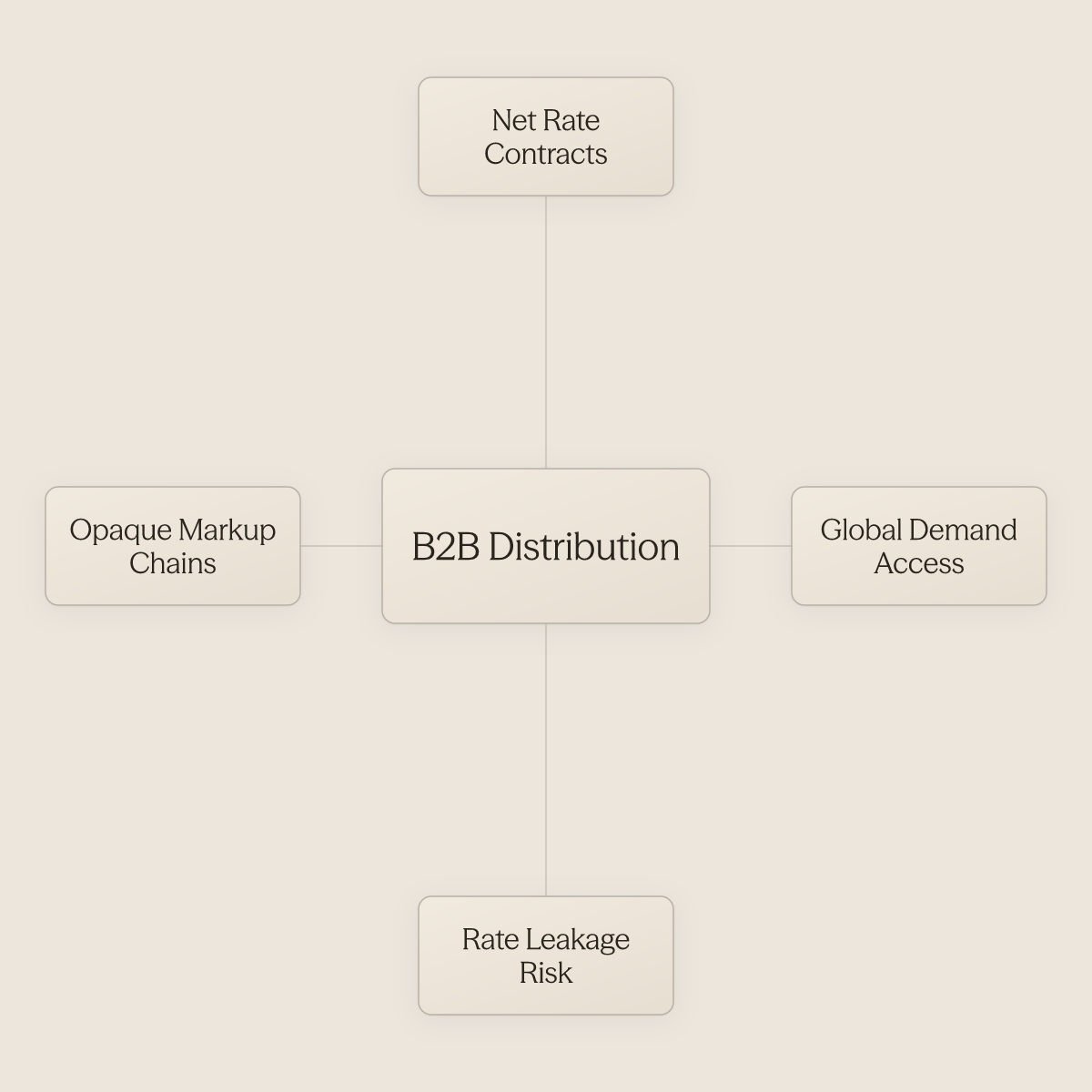
Wholesale and B2B distribution channels give hotels access to international demand they could never reach cost-effectively on their own, but that reach comes with structural trade-offs that most properties manage poorly or not at all. The same net rate mechanics that make wholesalers useful are also the primary engine behind rate leakage, meaning the channel that expands your global footprint is often the one quietly undermining your pricing integrity across OTAs. Understanding how these relationships actually work, from contracted net rates to opaque retail markup chains, is the foundation for managing them with any real control.
Wholesalers and tour operators rarely appear in the same strategic conversation as OTAs and metasearch, but for portfolio operators managing properties across multiple markets, they solve a problem that no amount of direct marketing spend can fix: reaching non-domestic leisure travelers who book through package pipelines you have no direct access to.
What Wholesalers and Tour Operators Actually Do
Wholesalers and tour operators act as bulk buyers of hotel inventory, purchasing rooms at contracted net rates and reselling them through retail travel networks that hotels cannot reach independently. A hotel provides a net rate below its published retail price; the wholesaler marks it up and distributes it through tour operators, travel agents, and package-travel platforms. The hotel gains access to international demand segments; the wholesaler earns the spread.
This model exists because geography creates real distribution gaps. A 180-room resort in a coastal market cannot cost-effectively market itself to leisure travelers in Germany, South Korea, or Brazil through direct channels. Wholesalers solve that structurally, and major B2B travel distribution groups such as HBX Group operate precisely within this wholesale-to-retail pipeline, connecting hotel inventory to retail travel networks at scale.
Net Rates vs. Retail Rates
Net rates are typically set well below the hotel's published retail price, giving the wholesaler room to mark up and remain competitive in their retail channel. The core synthesis here is that the wholesale channel's structural mechanics, net rates marked up through opaque retail networks, make it the primary source of the rate leakage that a hotel's channel manager is simultaneously trying to prevent; the two functions are in direct conflict, not parallel operation. Wholesaler rate leaks are a known and growing problem in OTA distribution.
Even when a property has no direct awareness of its B2B exposure, a rate parity breakdown surfacing on an OTA is frequently traceable back to a contracted wholesaler reselling inventory through a channel that undercuts the hotel's published price. Operators who expand wholesale reach without automated monitoring across downstream retail surfaces are not simply accepting margin erosion, they are actively paying to damage their own pricing integrity. For multi-property operators in particular, that exposure compounds: the same contracted net rate can surface inconsistently across geographically dispersed properties with no centralized visibility into where the leak originated.
This is precisely where the operational overhead becomes unsustainable for lean teams. Running a profitable short-term rental or lodging business with a small team means the recurring, manual work of monitoring guest communications, flagging rate anomalies, and managing escalations across properties competes directly with the strategic work of negotiating and governing wholesale contracts. When those touchpoints are predictable, a booking confirmation triggers a rate audit check, a check-in event triggers a downstream channel scan, they are also automatable.
Conduit's Workflows are most beneficial when a business has recurring, predictable guest and operational touchpoints that currently require manual staff action, firing after trigger events in a conversation or guest lifecycle rather than consuming staff attention continuously.
When B2B Distribution Earns Its Place
The wholesale channel is most defensible in three scenarios:
- High-capacity properties with genuine shoulder-season occupancy gaps
- Markets where non-domestic leisure travelers represent a material share of annual demand
- Portfolio operators filling inventory across geographically dispersed properties without building market-by-market direct marketing capabilities from scratch
Outside those three scenarios, particularly for smaller independent properties or those in markets with strong domestic leisure demand, the margin compression from net-rate contracts and the rate leakage risk typically outweigh the incremental occupancy gains.
Conduit's AI Agents are designed for businesses that receive high volumes of repetitive guest messages and already hold that institutional knowledge in tools like Notion, Google Drive, or Airbnb; the Integrations layer pulls that existing content directly so the agent can act on it without manual re-entry. The Inbox gives the operations or support team continuous visibility to monitor, review, and manage every conversation the AI agent is handling, a meaningful control layer when wholesale-driven booking volumes are highest and rate-parity sensitivity is at its peak. For complex multi-property operations with specific brand standards and escalation policies, the Operator configuration layer allows differentiated agent behavior across properties, so a coastal resort and an urban property in the same portfolio are not handled identically by the same undifferentiated automation.
Channel Management Technology, Rate Parity, and Rate Leakage - The Infrastructure That Holds Your Strategy Together
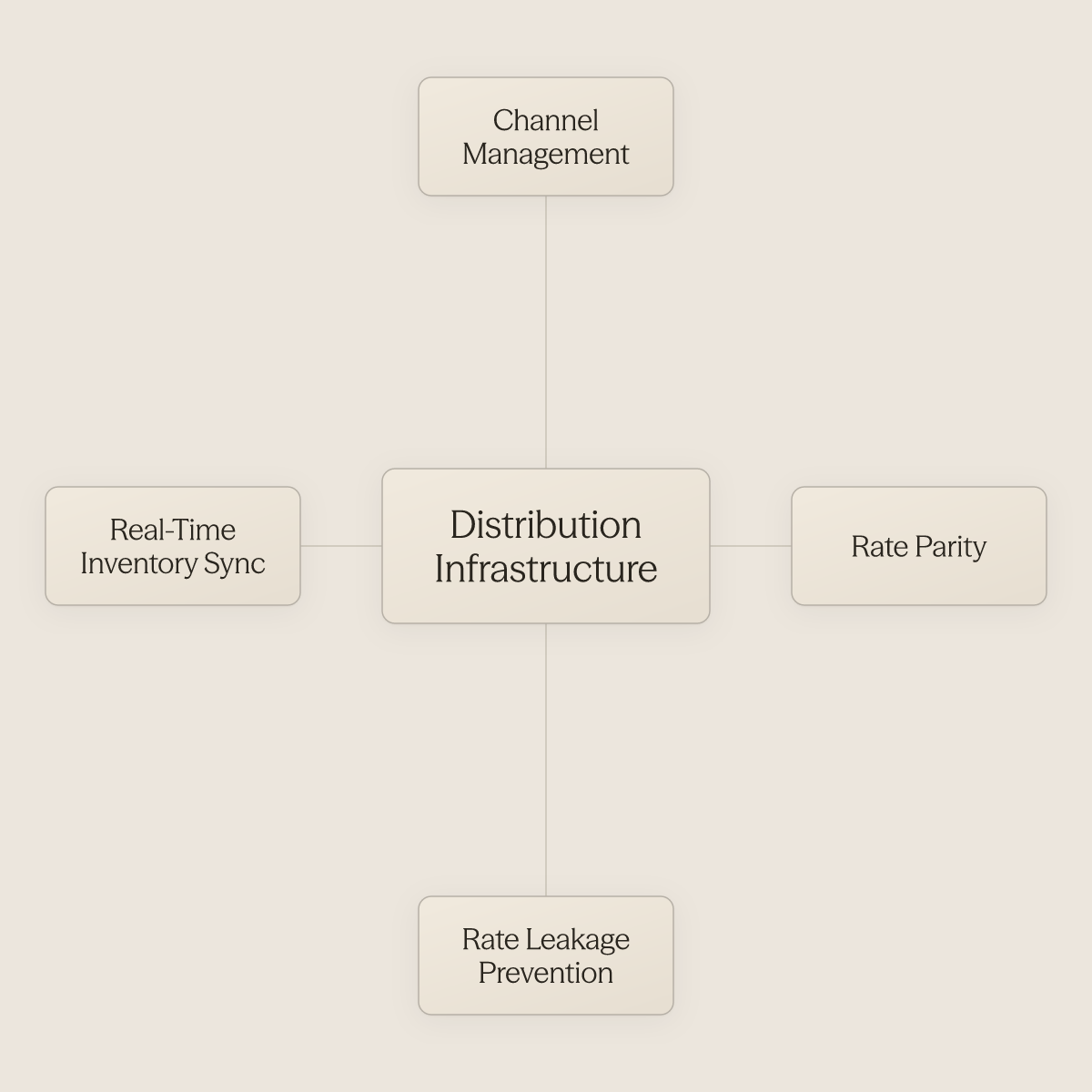
Treat channel management technology, rate parity enforcement, and rate leakage prevention as three separate problems and you will build three separate processes, assign three separate owners, and still wonder why your distribution infrastructure feels fragile. All three failures trace back to the same root cause, and they share the same fix.
Real-Time Inventory Sync as the Foundation Layer
Channel management technology is the system that pushes live inventory and pricing data to every connected booking platform simultaneously. The moment a room is booked on one channel, the channel manager closes that availability everywhere else, in real time. A property managing inventory manually across Booking.com, Expedia, and its own website is always one delayed update away from a double-booking.
Across the market, manual channel updates are a primary driver of overbooking incidents, a failure mode that damages guest trust and triggers costly compensation. SiteMinder, RateGain, and Cloudbeds each offer real-time inventory management as their core function, though they differ in downstream integrations and multi-property portfolio handling. One pressure point that boutique operators in emerging markets face, and that global platform vendors consistently underserve, is local payment gateway compatibility.
In markets like Sri Lanka, Stripe and PayPal are unavailable or heavily restricted, which means a channel manager or booking engine that cannot support custom REST-based bank IPGs (iframe, hosted-redirect, or direct API) is effectively unusable at the point of conversion. The inventory sync works; the booking fails at checkout. Building a distribution stack that actually closes reservations in these markets requires payment infrastructure that accommodates local gateway architectures natively, not as an afterthought.
Rate Parity - A Contract Obligation and Guest Trust Issue
Rate parity means offering consistent pricing across every channel, whether that is Booking.com, Expedia, or your own website. Most major OTA contracts include rate parity clauses prohibiting hotels from offering lower rates on competing platforms. Violating those clauses can result in penalties ranging from reduced placement visibility to contract termination, a pattern most revenue managers will recognize from broader distribution experience.
Rate parity is simultaneously a legal obligation, a brand integrity signal, and a direct booking conversion driver. The operational challenge is not understanding what rate parity means; it is monitoring it continuously across every channel without pulling a revenue manager away from actual strategy work. This is where automated infrastructure earns its place: a system that flags parity gaps the moment they appear, rather than surfacing them in a weekly report, is the difference between a recoverable discrepancy and a guest-facing trust failure that compounds across a portfolio.
How Wholesaler Rates Escape Into the Retail OTA Chain
Rate leakage is the specific failure mode where a wholesaler's contracted net rate, never meant to be visible to retail consumers, surfaces on a public OTA below your published rate. A multi-brand group can spend weeks loading rates carefully across every direct channel, only to discover that a wholesaler downstream has passed that net rate into a retail booking flow. The guest sees a price lower than your own website, your OTA parity clause is technically breached, and your direct booking proposition is undercut.
Detection requires automated rate monitoring that scans channels continuously, not a quarterly audit. Manual spot-checks cannot catch leakage at the speed it spreads.
Leakage that begins on a peak weekend has already done its damage by checkout. Building a systemized, scalable distribution business means removing that dependency structurally, not reinforcing it with more manual checkpoints.
Automated Infrastructure as the Replacement for Manual Processes
The failure mode operators describe most often is not a single catastrophic error but the slow accumulation of small sync delays: a rate update that took four minutes to propagate, a room that sold twice during a peak weekend, a parity gap that existed for 36 hours before anyone noticed. At one property those gaps are recoverable; across a portfolio of 20 or 50 properties they compound into material revenue loss and operational drag. Automated channel management infrastructure eliminates the reconciliation work structurally, not by improving the manual process but by making manual reconciliation unnecessary, freeing revenue management teams to focus on rate strategy and demand forecasting rather than error correction across a sprawling channel stack.
The same principle applies to the guest communication layer that sits alongside distribution. Booking inquiries do not arrive only during business hours, and a guest who sends a rate or availability question overnight and receives no reply until morning has often already converted elsewhere. Capturing every booking inquiry, including the ones that land after hours, is not a hospitality nicety; it is a direct booking revenue lever.
Conduit's AI Agents are most effective precisely in this context: properties that receive a high volume of repetitive guest messages and have existing SOPs, FAQs, or property manuals can connect that documentation to the agent and begin returning automated first replies within days. The Inbox layer then gives operations and support teams a single place to monitor, review, and manage every conversation the agent is handling across multiple platforms or properties simultaneously, so the team retains oversight without being the bottleneck. Workflows extend this further, triggering automated guest touchpoints after a booking is confirmed, after check-in, or when a specific keyword surfaces in a conversation, replacing the manual follow-up actions that currently require staff time at every predictable point in the guest lifecycle.
Related Reading
- Hotel Budgeting And Forecasting
- Hotel Demand Forecasting
- How To Improve Hotel Operations
- How To Increase Revpar
- Hotel Upselling
- Hotel Revenue Management Strategies
- Automated Hotel Reservation System
- Hotel Guest Messaging
- Hospitality Automation
- Hospitality Operations Management
- Adr Vs Revpar
Building a Hotel Distribution Strategy - Direct Booking Optimization, RMS Integration, and Performance Analysis
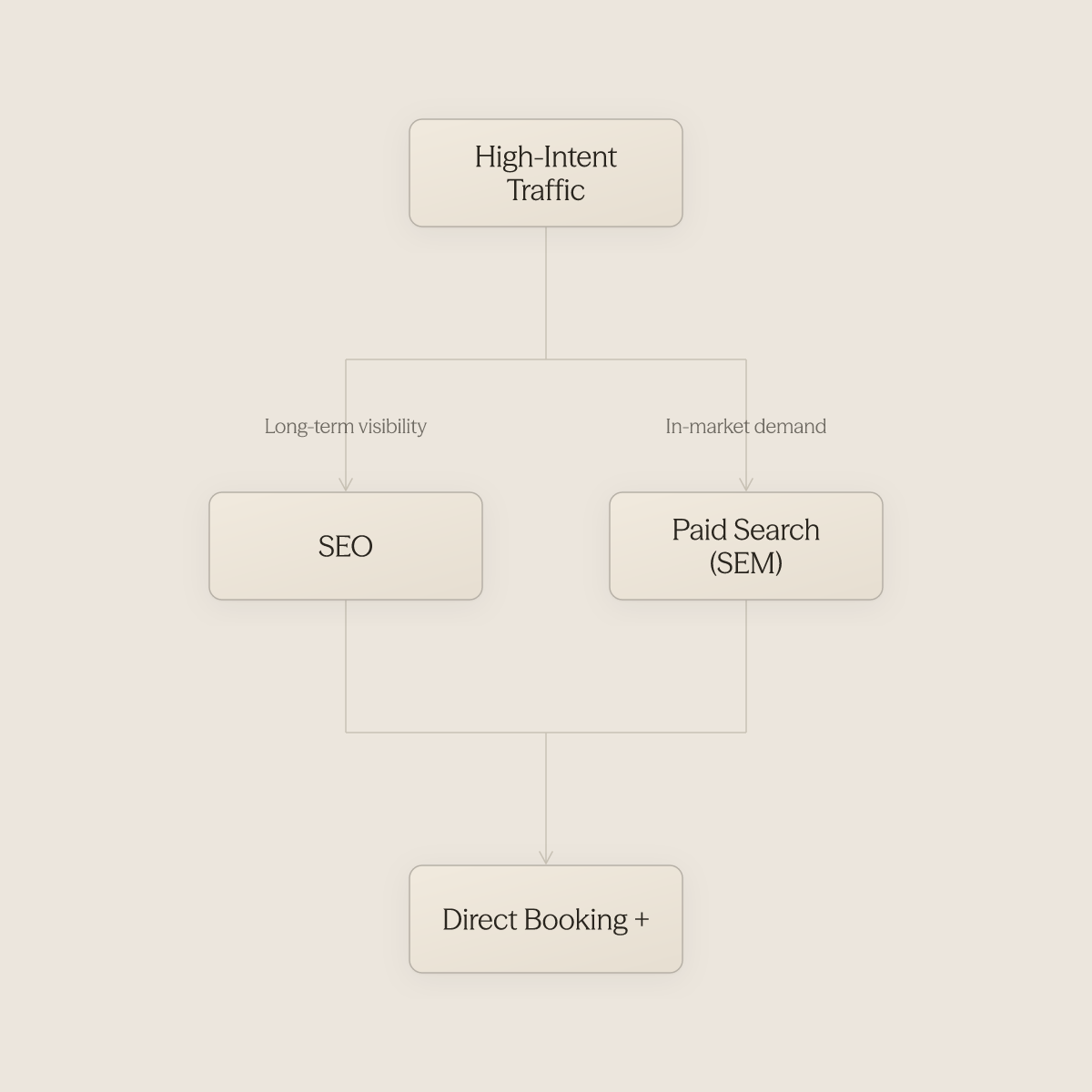
Optimizing direct bookings starts with driving high-intent traffic to the hotel's own website through organic search visibility and paid search campaigns. SEO builds the long-term foundation; SEM captures demand that is already in-market. Together they reduce OTA dependency and lower cost-per-acquisition meaningfully compared to the 15–25% commission drag that compounds across thousands of annual reservations.
That commission burden is not theoretical: properties that over-rely on a single OTA can watch a substantial share of every reservation's revenue evaporate before it reaches the bottom line, a margin erosion that no rate optimization strategy alone can fully offset. The math makes heavy OTA dependency structurally unsustainable. Loyalty programs are where the economics shift from linear to compounding.
A guest acquired through paid search at a $40 cost-per-acquisition becomes a direct-booking asset if a loyalty program pulls their second and third stays off the OTA entirely. The acquisition cost amortizes across a longer booking relationship, and repeat-guest net contribution grows with each stay. Without a loyalty layer, direct booking investment resets to zero with every new guest.
The RMS as Intelligence Layer, Not Just a Pricing Tool
A Revenue Management System (RMS) sits above the channel manager in the distribution stack. The channel manager executes: it pushes rates and inventory to connected platforms in real time. The RMS thinks: it reads market demand signals, competitor positioning, and booking pace to determine what rate to push and when.
Operators who treat the RMS as a pricing tool alone miss its actual function, telling the entire distribution strategy where demand is moving before it moves. One reason distribution strategy thinking stays siloed is that revenue management professionals, especially those still building their practice, often struggle to see how the distribution role intersects with Front Office, Reservations, and Sales & Marketing. When those connections are unclear, the RMS output stays inside the revenue team rather than shaping SEM bids, promotional timing, or the operational response layer.
Building that cross-departmental fluency is what separates a pricing operator from a genuine distribution strategist. RMS output should inform SEM bid adjustments and direct booking promotional timing, not just OTA rate cards. When the RMS signals a compression event three weeks out, that is the moment to increase paid search spend and push a direct booking incentive, not after the OTA has already captured the demand surge.
Cost-Per-Acquisition and Net RevPAR - The Metrics That Matter
A common pattern among operators is tracking channel revenue without netting out acquisition cost, which produces a misleading picture of channel performance. Net RevPAR, which subtracts distribution cost from revenue per available room, forces an honest channel comparison. A property generating $180 net RevPAR on direct bookings and $155 net RevPAR on OTA bookings is not running a balanced channel mix; it is subsidizing OTA volume at a cost to margin. Reallocating budget toward the higher-net-contribution channel is the performance analysis function that closes the strategy cycle.
Slow Inquiry Response as a Distribution Strategy Failure
No distribution strategy analysis that measures only channel mix, rate positioning, or booking volume will ever surface slow inquiry response as the cause of underperformance, because the failure registers as an OTA conversion, not as a lost direct booking. Speed of response to a direct inquiry is a distribution decision, not an operations detail. Guest expectations are now benchmarked against the response times of on-demand consumer platforms, same-minute confirmations, instant status updates, and a hospitality operation that replies in 45 minutes is not competing on the same standard, regardless of how well its channel mix is constructed.
The operational cost of slow response is real and documented. Wynwood House's customer experience team was running guest resolutions at well over ten minutes per interaction on average, with agents forced to context-switch between disconnected tools to draft messages, translate responses, pull guest history, and log performance data. Sentiment was tracked manually in inconsistent Google Sheets.
Shift handoffs required reading entire conversation histories. Managers had no reliable visibility into guest satisfaction at scale. Each of those friction points is a compounding tax on the direct booking relationship; every delayed reply or dropped handoff is a moment where a guest's next reservation drifts back toward the OTA.
Conduit's AI Agents close the gap. The agents are most beneficial when a property receives a high volume of repetitive guest messages and has existing documentation, SOPs, FAQs, manuals, to train on. Once connected, the first automated guest reply goes live within days, and from that point the agent responds continuously, before, during, and after a stay, without forcing human agents to switch between platforms for every interaction.
The Inbox layer sits above that, giving operations and support teams a single surface to monitor, review, and manage all conversations the AI agent is handling, across multiple platforms or properties simultaneously. Workflows extend the system further: after trigger events like a confirmed booking or check-in, the platform executes recurring guest touchpoints that would otherwise require manual staff action. And for properties already using tools like Notion, Google Drive, or Airbnb, the Integrations layer lets the AI agent draw on that existing content without manual re-entry, meaning the knowledge base that took years to build becomes the engine behind every guest reply.
The result is an operational response layer that matches the speed standard guests already expect, without adding headcount, and without allowing inquiry latency to silently drain the direct booking investment that the rest of the distribution strategy worked to earn.
Channel Mix Decision Framework - Matching Distribution Channels to Property Profile
Use this table to decide where to concentrate distribution investment based on your property's actual profile:
| Property Profile | Primary Channel Priority | Secondary Channel | Channels to Limit |
|---|---|---|---|
| Branded urban hotel, mature loyalty program | Direct (website + loyalty) | GDS (corporate) | OTA dependency |
| Independent boutique, leisure-focused | OTA (reach) | Metasearch (margin recovery) | Wholesale (rate leakage risk) |
| High-capacity resort, shoulder-season gaps | Wholesale + Tour Operators | OTA | Metasearch (low ADR efficiency) |
| Multi-brand portfolio, mixed markets | GDS + OTA + Direct in parallel | Metasearch | None, all channels required |
| Business-oriented, corporate demand | GDS (non-negotiable) | Direct (loyalty) | OTA (low corporate fit) |
Decision rule: Start with the channel that reaches the guest segment you cannot access through direct marketing alone. Layer margin-recovery channels (direct, loyalty, metasearch) on top once reach is solved. Then audit the operational response layer, because the commission savings recovered by shifting volume from OTA to direct are only realized when the inquiry that arrives through the direct channel is answered fast enough to convert.
The Operational Gap That Kills Hotel Distribution ROI - Why Multi-Channel Reach Without Execution Speed Loses Revenue
Most heads of operations and VPs of operations at multi-brand or enterprise hospitality groups think the gap between a sophisticated distribution strategy and the revenue it actually captures is a channel problem, that the problem must be upstream: wrong channels, bad rate positioning, or insufficient OTA coverage, and that the fix is always more distribution reach or better pricing technology. In reality, it is almost always a response problem. Hotels investing in OTA partnerships, metasearch bidding, and GDS connectivity are generating real demand, then losing a measurable share of it at the moment a guest inquiry arrives and the volume simply exceeds what any centralized team, no matter how capable, can clear fast enough during peak windows.
Multi-Channel Reach Multiplies Inquiry Volume and Fragments the Team That Has to Handle It
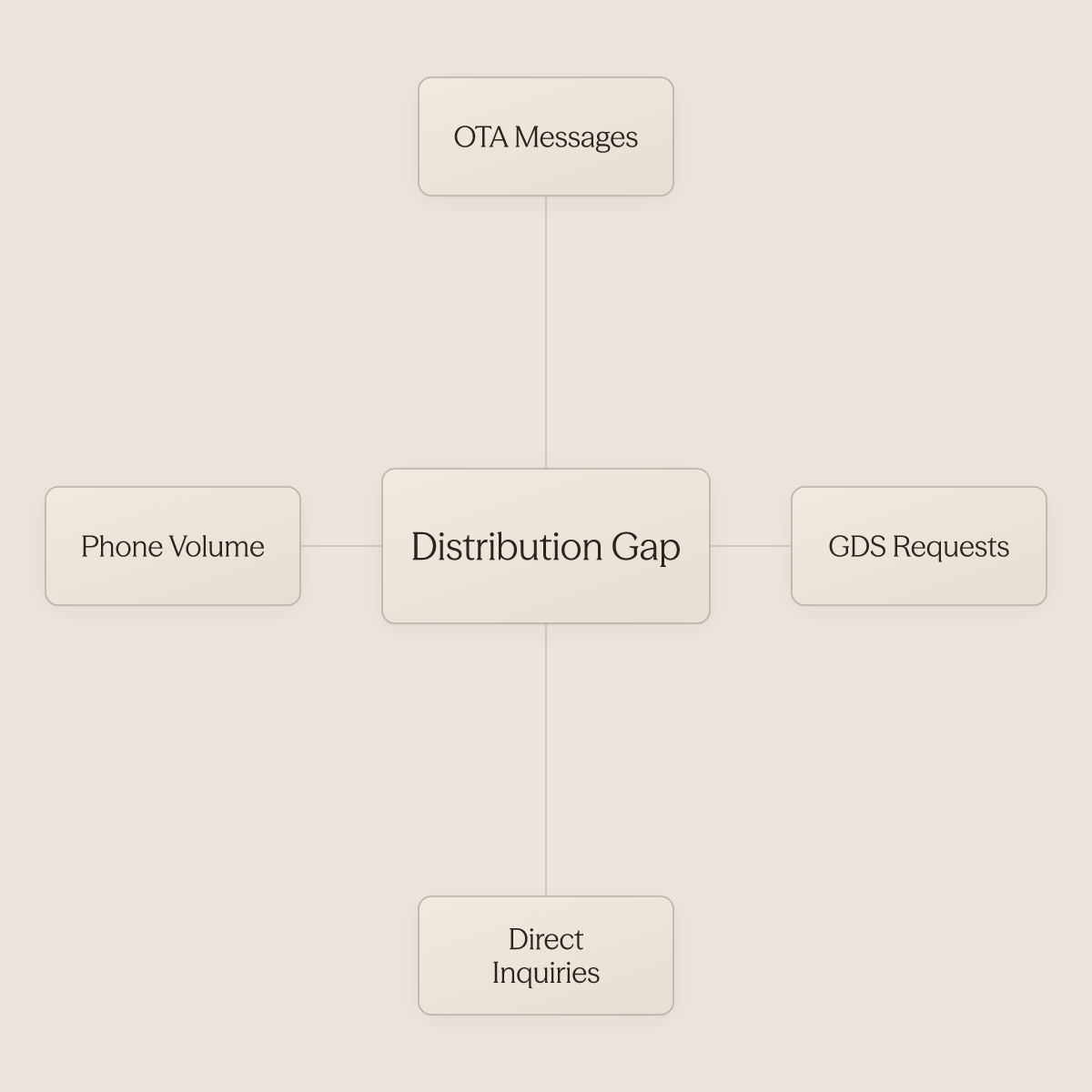
The main challenges in hotel distribution management are not strategic; they are operational. Every channel added to a distribution mix generates a separate stream of inbound inquiries, each arriving on its own platform, in its own format, with its own response-time expectation. A reservations team managing OTA messages, direct booking questions, GDS agent requests, and phone calls simultaneously is not executing a distribution strategy; it is triaging a communication queue.
The operational load compounds further for multi-property groups: each additional property multiplies the number of concurrent threads the team must track, and the conversations fragment across Airbnb, OTA extranets, direct email, and whatever other channels the portfolio touches. During peak booking windows, that queue grows faster than any centralized team can clear it, and the inquiries that wait longest simply convert elsewhere. This is precisely the operational scenario where Conduit's AI Agents and unified Inbox deliver the most measurable lift, specifically when a business receives a high volume of repetitive guest or customer messages across multiple platforms or properties simultaneously and has existing documentation (SOPs, FAQs, manuals) to ground the agent on.
Rather than routing every inbound message through a human queue, the AI Agent handles guest inquiries continuously, before, during, or after a stay, drawing on property-specific SOPs and documentation to respond accurately and consistently from the first automated reply. The operations or support team retains full visibility through the Inbox, monitoring, reviewing, and managing all conversations the AI is handling without needing to intervene on every thread. The practical result is the ability to add properties without adding coordination headcount, scaling the portfolio without proportionally increasing the staffing structure that receives what the channels generate.
Slow or Inconsistent Responses Erode the Review Scores That Feed Future Channel Performance
Inquiry response time is one of the sharpest predictors of conversion in hospitality: operators who reply within minutes convert at dramatically higher rates than those who respond after half an hour. That is not a marginal difference; it is a structural one. A guest who waits 45 minutes and books elsewhere is unlikely to leave a strong review.
Lower review scores reduce OTA ranking visibility, which suppresses future booking volume from the same channels the operator is paying to maintain. The slow response does not just lose one booking; it quietly degrades the distribution asset itself. The compounding effect is particularly damaging for multi-property groups, where inconsistent response quality across properties creates uneven review profiles that are difficult to diagnose and expensive to recover.
When one property's team is overwhelmed and another's is not, the portfolio's aggregate ranking suffers in ways that are invisible until the booking data is already trailing. Conduit's Workflows address this by triggering automated guest touchpoints after predictable lifecycle events, after a booking is confirmed, after check-in, or when a specific keyword is detected, so that the consistent, timely communication guests expect is not dependent on whether a human happened to be available at that moment.
How to Quantify the Revenue Cost of Slow Inquiry Response
Every minute between a channel-generated inquiry and a confirmed booking is a margin event, not just a service lapse. The operational gap is where hotel distribution challenges actually live, not in the channel mix, but in the communication infrastructure that receives what the channels generate. The conversion rate differential between a rapid response and a delayed one is large enough that communication speed functions as a structural revenue variable across every channel in the mix.
Conduit's AI Agents close that gap by handling OTA messages, direct booking questions, and guest inquiries across every channel simultaneously, drawing on property-specific SOPs and documentation, including content already stored in tools like Notion, Google Drive, or Airbnb, pulled in through Integrations without manual re-entry. The operations team monitors all of it through a single Inbox rather than toggling between platform extranets. The compound benefit for portfolio operators is the one that matters most at scale: the ability to add properties without adding coordination headcount, growing the portfolio without scaling the staffing layer that response volume would otherwise demand.
How AI Agents Close the Distribution Execution Gap: and Turn Channel Reach Into Captured Revenue
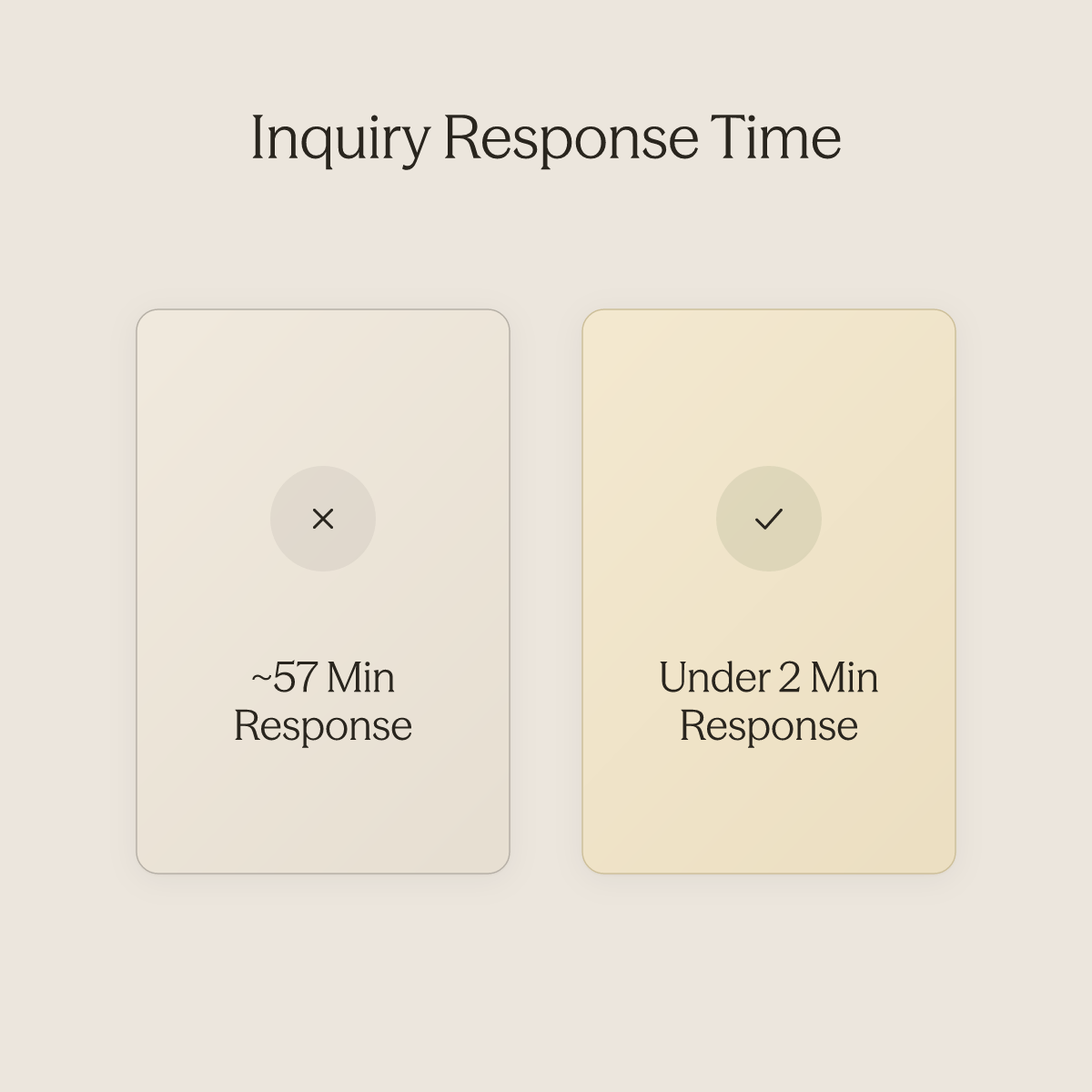
When response time drops from nearly an hour to under two minutes, channel mix optimization reveals what it always was: a demand-generation mechanism, not a revenue guarantee. For multi-property operators who have already balanced OTA exposure, activated metasearch, and tightened rate parity, the next revenue lever sits in the operational layer that receives demand and either converts it or loses it to whoever responds first.
AI Agents vs. Chatbots - What the Difference Means for Distribution Execution
The distinction matters in distribution terms. A scripted chatbot follows a decision tree. An AI agent reads your actual property documentation, interprets the guest's intent, and sends a complete, accurate reply without a human in the loop. For a multi-brand portfolio, each property's SOPs, rate policies, and escalation rules are encoded into the agent's behavior from day one. This approach delivers the most value in a specific operating condition: properties that already receive a high volume of repetitive guest inquiries and have existing documentation, SOPs, FAQs, or operational manuals, ready to train the agent on. Without that documentation foundation, the agent must be built from scratch, which extends deployment time and delays the response-speed gains.
From 57 Minutes to 2 Minutes - Response-Time Compression and Conversion
Response time is a direct conversion variable, not a service quality metric. The Lauderdale Boutique Hotel compressed average response time from 57 minutes to 2 minutes after deploying AI-powered guest support, a result that illustrates how response-time compression translates directly into conversion recovery across a channel mix that was already generating demand. OTA-generated demand is perishable: a guest who waits an hour is already browsing the next listing. Recovering that booking to a direct channel removes a 15 to 25 percent OTA commission from the transaction, making AI guest communication a distribution margin recovery tool, not merely an efficiency upgrade.
Scaling the Portfolio Without Scaling Headcount - Easy BnB's Expansion
Darren, founder of Easy BnB, added 75 properties and zero additional staff after restructuring his operation around AI-powered guest communication. Monthly labor costs dropped materially, a direct result of removing the per-property staffing overhead that previously scaled with unit count. The outcome was a P&L structure where headcount no longer scales with unit count, the condition that makes rapid portfolio expansion financially viable rather than margin-dilutive.
SOP Enforcement at Scale - Consistent Brand Voice Across a Multi-Brand Portfolio
The consistency problem is structural. When guest replies depend on which team member is on shift, brand standards degrade at exactly the rate the portfolio grows. Conduit's AI agents are trained on property-level and brand-level documentation, so the same escalation policy, tone, and rate information appear in every reply regardless of property, channel, or hour.
Wynwood House applied this across seven countries, significantly reducing resolution time per interaction while maintaining a strong Airbnb rating in Colombia. One honest trade-off: a portfolio with no written SOPs must build that foundation before the agent can enforce it.
The channels are already working. The demand is already arriving. The only question is whether your operational layer is built to capture it, and for most multi-property operators, the answer to that question determines more of the revenue outcome than any further adjustment to channel mix. This approach is best suited to operations that already manage a meaningful volume of repetitive guest inquiries and have existing documentation to train on. Operators running a single casual rental property or those who prefer fully relationship-driven, manual guest communication will find little lift here and are genuinely better served by other tools.
Related Reading
- Best Hotel Channel Manager Software
- Hospitality Chatbot
- Best Revenue Management Software For Hotels
- Siteminder Competitors
- Canary Technologies Competitors
- Cloudbeds Alternatives
- Digital Concierge Software
- Hospitality Conferences
Next steps
If your channel mix is generating demand that still isn't closing into confirmed revenue, the path forward starts with recognizing that the conversion gap lives in the operational response layer, not the channel list.
Rate parity technology and channel management infrastructure solve the inventory and pricing consistency problem, but they create a false sense of strategic completeness: they do nothing to address the response-time bottleneck at the direct-channel layer, where a 5-minute versus 30-minute gap produces a 100x difference in conversion probability. AI agents deployed at the guest communication layer structurally reverse that problem: documented deployments show response times compressing from 57 minutes to 2 minutes, and each direct booking recovered in that window eliminates a 15 to 25 percent OTA commission on demand the hotel already generated. Together, those two realities point to the same action: closing the execution gap before adding any further channel investment.
Start with AI for hospitality to see how the operational response layer connects to the distribution stack you already have. From there, you can evaluate how response-time compression affects net RevPAR across your current channel mix.
Frequently Asked Questions
What is a hotel distribution channel?
A hotel distribution channel is any platform or pathway through which a hotel sells rooms to potential guests, from its own website and phone reservations to OTAs like Booking.com and Expedia, GDS platforms like Amadeus and Sabre, metasearch engines like Google Hotel Ads, and wholesalers. Each channel reaches a different guest segment and carries a different cost structure, which is why treating them as interchangeable is a common strategy mistake.
Why do OTA commissions hurt so much even when occupancy looks healthy?
OTA commission rates typically run 15 to 25 percent of booking value, so the more occupancy you drive through those channels, the higher your total commission expense climbs regardless of your average daily rate. The compounding problem is that every slow response on a direct channel that pushes a guest toward an OTA transforms an operational failure into a self-inflicted margin tax on demand the hotel already generated and nearly owned.
How is metasearch different from an OTA, aren't they basically the same thing?
They are structurally different: OTAs take a commission on completed bookings, while metasearch engines like Google Hotel Ads and TripAdvisor charge on a cost-per-click basis, meaning you pay for the traffic whether or not it converts. The strategic opportunity with metasearch is that a well-managed bid can redirect a price-comparing guest from an OTA listing to your direct booking engine, recovering the margin you would otherwise pay as OTA commission.
Do I actually need GDS connectivity, or is a strong OTA presence enough?
For business-oriented properties, GDS connectivity is non-negotiable, corporate travel programs and travel management companies book through GDS by policy, and that segment does not migrate to OTAs regardless of how competitive your Booking.com listing is. The cost model also differs: GDS charges flat segment fees rather than percentage commissions, which changes the margin math entirely for higher-ADR corporate bookings.
What's the real risk of using wholesalers to fill occupancy gaps?
The core risk is rate leakage: wholesalers purchase inventory at contracted net rates and resell through opaque retail networks, and those marked-up rates frequently surface on OTAs at prices that undercut the hotel's own published price. Operators who expand wholesale reach without automated monitoring across downstream retail surfaces are not simply accepting margin erosion, they are actively paying to damage their own pricing integrity, a problem that compounds across multi-property portfolios with no centralized visibility into where the leak originated.

Stay in the loop
Get the latest on AI automation, product updates, and customer stories.


