23 Best Hotel Revenue Generating Ideas to Boost Profits


23 Revenue Ideas
Plug the timing gaps, keep the profit.
Most hotels already have the revenue ideas. What kills the return is a timing gap between when guests are ready to spend and when your team can respond. Here is where the money actually goes.
Most hospitality business owners think that if they haven't found the right revenue strategy yet, they just need a better pricing model or a new amenity package, that more tactical ideas will fix it. The whiteboard is full: a pre-arrival upsell sequence, a weekend package, a loyalty perk for repeat guests, a spa promotion timed to low occupancy. The ideas are solid. See our AI for hospitality for how this works in practice.
Execution is where everything quietly falls apart. The real leak is a timing gap between when a guest is ready to spend and when your team is available to respond. A guest books at midnight and checks in at noon, but the upgrade offer only goes out during business hours.
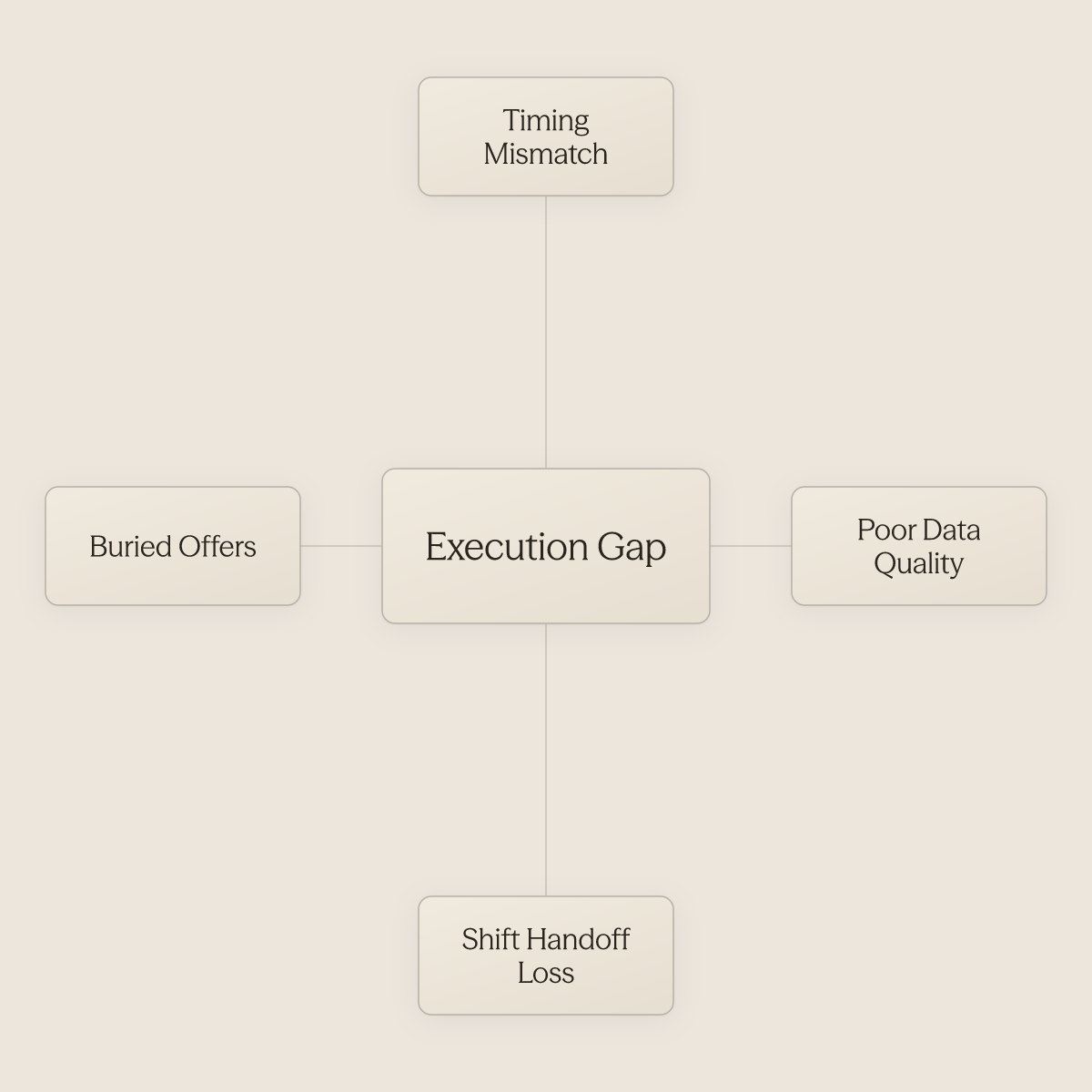
The inquiry lands, the moment passes, and the revenue never appears on any report because it was never captured. Revenue strategies are often undermined internally before they ever reach a guest. Poor data quality in property management systems, inconsistent front-desk handoffs, and shift changes that swallow context all erode execution before any pricing idea can convert.
A common pattern: a hotel builds a compelling ancillary offer, then buries it in a staff briefing skipped during a busy check-in rush. The offer exists on paper. It never reaches the guest.
That's not a strategy failure. It's a communication timing failure. Platforms with instant-confirm options train guests to expect immediate answers.
When a direct inquiry sits unanswered for six hours, conversion doesn't just slow, it disappears. Booking inquiry response time is a revenue variable, not a service metric. Most operators already have the ideas.
What they're missing is the mechanism that delivers those ideas precisely when a guest is ready to act. The revenue isn't gone. It's sitting in windows your current setup can't reach.
Key takeaways
- Most hotel revenue strategies fail at the delivery window, not the drawing board, the pricing logic, the upsell sequence, and the package are solid; what breaks is the timing of when they reach the guest.
- Pre-arrival upsell emails generate an average of $95 per booking, but only when they land at the moment a guest is still deciding, a sequence that fires late or not at all earns nothing regardless of the offer.
- OTA dependency is a response latency problem in disguise: guests default to Booking.com during overnight inquiry blackouts because no one at the property answered first.
- Loyalty program members spend up to 50% more annually than non-members, but that lift evaporates when the right message never reaches the right guest at the right moment.
- F&B, event space, and local experiences are chronically undermonetized not because the inventory is wrong, but because no one surfaced the offer at the moment a guest was ready to buy.
- Dynamic pricing only earns its keep when the conversation it triggers gets answered, a rate change at midnight means nothing if the inquiry it generates sits until morning.
- Conduit's AI-powered guest communication tools close the execution gap by handling inquiries, upsell offers, and package recommendations 24/7, so every revenue idea the team builds actually reaches the guest at the moment it can convert.
The Three Revenue Leaks Killing Hotel Profits Right Now
Three revenue streams sit inside every hotel property right now, quietly draining profit before the morning report surfaces them. The common assumption is that if we haven't found the right revenue strategy yet, we just need a better pricing model or a new amenity package, more tactical ideas will fix it. But the problem isn't a shortage of ideas, it's that each stream has a delivery window, and that window keeps closing before anyone can act.
As Erwan Le Roy of Cash Flow Street puts it bluntly: *"Right now you don't have an option anymore. We see a divergence of hosts now: the hosts that use AI and the hosts that don't use AI. If you compete human versus AI, I'm sorry, you lost the game.
"* That divergence is already visible across each of the three streams below.
1. The Booking Abandonment Bleed: 85% of Direct Website Visitors Leave Without Booking
85% of Direct Website Visitors Leave Without Booking
Industry conversion data consistently shows the vast majority of direct hotel website visitors leave without completing a booking, a pattern well-documented in hospitality analytics research, and the root cause is almost never price. That figure isn't driven by price objections or weak amenity packages, it's a conversion failure rooted in response timing. A guest lands on your site at 11pm, has a question about room configuration, and waits.
No reply arrives. By morning, they've booked through an OTA that offered instant confirmation. The margin cost compounds fast.
OTAs collect 15 to 25 percent commission on every booking they capture, so a guest who abandons your direct channel doesn't just cost you a booking, they cost you a significant slice of the revenue it generates. The structural fix is the ability to capture every guest inquiry across channels, day or night, without leaking revenue. Conduit's AI Agents are most valuable precisely here: properties receiving a high volume of repetitive pre-booking questions, room configuration, cancellation policy, bed types, can train an agent on existing SOPs, FAQs, and manuals and see their first automated guest reply within days of connecting that documentation.
From that point forward, the agent responds continuously, whenever a guest sends a message, before, during, or after a stay, closing the response gap that sends guests to OTAs. For teams managing guest communications across multiple platforms or properties simultaneously, the unified Inbox means no inquiry falls through the cracks regardless of which channel it arrives on. Direct booking conversion isn't a marketing metric; it's a margin protection problem, and it is one that closes the moment every inquiry gets an immediate, accurate answer.
2. The Static Pricing Trap - Flat Rate Cards That Bleed RevPAR in a Dynamic Market
A fixed rate card means your property charges the same rate on a sold-out festival weekend as on a slow Tuesday in February. What most teams report consistently bears this out: hotels using demand-responsive pricing outperform those on static rates in RevPAR, because they capture the price ceiling the market will pay rather than leaving it on the table, though the magnitude of the gain varies widely by market, property type, and implementation quality. Most lean teams lack the capacity to monitor competitor rates, local demand signals, and booking pace simultaneously, so the flat card stays and RevPAR quietly underperforms week after week.
Conduit's Workflows address the operational bottleneck that keeps teams stuck on static rates. When a trigger event occurs, a booking confirmed, a specific keyword detected in a conversation, a check-in completed, Workflows fire automatically, removing the manual staff action that would otherwise never happen consistently. Conduit's Integrations allow the AI agent to leverage that existing content without manual re-entry, keeping the agent's responses current as conditions change.
3. The Ancillary Revenue Desert - Guests Spending $250 Daily Offsite While Your F&B Sits Empty
Across the market, hotel guests spend a meaningful share of their daily travel budget on food, beverage, and experiences outside the property, not because on-site options are inferior, but because those options were never surfaced at the moment the guest was making a spending decision. The ancillary revenue gap is almost entirely a communication timing failure: the offer that arrives at the right moment converts; the one that doesn't arrive at all never appears on any report. ai Workflows are built for exactly this recurring, predictable touchpoint problem.
After a booking is confirmed, after check-in, or when a specific keyword appears in a guest conversation, a Workflow can surface the right F&B offer, spa promotion, or experience package automatically, without requiring a staff member to remember to send it. The AI Agent handles the conversation continuously, before, during, and after the stay, meaning a guest who messages at any hour asking for a dinner recommendation receives an immediate, on-property suggestion rather than a Google search. Properties managing communications across multiple platforms, messaging apps, booking platforms, direct website chat, can monitor and review all of those conversations through the unified Inbox, so the operations team retains full visibility into what guests are being offered and when.
The ancillary opportunity doesn't require new amenities; it requires that existing amenities reach the guest at the moment they're deciding where to spend.
Dynamic and Flexible Pricing Strategies That Actually Move the Needle
A rate change that fires at midnight is only as valuable as the conversation it can start. Most hoteliers assume the revenue management system handles the heavy lifting once rate logic is configured, but the pricing engine and the response layer are two separate machines that rarely move in sync. Hotels running AI-powered revenue management systems consistently report meaningful RevPAR gains over static pricing models, gains that reflect the system's ability to capture the price ceiling the market will bear at any given moment rather than defaulting to a flat rate that leaves value on the table.
The core synthesis here is that dynamic pricing gains are partially self-defeating when the inquiry window stays dark: the ceiling of any pricing strategy is ultimately set by the floor of communication execution, not by the sophistication of the rate model itself. Every optimally priced room that goes unbooked because no one answered the 1am inquiry is a direct subtraction from the RevPAR lift the algorithm was designed to deliver.
1. AI-Powered Dynamic Pricing That Reacts to Demand in Real Time
For revenue managers tired of manually chasing competitor rate changes, AI-driven dynamic pricing engines automatically adjust room rates multiple times daily based on occupancy velocity, local events, and competitor moves. This is the right pick for mid-to-large properties competing on OTAs where demand shifts hourly. The real tradeoff: implementation requires clean historical data and staff buy-in to trust algorithmic recommendations over gut instinct.
2. Open Pricing - Segment-Level Independence That Breaks the BAR-Discount Chain
Traditional BAR-anchored pricing forces every segment to move together: drop the rack rate and corporate, loyalty, and package rates all cascade downward in lockstep. Open pricing breaks that dependency, letting a property hold a premium transient leisure rate while offering a negotiated corporate rate without one undercutting the other. The tradeoff is complexity: managing independent rate tracks requires either a capable RMS or disciplined manual oversight, and smaller teams often find the operational load outpaces the revenue gain.
3. Length-of-Stay Restrictions and Pricing to Fill Shoulder-Night Gaps
Minimum length-of-stay (MinLOS) controls paired with discounted multi-night rates are one of the most underused hotel revenue generating ideas for properties with predictable peak-shoulder patterns. By incentivizing guests to bridge low-demand nights, hotels protect high-demand inventory while improving overall occupancy. The tradeoff is that overly aggressive MinLOS restrictions during soft periods can drive direct booking abandonment if not monitored and adjusted frequently through the PMS.
4. Event-Based Surge Pricing With Competitor Rate Benchmarking
Proactively identifying local events, concerts, conferences, sports fixtures, and benchmarking your rates against comparable competitors in real time allows hotels to capture premium ADR during predictable demand spikes. This strategy is especially powerful for independent and boutique properties that historically under-price during events relative to branded competitors. The limitation is lead time: hotels that set event rates too late after competitors have already moved lose the highest-value early bookers.
Upselling and Cross-Selling Strategies That Convert at Every Guest Touchpoint
Pre-arrival upsell sequences generate an average of $95 per booking, according to Revinate's guest journey email benchmarking study (Revinate, "Hotel Email Marketing Benchmark Report," cited edition). That number is not a product quality story. It is a timing story. The offer lands before the guest has mentally settled in, when they are still in planning mode and open to spending more. The problem is not that hoteliers lack good upsell ideas. The problem is that most never reach the guest at the right moment.
Pros and cons at a glance
| ✓ Pros | ✗ Cons |
|---|---|
| Packages anchored to guest identity command 20 to 35% rate premium | Bundle on booking page invites price audit that kills conversion |
| Time-sensitive personally delivered bundle captures conversion before comparison | Guests price-check components and discover they cost less separately |
| Bundle triggered by guest inquiry captures booking before math gets done | Communication timing problem is operationally harder to solve than most operators admit |
1. Deploy Automated Pre-Arrival Email Sequences With Personalized Upgrade Offers
Pre-arrival emails are among the highest-converting hotel revenue generating ideas, generating an average of $95 per booking in upsell revenue. This touchpoint works best for properties with segmented guest data, allowing tailored room upgrade or package offers sent 3–7 days before check-in. The key tradeoff: effectiveness drops sharply without clean CRM data and proper audience segmentation.
2. Offer Room Category Upsells at the Front Desk Using Anchored Pricing Techniques
Front desk upselling remains one of the most reliable hotel revenue generating ideas, particularly when staff are trained to present upgrade options using anchored pricing, showing the original rate alongside the marginal cost difference. This approach converts well for walk-in and same-day arrivals. The primary limitation is inconsistency: results depend heavily on individual staff confidence and training quality.
3. Bundle Local Experience Cross-Sells Into the Booking Confirmation Flow
Cross-selling local tours, transfers, and curated experiences directly within the booking confirmation email captures guests while purchase intent is highest. This strategy suits boutique and lifestyle hotels whose guests prioritize destination immersion over amenities. Revenue is additive rather than room-rate dependent, diversifying income streams. The tradeoff is operational complexity, coordinating third-party vendors requires reliable fulfillment partnerships and clear commission structures.
4. Digitize In-Stay Upsell Menus via Mobile Concierge and Guest-Facing Apps
Replacing printed in-room compendiums with mobile concierge platforms allows hotels to surface dynamic upsell offers, spa bookings, late checkout, F&B packages, throughout the entire stay. This is one of the most scalable hotel revenue generating ideas for mid-to-large properties with existing PMS integrations. The real tradeoff is upfront technology investment and the need for seamless PMS data sync to avoid double-booking or fulfillment errors.
5. Train Revenue-Focused Staff to Cross-Sell Spa and F&B at Every Service Interaction
Human-led cross-selling at every guest touchpoint, housekeeping, valet, restaurant staff, turns service interactions into low-friction revenue moments. Properties with strong service cultures and incentive-aligned staff compensation see the highest attach rates on spa treatments, dining upgrades, and premium amenity packages. The core limitation is scalability: this strategy requires ongoing coaching investment and risks feeling pushy without a guest-first service philosophy embedded in training.
Package Deals and Bundled Offers That Increase Average Booking Value
The bundle that sits on your booking page like a laminated diner menu rarely sells. Guests who sense a package was assembled for operational convenience will price-check its components, discover they can book cheaper separately, and revert to room-only. That comparison audit is the real conversion killer, not the price point.
A time-sensitive, personally delivered bundle offer triggered at peak demand or post-inquiry captures conversion before the guest runs a comparison, while a static bundle listed on a booking page invites the exact price audit that kills it. The packages that consistently command a 20 to 35% rate premium are anchored to a specific guest identity and delivered before the guest opens a comparison tab.
The same bundle delivered personally, triggered by a guest inquiry at peak intent, captures the booking before the math gets done. Communication timing is as important as margin math, and that timing problem is operationally harder to solve than most operators admit. Consider what the delivery mechanism actually requires: someone or something monitoring inbound inquiries around the clock, recognizing the moment of peak intent, and responding with the right offer before the guest navigates away.
For operators running multiple properties or platforms simultaneously, that is not a staffing challenge, it is a structural one. Easy BnB found this out directly: 14 virtual assistants handling 24/7 guest coverage created a heavy labor drag on EBITDA margins, and 80% of that communication volume was low-value routine inquiry that consumed the same staff bandwidth as a genuine upsell moment. Missed overnight shifts and staff reliability issues meant the window to deliver a time-sensitive bundle offer, the exact window that captures conversion before the comparison tab opens, was inconsistently covered.
The business could not scale its property portfolio without adding costly headcount, which capped the exit valuation multiplier directly. This is where the communication infrastructure underneath a bundle strategy matters as much as the bundle itself. AI Agents are most beneficial precisely when a business receives high volumes of repetitive guest messages and has existing documentation, SOPs, FAQs, rate sheets, and package details, to train the agent on.
The agent handles the 80% of low-value fluff automatically, which frees every genuine upsell inquiry to receive a fast, personally framed response. Workflows layer on top: triggered after a booking is confirmed, after check-in, or when a specific keyword is detected in a guest message, they allow bundle offers to be delivered at the moment of peak intent without requiring a staff member to be watching the inbox. The Inbox feature gives the operations or support team a single place to monitor and review every conversation the AI agent is handling across multiple platforms and properties simultaneously, so nothing slips through the overnight gap that cost Easy BnB its margin headroom.
The four package types below are built around guest identity, not operational convenience. But each one depends on the same underlying condition: the offer reaches the guest before they run the comparison. The infrastructure is what makes that possible at scale.
1. Romantic Escape Bundle - Room, Dining Credit, and Spa Add-On
Couples celebrating anniversaries or birthdays represent one of the highest-converting segments for bundled hotel packages. A room paired with a dining credit and spa add-on works because each element reinforces the same emotional occasion. The real tradeoff: spa capacity is finite, so this package requires honest inventory controls or you risk overselling and damaging the experience it was built to protect. Delivering this offer through a post-inquiry workflow, triggered the moment a guest message signals a celebration, means it arrives before the price audit begins, not after the guest has already compared components on OTAs.
2. Family Fun Package - Accommodation Plus Attraction Passes and Meal Credits
Families book longer when trip logistics are pre-solved. Family packages that include attraction passes and meal credits extend average length of stay because parents are paying for simplicity as much as accommodation. The limitation worth naming: if included attractions aren't genuinely local or age-appropriate, families feel oversold. Vet the partners before you print the collateral. For multi-property operators, Conduit.ai's Integrations make existing documentation in tools like Notion or Google Drive available to the AI agent without manual re-entry, so partner details, age restrictions, and local attraction information stay current and feed accurate responses across every property simultaneously.
3. Extended Stay Package - Discounted Nightly Rate Unlocked at Three-Night Minimum
Filling three nights at a modest per-night discount produces more total revenue than two nights at rack rate and fills occupancy gaps that would otherwise sit empty. This package only makes sense during low-demand windows; applying it during peak periods cannibalizes yield. Operators who add experiential value through local business partnerships make the rate feel earned rather than discounted. A workflow triggered after a one-night booking confirmation, surfacing the extended-stay offer with a genuine reason to extend, captures the upsell at the moment the guest is still in decision mode, not after checkout.
4. Wellness Retreat Bundle - Yoga Classes, Healthy Breakfast, and Late Checkout
The global wellness travel market was valued at over $800 billion in 2023, according to the Global Wellness Institute. A bundle combining structured wellness programming with healthy breakfast and late checkout appeals directly to the solo traveler or remote worker treating a hotel stay as recovery. The trade-off worth naming: wellness programming requires either qualified in-house staff or reliable local partners, and a bundle built around a yoga instructor or wellness facilitator who cancels creates a worse guest experience than not offering the package at all.
Vet the supply chain before you build the rate. AI Agents are most beneficial when businesses have specific brand standards and escalation policies in place. For a wellness bundle, that means the agent can handle routine pre-stay questions about the program while escalating anything that signals a supply-chain gap to a human before the guest's arrival.
Food and Beverage Revenue Enhancement Ideas Beyond the Standard Menu
Sit down at 8:45pm, kick off your shoes, and scan the room for dinner options. That is the moment a hotel either earns F&B revenue or loses it permanently. Not because the menu is wrong.
Because no one surfaced the offer. F&B revenue is a timing and trigger problem. According to CBRE's 2025 hotel outlook, food and beverage revenue is projected to grow 3.8%, outpacing overall hotel revenue growth.
The hotels leading that trend treat F&B as an active revenue center, not a passive amenity guests either find or don't. Across the market, F&B hospitality is one of the most powerful revenue strategies a property can deploy, not as a standalone amenity, but as a fully integrated part of the guest experience. Here is the synthesis that matters: the marginal F&B gain for most hotels is not unlocked by a new menu or a pricing adjustment, but by the same communication execution gap that costs them room revenue. An in-stay message that surfaces the dining experience at the right moment converts a guest who would otherwise skip the restaurant entirely.
The gap is almost entirely an execution problem. A guest who would have ordered room service at 9pm didn't, because no one sent a prompt at 8:45pm. A chef's table that ran half-empty wasn't under-priced; it was under-communicated.
Maximizing revenue per property by improving both occupancy and guest satisfaction means closing that execution gap, which is precisely where automated, timed guest communication delivers its highest return.
1. Chef's Table Dining Experiences That Command Premium Pricing
Hotels with full-service kitchens can monetize underutilized culinary talent by offering intimate chef's table seatings, ticketed, multi-course experiences priced at $150–$300 per guest. These work best for upscale and boutique properties targeting experience-driven travelers and special-occasion diners. The primary tradeoff is capacity: with seatings limited to 6–12 guests, revenue ceiling is low unless demand supports multiple weekly seatings.
2. In-Hotel Pop-Up Concepts That Activate Dead F&B Hours
Launching rotating pop-up food concepts in lobby bars, pool decks, or underused banquet spaces during off-peak hours converts idle square footage into incremental revenue streams. This strategy suits full-service hotels with flexible staffing and strong local brand awareness. The key limitation is operational complexity, each pop-up requires its own marketing push, temporary menu engineering, and staff retraining, which can strain lean F&B teams.
3. Curated Local Beverage Programs That Drive Bar Upsells
Replacing generic well spirits with a locally sourced craft beer, wine, and cocktail program gives hotel bars a differentiated identity that justifies higher price points and encourages longer guest dwell time. This approach resonates strongly with group planners and leisure travelers seeking authentic destination experiences. The tradeoff is margin management, local and craft products carry higher COGS, so menu engineering and staff upsell training are essential to protect profitability.
Related Reading
- How To Improve Hotel Operations
- Hotel Demand Forecasting
- Hospitality Operations Management
- How To Increase Revpar
- Hotel Revenue Management Strategies
- Hotel Upselling
- Hospitality Automation
- Automated Hotel Reservation System
- Hotel Budgeting And Forecasting
- Hotel Guest Messaging
- Adr Vs Revpar
Direct Bookings Optimization and Reducing OTA Reliance
Booking.com doesn't win because it has better rooms to sell. It wins because it answers at 1am. The real problem with OTA dependency isn't a distribution strategy failure, it's a response latency failure in disguise: guests default to OTAs specifically during the overnight and off-hours inquiry blackout, meaning every dollar spent on direct booking infrastructure is diluted by the structural fact that no human is available to close the inquiry at the moment guest intent peaks.
The common fix for OTA over-reliance is rate parity: match the price, add a best-rate guarantee, maybe throw in a complimentary breakfast. In practice, it misses the actual conversion moment. A guest browsing options at midnight gets an instant confirmation from an OTA.
That same guest who finds your website, clicks "contact us," and sends a direct inquiry gets silence until 8am. By then, they've booked elsewhere. OTA commission rates typically run between 15% and 25% of the booking value.
For independent and boutique properties, OTAs can capture 40 to 60 percent of total bookings. That commission drag compounds every quarter, and no loyalty program or Google free booking link recovers it if the direct channel can't close an inquiry when guest intent is highest. The fix isn't just a better booking engine.
It's keeping the direct channel responsive at every hour. Three tactics move the needle when they work together.
1. Launch a Best-Rate Guarantee With Exclusive Direct-Only Perks
Hotels paying 18–25% OTA commissions can reclaim margin by guaranteeing the lowest rate exclusively on their own website, bundled with perks unavailable on third-party platforms, early check-in, complimentary breakfast, or room upgrades. This strategy works best for independent and boutique properties with strong brand identity. The real tradeoff: it requires disciplined rate parity monitoring and staff training to consistently deliver on the promise.
2. Build a Post-Stay Email Retargeting Sequence to Convert OTA Guests Into Direct Repeat Bookers
Guests who first book via OTA can be recaptured through a structured post-stay email sequence that delivers personalized offers, loyalty enrollment prompts, and direct booking incentives before their next travel window opens. This approach is ideal for hotels with moderate repeat-visit potential, city-center, resort, or lifestyle properties. The key limitation is data dependency: hotels must actively collect guest emails at check-in to build a workable retargeting list.
3. Optimize the Hotel Website Booking Engine for Frictionless Mobile Conversion
A high-converting mobile booking engine is the single most controllable lever for shifting reservations away from OTAs. Hotels that streamline checkout steps, surface social proof, and load pages under three seconds see measurable lifts in direct conversion rates. This tactic suits any property investing in digital marketing but is especially impactful for hotels running paid search campaigns. The tradeoff: meaningful results require upfront investment in UX audits, A/B testing, and ongoing technical maintenance.
Guest Loyalty Program Optimization That Actually Drives Repeat Revenue
Your loyalty program probably isn't failing because the rewards are weak. It's failing because the right message never reaches the right guest at the right moment. A Cornell University study tracking more than 50,000 guests across 24 independent hotels found that loyalty program members increase their annual spend by up to 50 percent compared to non-members, generating between $405 and $780 per guest each year.
That number isn't driven by deeper discounts. It's driven by consistent communication: the post-stay nudge that lands while rebooking intent is still warm, the milestone reward that fires when a guest crosses a spend threshold, the re-engagement offer that arrives before the guest defaults to an OTA. There's a structural fragility beneath that opportunity, though.
Many independent properties discover that the perceived value of their loyalty program is propped up by external perks, staff rate access, bundled discounts, rather than the program's own intrinsic rewards. When those perks shift or disappear, repeat loyalty collapses with them, because there was never a consistent communication engine underneath holding it together. Properties operating under a franchise umbrella face a compounding version of this: franchisee owners absorb the operational cost of free-night redemptions while the corporate program captures the majority of the financial upside, which leaves property-level repeat revenue chronically underserved by the very program meant to protect it.
The failure point is almost never the perk structure alone. It's the follow-up that never gets sent, and the absence of a system that would have sent it regardless of who was staffed that shift. A front desk team juggling check-ins and guest requests cannot reliably identify which guests hit their fifth stay this week and draft a personalized reward message before the rebooking window closes.
Ai is built to eliminate. Its Workflows feature is designed precisely for recurring, predictable guest touchpoints that currently require manual staff action, firing automatically after a trigger event occurs in a conversation or guest lifecycle, such as after a booking is confirmed, after check-in, or when a specific keyword is detected. When loyalty touchpoints are automated and triggered by actual guest behavior rather than staff availability, the Cornell data performs the way it promises.
The communication cadence becomes a system, not a task, and that system scales across multiple properties simultaneously without adding headcount.
1. Tiered VIP Status With Experiential Rewards That Money Can't Buy
Hotels generating the most repeat revenue from loyalty programs move beyond points-for-discounts and instead offer status-gated experiences, early check-in guarantees, private dining access, or behind-the-scenes property tours. This approach works best for boutique and lifestyle hotels where the experience itself is the differentiator. The tradeoff: operationally complex to deliver consistently, especially at high occupancy periods when VIP perks strain staff capacity.
2. Direct-Booking Exclusive Rate Lock for Loyalty Members
Offering loyalty members a guaranteed best-rate promise exclusively through direct booking channels shifts reservation volume away from OTAs and meaningfully reduces commission costs. Independent hotels and boutique properties see the strongest ROI here since OTA dependency is proportionally higher. The key limitation is that members must perceive the rate advantage as real, if OTA flash sales undercut the member rate, trust erodes quickly and the program loses its core value proposition.
3. Shared Loyalty Network Across Independent Properties to Compete With Chains
Cornell University research on 50,000-plus guests across a shared independent hotel loyalty network found members increased annual spend by up to 50 percent, generating $405–$780 per guest annually. For independent hotels that can't match Marriott Bonvoy's global footprint, joining a coalition loyalty network dramatically expands earn-and-redeem opportunities. The tradeoff is reduced brand exclusivity, guests accumulate points across competitors, which dilutes single-property stickiness.
4. Personalized Post-Stay Re-Engagement Campaigns Triggered by Guest Behavior Data
Hotels like Daniel Thwaites and Ennismore drove measurable direct booking lifts by using CRM-powered segmentation to send loyalty members hyper-personalized re-engagement offers based on past stay behavior, room type preferences, F&B spend patterns, and visit frequency. This strategy is ideal for properties with a robust guest database and email marketing infrastructure. The limitation: data quality is everything, poorly segmented campaigns generate unsubscribes and damage the perceived exclusivity of membership.
5. Gamified Loyalty Challenges That Drive On-Property Ancillary Spend
Introducing challenge-based mechanics, such as 'earn double points for spa bookings this month' or 'complete three F&B visits to unlock Gold status', converts passive loyalty members into active on-property spenders. Gamification has been shown to boost loyalty program engagement by up to 47 percent across hospitality and retail contexts. The real risk for hotels is challenge fatigue: if new challenges aren't refreshed regularly, engagement drops sharply and the novelty advantage disappears within one to two quarters.
Monetizing Hotel Amenities, Event Space, and Local Experiences Beyond Rooms
Inventory constraints and confirmation timing are operational problems, not strategic ones, solvable with the right data infrastructure. The harder strategic question is whether your property is extracting revenue from its physical assets at all, or leaving most of the day unmonetized. Operators pulling ahead of their comp set aren't running a fundamentally different business; they're monetizing the same physical footprint across more hours, more customer segments, and more revenue occasions than their room-focused competitors consider.
CBRE Hotels Research finds that spa and wellness departments are increasingly positioned as standalone profit contributors rather than guest amenities, capturing demand from the surrounding local community independent of room occupancy. If your spa, rooftop, ballroom, or kitchen only earns when a room is sold, you're leaving most of the day on the table. The hidden cost of under-monetized amenities isn't just lost revenue; it's the staff time spent fielding the same inbound questions about availability, pricing, and booking logistics that could be automated.
Properties that maximize revenue per asset do so partly by improving occupancy of those assets and partly by reducing the friction that causes guests and locals to abandon the purchase. That's where guest communication infrastructure starts to matter beyond rooms.
1. Spa Membership Programs Open to Local Residents - Not Just Hotel Guests
Most hotel spas capture only 8–12% of guest spending, leaving enormous revenue on the table by ignoring the local community. Selling monthly wellness memberships to non-guests creates predictable recurring income, fills off-peak treatment slots, and builds brand loyalty. The real tradeoff: membership pricing must be carefully tiered to avoid cannibalizing premium in-house guest bookings or devaluing the spa's exclusivity perception.
2. Rooftop Bar Access Sold to Non-Guests with Ticketed Entry or Minimum Spend
Opening a hotel rooftop bar to walk-in visitors, with a cover charge or minimum spend requirement, transforms an underutilized amenity into a high-margin revenue center. This strategy is especially effective in urban markets where city views command premium pricing. The key tradeoff is managing guest experience: hotel guests may resent crowding or noise if non-guest access isn't carefully controlled through timed entry or capacity caps.
3. Day-Part Event Space Rental for Corporate Micro-Meetings and Pop-Up Markets
Ballrooms and meeting rooms sitting empty between large bookings represent pure lost revenue. Packaging these spaces as half-day rentals for corporate micro-meetings, local pop-up retail markets, or community workshops dramatically improves utilization rates. Hotels benefit from ancillary F&B spend during these events. The limitation: operational complexity increases with frequent turnover, requiring tighter housekeeping and AV staffing schedules to maintain quality.
4. Chef-Led Cooking Classes Using the Hotel Kitchen as a Paid Experience Venue
Hotels with full-service kitchens can monetize culinary expertise by hosting ticketed cooking classes led by the executive chef, targeting both in-house guests and local food enthusiasts. This approach aligns with the experiential travel trend, commands $75–$200+ per participant, and generates organic social media content. The primary tradeoff is scheduling: classes must be timed to avoid conflicting with peak kitchen prep hours for restaurant service.
5. Local Culinary Partnership Packages - Co-Branded Experiences with Nearby Food Venues
Partnering with local culinary businesses, cooking clubs, artisan producers, or farm-to-table restaurants, allows hotels to offer curated experience packages without building new infrastructure. River Terrace Inn's partnership with Kitchen Collective in Napa demonstrates how co-branded packages drive ancillary revenue and differentiate the property. The tradeoff is revenue sharing: commission structures must be negotiated carefully to ensure margins justify the operational coordination required.
6. Dynamic-Priced Parking Monetization Sold to Non-Guests via Third-Party Platforms
Hotels with surplus parking capacity can generate $100K to $500K in annual incremental revenue by selling spaces to non-guests through dynamic pricing platforms with LPR access control. This is particularly powerful for urban properties near stadiums, convention centers, or business districts. The critical tradeoff is guest priority: robust access management systems must guarantee hotel guests always have guaranteed spaces, or the strategy risks damaging core guest satisfaction scores.
Related Reading
- Best Revenue Management Software For Hotels
- Siteminder Competitors
- Digital Concierge Software
- Hospitality Conferences
- Hotel Distribution Management
- Best Hotel Channel Manager Software
- Canary Technologies Competitors
- Cloudbeds Alternatives
- Hospitality Chatbot
How AI for hospitality Turns Revenue Ideas Into Executed Revenue: 24/7
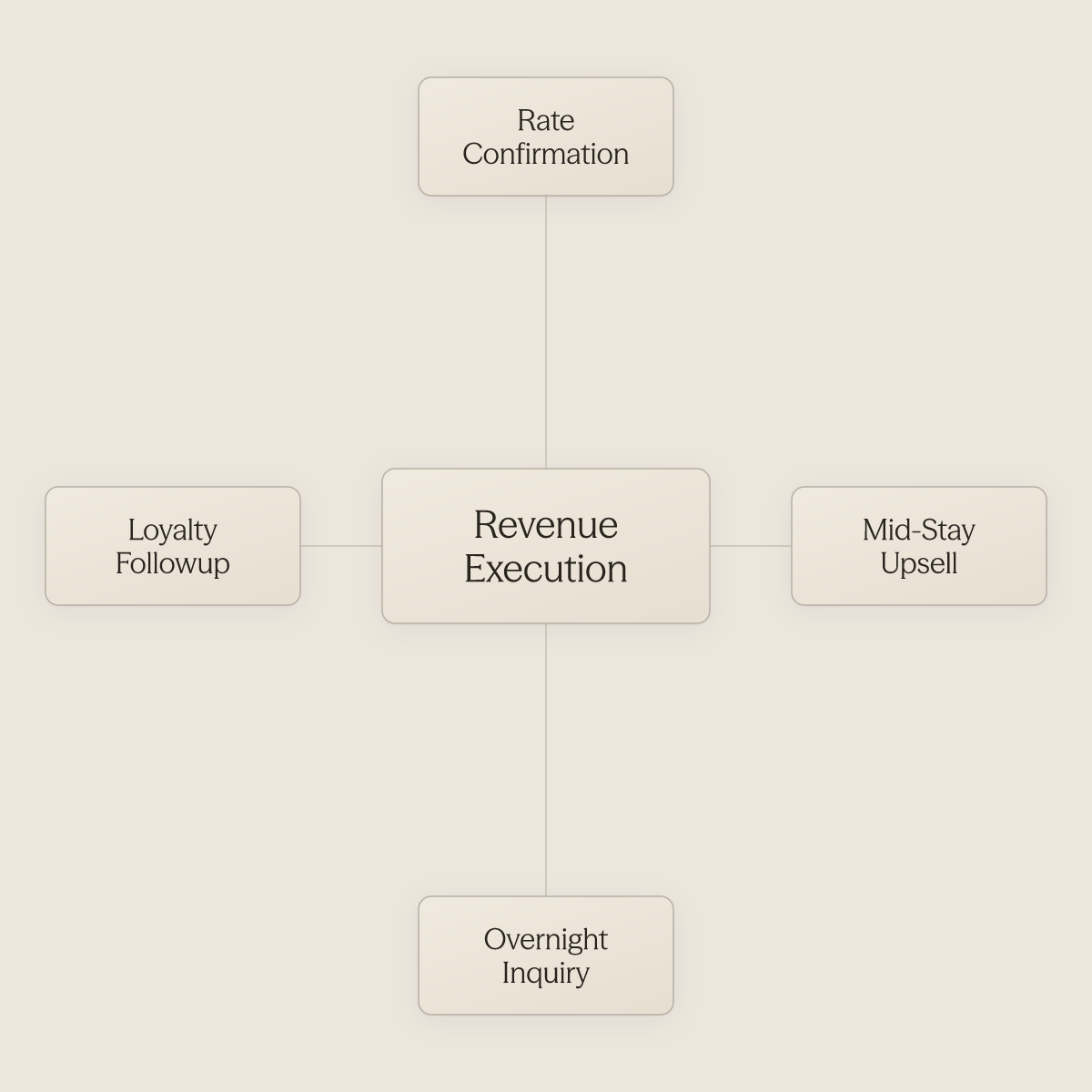
Most hotel revenue strategies fail not because the ideas are wrong, but because the window to act on them closes before anyone can respond. The real gap is structural: when revenue execution depends on staff availability, every overnight inquiry, mid-stay upsell opportunity, and rate confirmation request is at risk of arriving too late to matter. This section breaks down how a hospitality-trained AI communication layer keeps those revenue clocks running at every hour staff cannot.
The Hidden Barrier to Any Hotel Revenue Generating Idea - The Delivery Window
Most hoteliers assume the bottleneck is strategy. The real bottleneck is timing. Every revenue idea has a window measured in minutes, not hours.
Responses that arrive immediately dramatically outperform responses that arrive an hour later, yet most properties have no system to respond at that speed when staff are unavailable. The gap isn't a people problem. It's structural: revenue execution is tied to staff bandwidth rather than a repeatable, triggered process.
When bandwidth runs out, the window closes, and the booking goes somewhere else. Dynamic pricing only converts if someone can confirm the rate. A mid-stay upsell only lands if it arrives before the guest books a competitor's restaurant.
A loyalty follow-up only works if it gets sent. The operators who outperform have built a system that keeps every one of those clocks running overnight, on weekends, and during peak check-in surges when the front desk is buried. A significant share of hotel booking inquiries arrive outside standard business hours, making overnight latency one of the largest single revenue leaks in hospitality.
A guest comparing properties at 1am doesn't wait until 9am for a reply. They book the property that responds first. Where a general-purpose chatbot handles surface-level Q&A, a hospitality-trained AI communication layer is built to understand the specific texture of the guest journey: check-in windows, rate confirmation workflows, maintenance escalation thresholds, and the tonal register guests expect from a property they chose intentionally.
That specificity is what separates a tool that deflects inquiries from one that converts them. Mayra, Global Head of Customer Experience at Wynwood House, described the outcome plainly: "You cannot tell the difference between an AI agent and a human agent. With Conduit, we're not seeing that.
It feels like a full conversation with a human." That distinction matters operationally: a hospitality-trained AI that understands check-in windows, rate confirmations, and escalation thresholds produces a fundamentally different guest experience than a general-purpose chatbot repurposed from a customer service context. AI for hospitality built on hospitality-specific training data produces replies calibrated to the emotional register guests expect.
One honest trade-off: hospitality AI works best when the property has a defined set of recurring guest scenarios, check-in questions, rate inquiries, upsell touchpoints, maintenance escalations, that currently consume staff time without requiring genuine human judgment. Properties whose guest interactions are highly bespoke, relationship-driven, or dependent on real-time operational improvisation will need a thoughtful handoff protocol to ensure the AI layer knows when to step back and route the conversation to a team member.
Next steps
If your revenue strategies keep producing results that fall short of what the ideas themselves should deliver, the path forward starts with fixing the delivery window, not the strategy. Most operators already have the right playbook. What collapses is the moment between guest intent and property response, and no new amenity or pricing model closes that gap. Start with our AI for hospitality.
Dynamic pricing gains are partially self-defeating when the inquiry window stays dark, meaning the ceiling of any rate strategy is set by the floor of communication execution, not by the sophistication of the model itself. Upsell revenue is not a product availability problem but a delivery timing and consistency problem, meaning the $95 per booking that pre-arrival sequences prove is capturable stays theoretical whenever the trigger depends on a staff member remembering to send it. Together, they point to the same corrective action: a communication layer that runs continuously across every touchpoint in the guest journey, independent of who is staffed and when.
Start with conduit.ai to see how Conduit's AI Agents, Workflows, and Inbox turn the recurring touchpoints your team already knows about into consistent, triggered execution. Connect your existing SOPs or FAQs, and the first automated guest reply typically goes live within days. From that point forward, every optimized rate, every pre-arrival upsell, and every post-stay loyalty follow-up reaches the guest at the moment they are ready to act, rather than the moment someone finds bandwidth to send it.
Frequently Asked Questions
Why do most hotel upsell ideas never actually reach the guest?
The post identifies the root cause as a communication timing failure, not a strategy failure. Most upsell delivery depends on a staff member remembering to send the right message at the right moment, which makes execution inconsistent by design, so offers like room upgrades or dining prompts exist on paper but never get sent.
Do early check-in and late checkout actually generate meaningful revenue?
Yes, the post notes that early check-in solves a real guest problem and guests with early flights or long travel days will pay for guaranteed access, while late checkout converts well because the guest is already satisfied. The key caveat is that early check-in offers should only be sent when room availability can actually support them, and late checkout messages perform best when sent on the final morning rather than earlier in the stay.
How much can a pre-arrival upsell sequence realistically earn per booking?
According to Revinate's guest journey email benchmarking study cited in the post, pre-arrival upsell sequences generate an average of $95 per booking. The post frames this as a timing story: the offer lands before the guest has mentally settled in, when they are still in planning mode and open to spending more.
Is slow response time really hurting my direct bookings, or is it just a service issue?
The post is explicit that booking inquiry response time is a revenue variable, not a service metric. When a direct inquiry sits unanswered for six hours, conversion doesn't just slow, it disappears, and the guest typically ends up booking through an OTA that charges 15 to 25 percent commission on the booking.
What is the best way to surface on-property dining and experiences so guests don't spend their money offsite?
The post says the ancillary revenue gap is almost entirely a communication timing failure, guests spend offsite not because on-site options are inferior, but because those options were never surfaced at the moment the guest was making a spending decision. Automatically triggering the right F&B or experience offer after check-in, at booking confirmation, or when a relevant keyword appears in a guest conversation ensures the offer reaches the guest at the moment they are deciding where to spend, without requiring a staff member to remember to send it.

Stay in the loop
Get the latest on AI automation, product updates, and customer stories.

