11 Hotel Revenue Management Strategies to Boost Profit 2026


Hotel Revenue Management
Strategies to Boost Profit
Occupancy is a vanity metric. The hotels pulling ahead in 2026 are the ones closing the gap between a smart pricing signal and the reply that actually lands before the guest books somewhere else.
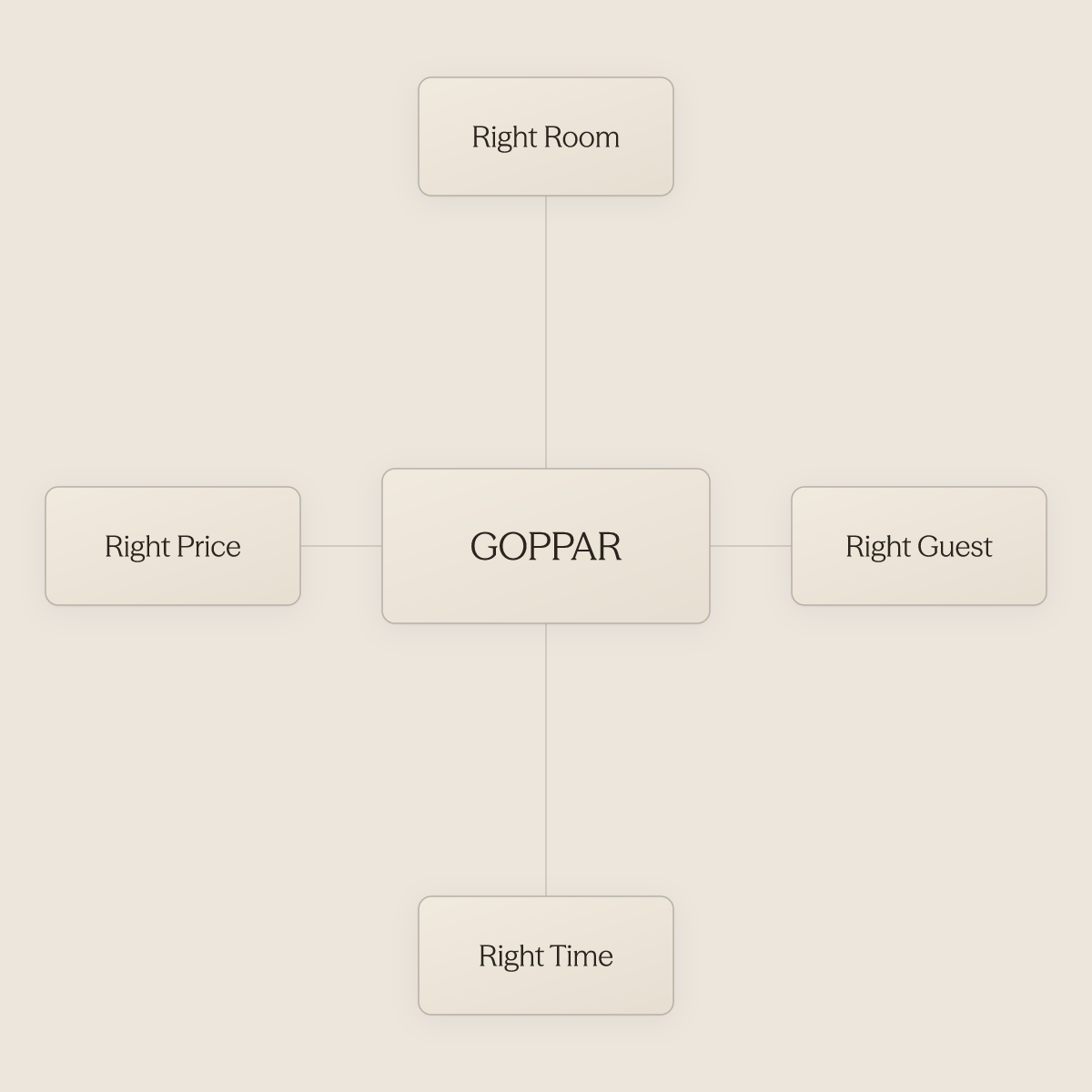
Hotel revenue management is the discipline of selling the right room to the right guest at the right time for the right price. What's changed is the standard of proof: occupancy and ADR tell you what you charged; GOPPAR tells you what you kept. For multi-property operators, that gap is where strategy either pays off or quietly evaporates.
The common assumption among heads of operations and VPs of operations at multi-brand and enterprise hospitality groups is that the tools are doing their job, that remaining revenue gaps are an execution and staffing problem, requiring more people or better-trained people to close them. 6 billion in 2024 and is projected to grow at a compound annual rate above 14% through 2026, according to independent market forecasts, and operators using tools like Conduit's AI for hospitality to close execution gaps are pulling ahead of those still optimizing for occupancy alone. Revenue management's founding principle is incomplete in practice.
See our AI for hospitality for how this works in practice. A 200-room hotel running 90% occupancy on discounted rates can lose to a 75%-occupied competitor capturing rack rate plus dining and spa revenue, because total profitability, not room count, determines what the asset is worth. Most operators implement the pricing half well. The guest-matching and timing halves, which require consistent, fast communication across every booking window, are where execution breaks down.
RevPAR treats a $150 direct booking and a $150 OTA booking identically. As Duetto Research has noted, that hidden profit gap does not surface until later in the reporting cycle, by which point the decision to discount or shift channel mix has already been made. GOPPAR forces the full cost picture into the same frame as revenue, making channel strategy, labor cost, and distribution fees visible before they become regrets.
Here is the variable most revenue management systems do not model: the time between a guest inquiry and a confirmed reply. What most teams report consistently shows inquiry response time is one of the strongest predictors of booking conversion. An unanswered message at midnight is a missed revenue event.
Key takeaways
- Hotel revenue management is not a pricing problem, it's an execution problem. The algorithm fires correctly; the booking walks because no one answered in time.
- GOPPAR, not occupancy or ADR, is the metric that separates strategies that look good on a dashboard from ones that actually move profit for multi-property operators.
- A rate change that fires in your RMS at 11 PM means nothing if the guest who sees it can't get a response until morning, dynamic pricing without real-time communication is a revenue leak dressed up as a strategy.
- The Lauderdale Boutique Hotel cut inquiry response time from 57 minutes to 2 minutes and closed revenue that would have converted on a competitor's site before sunrise.
- Most hotels execute the standard 11 revenue strategies correctly on paper and still watch RevPAR underperform projections, the gap lives between the pricing decision and the guest interaction that follows it.
- The execution gap is structural, not a staffing problem. Hiring more front-desk coverage doesn't fix a 2 a.m. direct booking inquiry that needs an answer in two minutes.
- conduit.ai's AI Agents close that gap by handling guest conversations autonomously, reading from your own SOPs, manuals, and FAQs to answer accurately across every channel, at any hour, without human intervention.
Where Hotel Revenue Management Strategies Break Down at the Execution Layer
Pricing algorithms don't lose bookings. Slow responses do. The most sophisticated revenue management setup in your portfolio is only as effective as the moment a guest receives a reply, and that moment is where most hotel revenue strategies quietly come apart.
Dynamic Pricing and Real-Time Communication
"Hotel groups are forced to hire more revenue managers not due to strategic growth, but to compensate for inadequate tooling that cannot automate basic execution tasks, a direct breakdown at the execution layer."
A rate change that fires in your RMS at 11 PM means nothing if the guest who inquires at 11:02 PM gets silence until morning. Hosts who respond within one hour are 116% more likely to secure a booking compared to those who take longer. That gap doesn't shrink at night; it widens. Dynamic pricing generates yield only when guest-facing communication matches the speed of the pricing signal. Without that match, the rate update is just a number in a dashboard.
Manual Teams and the Execution Layer
116% More likely to secure a booking within one hour
The common assumption among heads of operations and VPs of operations at multi-brand or enterprise hospitality groups is that the tools are doing their job, and that the remaining revenue gaps are an execution and staffing problem: we just need more people or better-trained people to close them. A distributed portfolio receives inquiries across multiple time zones, OTA channels, and direct booking flows simultaneously. No human team can maintain sub-two-minute response windows across all of them at 1 AM without burning out staff or accepting coverage gaps as a cost of doing business.
That is an expensive workaround, not a solution. Easy BnB illustrates the ceiling this creates with brutal clarity: the company was running a large team of virtual assistants to sustain 24/7 guest coverage, and the overhead was directly compressing EBITDA and capping the business's exit valuation. The business was trapped in a labor-growth dependency: every new property required new headcount, and the margin never improved.
That is not a staffing problem. That is an execution-layer infrastructure problem. Conduit's AI Agents are most beneficial precisely in this scenario, when the business receives a high volume of repetitive guest messages and already has documentation like SOPs, FAQs, or property manuals that can be used to train the agent.
Because the agent connects directly to existing content in tools like Notion, Google Drive, or Airbnb through native integrations, there is no manual re-entry of information already captured elsewhere. The agent is handling guest messages continuously, before, during, and after a stay, so the overnight coverage gap that forces operators to choose between burned-out staff and missed bookings is removed at the infrastructure level, not patched with more headcount.
How Slow Inquiry Response Times Leak Revenue
Hotel groups keep hiring more revenue managers not because the strategy is growing, but because the tools are so inadequate that more humans are required to compensate.
Response time is not a hospitality nicety, it is a direct revenue variable. When a guest inquiry arrives at 1 AM and the first human who could answer it won't be online for six hours, the booking window has almost certainly closed before the reply lands. Conduit Inbox gives operations and support teams a single surface to monitor, review, and manage every conversation the AI agent is handling across multiple platforms and properties simultaneously, so the team retains oversight without being the bottleneck.
Workflows layer on top of that: after a trigger event fires, a booking confirmation, a check-in, a detected keyword, the relevant guest touchpoint is handled automatically, without a staff member needing to initiate it. The compounding effect is what matters. An inquiry response time that drops from 57 minutes to 2 minutes does not just recover individual bookings.
It changes the structural relationship between the revenue strategy and its execution layer, so that every rate signal the RMS fires actually reaches the guest at the speed it was intended to.
11 Hotel Revenue Management Strategies to Boost Profit in 2026
Every revenue manager knows the 11 strategies on this list. The real question is why so many hotels execute them correctly on paper and still watch RevPAR underperform projections quarter after quarter. The answer is not the pricing logic. It is what happens after the pricing decision is made.
How to Close the Execution Gap That Undermines Every Revenue Management Strategy
Each of the 11 strategies has a pricing decision layer and a guest-facing execution layer. Revenue management software is built to optimize the pricing layer. The execution layer, the moment a guest reaches out about a rate, an upgrade, or a package question, is where most of the ROI actually lives or dies.
The math is direct. Responding to a booking inquiry within one minute increases conversion by 391% compared to responding after one minute, according to industry research on response time and lead conversion. A guest who sends an availability question at 1 AM and waits 57 minutes has already booked elsewhere.
The dynamic pricing algorithm priced correctly. The demand forecast was accurate. The upsell offer was configured.
None of it mattered, because the execution gap swallowed the revenue before it could close. Most hotels handle this with front-desk staff, overnight coverage rotations, and manual inbox monitoring. The structural problem is not the people; it is that no human team can maintain consistent, sub-minute response times across every channel, every property, and every time zone without either burning out or adding headcount that erodes the NOI gains the pricing strategy was supposed to generate.
The pricing failure is what an RMS prevents. The execution failure is quieter and more expensive, because it does not show up as a line item. It shows up as a booking that never completed, an upsell that never fired, an upgrade conversation that did not happen because the guest checked in without any pre-arrival contact.
Properties that have closed this gap share one operational characteristic: they have automated the guest-facing execution layer with the same discipline they applied to the pricing layer. Cash Flow Street runs the large majority of guest message volume through automated AI agents across dozens of properties, handling rate confirmations and booking inquiries without human routing. Cascadia Getaways maintains a top-rated guest communications score at high automation rates, demonstrating that communication quality does not degrade when volume scales.
Wynwood House significantly reduced guest resolution time across multiple countries, enforcing consistent brand voice without a centralized team managing every exchange. AI for hospitality platforms like Conduit deploy autonomous AI agents trained on a hotel's own SOPs, FAQs, and rate logic, responding across every channel in real time without human intervention. Properties that receive high volumes of repetitive guest inquiries and have existing documentation, SOPs, FAQs, rate logic, or operational manuals, to train the agent on see the fastest and most measurable lift; without that documentation foundation, the agent's response quality and setup speed are significantly reduced.
For a multi-property group where overnight inquiry volume is consistent and documentation already exists, the setup timeline is days, not months, and the first automated reply typically fires within the same week. The operational savings convert directly to asset value. Easy BnB captured significant monthly cost savings across its units without adding a single hire.
At a typical hospitality cap rate, that operational improvement represents a substantial increase in added asset value, the kind of number that belongs in a board presentation, not just an ops report. Implementing all 11 strategies gives you the right pricing architecture, but knowing which ones are actually working requires a measurement framework that goes beyond RevPAR. The next section shows you exactly which metrics, including GOPPAR and TrevPAR, reveal the strategies worth doubling down on and the execution gaps quietly eroding your gains.
Quick-Reference: 11 Hotel Revenue Management Strategies, Execution Checklist
391% Conversion lift from replying within one minute
| Strategy | Pricing Layer (RMS handles) | Execution Layer (requires guest comms) | Key Failure Point | |
|---|---|---|---|---|
| 1 | Dynamic Pricing | Rate adjusts in real time | Rate communicated in real time | Inquiry arrives after rate fires; no instant reply |
| 2 | Market Segmentation | Segment-specific rates set | Segment-specific offers delivered promptly | Off-hours inquiries receive no response |
| 3 | Demand Forecasting | 30/60/90-day occupancy modeled | Proactive outreach before compression | Forecast not acted on before window closes |
| 4 | Direct Booking Optimization | Best-rate guarantee live | Inquiry answered before guest returns to OTA | Unanswered direct inquiry → OTA booking |
| 5 | OTA Channel Mix Management | Inventory allocated by channel | Review responses timely; content consistent | Slow review response triggers OTA ranking penalty |
| 6 | Cross-Selling Ancillary Services | Package pricing set | Offer surfaced at right booking-journey moment | Offer buried in confirmation email; never seen |
| 7 | AI-Powered Upselling | Upgrade logic configured | Upgrade offer delivered 48 hrs pre-arrival | Fragmented PMS data produces wrong offers |
| 8 | Length-of-Stay Controls | MLOS restrictions calibrated | Guest notified of stay requirements instantly | Over-restriction suppresses shoulder occupancy |
| 9 | Loyalty Program Strategy | Member rate structured | Returning guest recognized and communicated with | Guest re-acquired via OTA on next visit |
| 10 | Total Revenue Management | TrevPAR tracked across departments | F&B/spa offers timed to guest touchpoints | Departmental data silos block cross-sell timing |
| 11 | Competitor Rate Intelligence | Comp-set data feeds RMS | Rate decision actioned within the compression window | Insight arrives after demand event has passed |
Use this checklist to audit each strategy: if the execution-layer column is handled manually or inconsistently, that strategy is leaking revenue regardless of how well the pricing layer is configured.
1. Dynamic Pricing - Adjust Rates in Real Time Based on Demand Signals
Dynamic pricing adjusts room rates continuously based on demand signals: booking velocity, competitor rate shifts, local event calendars, and seasonal patterns. A well-configured RMS handles the math automatically. The failure point most operators underestimate is communication lag: when a rate change fires at 11 PM and a guest inquiry arrives at midnight, a 57-minute response window does not just frustrate the guest, it loses the booking. Dynamic pricing generates the most lift when rate changes are paired with real-time guest communication, not just real-time inventory updates.
2. Market Segmentation - Tailor Pricing and Packages to Distinct Guest Personas
Market segmentation prices and packages rooms differently for distinct guest types: corporate travelers, leisure families, event attendees, and long-stay remote workers each have different price sensitivity and different booking triggers. The strategy works when segmentation logic is granular enough to match an offer to a guest's actual intent, not just their booking channel. The execution risk is consistency: a segmented rate offer that reaches one guest instantly and another four hours later, because inquiry volume spiked overnight, is a segmentation strategy that leaks at the edges.
3. Demand Forecasting - Use Historical Data and AI to Predict Future Occupancy
Accurate demand forecasting is the foundation every other strategy on this list depends on. Without a reliable occupancy picture 30, 60, and 90 days out, dynamic pricing has no signal to price against and length-of-stay controls have no rationale. AI-assisted forecasting models improve on legacy spreadsheet methods by incorporating real-time booking pace, web search trends, and competitor availability data simultaneously. The practical advantage is proactive rate-setting: instead of reacting to a demand spike after it arrives, a well-forecasted property adjusts rates before the compression window closes.
4. Direct Booking Optimization - Reduce OTA Dependency and Capture More Margin
OTA commissions run 15 to 25 percent per booking, according to EHL Insights and Cloudbeds industry data. On a $200 room night, that is $30 to $50 leaving the property before a single operational cost is counted. Direct booking optimization, through best-rate guarantees, frictionless booking flows, and loyalty incentives, is the primary lever for protecting that margin. The tradeoff is honest: direct booking conversion requires a faster, more responsive experience than most OTA pages, which means an unanswered inquiry from a guest who found the hotel website first is a more expensive loss than it looks on a channel report.
5. OTA Channel Mix Management - Strategically Balance Third-Party Distribution
Channel management is not about eliminating OTA presence; it is about controlling which inventory goes where and at what cost. A hotel that pushes all remaining inventory to Booking.com during a soft period pays the commission premium on rooms that could have been filled through a lower-cost channel. The strategic discipline is monitoring booking pace by channel and shifting availability before compression, not after. Hotels that manage this actively maintain rate parity, protect direct channel positioning, and avoid the OTA ranking penalties that come from inconsistent content and slow review response times.
6. Cross-Selling Ancillary Services - Grow Revenue Per Guest Beyond the Room Rate
Ancillary revenue, from spa bookings, dining packages, airport transfers, and activity add-ons, represents a meaningful share of total guest spend at properties that actively surface these offers. Hotels with structured cross-sell programs generate measurably higher revenue per guest than those relying on front-desk upsells alone. The critical condition: the offer has to reach the guest at the right moment in the booking or pre-arrival journey, not buried in a confirmation email they skim once. Timing is the variable most cross-sell programs get wrong, and it is entirely a communication execution problem, not a pricing one.
7. AI-Powered Upselling - Automate Room Upgrade and Add-On Offers at Scale
AI-powered upselling fires upgrade and add-on offers based on guest profile data, booking window, and real-time availability, without requiring a front-desk agent to make the ask. A guest who books a standard room and receives a targeted upgrade offer 48 hours before arrival converts at a higher rate than one who hears about upgrades at check-in, when the decision feels rushed. The limitation worth naming: AI upselling performs best when the hotel has clean guest data and defined offer logic. Properties with fragmented PMS records or undefined upgrade pricing will see inconsistent results until the data foundation is solid.
8. Length-of-Stay Controls - Apply Minimum Stay Restrictions to Protect Peak Revenue
Minimum length-of-stay (MLOS) restrictions prevent single-night bookings from consuming inventory during high-demand periods, protecting surrounding nights that would otherwise go unsold after a one-night gap blocks a longer stay. Applied correctly, MLOS controls lift peak-period RevPAR by ensuring high-rate nights are sold as part of a longer stay rather than as isolated transactions that fragment the calendar. The risk of over-restriction is real: MLOS thresholds set too aggressively during shoulder periods suppress occupancy without the demand to justify it. The strategy requires regular calibration against actual booking pace, not a set-and-forget configuration.
9. Loyalty Program Revenue Strategy - Convert Repeat Guests into a Direct Revenue Engine
Loyalty members book direct, spend more on ancillary services, and generate lower acquisition costs than OTA-sourced guests across nearly every hotel segment. The scale of direct booking is substantial: one analysis found that hotel-direct bookings accounted for 41.72% of all bookings, underscoring the strategic importance of nurturing that channel. The long-term value gap between a loyalty member and a third-party-acquired guest widens when the loyalty program is actively managed rather than treated as a points-accumulation system. For smaller and mid-market properties, the practical counter to complexity concerns is straightforward: even a simple rate-plus-recognition program, consistently communicated to returning guests, outperforms re-acquiring the same guest through an OTA on every visit.
10. Total Revenue Management - Optimize Profit Across All Hotel Revenue Centers
Total revenue management extends pricing discipline beyond rooms to every revenue-generating department: food and beverage, meeting space, parking, spa, and retail. The metric that reflects this correctly is TrevPAR, total revenue per available room, which captures the full revenue contribution of a guest stay rather than just the room rate. A hotel that optimizes room pricing while leaving meeting space underpriced or spa capacity unmanaged leaves a measurable share of total asset value on the table. Breaking down data silos between departments so the revenue manager sees F&B pace alongside occupancy pace is the operational shift that makes total revenue management real rather than theoretical.
11. Competitor Rate Intelligence - Monitor and React to Market Pricing in Real Time
Competitive rate intelligence means tracking what comparable properties are charging in real time and using that data to inform pricing decisions rather than reacting to comp set moves after the fact. A rate shopping tool surfaces this data automatically; the strategic value is in how quickly the property acts on it. A hotel that identifies a comp set compression event 72 hours out and adjusts rates proactively captures the demand wave. One that notices the same event after the weekend has passed simply paid the opportunity cost. Rate intelligence is only as useful as the speed of the decision loop it feeds.
Related Reading
- How To Improve Hotel Operations
- Hotel Demand Forecasting
- Hospitality Operations Management
- How To Increase Revpar
- Hotel Budgeting And Forecasting
- Hotel Upselling
- Automated Hotel Reservation System
- Hotel Guest Messaging
- Hospitality Automation
- Adr Vs Revpar
How to Measure Hotel Revenue Management Performance Beyond RevPAR
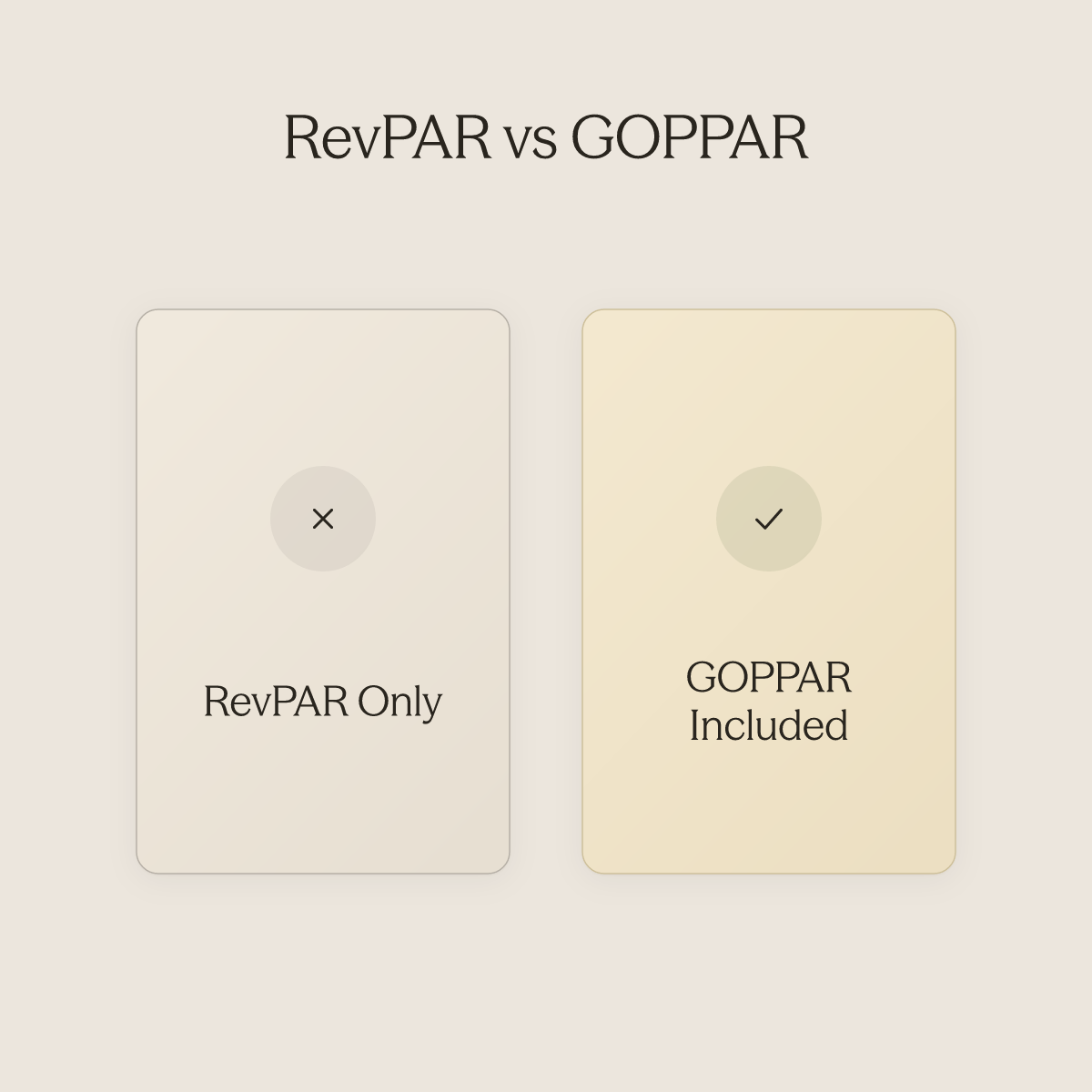
RevPAR tells you how much room revenue you generated per available room. What it cannot tell you is whether that revenue was worth generating. For operations leaders managing distributed portfolios, that distinction is not academic. It is the difference between a strategy that looks healthy on a dashboard and one that is actually moving the profit line.
RevPAR Is the Floor, Not the Ceiling
RevPAR is not a lagging indicator. It is a structurally misleading one. The same RevPAR number can be produced by radically different ADR and occupancy combinations, and by both direct and OTA bookings at wildly different net margins. According to HotelData.com's Q3 2025 Profit Report, U.S. hotel GOP% diverged from RevPAR performance in that period, meaning top-line room revenue gains did not translate proportionally into gross operating profit. A hotel tracking only RevPAR is flying on an instrument that cannot distinguish climbing from falling.
GOPPAR vs. RevPAR - The Gap Between Them
GOPPAR (Gross Operating Profit per Available Room) answers the question RevPAR ignores: what did it actually cost to generate that revenue? Labor, distribution fees, and OTA commissions all sit between room revenue and operating profit. A property running strong occupancy through high-commission OTA channels can post impressive RevPAR while GOPPAR quietly erodes. The gap between those two numbers is where strategy either pays off or evaporates. Operators focused on total revenue efficiency often extend this analysis to TrevPAR, which captures non-room revenue streams alongside rooms to give a fuller picture of asset performance.
AI for hospitality platforms like Conduit close the attribution gap by timestamping every automated response and booking assist, feeding communication yield data back into the performance picture GOPPAR is designed to complete. This matters most for portfolio operators receiving high inquiry volumes across time zones, where manual overnight coverage is structurally impossible.
Next steps
If your pricing engine is calibrated but bookings still slip away between midnight and morning, the path forward starts with closing the structural latency gap between a rate signal and the guest who receives it. Start with our AI for hospitality.
Responding within one minute lifts conversion by 391%, which means every hour of overnight coverage your team cannot sustain is a direct revenue event, not a staffing inconvenience. Channel mix decisions are revenue management decisions, and a $150 OTA booking and a $150 direct booking are not the same booking once commission is subtracted. Together, those two realities point to one action: automate the guest-facing execution layer with the same discipline already applied to the pricing layer.
Start with conduit.ai to put automated guest responses behind every inquiry your team cannot reach in time.
Frequently Asked Questions
Why does occupancy rate matter less than I thought for hotel profitability?
A hotel running 90% occupancy on discounted rates can still lose to a 75%-occupied competitor capturing rack rate plus dining and spa revenue, because total profitability, not room count, determines what the asset is worth. GOPPAR forces the full cost picture into the same frame as revenue, making channel strategy, labor cost, and distribution fees visible before they become regrets, whereas occupancy and ADR only tell you what you charged, not what you kept.
How much do OTA commissions actually eat into my room revenue?
OTA commissions run 15 to 25 percent per booking, which on a $200 room night means $30 to $50 leaves the property before a single operational cost is counted. Direct booking optimization, through best-rate guarantees, frictionless booking flows, and loyalty incentives, is the primary lever for protecting that margin, and one analysis found that hotel-direct bookings accounted for 41.72% of all bookings, underscoring how much opportunity exists in that channel.
Does demand forecasting actually change what I should charge, or is it just a reporting exercise?
Accurate demand forecasting directly drives proactive rate-setting: instead of reacting to a demand spike after it arrives, a well-forecasted property adjusts rates before the compression window closes. It is also the foundation every other strategy depends on, without a reliable occupancy picture 30, 60, and 90 days out, dynamic pricing has no signal to price against and length-of-stay controls have no rationale.
If my pricing strategy is solid, why are bookings still slipping through the cracks overnight?
A rate change that fires in your revenue management system at 11 PM means nothing if a guest who inquires at 11:02 PM gets silence until morning, the booking window can close before any human is available to reply. Hosts who respond within one hour are 116% more likely to secure a booking compared to those who take longer, and that gap doesn't shrink at night; it widens. Dynamic pricing generates yield only when guest-facing communication matches the speed of the pricing signal.
Is hiring more revenue managers and guest-service staff the right fix for coverage gaps across a multi-property portfolio?
More headcount is an expensive workaround, not a solution, the post describes hotel groups that keep hiring more revenue managers not because the strategy is growing, but because the tools are so inadequate that more humans are required to compensate, directly compressing EBITDA. No human team can maintain sub-two-minute response windows across multiple time zones, OTA channels, and direct booking flows at 1 AM without burning out staff or accepting coverage gaps as a cost of doing business. That is an execution-layer infrastructure problem, not a staffing problem.
Stay in the loop
Get the latest on AI automation, product updates, and customer stories.


