How To Automate Airbnb Business? 18 Ways to Automate Your Airbnb Business and Save Time


Automate Airbnb
18 ways to cut the manual work.
More tools won't free your nights. Here's the coordination architecture that lets operators run 35 properties at a 96% AI automation rate without being on call.
Airbnb automation means replacing manual, repetitive tasks with software that handles guest communication, pricing adjustments, cleaning coordination, and check-ins without you doing the work personally. But the real purpose of short-term rental automation is structural: it breaks the direct connection between your portfolio size and your personal hours. Without that break, every property you add doesn't just add revenue, it adds proportional work. See our AI for hospitality for how this works in practice.
Hosts in the Airbnb Community forum report spending anywhere from a few hours to 20-plus hours per week per property on hosting and admin tasks, and that number compounds fast across multiple listings. The failure point is usually invisible until you're already stuck. Most short-term rental owner-operators believe that incomplete automation is a tool-count problem: they just haven't found the right combination of apps yet, and once they do, the gaps will close on their own.
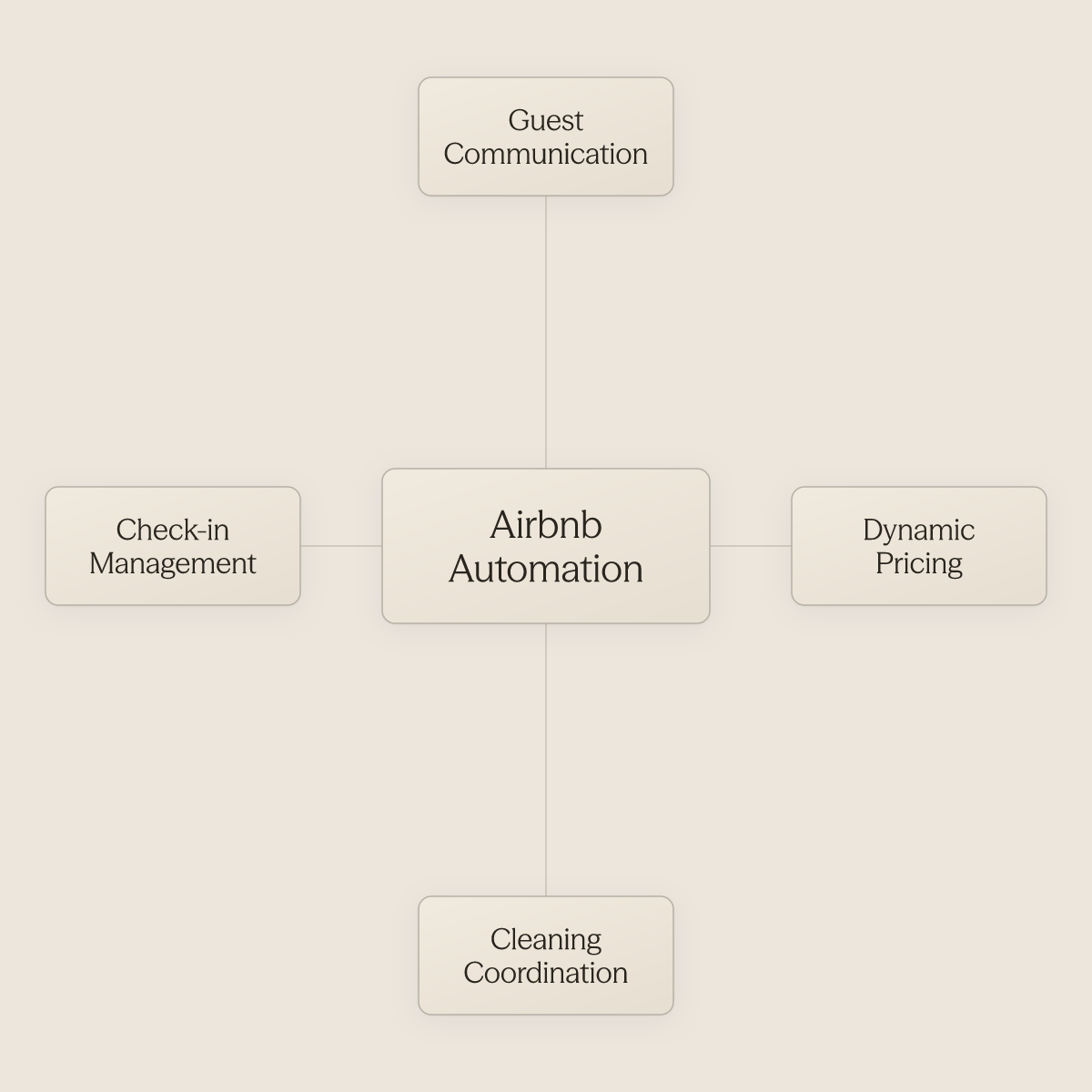
At one property, manual management feels manageable. At two or three, coordination overhead starts compounding, a cleaning handoff gets missed, a late-night check-in question arrives at 11pm, a pricing window closes while you're handling something else. Hosts report operational overwhelm right around this threshold, which is why most solo operators never scale past it.
The familiar approach is to stack tools: one app for messaging, another for pricing, a third for cleaning tasks. But the gaps between those tools still require a human to catch failures, route exceptions, and make judgment calls. Hosts who have tried AI for hospitality platforms describe the same realization: the missing piece isn't another app, it's a coordination layer that knows how their business runs. Erwan Le Roy, operating 35 properties under the Cash Flow Street brand, reached a 96% AI automation rate, verified through Conduit's platform analytics, not by accumulating more tools, but by giving an AI agent access to his actual SOPs and guest protocols.
96% AI automation rate across 35 properties
Key takeaways
- Airbnb automation isn't about convenience, it's structural: the only way to grow your portfolio without growing your hours is to break the link between property count and personal time.
- Most operators mistake an incomplete automation stack for a tool-count problem, but five apps running in parallel still leave a human in the middle catching every handoff the tools can't coordinate.
- Erwan Le Roy's 35-property operation hit a 96% AI automation rate, not by adding more apps, but by giving one coordination layer access to his actual SOPs, guest protocols, and operating knowledge.
- The 18 automation layers covered here span pricing, guest messaging, cleaning coordination, dynamic check-in, and review management, but the architecture matters more than any individual tool.
- Automation ROI isn't a monthly cost question; it's a 'what is manual handling costing me right now' question, and most operators are underestimating both sides of that math.
- conduit.ai's AI Agents close the final gap by reading directly from your SOPs, manuals, and FAQs to handle guest conversations across every channel, accurately, autonomously, and without a human on standby.
Why Most Airbnb Automation Stacks Hit a Ceiling: and What Operators Are Missing
Stacking more tools rarely closes the gaps that keep operators tethered to their phones, because the real problem is not the number of apps running but the absence of anything connecting them. Each point solution automates one slice of a workflow in isolation, leaving you as the only node in the system that holds enough context to handle anything those tools were not explicitly built for. Understanding where that coordination breaks down is the first step toward building an operation that does not route every edge case back to you.
Why Your Current Automation Stack Still Leaves You on Call at Midnight
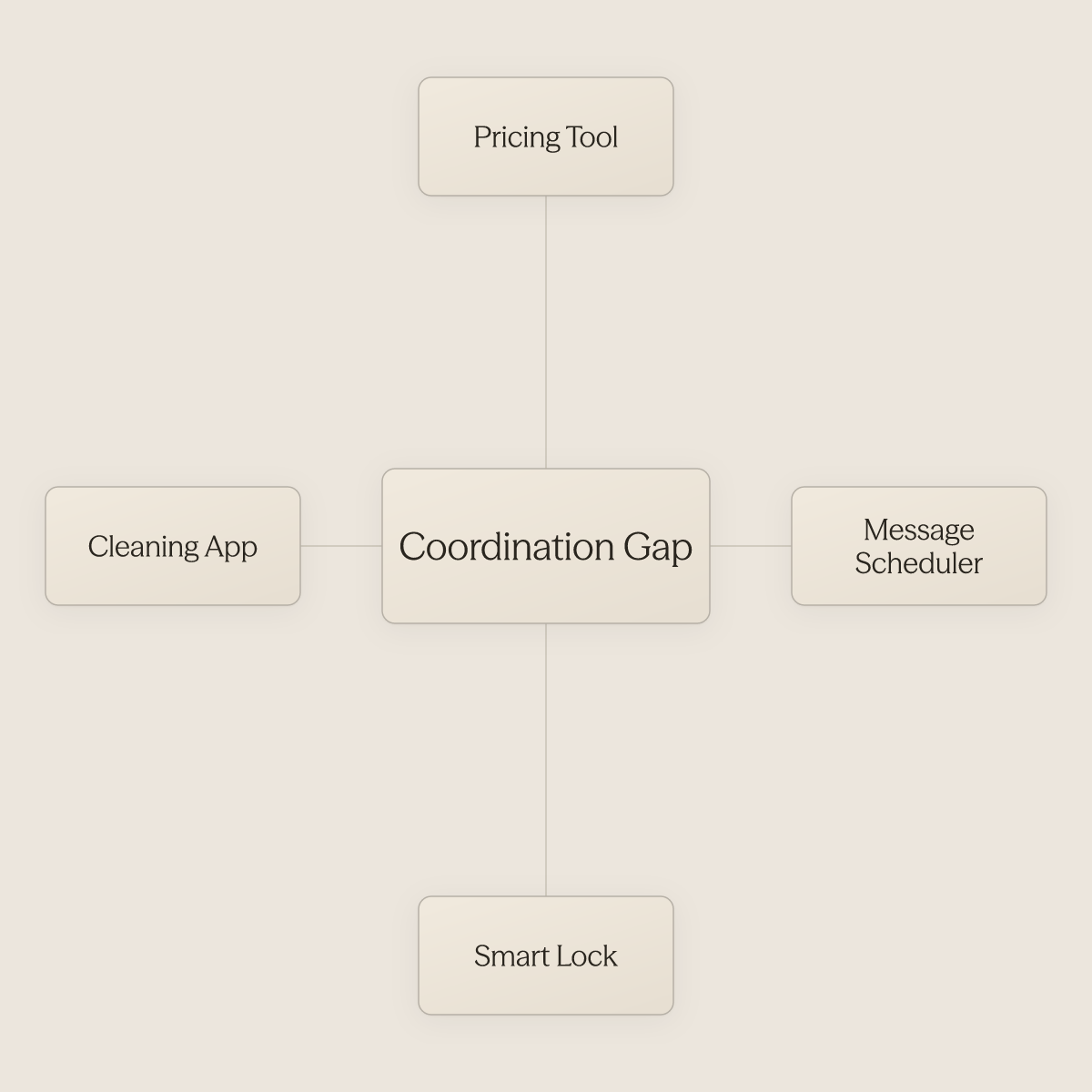
Most short-term rental owner-operators believe that incomplete automation is a tool-count problem: they just haven't found the right combination of apps yet, and once they do, the gaps will close on their own. Five tools running in parallel can feel like a solved problem. The pricing algorithm adjusts nightly rates, the message scheduler fires check-in instructions, the smart lock generates codes, and the cleaning app pings your housekeeper after checkout. Yet every stack has a gap: a missed notification, a guest question no template covers, a situation that falls precisely between two tools and routes straight back to you. The critical difference between task automation and operational freedom is coordination.
Each point solution in a typical short-term rental stack automates one slice of a workflow in isolation. The pricing tool does not know what the messaging tool just sent. The smart lock does not know the cleaner marked the unit as not ready.
When a guest messages at midnight asking whether early check-in is possible given a delayed cleaning job, no individual tool holds enough context to answer. That question lands in your inbox because you are the only node in the system that holds all the information. As Darren, Founder of Easy BnB / Bali Luxury Stays, puts it after making the shift: "We all agree that AI first is the best approach", because coordination has to be built into the foundation, not bolted on afterward.
Where Automation Gaps Hide, and How to Plug Them Before They Leak Revenue
We all agree that AI first is the best approach
Late-night booking inquiries are the clearest example of where fragmentation costs money. No automated message template was triggered because the guest has not booked yet.
Nobody in the stack owns the pre-booking conversation, so the inquiry sits unanswered until morning, when the guest has already booked somewhere else. The revenue leak is structural, not accidental, a direct consequence of building a stack where each tool's ownership ends at the edge of its own function. This problem is most acute for operators using AI messaging tools and AI for hospitality platforms, where the volume of pre-booking, mid-stay, and post-stay messages makes a manual response cadence impossible to sustain without someone being effectively on call around the clock.
The fix is not another message template. It is an AI Agent trained on your existing documentation, your SOPs, FAQs, and house manuals, that can answer any guest question continuously, before, during, or after a stay, without waiting for a human to intervene. Conduit's AI Agents are built for exactly this purpose.
Critically, connecting that documentation requires no IT or developer work: the operator or ops lead connects the docs directly, and the first automated guest reply is live within days of connecting those materials.
Why Adding More Apps Won't Break Your Automation Ceiling, and What Actually Does
The familiar response is to add another tool, a Zapier workflow, a new integration, a smarter scheduler. But the ceiling is not a tool-count problem; it is a coordination problem). What closes the gap is a unified layer that sits across your existing stack, reads the context those tools generate, and acts on it coherently.
That is the role Conduit's Integrations layer plays. It is most valuable when your business already uses tools like Notion, Google Drive, or Airbnb and you want the AI agent to leverage that existing content without manual re-entry. The operator links the accounts, no IT or developer needed.
The knowledge your team has already built lives where it always has; the AI agent simply gains access to it. From there, Workflows handle the recurring, predictable guest touchpoints that currently require a manual staff action:
- a booking confirmation follow-up
- a check-in reminder
- a post-stay review request
Workflows fire after a trigger event in a conversation or guest lifecycle: after a booking is confirmed, after check-in, or when a specific keyword is detected.
The operator or ops lead sets the rules; no IT needed. And the Inbox gives the operations or support team a single place to monitor, review, and manage every conversation the AI agent is handling across all platforms and properties, ongoing visibility without constant intervention. Together, these four layers, AI Agents, Inbox, Workflows, and Integrations, replace the coordination gap that no individual point solution can close.
You can read more about how STR operators are auditing their current automation stack to identify exactly where these gaps live before they leak another season of revenue.
18 Ways to Automate Your Airbnb Business - The Full Automation Architecture
Operators who hit 90% automation rates don't have more tools than everyone else. They have a better architecture. That distinction matters because the instinct most hosts follow, find a new app for every friction point, produces a stack that looks impressive in a spreadsheet and still requires a human in the middle to catch the handoffs.
The tools automate their own slice. Nobody automates the space between them. The 18 methods below are organized as a layered architecture, not a flat list.
The first layer builds the operational foundation. The second handles discrete tasks in isolation. The third shapes the guest experience.
The fourth, the one most operators never build, is the coordination intelligence layer that holds your operating knowledge and closes the gaps every other tool leaves open. Each layer compounds the one beneath it. Skip a layer and the whole structure leaks.
Automation Stack Decision Checklist - Which Layer Should You Build First?
Use this checklist before purchasing any new tool. A 'yes' to every item in a layer means you're ready to move to the next.
1. Conduit.ai - Best All-in-One Airbnb Automation Platform
Conduit.ai centralizes the full automation stack for Airbnb hosts, guest messaging, pricing, task dispatch, and review management, under one AI-driven dashboard. It's the right pick for hosts managing 3+ listings who want to eliminate tool-switching overhead. The one real tradeoff is that its breadth means a steeper onboarding curve compared to single-purpose tools.
2. Automated Guest Messaging with Triggered Sequence Templates
Automated guest messaging is the biggest daily time drain for most hosts who haven't addressed it. A properly configured sequence covers booking confirmation, pre-arrival instructions, check-in day reminders, a mid-stay check-in, checkout instructions, and a post-stay review request, all sent at the right interval without manual action. Platforms like Hospitable and most PMS tools handle this well for the predictable 80 percent of guest interactions. A lockout that requires a judgment call exposes a gap that is structural, not a configuration problem.
3. Dynamic Pricing Automation via Algorithmic Rate Tools
Dynamic pricing tools like PriceLabs, Wheelhouse, or AirDNA's own rate recommendations automatically adjust your nightly rate based on local demand signals, competitor occupancy, seasonality, and lead time. For hosts in competitive markets, this alone can lift revenue 15–40% over flat pricing. The core limitation is that algorithms can misprice during hyperlocal events unless you set manual overrides.
4. Smart Lock Integration for Keyless Automated Check-In
Connecting a smart lock, August, Schlage, or Yale, directly to Airbnb generates unique guest access codes automatically for each reservation window and revokes them at checkout. This eliminates key handoffs entirely and is the foundational automation for any host who wants to operate remotely. The tradeoff is upfront hardware cost and the need for a reliable Wi-Fi connection at the property.
5. Automated Cleaning Dispatch with Turno (formerly TurnoverBnB)
Turno syncs directly with your Airbnb calendar and automatically creates a cleaning job the moment a checkout is confirmed, notifying your cleaner with the exact turnover window. It handles cleaner payment, photo verification, and damage reporting in one flow. For hosts managing multiple properties, this replaces a spreadsheet entirely. The fee per property adds up at scale, but the time savings justify it for most operators.
6. Centralized Multi-Listing Calendar Sync Across OTAs
Using a channel manager or iCal sync to unify your Airbnb, VRBO, and Booking.com calendars prevents double-bookings and gives your entire team, cleaners, co-hosts, maintenance, a single source of truth. This is the connective tissue that makes every other automation reliable. The limitation is that iCal sync has a 15–30 minute delay, making real-time channel managers worth the cost for busy listings.
7. Automated Review Request and Response Workflows
Scheduling an automated post-checkout message that thanks guests and gently prompts a review, sent within 2 hours of checkout, consistently lifts review rates. Pairing this with templated host review submissions for guests closes the loop without manual effort. The risk is that a generic review request sent after a problematic stay can backfire, so smart hosts add a conditional logic filter for flagged reservations.
8. Property Management Software (PMS) as the Automation Hub
A full PMS like Hostaway, Guesty, or Lodgify acts as the central nervous system connecting pricing, messaging, cleaning, and reporting into one platform. For hosts with 5+ listings, a PMS pays for itself by replacing 4–6 separate subscriptions. The tradeoff is monthly cost and the time investment to configure it properly, hosts with 1–2 listings often find it overkill.
9. Automated Noise and Occupancy Monitoring with NoiseAware
NoiseAware and similar sensors monitor decibel levels continuously and send automated alerts when noise exceeds thresholds, letting you intervene before neighbors complain or property damage occurs. This is a critical automation layer for urban properties or those in HOA communities. The important caveat is that these devices must be disclosed to guests per Airbnb policy, and improper placement can create privacy concerns.
10. Automated Upsell and Early Check-In Offer Sequences
Triggered messages sent 48–72 hours before arrival can automatically offer guests early check-in, late checkout, or local experience add-ons for a fee. When the property is available, this converts dead time into incremental revenue with zero manual effort. The limitation is that Airbnb's native messaging doesn't support payment collection for upsells, requiring a third-party tool or direct payment workaround.
11. Automated Inventory and Restocking Alerts via Checklist Apps
Requiring cleaners to complete a digital checklist after each turnover, logging consumable levels like toiletries, coffee pods, and paper goods, creates an automated low-stock alert system. Tools like Turno and Properly support photo-verified checklists that flag shortages before the next guest arrives. The tradeoff is that this only works if your cleaning team consistently completes the digital checklist rather than skipping it.
12. Zapier-Powered Custom Automation Workflows Between Tools
Zapier and Make (formerly Integromat) let hosts build custom automation bridges between tools that don't natively integrate, for example, triggering a Slack notification to a co-host when a new booking lands, or logging every reservation into a Google Sheet for tax tracking. This is the power tool for hosts who want bespoke workflows without coding. The limitation is that complex multi-step Zaps require troubleshooting when APIs change.
13. Automated Pricing Floor and Ceiling Rules with Seasonal Overrides
Beyond basic dynamic pricing, setting hard minimum and maximum price rules, plus seasonal override blocks for holidays and local events, ensures algorithms never price your listing below profitability or above market tolerance. This rule-based guardrail layer is what separates hosts who profit from dynamic pricing from those who get burned by it. The tradeoff is that overly tight floors can reduce occupancy during slow periods.
14. Automated Tax Collection and Remittance via Avalara MyLodgeTax
Avalara MyLodgeTax and similar services automatically calculate, collect, and remit occupancy taxes to the correct jurisdictions based on your property location and booking dates. For hosts in states or cities where Airbnb doesn't collect taxes on their behalf, this automation eliminates significant compliance risk. The cost is a monthly subscription plus a percentage of taxes remitted, which is negligible compared to penalty exposure.
15. AI-Powered Guest Screening and Booking Approval Automation
Tools like Autohost and Superhog automatically screen incoming booking requests against risk signals, profile completeness, review history, ID verification status, and either approve, flag, or decline them without host intervention. This is essential for hosts who use Instant Book but want a safety net. The limitation is that automated screening can occasionally flag legitimate guests, requiring a manual review override process.
16. Automated Financial Reporting and Owner Statement Generation
For co-hosts and property managers handling owner properties, tools like Hostfully and Guesty automatically generate monthly owner statements showing revenue, expenses, cleaning fees, and management commissions. This eliminates hours of manual spreadsheet work and builds owner trust through transparency. The tradeoff is that accurate statements depend on all expenses being logged in the system, manual expense entries are still required for off-platform costs.
17. Smart Thermostat Automation for Energy Cost Control
Integrating a Nest or Ecobee thermostat with your booking calendar automatically sets energy-saving temperatures during vacant periods and restores guest-comfortable settings before each arrival. For properties in climates with extreme temperatures, this can cut utility costs by 20–30% annually. The limitation is that guests can override thermostat settings during their stay, so some hosts add a temperature range lock via the thermostat's app.
18. Automated Post-Stay Damage Detection with AI Photo Comparison
Emerging tools like Properly and Minut's damage detection features use AI to compare post-checkout cleaner photos against a baseline property photo set, automatically flagging new damage for host review. This creates a timestamped evidence trail that strengthens Airbnb AirCover claims. The current limitation is that AI detection accuracy still requires human confirmation before filing a claim, making it a triage tool rather than a fully autonomous system.
Related Reading
- Vrbo Management
- Airbnb Self Check In
- Vacation Rental Automation
- Best Apps For Short Term Rentals
- Best Pms For Airbnb
- Best Pms For Short Term Rentals
- Best Accounting Software For Short Term Rentals
- How To Manage A Vacation Rental Property
- Vrbo Smart Pricing
What Does Airbnb Automation Actually Cost: and How to Think About ROI
Treating automation as a line-item expense is the wrong frame entirely. The real question is not "what does this cost per month?" but "what is it costing me to go without it?" Both sides of that equation belong in the same spreadsheet.
Airbnb Automation Tool Costs by Category - Realistic Ranges for Each Layer of Your Stack
Airbnb automation cost varies significantly by category. A property management system (PMS) typically runs $20 to $50 per unit per month at the entry tier, scaling with channel count and feature depth. Dynamic pricing tools such as PriceLabs, Wheelhouse, and Beyond price between $19 and $30 per listing per month depending on portfolio size and billing structure.
Smart locks are a one-time capital expense averaging $150 to $300 per door, with no recurring SaaS fee. Stacked together, a full automation layer for a five-property portfolio runs $300 to $600 per month before factoring in any AI-powered communication layer. What that stack does not cover is guest communication, and that gap carries its own price tag.
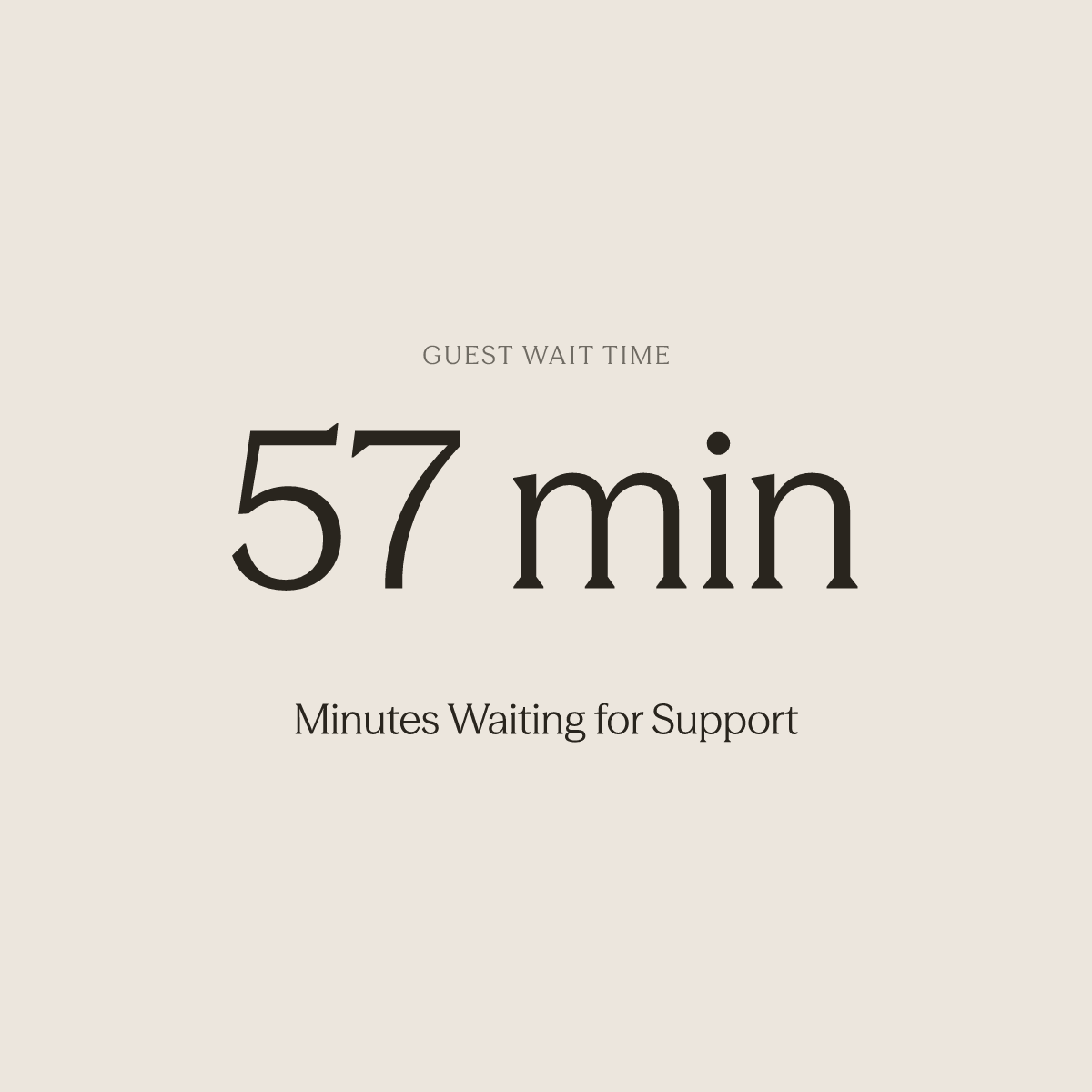
One property manager, Noel Poler, cycled through multiple support models including a PMS bundled with a call center and other hospitality call services, spending up to $4,000 per month, yet still encountered inconsistent service, guest wait times of up to 57 minutes, mounting refunds, and found himself personally answering questions on Slack. The software invoice looked manageable; the true cost of inadequate guest communication did not.
The Hidden Price of Not Automating - Revenue Leakage Hosts Rarely Measure
Airbnb's algorithm rewards fast response rates, and booking conversion drops measurably when inquiries go unanswered for hours rather than minutes. A single unanswered inquiry during peak booking hours can mean a lost reservation worth several hundred dollars, revenue leakage that only surfaces as a lower occupancy rate at month's end. The same dynamic plays out at scale.
Haven operated 270 properties and needed approximately 25 support staff across multiple shifts to handle check-in questions, lockouts, cleaning issues, and complaints. When Conduit was installed, the team was running at only 40% automation with no workflows and a minimal knowledge base, enough to reduce message volume at the margins, but not enough to change how the team operated. Every new property added more messages, more calls, and more headcount.
Growth, without a fully configured AI communication layer, was simply proportional hiring. That is the hidden expense the spreadsheet misses: not just the dollars spent on patchwork support models, but the ceiling it places on how far you can scale without adding labor costs in lockstep.
Time-Recovery Math - How to Convert Hours Saved Into a Dollar Figure
Airbnb community data shows hosts spending up to 20-plus hours per week on hosting and admin tasks even after adopting multiple tools. If your effective hourly rate is $75, recovering just five hours per week returns $1,500 per month in time value, enough to clear most mid-tier automation stacks twice over. The honest trade-off: each additional tool saves hours on its specific task while generating new coordination overhead between tools, quietly eroding the net gain.
This is where a unified guest communication layer earns its place in the stack. Conduit's AI Agents are most beneficial when a business receives a high volume of repetitive guest messages and already has documentation, SOPs, FAQs, property manuals, that can be used to train the agent. Workflows extend that further, triggering automated touchpoints after booking confirmations, check-ins, or keyword detections, without requiring manual staff action at each step.
Integrations with tools like Notion, Google Drive, or Airbnb mean that existing content feeds the agent directly, so there is no redundant data entry layer adding coordination cost on top. The time math only works in your favor when the tools talk to each other, and when guest communication, the single highest-volume task in short-term rental operations, is handled before it ever reaches your inbox.
From Tool Stack to Coordination Layer - The Mindset Shift That Unlocks Full Automation
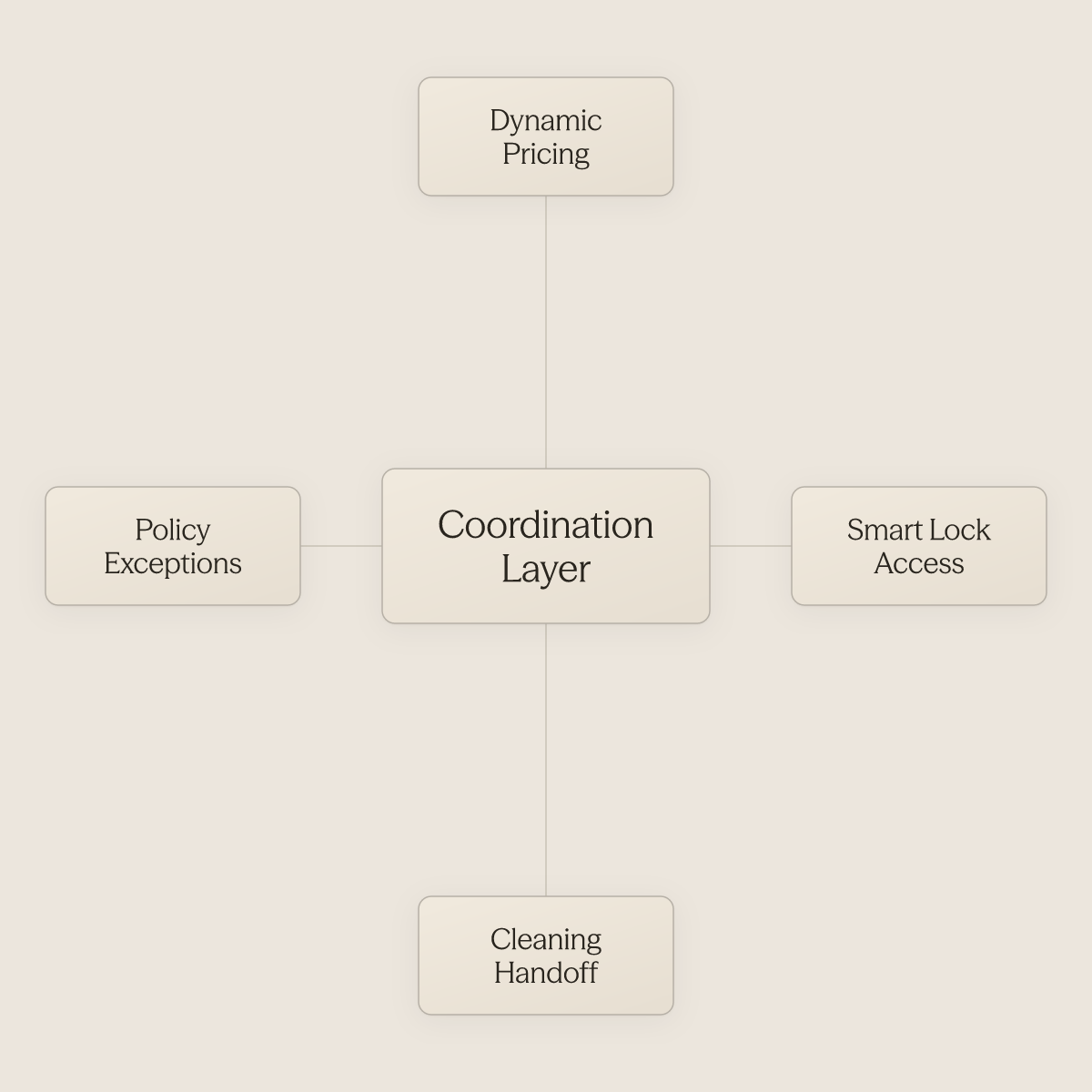
Most operators who feel stuck below full automation are not missing another tool. They are missing a layer that holds the knowledge connecting all the tools they already have, the layer that knows how a late checkout, a pet policy exception, and a cleaning handoff interact before something breaks at midnight. This section breaks down why that coordination gap is the real ceiling, and how collapsing it around a single trained layer is what separates operators who plateau from those who get to 96%.
Task Automation vs. Coordination Intelligence - How to Move Beyond the Tool-Count Trap
Reaching 90% automation is not a tool-count problem. Most operators discover this the hard way: they add a fifth tool, then a tenth, then an eighteenth, and the midnight pings keep coming because no single tool knows how their check-in window, pet policy exception, and cleaning handoff all interact. The stack grows; the tether stays.
Task automation handles one job in isolation: a dynamic pricing engine adjusts rates, a smart lock sends a code, a scheduler fires a cleaning request. Each tool executes its slice reliably. The problem is the space between slices. No individual tool owns the question of whether a late checkout conflicts with the next booking's early arrival. A human does, which is exactly why most operators plateau well below 90% automation on short-term rental operator stacks.
A common pattern among operators who feel "mostly automated" is that their tools work fine in isolation and fall apart at intersections. The routing role, deciding which tool's output applies to which guest situation, never disappears. It just becomes invisible until something breaks at midnight.
Erwan Le Roy of Cash Flow Street reached a 96% AI automation rate across 35 properties not by expanding his tool stack but by collapsing coordination around a single layer trained on his actual operating knowledge. Instead of asking "what tool covers this gap," he asked what layer could hold the knowledge that makes all existing tools execute without a human in the middle. That distinction is what separates 96% from 67%.
AI for hospitality platforms like Conduit close that gap by ingesting the operator's own SOPs, FAQs, and guest protocols, so the agent reasons across the entire operating model rather than executing one isolated task. The audit is simple: list every task your tools handle, then list every decision that still routes to you. Those routing decisions are your coordination gaps.
"We treat AI workflow platforms as a collection of disconnected tools rather than a unified coordination layer, leading to fragmented automation that fails to scale."
Next steps
If your automation stack keeps growing while you stay personally on call, the path forward starts with a coordination layer that holds your operating knowledge across every tool you already run. Start with our AI for hospitality.
The insight that task automation and coordination intelligence are structurally different categories means no combination of point solutions closes the routing gap on its own. And the finding that guest communication AI is the last tool operators add but the one that determines whether every preceding tool delivers its promised ROI means the sequencing error most operators make is building the task stack first and the coordination layer last. Together, they point to auditing your stack not for missing tools but for the decisions that still route back to you, and replacing that routing work with an AI agent trained on your actual SOPs.
Start by exploring AI for hospitality at Conduit. From there, connect your existing documentation, your FAQs, house manuals, guest protocols, and the agent begins handling the coordination gaps your current stack leaves open, without adding another point solution to manage.
Frequently Asked Questions
What exactly is Airbnb automation?
Airbnb automation means replacing manual, repetitive tasks with software that handles guest communication, pricing adjustments, cleaning coordination, and check-ins without you doing the work personally. Its real structural purpose is to break the direct connection between your portfolio size and your personal hours, so that adding a new property adds revenue without adding proportional work.
Can you fully automate an Airbnb business?
You can get very close, Erwan Le Roy, operating 35 properties under the Cash Flow Street brand, reached a verified 96% AI automation rate through Conduit's platform. The key isn't accumulating more point-solution tools; it's giving an AI agent access to your actual SOPs and guest protocols so it can handle coordination across your entire stack, not just isolated tasks.
Why bother investing in Airbnb automation if my current tool stack already covers the basics?
A stack of individual tools still requires a human to catch handoffs, route exceptions, and make judgment calls in the gaps between them, which is why hosts report operational overwhelm right around the two-to-three-property threshold and most solo operators never scale past it. The missing piece isn't another app; it's a coordination layer that holds all your operating context and acts on it coherently, which is what an AI agent trained on your existing documentation provides.
How do smart locks actually help with automating check-ins?
Smart locks generate unique, time-sensitive access codes for each guest automatically, tied to reservation start and end times, so check-in instructions go out without any human involvement. The most common failure point is integration lag, when the lock's code-delivery system and your messaging automation run on separate timers, guests can receive check-in instructions before their code is active, which is why choosing a lock that integrates directly with your PMS matters.
Are noise monitors allowed on Airbnb, and do I have to tell guests about them?
Airbnb's policy requires hosts to disclose noise monitoring devices, and guests who discover undisclosed monitoring tend to leave reviews that are difficult to recover from. Devices like Minut track decibel levels without recording audio; disclosing them upfront and framing them as a community-courtesy measure means most guests accept them without friction.
Stay in the loop
Get the latest on AI automation, product updates, and customer stories.
