How to Improve Hotel Operations With Proven Best Practices


Improve Hotel Operations
Tips to Boost Efficiency
Scale breaks hotel operations at the communication layer, not the staffing one. Here is what actually compounds the cost, and how operators are fixing it without another hire.
Hotel operations spans every coordinated function across a property: housekeeping, maintenance, food and beverage, guest communications, and compliance. The harder question, especially for operators managing more than one property, is what happens to that coordination as the portfolio grows. Most heads of operations and VPs of operations at multi-brand or enterprise hospitality groups think the only real fix is hiring more people, centralizing the guest services function, or buying an enterprise suite expensive enough to enforce standards, because operational consistency at scale requires human oversight at every touchpoint. See our AI for hospitality for how this works in practice.
That tension is where most operational guides stop short, and where the real cost of scale quietly compounds, particularly for portfolios already receiving high volumes of repetitive guest messages and sitting on documented SOPs or FAQs they haven't yet put to work. The 5 C's of hospitality, Cleanliness, Comfort, Communication, Compliance, and Courtesy, represent the standards a property must maintain across every guest touchpoint, every shift, every day. A full-service hotel typically manages eight or more operational departments simultaneously, each with its own workflows, staffing patterns, and handoff points.
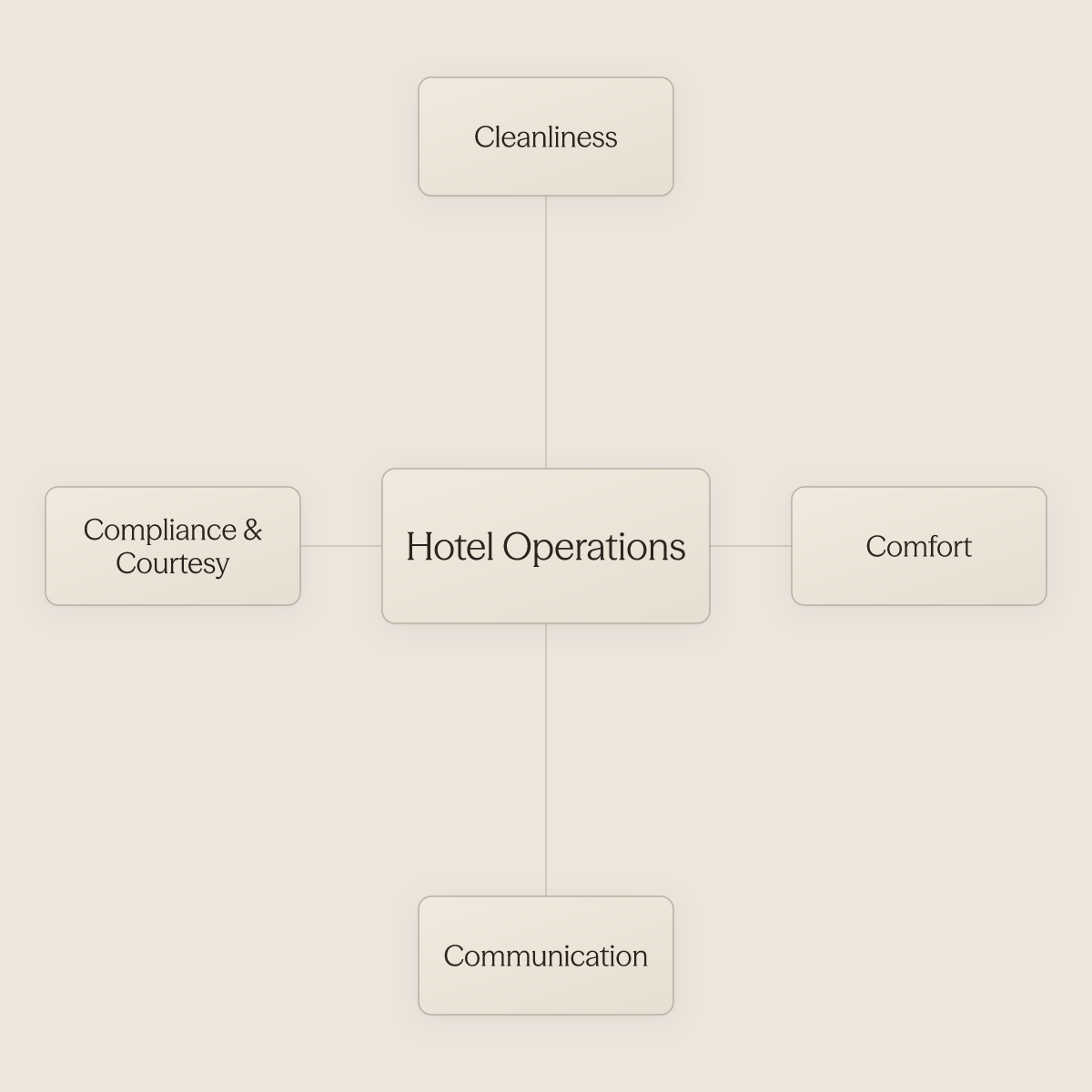
What breaks first at scale is Communication. It is the pillar most dependent on informal knowledge, individual judgment, and personal consistency. The others have physical checklists or regulatory requirements anchoring them.
Communication does not. The checklist view assumes that if every department knows its job, the operation runs cleanly. That holds at one property, where a GM can personally monitor tone, catch drift, and correct it in real time.
At ten properties across three markets, that personal enforcement layer disappears entirely, and no SOP document replaces it. The structural problem is coordination across people, shifts, and locations, not knowledge of what to do. Roughly 80% of guest inquiries are repetitive and low-complexity, covering check-in times, parking, Wi-Fi passwords, and local recommendations.
Across a portfolio, those interactions flow through dozens of staff members with no enforcement mechanism ensuring the answer is consistent, accurate, or on-brand. The problem is not the people. It is a routing problem disguised as a staffing problem.
The SOP drift that appears at property three or property seven is not a training failure. It is the predictable result of informal coordination being asked to stretch across a structure it was never designed to support, and the point at which operators start looking for a systemic answer rather than another hire.
Key takeaways
- Hotel operations isn't one function, it's housekeeping, maintenance, F&B, guest communications, and compliance running in parallel, and the coordination cost compounds with every property you add.
- Most multi-property operators assume the fix is more headcount, a centralized guest services team, or an expensive enterprise suite, but none of those approaches stop labor costs from scaling linearly with inquiry volume.
- The review is a lagging indicator. The communication gap that caused it happened 48 hours earlier, during pre-arrival or mid-stay, inside a system you can actually fix.
- Cross-training is the highest-return staffing investment a growing portfolio can make, not because it cuts headcount, but because it stops a single absence from becoming a guest-facing failure.
- Haven Vacation Rentals scaled from 40% to 90% guest communication automation and reduced support staff per shift from roughly 25 to 2, not by eliminating roles, but by redirecting people to work that requires human judgment.
- A PMS handles reservations and billing. The moment a guest messages at 2 a.m. about early check-in or a broken amenity, it has nothing to say, that gap is where guest experience holds or fractures.
- conduit.ai's AI Agents close that gap by handling guest conversations autonomously, pulling answers directly from your SOPs, manuals, and FAQs across every channel, no human routing required.
Common Challenges in Hotel Operations: and the Ones Most Guides Don't Admit
Most operational problems in hotel management are well-documented. The ones that quietly compound at scale, particularly around consistency and institutional knowledge, rarely get the direct treatment they deserve.
The Brand Consistency Gap That Scales Against You
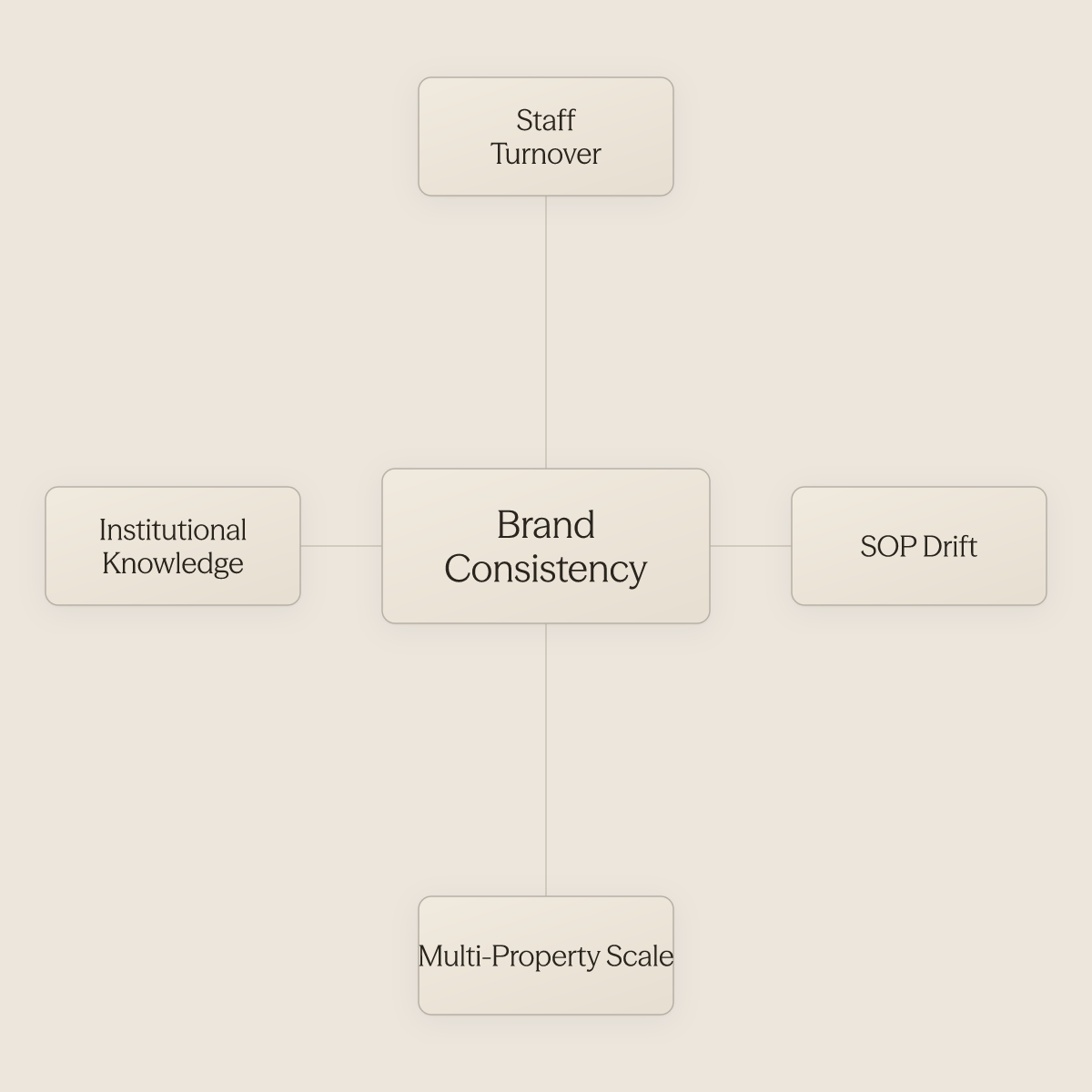
The common assumption among heads of operations and VPs of operations at multi-brand or enterprise hospitality groups is that the only real fix is hiring more people, centralizing the guest services function, or buying an enterprise suite expensive enough to enforce standards, because operational consistency at scale requires human oversight at every touchpoint. The same brand standard that feels manageable across two properties becomes structurally fragile across ten. Front desk staff turn over, new hires interpret SOPs differently, and institutional knowledge walks out with every resignation.
Hotel staff turnover in the hospitality industry remains among the highest of any sector, which means SOP enforcement effectively resets on a rolling basis. Consistency stops being a training outcome and starts being a system design question. This is precisely where AI agents become most valuable: when businesses have specific brand standards, escalation policies, or complex multi-property operations that require differentiated agent behavior.
Conduit's AI Agents are trained directly on your existing SOPs, FAQs, and manuals, the documentation you already have, so the standard is encoded in the system, not dependent on any individual. Most beneficial when that documentation already exists, the agent begins handling guest communication within days of connecting your materials, enforcing your standards consistently across every property and every message.
Why 24/7 Guest Communication Is a Structural Cost Problem
Labor costs account for approximately 50% of a hotel's total operating expenses, according to Hotel Tech Report. Staffing round-the-clock guest communications across multiple properties and time zones compounds that figure fast. You are not solving a staffing problem; you are funding a structural inefficiency one shift at a time.
Key takeaway: Labor already consumes ~50% of hotel operating expenses. Staffing 24/7 guest communications on top of that isn't a people problem; it's a routing problem you're paying for one shift at a time.
Labor already consumes ~50% of hotel operating expenses. Staffing 24/7 guest communications on top of that isn't a people problem; it's a routing problem you're paying for one shift at a time.
~50% of hotel operating expenses go to labor
The human cost of that inefficiency extends beyond the payroll line. Operations managers at multi-property groups face a 24/7 on-call work culture with no clear boundary between personal and professional time. A booking inquiry that lands at 11 PM doesn't wait until morning; neither does a check-in question from a guest in a different time zone. The chronic burnout this creates is not a personality problem; it is a routing problem. conduit.ai's AI Agents run continuously, capturing every booking inquiry including the ones that land overnight or after hours, so the operational burden no longer defaults to whoever is reachable at the worst possible moment.
How Repetitive Inquiries Drain Management Bandwidth
Industry data consistently shows that a large share of hotel guest inquiries, often cited at 70–80%, are repetitive and low-complexity, covering check-in times, directions, and amenity availability, according to Hotel Tech Report. That volume pulls operations managers into reactive mode, leaving no bandwidth for strategic work. The questions are predictable. The cost of routing them through humans is not.
Conduit addresses this at the infrastructure level. The Inbox gives your operations or support team a single place to monitor, review, and manage all conversations the AI agent is handling, across multiple platforms and properties simultaneously. This is most beneficial when managing guest communications across channels that would otherwise fragment into separate inboxes, making oversight impossible at scale.
Workflows layer on top of that: for recurring, predictable guest touchpoints that currently require manual staff action, a post-booking confirmation message, a pre-check-in reminder, a follow-up triggered by a specific keyword, Workflows fire automatically after the relevant trigger event, without any human having to remember to send them. The repetitive volume gets absorbed by the system. Your team's attention stays where judgment is actually required.
Conduit's Integrations allow the AI agent to draw on that existing content directly, without manual re-entry. The knowledge base you have already built doesn't need to be rebuilt; it gets connected.
Inefficient Processes and Guest Satisfaction Concerns Are Symptoms
Hotels that respond to guest messages within five minutes see up to 70% higher guest satisfaction scores compared to those that respond after an hour, per Hotel Tech Report. Most operations leaders read slow response times as a staffing gap. The accurate diagnosis is a routing problem: messages requiring no human judgment are still waiting for a human. Darren, founder of Easy BnB, put it plainly after restructuring around AI-first guest communication: "We all agree that AI first is the best approach."
70% higher satisfaction from sub-5-minute responses
These are structural problems, which means they have structural solutions. The next section maps the specific technology layers, from PMS backbone to AI communication infrastructure, so you can diagnose exactly which part of your stack is creating the friction and prioritize accordingly.
What Specific Technologies Should Hotels Invest In to Automate Operations?
Hotels that automate the most don't have longer software lists. They have the right tool at each of three distinct layers:
- An operational backbone that centralizes data
- A guest-facing layer that removes arrival friction
- A communication infrastructure layer that resolves inquiries without human routing
Miss any one layer and the other two can't cover for it.
Hotel Operations Technology Stack - Decision-Criteria Checklist
Use this checklist before purchasing any new hotel operations platform:
| Layer | What to Evaluate | Red Flag |
|---|---|---|
| Operational Backbone (PMS) | Does it centralize reservations, billing, and room inventory across all properties? | Requires on-site servers or per-property logins |
| Internal Coordination | Does it replace radio calls and paper checklists with real-time digital task assignment? | No mobile app for housekeeping staff |
| Revenue Management | Does it adjust pricing dynamically using demand signals and competitor data? | Requires manual rate overrides daily |
| Guest Communication (AI Layer) | Can it be trained on your existing SOPs and FAQs without IT involvement? | Generic template responses not tied to your property data |
| Integration | Does it connect to your existing PMS without a custom build? | Requires a dedicated integration project before go-live |
A stack missing any one layer forces the other layers to compensate, and they cannot.
1. Conduit.ai - Best AI Automation Platform for End-to-End Hotel Operations
Conduit's AI agents sit above the PMS as the communication infrastructure layer, reading directly from a property's own SOPs and FAQs to resolve guest inquiries instantly, without routing them through a staff member. This works best when a portfolio receives high volumes of repetitive guest messages and already has operational documentation to train the agent on. Haven Vacation Rentals used this approach to move from 40% to 90% automation, freeing a team that had been handling routine inquiries around the clock to redirect toward the higher-judgment work that actually moves guest satisfaction scores.
2. Flexkeeping - Best Housekeeping Operations Software for Real-Time Task Coordination
Flexkeeping digitizes housekeeping task assignment, room status updates, and maintenance reporting in real time, replacing radio calls and paper checklists that create handoff delays between departments. The practical gain for multi-property operators is faster room turnover and fewer guest complaints tied to check-in wait times. The trade-off: it solves the internal coordination layer but adds no guest-facing communication capability, so it works best alongside, not instead of, a dedicated guest messaging platform.
3. IDeaS Revenue Management System - Best AI-Driven Pricing Automation for Revenue Teams
IDeaS uses AI to set and adjust room rates dynamically based on demand signals, competitor pricing, and historical patterns. Properties that replace manual rate-setting with algorithmic pricing consistently see measurable RevPAR improvement. The limitation: IDeaS requires clean, consistent data inputs, so properties with fragmented Property Management Systems (PMS) records or inconsistent channel management will see weaker results until the data foundation is solid.
4. Roomnexa PMS - Best Cloud Property Management System for Centralizing Reservations and Billing
A cloud-based PMS gives operations leaders a live dashboard across every property without on-site server infrastructure, which is why cloud PMS adoption has become the prevailing approach for multi-property operators. Roomnexa centralizes reservations, billing, and room management in one place, reducing the manual reconciliation work that consumes operations staff hours across properties with fragmented legacy systems. For multi-property operators currently running on-site servers or disconnected per-property logins, it represents a straightforward consolidation path.
5. Prostay Hotel Chatbot - Best Conversational AI for Automating Guest Communication
Prostay's AI chatbot handles pre-arrival inquiries, check-in instructions, in-stay service requests, and post-stay feedback collection across web, WhatsApp, and messaging channels. It's the right investment for hotels with high inquiry volumes and lean front desk teams who need 24/7 guest communication without adding headcount. The key tradeoff is that complex or emotionally sensitive guest issues still require human escalation, so staff training on handoff protocols remains essential.
6. Smart Room Energy Management (SmartREM): Best IoT Solution for Automating Energy Efficiency
SmartREM uses IoT sensors and occupancy detection to automatically adjust HVAC, lighting, and climate controls in guest rooms, cutting energy waste without impacting guest comfort. It's the strongest fit for hotels with sustainability mandates or rising utility costs seeking measurable operational savings. The primary limitation is upfront hardware installation cost and the need for compatible building infrastructure, which can make retrofitting older properties expensive.
How to Optimize Hotel Staffing and Training Without Scaling Headcount Linearly
Staffing a growing hotel portfolio is less a volume problem than a design problem. The question isn't how many people you have; it's how much of their time goes to work that genuinely requires human judgment versus work a well-built system could handle.
Cross-Training - The Primary Resilience Lever
Cross-training hotel staff is the single highest-return investment a multi-property operator can make in operational resilience. When a front desk associate can flag room-readiness delays directly in the PMS without a separate radio call to housekeeping, you eliminate an entire coordination layer. According to hybridpayroll.com's 2026 analysis of hospitality turnover, cross-training across roles is a documented strategy for reducing the operational impact of understaffing without adding headcount. The limitation is real: cross-training breaks down if the underlying SOPs aren't written clearly enough for someone outside a role to follow them.
Retention and Fair Compensation as Operational ROI
The hospitality industry runs at roughly 73.8% annual turnover, and replacing a single employee carries substantial costs in recruiting, onboarding, and lost productivity (hybridpayroll.com, 2026). That math reframes retention programs from a soft HR benefit into a direct cost-control mechanism.
Key takeaway: At 73.8% annual turnover, every resignation resets your SOP enforcement. Fair compensation and predictable scheduling are cost-control levers, not HR soft benefits.
Fair compensation and predictable scheduling are the levers operators most consistently undervalue when building the case for retention investment to ownership groups.
Stop Routing Your Best People Through Routine Work
The real ceiling on staffing optimization is structural: when skilled staff spend the majority of their shift answering the same check-in questions and amenity inquiries, your cross-training and retention investment is being spent on work a system should own. Industry data consistently shows that a large share of daily guest interactions are routine, repeatable, and resolvable without human judgment. Platforms built for hospitality guest communication absorb that queue by reading directly from the operator's own SOPs and FAQs, so the human team handles escalations and the judgment calls that actually move review scores.
Getting staffing and training right raises the operational floor, but it's only half the equation. The other half is designing the communication layer so your best people aren't the first line of defense for questions a well-built system can answer without them.
Strategies to Improve Hotel Guest Experience - Personalization, Feedback, and Proactive Service
Guest satisfaction scores don't lie; they just tell you the truth too late. By the time a 3-star review lands on your OTA listing, the communication gap that caused it happened 48 hours earlier, during pre-arrival or mid-stay. The review is a lagging indicator. The operational system that produced it is what you actually need to manage. Personalization, feedback aggregation, and proactive service aren't hospitality values. They're repeatable disciplines with measurable outputs. Properties that treat them that way consistently outperform on review scores and repeat bookings.
One pattern worth naming directly: operators who struggle most with this gap are usually managing guest communications reactively, across multiple inboxes, platforms, and properties simultaneously, with no single owner and no documented workflow. The operational cost isn't just slower response times. It's the compounding effect of inconsistency: a guest at one property gets a warm pre-arrival message; a guest at another gets silence. Both reviews land on the same OTA profile.
1. Build Guest Profiles with Data-Driven Personalization
Hotels that centralize guest data, room preferences, dietary needs, past spend patterns, can deliver hyper-relevant experiences that drive loyalty and repeat bookings. This approach is ideal for mid-to-large properties with a CRM or PMS capable of storing behavioral data. The real tradeoff: smaller independent hotels often lack the tech stack or staff bandwidth to maintain accurate, actionable guest profiles consistently.
2. Send Personalized Pre-Arrival Emails to Set Expectations Early
Pre-arrival emails have among the highest open rates of any hotel communication, making them a high-leverage moment to upsell room upgrades, confirm preferences, and reduce front-desk friction. Best suited for independent hotels wanting to compete with branded chains on service quality. The limitation: generic, templated pre-arrival emails backfire, guests notice boilerplate language, so personalization tokens and segmentation are non-negotiable for real impact.
3. Centralize Guest Feedback to Identify Operational Blind Spots
Aggregating satisfaction scores, post-stay surveys, and OTA reviews into a single dashboard lets operations teams spot recurring issues, a noisy HVAC unit, slow breakfast service, before they compound into reputation damage. This strategy suits multi-property groups or revenue-focused GMs who need pattern recognition at scale. The tradeoff: without a dedicated analyst or automated tagging, raw feedback volume becomes noise rather than signal.
4. Train Staff in Proactive Service Recovery Before Complaints Escalate
Empowering front-line staff to identify dissatisfied guests and resolve issues on the spot, before a negative review is written, is one of the highest-ROI investments in guest experience. Properties like Andaz Bali demonstrate that a swift, genuine recovery can convert a complaint into a loyalty moment. The key limitation: recovery protocols only work when staff have clear authority and budget to act; rigid approval chains kill the moment.
5. Invest in Ongoing Employee Training Tied Directly to Guest Satisfaction Metrics
Linking structured hospitality training programs, emotional intelligence, cultural competency, service sequencing, directly to guest satisfaction KPIs creates a measurable feedback loop between staff development and review scores. This is the right approach for properties serious about consistent service delivery across high-turnover roles. The honest tradeoff: training programs require sustained investment and management buy-in; one-off sessions produce minimal long-term behavior change.
How to Enhance Hotel Operational Efficiency - Workflows, Inventory, and Demand Forecasting
Hotel Operational Efficiency - Workflows, Inventory, and Demand Forecasting
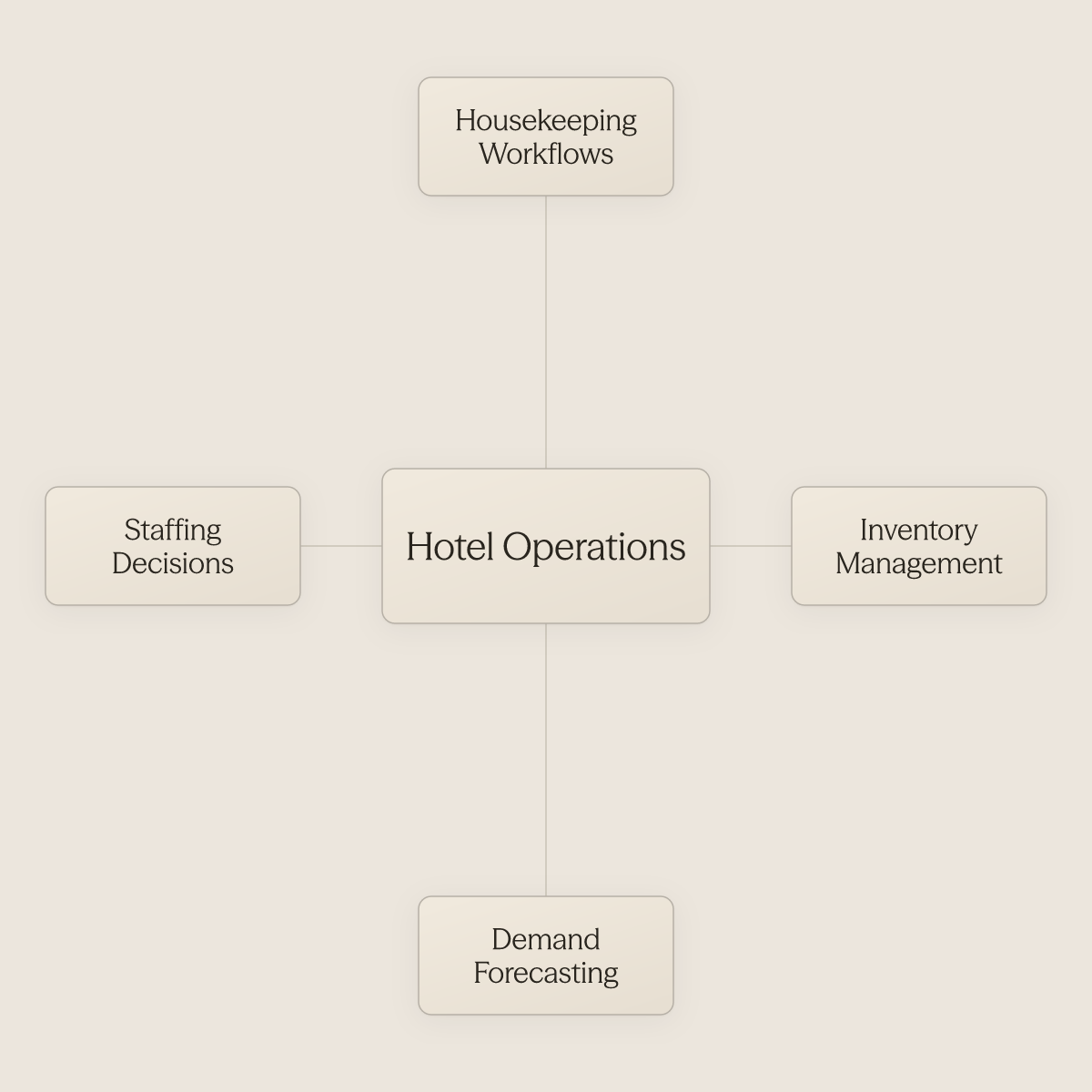
Supervisors who spend their mornings counting linen and their afternoons chasing down a broken HVAC report are not running a hotel; they are managing a to-do list. This pressure compounds for first-time GMs at boutique and small properties, who typically absorb every operational role simultaneously, no dedicated maintenance lead, no inventory coordinator, no finance manager. The real cost is not the wasted hour; it is every revenue conversation, staffing decision, and guest experience improvement that never happened because the person with the institutional knowledge to make it was buried in work a system could handle. The sections below cover how digitizing housekeeping workflows, automating inventory management, and applying demand forecasting as a staffing tool address each of these pressure points.
Housekeeping and Check-In Workflows
"First-time GMs at boutique/small hotels are forced to manage operational workflows single-handedly, with no dedicated finance, maintenance, or inventory personnel, creating unsustainable workloads."
Hotels can reduce room turnover time and negative reviews by digitizing task assignment so housekeeping supervisors receive real-time room status updates and can dynamically reassign staff as conditions shift. Family rooms take roughly 45 minutes to clean compared to 15 minutes for a standard business room. Without a live view of which rooms are ready, which are running long, and where staff are clustered, supervisors default to static schedules that cannot absorb that variability, the difference between a guest waiting 90 minutes for their room and a guest who never notices the gap.
Part of that gap widens at the front end: check-in questions, lockout calls, and cleaning complaints that flood a supervisor's phone before the shift has even stabilized. Haven found that handling those messages alone demanded a large number of support staff spread across multiple shifts, and even with Conduit installed, running at partial automation with no configured workflows and a minimal knowledge base, the model couldn't change. Every new property meant more messages, more calls, and more hiring.
The operational ceiling wasn't a people problem; it was a workflow problem. Conduit's AI Agents are most valuable precisely in that scenario: a high volume of repetitive guest messages, check-in instructions, room status questions, lockout procedures, answered automatically the moment an SOP or FAQ document is connected, with the first automated reply typically live within days. Workflows extend that further, triggering automatically after a booking is confirmed or at check-in so a supervisor is never the first point of contact for a predictable guest touchpoint.
The result is that the same supervisor managing turnover logistics is not simultaneously fielding the same five questions from guests who just arrived. The communications overhead that once required proportional headcount is absorbed by the system instead.
Automated Inventory Management
Inventory shrinkage and waste across linens, toiletries, and F&B can consume a meaningful share of a hotel's operating budget, yet many properties still rely on weekly manual counts to catch the problem after it has already cost them. Automated inventory management solves this by triggering restocking alerts when par levels drop, flagging consumption anomalies before a mid-shift shortage forces a scramble, and giving purchasing managers accurate usage data rather than estimates. The practical gain is not just cost control; it is the hour or two a supervisor recovers every shift to redirect toward decisions that require their judgment.
For a first-time GM wearing every operational hat, that recovered time is not a nice-to-have, it is the difference between a property that can respond to a maintenance issue before a guest notices and one that is always a step behind. When Conduit's Workflows are configured around recurring supply touchpoints, and its Integrations pull existing documentation from tools like Notion or Google Drive without manual re-entry, the administrative layer that previously lived in a supervisor's head, or on a clipboard, moves into a system that surfaces the right information at the right moment.
Demand Forecasting as a Staffing Tool
Hotels can align labor costs to actual demand by using PMS occupancy data and historical booking patterns to build staffing schedules before the shift begins. Reactive scheduling drives overstaffing on slow nights and understaffing on peak ones: overstaffing erodes margin while understaffing erodes the guest experience. Properties that use PMS occupancy data and historical booking patterns to set staffing levels before the shift begins absorb demand variability without either outcome.
The staffing calculation also changes when a portion of guest communication overhead is no longer a manual labor cost. Haven's experience is instructive: the labor required to staff guest support at scale was a direct function of how much of that communication remained manual. Reducing that proportion, through AI Agents handling repetitive messages and Workflows activating at predictable lifecycle moments, means the staffing model for a growing portfolio does not have to scale headcount linearly with message volume.
For a GM building a schedule, that is a real input: fewer reactive support hours needed means labor can be concentrated where human judgment is irreplaceable.
Related Reading
- Hotel Budgeting And Forecasting
- Hotel Demand Forecasting
- How To Increase Revpar
- Hotel Upselling
- Hotel Revenue Management Strategies
- Automated Hotel Reservation System
- Hotel Guest Messaging
- Hospitality Automation
- Hospitality Operations Management
- Adr Vs Revpar
What Compliance and Sustainability Practices Should Hotels Maintain?
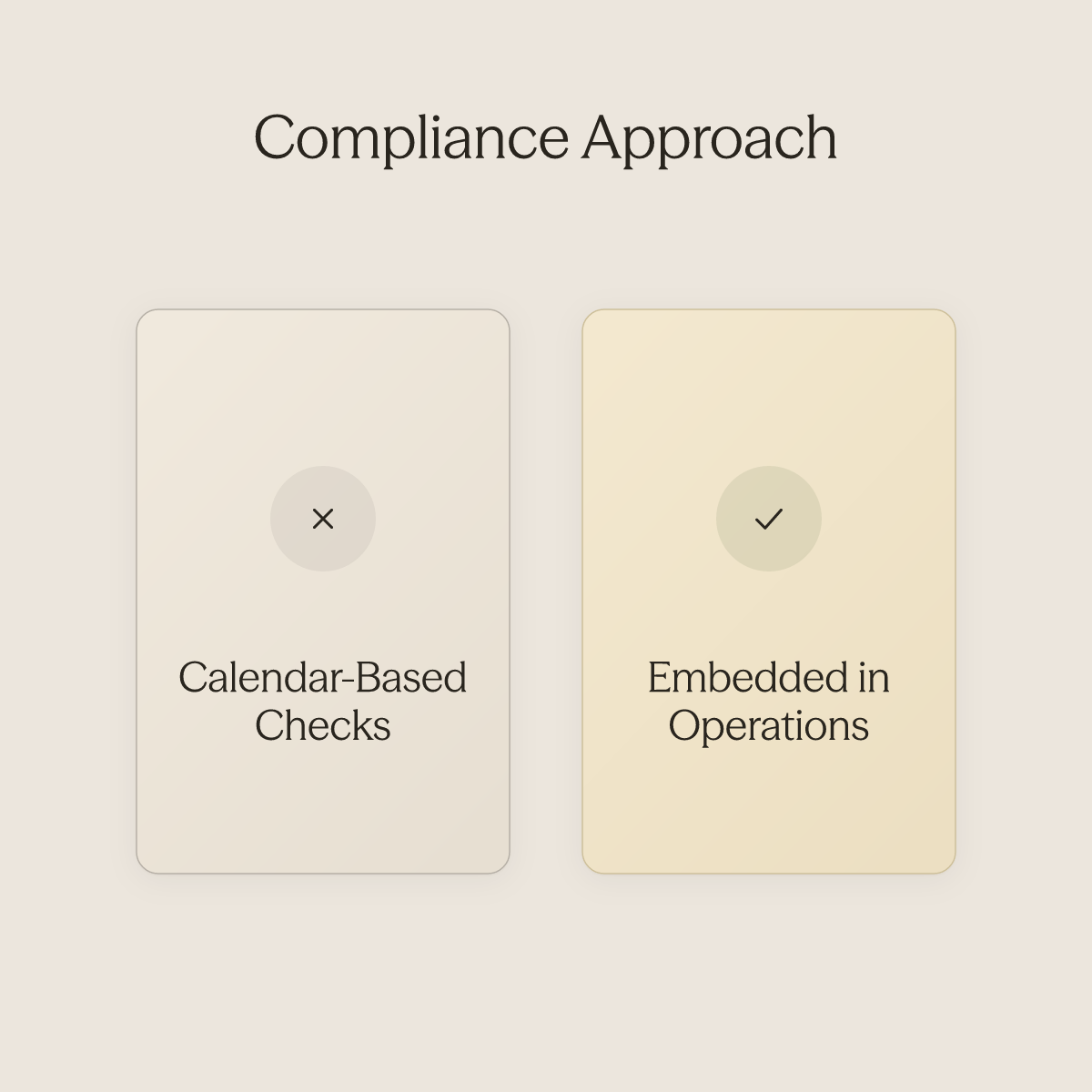
A fire exit blocked by a housekeeping cart. An ADA-accessible room with a broken grab bar that three shift teams walked past. A linen-reuse card placed in every room, but no system tracking whether the program actually reduced laundry costs. These are not edge cases; they are what happens when compliance and sustainability live on a calendar instead of inside the operation itself.
Regulatory and Safety Compliance as a System Property
Hotels that stay audit-ready embed checkpoints directly into the tools staff already use: housekeeping task lists, maintenance logs, and shift handoff records. According to oxmaint.com's 2024 compliance guidance, continuous tracking for OSHA, ADA, and fire safety regulations keeps properties audit-ready at all times, replacing reactive manual checks with an ongoing, systematized approach. When a fire alarm inspection is a scheduled task in the PMS rather than a paper binder reminder, it gets done regardless of who is on shift.
The same staffing fragility that erodes guest communication standards erodes compliance standards. Easy BnB's experience is instructive: relying on a team of virtual assistants to maintain 24/7 coverage meant that missed overnight shifts and unreliable staff weren't just a guest-experience problem, they were a gap in the operational consistency that safety and compliance workflows depend on. A grab bar that three shift teams walk past is, structurally, the same problem as an overnight shift that goes uncovered: accountability disappears between handoffs.
ADA violations carry civil penalties reaching tens of thousands of dollars per incident, and fire code failures can trigger mandatory closure. The exposure compounds across a portfolio: one missed inspection is a fine; a pattern of missed inspections affects insurance premiums and brand reputation simultaneously.
Sustainability Practices That Cut Costs
Sustainability is a revenue lever, not just a cost item. Based on our market understanding, roughly 70% of travelers factor eco-friendly practices into booking decisions. Linen-reuse programs, LED retrofits, and occupancy-based HVAC controls consistently produce energy cost reductions of 15–20%, a pattern that holds broadly across the market.
Key takeaway: Linen-reuse programs, LED retrofits, and occupancy-based HVAC controls consistently deliver 15–20% energy cost reductions; sustainability is a margin lever, not just a brand signal.
The honest trade-off: upfront capital for energy management systems is real, and payback periods vary by property age and utility rates.
Embedding Compliance Into Daily Workflows
The most effective compliance programs are not audit-driven; they are workflow-driven. When safety checks, linen-reuse tracking, and maintenance sign-offs are embedded directly into the digital tools staff use on every shift, compliance stops depending on someone remembering to do it and starts happening as a byproduct of normal operations.
This is where the staffing math matters. Easy BnB found that routine, low-value inquiries consumed the vast majority of staff bandwidth, and that the business could not scale its property portfolio without adding costly headcount, directly capping exit valuation multiples. The same dynamic plays out in compliance: when staff bandwidth is consumed by repetitive, low-complexity tasks, the higher-stakes work, safety sign-offs, maintenance escalations, shift handoff records, gets deprioritized or skipped.
Conduit's AI Agents are most beneficial precisely when a business receives a high volume of repetitive guest messages and has existing documentation, SOPs, FAQs, manuals, to train the agent on. By routing routine guest communication through an AI agent that handles those messages continuously, before, during, and after a stay, operations teams recover the bandwidth that compliance workflows actually require. Conduit's Workflows layer adds a further layer of structure: recurring, predictable guest touchpoints that currently require manual staff action, post-check-in messages, maintenance-request follow-ups, sustainability-program reminders, fire automatically after a trigger event in the guest lifecycle, without depending on a staff member to remember.
For multi-property operators, that consistency is the difference between a portfolio-wide standard and a standard that holds only at the properties with the strongest GMs. Conduit's Inbox makes this visible at scale: it is most beneficial when managing guest communications across multiple platforms or properties simultaneously, giving the operations team a single place to monitor and review everything the AI agent is handling, so nothing falls through the gap between shifts.
What Are the Specific Benefits of AI and Automation in Hotel Operations?
The gap between what guests expect and what lean hotel operations can consistently deliver comes down to one constraint: labor scales with volume, but margin does not. For operators managing multiple properties, that constraint shows up first in guest communications, where repetitive, low-judgment inquiries quietly consume the staff capacity that should be driving higher-value work. What the numbers from operators like Haven Vacation Rentals and Easy BnB reveal is that AI does not just reduce costs here, it removes the structural ceiling that prevents response quality and profitability from improving at the same time.
What the Production Numbers Actually Show
Most operators handle this by centralizing guest communications into a reservations team or outsourcing to virtual assistants. That approach works at one or two properties. At ten or twenty, labor costs scale linearly with volume while inquiry complexity does not. Easy BnB found that the vast majority of their communication volume consisted of low-value, repetitive messages. Fourteen virtual assistants were consuming margin on work that required no judgment, capping EBITDA and limiting exit valuation.
Key takeaway: Hotels that respond within 5 minutes see dramatically higher satisfaction scores, yet labor already consumes the largest single share of operating costs, and you cannot hire your way to sub-5-minute response consistency without collapsing your margin.
The operators breaking through this ceiling are not running larger teams. Haven Vacation Rentals scaled guest communication automation from 40% to 90%, freeing the majority of their support team, previously occupied with repetitive, low-judgment inquiries, to redirect toward higher-value guest interactions, with no reported service degradation. Easy BnB cut a significant amount in monthly labor costs and added units without a single new hire. Cash Flow Street reached near-full automation across their portfolio. These are not pilot results. They are production numbers.
Where AI Agents Fit and When They Work Best
Most operators evaluating AI communication tools assume they will need months to build a custom knowledge base before the system is accurate enough to trust with guests. That assumption is the reason many evaluations stall. AI for hospitality platforms like Conduit sidestep that problem by reading directly from the operator's existing SOPs, manuals, and FAQs on day one. Cascadia Getaways, for example, achieved a top-rated communications score using this approach, not despite automation, but because every AI-generated response was trained on their actual operating standards rather than generic templates.
Every response is brand-consistent and property-accurate without a human routing or reviewing it. One honest trade-off: if your SOPs are incomplete or inconsistent across properties, the AI-powered guest communication layer will surface that inconsistency quickly, not as a flaw, but as a forcing function. Operators who have not yet standardized their documentation will need to do that work first.
The KPIs that matter to ownership groups, RevPAR, GOPPAR, and occupancy rates, all move when the communication layer stops leaking. Faster resolution times reduce negative reviews, and a labor structure that does not grow headcount with unit count changes the NOI trajectory at the portfolio level, which is the conversation ownership groups and investors actually care about.
1. AI-Powered Dynamic Pricing That Maximizes Revenue Per Available Room
AI-driven dynamic pricing continuously analyzes competitor rates, local demand signals, and booking pace to adjust room prices in real time. Hotels with fluctuating occupancy patterns benefit most, as the system captures revenue during peak windows that manual rate managers routinely miss. The key tradeoff: initial calibration requires clean historical data, and properties with fewer than 50 rooms may see slower ROI on implementation costs.
2. Automated Self-Check-In Kiosks That Eliminate Front-Desk Bottlenecks
Self-service check-in kiosks reduce lobby congestion, cut front-desk labor hours, and accelerate guest throughput, a market growing at 8.9% CAGR through 2034. Independent and mid-scale hotels gain the most by reallocating staff to higher-value guest interactions. The real limitation is upfront hardware investment and the need for ongoing maintenance contracts, which can strain tight capex budgets at smaller properties.
3. AI Concierge Chatbots That Handle 60–80% of Guest Requests Without Staff
Multilingual AI concierge systems resolve common guest inquiries, restaurant recommendations, housekeeping requests, local directions, around the clock without human intervention, handling 60–80% of routine contacts. This directly reduces overnight staffing costs and improves response times. The tradeoff is that complex or emotionally sensitive guest issues still require human escalation, and poorly trained models can frustrate guests if edge cases aren't handled gracefully.
4. AI-Driven Upselling Engines That Personalize Ancillary Revenue Offers
AI upselling platforms analyze guest booking data, stay history, and behavioral signals to deliver personalized upgrade and add-on offers at precisely the right moment, pre-arrival, at check-in, and mid-stay. Hotels using these tools report meaningful lifts in ancillary revenue per guest. The limitation is data dependency: properties without a robust CRM or guest history database will see diminished personalization accuracy until sufficient data accumulates.
5. Automated Labor Scheduling Tools That Cut Overtime and Staffing Waste
AI-powered scheduling platforms forecast demand by shift, automatically match staffing levels to occupancy projections, and flag overtime risks before they occur. For hotels where labor represents 30–40% of operating costs, this directly protects margins. The key tradeoff is change management: department heads accustomed to manual scheduling often resist algorithmic recommendations, requiring deliberate adoption training to realize full savings.
6. AI-Automated Procurement and Inventory Management That Reduces Food and Supply Waste
Automated procurement platforms streamline purchase orders, track inventory levels in real time, and flag pricing anomalies against contracted supplier rates, eliminating manual AP tasks across food and beverage and housekeeping supply chains. Full-service hotels with high F&B volume gain the clearest ROI. The tradeoff is integration complexity: connecting the platform to existing PMS and accounting systems requires IT resources that lean operations teams may not have readily available.
Which PMS and Hotel Management Software Platforms Are Recommended: and Where AI Agents Fit
The PMS is not the whole stack. It was never meant to be.
When a guest messages about early check-in, parking, or a broken amenity, the PMS has nothing to say. That gap is where guest experience either holds or fractures, and it is the exact gap most software evaluations miss. Operators running 90%+ automation rates are not doing it through their PMS.
They have added a purpose-built AI communication layer on top of it. Below are three platforms serious multi-property operators should evaluate, organized by function.
| Platform | Function | Key Capability | Key Limitation / Note |
|---|---|---|---|
| Conduit.ai | AI Agent Layer, Guest Communication & Operational Automation | Reads from property-specific SOPs, FAQs, and manuals (via Notion, Google Drive, or Airbnb integrations); Inbox centralizes all conversations; Workflows fire on trigger events; first automated reply live within days | Operators without documented SOPs must build that knowledge base before the agent performs at full capacity; no IT involvement required for setup |
| Cloudbeds | All-in-One PMS | Top-rated by industry research for PMS, Hotel Management System, and Channel Manager (2021–2026); outranks Oracle OPERA Cloud on ease of use and support responsiveness for independent operators | Does not replace a guest communication layer |
| Mews | Cloud PMS | Cloud-native, API-first architecture; strong for boutique groups and design-forward multi-property portfolios where check-in experience is a brand differentiator | Manages operational backbone only, does not cover inbound guest messaging or communication automation; requires a dedicated AI communication layer alongside it |
1. Conduit.ai - Best AI Agent Layer for Guest Communication and Revenue Automation
The pressure operators feel is real and compounding. During pool season or peak booking windows, request volume spikes in ways that strain both staff and software, and questions stack up faster than any inbox can clear them. STR managers and hotel operators alike carry a disproportionate share of manual work: responding to repetitive guest messages, coordinating cleaners, and keeping calendars accurate across platforms, often simultaneously across multiple properties. These are not edge-case problems. They are the daily operational grind that erodes margin and burns out good staff.
Conduit's AI Agents sit on top of whichever PMS the operator already runs and address this directly. The agents read from property-specific SOPs, FAQs, and manuals, and if those documents already live in Notion, Google Drive, or Airbnb, Conduit's Integrations pull them in without manual re-entry. That means no rebuilding what already exists.
The first automated guest reply arrives within days of connecting those source documents, and the first custom rule that changes how the agent responds can be live the same day it is created. Once running, the agents work continuously, before, during, and after a stay, handling inbound messages without human routing. The Inbox gives the operations or support team a single place to monitor, review, and manage every conversation the agent is handling across all properties and platforms simultaneously.
Workflows extend the system further: after a trigger event, a booking confirmed, a check-in completed, a specific keyword detected, automated touchpoints fire without staff involvement, covering the recurring, predictable guest interactions that currently require manual action.
The product is most beneficial for operations that receive a high volume of repetitive guest messages and already have documentation to train the agent on. The honest tradeoff: operators without documented SOPs will need to build that knowledge base before the agent performs at full capacity. Setup requires no IT involvement.
2. Cloudbeds - Best All-in-One PMS for Independent Hotels Wanting Unified Operations
Cloudbeds is the strongest starting point for independent and mid-scale operators who want unified back-of-house visibility without enterprise-level implementation overhead. Based on publicly available ratings data, it ranks at the top for PMS, Hotel Management System, and Channel Manager across 2021 to 2026, and it outranks Oracle OPERA Cloud on ease of use and support responsiveness for independent operators in the same ratings data. It does not replace a guest communication layer.
3. Mews - Best Modern Cloud PMS for Design-Forward and Tech-Forward Properties
Mews is a cloud-native PMS built for operators who want flexible, API-first architecture and a modern guest-facing interface. It performs well for boutique groups and design-forward multi-property portfolios where the guest experience at check-in and throughout the stay is a brand differentiator. Like Cloudbeds, Mews manages the operational backbone, reservations, billing, room inventory, but does not cover inbound guest messaging or communication automation. Operators running Mews will still need a dedicated AI communication layer to handle the inquiry volume that falls outside the PMS's scope.
4. Oracle OPERA Cloud - Best Enterprise PMS for Large Hotels and Brand-Affiliated Properties
Oracle OPERA Cloud is the industry standard for full-service hotels, resort groups, and branded properties that require deep configuration, multi-property management, and enterprise-grade compliance. Its market penetration means staff often arrive with prior OPERA experience, reducing onboarding friction at scale. The critical tradeoff: support quality for smaller or independent properties is widely reported as poor, and implementation timelines are long.
5. SiteMinder - Best Channel Manager for Maximizing OTA Distribution and Direct Bookings
SiteMinder ranks as the top-rated channel manager on Hotel Tech Report, giving hotels centralized control over rates and inventory across hundreds of OTAs while also supporting direct booking engine functionality. It's the right pick for revenue managers who want granular distribution control without being locked into a single PMS ecosystem. The tradeoff: it's a distribution-focused tool, not a full operations platform, so it requires a separate PMS.
6. Actabl (formerly Flexkeeping/Alice): Best Housekeeping and Operations Management Platform
Actabl leads the housekeeping software category by giving operations teams real-time room status visibility, mobile task assignment, and maintenance reporting in one platform, directly reducing room turnaround time and improving cross-department coordination between housekeeping, front desk, and engineering. It's the right pick for full-service hotels struggling with communication gaps between operational teams. The tradeoff: it addresses ops workflow, not guest-facing communication or revenue management.
Related Reading
- Best Revenue Management Software For Hotels
- Siteminder Competitors
- Digital Concierge Software
- Hospitality Conferences
- Hotel Distribution Management
- Best Hotel Channel Manager Software
- Canary Technologies Competitors
- Cloudbeds Alternatives
- Hospitality Chatbot
Next steps
If your guest communication quality degrades every time you add a property, the path forward starts with removing humans from the middle of routine interactions entirely. Consistency stops being a staffing outcome the moment it becomes a system property. Start with our AI for hospitality.
The 73.8% annual hospitality turnover rate means every new hire resets your consistency clock, so any communication standard that lives in someone's memory rather than in a trained system is temporary by design. Hotels that respond within five minutes see up to 70% higher satisfaction scores, yet labor already consumes roughly half of operating expenses, making 24/7 human-staffed communications both the highest-impact lever and the most economically prohibitive one simultaneously. Together, these two constraints point to the same structural fix: a communication layer trained on your existing SOPs and FAQs that handles repetitive guest inquiries automatically, so your team's time concentrates where judgment is actually required.
Start with conduit.ai to see how Conduit trains directly on your existing documentation and begins handling guest messages within days, without adding headcount.
Frequently Asked Questions
What are the key departments a full-service hotel has to manage simultaneously?
A full-service hotel typically manages eight or more operational departments simultaneously, each with its own workflows, staffing patterns, and handoff points. These span functions including housekeeping, maintenance, food and beverage, guest communications, and compliance.
Why does brand consistency get harder to maintain as a hotel portfolio grows?
At a single property, a GM can personally monitor tone, catch drift, and correct it in real time, but at ten properties across three markets, that personal enforcement layer disappears entirely. Hotel staff turnover remains among the highest of any sector, which means SOP enforcement effectively resets on a rolling basis, making consistency a system design question rather than a training outcome.
How does cross-training hotel staff actually help with operational efficiency?
Cross-training is the single highest-return investment a multi-property operator can make in operational resilience. When a front desk associate can flag room-readiness delays directly in the PMS without a separate radio call to housekeeping, an entire coordination layer is eliminated, though it breaks down if the underlying SOPs aren't written clearly enough for someone outside a role to follow them.
What share of guest inquiries are actually repetitive and low-complexity?
Industry data consistently shows that roughly 80% of guest inquiries are repetitive and low-complexity, covering check-in times, parking, Wi-Fi passwords, and local recommendations. Across a portfolio, those interactions flow through dozens of staff members with no enforcement mechanism ensuring the answer is consistent, accurate, or on-brand.
How can hotels optimize revenue management without relying on manual rate-setting?
AI-driven revenue management systems can set and adjust room rates dynamically based on demand signals, competitor pricing, and historical patterns, with industry case studies showing measurable RevPAR improvement over manual approaches. The key prerequisite is clean, consistent data inputs, properties with fragmented PMS records or inconsistent channel management will see weaker results until that data foundation is solid.
Stay in the loop
Get the latest on AI automation, product updates, and customer stories.


