13 Best Lodgify Competitors and Alternatives in 2026


Best Lodgify Competitors
Compare the top Lodgify competitors
Most operators don't leave Lodgify because it broke. They leave because they outgrew it. Here's how to identify which layer is actually your bottleneck before you migrate to the wrong fix.
Searching for Lodgify alternatives in 2026 is rarely the result of a single catastrophic failure. Most operators who reach this point aren't fleeing a broken product; they're outgrowing the right tool for the wrong stage. See our AI for hospitality for how this works in practice.
A PMS With Built-In Messaging Lodgify was purpose-built for independent hosts who want a clean direct-booking website and simple channel management. What changes as portfolio complexity grows is scope; more properties, more channels, and more guest volume ask for things a solo-host-first architecture was not designed around. The requirements that surface at ten or fifteen properties, deeper guest communication automation and multi-property operations tooling, sit outside what the product set out to solve at two or three.
More Headcount to Handle Communication Volume Operators searching for Lodgify competitors are signaling that their business has grown beyond what a solo-host-first tool was designed to support. That's a milestone worth recognizing; the search reflects operational maturity, not dissatisfaction with a bad product. The next section maps the evaluation criteria that actually separate a tool that scales from one that stalls, starting with the layer most buyers forget to shop entirely.
"Property managers perceive Lodgify as more expensive than alternatives, making it a difficult choice for small-scale operators managing only 1–3 properties."
Key takeaways
- Most operators searching for a Lodgify alternative aren't fleeing a broken product, they've hit a scaling ceiling that a new PMS alone won't raise.
- Distribution and channel count are table stakes in 2026; every serious competitor on this list solves that problem adequately, which means it's no longer a differentiator worth leading your decision with.
- The layer buyers consistently forget to evaluate is guest communication, what happens between booking confirmation and checkout, at 11 PM, across every channel, without a human available.
- Switching platforms doesn't fix a staffing problem baked into how guest messaging works; it just resets the clock before the same bottleneck reappears at a higher property count.
- Erwan Le Roy's 35-property operation hit a 96% AI automation rate not by switching PMS, but by solving the communication layer his PMS was never designed to handle.
- conduit.ai's AI Agents close that gap by reading directly from a property manager's own SOPs, manuals, and FAQs, then handling guest conversations autonomously, across channels, without human intervention.
What to Look for in a Lodgify Alternative - Beyond Features and Pricing
The layer most buyers forget to shop entirely is also the one that determines whether a platform compounds growth or quietly caps it. Distribution, operations, and communication are not three separate checklists; they are the interlocking systems that either hold together under volume or fracture the moment a portfolio crosses the threshold a solo-host tool was never engineered to handle. Most vacation rental property managers and operations leads believe the solution to scaling guest communication is either a different PMS with built-in messaging or more headcount, and that these are the only levers available.
In reality, choosing a vacation rental software replacement is a three-layer decision, even though most buyers only price in the first two. The first layer is distribution: OTA integrations, channel sync reliability, and direct booking capability. The second is operations: calendars, owner statements, maintenance ticketing, and task management.
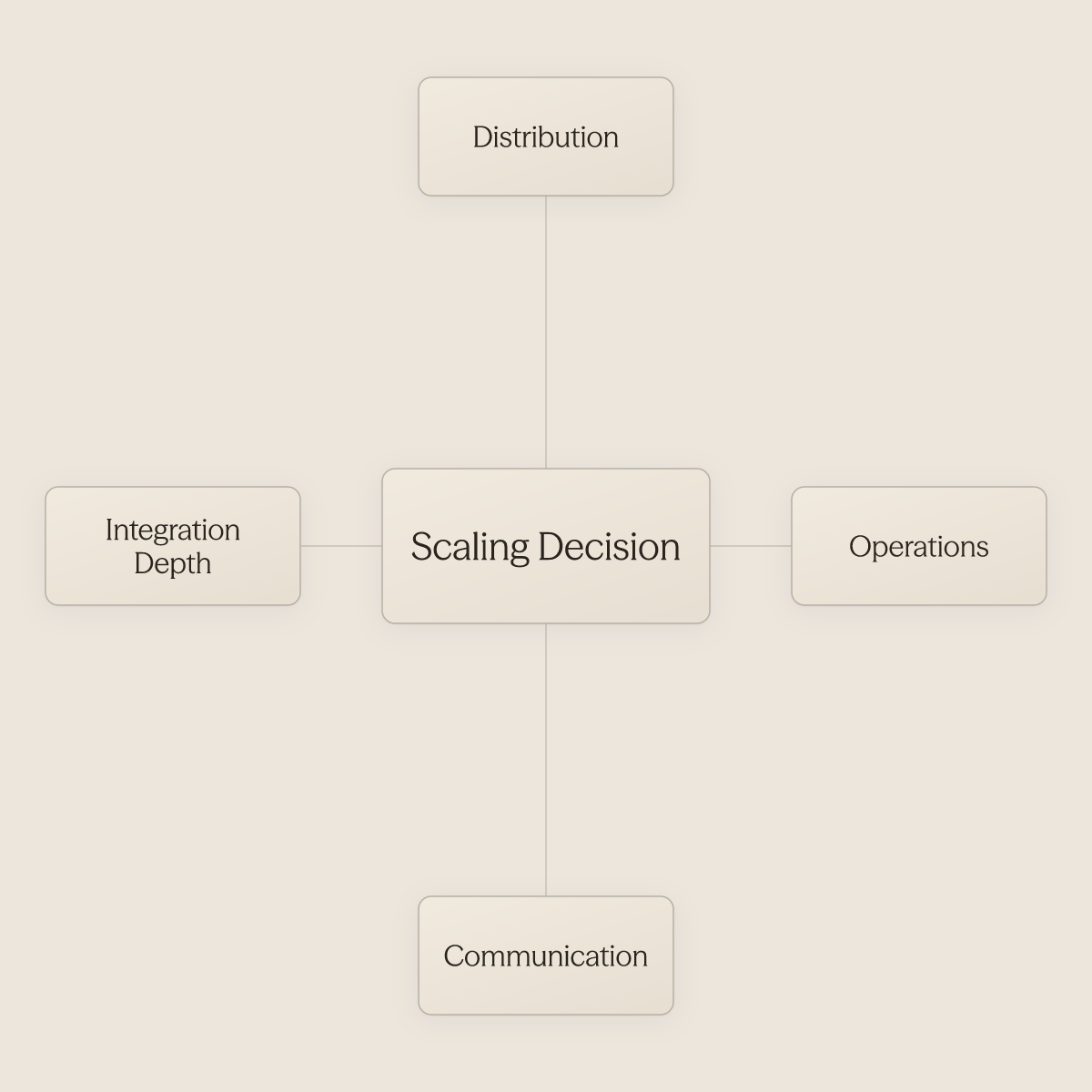
The third, and most consequential for growing portfolios, is communication infrastructure: how guest messages get answered, at what speed, and with what consistency when volume spikes.
Channel Integrations as Table Stakes
Channel manager OTA integrations are no longer a differentiator. Every serious platform on this list connects Airbnb, Vrbo, and Booking.com. The question worth asking is not "does this platform have 60 integrations or 80?" It is what happens after the booking lands. Operators managing 10 or more properties who have prioritised channel integration over communication tooling frequently report that the inbox remains a near-full-time job even after switching platforms, a pattern that surfaces consistently in short-term rental community forums and operator case studies.
Portfolio Size Changes the Decision
The right answer depends on how many properties you manage. A two-property host needs clean channel sync and a sensible direct booking website. A 15-property operator cannot afford to get the communication layer wrong. Industry research consistently shows that full-service property management commands the highest fees in the STR sector, and operator-reported cost breakdowns across industry communities identify guest communication, check-in coordination, and issue resolution as the primary labour-hour sinks, costs that tend to scale with booking volume rather than portfolio size alone.
How to Weigh Automation Depth When Team Bandwidth Is the Real Constraint
If your real constraint is team bandwidth rather than listing distribution, automation depth deserves the heaviest weight in your evaluation. Platforms like conduit.ai address exactly this gap, with AI agents that read from your existing SOPs and FAQs to answer guests accurately across properties simultaneously. Erwan Le Roy, managing 35 properties, reached a 96% AI automation rate using this approach. The honest trade-off is that this layer sits outside most PMS platforms entirely, shifting the evaluation question from "which PMS has the best inbox?" to "which communication layer do I add on top?"
Quick Evaluation Framework: Which Layer Is Actually Your Bottleneck?
| Your primary pain point | Layer to prioritize | Starting platform(s) to evaluate |
|---|---|---|
| OTA sync failures / double bookings | Distribution | OwnerRez, Hostaway |
| Calendar chaos, owner statements, maintenance | Operations | Guesty, Hostfully, Hostaway |
| Inbox overload, slow response times, VA costs | Communication | Conduit.ai (layer on top of any PMS) |
| Rate stagnation, low occupancy vs. market | Revenue management | PriceLabs, Beyond Pricing, Wheelhouse |
| Mixed long-term + short-term portfolio | Unified management | TenantCloud |
Identify which row describes your most acute constraint before you open a single demo call. Optimizing for distribution when your real ceiling is communication is how operators end up repeating the evaluation process 18 months later.
The 13 Best Lodgify Competitors and Alternatives for 2026
Thirteen tools appear on most "Lodgify alternative" shortlists, yet they don't all solve the same problem. Some are full-stack property management systems. Some are revenue-management specialists. And one sits in a category every other tool on this list ignores: the guest communication layer that activates the moment a booking confirms and doesn't stop until checkout. The distinction matters because committing to a migration before identifying which of those three layers is actually your bottleneck is how operators end up with a new platform that replicates the same friction under a different interface.
Pros and cons at a glance
| ✓ Pros | ✗ Cons |
|---|---|
| 60-plus real-time channel connections | Pricing starts at $9/listing but enterprise configurations carry significantly higher costs |
| Native accounting, guest screening, and AI-powered PriceOptimizer | Smaller operators often find the feature depth more than they need |
| Covers more operational surface area than almost any other platform | Onboarding curve reflects the complexity |
1. Conduit.ai - Best AI-Powered Guest Communication for Hospitality Operators
Most operators scanning this list will evaluate each entry on channel count and monthly cost per unit. That's the right question for the calendar layer, but it's the wrong question for what happens next. Every booking triggers a cascade of guest messages, check-in questions, and maintenance pings that consume staff hours at exactly the moment the portfolio is growing fastest.
Conduit's AI agents handle that cascade autonomously, reading from the operator's own SOPs and FAQs to answer guests accurately without human intervention. Erwan Le Roy runs 35 properties at a 96% AI automation rate, not by switching channel managers, but by layering this communication infrastructure on top of his existing PMS. The benefit materializes most clearly when the business receives high volumes of repetitive guest messages and already has documentation, SOPs, FAQs, or guest manuals to train the agents on.
Operators who lack that documentation foundation should build it first; the AI is only as accurate as the source material it reads from. Conduit is not a PMS replacement. Pair it with whichever platform on this list manages your calendars, and the combination becomes genuinely scalable.
2. Guesty - Best Full-Stack PMS for Scaling Property Management Companies
Guesty is best for scaling property management companies that need enterprise-grade features, native payments, and a single platform to manage operations across dozens or hundreds of units. With 60-plus real-time channel connections (boosted by the 2024 acquisition of Rentals United), native accounting, guest screening, and an AI-powered PriceOptimizer, Guesty covers more operational surface area than almost any other platform on this list. Pricing starts at $9 per listing per month, but enterprise configurations carry significantly higher costs. The real trade-off is complexity: smaller operators often find the feature depth more than they need, and the onboarding curve reflects it.
3. Hostaway - Best for Automation-Focused Hosts Who Need Reliable Channel Sync
Hostaway appears frequently in head-to-head Lodgify comparisons, holding approximately 4.8 stars on G2, with reviewers citing customer support and onboarding as recurring strengths. It connects to 300-plus integrations and offers an open API for custom workflows, which suits operators who need deep automation across messaging, tasks, and channel management without building a custom stack. Pricing is quote-based with no public breakdown, so operators who want to model costs before a sales call will need that conversation first. For portfolios beyond 15 properties, the automation depth is usually what makes the call worth booking.
4. Hospitable - Best User-Friendly PMS for Hosts Just Starting to Scale
Hospitable is best for hosts moving from manual management to their first real automation layer. The platform offers three pricing tiers starting at $29 per month, with dynamic pricing included at no extra cost for Host, Professional, and Mogul plan users, a genuine differentiator, since competing platforms charge separately for revenue management add-ons. The AI Copilot, guest summary tool, and MCP server add intelligence that most entry-level PMS tools lack. The honest limitation is scope: operators managing 30-plus properties with complex workflows tend to need more automation depth than Hospitable is built around, and look toward Hostaway or Guesty for that stage.
5. OwnerRez - Best for Data-Driven Property Managers Who Need Advanced Reporting
OwnerRez is best for operators who want maximum control over their data, direct booking infrastructure, and channel connections without paying booking commissions. Base monthly pricing for a one-to-five property portfolio runs $40 to $88, compared to Lodgify's $59 to $147 range for the same portfolio size, making it one of the more cost-competitive options on this list. The platform maintains direct, in-house-built channel partnerships with Airbnb, Vrbo, Booking.com, Google Vacation Rentals, and a wide network of regional OTAs. The trade-off is interface: OwnerRez rewards operators who invest time in configuration, and the learning curve is steeper than Hospitable or Lodgify.
6. Hostfully - Best Versatile PMS for Mid-Size Property Management Companies
Hostfully sits in the mid-market, built for companies managing 10 to 100 units that need more structure than Hospitable provides but less enterprise overhead than Guesty. The platform's guidebook feature and messaging automation are frequently cited as practical differentiators for operators focused on guest experience quality. Pricing is quote-required, putting it in the same category as Hostaway. It's the right operational choice for property management companies that have standardized their processes and need a tool that reflects that maturity, rather than one that forces them to build processes around the software.
7. PriceLabs - Best Standalone Dynamic Pricing Tool for Revenue Maximization
PriceLabs is a dynamic pricing specialist, not a PMS. Independent STR forums and operator community discussions consistently report meaningful revenue lifts, often in the double-digit percentage range, when switching from platform-native pricing tools to dedicated dynamic pricing solutions like PriceLabs, though results vary significantly by market, seasonality, and portfolio mix. The platform pulls market data, competitor rates, and demand signals to adjust nightly rates automatically, and integrates with most major PMS platforms on this list.
The trade-off is an additional subscription and setup investment. Most beneficial for operators managing five or more properties in competitive markets where rate optimization directly moves occupancy.
8. Beyond Pricing - Best Set-and-Forget Revenue Management for Busy Operators
Beyond Pricing is the right pick for operators who want revenue management running in the background without becoming a part-time job. Its automated rate-setting and market data layer integrate cleanly with Hostaway, Guesty, and most major PMS platforms. The trade-off versus PriceLabs is configurability: Beyond Pricing is opinionated by design, which suits operators who do not want to tune rate logic themselves and chafes on those who do. For busy operators managing 10 to 30 properties who want a reliable revenue floor without deep configuration, it delivers.
9. Wheelhouse - Best Dynamic Pricing Tool for Multi-Channel Rate Distribution
Wheelhouse differentiates from PriceLabs and Beyond Pricing on rate distribution breadth, pushing optimized rates across multiple channels simultaneously, which matters most for operators running listings on four or more OTAs at once. The platform's market intelligence layer and portfolio-level reporting give operations leads visibility across the full channel mix. Operators who want the most granular demand-signal customization tend to prefer PriceLabs. Wheelhouse fits multi-channel operators who prioritize distribution consistency over manual rate fine-tuning.
10. AirDNA - Best Market Intelligence and Benchmarking Platform for STR Operators
AirDNA is not a PMS or a pricing tool; it's a market intelligence platform, and that's exactly what makes it useful at a specific stage: evaluating new markets, benchmarking portfolio performance against local competitors, or building the business case for a rate increase. The platform aggregates short-term rental performance data across Airbnb and Vrbo listings globally. AirDNA tells you what the market is doing; it doesn't act on that information. Operators use it alongside a dynamic pricing tool, not instead of one. Most valuable for acquisition-stage decisions and investor reporting rather than day-to-day operations.
11. RoomMaster - Best Hotel Management Software for Independent Hotels Leaving Lodgify
RoomMaster is purpose-built for independent hotels, not vacation rental operators, a narrow but accurate fit for the boutique hotel or inn that landed on a Lodgify comparison page because Lodgify's website builder attracted them, but whose operational needs are fundamentally hotel-shaped. Front desk management, housekeeping workflows, and reservation handling are the core. If you're managing short-term rental units, this is not the right direction. If you're running a 20-room independent hotel and need a PMS with hotel-specific workflows, RoomMaster deserves evaluation.
12. TenantCloud - Best Property Management Software for Landlords Managing Long-Term and Short-Term Rentals
TenantCloud serves landlords who manage a mix of long-term residential leases and short-term rental units under the same operational umbrella, a practical consolidation play for that specific operator. The platform covers lease management, maintenance requests, and tenant communication alongside short-term rental tooling. Operators whose portfolio is primarily short-term rentals will find Hostaway, Guesty, or OwnerRez built more directly around channel management and automation. TenantCloud fits the mixed-portfolio landlord who doesn't want two separate systems.
13. Hostex - Best Lightweight PMS for Hosts Combining Channel Management with Dynamic Pricing Integrations
Hostex is a lightweight PMS covering automated messaging, channel management, multi-calendar synchronization, and direct booking website creation, appealing to hosts who want a single tool without enterprise pricing complexity. Its integration with dynamic pricing tools gives it more revenue management capability than its price point suggests. The trade-off is scale: operators managing 20-plus properties with complex workflows tend to need more than a lightweight PMS is scoped to carry.
Pick it when operational simplicity and cost efficiency matter more than deep automation configurability. The comparison-shopping instinct is to line up these 13 tools on a feature grid and find the best channel count at the lowest per-unit cost. That instinct optimizes for the calendar layer and leaves the guest communication layer, where the real staffing math problem lives at portfolio scale, completely unaddressed.
The operators who solve both problems don't necessarily switch PMS platforms. They add a purpose-built communication infrastructure layer on top of whichever PMS they already trust, so the post-booking workload stops consuming headcount as the portfolio grows. The ranked list above gives you a starting map, but a map isn't a decision.
The next section stress-tests the four alternatives most likely to appear on a serious operator's shortlist against each other, using portfolio size and growth trajectory as the deciding lens rather than feature checklists alone.
Related Reading
- Vrbo Automated Messages
- Lodgify Vs Smoobu
- Guesty Vs Hostfully
- Ownerrez Vs Guesty
- Hospitable Vs Hostaway
- Guesty Vs Hostaway
- Guesty Vs Hospitable
- Guesty Alternatives
Lodgify Direct Competitor Comparisons - How the Top Four Stack Up
That stress-test starts with a premise most comparison guides skip: the right alternative isn't the one with the longest feature list, it's the one whose cost structure and operational ceiling match where your portfolio is today and where it will be in eighteen months. The feature checklist gets you to a shortlist. What you do with that shortlist determines whether your operation scales cleanly or grinds to a halt at 20 properties.
The real question isn't which platform checks the most boxes today, it's which platform stops being the answer first, and why. The underappreciated trap in any PMS switch is that solving the channel management problem does not automatically solve the communication bottleneck. PMS platforms, including well-regarded options like Hostaway, are engineered for booking operations, not for the real-time, cross-channel response cadences that OTA algorithms reward.
Operators who switch PMS without separately addressing guest communication infrastructure often find they have traded one ceiling for a structurally similar one.
Matching Each Alternative to Where You're Going
Most operators evaluate PMS platforms against their current property count. That's the wrong frame. A platform that handles 8 properties smoothly can become a coordination nightmare at 25, not because it breaks, but because the workflows it was designed for don't compound well.
The smarter filter: does this platform's automation depth grow with the portfolio, or does it add more manual steps at higher volume? There is a second, less-discussed friction point that compounds this scaling problem: dynamic pricing stack misalignment. When Lodgify sits as a middleware layer between a tool like PriceLabs and Airbnb or VRBO, it can introduce a price markup, for example, a 15% uplift, that the pricing tool has no visibility into.
The practical consequence is that neighborhood competitor comparisons become structurally inaccurate, because the rate your guests see is not the rate your pricing logic thinks it set. For operators managing dynamic pricing across stacked tools, that invisible markup is an operational liability that compounds at volume, not one that resolves itself through better channel management alone.
Hostaway vs. Lodgify - Integration Depth and Support Infrastructure at Scale
Hostaway's core advantage is granular channel control. Its platform distinguishes between connected, mapped, and disconnected states for every listing-channel pairing, visibility that Lodgify's website-builder-centric architecture doesn't replicate at scale. The trade-off: Hostaway's onboarding curve is steeper, and the pricing reflects an operator who needs that infrastructure, not one managing three listings.
That channel-management depth matters most when your booking surface spans multiple OTAs simultaneously, a scenario Hostaway's integration architecture is explicitly designed to support. But even a well-connected channel stack leaves the guest communication layer unresolved. Operators who migrate to Hostaway for its listing-state granularity and then discover their inbox volume has scaled proportionally are facing a predictable gap: Hostaway controls where bookings come from; it does not automate what happens in the conversation thread after they arrive.
This is where a purpose-built guest communication layer becomes operationally relevant. AI Agents are most beneficial precisely when a business receives a high volume of repetitive guest messages and already has existing documentation, SOPs, FAQs, and property manuals that can be used to train the agent. Integrations with tools like Notion, Google Drive, and Airbnb mean that existing content can be leveraged without manual re-entry, so the setup overhead that typically delays automation is removed.
The first automated guest reply can go live within days of connecting those materials, not weeks.
Guesty vs. Lodgify - Enterprise Feature Set vs. Upfront Pricing Simplicity
Guesty is built for operators who have already crossed into complexity: multi-brand portfolios, dedicated ops teams, and revenue management requirements beyond a single channel. Guesty's enterprise tiers are custom-quoted, with entry-point pricing consistently sitting well above Lodgify's published rates. For an operator at 5 properties, that opacity is a friction point. For an operator at 40, the feature depth justifies the conversation. Guesty is not the right fit if you want pricing clarity before a sales call.
Small-scale hosts, particularly those migrating from Guesty for Hosts (formerly Your Porter), consistently find that Lodgify's cost sits above alternatives like Guesty Lite, which creates a real cost barrier when you are managing only one or two properties. The honest framing: for operators at that scale, neither Guesty's enterprise pricing nor Lodgify's mid-market rates are structured to minimize cost. The decision at 1–5 properties is less about feature depth and more about which cost structure you are willing to carry while you grow into the tooling.
Hospitable.com vs. Lodgify - Automation-First Design for the Mid-Market Operator
Hospitable.com was built around one premise: most guest messages are predictable, and predictable messages should never require a human. Its automated messaging sequences handle pre-arrival, check-in, and post-stay communication without manual triggers. Hospitable.com offers a practical middle path: its automated messaging sequences handle the most predictable guest touchpoints without requiring the configuration overhead of an enterprise PMS.
The honest boundary is that operators approaching 30 or more properties with complex multi-brand workflows tend to need more automation depth than Hospitable is scoped for, at which point Hostaway or Guesty fits the stage better. What Hospitable.com's model validates, and what holds true regardless of which PMS anchor you choose, is that the recurring, predictable nature of guest communication is a systems problem, not a staffing problem. Workflows are built on exactly that insight: they fire after a trigger event occurs in a conversation or guest lifecycle, after a booking is confirmed, after check-in, or when a specific keyword is detected, removing the manual staff action that would otherwise be required at each of those touchpoints.
Using the Inbox to monitor and review conversations the AI agent is handling, the result is a communication layer that scales with the portfolio rather than adding headcount linearly with property count.
The Communication Gap No Lodgify Competitor Fixes on Its Own
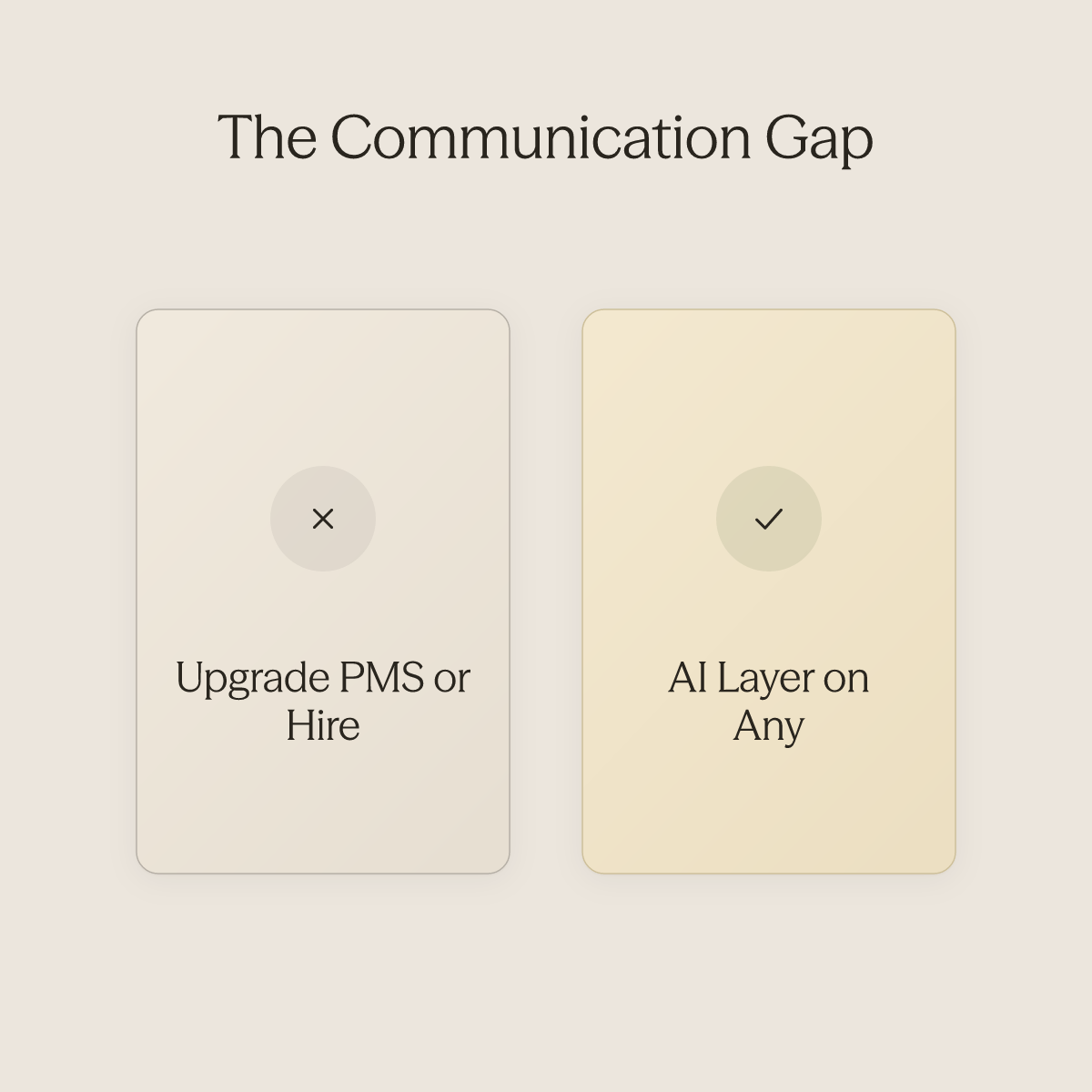
Every PMS comparison eventually narrows to the same variables: pricing, channel sync, and reservation management. What those comparisons consistently skip is the communication layer that sits on top of any platform you choose, and how that layer quietly determines whether a growing portfolio stays manageable or starts breaking down. This section makes that gap visible and explains why fixing it does not require switching software.
Why Guest Messaging Is the Invisible Variable in Every PMS Decision
Every PMS on this shortlist solves the same problem well: getting bookings into your calendar and syncing availability across OTAs. What none of them solve is what happens the moment a guest sends a message at 11 PM asking about the Wi-Fi password, early check-in, or a broken appliance. That gap is structural, and it compounds with every property you add.
The critical insight the PMS comparison market consistently ignores is this: because AI-powered guest communication tools operate as a PMS-agnostic layer, an operator can convert Lodgify's weak built-in inbox into a 24/7 autonomous channel without switching platforms, collapsing the false binary between "upgrade your PMS" and "hire more staff" that competitor comparisons are built around. Lodgify's reporting depth is a recognized weak spot for complex operations; as a portfolio scales, hosts consistently find they outgrow its communication and operational visibility long before they outgrow its calendar-sync functionality. The messaging gap arrives first.
Why Guest Messaging Breaks Down at 10+ Properties Regardless of Which PMS You Use
Airbnb, Vrbo, and Booking.com each treat response rate and response speed as direct inputs into search ranking algorithms, a dynamic that holds regardless of which channel manager sits underneath, and that grows harder to sustain manually as portfolio volume increases. As a portfolio grows, maintaining fast and consistent manual responses becomes structurally unsustainable. The guest still expects a reply in minutes, not hours. Eliminating the operational bottleneck of around-the-clock guest communication is not a staffing problem with a staffing solution, it is an infrastructure decision that determines whether your listings remain algorithmically competitive at scale.
The Hidden Staffing Cost Buried Inside Every PMS Comparison
The familiar approach is hiring a VA, writing templated replies, and hoping the team holds together as the portfolio scales. The hidden cost is that the majority of inbound guest messages, check-in instructions, Wi-Fi credentials, parking details, early checkout requests, are repetitive by nature, consuming the same finite team hours that could otherwise go toward guest experience, owner relations, or revenue decisions. Darren at Easy BnB scaled to 14 virtual assistants and found that even a strong, committed team couldn't structurally keep pace with inbox volume at scale, the bottleneck was the architecture of manual response workflows, not the capability of the people handling them. His conclusion was direct: "We all agree that AI first is the best approach."
What that shift looks like in practice is an AI Agent trained on your existing SOPs, FAQs, and property manuals, documentation most operators already have sitting in Notion, Google Drive, or a shared folder. Conduit.ai's Integrations pull that content in without manual re-entry, and the agent is handling its first automated guest reply within days of connecting those materials. From that point forward, it responds continuously, before, during, and after a stay, every time a guest sends a message, across every platform simultaneously. The operations team doesn't disappear; they move into Conduit.ai's Inbox to monitor, review, and manage the conversations the AI is handling, rather than racing to answer each one individually.
From 57-Minute Response Times to 2 Minutes - What a Purpose-Built AI Layer Actually Produces
Fast response times boost bookings by 116% for short-term rentals, a relationship OTA platforms reinforce through algorithmic ranking boosts for high-response-rate listings. Faster replies don't just improve guest experience and review scores through timely, consistent communication; they directly influence which listings surface first in search results. The gap between a 57-minute average and a 2-minute reply is not a staffing upgrade; it is an infrastructure decision.
Conduit's Workflows extend that infrastructure beyond reactive replies. After a booking is confirmed, after check-in, or when a specific keyword appears in a conversation, automated touchpoints trigger without any manual staff action, turning the recurring, predictable moments of every guest lifecycle into consistent communication that scales as the portfolio does, not against it.
Related Reading
- Vacation Rental Automation
- Best Pms For Short Term Rentals
- How To Manage A Vacation Rental Property
- Vrbo Smart Pricing
- How To Automate Airbnb Business
- Airbnb Self Check In
- Vrbo Management
- Best Apps For Short Term Rentals
- Best Pms For Airbnb
- Best Accounting Software For Short Term Rentals
Next steps
If your team's day is disappearing into inbox triage as your portfolio grows past 10 properties, the path forward starts with recognizing that no PMS on this list closes that gap by default. Switching to Hostaway or Guesty solves the channel management problem. It does not solve the communication bottleneck, because the two problems live on different layers of your operation. Start with our AI for hospitality.
The comparison-shopping framework most operators use, weighing channel count, automation depth, and per-unit pricing, systematically ignores guest communication infrastructure as a cost driver. That oversight is how operators pay migration costs to solve the wrong bottleneck. At the same time, because purpose-built AI communication tools operate as a PMS-agnostic layer, the decision to automate guest messaging is structurally independent from whichever PMS you choose or keep. Together, those two facts point to one practical action: add a dedicated communication layer before, during, or after any PMS decision, not instead of one.
Start with Conduit's AI for hospitality. Connect your existing SOPs, FAQs, and property manuals, and the AI agents begin handling repetitive guest messages across every channel within days, without a platform migration and without adding headcount proportional to your property count.
Frequently Asked Questions
Why are property managers looking for Lodgify alternatives in the first place?
Most operators leave Lodgify not because it's broken, but because they've outgrown it. Lodgify was purpose-built for independent hosts who want a clean direct-booking website and simple channel management, and community-reported friction clusters around three specific pain points: calendar sync failures across OTA channels, limited automation for guest communication, and slow customer support response times. These issues are manageable at two or three properties, but at ten or fifteen, a single sync failure can produce a double booking and a 48-hour support queue becomes an operational liability.
How does Lodgify compare to OwnerRez on price?
OwnerRez is one of the more cost-competitive options on this list. Base monthly pricing for a one-to-five property portfolio runs $40 to $88, compared to Lodgify's $59 to $147 range for the same portfolio size. The trade-off is interface: OwnerRez rewards operators who invest time in configuration, and the learning curve is steeper than Lodgify or Hospitable.
How does Lodgify compare to Hospitable for someone just starting to scale?
Hospitable is best for hosts moving from manual management to their first real automation layer, with pricing starting at $29 per month and dynamic pricing included at no extra cost, a genuine differentiator since competing platforms charge separately for revenue management add-ons. Like Lodgify, it suits smaller portfolios well, but operators managing 30-plus properties with complex workflows tend to outgrow Hospitable's automation depth and look toward platforms like Hostaway or Guesty for the next stage.
I've already switched PMS platforms once and still feel buried in guest messages, what am I missing?
The layer most buyers forget to shop entirely is communication infrastructure: how guest messages get answered, at what speed, and with what consistency when volume spikes. Operators who have prioritized channel integration over communication tooling frequently report that the inbox remains a near-full-time job even after switching platforms. Conduit's AI agents address exactly this gap, reading from your existing SOPs and FAQs to answer guests accurately without human intervention, Erwan Le Roy, managing 35 properties, reached a 96% AI automation rate by layering this communication infrastructure on top of his existing PMS rather than switching channel managers.
How does Lodgify compare to Guesty for larger property management companies?
Guesty covers a wider operational surface area than Lodgify, with 60-plus real-time channel connections, native accounting, guest screening, and an AI-powered PriceOptimizer, which suits scaling property management companies that need enterprise-grade features across dozens or hundreds of units. The real trade-off is complexity: smaller operators often find that feature depth more than they need, and the onboarding curve reflects it, while Lodgify's simpler architecture is scoped to earlier stages.
Stay in the loop
Get the latest on AI automation, product updates, and customer stories.

