Lodgify vs Smoobu: How They Compare for Hosts in 2026


Lodgify vs Smoobu
How they compare for hosts in 2026
Both platforms solve your distribution problem. Neither solves what breaks next. Here is where Lodgify and Smoobu actually differ, and what hosts scaling past five properties consistently get wrong about this choice.
Most vacation rental property managers and operations leads think that picking the right PMS/channel manager is the structural fix for operations, that if they choose correctly between Lodgify and Smoobu, their workflow bottlenecks will clear up. That diligence is worth respecting. But there's a framing problem baked into the comparison itself.
Both platforms are, at their core, distribution-layer tools. They connect listings to OTAs, sync calendars, and help bookings land. Lodgify layers on a website builder for direct bookings; Smoobu leans into simplicity and affordability.
See our AI for hospitality for how this works in practice.
What neither platform addresses is the operational load that begins the moment a booking confirms, a gap that compounds with every listing added. Hosts building toward a scalable guest communication operation tend to discover this ceiling only after committing to one tool. Lodgify, founded in 2012 in Barcelona, built its identity around OTA independence, a direct-booking-first philosophy backed by a website builder, booking engine, and channel manager in one package.
Smoobu, founded in 2014, made a different bet: that most hosts want simplicity over breadth. It positioned itself as a lower-friction entry point, particularly for European operators and smaller portfolios. The 5-to-15 property range is where this comparison gets urgent.
Below five units, almost any tool works. Above fifteen, operational gaps become expensive. The middle band is where hosts feel the pressure most acutely: too many listings to manage manually, not enough volume to justify enterprise tooling.
What hosts consistently underestimate is that communication volume scaling alongside those listings doesn't get solved by either platform. The Lodgify vs. Smoobu decision is fundamentally a question about booking source strategy.
Lodgify suits hosts who want to reduce OTA dependency and build a direct booking brand.
Key takeaways
- Lodgify and Smoobu solve a distribution problem, OTA sync, calendar management, direct booking infrastructure, not an operations problem.
- Lodgify fits hosts prioritizing direct bookings and a built-in website; Smoobu fits lean operators who want multi-channel management without the overhead.
- Pricing looks comparable on the surface, but the true cost-to-value ratio for both platforms only becomes visible after you've committed to a plan.
- Lodgify offers 24/7 support on qualifying plans; Smoobu caps you at CET business hours, a structural difference that matters the moment something breaks at 2am.
- Neither platform was built to handle guest communication once the booking lands. Templates fire, but no one answers the 1am lockout message or follows up on an unanswered inquiry.
- Operators scaling past 10 properties consistently hit the same wall: the channel manager runs fine and the inbox is still a disaster at 11pm.
- conduit.ai's AI Agents close that gap by handling guest conversations autonomously, reading from your own SOPs, manuals, and FAQs to answer accurately across channels, without human intervention, regardless of which platform sits underneath.
Lodgify vs Smoobu Feature Comparison - Where Each Platform Focuses
That operational gap does not close by picking the right platform. Both Lodgify and Smoobu solve real distribution problems, but they solve different ones, for different operators, at different stages of portfolio growth. Getting the comparison right means evaluating each dimension separately rather than hunting for a single answer.
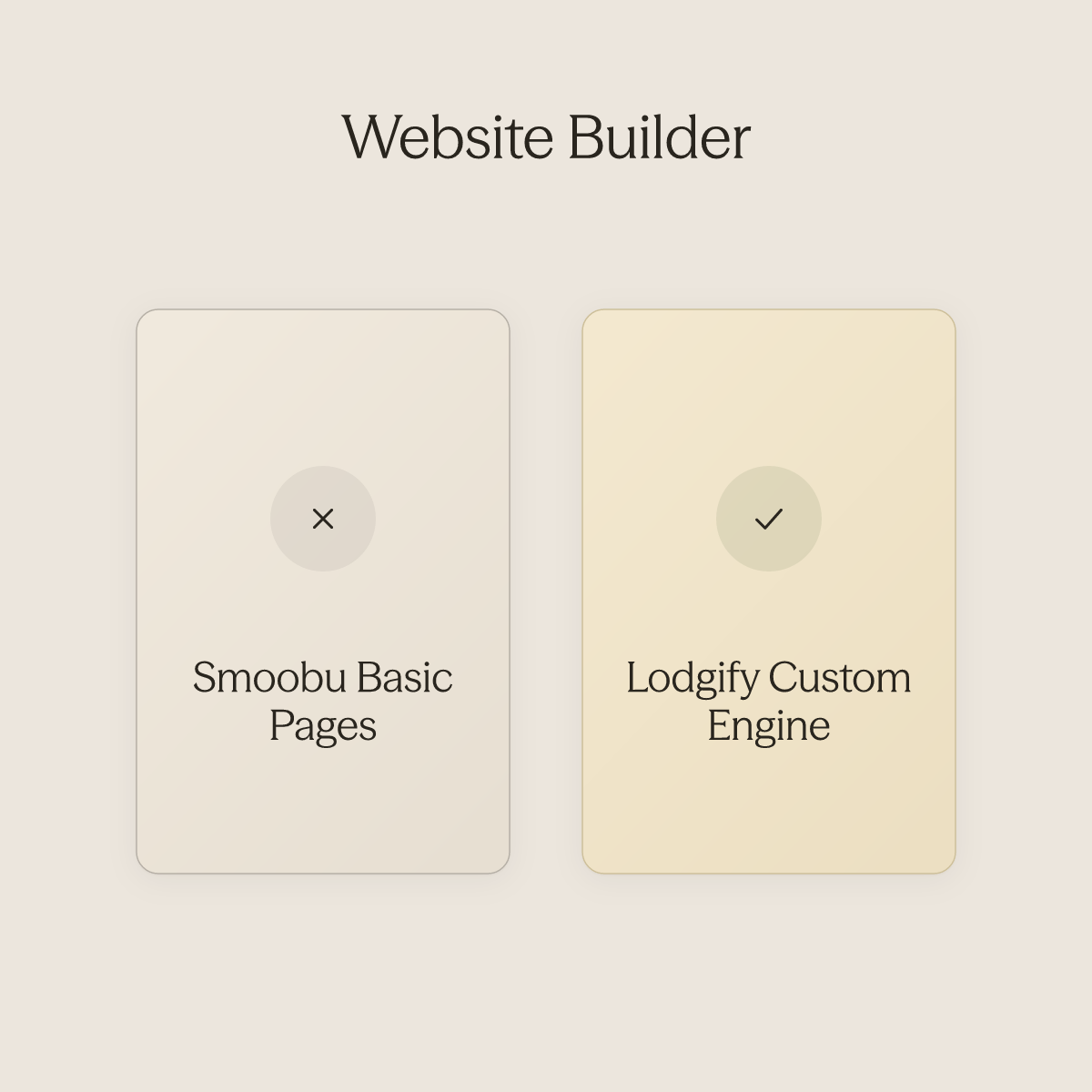
Website Builder - Lodgify's Polished, Customizable Engine vs Smoobu's Functional-but-Basic Pages
"I've found that gap night management on my platform is too limited, certain nights end up unsellable, which is a real functional gap compared to what hosts actually need."
Lodgify's website builder is meaningfully more capable than Smoobu's for hosts who want a direct booking channel that competes visually with OTA listings. Lodgify offers drag-and-drop customization, custom domain support, and an integrated booking engine that converts visitors without redirecting them to a third-party platform. Smoobu's booking pages are functional for calendar display and reservation capture, but customization is limited.
For anyone building brand equity around a portfolio, Smoobu's pages feel like a placeholder rather than a destination. One friction point worth naming for French operators specifically: Lodgify is perceived as less turnkey for French fiscal requirements, taxe de séjour, LMNP status, and loi Le Meur compliance, compared to local alternatives like SuperHote. Hosts in France weighing Lodgify against Smoobu or a regional tool should factor that compliance overhead into the setup cost, because the website builder advantage does not eliminate the administrative gap.
Ease of Setup - Why Smoobu Gets Beginners Live Faster While Lodgify's Onboarding Demands More
Smoobu is easier to set up. Most hosts connect their first OTA channel within hours of signing up. Lodgify's broader feature set, particularly the website builder and booking engine configuration, introduces more decisions upfront.
Lodgify's setup investment pays off later, when direct booking traffic and integration depth start compounding. Smoobu's faster start is most valuable for hosts who want to test the market quickly or manage a small portfolio without dedicated operations staff. What neither platform fully solves at setup is the guest communication load that scales with the portfolio.
Conduit consistently identifies this as the first thing that stops being manageable as properties multiply. Conduit's AI Agents are most beneficial precisely when a business receives a high volume of repetitive guest messages and already has documentation, SOPs, FAQs, property manuals, to train on. Once those materials are connected, the first automated guest reply is live within days, handling inquiries before, during, and after a stay without manual intervention.
Channel Syncing and Integrations - Lodgify's Reliability Edge and Google Vacation Rentals Advantage
Lodgify connects to over 60 channels and third-party tools, and integrates with Google Vacation Rentals, which surfaces listings directly in Google Search and Maps, a structural advantage over relying solely on OTA traffic. Smoobu's channel sync is reliable for the platforms it covers, but its integration library is narrower. Hosts managing dynamic pricing engines, CRM systems, or multiple software tools will find Lodgify's integration library covers more of that stack.
One practical constraint Smoobu users encounter is gap night management: the platform has restrictions around selling certain nights between bookings. For hosts running tighter calendars across multiple properties, that matters more as occupancy climbs. Conduit's Integrations layer is designed for exactly this multi-tool environment, most beneficial when a business already uses tools like Notion, Google Drive, or Airbnb and wants an AI agent to leverage existing content without manual re-entry.
Rather than duplicating information across platforms, the agent pulls from documentation already in place, keeping operations coherent as the channel stack grows.
OTA Coverage by Geography - Where Smoobu's European Network Runs Deep
Smoobu's European OTA coverage is a genuine differentiator for hosts with inventory in Germany, Austria, Switzerland, or France. The platform connects directly with Booking.com, HomeToGo, and FeWo-direkt via both API and iCal, giving European operators channel depth that Lodgify does not fully replicate at the regional level. Those direct relationships reduce the manual iCal workarounds that can introduce sync delays.
Mobile App Experience - Smoobu's On-the-Go Interface vs Lodgify's Desktop-First Design
Smoobu's mobile app is built for hosts who manage properties without a dedicated office setup, a pattern reflected in user reviews on G2, where Smoobu rates higher than Lodgify on mobile usability. Lodgify offers iOS and Android apps, but its design roots are desktop-first. For a solo operator or small team managing properties across multiple locations, that difference shows up daily.
Where the mobile gap bites hardest is guest communications: monitoring and responding to conversations across multiple platforms or properties simultaneously from a phone is exactly the scenario where a unified inbox with AI support matters most. Conduit's Inbox is most beneficial in this context, giving operations and support teams a single place to monitor, review, and manage every conversation the AI agent is handling, so that no message falls through the gap regardless of which channel it arrived on or which device the host is using.
Pricing Comparison - Which Platform Is More Affordable and What Do You Actually Get?
Subscription fees are easy to compare. What they unlock is harder to see until you're already committed to a plan and watching your calendar fill, or not fill, based on decisions you made months ago. One of the quieter frustrations hosts encounter when evaluating tools in this space is opaque pricing, where the true cost-to-value ratio only becomes clear after you've signed up, not before. That evaluation gap matters more than most operators realize when they're choosing between platforms.
Image: Side-by-side comparison of opaque pricing versus a flat predictable subscription model
Smoobu Is the More Affordable Platform, Here's What That Actually Buys You
Smoobu is the more affordable option, full stop. According to Smoobu's pricing page, paid plans start at approximately €29 per month, structured as flat monthly subscriptions with no commission charged on bookings across any paid tier. For a host managing three to five properties on tight margins, that predictability matters. You know your cost before the month starts, regardless of how many bookings land.
Smoobu's pricing scales by property count and feature access, not by revenue generated, making it optimal for lean operators who don't need a direct booking engine as a growth lever yet. The no-commission model is a structural advantage for anyone whose bookings flow primarily through OTAs rather than a branded website. What that flat fee doesn't buy, though, is the operational infrastructure that keeps guest communication from becoming a headcount problem as you scale.
A host growing from five to fifteen properties quickly discovers that more properties means more messages, check-in questions, lockout calls, cleaning issues, and complaints. Without automation layered on top, those messages translate directly into staff hours. The tool cost stays flat; the labor cost doesn't.
Lodgify's Higher Cost and the 0.8% Dynamic Pricing Commission
Lodgify's entry-level plans run higher than Smoobu's equivalent tiers, and the gap widens at mid and growth stages. The detail that catches hosts off guard is the 0.8% commission Lodgify charges on dynamic pricing bookings, applied specifically when hosts use Lodgify's dynamic pricing feature rather than setting static rates. For a property generating $4,000 per month in direct booking revenue, that adds $32 per month on top of the subscription fee, compounding as revenue grows. Hosts who set fixed rates avoid it entirely. The honest read: Lodgify's cost structure rewards hosts who generate enough direct booking volume to justify the higher base fee plus commission, and penalizes those who pay for the tier without activating the revenue upside.
When Lodgify's Higher Price Tag Pays for Itself (and When It Doesn't)
Lodgify's higher cost pays for itself when direct bookings represent a meaningful share of your revenue mix. For a 20-property operator generating $15,000 per month in direct bookings, even a modest conversion improvement from Lodgify's booking engine can dwarf a $60 to $80 monthly subscription difference. It pays less for operators who rely entirely on OTAs, or for anyone in the first year of building a portfolio who hasn't yet established direct booking demand.
In those cases, Smoobu's flat, no-commission structure is the more defensible choice. The more important variable, however, is what happens operationally once bookings arrive, regardless of which platform generated them. Haven's experience illustrates this clearly: at 270 properties, their team needed roughly 25 support staff across multiple shifts just to handle check-in questions, lockouts, cleaning issues, and complaints. Conduit was installed during that period but ran at only 40% automation with no workflows and a minimal knowledge base, enough to reduce message volume at the margins, but not enough to change how the team actually operated.
Growth still meant more messages, more calls, and more hiring. The platform subscription cost was never the binding constraint; the guest communication load was. That's the cost dimension that neither Smoobu's pricing page nor Lodgify's commission structure surfaces.
Conduit's AI Agents are most beneficial precisely when a business receives a high volume of repetitive guest messages and already has documentation, SOPs, FAQs, property manuals, to train the agent on. Connected to those sources through Integrations that pull from tools like Notion, Google Drive, or Airbnb without manual re-entry, and paired with Workflows that trigger automatically after booking confirmation, check-in, or a detected keyword, the first automated guest reply typically goes live within days. The result isn't a cheaper subscription; it's getting off the 24/7 on-call treadmill and back to growing the portfolio, which is the margin that a flat €29 or a dynamic-pricing commission can't account for on its own.
40% Automation rate with minimal setup
270 Properties needing 25 support staff
Channel Manager Capabilities and OTA Support - Which Platform Connects You to More Guests?
Your channel manager determines which guests can even find your properties, making it one of the highest-leverage decisions in your distribution stack. Both Lodgify and Smoobu cover the core OTAs that drive the bulk of vacation rental bookings, but the meaningful differences emerge at the edges: Google Vacation Rentals access, European platform depth, and how each platform's reach maps to where your portfolio actually operates. What follows breaks down exactly where each platform concentrates its reach and why that matters before you commit to one.
Both Platforms Cover the Big Three OTAs
Both Lodgify and Smoobu connect to Airbnb, Booking.com, and VRBO/Expedia with two-way calendar sync, confirming baseline parity on the channels that drive the majority of vacation rental bookings globally. The real comparison starts at the edges of that shared foundation, and that foundation matters more than most operators realize at the outset, because switching channel managers mid-portfolio is genuinely disruptive. The initial choice carries long-tail consequences, making it worth evaluating both platforms against your actual distribution strategy before you commit.
Where Lodgify Pulls Ahead on Channels
Lodgify extends its reach through a broader third-party integration library and, critically, a Google Vacation Rentals connection that Smoobu does not match. Google Vacation Rentals surfaces listings directly in Google Search and Maps, giving properties incremental visibility outside traditional OTA discovery. For hosts building a North American portfolio or prioritizing direct booking traffic, that additional surface area is a structural distribution advantage. Across the market, this broader channel footprint is one of its clearest differentiators against competitors operating in the same segment.
Where Smoobu Goes Deep on European OTAs
Smoobu's edge is geographic. Its deeper connections to European platforms, including FeWo-direkt and Atraveo, give EU-concentrated operators coverage that Lodgify's library does not replicate at the same depth. A host managing properties across Germany, Austria, or Spain will find Smoobu's channel roster more relevant than Lodgify's broader but North American-weighted library.
Direct Bookings as a Structural Channel
Lodgify's built-in website builder creates a genuine direct booking channel, letting operators capture commission-free reservations without full OTA dependency. What most teams report is that direct bookings now represent a growing share of total vacation rental revenue, making this a revenue-mix decision rather than a feature checkbox. Smoobu does not include a comparable native website tool, which is a real trade-off for any host actively reducing OTA commission exposure and building a channel mix they fully control.
Two-Way Sync and the Post-Booking Gap
Reliable two-way channel sync prevents double-bookings across platforms, and both tools handle this competently for multi-property operators. Airbnb, Booking.com, VRBO, and any direct-booking surface each generate guest conversations, and neither platform handles those conversations once the reservation is confirmed. That is the coordination layer where Conduit closes the gap.
Conduit's AI Agents are most valuable precisely at this stage: when a business receives a high volume of repetitive guest messages and already has existing documentation, SOPs, FAQs, property manuals, to train the agent on. An operator or ops lead connects those docs directly; no IT involvement is needed. From there, Conduit can deliver the first automated guest reply within days of setup, and it runs continuously, before, during, and after a stay, so no inquiry leaks revenue regardless of the hour or the channel it arrives from.
What operators notice first is not the speed, it is the quality. Mayra, Global Head of Customer Experience at Wynwood House, put it directly: "The first thing we noticed was the quality of the AI replies. You cannot tell the difference between an AI agent and a human agent. I work with ChatGPT and other AI tools every day, and sometimes you can immediately tell it's AI. With Conduit, we're not seeing that."
For a team managing guests across Airbnb, Booking.com, and a direct-booking site simultaneously, that conversational quality is what makes the layer feel seamless rather than mechanical.
Conduit's Inbox gives the ops team a single place to monitor, review, and manage every conversation the AI agent is handling, across all platforms, at once. Channel selection determines which guests find you. What happens after they do is a separate operational problem, and it is one that scales directly with the breadth of the distribution footprint you choose.
The first thing we noticed was the quality of the AI replies. You cannot tell the difference between an AI agent and a human agent.
Related Reading
- Vacation Rental Automation
- Best Pms For Short Term Rentals
- How To Manage A Vacation Rental Property
- Vrbo Smart Pricing
- How To Automate Airbnb Business
- Airbnb Self Check In
- Vrbo Management
- Best Apps For Short Term Rentals
- Best Pms For Airbnb
- Best Accounting Software For Short Term Rentals
Customer Support and Reputation - Which Platform Has Your Back When It Matters?
Support availability feels like a minor detail until it isn't. The moment a guest is locked out at 2am and your calendar shows a sync error, the only thing that matters is whether someone picks up.
Lodgify Offers 24/7 Support on Qualifying Plans, Smoobu Caps You at CET Business Hours
Lodgify's 24/7 phone and live chat support is gated by plan tier; Basic and Starter plans receive email-only or limited human support, while Professional and Ultimate plans unlock phone access and priority response, according to an analysis of over 4,800 Lodgify reviews. Smoobu's support operates during CET business hours, full stop. For hosts in US Mountain Time or APAC time zones, that window closes well before the evening check-in rush begins.
A US Mountain Time host who spots a calendar sync error at 9pm has already missed Smoobu's support window by several hours. The cost is not just frustration; it is a guest at the door with no resolution path and a review score at risk. That pressure is structural, not occasional, and it compounds as portfolio size grows.
Synchronization bugs in particular tend to surface at the worst possible moments, and slow or inaccessible vendor support turns a solvable technical hiccup into a guest experience failure. Support flows that authenticate callers by listing number can also leave a brand-new account without a route in before its listings are imported. These are structural friction points in how platform support is designed, not edge cases.
Smoobu is a legitimate, well-regarded platform with a strong track record, particularly among European operators and budget-conscious hosts. The honest trade-off: if your portfolio spans US or APAC time zones and you need a live human when something breaks overnight, Smoobu's CET window is a genuine operational constraint worth pricing into your decision. The deeper issue both platforms share is that their support teams answer your questions, not your guests' messages.
A host managing 15 properties across multiple OTAs is fielding a high volume of repetitive guest messages, check-in instructions, WiFi passwords, early check-out requests, parking questions, that arrive continuously before, during, and after every stay. That volume does not pause because Smoobu's support window is closed or because you are on hold with Lodgify. This is where an AI-powered inbox and agent layer is most valuable.
The Inbox is built for operations teams managing guest communications across multiple platforms and properties simultaneously, a single place to monitor, review, and manage every conversation the AI agent is handling. The AI Agents themselves are trained on your existing SOPs, FAQs, and property manuals, and begin delivering automated guest replies within days of connecting that documentation. They respond continuously, before a booking, during a stay, after check-out, so the overnight gap in vendor support never becomes a gap in guest communication.
Workflows extend this further: triggered automatically after a booking is confirmed, after check-in, or when a specific keyword appears, they handle the recurring, predictable touchpoints that currently require a staff member to act manually. The practical outcome is that portfolio expansion no longer requires proportional growth in support headcount, the operational load of guest messaging scales without adding people to absorb it.
Which Platform Should You Choose Based on Your Business Needs?
There is no single answer in the Lodgify vs Smoobu debate. The right answer depends entirely on your operational profile: your portfolio size, your revenue goals, and whether direct bookings or lean multi-channel management is your primary growth lever.
Quick-Decision Checklist - Lodgify or Smoobu?
Work through each criterion and tally your answers:
| Decision Criterion | Lodgify | Smoobu |
|---|---|---|
| Portfolio size | 10+ properties | Fewer than 10 properties |
| Primary booking source | Direct bookings / Google | OTAs only |
| Geographic focus | North America / global | Europe-heavy (DE, AT, CH, FR) |
| Direct booking revenue target | 20–30%+ of total revenue | Not a current priority |
| Budget tolerance | Higher monthly fee acceptable | Flat, low-cost subscription preferred |
| Setup investment | Willing to invest time upfront | Need to be live within hours |
| Mobile-first management | Primarily desktop / office | Frequently on the go |
| 24/7 support need | Yes, US/APAC time zones | No, CET hours sufficient |
Scoring: If 5 or more rows point to Lodgify, Lodgify is your fit. If 5 or more rows point to Smoobu, start there. A 4–4 split almost always resolves on portfolio size: fewer than 10 properties, go Smoobu; 10 or more, go Lodgify.
Choose Lodgify for Direct Bookings and Integration Depth
Lodgify fits if you are actively building direct booking revenue and want a credible, bookable website to reduce OTA commission dependency. Hosts managing 10 or more listings who are targeting 20 to 30 percent of revenue from direct channels will find Lodgify's booking engine, Google Vacation Rentals integration, and owner reporting automation worth the higher price. The platform is purpose-built for managers who want to scale without operational chaos.
Choose Smoobu for Budget-Conscious or EU-Heavy Portfolios
Smoobu is built around simplicity and a lower price point. If you are managing fewer than 10 properties, running a lean operation, or holding inventory concentrated across European OTAs, Smoobu's pricing and gentler onboarding curve make it a natural fit for your stage. A solo host with 3 properties and a tight budget may not need Lodgify's depth yet.
Portfolio Size as the Final Tiebreaker
In our experience, hosts typically outgrow entry-level tools around 10 to 15 properties, not because features run out, but because coordination complexity multiplies. At that threshold, Lodgify's centralized operations and reporting infrastructure justify the investment.
Decision Matrix - Which Platform Fits Your Operation at a Glance
Neither platform is the right choice if your primary bottleneck is guest communication volume. Whichever tool you pick, the operational layer that handles guest messaging sits entirely outside both platforms and grows heavier with every listing you add. Once the booking lands in whichever platform you chose, a new operational clock starts ticking, one that has nothing to do with channel management. The next section names the gap both platforms leave open, and why it grows faster than your portfolio does.
The Gap Neither Lodgify Nor Smoobu Closes - Guest Communication at Scale
Pick the right channel manager and the distribution problem is solved. The calendar syncs, the OTAs update, the direct booking engine runs. Most vacation rental property managers and operations leads think that picking the right PMS or channel manager is the structural fix for operations, that if they choose correctly between Lodgify and Smoobu, their workflow bottlenecks will clear up. What the comparison charts never show you is what's waiting on the other side: a communication queue that grows with every booking, every property, and every guest who has a question at an inconvenient hour.
What Lodgify and Smoobu Actually Automate and Where They Stop
Both platforms do their core job well. They sync availability across OTAs, route bookings into a unified calendar, and give hosts a structured way to manage listings. What neither platform does is read an incoming guest message, understand what the guest needs, and send a useful reply.
That step still belongs to a human. Scheduled message templates get close, but templates fire on timers, not on context. A guest asking about early check-in at 11pm doesn't need your checkout-day reminder sequence; they need an answer.
Conduit is built to close that gap. Its AI Agents are most beneficial precisely when a business receives a high volume of repetitive guest messages and already has existing documentation, SOPs, FAQs, and property manuals to train the agent on. Connect those materials and the agent can begin handling automated guest replies within days.
Conduit also integrates directly with tools like Notion, Google Drive, and Airbnb, so that existing content doesn't need to be manually re-entered; the AI agent draws on it continuously, before, during, and after every stay. As one operator put it plainly: "We all agree that AI first is the best approach."
Guest Message Volume Scales Linearly, Staff Capacity Does Not
The math is uncomfortable. Hosts consistently report sending 5 to 7 touchpoint messages per reservation, a pattern documented across the Airbnb host community. At 15 properties with moderate occupancy, that translates to 300 to 500 individual guest messages per month.
Add 10 more properties and the number climbs proportionally. Your channel manager doesn't change that math. It just means the same volume arrives through a cleaner interface.
What makes this unmanageable isn't any single message; it's the compounding effect across platforms and properties simultaneously. Hosts who tried to manage all guest communications personally find it unsustainable as their property count grows. The volume doesn't plateau, and the expectation of a fast, relevant reply doesn't either. Conduit's Inbox addresses this directly: it gives operations and support teams a single place to monitor, review, and manage every conversation the AI agent is handling across all properties and platforms at once, eliminating the operational bottleneck of around-the-clock guest communication without requiring a proportional increase in headcount.
Conduit's Workflows layer adds another dimension of relief. For recurring, predictable guest touchpoints, booking confirmations, pre-arrival instructions, check-in follow-ups, Workflows trigger automatically after a defined event in the guest lifecycle, such as a confirmed booking or a detected keyword. The result is consistent, timely communication that doesn't require a staff member to remember to send it.
The 1am Problem - Unanswered Inquiries and Review Consequences
Over 60% of vacation rental guest inquiries arrive outside standard business hours, according to industry research. That's not a staffing edge case; it's the norm. A guest who can't reach anyone before check-in doesn't quietly wait until morning; they leave a review mentioning feeling unsupported.
Slow or unanswered responses are among the most cited factors in below-average hospitality ratings, and no scheduled template closes that gap when the guest's question falls outside the trigger. Conduit's AI Agents run continuously, whenever a guest sends a message, regardless of the hour, which means the 1am question about parking, entry codes, or early check-in gets a response grounded in your actual property documentation, not a generic holding message. That consistency is what improves guest experience and review scores through timely, relevant communication at every stage of the stay.
Somewhere between 10 and 15 properties, manual guest messaging stops being manageable and becomes a structural problem. The channel manager was never going to solve it.
How Hosts Scaling Past 10 Properties Are Solving the Communication Gap Lodgify and Smoobu Leave Open
At some point, every operator scaling past 10 properties has the same realization: the channel manager is running smoothly, the templates are firing, and the inbox is still a disaster at 11pm. The problem was never the platform. The problem is what happens to guest communication once the booking lands, and neither Lodgify nor Smoobu was built to solve it. And as portfolio size grows, so does a second problem: per-property PMS pricing that made sense at five units becomes financially unsustainable at thirty-five, a cost structure that quietly erodes margin long before the staffing crisis arrives.
The Operational Ceiling Most Hosts Hit Around Property 10
The familiar approach is to add more templates, hire a VA, or split inbox duties across the team. That works until it doesn't. Fast response times boost bookings by 116% for short-term rentals, while the average guest message response time sits at 57 minutes across the industry, with guest expectations having shifted toward near-instant replies driven by daily experiences with platforms like Uber and Amazon.
That compounding revenue signal makes every unanswered message a calculable loss event. What makes this ceiling harder to clear than it looks: the operators who feel it most are often the same ones already stretched thin by per-property software costs. When each additional unit adds another line item to the PMS invoice, the instinct to hire a VA or split inbox duties across the team can feel like the only lever left.
It is not. The ceiling is architectural, not staffing.
What Guest Communication Actually Means at Scale
Templates handle the predictable moments: booking confirmation, check-in instructions, checkout reminder. What they cannot handle is the 1am WiFi question, the mid-stay maintenance request, the pre-arrival inquiry that arrives on a Sunday. At 10 properties, a person can cover those gaps.
At 35, the volume compounds faster than any hire can absorb it. The structural ceiling is not a staffing failure; it is an architectural one the channel manager was never designed to close. Erwan Le Roy of Cash Flow Street, who reached 96% automation across 35 properties, puts the inflection point plainly: "Right now you don't have an option anymore.
We see a divergence of hosts now: the hosts that use AI and the hosts that don't use AI. If you compete human versus AI, I'm sorry, you lost the game." That is not a prediction about the future of the industry; it is a description of what is happening to portfolios right now.
The Communication Yield Gap
Adding headcount or extending VA hours creates a cost structure that grows in lockstep with the portfolio. The hidden cost is not the payroll; it is the compounding effect of slower responses, inconsistent answers, missed upsells, and staff burnout across every property added. Operators clearing this ceiling are deploying a hospitality-specific AI communication layer, trained on their own SOPs and property manuals, that sits above the PMS entirely.
The system is built around three interlocking components that address this directly:
- AI Agents handle the high-volume, repetitive layer, check-in questions, WiFi troubleshooting, early checkout requests, and can deliver a first automated guest reply within days of connecting existing SOPs, FAQs, or property manuals.
- No content needs to be re-entered manually.
- Integrations pull directly from tools the team already uses, including Notion, Google Drive, and Airbnb, so the agent is trained on documentation that already exists.
- Workflows fire automatically after trigger events, a booking confirmation, a check-in, a detected keyword, handling the recurring guest touchpoints that currently require a staff member to act.
The Inbox sits above all of it, giving the operations or support team a single place to monitor, review, and manage every conversation the AI agent is handling across all properties simultaneously. The result is a capability the channel manager was never designed to provide: the ability to add properties without adding coordination headcount, scale the portfolio without scaling communication costs, and standardize guest communication quality and brand voice across a large, distributed portfolio, consistently, at every hour, across every channel.
Real Operators, Real Results
Cash Flow Street reached 96% automation across 35 properties without adding a single hire. Easy BnB saved approximately $22,000 per month and absorbed 75 new units while keeping headcount flat. Wynwood House reduced guest resolution time from 15 minutes down to 3 minutes across seven countries, with guests unable to distinguish AI replies from a human agent.
Fast response times boost bookings by 116% for short-term rentals, making the revenue leakage unambiguous when the communication question goes unanswered. The channel manager debate is a distribution question. The communication question is what determines whether the portfolio is actually scalable.
Why Per-Property Pricing Becomes a Structural Problem at Scale
Most PMS platforms price per unit, which feels reasonable at five properties and begins to distort the business model somewhere between fifteen and twenty-five. The cost does not scale with revenue; it scales with the number of doors, meaning a portfolio that doubles in size doubles the software line item regardless of whether operational complexity actually doubled. Operators who have run the numbers on this know the pattern: margin pressure from software costs arrives before the staffing crisis does, and the two problems compound each other in ways that make the next acquisition harder to justify on paper.
The alternative is not to find a cheaper per-property tool. It is to separate the distribution layer, where per-property pricing is often unavoidable, from the communication layer, where it does not have to be. A flat-rate AI communication layer that covers the entire portfolio regardless of unit count changes the unit economics of scaling in a way that per-seat or per-property pricing structures cannot. The cost curve flattens precisely when the portfolio is growing fastest, which is the moment operators need margin headroom most.
How AI Agents Are Trained Without Adding New Work
The most common objection to deploying an AI communication layer is the assumption that training it requires building something from scratch: writing new documentation, entering property details manually, constructing response libraries that do not yet exist. That assumption is wrong for most operators who have been running more than a handful of properties for any length of time. The documentation already exists. It lives in Notion pages, Google Drive folders, Airbnb listing descriptions, house manuals, and the email threads a VA has been working from for months.
The integration layer pulls from those sources directly. An AI agent can be trained on existing SOPs, property-specific FAQs, and house rules without requiring any content to be reformatted or re-entered. For operators with inconsistent or incomplete documentation, the process of connecting existing materials to the agent also functions as a documentation audit, surfacing gaps that were already costing the team time in the form of repeated guest questions that had no standardized answer. The setup work is lower than expected, and the byproduct of doing it is a more organized operational knowledge base regardless of what the AI subsequently does with it.
The Inbox Problem That Channel Managers Were Never Designed to Solve
Channel managers consolidate calendars, rates, and availability across platforms. That is the problem they were built to solve, and they solve it well. What they were not built to do is manage the conversational layer that follows a booking, the back-and-forth that begins the moment a guest has a question and does not end until checkout is complete. Most channel managers include a unified inbox as a feature, but a unified inbox is not a communication management system. It is a place where messages from multiple platforms appear in one location, which reduces the number of tabs open without changing the underlying problem of who responds, how fast, and with what level of consistency.
At five properties, a unified inbox is sufficient. At thirty-five, the volume of conversations running simultaneously across platforms, time zones, and guest situations exceeds what any inbox view alone can manage. The structural gap is not visibility into messages; it is the capacity to respond to all of them appropriately, at any hour, without a proportional increase in the number of people doing the responding. That gap is what an AI communication layer closes, sitting above the inbox rather than replacing it, handling the high-volume layer automatically while surfacing the exceptions that genuinely require a human decision.
What Consistency Actually Costs When It Breaks Down
Guest communication inconsistency is rarely measured directly, but its effects show up in review scores, rebooking rates, and the frequency of escalations that consume disproportionate staff time. A guest who receives a slow or unclear response to a pre-arrival question does not typically complain in a way that gets logged; they simply book elsewhere next time, leave a three-star review that mentions communication without elaborating, or require a longer resolution conversation that pulls a team member away from something else. The cost is distributed and invisible until the portfolio is large enough that the pattern becomes statistically obvious.
Standardizing guest communication across a large portfolio is not a training problem or a hiring problem. It is an architectural one. When responses are generated by different people working different hours with different interpretations of the same house rules, inconsistency is the structural output regardless of how good the team is individually. An AI layer trained on a single source of truth, the operator's own SOPs and property documentation, produces the same answer to the same question at 2pm on a Tuesday and 1am on a Saturday, across every property in the portfolio simultaneously. That consistency compounds over time in the form of review language, guest trust, and reduced escalation volume in ways that are measurable at scale even when they are invisible at the individual conversation level.
The Upsell Layer Most Operators Leave Unaddressed
Late checkout requests, early check-in inquiries, mid-stay extensions, and add-on services represent a revenue layer that most operators acknowledge in principle and capture inconsistently in practice. The reason is structural: upsell opportunities arrive embedded in guest conversations, often at hours or in volumes where the team is not positioned to respond with a timely, accurate offer. A guest who messages at 9pm asking whether late checkout is available on their last night is presenting a revenue moment with a short window. If the response arrives the next morning, the moment has passed and the guest has already made other arrangements.
AI workflows triggered by specific guest messages or booking events can present upsell offers at the moment they are most likely to convert, with pricing and availability logic drawn from the operator's existing rules rather than requiring a staff member to calculate and respond manually. The revenue impact of capturing a meaningful percentage of these moments consistently across a large portfolio is not trivial, and it arrives without adding to the communication workload that is already straining the team. For operators who have focused primarily on the cost-reduction case for AI communication, the yield improvement case is often the more compelling number once the system is running and the data becomes visible.
How to Evaluate Whether the Architecture Is the Right Fit
The decision to add an AI communication layer is not primarily a technology evaluation. It is an operational diagnosis. The relevant questions are not about features or integrations in the abstract; they are about where the current communication system is actually breaking down and whether the failure mode is one that an AI layer is structurally positioned to address. Operators who are losing response time at high-volume periods, carrying VA costs that scale with unit count, seeing inconsistent review language around communication, or finding that their team's time is consumed by repetitive guest questions rather than genuine exceptions are describing the same architectural problem from different angles.
The fit is strongest when the operator already has documentation that can train the agent, a portfolio large enough that per-conversation labor costs are measurable, and a team that would benefit from handling exceptions rather than volume. The fit is weaker when the portfolio is small enough that a single person can manage all communication without meaningful strain, or when guest interactions are so property-specific and unpredictable that standardized responses would create more problems than they solve. Most operators scaling past ten properties fall into the first category, which is why the inflection point tends to surface around the same portfolio size regardless of market, property type, or team structure.
Related Reading
- Lodgify Competitors
- Vrbo Automated Messages
- Guesty Vs Hostfully
- Ownerrez Vs Guesty
- Hospitable Vs Hostaway
- Guesty Vs Hostaway
- Guesty Vs Hospitable
- Guesty Alternatives
Next steps
If your channel manager is running smoothly and the inbox is still a disaster at 11pm, the path forward starts with recognizing that the operational ceiling is not which platform you picked, it is what happens to guest messaging after the booking lands. Start with our AI for hospitality.
The OTA coverage comparison between Lodgify and Smoobu is largely irrelevant to the bottleneck most hosts are actually trying to solve, because both platforms achieve near-identical reach on the channels that drive the majority of bookings, yet neither owns the post-booking communication layer where guest dissatisfaction and missed revenue actually originate. At the same time, a 57-minute average industry response time in an environment where faster replies drive 116% more bookings means every unanswered message is a calculable revenue event, not a minor inconvenience. Together, those two realities point to adding a dedicated AI communication layer above whichever platform you chose.
Start by exploring conduit.ai to see how Conduit sits above your existing PMS, trains on your own SOPs and property manuals, and handles guest conversations autonomously across every listing without adding headcount. From there, the first automated guest reply typically goes live within days.
Frequently Asked Questions
How do the Lodgify and Smoobu mobile apps differ?
Smoobu's mobile app is built for on-the-go management, and user reviews on G2 rate it higher than Lodgify on mobile usability. Lodgify's design is desktop-first, meaning complex tasks like website builder edits or integration settings effectively require a laptop.
Does Lodgify charge a commission on bookings?
Lodgify charges a 0.8% commission specifically on bookings made through its dynamic pricing feature, hosts who set static rates avoid it entirely. Smoobu, by contrast, charges no commission on bookings across any of its paid tiers, making its cost fully predictable regardless of booking volume.
Does Lodgify integrate with Google Vacation Rentals?
Yes, Lodgify connects to Google Vacation Rentals, which surfaces listings directly in Google Search and Maps, giving hosts incremental visibility outside traditional OTA discovery. Smoobu does not offer a comparable Google Vacation Rentals connection.
I'm primarily getting bookings through Airbnb and Booking.com, does it matter which platform I choose?
Both Lodgify and Smoobu connect to Airbnb, Booking.com, and VRBO/Expedia with two-way calendar sync, so baseline OTA coverage is equivalent. If your guests book almost exclusively through those channels and you haven't yet built direct booking demand, Smoobu's lower flat-fee structure is the more defensible choice, but the post notes that neither platform addresses the guest communication load that scales alongside bookings once they start arriving.
How does Smoobu fit hosts operating in Europe?
For hosts with properties in Germany, Austria, Switzerland, or France, Smoobu's deeper connections to European platforms like FeWo-direkt and Atraveo give it genuine regional channel depth that Lodgify does not fully replicate. Those direct API relationships also reduce the manual iCal workarounds that can introduce sync delays.
Stay in the loop
Get the latest on AI automation, product updates, and customer stories.