Vacation Rental Guest Screening Checklist: Complete Guide 2026


Guest Screening
Six red flags to check before you accept.
Vacation Rental Guest Screening Checklist: Complete Guide 2026
Your OTA's "Verified" badge checks identity, not intent. Here is what actually separates hosts who stop bad guests from hosts who file damage claims after the fact.
Vacation rental guest screening is the process of verifying a guest's identity and evaluating their risk level before confirming a booking or handing over property access. Most vacation rental property managers and operations leads think that tightening their screening checklist or hiring a more diligent VA will solve inconsistency, because the problem is criteria or effort, not structure. Far fewer execute the second, and that gap is where the costliest incidents happen. See our AI for hospitality for how this works in practice.
According to industry research, guest-caused financial loss has become routine across the sector, reflecting how widespread the problem is in 2025. Vacation rental guest screening is a two-part process: confirming that a guest is who they claim to be, then assessing whether they represent an acceptable risk to the property. Identity verification answers the first question.
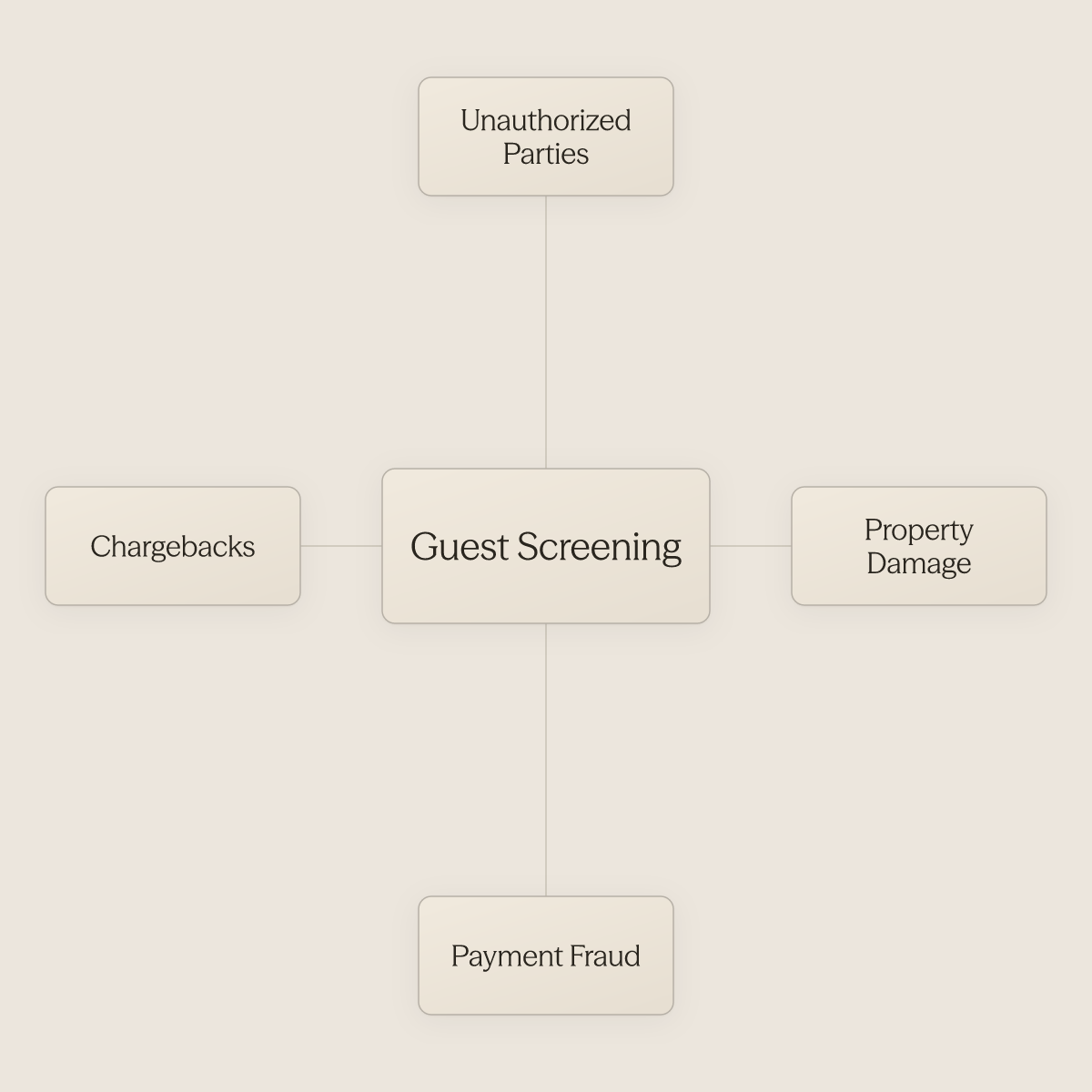
Risk evaluation, which examines booking patterns, profile completeness, communication tone, and payment behavior, answers the second. One without the other leaves the door open to guests who are real people with bad intentions, the profile behind most serious incidents. Screening exists to prevent four specific threats: unauthorized parties, property damage, payment fraud, and chargebacks.
A guest who passes a standard name-and-photo check can still book under the pretense of a quiet family stay and host a 40-person event by midnight. Chargeback fraud, where a guest disputes a legitimate charge after checkout, is a separate exposure that identity confirmation alone does nothing to prevent. The real exposure for multi-property operators is structural, not criteria-based.
A hospitality AI platform built for portfolio-scale operations recognizes what individual hosts often miss: screening quality degrades under volume. When booking requests arrive overnight or across a dozen simultaneous listings, the vetting that happens at 2pm on a Tuesday rarely matches what happens at 1am on a Friday. That inconsistency, not weak criteria, is where bad guests get through.
$4.8 billion Vacation rental damage protection market, 2025
Key takeaways
-
OTA 'Verified' badges confirm identity, not risk, the gap between what Airbnb checks and what actually protects your property is where financial exposure lives.
-
Manual screening earns its place because automated ID verification says nothing about what a guest plans to do with your property.
-
The first message a guest sends reveals more about intent than any ID check, how they write, what they ask, and what they omit are all signals.
-
Less than 1% of vacation rental bookings result in a damage claim, which doesn't mean screening is working, it means screening failures are concentrated in the cases that do slip through.
-
At volume, the failure point in any screening process is rarely the criteria, it's the gap between a booking arriving and a human actually seeing it at 1am on a Saturday across four channels.
-
Screening removes bad actors; it does nothing for the friction good guests still experience, and most negative reviews trace back to communication failures, not property condition.
-
Conduit closes that gap by running AI-powered guest communication continuously, from booking confirmation through checkout, so the process that screening starts doesn't collapse the moment a human isn't watching.
Why OTA Platform Screening Tools (Airbnb, Vrbo, Booking.com) Aren't Enough
The "Verified" badge on a guest's Airbnb profile feels reassuring. The problem is that what got checked is far narrower than most hosts assume, and the gap between what platforms verify and what actually protects your property is where real financial exposure lives. According to Airbnb's own help documentation, the platform collects email addresses, phone numbers, and government-issued ID uploads, then uses automated checks to confirm the name, photo, and document match.
That is the full scope. Criminal history, sex offender registry status, prior eviction records, and damage incident databases sit entirely outside what any major OTA checks as standard. A guest can hold a verified badge and a prior property damage incident on their record simultaneously, and the platform will never surface that conflict to you.
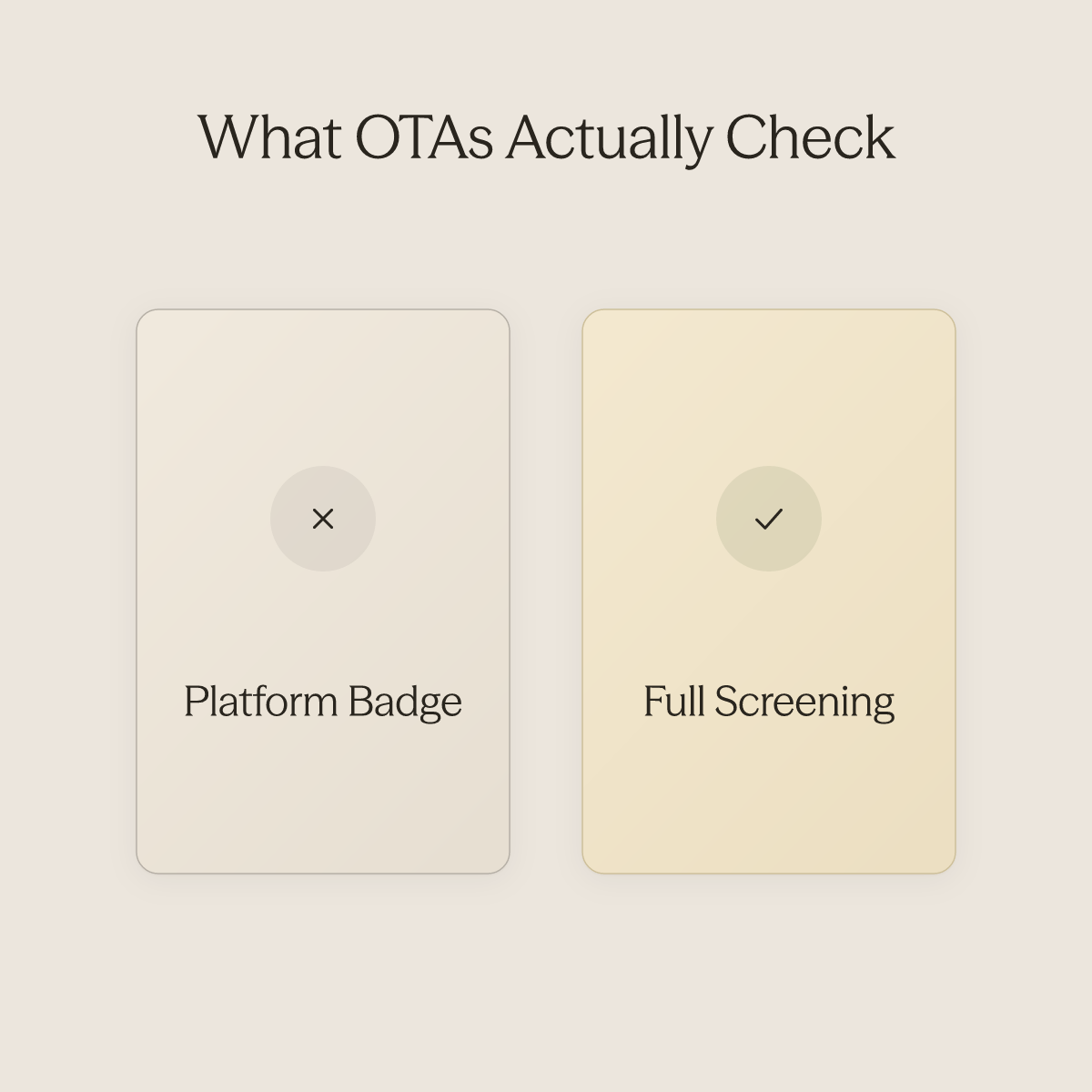
Vrbo's verification posture is materially similar. Booking.com goes further in the other direction: many rate plans require no ID verification at all, leaving hosts with even less signal before a stranger arrives. This is the limitation hosts on Booking.com, MakeMyTrip, and Goibibo encounter repeatedly: the built-in screening tools feel authoritative but deliver surprisingly little actionable risk data.
"How do I effectively screen guest quality across OTA platforms like Airbnb, MakeMyTrip, Goibibo, and Booking.com? The built-in screening tools on these platforms feel insufficient or unclear to me."
At a glance
The badge creates confidence the underlying check doesn't warrant. The platforms are not hiding this limitation; they are built around a different incentive entirely. Airbnb's revenue depends on completed bookings.
Every additional friction point in the guest flow, including a rigorous background check, risks killing a conversion. As Airbnb's own documentation frames it, verification tools are designed to build guest trust and reduce booking friction, not to hand hosts granular risk data. Airbnb's help resources on guest standards confirm that platform policies prioritize community trust at scale, a mandate that is structurally different from protecting an individual host's asset.
The host's protection interest and the platform's conversion interest are structurally misaligned. Expecting one to serve the other is the core mistake. Where this misalignment hits hardest in practice is in the gap between inquiry and insight.
Booking inquiries arrive overnight, after hours, and across multiple platforms simultaneously, precisely the moments when a host is least able to manually evaluate a guest's communication patterns, flag inconsistencies, or ask follow-up questions. By the time a host reviews an inquiry the next morning, the window for meaningful pre-booking screening has often already compressed. Conduit's AI Agents address this directly: they capture every booking inquiry, including those that land overnight or after hours, and deliver a first automated guest reply within days of connecting your existing SOPs and manuals, so the conversation begins immediately and the host retains a record of every exchange before a booking is confirmed.
Direct booking compounds this further. A guest who books directly through your website receives zero automated identity verification unless you have independently integrated a third-party tool, a blind spot that expands proportionally as your direct booking share grows. For multi-property operators distributing across channels, these inconsistent screening postures create compounding exposure.
Operating across Vrbo, Booking.com, and direct channels simultaneously means each channel's gaps stack. ai's unified Inbox consolidates all of those conversations, monitored continuously by your operations team, so no inquiry falls through the cracks of a fragmented channel stack. And because the AI Agents integrate directly with tools like Notion, Google Drive, and Airbnb, your existing documentation feeds the agent without manual re-entry, meaning the screening and communication logic you've already built into your SOPs is applied consistently across every channel, every booking, every hour.
The host's protection interest and the platform's conversion interest are structurally misaligned.
Manual Guest Screening Methods Every Host Should Use Before Choosing Software
Automated ID verification tells you who a guest claims to be. It says nothing about what they plan to do with your property. That gap is where manual screening earns its place, and where operators who skip it pay the price in damage claims, bad reviews, and platform disputes.
How the First Message Reveals More Than Any ID Check
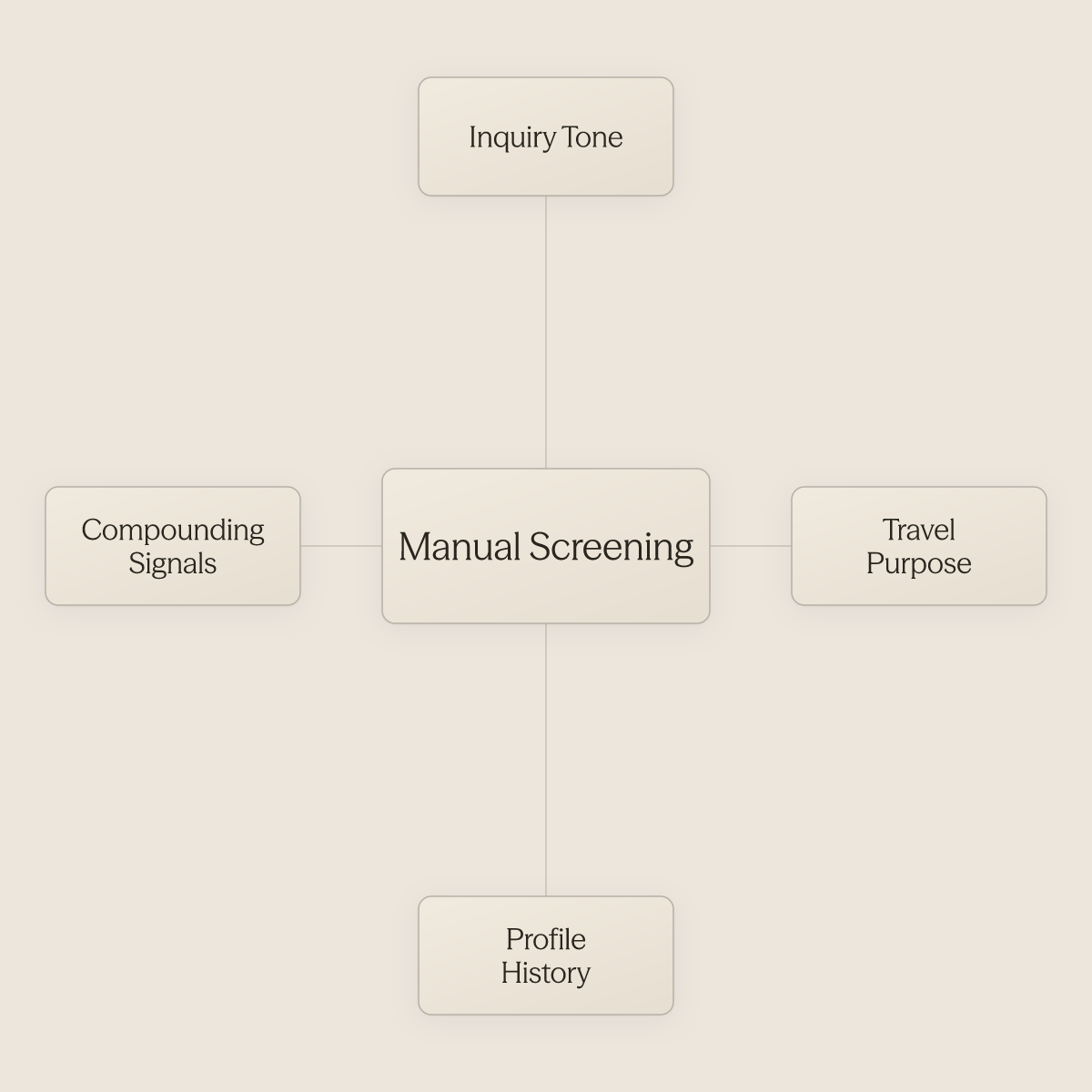
Inquiry tone is the first behavioral signal most hosts never formally evaluate. A guest who introduces themselves, names their travel purpose, and asks a specific question about the property is showing you something an algorithm cannot score: intentionality. A message that reads "is this available fri-sun" for a six-bedroom property on a holiday weekend shows you something too.
Experienced hosts consistently flag vague inquiries and high-pressure requests to confirm immediately as warning signs worth a follow-up before any approval. The combination of signals matters more than any single flag. A 60-night booking request from a profile with no review history that also offers a private phone number to "sort details faster" is not three separate concerns; it is one compounding risk picture that only a human reading the full inquiry can assemble.
Where volume makes this harder is exactly where the structural risk compounds. Operators managing guest communications across multiple platforms or properties simultaneously face a practical ceiling: the more inboxes you monitor, the more likely a nuanced first message slips past without the scrutiny it warrants. Conduit's Inbox centralizes those conversations so the operations or support team can monitor, review, and manage all guest communications in one place, continuously, before, during, or after a stay, rather than context-switching across platforms while behavioral signals quietly accumulate.
What a Guest's Review History (or Absence of One) Actually Tells You
If the message is detailed, the profile is complete, and the guest answers a follow-up question clearly, the absence of prior reviews becomes a manageable unknown rather than a hard stop. What warrants sharper scrutiny is the combination of no reviews, an incomplete profile (missing photo, unverified phone, no bio), and a vague first message. From what experienced operators consistently observe, incomplete guest profiles are linked to a disproportionate share of vacation rental damage claims, which is why they treat profile gaps as a prompt for follow-up rather than a reason to reflexively decline.
The follow-up message itself, the one you send to surface more context, is where a well-configured AI Agent earns its keep. Conduit can deploy a first automated guest reply within days of connecting those materials. That means a zero-review inquiry gets a prompt, consistent, on-brand response that asks the right clarifying questions immediately, rather than sitting unanswered while a host juggles three other properties.
Why Manual Screening Is a Compounding Fragility, Not a Scalable System
This is the synthesis point most operator guides omit entirely: manual screening is not merely difficult to scale, it is structurally guaranteed to produce inconsistent outcomes as portfolio volume grows. Evaluating inquiry tone, zero-review profiles, and off-platform contact attempts simultaneously requires contextual interpretation that no checklist can encode, meaning the combinatorial variety of behavioral red flag combinations expands faster than any screener's capacity to apply uniform judgment across them. Diligence and experience slow the deterioration; they do not stop it.
The operational model that reduces this fragility is one where guests, cleaners, contractors, and owners stay coordinated without a human sitting in every thread. Conduit's Workflows fire after trigger events in the guest lifecycle, after a booking is confirmed, after check-in, or when a specific keyword is detected, so that recurring, predictable touchpoints happen without manual staff action. This does not replace human judgment on high-signal inquiries; it reserves human judgment for them by clearing the routine volume out of the way.
The Two Strategic Questions That Surface Intent Without Violating Fair Housing Rules
Hosts can ask questions about the stay without asking questions about the person. Two questions do the most work: "What brings you to the area?" and "How many guests will be staying?"
The first surfaces intent without touching protected characteristics. The second confirms whether the booking matches the property's registered occupancy, a house-rule enforcement question, not a demographic one. Conduit's AI Agents handle scripted follow-up questions and house-rule acknowledgments without manual re-entry, drawing from the same documentation the team already maintains.
The integration keeps the screening layer consistent across properties and platforms, which is precisely where manual processes tend to drift as portfolios grow.
Why Enforceable House Rules Are a Screening Instrument, Not Just a Legal Formality
House rules that guests must explicitly agree to before booking function as a pre-screening layer. A minimum booking age of 25, a registered-guest-only occupancy policy, and a no-events clause all do double duty: they set legal expectations and they filter for guests who read and engage with conditions before booking. A guest who breezes past every rule on a six-bedroom holiday weekend booking is telling you something worth noting before you confirm.
Red Flags to Watch for When Screening Vacation Rental Guests
The signals worth acting on fall into two categories: those visible before a guest ever sends a message, and those that emerge from the conversation itself.
Less than 1% of vacation rental bookings result in a damage claim, a rate that does not indicate that screening is working, but rather that screening failures are largely invisible because they manifest not as catastrophic damage events but as compounding operational costs: slower response times, missed upsells, disputed reviews, and retaliatory platform reports that erode NOI and owner relationships without triggering a formal claim. This means the real cost of poor screening is systematically undercounted, and operators who rely on claim rates as a proxy for screening effectiveness are measuring the wrong outcome entirely.
The most important red flags in vacation rental guest screening are not individual alarms. They are data points in a risk score. A single flag warrants a follow-up message.
Two or more flags in combination, especially when they cross identity, payment, and communication, warrant a documented decline. Where the cost of slow detection compounds fastest is in the inbox. Operators managing guest communications across multiple platforms or properties simultaneously face a version of this problem every day: a suspicious booking arrives on a Saturday night, no one is watching the channel it came in on, and an automated confirmation goes out before anyone reviews it.
Conduit's Inbox is designed precisely for this scenario, centralizing conversations across platforms so that manual review, when it matters most, is not delayed by fragmented tooling.
1. Underreporting the Number of Guests at Booking

One of the most common red flags in vacation rental guest screening is a guest who books for one or two people but arrives with a significantly larger group. This creates liability gaps, voids insurance coverage, and causes excessive wear on the property. Hosts should cross-reference guest count with vehicle arrivals and security camera footage. The tradeoff: some guests genuinely misunderstand per-person fee structures, so a firm but polite clarification message is essential before escalating.
2. A Completely Blank or Newly Created Guest Profile

A brand-new account with zero reviews, no profile photo, and no personal bio is a meaningful screening signal during vacation rental guest screening. While many first-time guests are entirely legitimate, the combination of a blank profile with vague messaging or a local address dramatically raises risk. Hosts should ask targeted pre-booking questions to gauge intent. The tradeoff: rejecting all zero-review guests eliminates a large portion of the booking pool, so context matters enormously.
3. Requests to Move Payment Off-Platform
When a guest, or someone posing as a host, pushes to handle deposits or full payments outside the official booking platform, it is a serious red flag in vacation rental guest screening. Off-platform transactions eliminate dispute resolution protections and make fraud recovery nearly impossible. Hosts receiving stolen credit card information may also be targeted this way. The tradeoff: some legitimate API-connected property managers do require secondary payment portals, so always verify directly with the platform before acting.
4. Vague or Evasive Answers About the Purpose of the Stay
During vacation rental guest screening, guests who refuse to answer basic questions about why they are visiting, who they are traveling with, or what they plan to do during their stay are exhibiting a classic evasion pattern. Legitimate travelers typically share trip context willingly. Evasive responses often correlate with unauthorized parties, subletting, or commercial use of the property. The tradeoff: some introverted guests simply dislike small talk, so one unanswered question alone should not trigger a denial.
5. Last-Minute Bookings for Extended Stays
A booking request made the same day or the day before for a stay of seven or more nights is a notable red flag in vacation rental guest screening. Genuine vacationers rarely plan extended trips with zero lead time, while individuals seeking temporary housing, fleeing a situation, or attempting fraud often do. This pattern becomes more suspicious when combined with a new profile or vague answers. The tradeoff: last-minute extended bookings occasionally come from legitimate corporate travelers or emergency relocations.
6. Use of Stolen or Mismatched Identity Information
Scammers increasingly book vacation rentals using stolen credit card details or colluding with insiders to provide fraudulent identity verification. During vacation rental guest screening, mismatches between the name on the booking, the ID submitted, and the payment method are serious warning signs. Hosts using direct booking websites are especially vulnerable. The tradeoff: identity verification tools add friction that can deter legitimate guests, so the screening process must balance security with a smooth booking experience.
7. Negative or Retaliatory Reviews Left on Previous Stays
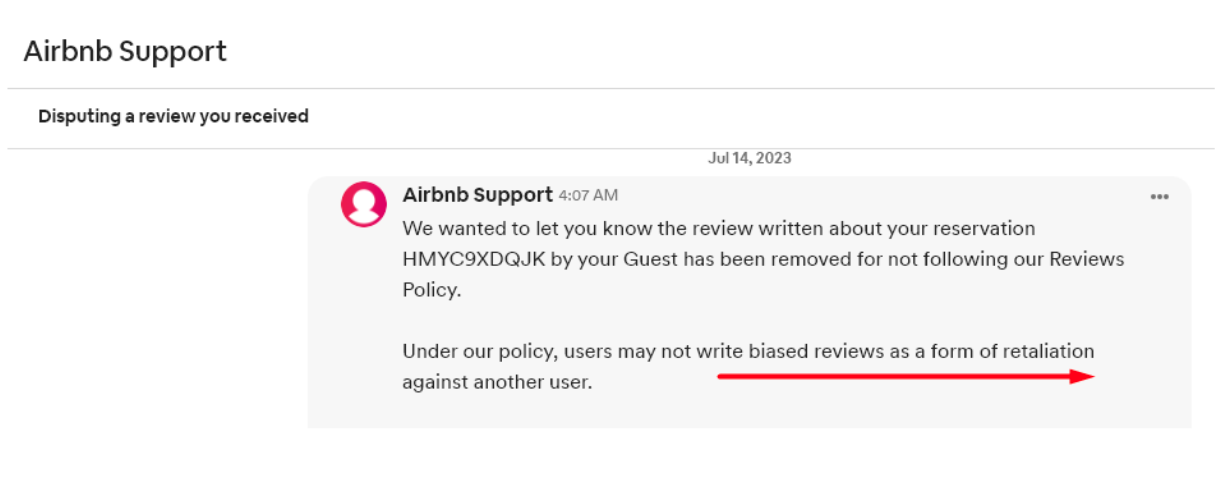
A guest profile showing a pattern of low ratings given to previous hosts, or hosts who left cautionary reviews about rule violations, is a critical signal in vacation rental guest screening. Five-star review counts alone do not tell the full story, what a guest says about past hosts reveals their expectations and behavior. Hosts should read outgoing reviews carefully, not just incoming ones. The tradeoff: a single negative review may reflect a genuinely bad host experience rather than a problematic guest.
Top Automated Guest Screening Software Tools and What Each Specializes In
Not every guest screening tool was built to solve the same problem, and for multi-property operators, choosing by name recognition alone can mean paying for coverage that misses the exposures that actually keep you up at night. The tools compared below each emerged from a distinct gap in the market, from identity verification to damage protection to post-booking communication, so the comparison is less about ranking features and more about matching the right tool to the risk you are genuinely trying to close. Conduit.ai sits at the top of that list for a reason that goes beyond screening itself.
Vacation Rental Guest Screening Software Compared - Top Tools for 2026
The "verification badge" that OTA platforms display to hosts is not a risk signal, it is a conversion signal engineered to reduce booking friction for the platform's revenue model. That distinction matters because multi-property operators who treat platform verification as a first-pass risk filter are unknowingly conflating identity confirmation with risk assessment, leaving their entire direct-booking channel and every edge-case OTA booking systematically unscreened. Not all guest screening software is built to solve the same problem.
The tools that dominate this category each emerged from a different gap in the market, which means choosing by name recognition alone is one of the more expensive mistakes a multi-property operator can make. The comparison below is less about features and more about which exposure you are actually trying to close.
1. Conduit.ai - Best Overall AI-Powered Vacation Rental Guest Screening
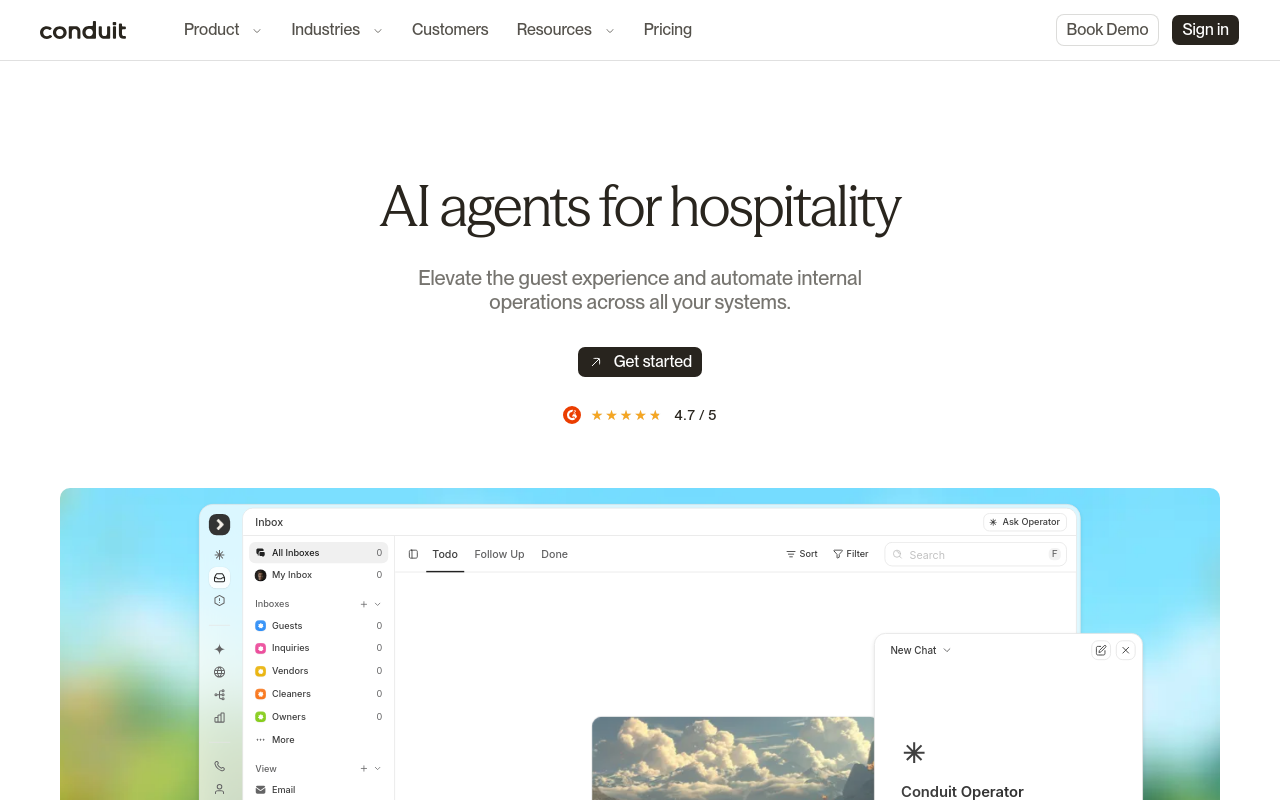
Conduit.ai earns the top slot not because it replaces identity checks or background databases, but because it solves the problem every other tool on this list leaves open: what happens immediately after a booking clears. Most operators assume the hard work ends at "Approved," but the communication layer that follows, welcome messages, rental agreement reminders, pre-arrival instructions, is where screened guests either become five-star reviews or support escalations.
Conduit's AI-powered guest communication layer triggers personalized pre-arrival sequences the moment a booking clears, without a staff member touching the thread. It is most beneficial when managing 20 or more properties, where manual post-approval follow-up degrades under volume.
2. Truvi - Best for Comprehensive Identity Verification at Scale
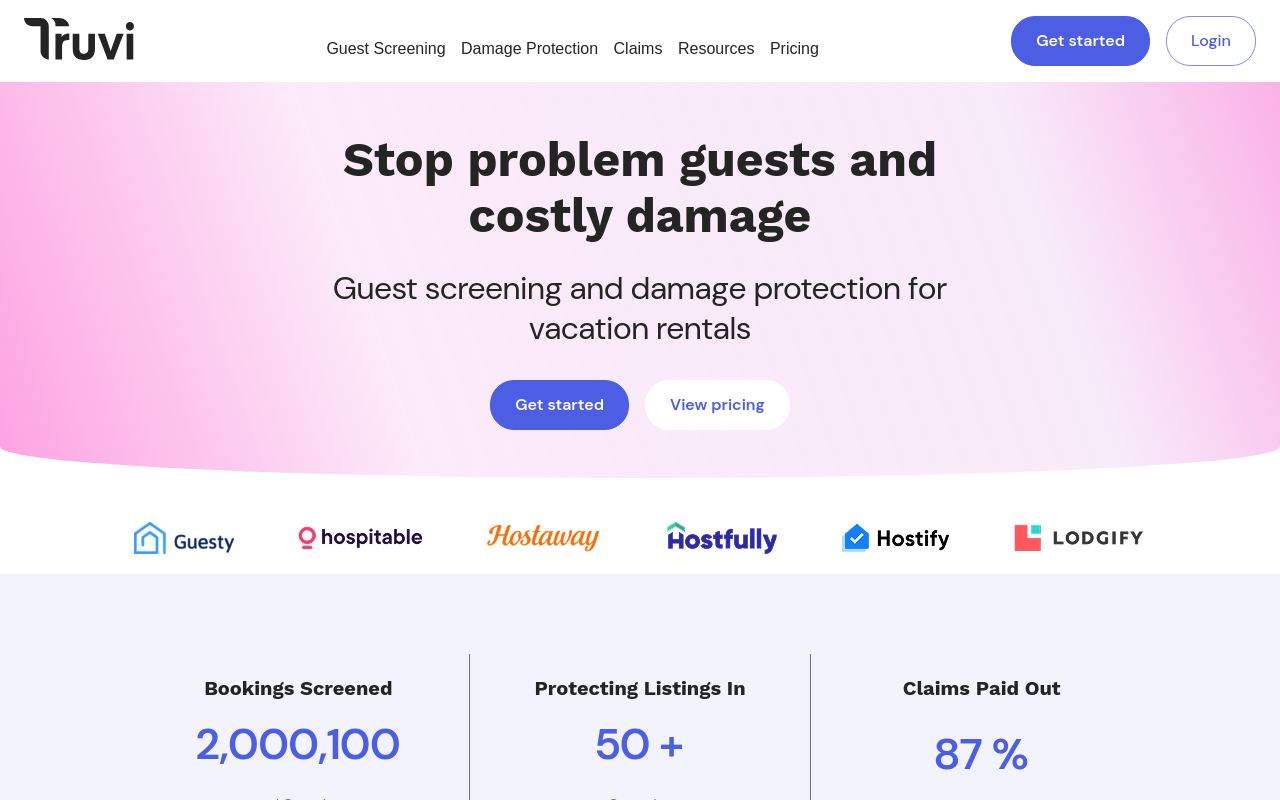
Truvi is purpose-built for operators who need fraud-signal detection before a guest ever reaches the property. Its automated checks span VPN and burner-phone detection, sex offender watchlists, and criminal background databases across 2,400-plus sources with a seven-year lookback, according to its product documentation. It automatically verifies contact details, scans for VPN and burner-phone use, checks sex offender watchlists, and delivers a clear Approved, Flagged, or Rejected verdict in the dashboard.
Optional add-ons include criminal background checks across 2,400-plus databases with a seven-year lookback and up to $1 million in damage protection. The tradeoff: Truvi's strength is front-end fraud detection, so operators who need post-screening communication automation will still require a separate layer for guest coordination after the verdict lands.
3. Authenticate.com - Best for Criminal Background Check Depth
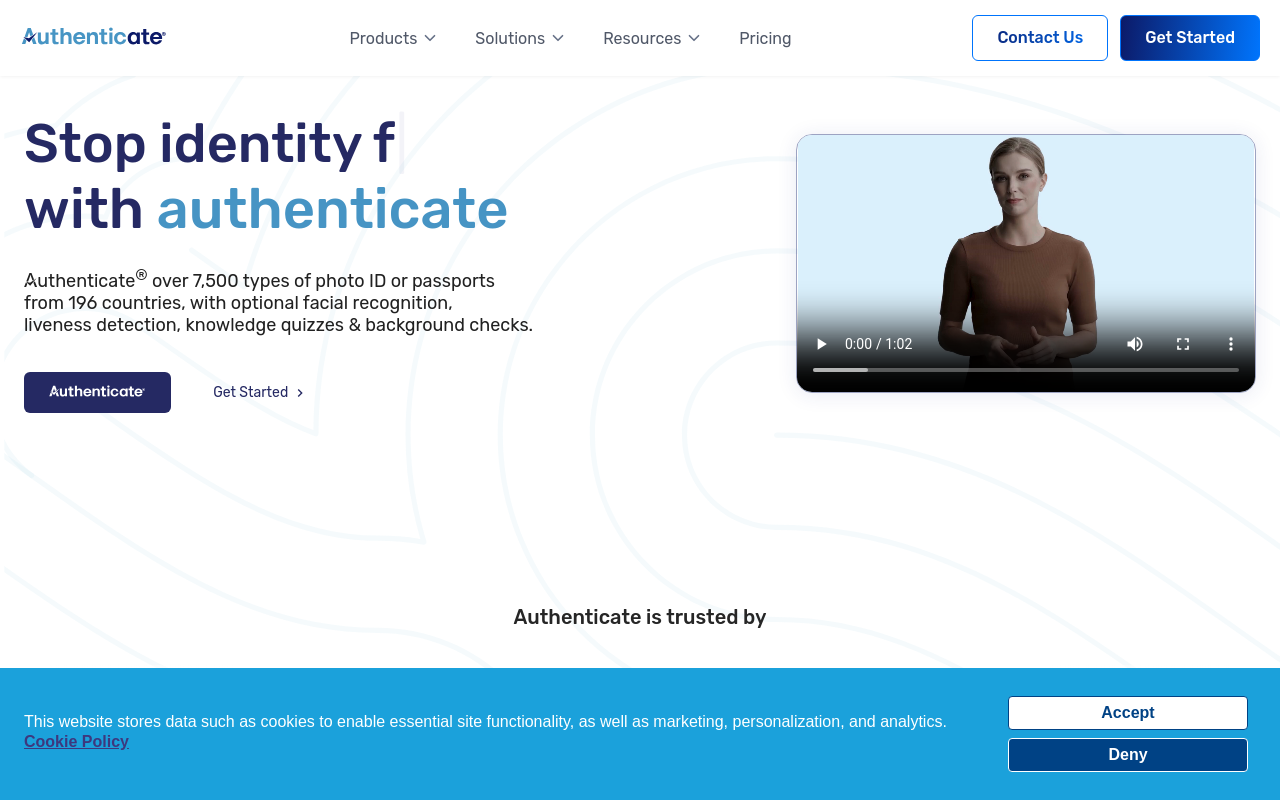
Authenticate.com is the right pick when criminal record depth is the primary gap. Its background check infrastructure reaches county, federal, and international databases, a scope that goes materially beyond what any major OTA badge covers, as confirmed by Airbnb's own help documentation, which limits platform verification to name, photo, and document match. Deeper database searches take longer to return results, creating friction in high-velocity booking windows where guests expect near-instant confirmation, a genuine constraint for direct booking sites with fast checkout flows.
4. Superhog - Best for Damage Protection Bundled with Guest Screening

Superhog combines biometric identity verification, matching a live selfie to a government-issued ID, with damage deposit management and a property damage guarantee typically ranging from $5,000 to $50,000 depending on the plan, according to its product documentation. Guests complete verification in under five minutes, and the platform integrates directly with PMS tools including Hostaway and Lodgify. Operators with high-value properties should confirm whether the guarantee replaces or supplements a traditional security deposit, because the coverage cap may not match replacement costs for premium furnishings.
5. Safely - Best for Instant Screening Decisions on Direct Booking Sites
Safely is engineered for speed, delivering automated guest screening decisions in under 30 seconds, a critical advantage for hosts running direct booking websites where friction kills conversions. It screens for criminal history, fraud signals, and identity mismatches while issuing a guest guarantee to the host. The main limitation is that its screening model is proprietary and opaque, so hosts who want granular control over screening criteria or raw report data may find it insufficiently transparent.
Related Reading
-
Vacation Rental Automation
-
How To Automate Airbnb Business
-
Vrbo Management
-
Airbnb Self Check In
-
Best Apps For Short Term Rentals
-
Best Pms For Airbnb
-
Best Pms For Short Term Rentals
-
Best Accounting Software For Short Term Rentals
-
How To Manage A Vacation Rental Property
-
Vrbo Smart Pricing
How Automated Screening Integrates with Your PMS: and Why It Breaks Down at Scale
Turning on a screening tool inside your PMS is not the same as having a screening process that actually runs. Most vacation rental property managers and operations leads believe that tightening their screening checklist or hiring a more diligent VA will solve inconsistency, because the problem is criteria or effort, not structure. The distinction sounds minor until you're managing 25 properties and three flagged bookings arrive between midnight and 6am on a holiday weekend, the alerts sit unread until morning, and the penalty-free cancellation window on one of them has already closed.
At that point, the configuration is irrelevant. What failed was execution. That failure compounds at the staffing layer.
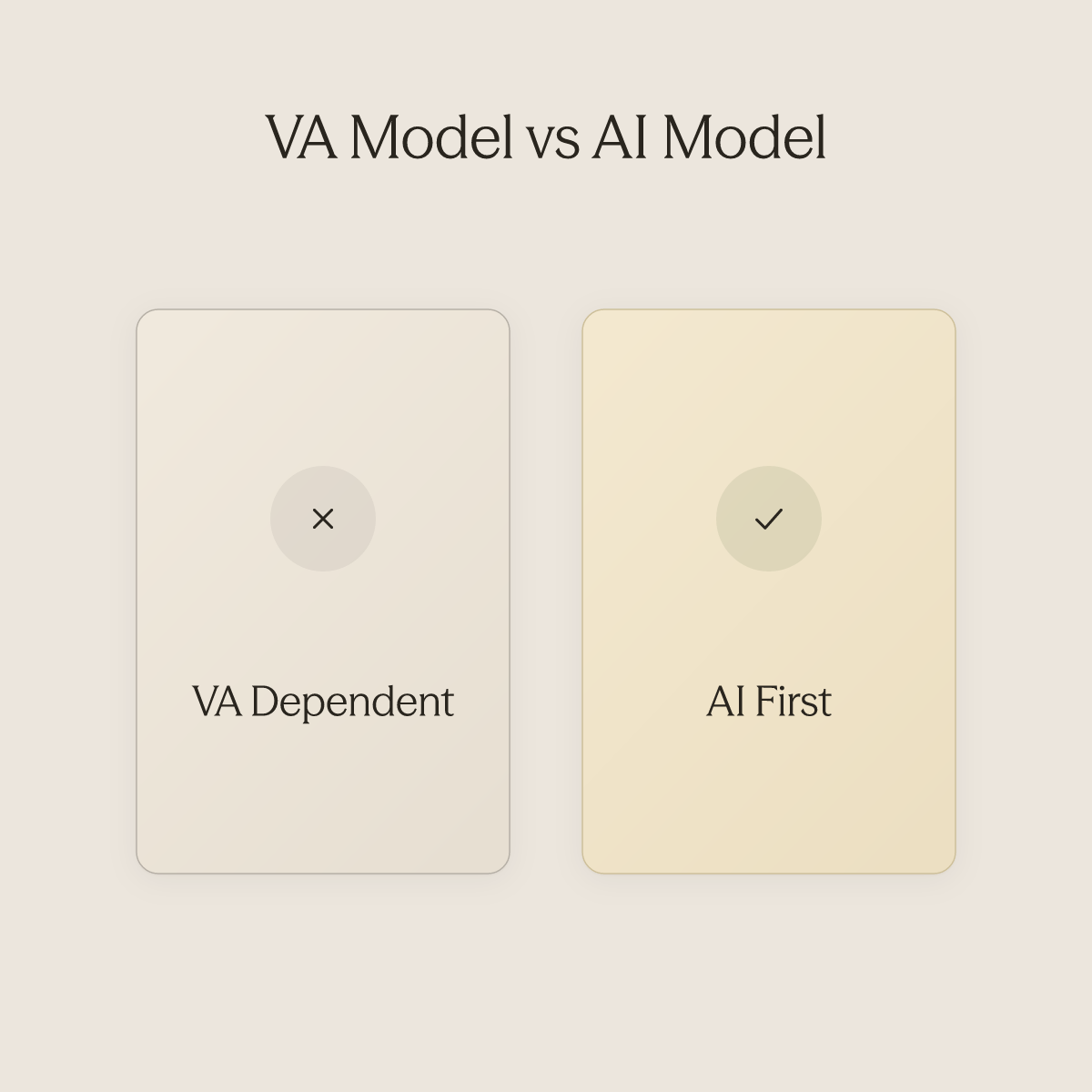
Operators who've scaled past 15 or 20 properties often find themselves running on 10, 12, or 14 virtual assistants to maintain 24/7 coverage, a model that drags on margins and caps EBITDA directly. Darren, Founder of Easy BnB / Bali Luxury Stays, found that staff reliability issues, secret second jobs, missed overnight shifts, made it structurally impossible to cover the hours that matter most for screening. His conclusion was direct: "We all agree that AI first is the best approach."
The problem isn't finding better VAs. The problem is that a VA-dependent model cannot scale a portfolio without proportionally increasing coordination headcount, and that headcount ceiling limits the business itself.
How the PMS-to-Screening Webhook Loop Actually Works
Automated screening works through a webhook: the moment a booking is created in your PMS, a signal fires to your screening tool, which runs its checks and returns a risk score or status. The booking has to trigger the webhook. The webhook has to reach the screening tool without a timeout.
The result has to route back to the right inbox, with the right alert, reaching someone with authority to act. Each handoff is a point where the process can quietly break without anyone noticing until a guest is already at the door. This is where a unified Inbox, one that monitors, reviews, and manages all conversations the AI agent is handling across multiple platforms and properties simultaneously, changes the failure mode.
Instead of a flag routing to whichever VA happens to be logged in, every signal lands in a single monitored surface. The structural gap between "the tool flagged it" and "a human with authority saw it" narrows to seconds, not hours.
The Overnight Booking Problem
Most platforms give hosts a narrow window to cancel without penalty. When the flag and the cancellation window don't overlap with staffed hours, the process fails regardless of how well the screening criteria are configured. The tool did its job. The workflow didn't.
Easy BnB's experience is instructive here: the vast majority of their communication volume was low-value messages that still required a human to read, triage, and respond before anything actionable could happen. That load meant overnight shifts were consumed by noise, leaving the high-stakes flags, the ones with a closing cancellation window, buried.
An AI agent that handles repetitive, low-value guest messages continuously, before, during, and after a stay, frees the human review layer for the decisions that actually carry risk. The agent runs on existing SOPs and FAQs; the operations team monitors what requires judgment. That separation is what makes 24/7 coverage viable without adding costly headcount.
Inconsistent Team Execution at 20-Plus Properties
The failure mode that scales fastest is also the least visible: different staff members applying screening criteria differently under time pressure. One team member follows the full checklist. Another, handling a queue of eight bookings on a Friday afternoon, skips the manual review step for guests with a "Verified" badge.
Neither decision gets logged. The dominant assumption is that better checklists fix inconsistency, when the actual problem is structural: no single enforced workflow means no consistent output, regardless of how experienced the team is. Workflows that trigger automatically after a booking is confirmed, rather than relying on a staff member to remember the next step, remove the discretion that produces variance.
When a trigger event fires the same sequence every time, the checklist stops being a document someone consults and becomes a process that runs. For operators managing recurring, predictable guest touchpoints that currently require manual staff action, this is the structural fix that checklists cannot provide. It also directly addresses the portfolio scaling problem: you can grow the number of properties without growing the coordination headcount required to keep execution consistent across all of them.
Integration Lag and Misconfigured Automations
Webhook-based integrations between PMS platforms and third-party screening tools are not instantaneous. Processing delays, API timeouts, and misconfigured automation triggers can create windows where a booking is confirmed and access credentials are sent before the screening result returns.
The short-term rental market has declined year-over-year, compressing the margin operators have to absorb the cost of a bad booking. In that environment, integration failures that were previously a nuisance become a direct threat to unit economics. Integrations that allow the AI agent to leverage existing content from tools like Notion, Google Drive, or Airbnb, without manual re-entry, reduce the configuration surface where mismatches and lag typically originate, keeping the loop tighter from the moment a booking is created.
After Screening Passes - The Guest Communication Layer That Determines Your Review Score
Screening a guest and serving a guest are two completely different operational problems. The first happens once, before check-in. The second happens continuously, from booking confirmation until the guest leaves a review. Most property managers invest heavily in the first and assume the second takes care of itself. It does not.
The Hidden Cost Screening Never Eliminates - Communication Friction for Good Guests
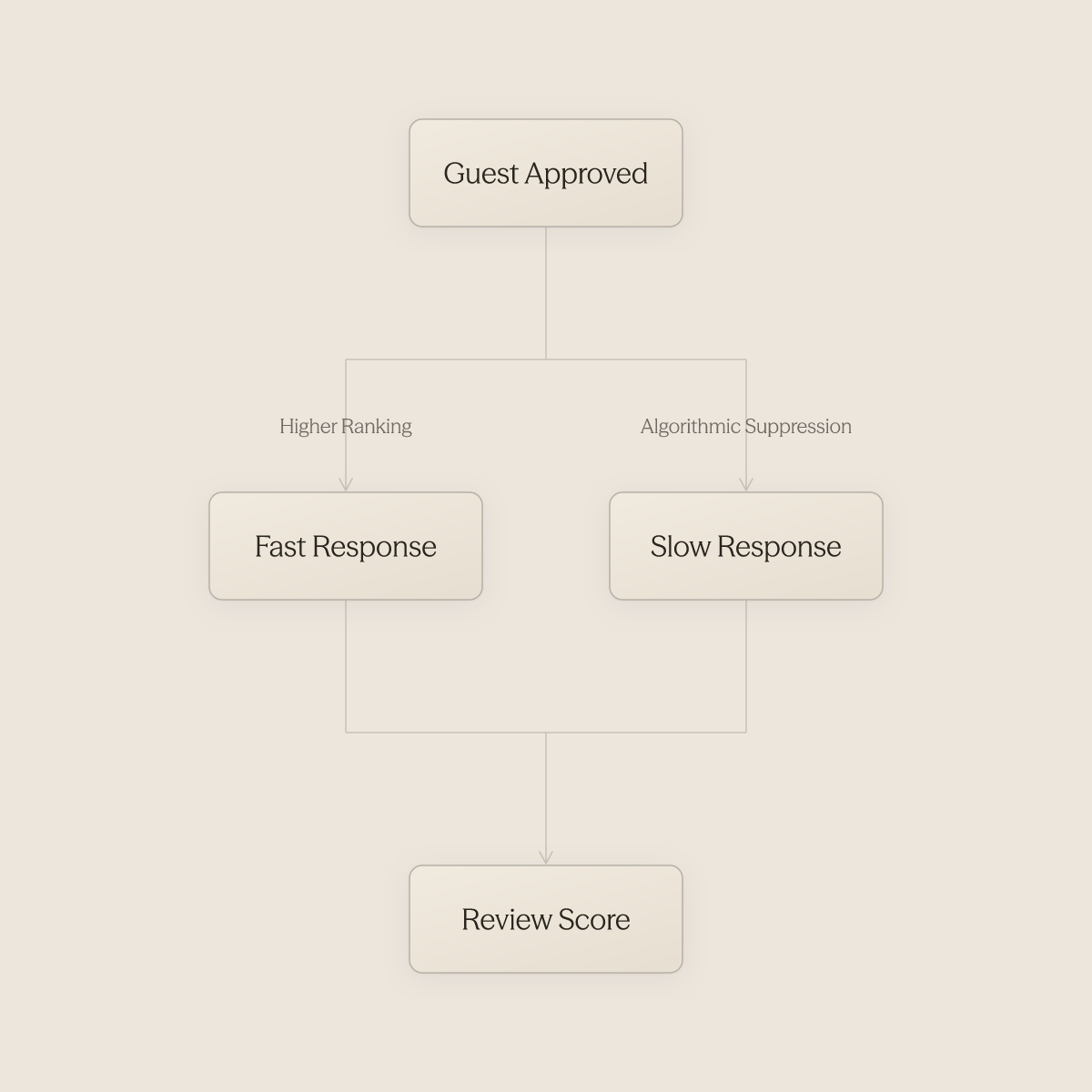
A vetted guest with five-star reviews and a verified ID can still leave a three-star rating. The reason is almost never who they are; it is what they experienced after approval: a check-in message that arrived 45 minutes late, a maintenance question unanswered until morning, a door code never confirmed. According to data tracked by Airbnb and Vrbo, response time is a direct ranking signal, and platforms algorithmically suppress listings where hosts reply slowly, regardless of how carefully those hosts screened their guests.
The cost compounds: slower response times reduce search visibility, which reduces booking volume, which reduces the revenue that justified portfolio expansion. Screening and communication are not sequential phases. They are a single compounding system, and operators who treat them as separate trade the risk of one bad stay for the certainty of ongoing algorithmic suppression.
Why Review Scores Degrade at Volume Even When Your Screening Is Airtight
The pattern is consistent across growing portfolios: screening criteria stay tight, but review scores drift downward past 20 or 30 units. The root cause is response consistency, not guest quality. At five units, one person covers overnight messages.
At 50, that same person cannot, and the 2am question from a perfectly screened guest goes unanswered until 7am. Hosts in larger operations frequently trace their worst reviews to communication gaps: a delayed response to a broken thermostat, a check-in instruction that arrived after the guest was already at the door. These are coordination failures no screening tool addresses.
Related Reading
-
Lodgify Competitors
-
Vrbo Automated Messages
-
Guesty Alternatives
-
Lodgify Vs Smoobu
-
Guesty Vs Hostfully
-
Ownerrez Vs Guesty
-
Hospitable Vs Hostaway
-
Guesty Vs Hostaway
-
Guesty Vs Hospitable
Your 2026 Guest Screening Checklist - Build a Process That Holds at Volume
At volume, the failure point in any guest screening checklist is rarely the criteria. It is the moment between a booking arriving and a human actually seeing it, at 1am on a Saturday, across four channels simultaneously. The checklist you build matters. The infrastructure executing it on every single booking is what determines whether that checklist holds.
The 8-Step Screening Sequence Every Booking Must Clear, In Order
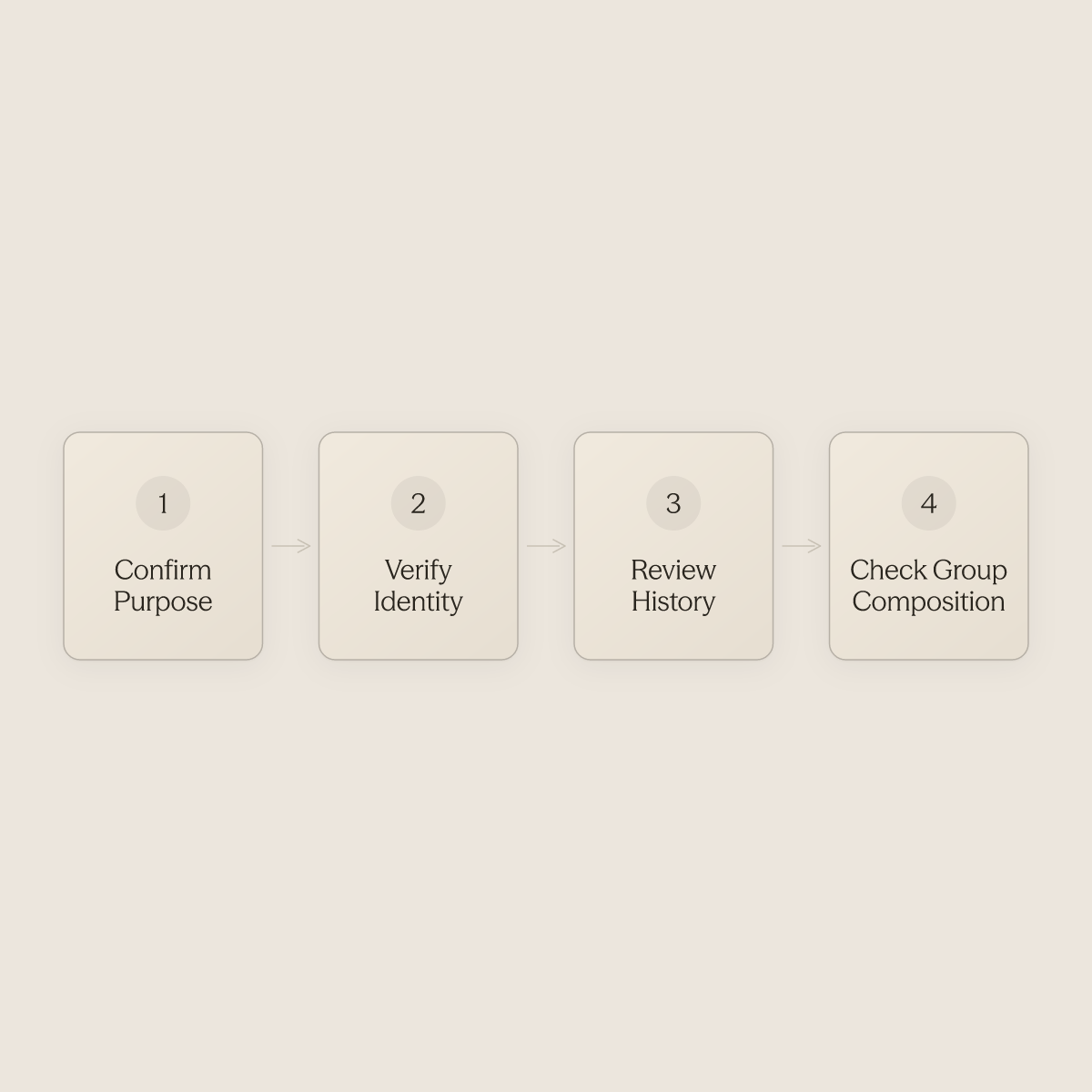
A reliable booking approval process runs the same steps in the same order, every time: (1) confirm the inquiry communicates a clear purpose; (2) verify identity against a government-issued ID; (3) review guest history and prior host ratings; (4) ask targeted questions about group composition; (5) require explicit agreement to house rules before confirmation; (6) collect a security deposit or damage waiver; (7) run an automated risk score through your screening tool; and (8) route any flagged booking to a named decision-maker before the cancellation window closes. Across the market, consistency of execution across every booking source is what separates high-performing multi-property operators from those who accumulate gaps.
Consistency Is the Differentiator - Why Multi-Property Operators Fail at Step 7, Not Step 1
Operators managing 20-plus properties rarely fail at step 1. They fail at step 7, when booking volume spikes and the automated risk score never fires because an integration was misconfigured on a new channel, or because the one team member who knew how to read the flag was unavailable. The gap is not a knowledge problem.
It is an infrastructure problem: who, or what, is watching every conversation across every platform at every hour. This is precisely where an AI-first operations layer changes the equation. Operators we work with who manage complex multi-property portfolios, particularly those with specific brand standards, escalation policies, and differentiated rules per property, find the highest leverage in removing themselves as the single point of failure on repetitive, high-volume guest touchpoints.
Ai's AI Agents are trained directly on your existing documentation, your SOPs, house rules, FAQs, and screening criteria, so the logic encoded in your 8-step sequence does not live in one person's head. It executes in the agent, consistently, whether the booking comes in at 2pm on a Tuesday or 1am on a Saturday. The first automated guest reply typically goes live within days of connecting your documentation, without manual re-entry, including content already living in tools like Notion, Google Drive, or Airbnb via native Integrations.
The Inbox gives your operations team a single surface to monitor every conversation the AI agent is handling across multiple platforms and properties simultaneously, so human oversight is not eliminated, it is elevated to the moments that actually require judgment. Workflows handle the recurring, predictable touchpoints, post-booking confirmation messages, pre-check-in rule acknowledgment requests, security deposit reminders, triggered automatically when a booking is confirmed or a specific keyword is detected, without manual staff action. The goal is a systemized, scalable business that does not depend entirely on owner involvement.
That does not mean removing human decision-makers from step 8. It means ensuring steps 1 through 7 never quietly skip themselves because your volume exceeded your bandwidth. What most teams report at scale is this: that execution consistency, not the sophistication of the criteria, is what defines top-performing operators at scale.
Next steps
If your screening criteria are solid but your outcomes are still uneven across properties and time zones, the path forward starts with treating this as a structural problem, not a discipline problem. Inconsistent execution at scale is not fixed by a tighter checklist. It is fixed by a communication and verification layer that runs identically at 2pm and 2am, across every unit in the portfolio. Start with our AI for hospitality.
Platform verification badges are conversion signals, not risk signals, which means every direct booking and every edge-case OTA inquiry arrives without meaningful front-end screening unless you have built that layer yourself. And screening and guest communication are a single compounding system, not sequential phases, which means a screened guest who receives slow or unstructured post-booking communication becomes a review liability and a ranking penalty regardless of how carefully you vetted them. Together, those two realities point to one action: replacing the human-in-the-loop model with an automated layer that handles both verification logic and post-approval communication without degrading under volume.
Start with Conduit to see how it deploys AI Agents trained on your existing SOPs, triggering consistent screening touchpoints and post-booking communication sequences automatically, so your 8-step process holds on every booking, from every channel, at every hour.
Frequently Asked Questions
What does a guest's first message actually tell me before I approve a booking?
Inquiry tone is the first behavioral signal most hosts never formally evaluate. A guest who introduces themselves, names their travel purpose, and asks a specific question about the property is showing intentionality, while a vague message like "is this available fri-sun" for a large property on a holiday weekend is a warning sign worth a follow-up. The combination of signals matters more than any single flag, a long booking from a profile with no review history that also offers a private phone number to sort details faster is one compounding risk picture, not three separate concerns.
If a guest has no reviews, should I just decline them?
Not necessarily, an absent review history shifts the vetting burden onto the inquiry itself. If the message is detailed, the profile is complete, and the guest answers a follow-up question clearly, the absence of prior reviews becomes a manageable unknown rather than a hard stop. What warrants sharper scrutiny is the combination of no reviews, an incomplete profile (missing photo, unverified phone, no bio), and a vague first message.
Does Airbnb's "Verified" badge mean a guest has passed a background check?
No. According to Airbnb's own help documentation, the platform collects email addresses, phone numbers, and government-issued ID uploads, then uses automated checks to confirm the name, photo, and document match, that is the full scope. Criminal history, sex offender registry status, prior eviction records, and damage incident databases sit entirely outside what any major OTA checks as standard, meaning a guest can hold a verified badge and a prior property damage incident on their record simultaneously.
Can I use house rules to filter out risky guests without crossing any legal lines?
Yes, house rules that guests must explicitly agree to before booking function as a pre-screening layer. A minimum booking age of 25, a registered-guest-only occupancy policy, and a no-events clause set legal expectations and filter for guests who read and engage with conditions before booking. A guest who breezes past every rule on a six-bedroom holiday weekend booking is telling you something worth noting before you confirm.
If guests book directly through my website instead of an OTA, do they get screened at all?
Not automatically. Platform-level screening applies only to bookings made through that platform, so a guest who books directly through your website receives zero automated identity verification unless you have independently integrated a third-party tool. This is a blind spot that expands proportionally as your direct booking share grows, and for multi-property operators distributing across channels, these inconsistent screening postures create compounding exposure.

Stay in the loop
Get the latest on AI automation, product updates, and customer stories.

