Best Hotel Reservation Systems of 2026: Top Picks Ranked


Reservation Systems
The 2026 picks, ranked.
Your reservation system automates the booking, then goes silent. Here is exactly where it stops, what it leaves exposed, and how the sharpest operators are closing the gap.
Most hospitality business owners think that a good hotel reservation system automates the booking, and that once that's handled, guest communication is a separate, manual, people-first job that technology can't replicate without feeling cold. Operators who invest in a hotel reservation system often walk away from the demo feeling like the operational heavy lifting is handled. The room is confirmed, the inventory is synced, the guest gets a confirmation email.
What the demo rarely shows is everything that happens next, and how much of it still lands on a human being. Understanding where a hotel reservation system actually stops is the prerequisite for evaluating any platform honestly. Platforms built for guest communication at scale approach this differently, but the gap only becomes visible once you know what the reservation layer was designed to do.
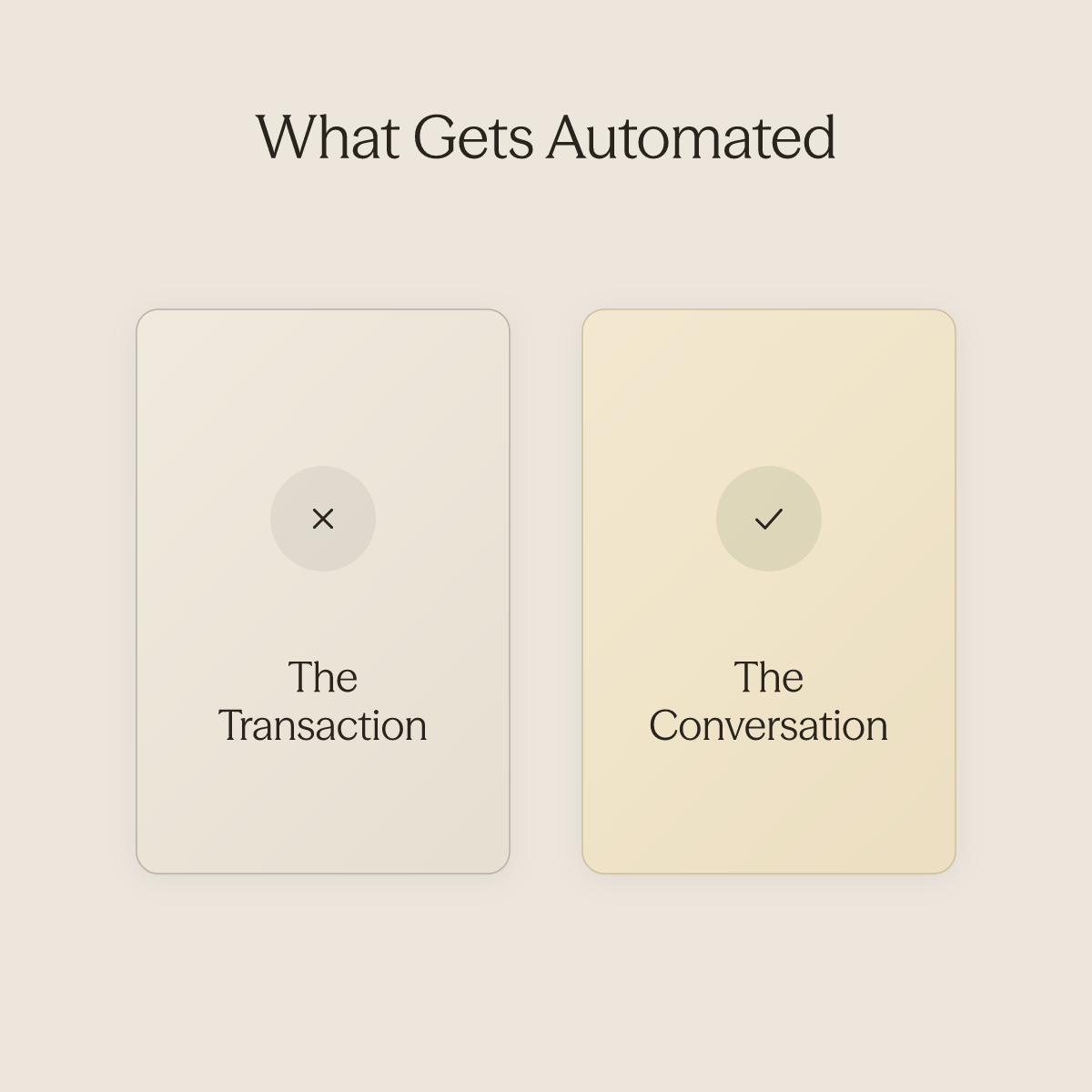
See our AI for hospitality for how this works in practice. An automated hotel reservation system is a cloud-based platform that manages room inventory, pricing, availability, and bookings in real time. When a guest completes a booking, the system captures the reservation, updates available inventory across every connected channel simultaneously, and fires a confirmation.
That is the full scope of its automation mandate: the transaction. What it does not manage is the conversation. Pre-arrival questions, check-in instructions, mid-stay maintenance requests, late checkout negotiations, none of those live inside the reservation system's workflow.
They land in email inboxes, WhatsApp threads, OTA message portals, and SMS queues, entirely outside the system's reach.
The Property Management System (PMS) acts as the single source of truth for rates, availability, and guest records, preventing double-bookings and keeping inventory accurate across channels. The PMS handles the transaction layer with genuine reliability. The problem is that operators sometimes mistake "transaction reliability" for "communication coverage," and those are two entirely different things. The confirmation email is not the end of the guest relationship. It is the beginning of a communication window that, according to industry research, represents the highest-value upsell opportunity a property has, with pre-arrival emails generating an average of $95 per booking in incremental revenue.
$95 Average pre-arrival upsell revenue per booking
Key takeaways
- A hotel reservation system automates the booking, and then it stops. Everything after the confirmation email: check-in questions, mid-stay requests, late-night complaints, is a manual problem your team inherits.
- The four core components of any automated hotel reservation system (booking engine, channel manager, PMS, payment layer) are table stakes in 2026, not differentiators. The operators pulling ahead have added a fifth layer: AI-powered guest communication.
- Real-time OTA sync and overbooking prevention are the benefits vendors lead with, but the compounding revenue loss happens after confirmation, when the guest relationship has barely started and no system is handling it.
- Picking the wrong system type rarely surfaces during the demo. It surfaces at midnight, when a guest sends a multi-part question across three channels and your front desk is closed.
- Erwan Le Roy's 35-property operation now handles the post-booking guest journey without a human in the loop, the gap wasn't in the reservation system; it was in everything that came after it.
- conduit.ai's AI Agents close that gap by handling guest conversations autonomously across every channel, reading directly from your SOPs, manuals, and FAQs to answer accurately, no human intervention required, no cold scripted replies.
How Hotel Reservation Systems Work: and the Communication Gap They Leave Open
Most hospitality business owners think that a good hotel reservation system automates the booking, but once that's handled, guest communication is a separate, manual, people-first job that technology can't replicate without feeling cold. A confirmed reservation feels like the finish line. The PMS updates, the OTA syncs, the confirmation email fires, and the system goes quiet. That quiet is exactly the problem.
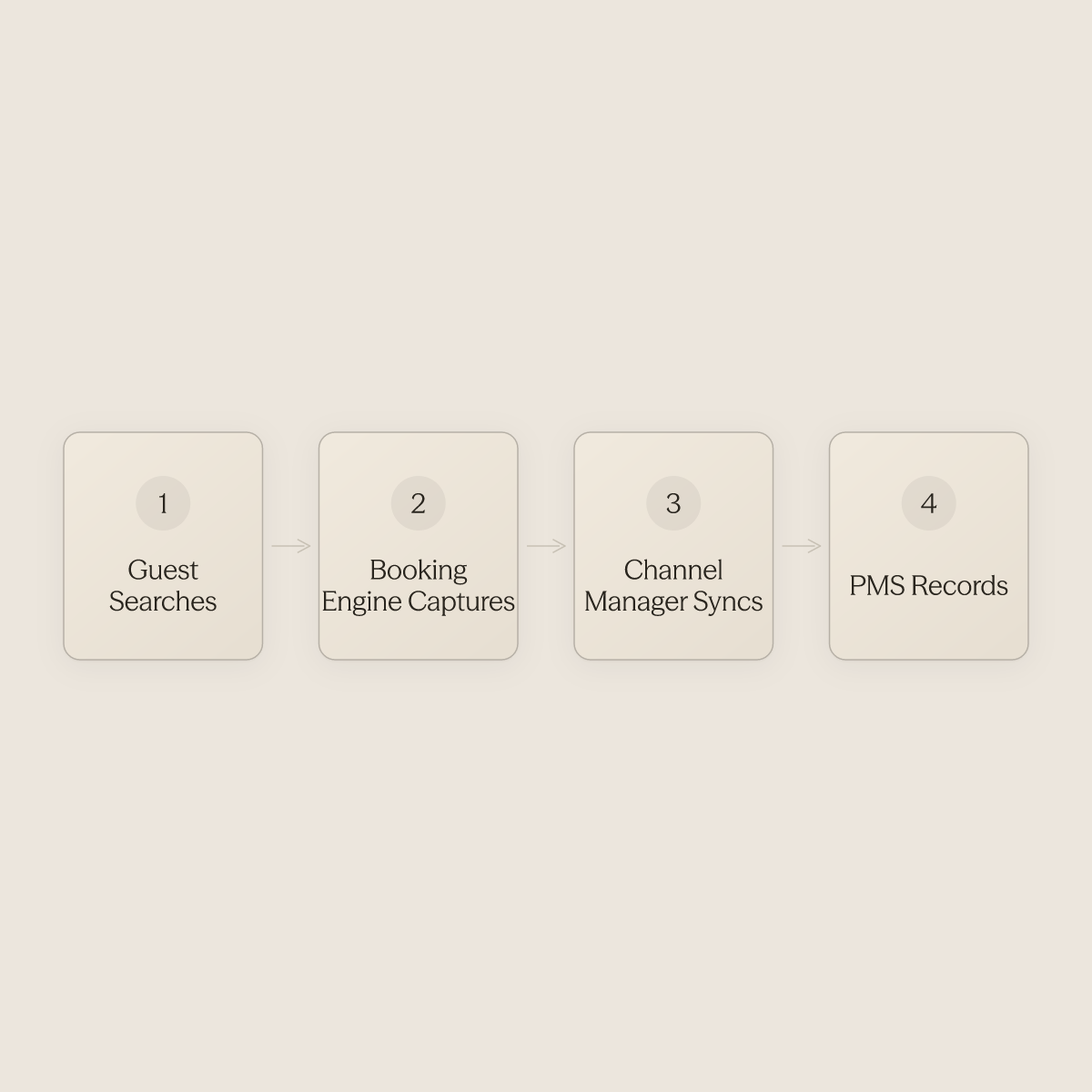
The Four-Stage Handoff - How a Reservation Moves From Search to Confirmed PMS Record
Every booking travels through four distinct stages before it lands as a confirmed PMS record:
- A guest searches availability on an OTA like Booking.com or directly on the hotel website.
- The booking engine captures the request and checks real-time inventory.
- The channel manager updates availability across every connected platform simultaneously.
- The PMS records the reservation as the authoritative source of truth.
Each handoff is automated. Each one is also the last moment the system acts on the guest's behalf.
Booking Engine vs. Reservation System - Why Conflating the Two Costs Operators Real Money
The hotel booking engine is one component inside a broader automated booking system; treating them as synonyms creates blind spots in purchasing decisions. A booking engine handles the transaction interface, guests search rooms, view pricing, and complete a direct booking. The reservation system is the full ecosystem: booking engine, PMS, and channel manager integrated into one record. Operators who buy a booking engine and call it a reservation system typically discover the gaps when the first OTA conflict surfaces, or when a guest's mid-stay question arrives with no system in sight to handle it.
The Three Friction Gaps That Live Past the Confirmation
Overnight inquiries are the most measurable loss point. According to industry research, guests who send booking inquiries outside staffed hours and receive delayed responses frequently book elsewhere, and hospitality now competes on response speed against Uber and Amazon, not just the hotel down the street. The second gap is channel scatter: guest conversations fragment across email, SMS, WhatsApp, and OTA messaging, including platforms like Booking.com, with no unified view, making consistent brand communication structurally impossible at scale. The third gap is portfolio math: every new property multiplies message volume without multiplying staff.
Key Components of an Automated Hotel Reservation System (and What to Demand in 2026)
The key components of an automated hotel reservation system are a booking engine, channel manager, property management system (PMS), and payment processing layer. But checking all four boxes in 2026 is table stakes, not a competitive advantage. The operators pulling ahead have added a fifth layer: AI guest communication that runs from booking confirmation through checkout.
1. conduit.ai - Best Automated Hotel Reservation System for Full-Funnel Intelligence
Every component above handles a defined transaction. What none of them handles is the check-in question, the mid-stay maintenance request, or the pre-arrival upsell, the continuous, unscheduled guest communication that operations and support teams field every day across every platform a property uses.
Conduit addresses this through three interlocking capabilities. AI Agents read your existing SOPs, FAQs, and manuals and begin delivering automated guest replies within days of connecting those documents, no custom engineering required. Conduit puts that documentation to work automatically, continuously, whenever a guest sends a message before, during, or after a stay.
Workflows trigger outbound communication automatically after defined events in the guest lifecycle, after a booking is confirmed, after check-in, or when a specific keyword is detected, replacing the recurring manual touchpoints your staff currently handles by hand. ai to tools your team already uses, such as Notion, Google Drive, or Airbnb, so the AI agent draws on existing content without requiring manual re-entry or a parallel knowledge base to maintain. Every conversation the AI handles is surfaced in a unified Inbox, where your operations or support team can monitor, review, and manage all active threads in one place, most beneficial when guest communications are spread across multiple platforms or properties simultaneously.
Conduit closes the communication gap that none of the other components were built to fill.
2. Cloudbeds Channel Manager - Best for Multi-OTA Inventory Synchronization
Cloudbeds connects to 450+ OTAs for automatic distribution of rates and availability, pushing real-time rate and availability updates the moment a reservation is confirmed. That eliminates double-bookings and rate parity errors across Expedia, Airbnb, and every other connected channel simultaneously. The honest tradeoff: channel managers are structurally silent after the booking confirms. The administrative hours they save on distribution migrate invisibly into manual guest message triage, a cost most operators never measure. For a broader comparison of how Cloudbeds stacks up against competing channel managers, Jetstream Tech's independent breakdown is a useful reference point.
3. SiteMinder - Best Hotel Reservation System for Global Distribution Reach
SiteMinder's distribution network spans GDS connections alongside hundreds of OTA integrations, making it the strongest pick for properties chasing corporate travel and international bookings that rarely flow through Airbnb or Expedia alone. The limitation worth naming: broader distribution amplifies post-booking communication volume across multiple platforms simultaneously, and SiteMinder does not include a native guest messaging layer to absorb it. Properties managing guest communications across multiple channels at once feel this gap most acutely, every new connected platform adds another inbox to monitor manually.
4. Lighthouse Dynamic Pricing Engine - Best Automated Rate Intelligence Component
Lighthouse delivers competitor rate intelligence and demand-signal data that lets revenue managers move from weekly manual rate reviews to continuous, automated pricing decisions. Dynamic pricing tools improve RevPAR for properties that replace static rate ladders with signal-driven adjustments. Most beneficial when a property has enough booking velocity to make rate sensitivity visible; a 10-room property with flat demand patterns will see less measurable lift than a 50-room property in a competitive urban market.
5. AltexSoft Payment Processing Layer - Best Secure Online Payment Component
PCI-DSS-compliant tokenization handles pre-authorization and no-show charge recovery without front-desk involvement, removing one of the most time-consuming manual workflows in small-to-mid-size operations. Automated pre-authorization at booking captures the card credential securely, so late cancellations and no-shows generate a charge rather than a lost night.
6. SHR Group CRM Upsell Automation - Best Component for Post-Booking Revenue Capture
SHR Group's CRM-driven upsell automation triggers personalized room upgrade and add-on offers between booking confirmation and check-in, turning the reservation pipeline into an active revenue channel. It's the right fit for full-service hotels and resorts where ancillary revenue per stay is a KPI. The real limitation is that maximum effectiveness requires clean, segmented guest data, properties with fragmented CRM histories will see diminished upsell conversion rates.
Benefits of Automation in Hotel Reservation Systems - Including the One Most Operators Miss
Automation reduces overbooking, cuts administrative hours, and lifts average daily rate. What fewer operators track is the compounding revenue loss that happens after the confirmation email lands, when the reservation system has done its job but the guest relationship has barely started.
1. Real-Time Inventory Sync Across All OTA Channels
An automated hotel reservation system that syncs inventory across Booking.com, Expedia, and direct channels in real time eliminates the double-booking nightmare that plagues manually managed properties. This is the right choice for multi-channel operators running 50+ rooms who can't afford the reputational damage of walking a guest. The tradeoff: initial channel mapping setup requires careful configuration or mismatches persist.
2. Dynamic Pricing Engine Tied Directly to Booking Demand
Automated reservation systems with embedded dynamic pricing adjust room rates based on occupancy thresholds, local events, and competitor data without manual intervention. Revenue managers at mid-scale properties see ADR lifts of 8–15% in peak windows. The critical limitation: rule-based engines without machine learning can misfire during atypical demand spikes, requiring human override protocols to prevent underselling premium inventory.
3. Automated Pre-Arrival Guest Communication and Upsell Sequencing
Reservation systems that trigger personalized pre-arrival email and SMS sequences, offering room upgrades, spa packages, or early check-in, convert passive bookings into ancillary revenue without front-desk labor. Best suited for lifestyle and boutique hotels where guest experience differentiation drives repeat stays. The tradeoff is message fatigue: over-automated sequences without behavioral triggers can suppress open rates and erode the personal brand feel operators work hard to build.
4. PMS-Integrated Reservation System Eliminating Manual Data Re-Entry
When an automated hotel reservation system writes directly to the property management system, front-desk staff stop re-keying guest data, cutting check-in errors and freeing 2–4 hours of daily administrative labor. This integration is essential for properties scaling past a single location where data inconsistency compounds. The real limitation operators underestimate: legacy PMS platforms often require costly middleware or custom API work before true bidirectional sync is achievable.
5. Automated Waitlist and Cancellation Recovery to Recapture Lost Revenue
The benefit most operators miss: automated reservation systems can maintain a live waitlist and instantly re-offer cancelled rooms to queued guests or redistribute inventory to high-converting channels within seconds of a cancellation. For resort and event-adjacent properties with predictable sellout periods, this alone can recover 3–7% of annual revenue that would otherwise evaporate. The tradeoff is complexity, waitlist logic must account for rate parity rules across channels or trigger OTA policy violations.
Types of Hotel Reservation Systems - Which Model Fits Your Property in 2026?
Pick the wrong system type and you will not discover the mistake during the demo. You will discover it at midnight, when a guest sends a multi-part question across three channels and your front desk is closed. The category label on a reservation system tells you less than vendors want you to believe.
Two platforms can both call themselves all-in-one hotel management platforms and deliver completely different levels of coverage once the booking confirmation fires. The real filter is not the software category. It is the communication model each system implies after the transaction closes.
That gap matters most when operations scale. Noel Poler, Owner of The Lauderdale Boutique Hotel, put it plainly: "The more hands-off the property, the higher the valuation. We designed and built for that."
The properties that reach that standard share a common trait: they have resolved the midnight messaging problem before it surfaces, not after. The core synthesis claim this section builds toward: The hospitality industry's emergent platform consolidation, where PMS, channel manager, and "guest experience" are marketed as a single unified system, creates a dangerous selection blind spot for operators. Platforms like Cloudbeds frame AI-enhanced guest journeys as native features, yet the evidence shows that handling multi-part questions, atypical requests, and real-time cross-channel conversations requires a purpose-built AI agent layer that no integrated PMS has yet fully replicated.
All-in-One Hotel Management Platforms - What They Include and Where They Fall Short
All-in-one platforms combine the PMS, booking engine, and channel distribution in a single environment. Mews, for example, builds automated triggered messaging directly into the reservation workflow, collapsing the assumed separation between booking automation and guest engagement, a model Mews documents in its direct guest messaging guidance. This is the strongest fit for independent properties that cannot staff a dedicated guest relations role.
The limitation: bundled messaging tools handle scripted touchpoints well but struggle with unscripted, multi-part guest conversations. This is precisely where operators who select a reservation platform based on "unified guest experience" marketing language, without stress-testing how the system handles atypical requests, discover the gap at midnight rather than at demo. A purpose-built AI agent layer addresses this directly: it fires the first automated guest reply days after connecting your existing SOPs and manuals, responds continuously whenever a guest sends a message before, during, or after a stay, and standardizes brand voice and escalation policies across every property and market without requiring staff to be online.
For properties with specific brand standards or complex multi-property operations that require differentiated agent behavior, that consistency is the operational floor, not a premium add-on. Where all-in-one platforms automate predictable touchpoints, post-booking confirmations, check-in reminders, a Workflows layer extends that logic to recurring, predictable guest touchpoints that currently require manual staff action, triggering after a booking is confirmed, after check-in, or when a specific keyword is detected in a conversation. The distinction matters because bundled messaging stops at the scripted edge; workflows and AI agents operate past it.
For operators already running tools like Notion, Google Drive, or Airbnb, an Integrations layer allows the AI agent to draw on that existing content without manual re-entry, removing the implementation friction that causes most properties to abandon automation before it delivers value. The Inbox then gives the operations or support team a single place to monitor, review, and manage all conversations the AI agent is handling on an ongoing basis, preserving human oversight without requiring human availability at every hour. The properties that maximize revenue per property by improving occupancy and guest satisfaction are not the ones with the most features in a single platform.
They are the ones that resolved what happens after the booking confirmation fires, and built that resolution into the system before the first midnight message arrived.
1. Conduit.ai - Best Automated Hotel Reservation System for AI-Driven Direct Bookings
Conduit.ai leads in 2026 for properties that want to convert more direct bookings through AI-powered automation, reducing OTA dependency and commission bleed. Its real-time intent detection and automated follow-up sequences make it ideal for independent hotels and boutique groups. The tradeoff: onboarding requires clean CRM data and a committed setup period before the automation delivers measurable ROI.
2. Cloud-Based PMS with Built-In Booking Engine - Best for Independent and Boutique Hotels
An all-in-one cloud PMS with a native booking engine eliminates the need for third-party reservation tools, giving independent and boutique hotels a single source of truth for availability, rates, and guest data. Platforms like Mews exemplify this model with mobile-first interfaces and open APIs. The key limitation is that deep customization for complex rate structures can require developer support or paid add-ons.
3. Central Reservation System (CRS): Best for Multi-Property Hotel Groups Needing Centralized Control
A standalone CRS is the right model for hotel groups managing inventory, pricing, and reservations across multiple properties from a single hub. It synchronizes availability in real time across all distribution channels and front-desk systems, dramatically reducing double-booking risk. The tradeoff is cost and complexity, a CRS requires robust integration work and is overkill for single-property operators with fewer than 50 rooms.
4. Channel Manager-Integrated Automated Reservation System - Best for OTA-Heavy Independent Hoteliers
For independent hoteliers whose revenue depends heavily on OTA traffic, a reservation system built around a powerful channel manager automates rate and availability updates across Booking.com, Expedia, Airbnb, and dozens more simultaneously. This model eliminates manual extranet management and slashes overbooking incidents. The core tradeoff is that OTA commission costs remain unchanged, this system optimizes distribution efficiency, not commission reduction.
5. Self-Service Kiosk-Anchored Reservation System - Best for High-Volume Hotels Prioritizing Contactless Guest Journeys
This model extends the automated hotel reservation system beyond the booking moment into arrival, pairing reservation data with lobby kiosks that handle check-in, ID verification, room key encoding, and upsell offers without staff involvement. It suits high-occupancy urban hotels and airport properties where front-desk queues erode guest satisfaction. The limitation is upfront hardware investment and the need for reliable on-site technical support to prevent kiosk downtime.
Related Reading
- How To Improve Hotel Operations
- Hotel Demand Forecasting
- Hospitality Operations Management
- How To Increase Revpar
- Hotel Budgeting And Forecasting
- Hotel Upselling
- Hotel Revenue Management Strategies
- Hotel Guest Messaging
- Hospitality Automation
- Adr Vs Revpar
Best Automated Hotel Reservation Systems of 2026 - Top Picks Ranked by Use Case
OTA commissions represent a significant share of booking revenue, which means every direct booking a system captures is worth meaningfully more than the same room sold through a third-party channel. That financial reality sharpens the stakes of the head-to-head comparison that follows, because the leading platforms in 2026 are not all competing for the same operator. The right pick comes down to two questions: which platform handles the reservation workflow itself, and which layer handles every guest conversation after the confirmation lands.
1. Conduit.ai - Best Automated Hotel Reservation System for AI-Driven Direct Bookings
Its AI agents are trained on your own SOPs and FAQs, responding instantly across SMS, email, WhatsApp, and OTA inboxes without waking staff, and the unified Inbox makes it practical for operations teams managing guest communications across multiple platforms or properties simultaneously, giving staff a single place to monitor, review, and manage every conversation the AI agent is handling. The value compounds fastest when you have existing documentation to train on.
Properties receiving a high volume of repetitive guest messages and with SOPs, FAQs, or manuals already written can deploy and see their first automated guest reply within days of connecting that content, with no manual re-entry required. Conduit.ai pulls from those sources directly so the agent leverages content you already own. Beyond reactive replies, Workflows handle recurring, predictable guest touchpoints that currently eat manual staff time, firing automatically after a booking is confirmed, after check-in, or when a specific keyword surfaces in a conversation, so no trigger goes unattended.
The limitation holds: properties without existing documentation will need to build it before the agent can be trained, and that groundwork is the operator's responsibility before deployment begins.
2. Cloudbeds - Best Automated Hotel Reservation System for Boutique Hotels (20–100 Rooms)
Cloudbeds integrates PMS, booking engine, and channel distribution, with real-time multi-OTA rate and availability synchronization across every connected channel. It is trusted by properties across many countries and has earned top honors across multiple consecutive years, according to industry research. Pricing is not published as a flat rate; Cloudbeds uses custom quote pricing based on property size and feature tier, which independent reviewers have confirmed positions it at a premium tier relative to small-property alternatives. For properties under 20 rooms, that monthly cost can strain budgets before the platform's full distribution power is needed.
3. Little Hotelier - Best Automated Hotel Reservation System for Small Hotels and B&Bs
Little Hotelier is purpose-built for properties under 30 rooms, with a simplified interface that lets a solo operator run bookings, channel distribution, and front-desk tasks without a steep learning curve. Operator reviews from 2024 and 2025 consistently flag it as among the highest-rated platforms for onboarding ease in the small-property segment. The concrete limitation: operators expecting to scale past 30 rooms will outgrow it, and the platform lacks the integration depth a growing portfolio eventually demands.
4. Mews - Best Automated Hotel Reservation System for Tech-Forward and Lifestyle Hotels
Mews is built for operators who want an open, API-first ecosystem. Its marketplace connects to over 1,000 third-party applications, making it a strong pick for properties running non-standard tech stacks or building custom guest experience workflows on a modern PMS core. The tradeoff is complexity: that configurability is overkill for an operator who wants a system that works out of the box with minimal setup.
5. ThinkReservations - Best Automated Hotel Reservation System for Independent Inns Maximizing Direct Revenue
ThinkReservations is designed for independent inns and bed-and-breakfasts that want to reduce OTA dependency and own their booking relationship directly. Its built-in booking engine, automated email sequences, and direct-channel tools make it a strong fit where direct revenue strategy is the priority. The limitation is scope: it does not offer the enterprise-grade channel distribution or multi-property management depth that operators running five or more properties will need.
Knowing which system fits your property type is only half the decision. The next section gives you a criteria-first framework to pressure-test any platform on this list before you sign a contract.
How to Choose the Right Hotel Reservation System - A Criteria-First Framework for 2026 Buyers
Vendors spend most of the demo on the booking flow because that's where the visual drama is. Availability grids update in real time, OTA logos populate a channel map, and the calendar turns green. What you rarely see is what the system does at 2 a.m. when a guest messages about a broken heater, or how the architecture holds when you add your fifteenth property without adding a coordinator. Those are the questions that separate a system that scales from one that stalls.
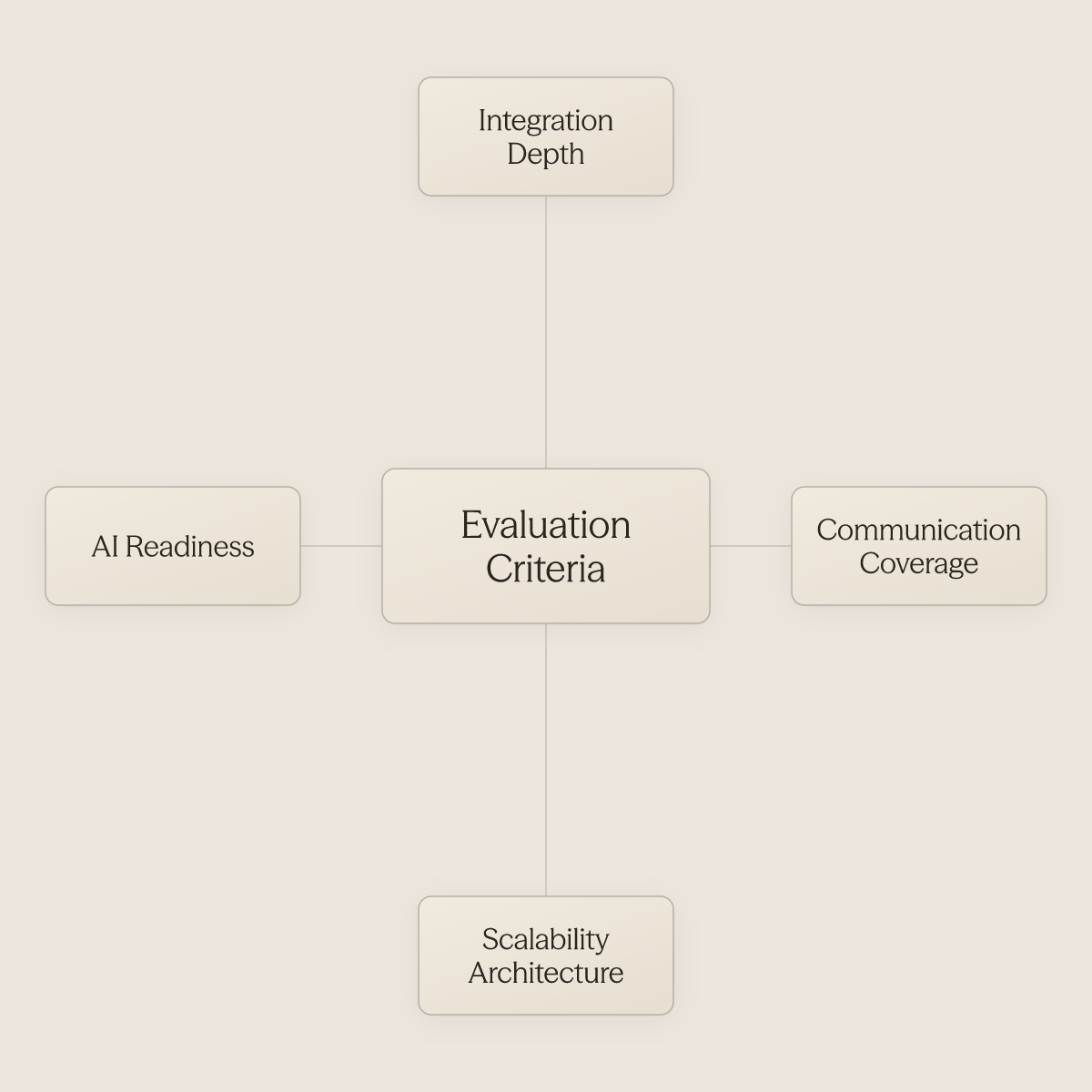
Five Criteria That Separate 2026's Best Systems
The booking flow is table stakes; every leading platform evaluated in this guide passes that test. The criteria that matter are integration depth (does the system connect cleanly to your PMS and OTA stack without creating manual reconciliation work), communication coverage (what happens to guest messages between confirmation and checkout), scalability architecture (can the system absorb portfolio growth without forcing proportional headcount increases), reporting granularity, and AI readiness. That last criterion is the one most evaluation frameworks skip entirely.
Communication coverage deserves particular scrutiny because the gap is widest there. A 2 a.m. broken-heater message gets a substantive, property-specific response without a coordinator on call.
That coverage is most valuable when a business receives a high volume of repetitive guest messages and already has existing documentation, SOPs, FAQs, operational manuals, to train the agent on. Properties with that documentation in place can reach their first automated guest reply within days of connecting their materials; properties without it are not AI-ready regardless of which reservation platform they select. Scalability architecture follows directly: because the AI Agent handles the communication layer autonomously, adding properties multiplies throughput without requiring proportional headcount increases.
The Inbox surfaces every conversation the AI is managing so the operations or support team can monitor, review, and intervene, most beneficial when juggling guest communications across multiple platforms or properties simultaneously.
The One Question Most Hotel Reservation System Buyers Forget to Ask
Most buyers ask how many OTA channels the system supports. The better question is: does this platform have a structured pathway for an AI communication layer to train on my SOPs, FAQs, and operational manuals? This reframes the standard integration depth criterion entirely. Operators have been measuring integration in the wrong direction, evaluating how well a reservation system connects to existing PMS and OTA stacks, when the more consequential test is whether the system can ingest property-specific operational knowledge and put it to work autonomously.
Conduit.ai's Integrations feature addresses exactly this gap. If a property already stores its guest guides, house rules, or FAQ documents in tools like Notion, Google Drive, or Airbnb, the AI agent can leverage that existing content without manual re-entry. The first source is connected and syncing within minutes of linking the account.
From there, Workflows let operators encode recurring, predictable guest touchpoints, post-booking confirmations, check-in instructions, post-stay follow-ups, so that after a trigger event fires (a booking confirmed, a check-in recorded, a specific keyword detected in a message), the action executes automatically without staff intervention. The first custom rule that changes how the agent responds can be live the same day. Properties with that documentation already in place can achieve immediate automation ROI; properties without it are not AI-ready regardless of which reservation platform they select.
Automation readiness is a prerequisite filter, not a post-purchase optimization.
What Automated Hotel Reservation Systems Typically Cost and How Long Implementation Really Takes
Automated hotel reservation systems vary widely in cost for SMB and mid-market operators, with enterprise and multi-property tiers priced on portfolio size. Implementation timelines vary significantly by setup model: managed onboarding runs 24 to 48 hours for event-focused platforms, while DIY cloud configurations average two to four weeks, according to Event Hotel Stay. For the AI communication layer specifically, the sequencing is faster than most operators expect: source integrations go live within minutes of account linking, custom behavioral rules take effect the same day, and automated guest replies are typically running within days of uploading SOPs and manuals, timelines that bear no resemblance to the multi-month professional-services engagements that defined earlier automation generations.
How to Integrate AI Agents for Front-Desk Automation - The Layer Most Reservation Systems Don't Provide
Every confirmed reservation triggers a celebration in the dashboard, and then the real work begins. Check-in instructions, maintenance requests, late-checkout negotiations, mid-stay complaints: none of that flows through the booking engine. It lands in whoever's inbox is open, at whatever hour the guest decides to write, which, more often than not, is outside business hours, when no one is there to catch it.
"Small businesses miss customer interactions outside business hours because their reservation or front-desk systems lack 24/7 coverage, a gap AI front-desk agents are positioned to fill."
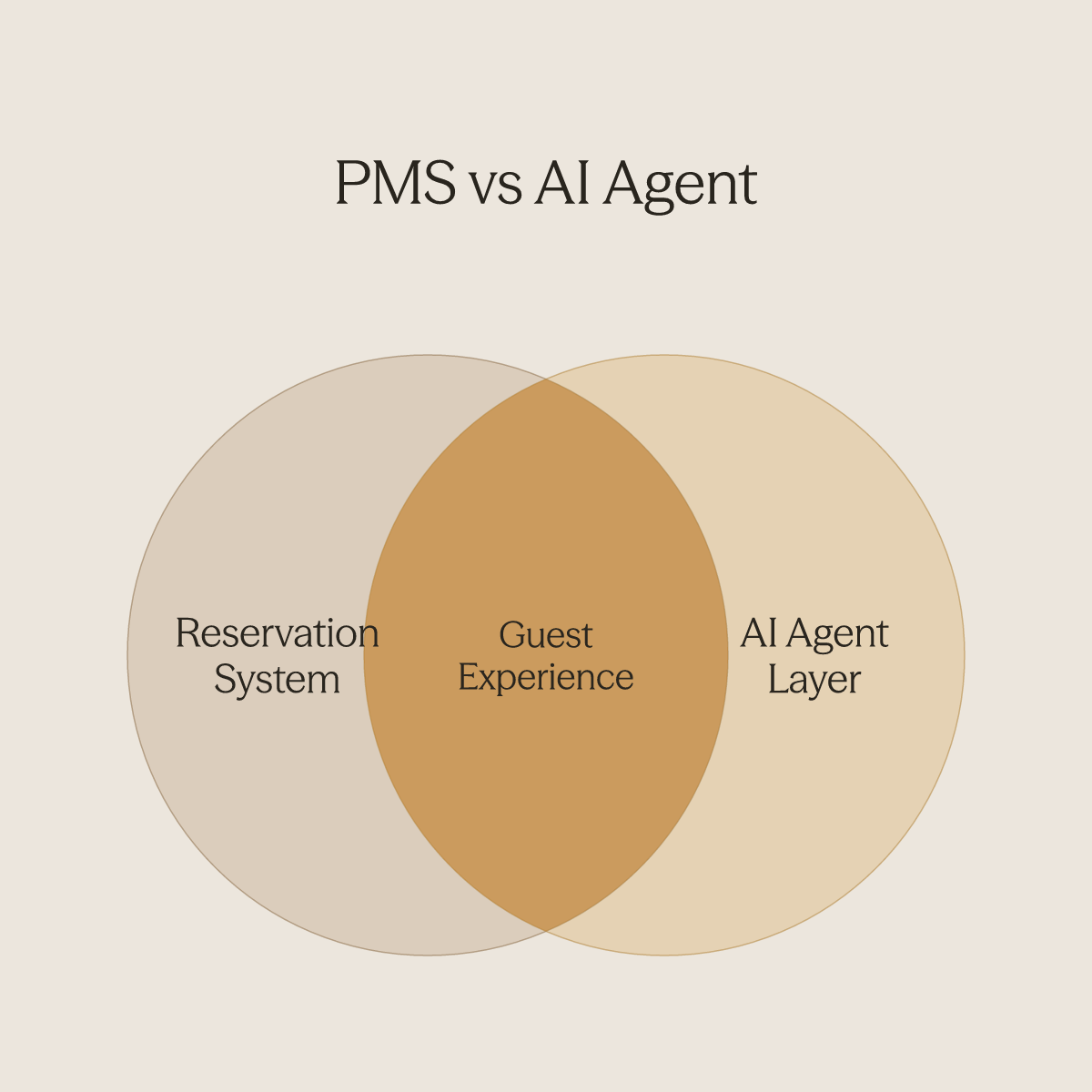
What Your Reservation System Doesn't Handle, and How AI Agents Fill the Gap
The documented performance results from AI agent integration reveal a structural architecture that no industry source explicitly names: the reservation system and the AI agent layer are not competing products or feature sets. They are two distinct operational layers with non-overlapping jobs. The PMS owns the transaction; the AI agent owns the relationship. AI for hospitality case results, resolution time cut from 15 to 3 minutes at Wynwood House across 7 countries, and a 4.9 communications score maintained at 60% automation at Cascadia Getaways, illustrate this distinction clearly. Properties that evaluate AI communication tools as reservation system features are misclassifying the product category and will consistently underinvest in the layer responsible for the majority of guest-perceived quality.
One of the most consistent patterns we see among independent operators is that guest messages arrive before, during, and after a stay, continuously, across email, SMS, WhatsApp, and OTA messaging, while their reservation system is engineered to handle exactly one moment: the booking itself. The gap between those two things is where guest experience is actually won or lost. Small properties that rely on their front-desk or booking system for round-the-clock coverage discover the hard way that the system was never designed for it. These are not competing products; they are two distinct operational jobs, and conflating them is why operators consistently underinvest in the layer guests actually experience.
A Five-Step Integration Checklist
Integrating an AI agent for front-desk automation follows a repeatable path:
- Audit your existing SOPs, FAQs, and guest-facing manuals.
- Connect those documents to the agent builder, no IT team required.
- If your documentation already lives in Notion or Google Drive, Conduit's Integrations pull from those sources directly so nothing needs to be re-entered manually.
- Map the channels where guests actually reach you: email, SMS, WhatsApp, OTA messaging.
- Run a supervised pilot on your highest-volume message categories.
- Deploy across all channels and shift staff to exception handling, monitored through the unified Inbox your operations team uses to review every conversation the agent is managing.
The condition that makes this worthwhile is specific: high message volume, repetitive guest inquiries, and existing documentation. If you receive a steady stream of the same check-in questions, parking instructions, and early-checkout requests, and those answers already exist somewhere in a Google Drive folder or a Notion SOP, the agent is trained on what you already have, and the first automated guest reply typically goes live within days of connecting your materials. For operators managing communications across multiple properties or platforms simultaneously, the Inbox consolidates every conversation into one place, eliminating the platform-switching that inflates resolution time and lets messages slip through overnight.
Workflows extend this further: once a trigger event occurs, a booking confirmation, a check-in, a keyword detected in a guest message, a pre-mapped response sequence fires automatically, handling the recurring, predictable touchpoints that currently consume staff time on a task-by-task basis. The combination of AI Agents, Workflows, and Integrations means the system is doing the work continuously, not only when someone on your team happens to be available.
Wynwood House, 15 to 3 Minutes Across 7 Countries
Wynwood House's customer experience team was averaging around 15 minutes per resolution, switching between platforms to draft replies, translate messages, and track sentiment manually. After consolidating into a single AI-powered inbox, resolution time dropped to 3 minutes across seven countries in Latin America and Europe. Mayra, their Global Head of Customer Experience, attributed the gain directly to eliminating platform-switching and centralizing every guest conversation, the same structural shift the Conduit Inbox is designed to enable for operations teams managing guest communications at scale.
Related Reading
- Best Revenue Management Software For Hotels
- Siteminder Competitors
- Digital Concierge Software
- Hospitality Conferences
- Hotel Distribution Management
- Best Hotel Channel Manager Software
- Canary Technologies Competitors
- Cloudbeds Alternatives
- Hospitality Chatbot
Next steps
If your team is still fielding guest messages at midnight while your reservation system sits idle after the confirmation fires, the path forward starts with recognizing that the PMS and the AI agent layer are two distinct operational jobs, not competing features inside one platform. Start with our AI for hospitality.
Channel managers eliminate overbooking across 450-plus OTAs, but they go structurally silent the moment the booking confirms, meaning the administrative hours they appear to save quietly migrate into manual message triage instead of revenue-generating activity. At the same time, off-hours response failures suppress booking conversion by as much as 116% while pre-arrival messaging alone generates $95 per booking in upsell revenue, a dual revenue leak that no reservation system metric currently surfaces. Together, those two realities point to one action: adding a purpose-built AI communication layer trained on your own SOPs and FAQs, so the relationship work that starts after every confirmation gets the same coverage your transaction layer already provides around the clock.
Start with AI for hospitality to see how Conduit trains AI agents on your existing documentation and closes the post-booking communication gap across every channel your guests use.
Frequently Asked Questions
What's the actual difference between a hotel booking engine and a reservation system?
A booking engine is just one component inside a broader automated reservation system, it handles the transaction interface where guests search rooms, view pricing, and complete a booking. The full reservation system is the entire ecosystem: booking engine, PMS, and channel manager integrated into one record. Treating them as the same thing creates blind spots in purchasing decisions, typically exposed when the first OTA conflict surfaces or a guest's mid-stay question arrives with no system in sight to handle it.
How do these systems actually prevent double-bookings across Expedia, Airbnb, and other OTAs?
The channel manager component pushes real-time rate and availability updates the moment a reservation is confirmed, syncing inventory simultaneously across every connected OTA platform. The PMS then acts as the single source of truth for rates and availability, so no two channels can ever confirm the same room for the same night.
Does a reservation system handle guest messages and questions automatically, or does that still fall on my team?
Reservation systems stop at the transaction, once the confirmation email fires, pre-arrival questions, check-in instructions, mid-stay maintenance requests, and late checkout negotiations all land outside the system's reach in email inboxes, WhatsApp threads, OTA message portals, and SMS queues. A purpose-built AI guest communication layer like conduit.ai addresses this directly by training AI agents on a property's own SOPs and FAQs to handle those conversations autonomously across channels before, during, and after a stay.
Can the system automatically adjust room rates based on demand, or do I still have to update pricing manually?
A dynamic pricing engine component, like Lighthouse, delivers competitor rate intelligence and demand-signal data that enables continuous, automated pricing decisions, replacing the weekly manual rate reviews a static rate card requires. A static rate set on Monday cannot respond to a Thursday demand spike, but an automated pricing engine can without anyone logging in.
Is guest payment information handled securely without front-desk staff getting involved?
Yes, a PCI-DSS-compliant payment processing layer uses tokenization to handle pre-authorization and no-show charge recovery without front-desk involvement. Automated pre-authorization at booking captures the card credential securely, so late cancellations and no-shows generate a charge rather than a lost night.
Stay in the loop
Get the latest on AI automation, product updates, and customer stories.


