15 Hotel Upselling Techniques to Boost Revenue in 2026


Hotel Upselling Ideas
Boost Revenue Without More Bookings
Most upsell programs underperform because they treat room upgrades and ancillary add-ons as one motion. They are two different guest decisions, two different timing windows, and they need two different systems.
Most heads of operations and VPs of operations at multi-brand or enterprise hospitality groups think that better upselling comes from better staff training: the right scripts, the right incentives, and the right manager holding people accountable at the point of check-in. The real problem is that "upselling" has become a catch-all term that quietly swallows two very different revenue strategies, each with its own timing, channel, and trigger logic. Conflating them is the reason most upsell programs underperform, and why automated guest communication is increasingly where the sharpest operators are routing their attention. See our AI for hospitality for how this works in practice.
Hotel upselling is a revenue management strategy where a guest is offered a better version of what they already booked. A guest reserves a standard king room; the upsell is the suite upgrade. Across the market, this is the primary mechanism for increasing average revenue per booking, and it works best when the offer is relevant, timely, and framed around the guest's comfort rather than the property's inventory pressure.
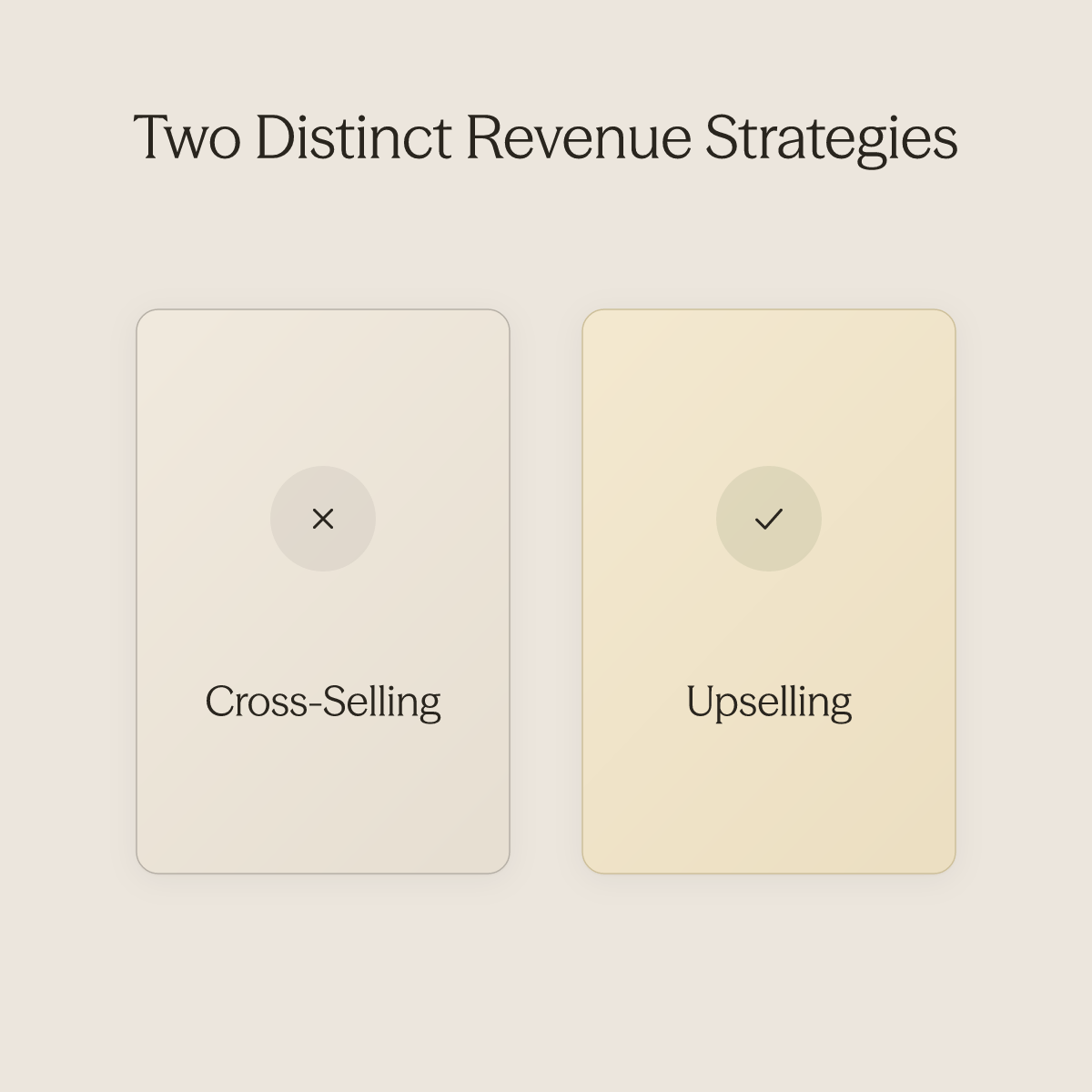
Upsell offers have a narrow window of peak receptivity: the 48-to-72-hour pre-arrival period, when guests are mentally engaged with their trip and not yet fatigued by travel. This benefit materializes most reliably for operations that already have recurring, predictable guest touchpoints, booking confirmations, pre-arrival sequences, post-stay follow-ups, but are still triggering them manually or inconsistently. The same offer sent automatically two days before arrival converts at a measurably higher rate, with no front-desk agent required to remember to make it.
Cross-selling targets revenue streams that sit alongside the booking rather than inside it: spa treatments, airport transfers, in-room dining packages. What most teams report is that cross-selling and upselling require different messaging because they address different guest decisions at different psychological moments. Cross-sell offers land best during the in-stay window, when the guest is present and open to enhancing an experience already underway. Sequencing them correctly creates revenue; conflating them creates noise. The upstream implication is practical: if your upsell program treats room upgrades and ancillary add-ons as a single motion, you are applying one timing model to two fundamentally different guest decisions, and paying for it in conversion rates across both.
Key takeaways
- Upselling and cross-selling are not the same motion, conflating them is why most operators optimize the wrong touchpoint and leave the higher-value window untouched.
- Pre-arrival is the highest-converting upsell moment: Revinate benchmarks put automated pre-arrival emails at $95 per booking in upsell revenue, before a single staff member says a word.
- Most multi-property operations only work one of three available upsell categories, the missed categories aren't a training gap, they're a structural one the current system was never built to reach.
- Upsell revenue that tracks with who's on shift is a systems problem, not a staffing problem, the offer didn't fail because the team forgot the script, it failed because nothing made the offer fire.
- Higher ADR, stronger satisfaction scores, and more repeat bookings aren't independent wins, they compound from the same upsell motion when it runs consistently across every eligible guest.
- conduit.ai's Workflows close the execution gap by triggering upsell sequences automatically based on guest data and conversation events, so the offer fires every time, on every shift, without anyone having to remember.
The Main Categories of Hotel Upselling Opportunities (And Why Most Operators Only Work One)
For multi-property operations teams, the instinct when upsell numbers disappoint is to revisit incentive structures or add a coaching session, a reasonable instinct that targets the wrong constraint. The more revealing question is not how well staff are trained but how many revenue windows the current system is structurally positioned to reach. Three upsell categories exist in every hotel operation.
Most properties work one consistently, treat the second as an afterthought, and barely know the third is a revenue line at all. The result is an upsell program that looks functional but captures only a fraction of its actual potential. This gap is especially visible across LATAM hotel operations, where most operators are leaving significant revenue categories untapped, not from lack of intent, but from lack of infrastructure to reach every window.
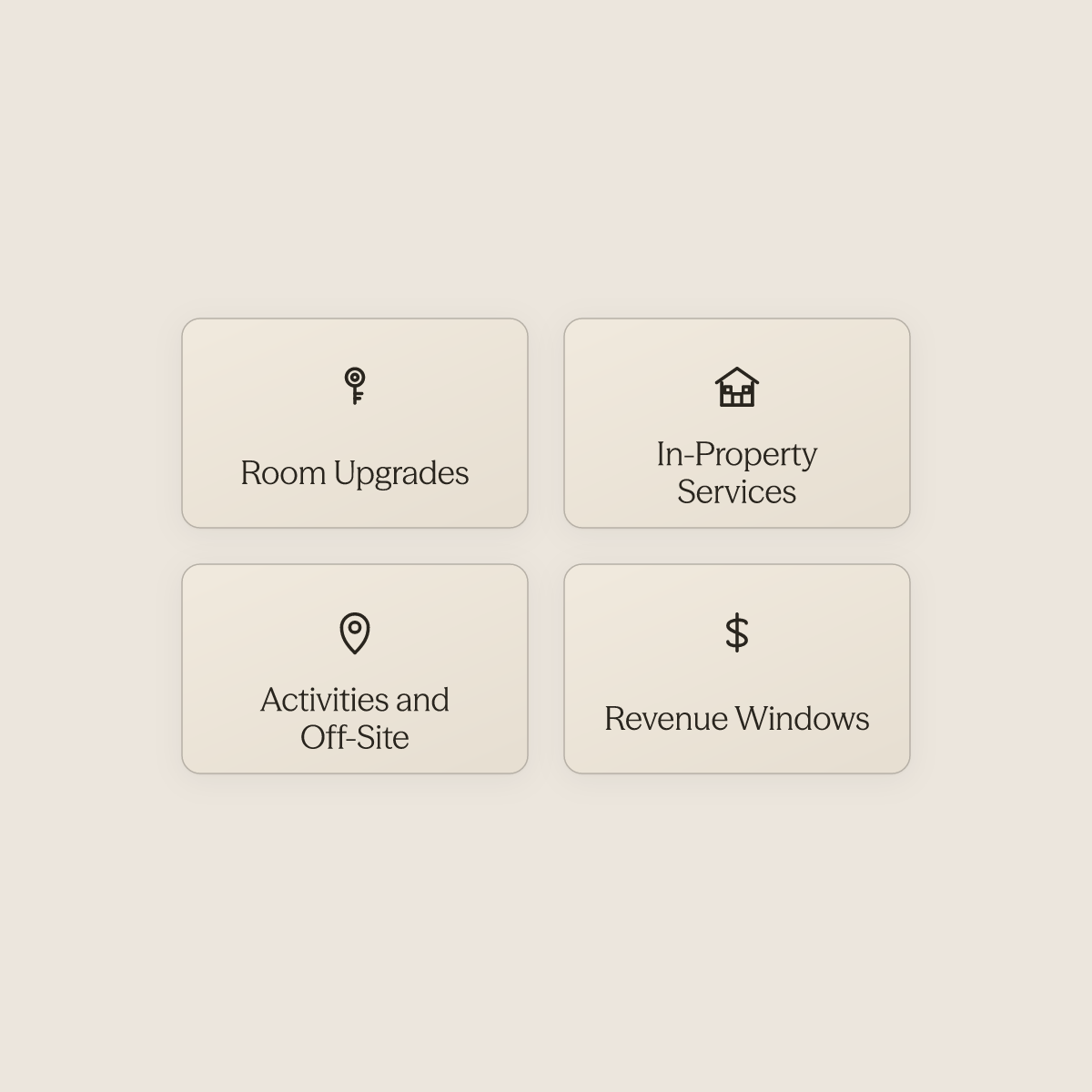
Three Hotel Upselling Categories (Two Chronically Underused)
Hotel upselling opportunities fall into three distinct categories, a taxonomy confirmed by Premier Advisory Group: Room Upgrades and Add-ons, In-Property Services, and Activities and Off-Site Services. Each category lives in a different timing window of the guest journey. Room upgrades belong to the pre-arrival and check-in window. In-property services belong to the in-stay window. Activities and off-site experiences belong to both pre-arrival and mid-stay. Most operators have a system for the first window and improvise through the other two.
In-Property Services Hotels Can Upsell
In-property services are the clearest example of a category that exists on every property and converts reliably when offered, but rarely gets offered consistently. Early check-in, late check-out, breakfast packages, parking, and spa access are high-margin, low-friction additions guests would accept if asked. The problem is timing.
These offers belong to the in-stay window, which is structurally invisible to front-desk staff once a guest has checked in. Busy shifts mean in-stay upsell prompts never happen, not because staff don't care, but because there is no trigger reminding them to make the offer. Tools like Conduit's Workflows feature are built to close that gap.
Workflows fire after a trigger event occurs in a conversation or guest lifecycle, for example, after check-in is confirmed, on day two of a multi-night stay, or when a specific keyword is detected in a guest message. Because the trigger is automated, the offer reaches the guest at the right moment regardless of how busy the front desk is. The operations or brand lead sets the rules; no IT or developer is needed to configure them.
Why Two of the Three Categories Require Automation to Capture, Not Better Staff Training
According to Premier Advisory Group's analysis of hotel upselling strategies, automated pre-arrival upsell campaigns are the primary driver of ancillary revenue gains, not staff-driven check-in scripts. In-property service upsells and activities upsells fail not because staff are undertrained, but because both categories require offers that fire at moments, mid-stay, mid-morning, day two of a multi-night stay, when no front-desk agent is structurally positioned to make them. Automated trigger logic fills that gap in a way that additional training cannot, a point further supported by Mews's research on hotel ancillary revenue.
AI Agents are most effective precisely in this situation: when a property receives a high volume of repetitive guest messages and already has existing documentation, SOPs, FAQs, service menus, to train the agent on. The operator or ops lead connects those documents directly; no IT involvement is required. Once connected, the AI agent begins handling guest conversations continuously, before, during, and after a stay, surfacing the right in-property or activity offer at the moment a guest is most likely to act on it.
For multi-property teams, the Inbox consolidates all of those AI-managed conversations into a single view, so the operations or support team can monitor, review, and manage every interaction across properties simultaneously without adding headcount. The operator links the accounts; again, no developer is needed. The structural gap that keeps two of three upsell categories dark is, in that sense, a configuration problem, not a training problem.
Key Benefits of Hotel Upselling - ADR, TRevPAR, and Guest Loyalty in One Motion
Hard numbers tell a specific story here. Hotel upselling delivers three measurable outcomes: higher revenue per available room, stronger guest satisfaction scores, and more repeat bookings. According to the Revinate 2024 Hospitality Benchmark Report, these outcomes are not independent wins. They form a single loop, and the loop only closes consistently when upselling runs on a system rather than a person's memory, particularly for operations teams managing guest communications across multiple properties simultaneously.
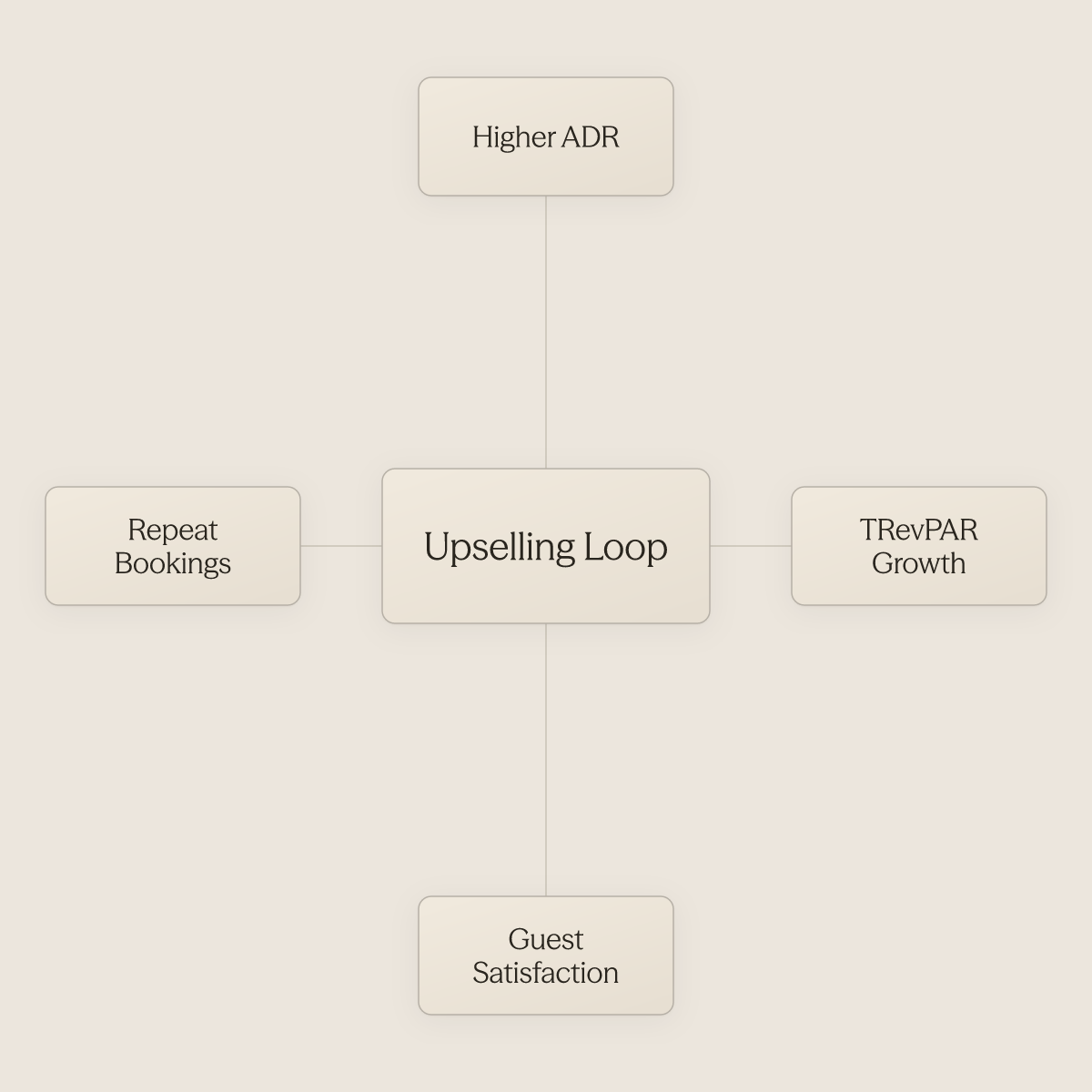
ADR and TRevPAR - Why Upselling Moves Both Needles Simultaneously
ADR measures what guests pay for the room. TRevPAR measures what guests spend across the entire stay, including spa, dining, activities, and add-ons. A hotel that personalizes pre-arrival upgrade offers by guest tier lifts ADR without touching rack rate, while every accepted ancillary offer pushes TRevPAR higher.
The Revinate 2024 Hospitality Benchmark Report identifies upselling and ancillary revenue programs as a primary lever for improving TRevPAR specifically because they capture spend the room rate never touches. Tracking only ADR leaves that revenue invisible. The operational challenge compounds for multi-property teams.
When a revenue manager or operations lead needs to demonstrate measurable improvements in guest satisfaction metrics to leadership across several locations, manually coordinating pre-arrival upsell touchpoints at each property creates an unsustainable workload. That bottleneck, not strategic intent, is usually why upsell programs underperform.
Revinate Data: Personalized Offers Earn Trust, Not Just Revenue Personalized email campaigns generate 3x more revenue per email than non-personalized campaigns, according to the Revinate 2024 Hospitality Benchmark Report. A guest who receives an upgrade matched to their booking history feels recognized, not sold to. That distinction drives reviews, satisfaction scores, and the probability they book directly next time rather than through an OTA.
This dynamic is also documented in Revinate's EMEA benchmark findings, reinforcing that personalization's revenue lift is not a regional anomaly, it is a repeatable outcome tied to how the offer is delivered, not just what the offer contains. For teams already using tools like Notion or Google Drive to store SOPs, guest FAQs, and upsell playbooks, that existing documentation is the foundation.
Why Consistency Closes the Loop
The loop breaks the moment upselling becomes optional. Pre-arrival automated upsells consistently outperform desk-driven offers because the channel does not depend on shift coverage, cognitive bandwidth, or a front-desk agent remembering to make the offer during a six-deep check-in queue.
And triggers a pre-arrival upsell window should receive that offer just as reliably as one who books at noon on a Tuesday. Eliminating the operational bottleneck of around-the-clock guest communication is precisely what moves upselling from a best-effort practice to a closed-loop system. With Conduit, Workflows fire after a trigger event, such as a booking confirmation or a detected keyword in a guest message, without requiring manual staff action at the moment of send.
AI Agents handle the high volume of repetitive pre-arrival and in-stay messages continuously, before, during, and after a stay. The Inbox gives operations teams a single place to monitor, review, and manage every conversation the AI agent is handling across properties. When the trigger lives in a workflow rather than a person's memory, the loop closes on every eligible guest, not just the ones who happen to arrive at the right moment.
Guest Satisfaction Scores as a Revenue Signal, Not Just a Vanity Metric
Satisfaction scores are often treated as a reporting obligation rather than a forward-looking revenue indicator, but the relationship between the two is direct and measurable. A guest who receives a relevant, well-timed upgrade offer before arrival arrives with expectations already shaped positively. When the stay then matches or exceeds what was offered, the review reflects that alignment. The Revinate 2024 Hospitality Benchmark Report establishes that personalized pre-arrival communication is one of the strongest predictors of post-stay satisfaction scores, precisely because the guest feels the property understood their stay before it began.
For operations teams managing multiple properties, this creates a compounding advantage. Higher satisfaction scores improve organic search visibility on OTAs and review platforms, reduce the cost of acquiring the next guest, and increase the probability of a direct repeat booking. Each of those outcomes reduces distribution cost and improves net revenue per booking, meaning satisfaction scores function as a lagging indicator of upsell program quality and a leading indicator of future RevPAR performance. Teams that track satisfaction scores alongside ADR and TRevPAR get an early signal when upsell messaging is landing well and an early warning when it is not, before the revenue impact becomes visible in monthly reporting.
15 Hotel Upselling Techniques That Actually Convert in 2026
Pre-arrival emails generate $95 per booking in upsell revenue, according to Revinate's guest journey benchmarks. That single number reframes where hotel upselling actually happens, not at the front desk, not during check-in, but days before the guest arrives, in an automated sequence that runs without a single staff member involved. The common assumption is that upselling is a front-desk skill: hire better agents, write sharper scripts, run quarterly coaching sessions.
That logic is incomplete. Training improves individual ceilings but does not standardize outcomes across every shift, every property, and every guest segment. The three highest-yield upsell categories, room upgrades, in-property services, and off-site experiences, each require offers at distinct moments across the guest journey, most of which fall outside the check-in window.
Automated workflows are the only mechanism that can consistently cover all three windows simultaneously, pre-arrival triggers fire before the guest arrives, in-stay prompts fire while they are on property, and post-stay sequences fire after checkout, regardless of which staff member is working each shift. Erwan Le Roy's 35-property operation, Cash Flow Street, reached 96% AI automation with sub-one-minute response times because upsell triggers are baked into repeatable workflows rather than left to staff memory. His virtual assistant team was redeployed from routine inbox management into active upselling and business development.
That is the structural shift this section maps across 15 techniques.
Check-In Window - Buying Signal Techniques
Effective front desk upselling starts with listening, not pitching. Frontline Performance Group's front desk upsell training shows that agents trained to identify buying signals, rather than deliver scripted pitches, produce measurable RevPAR lift. The signals are specific and learnable.
Buying Signal - Room Type Question
When a guest asks "What room am I in?" or "What floor is that on?", they are signaling openness to a conversation about their accommodation. That is the moment to present an upgrade. Front desk staff trained to treat that question as an invitation rather than an information request convert at meaningfully higher rates than those working from a generic script.
Buying Signal - View or Feature Request
The guest has already decided they want something better. The agent's job is to confirm availability, name a specific room, and quote a price. Vague responses ("I can check") kill the conversion. Specific, confident responses ("Room 412 has a direct ocean view and is available for $35 more tonight") close it.
Buying Signal - Special Occasion Mention
Guests who mention a birthday, anniversary, or honeymoon at check-in are signaling that this stay matters to them. A trained agent who acknowledges the occasion and connects it to an available upgrade or amenity package converts at higher rates than one who processes the check-in and moves on. This is the one upsell technique that genuinely requires human warmth, automation cannot replicate the in-person acknowledgment.
How to Execute All 15 Upselling Techniques Consistently Across Every Property
Most operators will recognize the pre-arrival techniques as the highest-leverage plays, and also recognize that executing all five consistently across a 10- or 35-property portfolio is structurally impossible without automation. A front desk agent who remembers to offer a late checkout on a busy Saturday morning is doing their job well. A system that fires the offer automatically to every eligible guest the night before, regardless of who is working, is doing something structurally different.
The familiar approach is to train harder and script better, then accept that consistency will vary by shift and property. The hidden cost is not just missed revenue per booking, it is the absence of reliable data on which offers convert, which segments respond, and which properties are leaving the most on the table. Without automated triggers, there is no consistent baseline to measure against.
Conduit's Workflows feature lets operations teams encode each upsell trigger (booking segment, occasion flag, occupancy threshold, post-stay satisfaction score) into a repeatable automated sequence that fires at the right moment for every guest, on every property, on every shift. That architecture is what enabled Erwan Le Roy's operation to reach 96% AI automation and redeploy his team from routine messaging into active revenue generation. This workflow layer does not replace front desk judgment, it ensures that pre-arrival and in-stay techniques actually fire, so the front desk team can focus on the buying signals that genuinely require a human in the room.
Knowing which technique to deploy is only half the equation. Knowing exactly what to say, and whether a human or an automated message should say it first, is where conversion is won or lost. The next section breaks down the scripts and sequencing logic that make each of these techniques land.
1. AI-Powered Pre-Arrival Upsell Emails Triggered by Booking Segment
Pre-arrival emails generate an average of $95 per booking in upsell revenue, making them the highest-ROI touchpoint in the guest journey. This technique works best for full-service hotels with segmented CRM data, honeymooners get romance packages, business travelers get early check-in. The tradeoff: without clean segmentation data, generic blasts underperform and can feel intrusive rather than helpful.
2. Digital Pre-Check-In Room Upgrade Bidding via Mobile App
Letting guests bid on room upgrades through a mobile pre-check-in flow converts upgrade anxiety into excitement and drives incremental RevPAR without devaluing rack rates. It suits mid-to-large hotels with varied room inventory, boutique properties with only two room types see limited lift. The key limitation is that it requires a robust PMS integration to manage real-time inventory availability accurately.
3. Front Desk Upsell Scripts Anchored to Visible Room Benefit Comparisons
Training front desk agents to present upgrades using side-by-side benefit comparisons, 'Your current room has a city view; for $35 more you get a private balcony and ocean view', dramatically increases conversion versus vague upgrade pitches. This technique is ideal for properties with strong staff tenure and ongoing coaching programs. The tradeoff is inconsistency: high staff turnover erodes script adherence and conversion rates quickly.
4. Post-Booking Upsell Landing Pages Embedded in Confirmation Emails
Embedding a personalized upsell landing page link directly inside the booking confirmation email captures guests at peak excitement, immediately after purchase, when they are most receptive to enhancing their stay. Spa credits, airport transfers, and breakfast bundles perform especially well here. The limitation is click-through dependency: hotels with low email open rates will see minimal incremental revenue without first fixing deliverability and subject-line optimization.
5. In-Stay WhatsApp and SMS Upsell Messaging for F&B and Spa
Sending contextual upsell offers via WhatsApp or SMS during the stay, a dinner reservation prompt at 4 PM or a spa deal on a rainy afternoon, meets guests on the channel they already use and drives same-day F&B and wellness revenue. This works best for lifestyle and resort hotels with on-site amenities to sell. The tradeoff is opt-in friction: GDPR and TCPA compliance requirements mean hotels must collect explicit messaging consent at booking.
6. Experience Bundling - Curated Local Activity Packages Sold at Booking
Packaging hotel stays with curated local experiences, guided tours, cooking classes, wine tastings, at a bundled price increases perceived value and average booking value simultaneously. This technique resonates strongly with experience-driven leisure travelers and boutique hotels in destination markets. The limitation is operational complexity: hotels must vet, contract, and coordinate with third-party experience providers, which adds overhead that smaller properties may struggle to manage.
7. Dynamic Pricing Upsells That Adjust Upgrade Offers Based on Occupancy
Using revenue management logic to dynamically price upgrade offers, lowering the upgrade delta when occupancy is high to clear premium inventory, raising it when demand is soft, maximizes both conversion and yield simultaneously. This is the right approach for hotels already running a revenue management system with real-time occupancy data. The tradeoff: without proper RMS integration, manual dynamic pricing is error-prone and time-consuming for revenue managers.
8. Spa and Wellness Upsell Add-Ons Triggered by Guest Profile Data
Presenting spa and wellness add-ons, massages, facials, hydrotherapy sessions, based on guest profile signals like repeat stay history, room type booked, or declared travel purpose drives significantly higher attachment rates than blanket promotions. Resort and full-service hotels with on-site spas see the strongest ROI. The limitation is data dependency: hotels without a unified guest profile or CRM cannot personalize offers and revert to low-converting generic promotions.
9. Early Check-In and Late Check-Out as Paid Premium Upsells
Monetizing early check-in and late check-out as explicit paid add-ons, rather than complimentary gestures, converts a previously free loyalty perk into a reliable ancillary revenue stream. This technique is particularly effective for airport-adjacent hotels and business travel properties where schedule flexibility has high perceived value. The key tradeoff is loyalty program tension: frequent guests accustomed to complimentary flexibility may perceive the shift negatively if not communicated carefully.
10. In-Room Digital Upsell Menus via Smart TV or QR-Code Tablet
Replacing printed in-room compendiums with interactive digital menus on smart TVs or QR-linked tablets allows hotels to present F&B, spa, and activity upsells with photos, pricing, and one-tap ordering 24/7 without staff involvement. This is ideal for tech-forward hotels targeting millennial and Gen Z guests who prefer self-service. The limitation is adoption: older guest demographics and properties with inconsistent Wi-Fi infrastructure see significantly lower engagement rates.
11. Loyalty Tier Upgrade Upsells That Accelerate Points or Status
Offering guests the ability to pay a small fee to jump to the next loyalty tier or earn bonus points on their current stay creates a compelling upsell framed as an investment in future value rather than a cost. This technique converts best with frequent travelers who are close to a tier threshold and already engaged with the loyalty program. The tradeoff is program complexity: hotels without a proprietary loyalty system must rely on OTA or chain-level programs where they have limited control over offer mechanics.
12. Romantic and Celebration Package Upsells Triggered by Occasion Flags
Automatically surfacing anniversary, honeymoon, or birthday packages when guests flag a special occasion during booking captures high-intent upsell moments with minimal friction. Champagne on arrival, rose petal turndown, and couples spa credits are proven high-margin add-ons for this segment. The limitation is occasion data capture: hotels that do not prompt guests to declare their travel purpose at booking miss the trigger entirely and cannot retroactively personalize the offer.
13. Upsell Automation Platforms That Score Guest Propensity to Buy
Dedicated hotel upselling platforms use machine learning to score each guest's likelihood to purchase specific add-ons based on booking source, room type, stay length, and historical behavior, then serve the highest-probability offer at the optimal moment. This is the right investment for hotel groups managing multiple properties at scale. The tradeoff is cost and implementation time: standalone upsell platforms require PMS integration, staff training, and a minimum data volume to generate reliable propensity scores.
14. F&B Breakfast Bundle Upsells Offered at a Discount vs. Walk-In Rate
Presenting breakfast as a pre-paid bundle at a 15–20% discount versus the walk-in restaurant rate creates urgency and perceived savings that convert well during the booking and pre-arrival phases. This technique is especially effective for European travelers and business guests who value predictable morning routines. The key limitation is margin management: hotels must price the bundle carefully to avoid cannibalizing full-price F&B revenue from guests who would have paid walk-in rates regardless.
15. Concierge-Led Upselling Through Personalized Pre-Arrival Itinerary Emails
Having a concierge or guest experience team send a personalized pre-arrival email with a curated itinerary, including bookable hotel services woven naturally into the recommendations, blends hospitality with revenue generation in a way that feels genuinely helpful rather than sales-driven. Luxury and boutique hotels with dedicated concierge staff see the highest conversion. The tradeoff is labor intensity: this approach does not scale without automation tools or AI-assisted itinerary drafting to reduce per-guest effort.
Related Reading
- How To Improve Hotel Operations
- Hotel Demand Forecasting
- Hospitality Operations Management
- How To Increase Revpar
- Hotel Revenue Management Strategies
- Automated Hotel Reservation System
- Hotel Budgeting And Forecasting
- Hotel Guest Messaging
- Hospitality Automation
- Adr Vs Revpar
Hotel Upselling Scripts - What to Say at the Desk (and When to Let Automation Say It First)
The scripts and sequencing logic covered below are only as effective as the people and systems delivering them. A well-trained front-desk agent is a genuine revenue asset, but even your best agent is off shift sometimes, distracted during a Friday night rush, or working a lobby too busy to pause for an upgrade conversation. Scripts sharpen individual performance, but they cannot standardize outcomes across every shift, every property, and every guest.
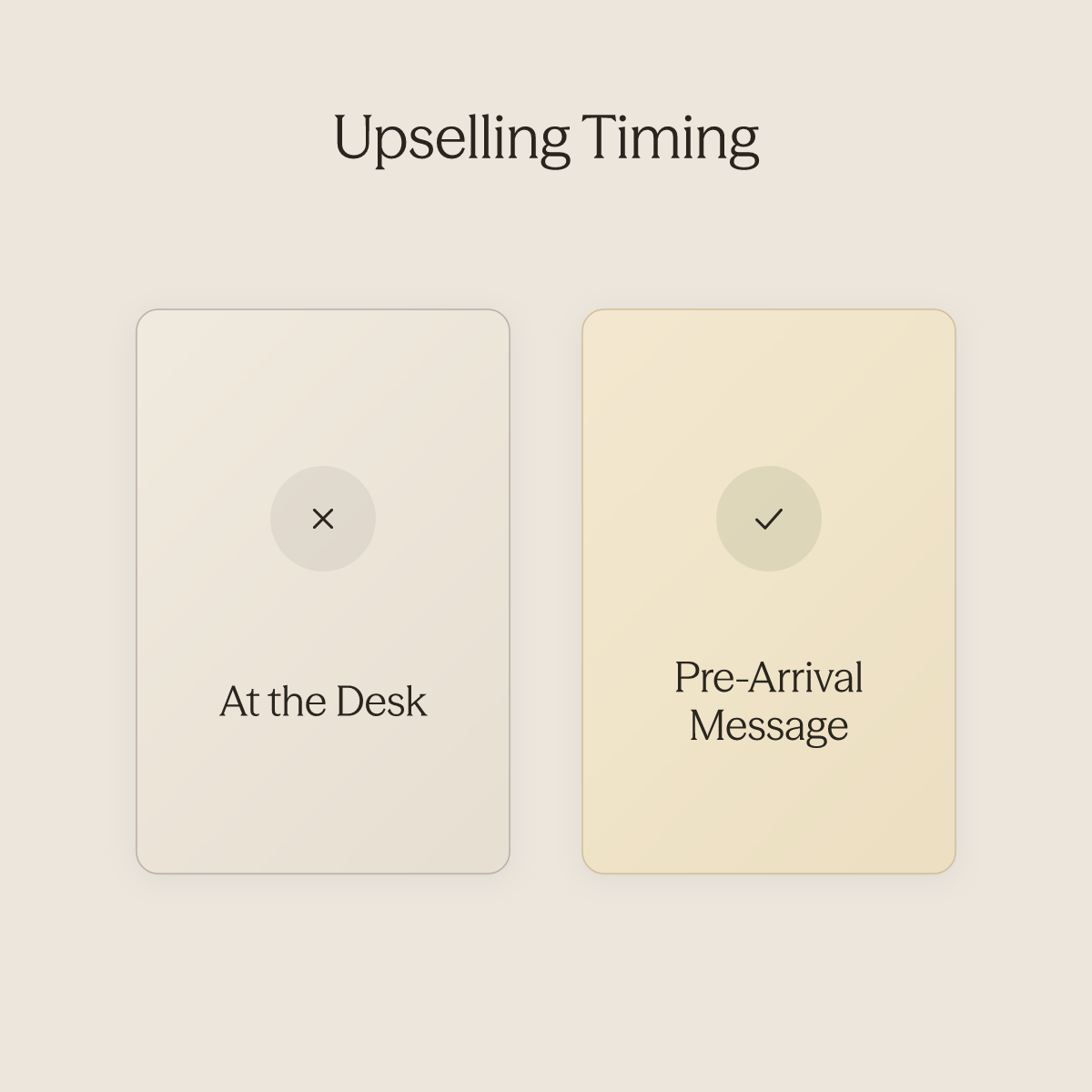
Front-Desk Script Fragments Mapped to Guest Buying Signals
Buying signals at check-in are worth capturing. A guest who mentions they're celebrating an anniversary or asks about a better view is an open door. A trained agent can respond: "You're in our Deluxe King on the fourth floor. We do have a Corner Suite available tonight with a city view for $45 more." Direct, specific, low-friction. These fragments work because they meet the guest's stated interest rather than interrupting it.
The catch, as multiple industry sources note, is that these moments are only captured when a trained agent is present, attentive, and not managing four other check-ins simultaneously.
The guest who arrives at your front desk is cognitively overloaded. They want their room and are the least receptive version of themselves. The same guest, reached 24 to 48 hours earlier by a pre-arrival message, is in a planning mindset and far more open to a considered upgrade decision. Revinate's benchmarks put pre-arrival upsell revenue at $95 per booking, a figure that reflects this receptivity gap. Automated guest communication built on workflow triggers fires the offer at the optimal window regardless of which agent is working, removing the dependency on staff timing and memory entirely.
Hotel Upselling Scripts Are a Ceiling Fix, Not a Floor Fix
Scripts raise the ceiling for individual agents, but without an automated workflow layer underneath, the floor of your upsell program stays wherever your weakest shift sets it. Scripts are a training investment, not a systems investment, and those two things fix different things, especially across a multi-property portfolio where consistency requires triggers that fire by default, not by memory.
Hotel Upselling Software Tools That Automate What Staff Can't Consistently Do
The operators who get this wrong don't pick a bad tool. They pick the right tool and configure it like a feature checklist, never asking the one question that determines whether upsell revenue compounds: does this platform fire the offer automatically, or does it wait for someone to remember? That distinction is the real selection criterion for hotel upselling software in 2026.
Most multi-property operators evaluate these platforms by counting integrations, comparing template libraries, and asking which system connects to their PMS. In practice, a platform with forty upsell templates that requires a front-desk agent to initiate the offer is structurally identical to no platform at all. The moment staff are stretched thin or mid-shift on a busy Friday, the revenue window closes.
Shifting upsell timing by even 24 hours can double conversion rates while improving guest satisfaction scores, rather than relying on desk delivery at check-in, because the guest is in a planning mindset rather than a fatigued, cognitively overloaded one. That lift only materializes if the trigger fires automatically. The struggle is one that surfaces across every stage of hotel operations, and it's especially acute for newer operators without a deep ops background: vendor after vendor pitches upselling tools that look automated on a demo slide but, in practice, still require a human to press send.
Distinguishing genuinely automated software from an expensive reminder system is one of the hardest evaluation problems in this category. The tell is always the same, where does the trigger live? If it lives inside a staff member's memory or daily checklist, it will be skipped the moment that staff member is managing three other conversations.
That structural fragility compounds across departments. Staff inconsistency in communicating upsell opportunities isn't a hiring problem or a training problem; it's a workflow architecture problem. A front-desk agent who fields a late-checkout request may never relay the corresponding upsell opportunity to the appropriate queue.
A room-upgrade offer verbally made at check-in disappears if the guest says "let me think about it" and the agent moves on. The research on upsell timing is clear: the offer that arrives at the right moment in the guest lifecycle, not when a human happens to remember, is the offer that converts. The right evaluation question is not "what does this tool offer?"
M. late-checkout nudge without a single manual action, enforcing the same upsell cadence whether the property has two front-desk agents or twenty. At 35-property scale, Erwan Le Roy's operation reached 96% AI automation and sub-one-minute response times, and his team shifted their focus from routine inbox management into active revenue generation and guest relationship work, precisely because upsell triggers are baked into workflows rather than left to individual staff execution.
There is a second dimension that matters beyond timing, and it directly connects to review scores: the quality of the automated reply itself. Multi-property operators who have lived through early chatbot deployments know the reputational cost of robotic, obviously-AI responses, guests flag them, review them, and remember them. Mayra, Global Head of Customer Experience at Wynwood House, put it plainly: *"The first thing we noticed was the quality of the AI replies.
You cannot tell the difference between an AI agent and a human agent. I work with ChatGPT and other AI tools every day, and sometimes you can immediately tell it's AI. With Conduit, we're not seeing that.
"* That distinction matters operationally: a guest who receives a natural, on-brand reply to a pre-arrival upsell offer is in a fundamentally different emotional state than one who receives a template that reads like a template. The former converts and protects your review score; the latter creates friction before the stay has begun. Industry data puts the hotel upselling software market on a strong growth trajectory through 2026, reflecting adoption by enterprise operators who've moved past pilot programs and into portfolio-wide deployment.
That context matters when presenting a software investment to a buying committee: this is a mature, validated revenue motion, not a test. The fourteen platforms below are evaluated on workflow architecture first, feature depth second. Each entry names the operator profile it fits best and the real tradeoff that belongs on your shortlist.
1. Conduit.ai - Best AI-Driven Hotel Upselling Automation Platform
Conduit.ai earns the top position for multi-property operators whose upsell revenue currently depends on which agent is working the desk, a structural dependency illustrated by Erwan Le Roy's 35-property operation (Cash Flow Street), which reached 96% AI automation and sub-one-minute response times after encoding upsell triggers into Conduit Workflows rather than relying on staff memory. Its Workflows feature builds event-driven automation sequences that encode upsell triggers, booking confirmation, 72-hour pre-arrival upgrade offer, in-stay day-two prompt, late-checkout nudge, into a single repeatable cadence that fires for every guest on every property without manual initiation. Workflows are most beneficial when the business has recurring, predictable guest touchpoints that currently require manual staff action; they activate after a trigger event occurs in a conversation or guest lifecycle, after a booking is confirmed, after check-in, or when a specific keyword is detected.
That architecture is what allows a 35-property operation to enforce consistent upsell timing whether the property has two front-desk agents or twenty. The AI Agents layer handles the actual guest-facing communication, and it is where Conduit separates from platforms that automate the trigger but still deliver a noticeably robotic reply. The agents are trained on the property's existing documentation, SOPs, FAQs, brand standards, escalation policies, without requiring manual re-entry.
They are most beneficial when the business receives a high volume of repetitive guest messages and already has that documentation in place. The result, in Mayra's words from Wynwood House, is that guests experience "a full conversation with a human" rather than a detectable AI interaction, a distinction that protects review scores by resolving issues fast and consistently at every touchpoint. For operations with complex, differentiated brand standards across properties, the AI Agents layer supports property-specific behavior: each agent can operate under the escalation policies and guest communication norms of its individual property rather than a single generic profile.
The Integrations capability ensures that if the business already uses tools like Notion, Google Drive, or Airbnb, the AI agent can leverage that existing content without manual re-entry, keeping training overhead low as the portfolio scales. The Inbox sits above all of this, a unified layer where the operations or support team monitors, reviews, and manages every conversation the AI agent is handling across all properties simultaneously. That visibility is what makes portfolio-wide deployment operationally sustainable: the team can see where the AI is performing, where escalations are occurring, and where a specific property's guest communication might need refinement, all from a single surface.
The tradeoff to name honestly: Conduit is most valuable when the property already has documentation, SOPs, FAQs, brand standards, that can train the agent. Operations without that foundation will need to build it before the system can reach its ceiling. For operators who have that documentation and are managing guest communications across multiple platforms or properties simultaneously, the architecture removes the structural bottleneck entirely: the trigger is in the workflow, not in a human memory, and the reply is indistinguishable from a trained human agent.
2. Canary Technologies - Best for Full Guest Journey Upselling
Canary Technologies automates upselling across the entire guest journey, from pre-arrival digital check-in to in-stay messaging and checkout, making it the top-ranked platform on HotelTechReport by verified hoteliers. It suits independent hotels and small groups that want a single tool covering upselling, digital tipping, and guest messaging. The tradeoff is that its breadth means no single feature is as deep as a point-solution specialist.
3. Oaky by Plusgrade - Best for Ancillary Revenue Merchandising
Oaky by Plusgrade specializes in turning ancillary services, spa packages, late checkout, breakfast bundles, into automated revenue streams delivered via personalized pre-arrival emails and a branded guest portal. It excels for full-service hotels and resorts with rich F&B and experience offerings. The limitation is that properties with minimal ancillary inventory won't see the same ROI, as the platform's value scales directly with offer catalog depth.
4. Duve - Best for Personalized Pre-Arrival Upsell Campaigns
Duve automates pre-arrival email and SMS upsell campaigns that are dynamically personalized based on guest segment, booking channel, and room type. It integrates with most major PMS platforms and allows hotels to offer room upgrades, early check-in, and curated local experiences before guests arrive. Best for boutique and lifestyle hotels focused on guest experience differentiation. The tradeoff is limited in-stay upselling capability compared to broader platforms.
5. RoomRaccoon - Best Automated Upselling for Independent Hotels
RoomRaccoon embeds automated upselling directly into its all-in-one PMS, channel manager, and booking engine, making it uniquely suited for independent hotels that want upselling without adding another vendor. Room upgrades and add-ons are presented automatically at booking and pre-arrival without staff prompting. The key limitation is that it's only available to hotels already using RoomRaccoon's PMS, making it a non-starter for properties on other systems.
6. HiJiffy - Best for WhatsApp-Native Hotel Upselling Automation
HiJiffy uses AI-powered conversational automation over WhatsApp to deliver upsell and cross-sell campaigns at scale, capitalizing on the channel's industry-leading open rates. It's the right pick for hotels in markets where WhatsApp dominates guest communication, particularly Europe, Latin America, and the Middle East. The tradeoff is channel dependency: hotels in markets where guests prefer email or SMS will see significantly lower engagement rates.
7. NexGen Guest - Best for Pre-Arrival Room Upgrade Bidding
NexGen Guest automates room upgrade offers before arrival using a bidding or fixed-price model that lets guests self-select upgrades without front-desk negotiation. This removes the inconsistency of staff-led upgrade conversations entirely. It's ideal for hotels with tiered room categories and variable inventory. The limitation is that the upgrade-centric focus means it doesn't cover broader ancillary upselling like dining or spa without additional configuration.
8. Mews - Best PMS-Integrated Upselling for Tech-Forward Hotels
Mews automates upselling through its native guest journey tools, including pre-arrival emails and an online check-in flow that surfaces upgrades and add-ons at the moment of highest intent. Built for tech-forward independent hotels and lifestyle groups, it eliminates the need for a separate upselling vendor. The tradeoff is that Mews requires full PMS migration to access these features, which is a significant commitment for hotels already invested in another system.
9. Akia - Best for SMS and Messaging-Based Upsell Automation
Akia automates hotel upselling through SMS and two-way messaging workflows, enabling properties to send timed, personalized upsell offers that guests can respond to conversationally. It's particularly effective for limited-service and select-service hotels where staff bandwidth is tightest and phone-based guest communication is the norm. The limitation is that its conversational interface requires thoughtful workflow setup, poorly designed message trees can frustrate guests rather than convert them.
10. SiteMinder - Best for Upselling at the Booking Engine Stage
SiteMinder integrates upselling directly into the direct booking engine, presenting room upgrades and add-ons to guests while they are actively completing a reservation, the highest-intent moment in the purchase funnel. This approach captures upsell revenue before the guest even arrives, reducing reliance on post-booking outreach. The tradeoff is that it primarily serves direct bookers, leaving OTA reservations without automated upsell coverage unless supplemented by another tool.
11. Frontline Performance Group - Best for Staff-Assisted Upselling with Automation Support
Frontline Performance Group takes a hybrid approach, using software to prompt and guide front-desk staff through upsell conversations rather than replacing them entirely. It's the right fit for full-service hotels where a human touch at check-in is a brand standard but consistency is lacking. The platform tracks individual staff upsell performance and provides coaching data. The tradeoff is that it still depends on staff execution, making it vulnerable to the same inconsistency it aims to reduce.
12. Zucchetti Hotel Suite - Best for Upselling Automation Within a European PMS Ecosystem
Zucchetti's hotel management suite automates upselling as part of a broader hotel automation framework, making it a strong fit for European independent hotels and groups already operating within the Zucchetti ecosystem. Automated triggers push upgrade and service offers at configurable points in the guest journey. The limitation is geographic and ecosystem concentration, hotels outside Europe or on non-Zucchetti PMS platforms will find integration options limited and support less accessible.
13. Acropolium Custom Revenue Optimization Platform - Best for Enterprise Hotels Needing Bespoke Upsell Logic
Acropolium builds custom hotel revenue optimization and demand forecasting software that can incorporate bespoke upselling logic tailored to a property's specific inventory, pricing strategy, and guest segments. It's the right choice for large hotel groups or resorts with complex upselling rules that off-the-shelf tools can't accommodate. The significant tradeoff is cost and timeline, custom development requires substantial investment and months of build time versus immediate SaaS deployment.
14. In-Stay Digital Concierge Upselling - Best for Capturing Revenue After Check-In
In-stay upselling automation via digital concierge platforms delivers targeted offers, late checkout, dinner reservations, spa bookings, to guests during their stay through mobile web or messaging, when purchase intent is high and staff are unavailable or occupied. This approach captures revenue that pre-arrival campaigns miss entirely. The tradeoff is that in-stay offers require real-time inventory availability data from the PMS and F&B systems, making integration complexity the primary barrier to deployment.
What Metrics Should Hotels Track to Measure Upselling Success?
Revenue totals from upsell programs have a way of looking definitive when they are anything but. A strong month confirms the program is working; a weak one confirms it isn't, and neither figure points to where the breakdown actually lives or which part of the process is responsible. This is a genuine operational blind spot: hotel operators routinely struggle to identify the right financial KPIs to use as a monthly scorecard, which means the gap in standardized upselling performance metrics isn't a knowledge failure, it's a structural one. The numbers exist; the diagnostic framework to read them usually doesn't.
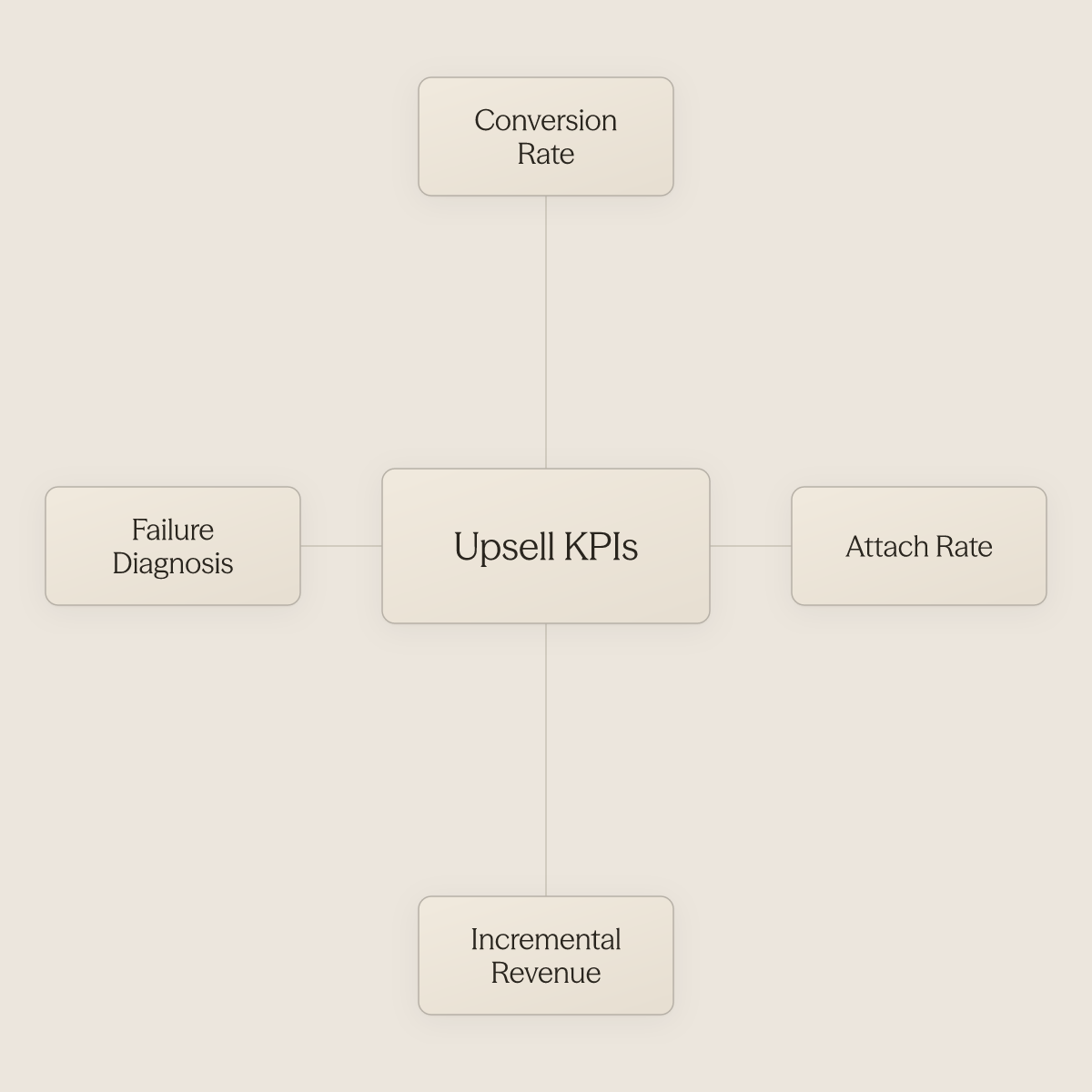
The Three Core Upsell KPIs and What Each One Actually Diagnoses
Hotels that track upselling KPIs properly measure three distinct numbers: conversion rate (offers accepted divided by offers made), attach rate (upsell offers made per check-in), and incremental revenue per booking (additional yield above base booking value). Each diagnoses a different failure mode. Conflating them is like treating a staffing problem with a pricing fix, or rewriting scripts when the real gap is that no one is making offers at all.
Low Conversion Rate Signals an Offer Relevance or Timing Problem
According to data compiled from over 120 client accounts across hospitality, a low conversion rate points to an offer resonance problem, not a staff attitude problem. The offer is reaching guests but not landing, a personalization or timing issue. The correct lever is adjusting what is offered, to whom, and at which moment in the guest journey.
What makes this hard to diagnose manually is that the evidence required, guest history, prior interactions, stated preferences, is rarely in one place. The Wynwood House customer experience team ran into exactly this: agents were forced to constantly switch between platforms to draft messages, translate responses, and review guest history before they could even frame a relevant offer. When guest context is buried across disconnected tools, personalization collapses into guesswork, and a low conversion rate becomes the inevitable result.
Conduit's AI Agents pull from existing documentation, SOPs, FAQs, and manuals, so offer context is available before the first reply goes out, not reconstructed mid-shift.
Low Attach Rate Exposes a Coverage Gap Training Cannot Fix
A low attach rate is the metric most operators underweight, and it is the most structurally revealing. If offers are only made during certain shifts or by certain agents, the program's ceiling is set by whoever happens to be working. What most teams report bears this out: a healthy attach rate requires consistent offer delivery across every guest touchpoint, including pre-arrival windows where staff are rarely in the loop. Training improves individual performance; it cannot manufacture offers that were never triggered.
The Wynwood House case makes the mechanism concrete: shift handoffs required agents to read entire conversation histories just to get current, and managers had no reliable visibility into what was or wasn't being communicated at scale. In that environment, attach rate doesn't reflect program quality, it reflects whoever was on duty and how much context they could recover before the window closed. Conduit.ai's Workflows fire after trigger events in the guest lifecycle, after a booking is confirmed, after check-in, or when a specific keyword is detected, which means pre-arrival upsell touchpoints execute whether or not a staff member initiates them. The offer gets made because the system made it, not because an agent remembered to.
Low Incremental Revenue Points to a Pricing or Offer-Value Mismatch
When attach rate and conversion rate both look acceptable but incremental revenue performance stays flat, the problem is structural value. Guests are accepting offers, but those offers are priced too low relative to the perceived benefit, or are bundled in ways that obscure their value rather than amplify it. The lever here is offer architecture, repricing, reframing the bundle, or anchoring against a higher-value option, not messaging volume or training.
Managers can only make that call if they can see performance cleanly. At Wynwood House, sentiment was tracked manually via inconsistent Google Sheets, which meant the signal required to distinguish a pricing problem from a messaging problem was unreliable by design. Conduit's Inbox consolidates all guest conversations into a single view, most valuable when managing communications across multiple platforms or properties simultaneously, so performance patterns surface from real data rather than from whoever remembered to update the spreadsheet last.
Hotel Upselling KPI Diagnostic Framework
| KPI | What It Measures | Failure Signal | Correct Lever |
|---|---|---|---|
| Conversion Rate | Offers accepted ÷ offers made | Low = offer relevance or timing problem | Adjust what is offered, to whom, and when |
| Attach Rate | Upsell offers made per check-in | Low = coverage gap (missed shifts, no automation) | Add automated pre-arrival triggers |
| Incremental Revenue per Booking | Additional yield above base booking value | Low despite acceptable CR & AR = pricing or offer-value mismatch | Reprice offers or reframe bundle value |
Use this table as a diagnostic tool before changing scripts or retraining staff, the numbers will point you to the structural fix first. When guest history is visible, triggers are automated, and performance data is centralized, the three KPIs stop being a post-mortem and start functioning as a real-time control panel.
From Manual Upselling to a Repeatable Revenue System - The Workflow Bridge
Most upsell programs fail quietly, not because staff lack motivation, but because the revenue logic lives in individual heads rather than a repeatable workflow that fires regardless of who is on shift or how chaotic the check-in queue gets. The gap between what a property is capable of generating and what it actually captures comes down to structure, and closing it means treating upselling as a systems problem first. This section breaks down exactly where that structure breaks down and how to rebuild it into something consistent at scale.
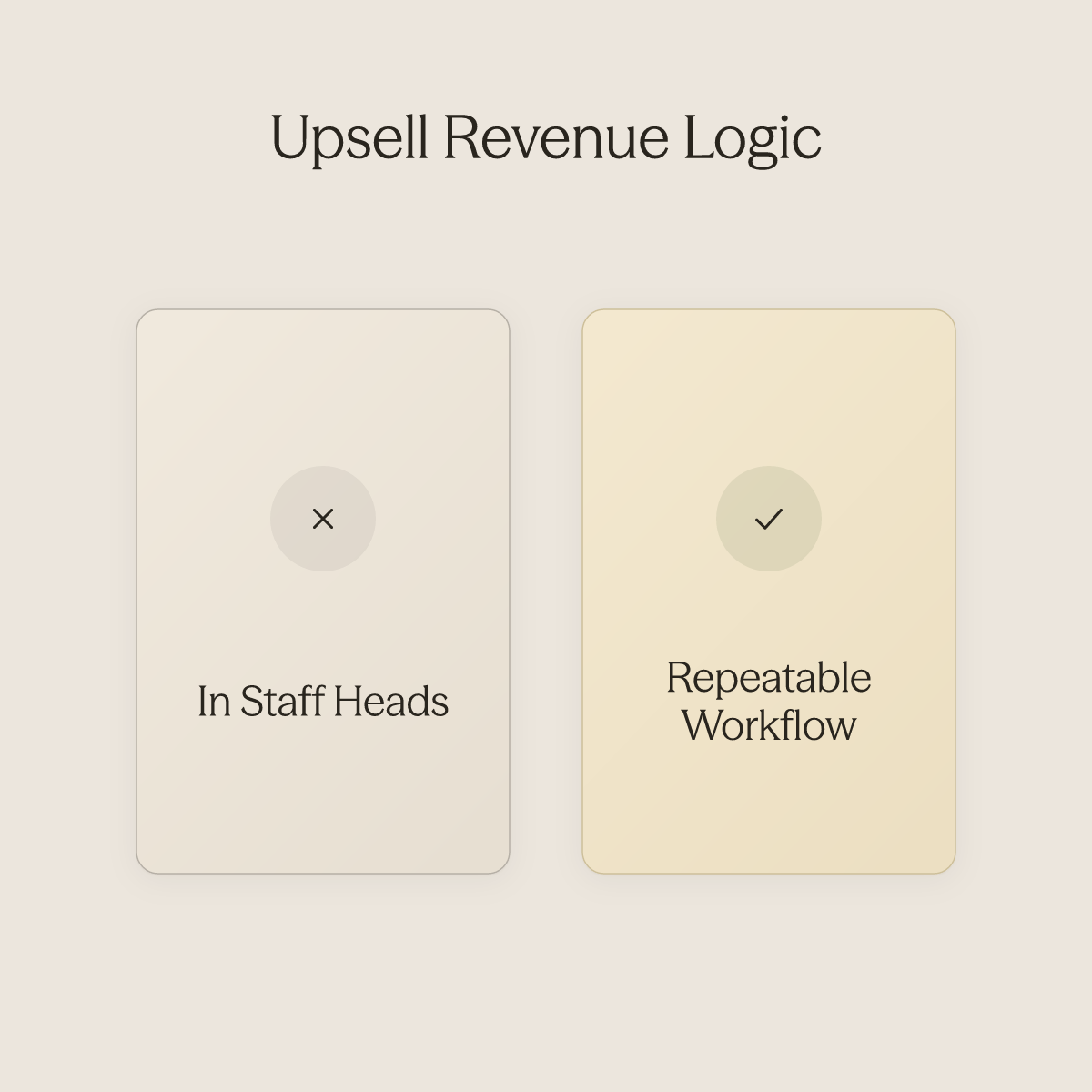
Why Upselling Is a Systems Problem, Not a Staffing Problem
Spend enough time managing a multi-property portfolio and you will notice a pattern: upsell revenue moves in direct correlation with which staff member is on shift, not with what your properties are actually capable of generating. That is not a training problem. It is a structural one, and the fix is not a better script.
The failure point is almost never a skills gap. Front-desk agents who upsell well on a quiet Tuesday afternoon forget entirely during a peak Friday check-in rush because their working memory is already full. When upsell triggers live in a person's head rather than a workflow, revenue output becomes a function of cognitive load and shift timing.
No incentive scheme changes that arithmetic at scale. The same fragmentation that plagues broader hospitality operations, teams manually stitching together disconnected tools rather than operating inside a single repeatable revenue workflow, shows up identically at the upsell layer: individual memory and ad-hoc effort substituting for a system that fires consistently every time.
The Hidden Revenue Leak: 1 AM, Peak Check-in, and 35 Properties at Once
"We struggle to identify which PMS platforms natively support upsell integrations versus those that require costly add-ons, making it hard to build a repeatable revenue system from the start."
Pre-arrival email upsell conversion rates outperform front-desk rates, yet most properties still treat the desk as the primary upsell channel. What gets missed overnight, during a six-deep check-in queue, or simultaneously across dozens of properties compounds into a structural revenue leak that no retraining recovers. Every guest inquiry that goes unanswered at 1 AM, because a lean overnight shift cannot cover all channels at once, is recoverable only if a system is capturing it without human intervention.
The top-performer outlier, a single agent producing upsell numbers that far exceed the team average, is often cited as evidence of what staff-led upselling can achieve. It is more accurately read as evidence of why it does not scale: the results are not replicable across shifts without a systematic trigger layer underneath individual training. What most teams report from front-desk upsell programs confirms that top-performer results do not replicate across shifts without a systematic trigger layer underneath individual training.
A system that cannot replicate that agent's output across every shift, property, and time zone is not a revenue program; it is a talent lottery that averages down to inconsistency at scale.
Moving Upsell Triggers from Staff Memory into Workflow Automation
The operational shift looks straightforward: instead of relying on a staff member to remember to offer a room upgrade, the offer fires automatically when a booking is confirmed, again 48 hours before arrival, and again on check-in day. Every guest receives the same well-timed sequence regardless of who is working. Across the market, this trigger-layer approach is what separates properties with consistent upsell revenue from those whose results vary by shift.
AI Workflows are built for exactly this: they are most beneficial when a business has recurring, predictable guest touchpoints that currently require manual staff action. AI Workflows fire automatically after each trigger occurs in the guest lifecycle, whether that is a booking confirmed, a check-in detected, or a specific keyword in a guest message. The result is that every guest receives the same well-timed sequence without a staff member needing to remember, reducing time spent on manual, repetitive messaging tasks and freeing the team to focus on service rather than sequencing.
Conduit's Inbox provides a single layer where the operations team can monitor, review, and manage every conversation the AI agent is handling, so nothing slips through a gap between channels. Because AI Agents can be trained on existing SOPs, FAQs, and manuals, the system captures every guest inquiry across channels, day or night, without leaking revenue to an unstaffed hour or an overlooked message thread. One practical constraint worth naming: small motel operators often struggle to determine which PMS platforms natively support upsell integrations versus which require costly add-ons before a repeatable system is achievable.
Conduit's Integrations are most beneficial when a business already uses tools like Notion, Google Drive, or Airbnb and wants the AI agent to leverage existing content without manual re-entry, meaning operators can build on the documentation and platforms they already have rather than overhauling their stack. That lowers the barrier to deploying a consistent trigger layer across a full portfolio, encoding booking-confirmed messages, pre-arrival upgrade offers, in-stay prompts, and post-stay loyalty sequences into workflows that fire reliably whether a property is running a full desk team or a lean overnight shift, and maximizing revenue per property by improving both occupancy and guest satisfaction in the process.
Related Reading
- Best Revenue Management Software For Hotels
- Siteminder Competitors
- Digital Concierge Software
- Hospitality Conferences
- Hotel Distribution Management
- Best Hotel Channel Manager Software
- Canary Technologies Competitors
- Cloudbeds Alternatives
- Hospitality Chatbot
Next steps
If your upsell revenue still moves up and down with whoever is working the desk that night, the path forward starts with removing the offer from staff memory and putting it inside a workflow that fires automatically for every eligible guest. Start with our AI for hospitality.
Automated pre-arrival triggers reach guests 24 to 48 hours before arrival, in a planning mindset, generating a documented $95 per booking in upsell revenue because the offer arrives before cognitive overload sets in at check-in. At the same time, tracking conversion rate without measuring offer coverage systematically undercounts the revenue gap, because a conversion rate can only measure offers that were actually made. Together, those two realities point to the same corrective action: encode the trigger into an automated sequence so the offer gets made in the first place, then measure what converts.
Start with conduit.ai to see how Conduit builds the workflow layer that fires pre-arrival, in-stay, and post-stay upsell triggers automatically across every property and shift.
Frequently Asked Questions
Why is upselling so important for hotels?
Upselling raises both ADR and TRevPAR simultaneously, it lifts what guests pay for the room while capturing ancillary spend the room rate never touches. The Revinate 2024 Hospitality Benchmark Report identifies upselling and ancillary revenue programs as a primary lever for improving TRevPAR, and personalized upsell offers also drive stronger guest satisfaction scores and more repeat direct bookings, closing a single revenue-and-loyalty loop.
What are the best services and add-ons to upsell at a hotel?
The post organizes upsell opportunities into three categories: room upgrades (suites, better room types), in-property services (early check-in, late check-out, breakfast packages, parking, spa access), and activities or off-site experiences. Each category belongs to a different timing window, room upgrades fit the pre-arrival and check-in window, in-property services fit the in-stay window, and activities span both pre-arrival and mid-stay.
Do early check-in and late check-out actually work as upsells?
Yes, the post calls early check-in one of the lowest-friction upsells available, noting that guests arriving on red-eye or long-haul flights are already experiencing the problem the offer solves. Operators consistently report strong conversion when a pre-arrival message offering early access at a fixed fee is sent the evening before arrival. Late check-out is listed alongside breakfast and parking as a high-margin, low-friction in-property service guests would accept if offered.
How well do pre-arrival emails actually perform for upselling?
Pre-arrival emails average $95 per booking in incremental upsell revenue, according to Revinate's guest journey benchmarks. The post identifies the 48-to-72-hour pre-arrival window as the period of peak guest receptivity, when guests are mentally engaged with their trip. The same offer sent automatically at that moment converts at a measurably higher rate than one made at the front desk, with no staff action required.
Should front desk staff focus on scripts or buying signals when upselling?
The post recommends buying signals over scripted pitches, industry research cited in the post shows that agents trained to identify buying signals produce measurable RevPAR lift. That said, the post also argues that front-desk upselling alone is structurally limited, because two of the three upsell categories require offers that fire during in-stay and mid-stay moments when no front-desk agent is positioned to make them, which is why automated trigger workflows are presented as the more reliable mechanism for full-program coverage.
Stay in the loop
Get the latest on AI automation, product updates, and customer stories.

