How to Increase Hotel RevPAR: 7 Strategies That Work in 2026


Increase RevPAR
7 strategies that don't touch rate.
Your pricing strategy is not the problem. The inquiries leaking out before it ever applies are.
Most hospitality business owners think RevPAR tracking is a reporting function: you measure it after the period closes, identify what went wrong, and adjust rates for next month. That widespread belief turns RevPAR into a report card rather than a diagnostic tool, and that distinction costs real money. Understanding what the number actually measures, and what its formula exposes, is the first step toward knowing which part of your operation to fix.
See our AI for hospitality for how this works in practice. RevPAR answers a single question: of all the room revenue your property could theoretically earn, how much did you actually capture? RevPAR isolates rooms revenue specifically, making it the clearest signal of core pricing and occupancy performance before ancillary noise enters the picture.
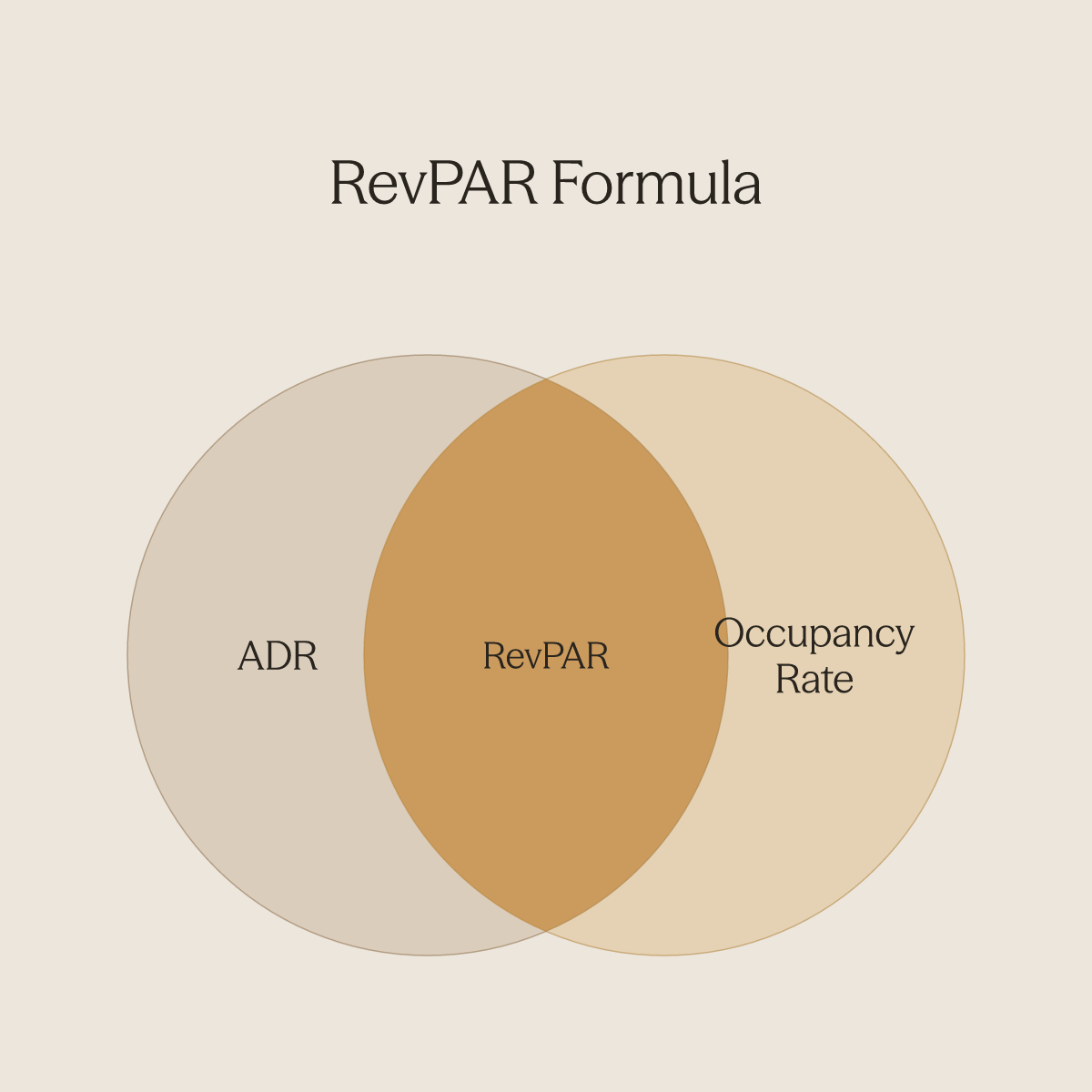
The first formula is straightforward: RevPAR = Room Revenue divided by Available Rooms.
The second is more instructive: RevPAR = ADR multiplied by Occupancy Rate. A hypothetical hotel's RevPAR can be identical under two very different scenarios, yet the strategic problem in each case is completely different:
- Full occupancy at a lower ADR
- Partial occupancy at a higher ADR
The interaction between ADR and occupancy is multiplicative, not additive. Cutting your rate to fill empty rooms only recovers RevPAR if the occupancy gain is proportionally larger. STR's benchmarking methodology tracks both levers separately in every performance report precisely because a gain in ADR offset by an occupancy decline can leave RevPAR flat, a dynamic a single revenue figure never reveals.
Scenario 2: High ADR, Low Occupancy
On the surface, the rate integrity looks admirable, and ownership often interprets the strong ADR as a sign of healthy positioning. The diagnostic problem is that 46% of available rooms generated zero revenue every night of the period.
The fixed cost base, debt service, housekeeping labor, utilities, and property insurance, does not compress when those rooms sit empty. RevPAR in this configuration signals a demand capture failure, not a pricing success. The rate is working; the distribution, marketing reach, or booking window strategy is not.
The corrective lever is not a rate cut. Dropping ADR to $200 and achieving 76% occupancy produces a RevPAR of $152, virtually identical, while simultaneously training the market to expect a lower price point that is extremely difficult to reverse. The correct intervention is demand generation: expanding channel mix, adjusting length-of-stay restrictions that may be blocking shorter bookings, or targeting feeder markets that are underrepresented in the current guest profile.
RevPAR here is the alarm; ADR and occupancy read side by side are the diagnostic that points toward the actual repair.
Key takeaways
- RevPAR is a diagnostic tool, not a report card, treating it as a post-period summary means you're always fixing last month's problem instead of catching this month's leak.
- The fastest revenue losses don't happen in your rate strategy, they happen in the conversation layer: the 1am inquiry nobody answers, the upsell that never fires, the mid-stay complaint that becomes a 3-star review.
- Independent hotels using data-driven dynamic pricing increase RevPAR by an average of 21%, but pricing tools can't capture revenue from a guest who never got a response.
- Upselling underperforms because of delivery infrastructure failure, not front-desk skill, if the offer isn't triggered and sent automatically, most guests never see it.
- A room booked through an OTA at $200 ADR nets $140 to $170 after commission; the same room booked direct nets the full $200, that gap is a net RevPAR problem, not a marketing one.
- Repeat guests book direct more often, compare prices less, and reduce OTA commission drag, loyalty compounds RevPAR in ways a rate adjustment never can.
- Rate cuts during slow periods treat a symptom; single-segment concentration is the structural cause, diversifying your audience mix protects RevPAR without sacrificing ADR.
- conduit.ai's Workflows close the execution gap by triggering automated follow-ups, upsell sequences, and mid-stay check-ins based on conversation events and guest data, so every strategy in this post actually runs, even at 1am.
Why Your Current RevPAR Strategy Has a Blind Spot (And Where Revenue Actually Leaks)
Pricing strategy gets the credit. The conversation layer takes the blame quietly, one missed inquiry at a time. Most operators assume the hard work is done once rates are dialed in, OTA mix is optimized, and demand signals are feeding the system. What that assumption misses is the layer between a guest's decision to book and the moment revenue actually lands: the communication infrastructure that either captures intent or lets it walk to a competitor.
The Conventional RevPAR Playbook Is Necessary, But It Stops at the Rate Sheet
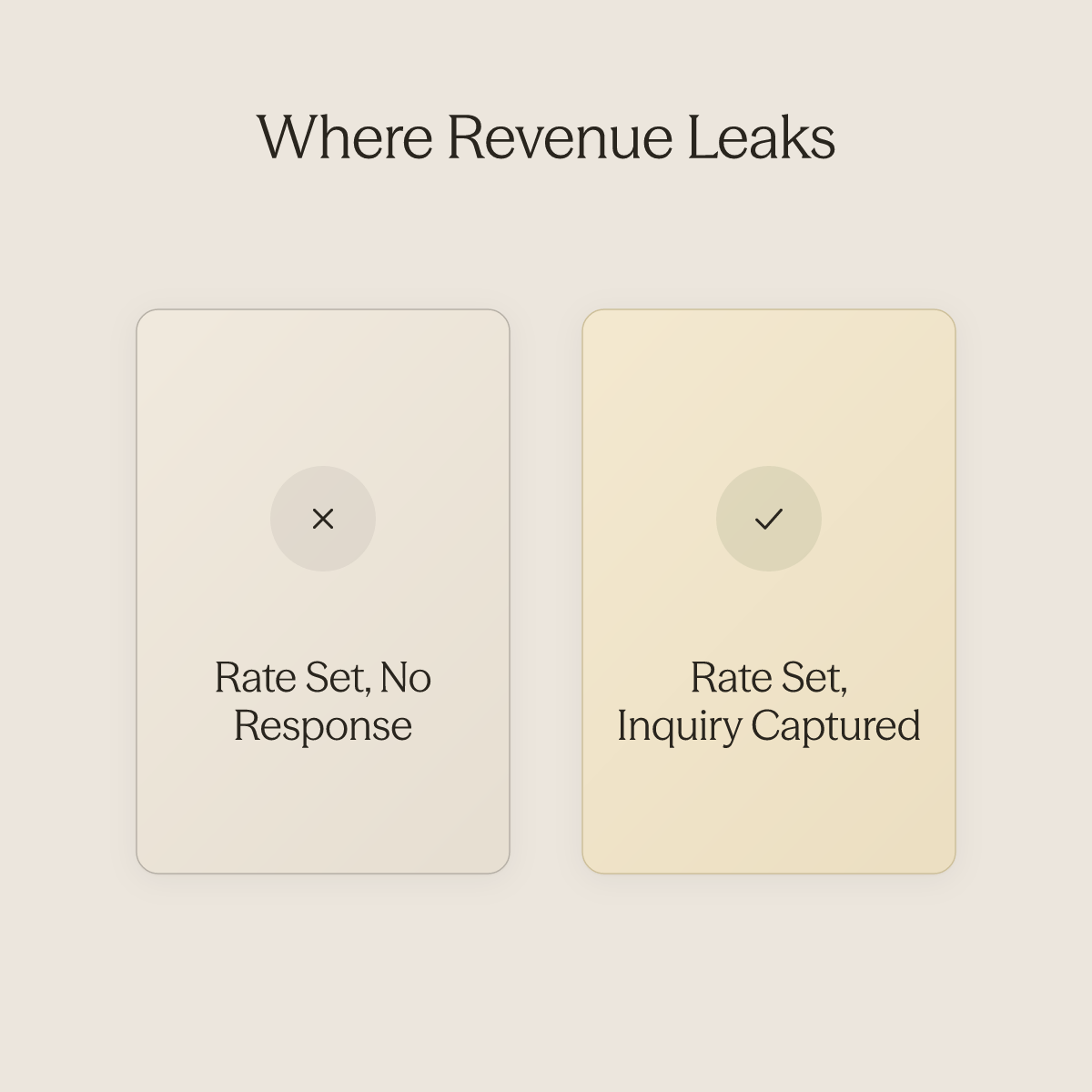
Dynamic pricing, comp-set indexing, and channel mix optimization are all legitimate RevPAR levers. The blind spot is structural: pricing tools can only capture revenue from inquiries that actually get answered. If a guest reaches out at 11pm and no one responds until morning, the rate you set is irrelevant. The booking is already gone. This is a tension revenue managers know intimately: strong internal ADR, RevPAR, and occupancy numbers are hard-won, yet they tell you nothing about the inquiries that never converted in the first place. The leak doesn't show up in your rate report; it shows up in the gap between what your pricing model projected and what the period actually closed.
The Three Friction Points Where Revenue Escapes Before Pricing Even Applies
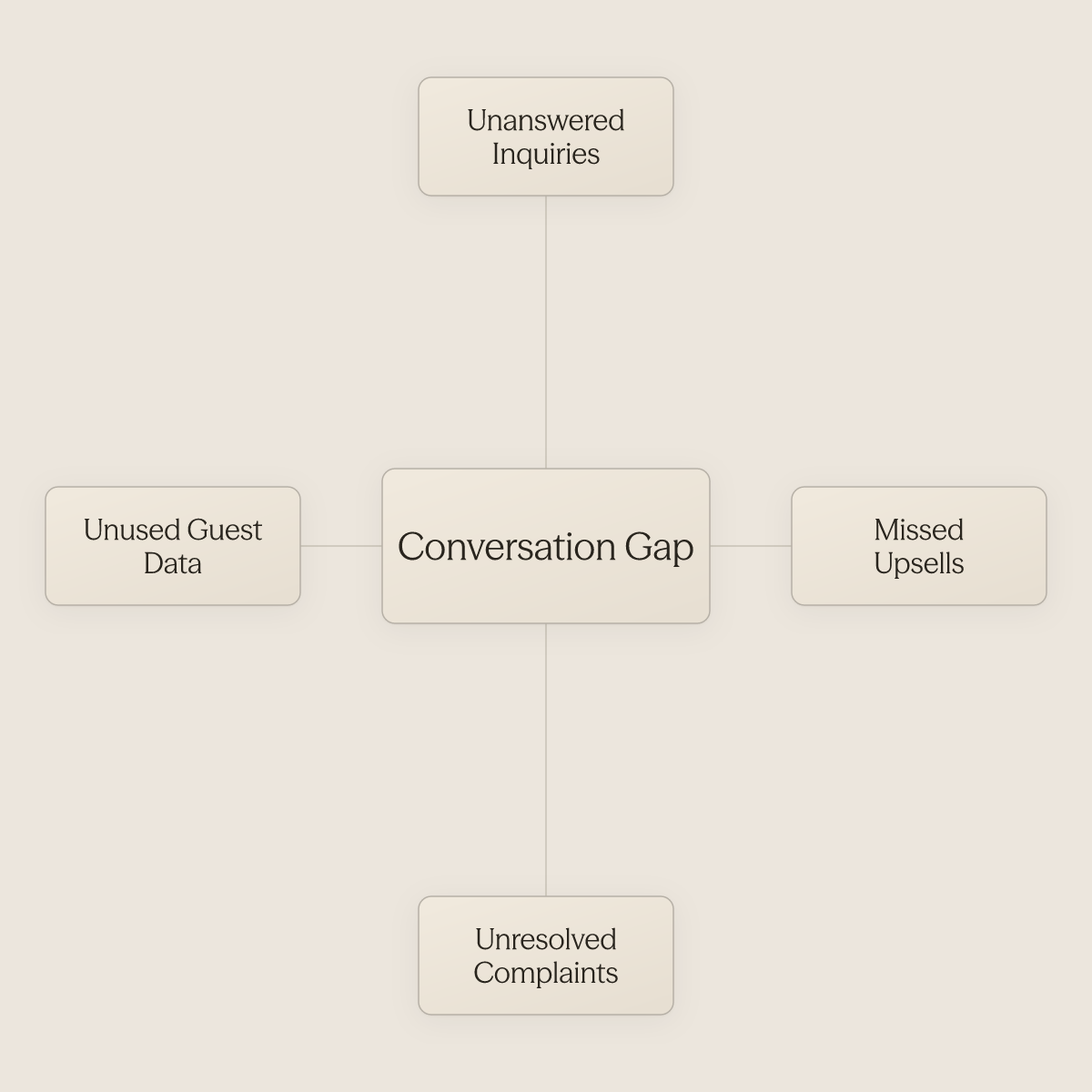
The leak shows up in three predictable places: unanswered inquiries, especially overnight; upsell offers that never get sent because the team is buried in routine messaging; and mid-stay complaints that fester into three-star reviews before anyone catches them. None of these appear in a rate report. All three compress RevPAR in ways a pricing adjustment next month cannot undo.
The friction is compounded when guest messages arrive across multiple platforms simultaneously, a direct-booking inquiry on one channel, a question on another, a complaint routed through a third, with no unified view. Operations teams managing communications at this volume manually are not slow; they are structurally outnumbered. Conduit's Inbox is designed specifically for this scenario: it consolidates guest conversations across channels into a single monitored workspace, so the operations or support team can review and manage every interaction the AI agent is handling without toggling between platforms or losing context mid-thread.
Why After-Hours Booking Inquiries Are a RevPAR Problem, Not Just a Staffing Problem
Industry analysis published on LinkedIn by hospitality revenue consultant Darya M. notes that after-hours callers are the highest-intent buyers of the day, calling because they are ready to commit. Treating the gap as a headcount problem rather than a revenue-leak problem means the rate sheet keeps getting refined while the conversion layer stays broken.
Conduit's AI Agents address this directly, capturing every guest inquiry across channels, day or night, without leaking revenue. The agents are most effective when a property already has documentation in place: SOPs, FAQs, training manuals. Connect those materials and the first automated guest reply is live within days, not weeks.
From that point forward, every time a guest sends a message, before, during, or after a stay, the agent responds, without the delay that sends a high-intent caller to a competitor's booking page overnight. Conduit's Workflows layer fires automatically after trigger events in the guest lifecycle, without requiring a staff member to remember to send them. That structural consistency is what turns a communication gap into a revenue-capture layer that runs in the background at all times.
Reactive RevPAR Tracking Means You're Counting Lost Revenue After It's Gone
The core problem with measuring RevPAR in arrears is that every number in the report is a lagging indicator. By the time a weak conversion period shows up in the data, the inquiries are gone and the guests who booked elsewhere have already checked out somewhere else. The goal is to close the loop between demand signal and captured revenue, which requires the communication layer to be as systematically optimized as the pricing layer.
Maximizing revenue per property means improving both occupancy and guest satisfaction concurrently, not sequentially. A rate that never gets answered is not a rate; it is an aspiration. The infrastructure that closes that gap is where RevPAR is actually won or lost.
How Dynamic Pricing Works to Increase RevPAR
Dynamic pricing is the engine most revenue managers point to when RevPAR underperforms. According to Hospitality Net's complete guide to dynamic pricing, independent hotels that implement data-driven dynamic pricing increase RevPAR by an average of 21% through automated rate adjustments. But that figure represents a ceiling, not a floor, and it can only be realized on bookings that are actually captured.
The core synthesis here is this: dynamic pricing optimizes surviving demand, but your communication layer determines how much demand survives to be optimized. When after-hours high-intent callers hit voicemail during the 5–9 PM window and rebook with a competitor, dynamic pricing has already been defeated before it runs a single calculation. There is a second failure mode that operators rarely name directly: sticker shock.
When algorithms push rates to extreme levels, the kind of compression nights that produce $2,200 nightly rates at a mid-tier property, guests don't always abandon quietly. They abandon loudly, with a question first. "Is this rate correct?" "Is there anything available for fewer nights?" "What's included at this price?" Those questions land in your inbox at 11 PM.
If no one answers them, the booking evaporates. The rate was right. The conversation was missing.
Dynamic Pricing Adjusts Rates in Real Time
Dynamic pricing works by reading demand signals continuously, occupancy pace, competitor rate moves, local event calendars, and seasonality patterns, then adjusting your Best Available Rate (BAR) before the market moves past you. It is a forward-looking tool, not a reporting function. The honest trade-off: dynamic pricing surfaces the right price at the right moment, but it cannot close the guest who showed up at that price.
That conversion still depends on what happens next. This is exactly the operational gap that operators like Le Roy have lived inside. His virtual assistant team struggled to deliver consistent, around-the-clock instant responses across all time zones, spending their days fielding mundane questions, Wi-Fi codes, parking instructions, check-in details, while higher-value work went untouched.
The bottleneck wasn't strategy; it was volume and hours. Le Roy found himself micromanaging the team like "the mom," unable to escape the operator role despite having SOPs in place. Dynamic pricing was doing its job. The communication layer was not.
Conduit's AI Agents address this directly. The agents are most beneficial when a property receives a high volume of repetitive guest messages and has existing documentation, SOPs, FAQs, manuals, to train on. After connecting those documents, the first automated guest reply can go live within days. From that point forward, the agent responds continuously, whenever a guest sends a message, before, during, or after a stay, so that the inquiry arriving at midnight on a peak-compression night gets an answer before the guest opens a competitor's booking page.
Length of Stay Restrictions, The Underused Lever
Minimum Length of Stay (LOS) restrictions are the most underused control in demand-based pricing. During peak demand periods, a single-night booking can occupy inventory that a three-night stay would have filled at a materially higher total value. Setting a two- or three-night minimum on high-compression dates protects that inventory and lifts ADR without touching your rate card.
Applied too broadly, LOS restrictions suppress occupancy on shoulder nights, so target them to specific high-demand windows rather than using them as a blanket rule. When LOS restrictions are active, guest questions about them spike. "Can I book just two nights?"
"Is there any flexibility on the minimum?" Those inquiries require a fast, consistent answer, the kind a trained AI Agent can deliver without pulling a human operator back into the inbox at off-hours. Conduit's Inbox surfaces all of these conversations across platforms simultaneously, which is most beneficial when managing guest communications across multiple properties or channels at once.
The operations or support team can monitor and review everything the AI Agent is handling in one place, without each platform becoming its own fire to fight.
Raising BAR During Events and Area-Wide Sellouts
Industry guidance from Hospitality Net recommends moving aggressively on BAR the moment area-wide compression signals appear, not after your own occupancy confirms it. A coastal property raising BAR by 35% during a nearby music festival captures those bookings only if the rate is live before demand peaks, and if the inquiry channel stays open overnight when festival-goers are actually searching. That second condition is where most independent properties leak revenue.
The rate is live. The guest finds the property. The guest has a question, about parking, about the cancellation policy at this elevated rate, about whether a late check-out is available. If the answer comes six hours later, the guest has already booked elsewhere.
Conduit's Workflows automate the predictable touchpoints in exactly these moments: after a booking is confirmed at a peak rate, after check-in, or when a specific keyword is detected in a guest message. Because the Workflows trigger off conversation events rather than staff availability, a sold-out event weekend doesn't require additional labor to stay responsive, it runs on what the property has already documented.
STAAH's analysis of dynamic pricing and channel management reinforces this point: rate optimization and distribution only convert when the guest experience surrounding the booking is equally dialed in. The 21% RevPAR lift that data-driven pricing makes possible is earned on both sides of the equation, the algorithm that sets the rate, and the communication layer that catches the guest who arrived at it.
Upselling Strategies That Increase RevPAR - Including the Ones Most Hotels Never Send
Somewhere between the room rate and the checkout receipt, most hotels leave real money on the table, not because guests wouldn't spend it, but because the offer never arrived. It is a delivery infrastructure problem. What we see consistently is that upselling is treated as a known pain point by hotel managers, yet the workflows meant to address it are either silently broken or quietly deprioritized. The manual process means many upsell opportunities are simply never communicated to guests at all.
According to BookingWhizz, the 48-to-72-hour pre-arrival window converts upsell offers at 15-to-25%. That window opens for every single reservation. The question is whether your property has a mechanism to reach every guest inside it, or whether you're depending on a front-desk agent to remember, find the right moment, and make the pitch while checking in a queue of arrivals.
Industry data from Revinate's 2024 Hospitality Benchmark Report confirms what operators already sense: upsell revenue is most often lost not because guests decline, but because the offer is never sent. Conduit.ai's Workflows are most beneficial precisely when a business has recurring, predictable guest touchpoints, like the pre-arrival window, morning of departure, or post-booking confirmation, that currently require manual staff action. A workflow fires after a trigger event occurs in a conversation or guest lifecycle: after a booking is confirmed, after check-in, or when a specific keyword is detected.
That means the offer goes out automatically, at the right moment, without anyone on your team having to remember to send it. For properties managing communications across multiple platforms or properties simultaneously, the Inbox consolidates every conversation the AI agent is handling so your operations team can monitor and review without switching between tools. Conduit.ai also captures every booking inquiry, including the ones that land overnight or after hours, so no upsell trigger is missed because the front desk was closed.
1. Automated Pre-Arrival Email Upsells - The $95-Per-Booking Window Most Hotels Leave Open
Pre-arrival emails sent 3–5 days before check-in consistently generate around $95 per booking in upsell revenue, yet most hotels send a single generic confirmation and nothing more. This window works because guests are in active trip-planning mode and receptive to room upgrades, early check-in, and add-on packages. The tradeoff: results depend heavily on segmentation quality, blasting the same offer to every reservation erodes conversion fast.
2. CRM-Powered Personalized Offers - Upselling Based on What the Guest Actually Did Last Time
Using reservation history and CRM data to tailor upsell offers, spa packages to guests who booked them before, suite upgrades to anniversary travelers, dramatically outperforms generic promotions. Hotels with even basic CRM automation can trigger relevant offers without manual effort. The real limitation is data hygiene: if your PMS and CRM aren't synced cleanly, personalization misfires and damages trust more than a generic email would.
3. Late Check-Out as a Standalone Paid Upsell - The Easiest RevPAR Lift Nobody Automates
Late check-out is one of the highest-margin upsells available, zero incremental cost when housekeeping permits it, and guests pay $20–$50 willingly for the convenience. Most properties offer it only at the front desk when asked, missing the automated offer window entirely. Sending a targeted late check-out offer the morning of departure via SMS or app notification captures impulse decisions. The constraint: it requires real-time room availability logic to avoid operational conflicts.
4. In-Stay Cross-Sell Messaging - Ancillary Revenue From Guests Already on Property
The in-stay phase, day one through the night before departure, is the most underused upsell window in hospitality. Guests who've already committed to the property are far more likely to add a dinner reservation, spa treatment, or activity package than a cold prospect. Triggered messaging via WhatsApp, SMS, or in-app chat at contextually relevant moments (post-check-in, mid-afternoon slump) drives measurable F&B and wellness revenue. The tradeoff: over-messaging kills the experience and generates complaints.
5. Pool and Wellness Facility Upsells - Packaging Amenities That Guests Don't Know Are Purchasable
Hotels with pools, spas, or wellness centers routinely fail to monetize them beyond guests who proactively seek them out. Packaging day-pass access, cabana reservations, or thermal circuit experiences as purchasable upsells, promoted in pre-arrival emails and at check-in, can lift RevPAR by up to 40% on those amenity lines. The limitation is operational: without capacity management, overselling wellness slots creates a guest experience problem that negates the revenue gain.
How to Drive More Direct Bookings to Improve RevPAR
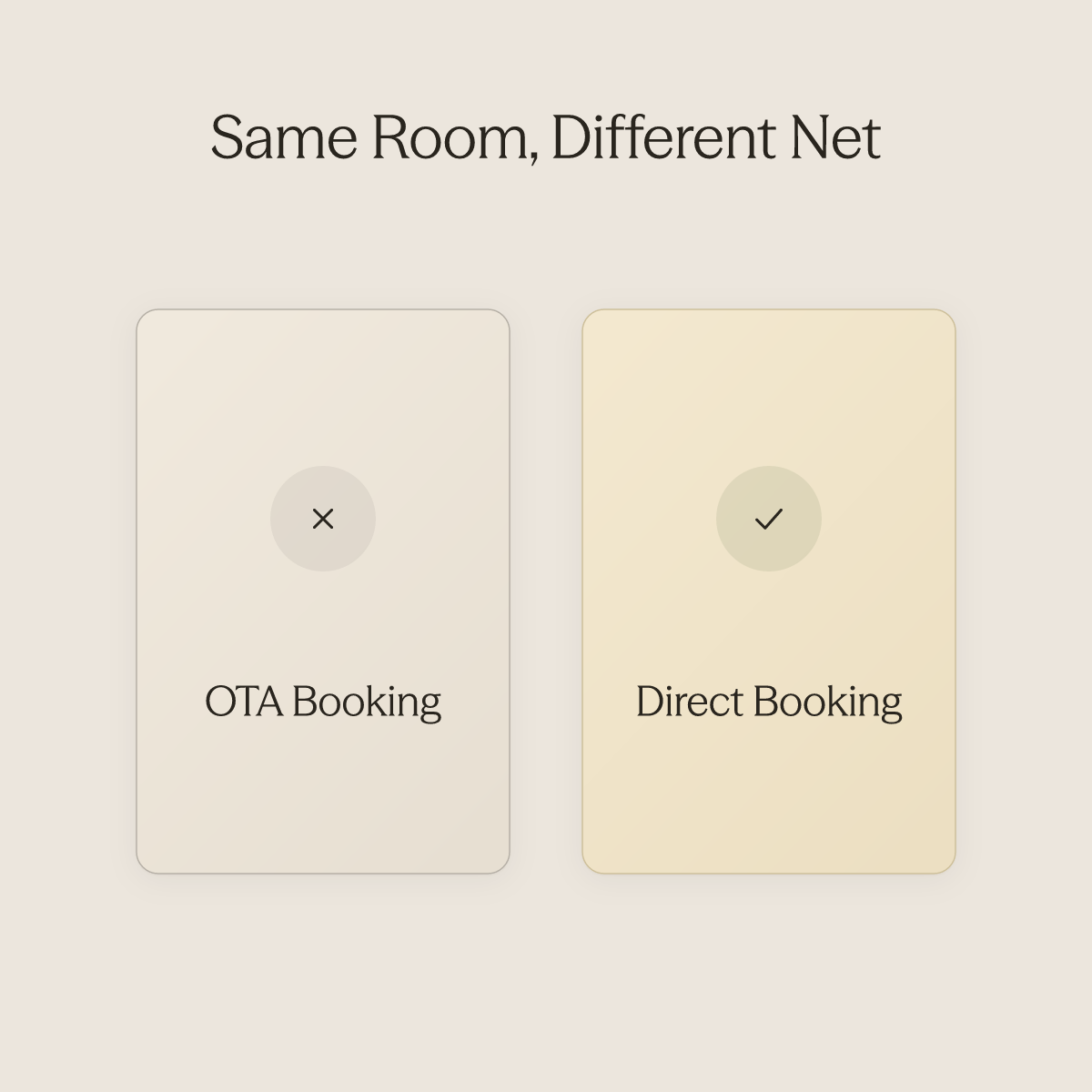
A room sold at $200 ADR through an OTA nets your property somewhere between $140 and $170 after commission, according to Cloudbeds' distribution analysis. The same room booked direct nets the full $200. That gap is not a marketing problem; it is a net RevPAR problem, and it compounds silently across hundreds of room-nights every quarter.
The 15 to 30 Percent Commission Drag
OTAs typically charge 15 to 30 percent per booking, sometimes higher depending on the platform tier and visibility program you participate in, meaning every reservation they deliver costs you a meaningful share of the revenue you already earned. Shift a meaningful share of your OTA volume to direct, and you recover a material RevPAR gain without touching your rate card. No pricing tool closes that gap if the booking mix stays broken.
There is a second, less-discussed cost layered on top of commissions. Hotels that rely heavily on OTA volume often find themselves offloading unsold room blocks to third-party channels at discounted rates simply to avoid vacancy, a pressure that further undermines their ability to control pricing and compounds the RevPAR erosion. Then comes the inventory allocation problem: when a property is running tight on rooms, OTA-sourced guests routinely receive the least desirable inventory, rooms near elevators, ice machines, or stairwells, non-renovated wings, no views.
The guest experience suffers before the stay even begins, and review scores follow. OTA commission drag and cancel-rebook arbitrage are two distinct but compounding RevPAR destroyers that share the same root cause: price-sensitive, non-loyal guests acquired through rate-led channels. Guests acquired through OTA channels are more likely to cancel and rebook when a cheaper night appears, and less likely to respond to upsell offers.
No rate strategy addresses both problems simultaneously; only booking mix and loyalty infrastructure do. That loyalty infrastructure starts with communication, and this is where operations teams consistently lose ground they never recover. Haven's property management operation illustrates the scale problem directly: with a large portfolio of properties, they needed significant support staff across multiple shifts to handle check-in questions, lockouts, cleaning issues, and complaints.
When Conduit was installed but running at a low automation rate with no workflows and a minimal knowledge base, it took the edge off the volume, but it did not change how the team operated. Growth still meant more messages, more calls, and more hiring. The lesson: timely, consistent guest communication is itself a RevPAR lever, because it directly improves guest experience and review scores, and review scores influence whether the next traveler books direct or defaults to an OTA.
Conduit's AI Agents are most impactful precisely in this scenario, properties receiving a high volume of repetitive guest messages that already have existing documentation (SOPs, FAQs, manuals) to train the agent on. The first automated guest reply can go live within days of connecting those materials, and the agent runs continuously, before, during, and after a stay, without adding headcount. Workflows extend this further: after a trigger event such as a confirmed booking or a check-in, automated touchpoints fire without any manual staff action.
For teams already operating across tools like Notion, Google Drive, or Airbnb, Conduit's Integrations pull existing content directly into the agent without requiring re-entry, closing the gap between what your documentation says and what your guests actually experience at the moment they need an answer.
SEO, PPC, and Metasearch as Direct Demand Channels
Hotels that drive meaningful direct booking share treat SEO, paid search, and metasearch as a coordinated acquisition system, not separate line items. Google Hotel Ads and TripAdvisor metasearch place your direct rate alongside OTA rates at the exact moment a traveler is deciding where to book. Industry data consistently shows that properties investing in metasearch recover a measurable share of bookings that would otherwise default to Expedia or Booking.com, at a cost-per-acquisition well below OTA commission rates. The objective is to intercept high-intent travelers before they complete their journey inside an OTA interface, routing them to your booking engine where the full rate is retained.
Why Guest Loyalty and Experience Impact RevPAR: and How to Build Both at Scale
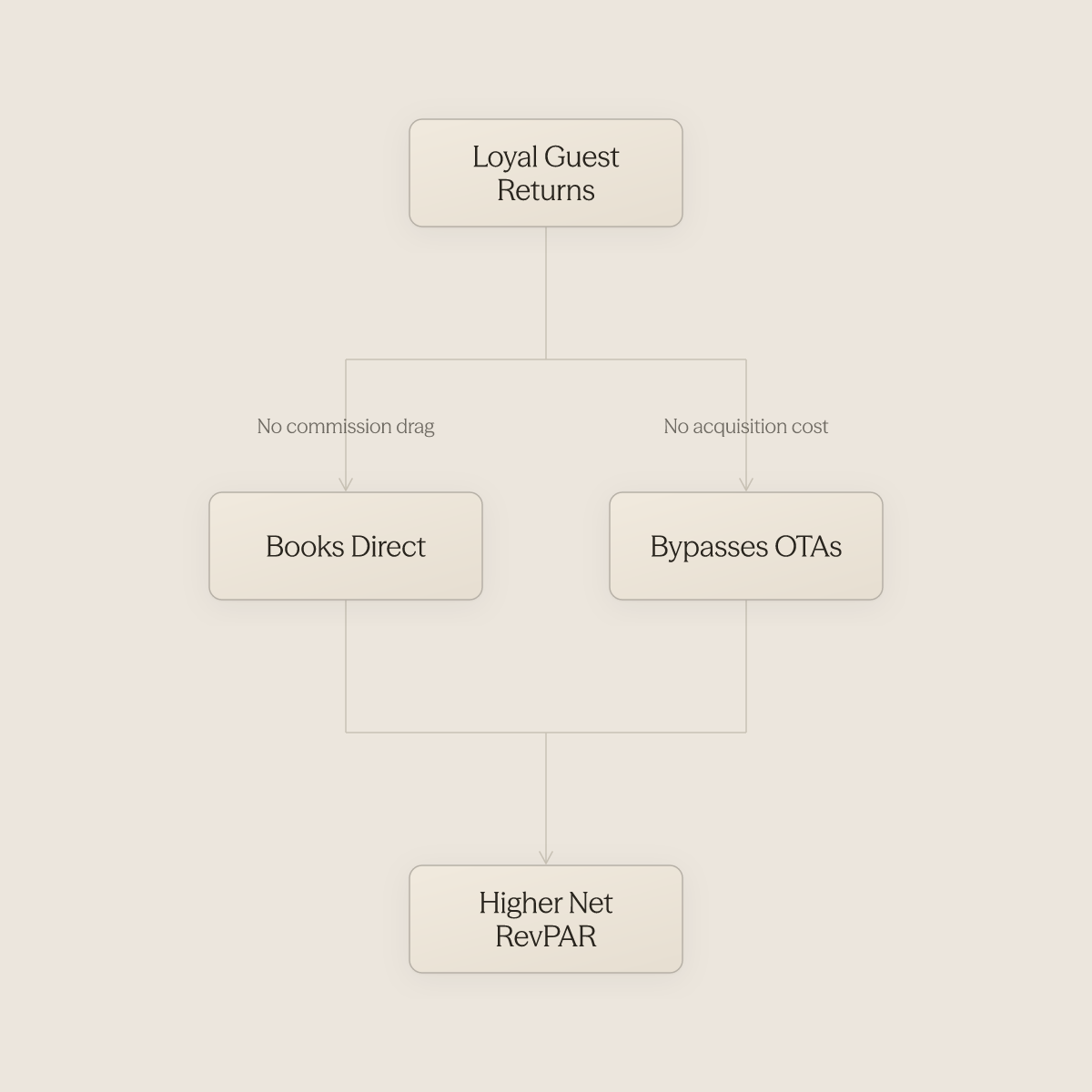
Repeat guests are structurally more profitable than new ones. Industry research confirms that loyalty-driven direct bookings reduce OTA commission drag and improve net RevPAR because loyal guests are less price-sensitive and more likely to bypass intermediaries entirely. A guest who already trusts your property doesn't comparison-shop on three OTAs before committing, they go straight to your booking page, pay your rate, and cost you nothing in acquisition spend.
Across the market, acquiring a new hotel guest consistently costs substantially more than retaining an existing one. Properties that treat loyalty as a financial mechanism rather than a hospitality virtue compound this margin advantage with every stay. One underappreciated distortion inside that margin calculation, however, is that traditional loyalty programmes reward frequency and spend without distinguishing between high-value, low-friction guests and high-frequency guests who generate disproportionate operational burden.
The result is a RevPAR figure that flatters the top line while masking the cost drag underneath it. Service quality erodes under that operational strain, which feeds directly back into review scores and return intent, a feedback loop that is easy to miss until the damage is already done.
How Online Review Scores Create Rate Elasticity
Higher review scores allow properties to hold firmer on rate without losing occupancy. What most teams report bears this out: hotels with consistently strong review scores command a meaningful ADR premium over comparable properties with middling scores, because guests use ratings as a proxy for risk. A strong score doesn't just feel good, it removes the price objection.
A weak score doesn't just hurt brand perception; it forces rate concessions to compete. Broader industry trends on revenue leakage from price cuts in hotels reinforce exactly this mechanism: reactive rate reductions triggered by softening demand compound revenue loss in ways that are structurally difficult to recover from, making the protection of the ADR ceiling, through reputation rather than pricing tools alone, a first-order financial priority. Properties that invest in online reputation management as a revenue discipline protect that ceiling in a way no pricing tool alone can replicate.
The Mid-Stay Moment That Determines Whether a Guest Returns
The most consequential guest experience moment isn't check-in or checkout. It's the mid-stay window when a small friction point sits unresolved long enough to harden into a negative review. A guest who flags a problem and gets it fixed in-stay almost always leaves satisfied.
A guest who stews quietly almost always leaves a 3-star review. Research on mid-stay issue resolution consistently shows that catching and resolving complaints before checkout significantly improves both review scores and return intent. The failure mode isn't bad hospitality; it's the absence of a structured trigger to ask how the stay is going before it's too late to act.
Using Guest Data to Trigger Loyalty-Building Moments Without Adding Headcount
The gap isn't intention, it's infrastructure. When mid-stay check-ins, post-checkout review prompts, and returning-guest acknowledgments depend on a staff member remembering, they fire inconsistently or not at all. The problem compounds at scale: every additional property multiplies the coordination surface without multiplying the headcount available to cover it.
Conduit's Workflows are built specifically for this failure mode. Because they fire automatically after a trigger event, a booking confirmation, a check-in, a detected keyword mid-conversation, the mid-stay check-in and the post-checkout review prompt happen without anyone on the operations team needing to remember to send them. The touchpoints that loyalty depends on become structural rather than aspirational.
What makes this work at scale is that the AI Agents handling the underlying conversations don't read like automation. Mayra, Global Head of Customer Experience at Wynwood House, describes the output directly: "The first thing we noticed was the quality of the AI replies. You cannot tell the difference between an AI agent and a human agent. I work with ChatGPT and other AI tools every day, and sometimes you can immediately tell it's AI. With Conduit, we're not seeing that." That conversational quality matters for loyalty specifically, a mid-stay check-in that reads like a form doesn't produce honest feedback; one that reads like a genuine human touchpoint does.
For multi-property operators, the Inbox consolidates every AI-managed guest conversation across all properties into a single monitored view, so the operations team maintains oversight without being the bottleneck. The practical outcome is the one that changes the unit economics: properties can scale the portfolio without proportionally increasing coordination headcount, which means the margin advantage of loyal guests compounds rather than getting eroded by the staffing cost required to service them properly.
Related Reading
- How To Improve Hotel Operations
- Hotel Demand Forecasting
- Hospitality Operations Management
- Hotel Budgeting And Forecasting
- Hotel Upselling
- Hotel Revenue Management Strategies
- Automated Hotel Reservation System
- Hotel Guest Messaging
- Hospitality Automation
- Adr Vs Revpar
How to Segment and Target Market Audiences to Protect RevPAR During Slow Periods
The conventional fix for a slow period is a rate cut. Drop the price, stimulate demand, protect occupancy. It feels logical until you realize the problem was never the price, it was the audience. Properties that rely on a single demand segment don't just feel seasonal swings more sharply; they structurally guarantee them.
Single-Segment Concentration Is the Real Reason Slow Periods Hurt
Hotel market segmentation is not a marketing exercise. It is a revenue floor strategy. When one segment softens, leisure travelers disappear after summer, corporate travelers vanish over the holidays, a single-segment property has no floor. The only tool left is discounting, which compresses ADR while the same narrow buyer pool waits for rates to fall further. The discount trains the segment to expect lower rates, making the next slow period worse.
The Four Demand Segments That Fill Different Gaps
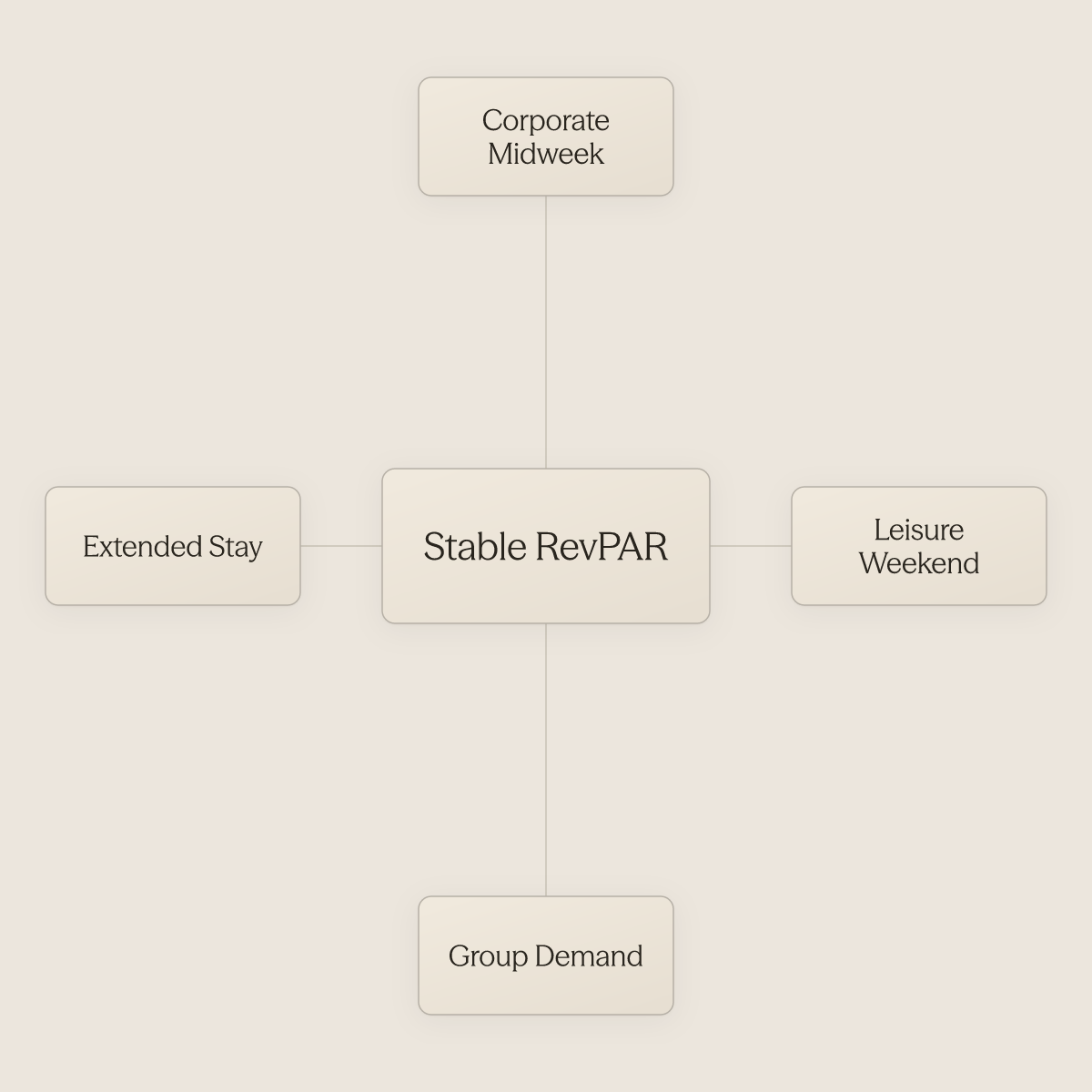
Hotels that maintain ADR through off-season hotel occupancy dips do so by holding corporate mid-week, leisure weekend, group, and extended-stay demand simultaneously. Each segment occupies a different part of the calendar. Extended-stay guests, corporate relocations, project-based workers, families in transition, fill mid-week gaps that transient leisure cannot. A city property running a Q1 mid-week corporate package alongside a Q3 weekend leisure rate keeps its occupancy floor stable without competing against itself on price.
How Segment-Specific Workflows Fire the Right Offer Automatically. The failure point is almost never strategy. The real problem is execution: hotel audience targeting by segment lives in a spreadsheet and dies in a busy week.
How to Track and Measure RevPAR Performance: and Catch Revenue Leaks Before They Compound
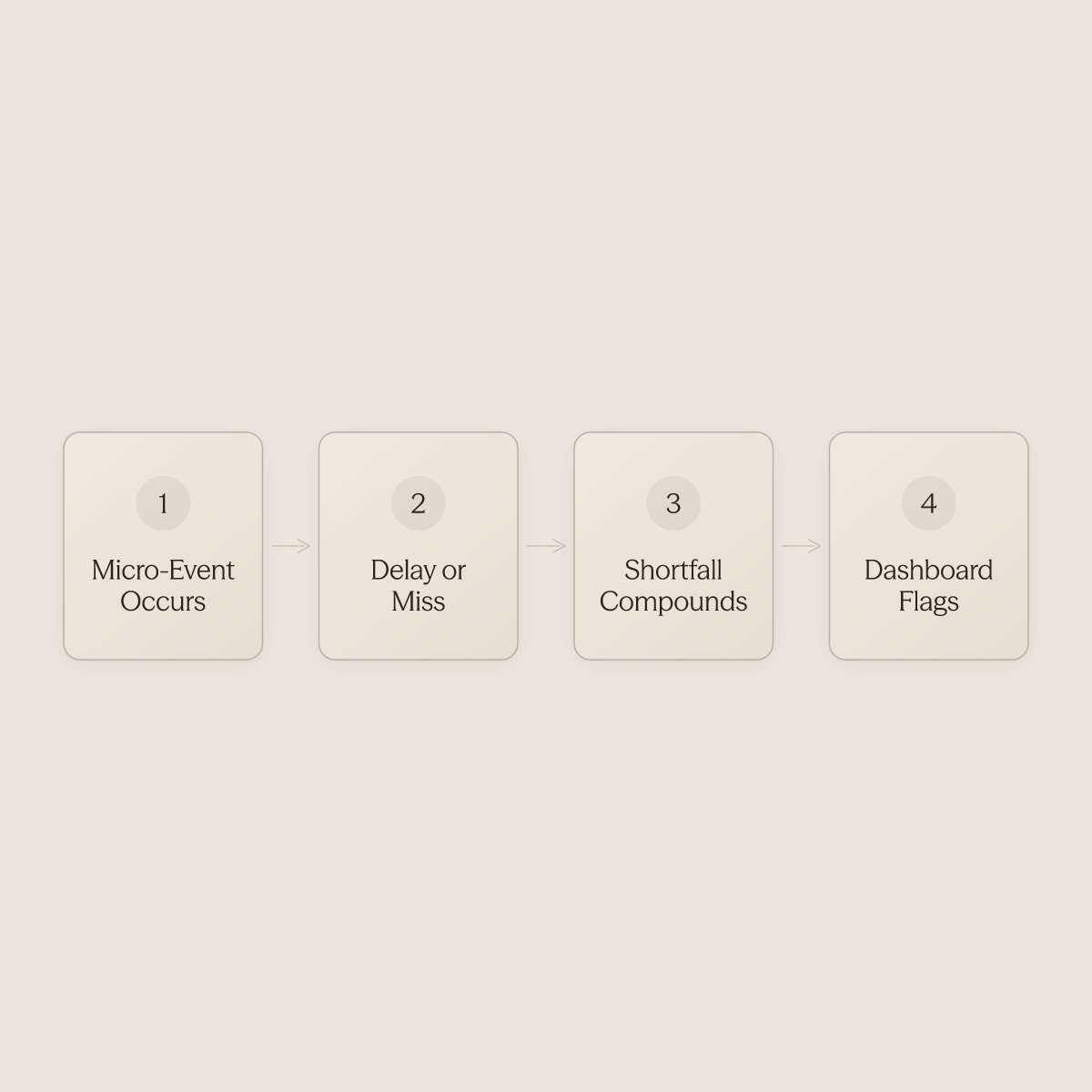
Most RevPAR problems are not measurement problems; they are timing problems. The shortfall that appears in a monthly benchmark report was caused by a sequence of small, recoverable events, unanswered late-night inquiries, upsells that never sent, complaints that hardened into bad reviews, that each compounded long before any dashboard flagged them. This section covers how to close that gap, from the four metrics worth tracking on a weekly cadence to how AI-native tools like Conduit eliminate the context-switching that lets those micro-events slip through in the first place.
The Measurement Gap That Costs More Than the Shortfall Itself
STR/CoStar reports performance monthly (or weekly via STAR), but a missed after-hours inquiry converts to a competitor reservation the same evening. By the time a shortfall appears in your STR benchmark or internal dashboard, the unanswered 1am inquiry, the upsell offer that never sent, and the mid-stay complaint that became a 3-star review have each compounded well beyond the point of easy recovery. The structural problem runs deeper than cadence.
Most hotel operations teams are working across disconnected tools simultaneously, switching between platforms to draft messages, translate responses, review guest history, and track performance. That context-switching isn't just operationally inefficient; it directly delays the resolution of the exact micro-events that bleed RevPAR. Industry research documents the revenue consequences of response latency at the guest-communication layer, precisely the layer that monthly reporting never surfaces.
The Four Analytics Pillars to Monitor Weekly, Not Monthly
Hotels that protect RevPAR consistently track four metrics on a weekly cadence:
- Occupancy pace against the same window last year
- ADR by segment
- Channel mix shift (direct vs. OTA)
- Ancillary revenue per stay
Weekly visibility lets you catch a pace deficit early enough to act with a targeted promotion or rate adjustment, rather than discounting aggressively in the final days before arrival. For teams managing guest communications across multiple platforms or properties simultaneously, consolidating that visibility into a single inbox, rather than toggling between systems, is what makes weekly review practically sustainable rather than aspirational.
Pace Reporting and Comp-Set Indexing - Setting Goals That Are Defensible
RevPAR goals anchored to internal gut feel tend to drift. Comp-set indexing via STR data grounds your targets in what comparable properties are actually achieving. A useful framing: set your RevPAR Index (RGI) target first, then back-calculate the ADR and occupancy combination required to hit it. That sequence forces a conversation about rate strategy and demand mix before the period opens, not after it closes. For a deeper breakdown of how RevPAR itself is constructed and benchmarked, conduit.ai's RevPAR reference is a practical starting point.
Conversation-Layer Metrics Most Hotels Never Track
The fastest-moving RevPAR leaks happen below the analytics dashboard, in the conversation layer. Three metrics most operators never formally track are:
- Unanswered inquiry rate by hour (with particular attention to the 10pm–8am window)
- Upsell sequence fire rate
- Mid-stay issue resolution time
After-hours inquiries that go unanswered for more than a few hours convert at a fraction of the rate of prompt responses, and the guest who doesn't hear back is already booking elsewhere before your morning shift logs in.
The operational reality behind those numbers is instructive. Before implementing unified guest communication infrastructure, Wynwood House's customer experience team faced significantly elevated guest resolution times per interaction, driven largely by agents having to switch between platforms mid-conversation to draft messages, translate responses, pull guest history, and log performance. Sentiment was tracked manually via inconsistent Google Sheets.
Shift handoffs required reading entire conversation histories from scratch. Managers had no reliable, real-time visibility into guest satisfaction at scale. That is not an edge case; it is the default state for most independent and boutique operators running lean teams across multiple channels.
The connection to RevPAR is direct: a 15-minute average resolution time on a mid-stay complaint is a 15-minute window in which a guest's frustration compounds, a review score drifts toward three stars, and a potential upsell moment evaporates. Academic research provides the grounding for what operators already feel in their numbers, that guest experience friction at the conversation layer has measurable downstream effects on revenue performance metrics, including those that eventually surface in RevPAR benchmarks. Operations teams that receive a high volume of repetitive guest messages, pre-arrival FAQs, check-in logistics, amenity questions, and already have SOPs or manuals in place are best positioned to absorb that volume through AI agents trained on existing documentation, freeing staff attention for the non-routine interactions where human judgment actually matters.
Workflows triggered at predictable lifecycle moments, booking confirmation, check-in, keyword detection mid-stay, are what convert the upsell sequence fire rate from a metric no one tracks into one that moves automatically. Integrations with tools like Notion, Google Drive, or Airbnb mean that existing content doesn't have to be re-entered manually before any of that becomes active.
RevPAR Measurement Checklist - What to Track and How Often
Use this checklist to audit your current tracking infrastructure against the four pillars described above:
| Metric | Tracking Cadence | Current Tool | Action if Lagging |
|---|---|---|---|
| Occupancy pace vs. same window LY | Weekly | PMS / Channel Manager | Targeted promo or rate adjustment |
| ADR by segment | Weekly | PMS / RMS | Re-evaluate segment mix or rate floor |
| Channel mix (direct vs. OTA %) | Weekly | PMS / Analytics dashboard | Shift metasearch or PPC spend |
| Ancillary revenue per stay | Weekly | PMS / POS | Audit upsell sequence fire rate |
| Unanswered inquiry rate (10pm–8am) | Daily | Guest messaging platform | Activate after-hours AI agent automation |
| Upsell sequence fire rate | Weekly | CRM / Messaging tool | Fix trigger logic or sequence gaps in Workflows |
| Mid-stay issue resolution time | Weekly | Guest messaging platform | Add automated mid-stay check-in trigger; benchmark against pre-automation baseline |
The RevPAR Layer Most Hotels Still Miss - Automating the Communication Infrastructure That Captures Every Dollar
Every RevPAR strategy in this article has a final common failure point that pricing tools cannot fix: the conversation layer. The rate is right, the upsell menu exists, the loyalty program is live, and then a 1am inquiry goes unanswered, an upgrade offer never fires, and a mid-stay complaint festers into a 3-star review. The revenue that disappears here is invisible on a monthly report but entirely measurable in the moment it happens.
Why Most RevPAR Strategies Fall Short - The Conversation Layer Gap
Most operators treat communication as a hospitality function, not a revenue function. That framing is the problem. From what we see across properties, the 5pm–9pm window carries some of the highest-intent buyers attempting to reach a property, corporate bookers, international guests, couples who have already decided to book, and it is also the window with the worst coverage.
Lower volume correlates with higher intent, meaning the revenue leaking through that gap is disproportionately expensive per missed conversation. There is a second, quieter leak running in parallel: hotels routinely collect guest data but fail to activate it operationally. It sits in a PMS or a spreadsheet rather than being converted into the personalized, timely communication that actually drives revenue.
That gap between data collected and data used is where personalization dies before it starts, and where RevPAR strategies that look sound on paper break down in execution. Eliminating this operational bottleneck is precisely what around-the-clock guest communication infrastructure is designed to do.
The Seven Revenue Leaks - Where Each RevPAR Strategy Breaks Down Without Automation
Each strategy covered in this article has a specific failure point in the conversation layer. Dynamic pricing sets the right rate; an unanswered inquiry means no one books it. Upsell menus exist; the offer never reaches the guest because staff is buried in routine messaging. Direct booking campaigns drive traffic; a slow response pushes the visitor back to an OTA. Loyalty sequences are designed; the post-stay follow-up never sends. Analytics flag a trend; no one acts until the month closes. The pattern is consistent: the strategy is sound, the execution infrastructure is not.
The operational reality compounding this is that guest communication rarely arrives through a single channel or stays within a single thread. Coordinating guests, cleaners, contractors, and owners simultaneously, across platforms and properties, creates the volume and complexity that manual coverage simply cannot absorb. When that complexity overwhelms the team, routine messages crowd out high-intent ones, and the revenue consequences are invisible until the month closes with unexplained ADR softness.
Closing Each Gap Around the Clock
Communication infrastructure means the triggered sequences, escalation paths, and response logic that run regardless of who is at the desk or what time it is. Conduit.ai is built specifically for this layer. Its AI Agents are most valuable precisely when a business receives a high volume of repetitive guest messages and already has documentation, SOPs, FAQs, manuals, to train the agent on. Connect that existing documentation and the first automated guest reply is live within days, not a months-long implementation cycle. The three components work together to close the gaps identified above:
- AI Agents handle guest and customer messages continuously, before, during, and after a stay, so that the 1am inquiry, the mid-stay complaint, and the post-checkout follow-up all receive a response without a human in every thread.
- Workflows fire after trigger events in the guest lifecycle, booking confirmed, check-in completed, a specific keyword detected, converting the upsell offers, loyalty follow-ups, and satisfaction checks that currently require manual staff action into automated sequences that run on schedule.
- Inbox gives the operations or support team a single surface to monitor, review, and manage every conversation the AI agent is handling across multiple platforms or properties simultaneously, so oversight scales without headcount scaling with it.
- Integrations with tools like Notion, Google Drive, and Airbnb mean the guest data and documentation the property already owns feeds the agent directly, no manual re-entry, no second system to maintain, and no continued gap between data collected and data activated.
The combination closes the around-the-clock coverage gap that renders otherwise sound RevPAR strategies incomplete.
The revenue that disappears in the conversation layer is not a hospitality problem. It is an infrastructure problem, and infrastructure problems have infrastructure solutions.
Next steps
If your RevPAR is slipping between the rate sheet and the reservation, the path forward starts with closing the communication layer that pricing tools cannot reach. Dynamic pricing's documented 21% RevPAR lift is a ceiling that only applies to demand that actually gets captured, and standard monthly reporting is structurally blind to the causal events that resolve in hours, not weeks. Start with our AI for hospitality.
The pre-arrival upsell window converts at 15 to 25 percent, but only when the offer actually sends. Real-time communication gaps, the 1am inquiry, the upgrade sequence that never fired, the mid-stay complaint that aged into a 3-star review, are each fully measurable in the moment they happen and fully invisible by the time a monthly benchmark report surfaces them. Those two facts together make the next step obvious: the conversation layer needs the same systematic infrastructure the pricing layer already has.
Start with conduit.ai to see how Conduit's Agents, Workflows, and Inbox close the overnight coverage gap, automate the pre-arrival upsell window, and give your operations team a single surface to monitor every guest conversation across channels. From there, connect your existing SOPs and FAQs, and the first automated guest reply goes live within days, so the next high-intent inquiry that arrives at 1am gets an answer before the guest opens a competitor's booking page.
Frequently Asked Questions
What is a good RevPAR benchmark for U.S. hotels?
According to CoStar data from July 2025, U.S. hotels averaged a RevPAR of $104.55, built from an ADR of $163.42 and an occupancy rate of 63.9%. Those three numbers together give you a useful starting baseline for comparing your property's performance against the broader market.
What's the difference between ADR and RevPAR?
ADR measures the average rate charged per occupied room, while RevPAR measures how much of your total available room revenue you actually captured, occupied or not. A property can have a strong ADR but a weak RevPAR if occupancy is low, which is exactly why the two levers are tracked separately in performance benchmarking.
Can RevPAR ever be higher than ADR?
No, RevPAR cannot exceed ADR. Because RevPAR equals ADR multiplied by occupancy rate, and occupancy rate is always a fraction between 0 and 1, RevPAR will always be equal to or less than ADR. The only scenario where they would be equal is 100% occupancy.
What factors actually affect RevPAR?
RevPAR is driven by two direct levers, your ADR and your occupancy rate, but the post identifies a third factor that most operators overlook: the communication layer between a guest's intent to book and the moment revenue lands. Missed after-hours inquiries, unanswered sticker-shock questions during peak-compression nights, and upsell offers that never get sent all compress RevPAR in ways a pricing adjustment the following month cannot undo.
If my dynamic pricing is already optimized, why is my RevPAR still underperforming?
Dynamic pricing can only capture revenue from inquiries that actually get answered. As the post puts it, a rate that never gets answered is not a rate, it is an aspiration. High-intent guests who reach out after hours, or who have a quick question about a peak-compression rate, will book with a competitor if no one responds, and that lost booking never appears in your rate report, only in the gap between what your pricing model projected and what the period actually closed.
Stay in the loop
Get the latest on AI automation, product updates, and customer stories.


