13 Best Hotel Digital Concierge Software Solutions in 2026


Digital Concierge
13 platforms for hotel ops teams.
Most digital concierge tools just route messages to a human inbox. The real problem is not the channel you pick: it is the missing knowledge base behind it.
Digital concierge software enables hotel guests to communicate with staff, make requests, and access property information without calling the front desk. The category is designed to replace the reactive, phone-heavy service model with a channel guests can use on their own terms, at any hour. According to a 2024 Mews survey, 80% of travelers prefer hotels with a completely automated front desk or self-service technology, which means demand-side pressure for this category is real and growing fast. See our AI for hospitality for how this works in practice.
The common assumption among heads of operations and VPs of operations at multi-brand and enterprise hospitality groups is that the fix is finding a platform with more features or tighter integrations, if the software is comprehensive enough, consistency will follow automatically. The category covers answering pre-arrival questions, routing housekeeping requests, surfacing local recommendations, and handling check-out logistics. The intent is autonomous resolution, the guest gets a complete answer without a staff member stepping in to approve it.
Guests reach digital concierge tools through three primary surfaces: a mobile app, a web interface accessible via SMS or email link, and an in-room tablet. Each serves a different moment in the stay. Mobile apps handle pre-arrival and post-checkout touchpoints.
Web interfaces lower friction because guests skip the download entirely. In-room tablets catch in-stay requests when a guest is already settled and not looking at their phone. A guest who wants to know whether late checkout is available will try whichever surface is in front of them.
If the system cannot answer that question without escalating to a human queue, the channel is irrelevant. The bottleneck was never the channel. It was the absence of institutional knowledge behind it.
A 50-property group whose digital concierge still routes 80% of messages to a staff inbox is not experiencing a software failure; it is experiencing a knowledge-base failure. The AI cannot answer property-specific questions about late checkout policies, parking validation, or room upgrade criteria because none of that information was ever loaded into the system. Every escalation erodes staff trust in the system and, more visibly, guest trust in the brand.
A 50-property group whose digital concierge still routes 80% of messages to a staff inbox is not experiencing a software failure; it is experiencing a knowledge-base failure.
80% of travelers prefer self-service hotel technology
Key takeaways
- 80% of travelers prefer hotels with a fully automated front desk, yet most digital concierge tools are glorified FAQ bots that still require staff to fill the gaps the AI can't handle.
- The feature list every vendor demos (real-time messaging, service request routing, multilingual support) is table stakes, the gap that actually separates platforms is whether the AI knows your property's specific rules or just generic hospitality scripts.
- Labor savings and NOI impact are the numbers that survive a budget review; satisfaction scores and response-time charts are not the same thing and most vendors lead with the wrong ones.
- Two properties can run identical software and land in completely different places, one with a front desk team that has breathing room, the other with staff manually overriding AI responses all shift because the system never learned how the property actually operates.
- Operators running multi-property portfolios compound every mistake: a platform that underperforms at one hotel underperforms across every property, every shift, and every market simultaneously.
- Erwan Le Roy hit 96% automation without degrading the guest experience that protects ratings, that result comes from AI trained on institutional knowledge, not a generic chatbot.
- Conduit's AI Agents close the gap by running directly on your SOPs, brand voice, and operating rules, handling guest conversations across channels, without human intervention, with the same judgment your best team member would apply at noon or 1am.
Key Features of Digital Concierge Software - What to Expect vs. What Actually Moves the Needle
Not every feature on a vendor's checklist moves a guest experience forward. What separates platforms that reduce operational pressure from those that simply add another inbox is how they perform when the standard conditions for success, available staff, fast response times, consistent routing, break down. This section separates the baseline capabilities every credible platform ships from the decisions that actually determine whether digital concierge software holds up at scale.
The Hygiene Features Every Platform Ships
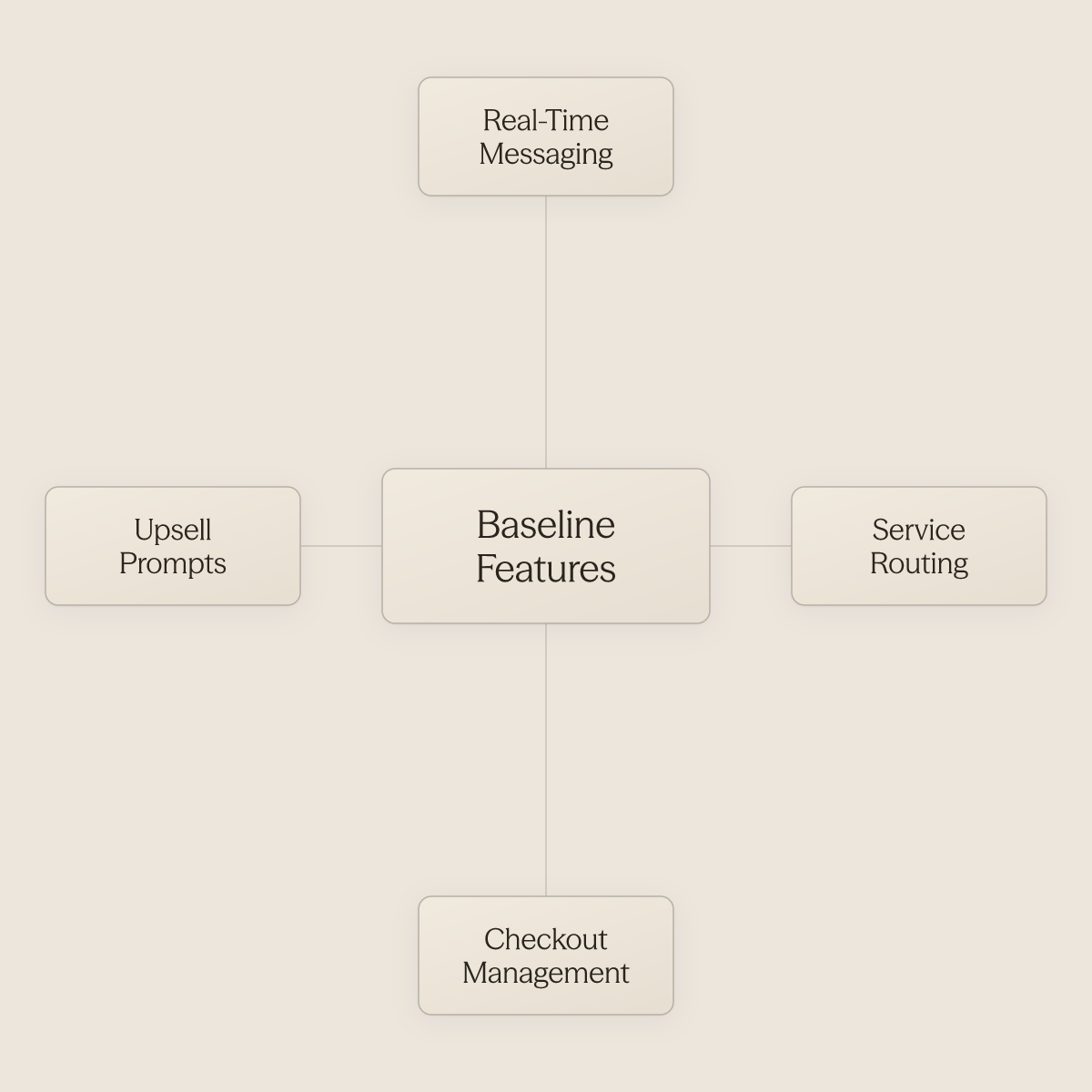
The common assumption among heads of operations and VPs of operations at multi-brand or enterprise hospitality groups is that the fix is finding a platform with more features or tighter integrations, that if the software is comprehensive enough, consistency will follow automatically. Real-time messaging, service request routing, check-out management, and upselling are the baseline of digital concierge software. Every credible platform ships all four.
Real-time messaging connects guests to staff across SMS, in-app chat, or web interfaces. Service requests route housekeeping, transportation, spa bookings, and room service to the right team. Check-out tools let guests schedule departure times and review folios without calling the front desk.
Upsell prompts surface room upgrades at moments of high intent. These features are necessary. They are not differentiators.
Real-Time Guest-to-Staff Messaging, Table Stakes, Not a Finish Line
The benchmark for guest message response time has tightened considerably. From our market understanding, the expectation sits at under five minutes for routine inquiries, with guests increasingly comparing hotel responsiveness to the instant replies they get from consumer apps. A messaging layer that delivers notifications to a staff inbox clears that bar only when a human is available, awake, and not handling three other requests.
The question is what happens when no one is there to answer. This pressure is sharpest for lean teams, solo operators or small groups running multiple properties without a dedicated communications staff. Managing guest conversations across several platforms or listings simultaneously means a single unanswered message thread can represent several simultaneous guests waiting.
The operational reality is that no inbox-monitoring rotation fully covers that surface area around the clock.
Service Request Routing, Routing Is Not Resolution
Routing a housekeeping request to the right team is operationally useful. It is not the same as resolving the guest's need. A platform that sends a "we've received your request" confirmation and then waits for a staff member to close the loop has added a coordination layer, not removed one.
What most teams report bears this out: hotels that route every query through a human approver see no measurable reduction in response workload; the burden shifts from answering to triage. For multi-property operators, that math compounds fast across shifts, time zones, and brands. The deeper problem is interface complexity.
Operations teams managing referrals, bookings, and multi-party guest communication across properties find that the more routing logic a platform adds, the more cluttered and overwhelming the staff-facing interface becomes. Adding a coordination layer without simplifying the review layer trades one bottleneck for another.
The Capability That Separates Tools Worth Evaluating
The variable that actually determines whether a platform reduces your operational load is whether it can resolve guest questions autonomously, using your property's own rules, or whether every non-trivial response still requires a human to approve it. Across the market, roughly 70 to 80 percent of inbound guest messages are repetitive or FAQ-type questions a well-documented SOP could answer without human judgment. Most platforms surface those answers as suggestions for staff to send.
That is not automation; that is assisted typing. Conduit's AI Agents operate differently. When a business has existing documentation, SOPs, FAQs, property manuals, the AI Agent is trained directly on that material, with the first automated guest reply typically live within days of connecting those sources.
The agent then responds continuously, before, during, and after a stay, every time a guest sends a message, without waiting for a staff member to approve each reply. Conduit's Integrations pull that existing content in without manual re-entry, so there is no parallel documentation burden to maintain. The Inbox layer sits above all of this, not as a replacement for human judgment, but as the surface where the operations or support team monitors, reviews, and manages the conversations the AI Agent is already handling.
The result is a consolidated view across multiple platforms and properties simultaneously, without the staff needing to triage every individual message before a guest gets a response. Conduit's Workflows fire automatically after a trigger event: a booking confirmed, a check-in recorded, or a specific keyword detected in a conversation. These are the moments that currently require a staff member to remember to act.
Automating them does not remove the team from the guest relationship; it removes the manual reminder system that was never reliable at scale anyway. As Noovy's analysis of hotel CRM and guest communication reinforces, the properties that improve consistency do so by systematizing the predictable so that staff attention is preserved for what is genuinely unpredictable.
Benefits of Hotel Digital Concierge Software - Including the Financial Outcomes Most Vendors Don't Quantify
The financial case for digital concierge software is hiding in plain sight, but most vendors bury it under satisfaction scores and response-time charts. The real numbers, the ones a VP of Operations can defend in a budget review, live in labor line items, NOI calculations, and compounding asset value. Getting there requires looking past the demo and into what the platform actually does at 1am when no one is watching.
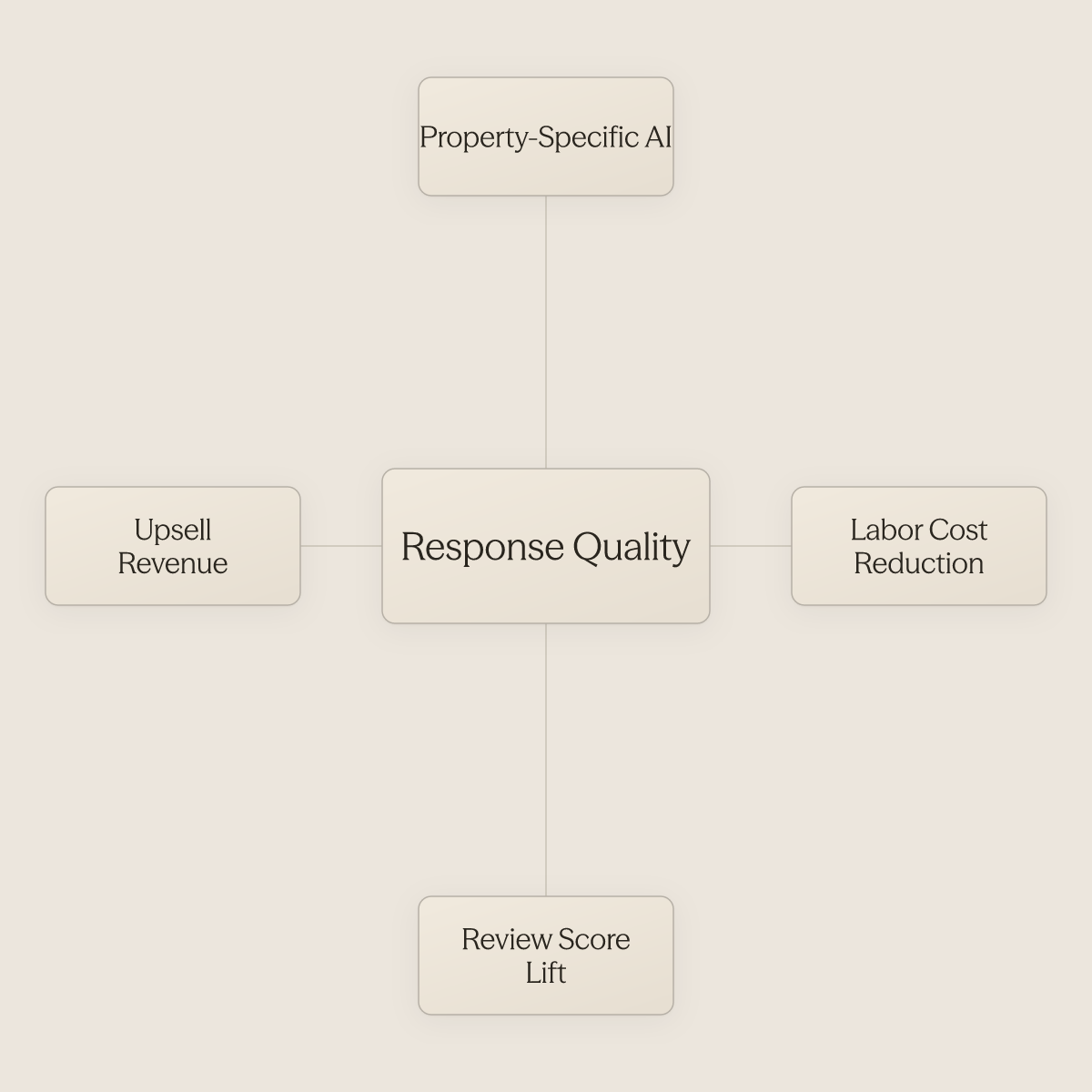
Platforms that require human approval on every response shift the operational burden to triage without reducing it, meaning the resolution rate ceiling is set by the quality of institutional knowledge fed into the system, not by the number of integrations on the vendor's spec sheet.
Immediate, Personalized Responses and Satisfaction Scores
Digital concierge software delivers measurable guest satisfaction improvements by reducing wait times from double-digit minutes to under five. Properties running AI-powered guest communication on property-specific knowledge report significant reductions in resolution times, a shift that shows up directly in review scores and repeat-booking intent. Personalized, accurate responses only materialize when the AI is trained on real property data, not a generic FAQ library. A platform answering from default knowledge will resolve common questions but escalate edge cases, precisely when guest frustration peaks.
Automated Upsells and In-Stay Revenue
Automated upsell capabilities turn idle guest moments into incremental revenue without requiring a staff member to initiate the conversation. Hotels using automated in-stay upsell prompts see measurable ancillary revenue uplifts per room night, depending on property type and offer relevance. Platforms that surface upsells based on guest behavior and stay timing outperform those pushing static promotional sequences.
Routine Task Automation and Real Labor Savings
The labor savings operators actually report are larger than vendor marketing suggests. Some short-term rental operators have documented significant monthly cost savings after shifting overnight and daytime messaging to AI-powered automation, adding zero additional staff. Based on what we observe across high-volume deployments, digital concierge platforms can reduce guest support staffing requirements by up to 92 percent at properties with sufficient message volume. The trade-off is real: operators without written SOPs, house manuals, or FAQ libraries will spend time building that foundation before automation rates climb, and that preparation time belongs in any honest implementation timeline.
Related Reading
- Hotel Budgeting And Forecasting
- Hotel Demand Forecasting
- How To Improve Hotel Operations
- How To Increase Revpar
- Hotel Upselling
- Hotel Revenue Management Strategies
- Automated Hotel Reservation System
- Hotel Guest Messaging
- Hospitality Automation
- Hospitality Operations Management
- Adr Vs Revpar
13 Best Hotel Digital Concierge Software Solutions in 2026
Two hotels can run the same software, pay the same license fee, and land in completely different places: one sees a front desk team that finally has breathing room, the other watches staff manually override AI responses all shift long because the system doesn't know the property's actual rules. That gap is the real story behind this roundup. The platforms below diverge sharply on one question: does the AI run on your property's SOPs, brand voice, and operating rules, or on a generic knowledge base the vendor pre-built? That single architectural difference explains why automation rates vary dramatically across real deployments. Every entry is evaluated through that lens, because feature parity is a distraction when the underlying logic engine is the variable that actually determines resolution rates.
1. Conduit.ai - Best Purpose-Built AI Concierge for Hospitality
Conduit trains its AI agents directly on your operational documentation, brand voice, and escalation policies before they handle a single guest message. Operators like Erwan Le Roy have reached 96% automation rates without a guest satisfaction regression, and Wynwood House cut average resolution time from 15 minutes to 3 minutes across seven countries. This matters most for lean teams, including solo operators and short-term rental businesses running without a full front-desk roster, where every manual intervention has a direct labor cost attached to it.
Conduit is built around three interlocking layers:
- AI Agents, most beneficial when the business receives a high volume of repetitive guest or customer messages and has existing documentation, SOPs, FAQs, and operating manuals to train the agent on; the first automated guest reply typically arrives within days of connecting that material.
- Inbox, most beneficial when managing guest communications across multiple platforms or properties simultaneously, giving the operations or support team a single surface to monitor, review, and manage every conversation the AI agent is handling.
- Workflows, most beneficial when the business has recurring, predictable guest touchpoints that currently require manual staff action, triggering automatically after a booking is confirmed, after check-in, or when a specific keyword is detected, without anyone queuing the action.
- Integrations, connects tools the business already uses, such as Notion, Google Drive, and Airbnb, so the AI agent can leverage existing content without manual re-entry.
One pain point operators consistently encounter with concierge software is unnecessary friction on tasks that used to be simple: forcing guests through multi-step chatbot flows just to retrieve a bill or confirm a booking detail introduces more friction than the previous manual process did.
Conduit addresses this directly. Because the AI is trained on your actual operating documentation rather than a generic decision tree, it resolves routine requests in the first response rather than routing guests through a chain of clarifying prompts that erode confidence in the system. The honest trade-off: operators with no existing documentation will need to build that foundation first before the automation rate climbs. The AI is only as precise as the institutional knowledge connected to it.
2. HiJiffy - Best for Omnichannel Guest Messaging Across Social Platforms
HiJiffy aggregates messaging, direct booking, and upsell workflows across WhatsApp, Instagram, and web chat into one surface. With 249 verified hotelier reviews on Hotel Tech Report averaging 4.5 out of 5, it has earned real credibility in the hotel segment. The HiJiffy platform is strongest for properties where a large share of inquiries arrive through social channels and consolidating those inboxes is the primary pain point. The structural trade-off: breadth-first platforms that combine messaging, booking, and upsell in a single dashboard introduce a depth deficit that surfaces as inconsistency across properties and shifts. For multi-brand operators who need each property's AI to enforce distinct SOPs, that trade-off matters more than the feature count on the spec sheet.
3. Hudini - Best In-Room Tablet Digital Concierge for Upsell Revenue
Hudini transforms the guest room into an active revenue channel by surfacing spa bookings, dining reservations, and late checkout offers directly on an in-room tablet at the moment a guest is most receptive. Tablet-based solutions like Hudini are the right pick for full-service hotels and resorts where ancillary revenue per stay is a tracked KPI and the physical room experience is part of the brand. The limitation: tablet hardware introduces a deployment and maintenance layer that adds cost and complexity, making it a poor fit for limited-service or aparthotel portfolios where guests rarely linger in-room.
4. Hoteza AI Concierge - Best Multilingual 24/7 Chatbot for International Hotels
Hoteza is built for properties where guest communication spans multiple languages and time zones, offering a 24/7 AI concierge layer with strong multilingual response capability. It integrates with in-room TV systems as well as mobile, giving it a room footprint without separate tablet hardware. The trade-off is depth of SOP customization: Hoteza's strength is broad multilingual coverage, not deep configurability of operating rules per property, so operators who need the AI to enforce nuanced escalation policies or brand-specific response standards will find the out-of-the-box logic limiting.
5. Canary Technologies - Best for Contactless Check-In with Integrated Upsells
Canary Technologies has built a strong reputation for contactless check-in workflows that double as a pre-arrival upsell surface, with operators reporting incremental revenue from room upgrade and add-on offers surfaced during the digital check-in flow. The platform is well-suited to hotel groups that want to capture revenue at the highest-intent moment in the guest journey, the 24-hour pre-arrival window, and its PMS integrations are broad. The limitation for multi-property operators: Canary's core strength is the check-in and upsell workflow, not deep ongoing guest communication, so properties that need a full-lifecycle AI guest messaging layer will likely need a second platform alongside it.
6. Duve - Best Guest Experience Platform for Personalized Pre-Stay Communication
Duve centers on the pre-stay guest journey, using a digital guest portal to deliver personalized upsells, early check-in offers, and property information before arrival. Its segmentation logic lets operators tailor messaging by booking source, guest type, or stay length, genuinely useful for hotels running multiple rate strategies across a portfolio. The honest limitation: the portal-dependent model assumes guests will engage with a dedicated web experience before they arrive, and engagement rates vary considerably depending on property type and booking channel mix.
7. Mews - Best Hotel PMS with Native Digital Concierge and Check-In Capabilities
Mews is a prominent example of a modern cloud PMS that has built digital check-in and guest messaging natively into its core platform, removing the integration dependency that plagues bolt-on concierge tools. For hoteliers already on the Mews stack, guest data, reservation context, and messaging all live in one system without a middleware layer. Mews serves a large number of properties globally, giving it the scale multi-property operators need when evaluating a PMS-native digital concierge alternative. The trade-off is lock-in: the concierge capability is strongest for operators committed to Mews as their PMS, and operators running a mixed or legacy PMS environment will find the native advantage largely unavailable to them.
8. Myma.ai - Best AI Concierge for Destination and Activity Recommendations
Myma.ai focuses on a specific and underserved slice of the category: destination intelligence. Its AI is trained on local activity, dining, and experience data, allowing it to function as a knowledgeable local guide rather than a generic information lookup, genuinely useful for resorts, boutique hotels, and destination properties where the guest experience extends well beyond the room. The limitation is scope: Myma.ai is a depth play on one workflow, not a full guest communication platform, so operators who need it to handle service requests, maintenance escalations, or check-in will need to integrate it alongside a broader operational layer.
9. Akia - Best SMS and Messaging Automation for Limited-Service Hotels
Akia is built around SMS-first guest communication, making it a practical fit for limited-service hotels, motels, and extended-stay properties where guests are unlikely to download an app or engage with a web portal. The platform automates pre-arrival messaging, check-in instructions, and post-stay follow-ups through text, the channel with the highest open rates in hospitality, and is a straightforward, low-friction option for lean front-desk teams looking to reduce inbound call volume. The trade-off is ceiling: operators who need the AI to resolve complex multi-turn guest conversations or enforce nuanced brand standards will find the platform's depth limited compared to full-stack AI agent solutions.
10. Straiv - Best Digital Guest Journey Platform for European Hotel Groups
Straiv is a German-built platform designed for the European hotel market, covering check-in, in-stay messaging, and check-out in a unified flow with strong GDPR compliance alignment. Its regulatory positioning makes it a relevant option for hotel groups where data residency and consent management are procurement requirements, not afterthoughts. The limitation for operators outside Europe: Straiv's integrations, support infrastructure, and product roadmap are oriented toward European PMS and channel manager ecosystems, which creates friction for global portfolio operators.
11. LIKE MAGIC - Best Contactless Guest Experience for Luxury and Lifestyle Hotels
LIKE MAGIC covers digital check-in, in-stay communication, and service requests through a branded guest-facing interface that luxury and lifestyle operators can configure to match their aesthetic standards. For boutique hotels and lifestyle brands where the app or web interface is itself a brand expression, that design flexibility is a genuine differentiator. The honest limitation: operators who need deep back-of-house coordination, SOP enforcement, or multi-team dispatch logic will find the operational depth doesn't match the front-end polish.
12. Roommaster AI Chatbot - Best Integrated Chatbot for Independent Hotels on a Unified PMS
Roommaster's AI chatbot is a native extension of the Roommaster PMS, making it a low-friction entry point for independent hotels already running that system. It handles routine inquiries and surfaces reservation information directly from the PMS, reducing manual lookup burden on front desk staff without requiring a separate vendor relationship. The ceiling is clear: operators who need the system to enforce complex SOPs, handle multi-channel communication, or scale across a distributed portfolio will outgrow its capabilities quickly.
"Hotel digital concierge software (e.g., IHG's implementation) can introduce unnecessary friction into previously simple tasks, like downloading a hotel bill, by forcing users through multi-step chatbot flows that didn't exist before."
96% automation rate with zero satisfaction drop
The hidden cost of a mismatched platform isn't the license fee, it's the staff hours spent correcting a system that was never given the institutional knowledge to act on your behalf. That tax compounds across every shift, every property, and every market in a distributed portfolio. The familiar approach is to select the platform with the most integrations and the broadest feature set.
In practice, breadth-first platforms introduce a depth deficit that surfaces as exactly the inconsistency operators were trying to eliminate. AI-powered platforms like Conduit address this differently: the AI agents are trained on your actual SOPs, brand voice, and operating manuals, pulling from tools you already use like Notion, Google Drive, or Airbnb, so the system enforces your standards autonomously at 1am with the same judgment your best team member applies at noon. Operators with specific brand standards, escalation policies, or complex multi-property operations see the clearest return, because the AI has the operational context to act without a human interpreting every edge case.
Knowing which platforms exist is only half the decision. The harder question is which evaluation criteria actually predict performance across a multi-property portfolio rather than a single pilot property. The next section gives VP-level buyers a three-filter framework designed to surface that answer before a vendor contract is signed.
Related Reading
- Best Hotel Channel Manager Software
- Hospitality Chatbot
- Hotel Distribution Management
- Hospitality Conferences
- Best Revenue Management Software For Hotels
- Siteminder Competitors
- Canary Technologies Competitors
- Cloudbeds Alternatives
How to Choose the Right Digital Concierge Software - A Framework for Multi-Property Operators
Buying a digital concierge platform for a multi-property portfolio is not the same decision as buying one for a single hotel. The stakes compound: a poor choice underperforms across every property, every shift, and every market you operate in. The framework below gives VP-level operators the specific filters that separate platforms that reduce operational load at scale from those that quietly become a new management layer.
The Three Non-Negotiable Filters That Separate Scale-Ready Platforms from New Management Layers
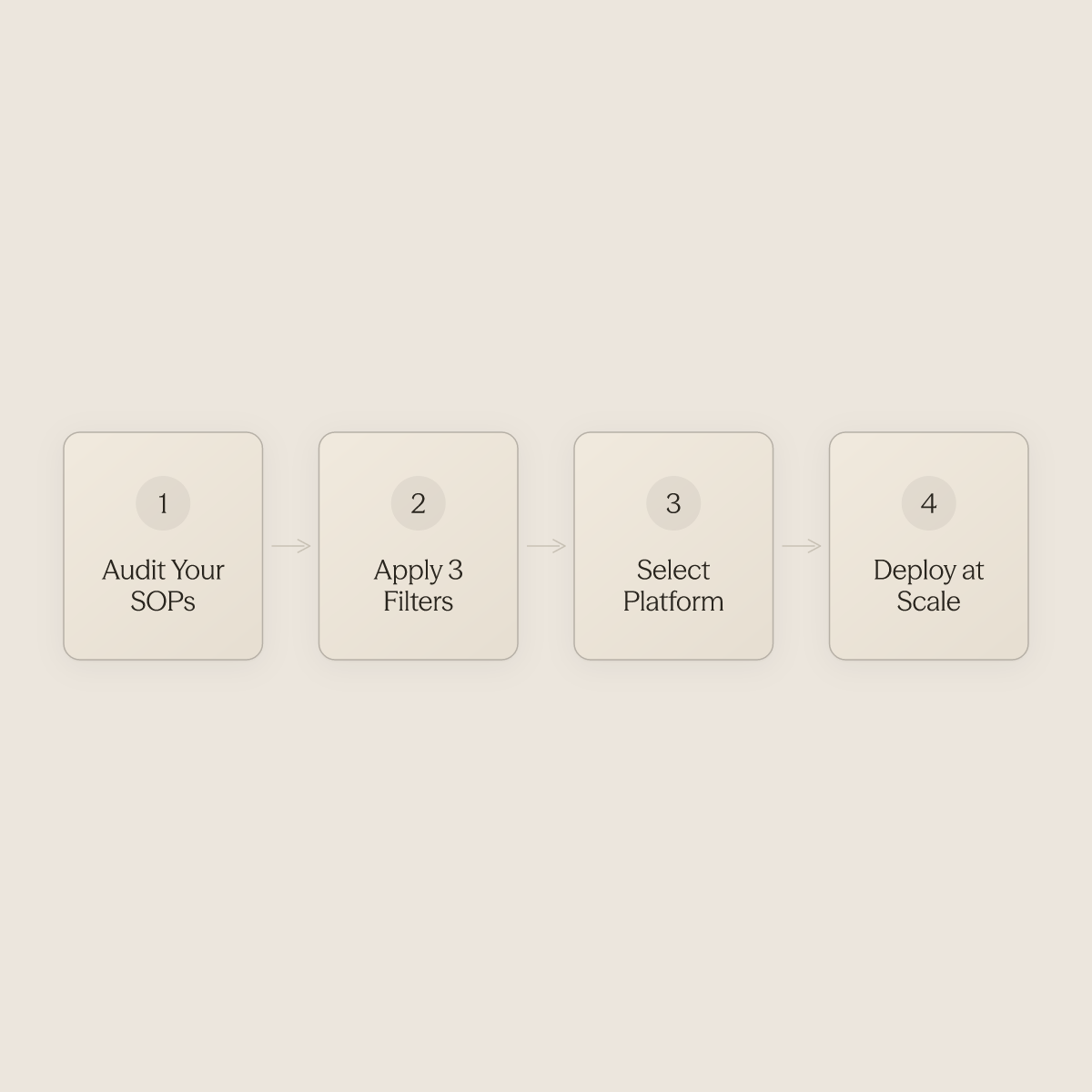
Three criteria cut through vendor noise faster than any feature checklist. First, can the platform ingest your existing SOPs and enforce them without a human interpreter in the middle? Second, does it resolve guest queries autonomously across every property type in your portfolio, or does it escalate the majority to staff? Third, can it deploy across a new property without a bespoke integration project? A platform that fails any one of these filters will cost you more to operate than it saves.
SOP-Trainability Over Feature Count
Multi-property operators commit a compounding selection error when they evaluate digital concierge software before auditing whether their own SOPs are documented and standardized enough to be enforceable by any system. An operator without documented SOPs who selects a more feature-rich platform over a SOP-trained AI will reliably underperform an operator with documented SOPs running on a simpler system, regardless of the vendor's resolution-rate marketing claims. The binding constraint on ROI is not the vendor's feature list; it is the quality of your own documentation, because technology can only enforce consistency where operational standards have already been defined. Across the market, operators with documented, standardized SOPs extract immediate value from automation precisely for this reason.
Audit your SOP library before you evaluate software, not after.
Autonomous Resolution Rate Is the Only Metric That Predicts Operational ROI
Autonomous resolution rate is the single number that tells you whether a platform reduces headcount dependency or just reroutes work. What most teams report is that leading hospitality AI platforms achieve high resolution rates for routine guest queries; some deployments, such as Wynwood House's operation across seven countries, have reached very high automation rates without guest-experience degradation. At 100 properties, the gap between 60 percent and 96 percent is the difference between a team that handles exceptions and a team that handles everything.
Portfolio Pricing and Integration Scalability
Ask every vendor two questions before advancing them to a shortlist. First: what is the per-property cost to add a new unit, and does that cost include knowledge-base configuration or does it bill separately? Custom PMS integration projects can carry significant per-property costs that compound quickly across a portfolio.
Second: does pricing scale linearly with property count, or does the vendor offer portfolio-level licensing? The hidden cost is not the license fee; it is the dedicated staff hour that follows the software everywhere it goes. AI for hospitality platforms like Conduit sidestep that cost by training AI agents directly on your existing SOPs, manuals, and FAQs, enforcing brand voice and operational standards across every property from day one, without a new internal admin role or a bespoke integration project per site.
Next steps
If your guest communication quality keeps drifting across properties and shifts despite adding new tools, the path forward starts with giving the AI the same institutional knowledge your best operator carries, not a broader feature set. Start with our AI for hospitality.
Resolution rates of 80 to 96 percent are outputs of SOP-trained AI, not integration counts. That means every platform running on a generic knowledge base is capped by what it doesn't know about your property. Separately, operators without documented, standardized SOPs who select a more feature-rich platform will reliably underperform operators running a simpler system built on real operational documentation. Together, these two points point to the same action: audit your SOPs first, then evaluate whether a platform can train directly on them and enforce them autonomously at 1am the same way it does at noon.
Start by exploring AI for hospitality to see how Conduit's agents run on your existing SOPs, brand voice, and operating manuals. Connect your documentation, and your first automated guest reply can be live within days.
Frequently Asked Questions
What's the difference between a digital concierge and a guest messaging platform?
A guest messaging platform routes messages to a staff inbox and waits for a human to reply. A true digital concierge resolves the guest's question autonomously, without requiring a staff member to approve each response. The post draws this line sharply: roughly 70 to 80 percent of inbound guest messages are repetitive FAQ-type questions that a well-documented SOP could answer without human judgment, and platforms that only surface suggested replies for staff to send are doing assisted typing, not automation.
Can digital concierge software handle guest requests before they even arrive at the property?
Yes, pre-arrival communication is one of the core use cases the post describes. Mobile apps handle pre-arrival touchpoints specifically, and AI agents trained on property documentation can answer questions about late checkout policies, parking validation, and room upgrades from the moment a booking is confirmed, not just during the stay.
Does digital concierge software actually help hotels make more money, or is it just a cost-cutting tool?
Both, according to the post. On the revenue side, automated upsell prompts surface room upgrades at moments of high intent and drive measurable ancillary revenue uplifts per room night, with behavior-based timing outperforming static promotional sequences. On the cost side, real-world deployments have documented up to a 92 percent reduction in guest support staffing requirements, with some operators adding zero additional staff while shifting overnight messaging entirely to AI-powered automation.
If 80% of our guest messages still get routed to a staff inbox, is that a software problem or something else?
According to the post, that is almost certainly a knowledge-base failure, not a software failure. The AI cannot answer property-specific questions about late checkout policies, parking validation, or room upgrade criteria if none of that information was ever loaded into the system. Platforms like Conduit's AI agents are trained on the operator's own SOPs, manuals, and brand voice, which is why they achieve high autonomous resolution rates, the institutional knowledge behind the channel is the actual bottleneck.
Can guests use digital concierge tools to check out without calling the front desk?
Yes, check-out management is listed as a baseline feature every credible platform ships. These tools let guests schedule departure times and review folios without calling the front desk. For recurring, predictable touchpoints like check-in instructions and post-stay follow-ups, platforms like Conduit can also fire automated workflows after a trigger event such as a check-in recorded or a booking confirmed, removing the need for a staff member to manually queue those actions.
Stay in the loop
Get the latest on AI automation, product updates, and customer stories.


