15 Best Hotel Guest Messaging Tools to Boost Stays in 2026


Hotel Guest Messaging
Conduit shows how hotel guest messaging works.
Most guest messaging platforms reduce inbox volume. The ones that resolve requests autonomously do one thing differently: they train on your SOPs.
Hotel guest messaging software is the system that connects a property to its guests across every digital channel, from the moment a booking is confirmed to the review request sent after checkout. The common assumption among heads of operations and VPs of operations at multi-brand and enterprise hospitality groups is that the automation ceiling in guest messaging is a technology limit, every platform eventually needs a human handler for nuanced queries, so the best you can do is reduce volume and accept that your team carries the rest, even on a sold-out night with one person on shift. Platforms like Conduit's AI for hospitality are redefining where the automation ceiling sits, particularly for operations teams that already receive a high volume of repetitive guest queries and have existing SOPs, FAQs, or operational manuals ready to train the AI on.
Without that documentation foundation, the ceiling stays low regardless of platform.
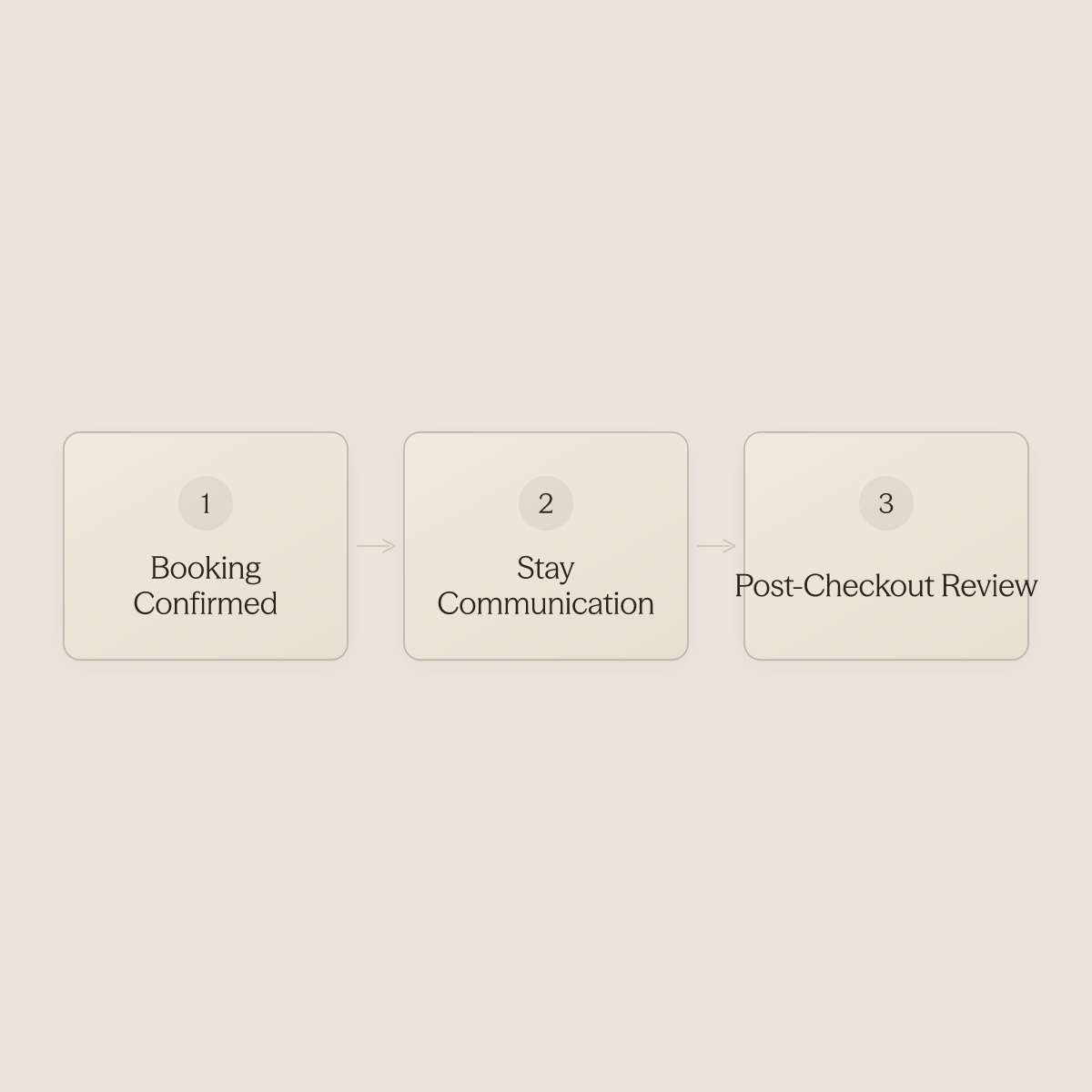
The first step is getting clear on the mechanics. Hotel guest messaging is two-way, real-time communication between a property and its guests, delivered across SMS, WhatsApp, email, OTA threads, and web chat without requiring guests to download anything. App-download friction kills adoption; channel-agnostic delivery meets guests where they already are. The platform reads the reservation, confirms the time, and responds in under a minute without waking anyone. That is the baseline the category now promises.
The guest journey has three distinct messaging windows, each with a different failure mode when messaging is manual:
- Pre-arrival covers booking confirmation, upsell offers, and check-in instructions. Pre-arrival emails miss personalization when handled manually.
- In-stay handles real-time service requests and issue resolution. In-stay requests sit unread overnight without automation.
- Post-stay captures review requests while sentiment is still fresh. Post-stay follow-ups arrive too late to influence a review when sent manually.
A structured messaging timeline, triggered by reservation data rather than staff memory, closes all three gaps. A unified inbox aggregates every guest conversation from every channel into one view. The PMS integration layer is what makes messaging contextual rather than generic.
Key takeaways
- Hotel guest messaging software connects a property to guests across every digital channel, from booking confirmation to post-checkout review request, but the automation ceiling most operators hit is not a technology limit; it's a training data limit.
- Most AI-powered guest messaging platforms handle check-in times and parking instructions without friction, then immediately route anything requiring real property knowledge back to a human coordinator.
- The highest-converting revenue window in the guest journey is pre-arrival, operators who treat it as a sequential upsell gate, not an administrative task, consistently outperform on both guest satisfaction and net operating income.
- Unified inbox and PMS integration matter, but neither solves the core problem: an AI that wasn't trained on your SOPs will still page the duty manager at 2 a.m. when a guest asks something property-specific.
- Channel count and template libraries are the wrong evaluation criteria, autonomous resolution rate, measured against your actual operating knowledge, is the number that determines long-run ROI.
- Conduit.ai's AI Agents close the gap by running directly on a property's own SOPs, manuals, and FAQs, handling conversations across every channel without human intervention, which is how operators like Erwan Le Roy reached a 96% automation rate and sub-1-minute response times across 35 properties without adding headcount.
Key Features of Guest Messaging Software: and the Ones That Actually Move the Needle
Operators evaluating guest communication platforms often walk in with a feature checklist and walk out with a tool that still pages the duty manager every time a guest asks about the pool towel policy. The common assumption among most heads of operations and VPs of operations at multi-brand or enterprise hospitality groups is that the automation ceiling in guest messaging is a technology limit, that every platform eventually needs a human handler for nuanced queries, so the best you can do is reduce volume and accept that your team carries the rest. The real question is not how many channels a platform covers. It is how far the platform can go before it needs a human to finish the job.
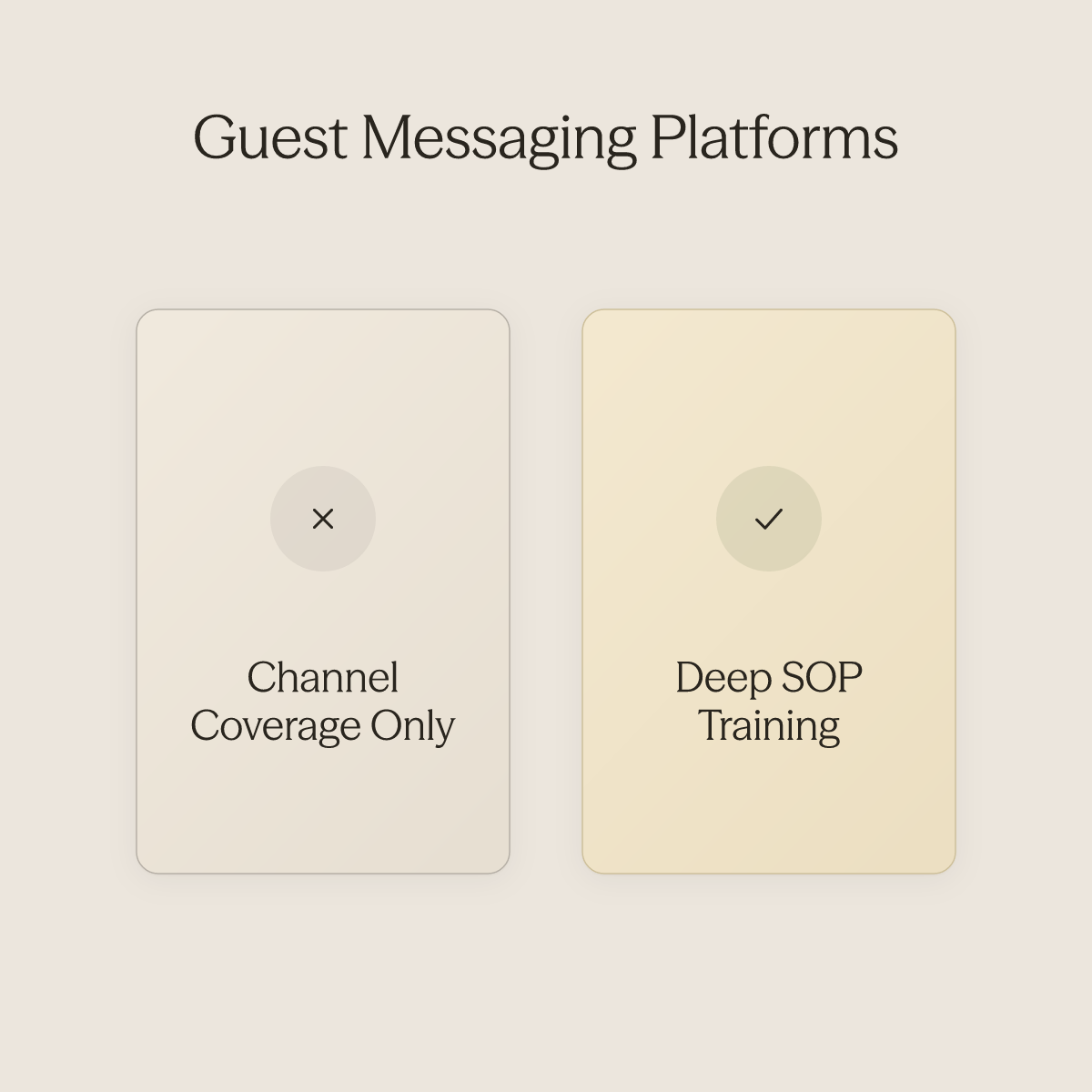
Table-Stakes Features Every Platform Claims
The core feature set across most platforms looks nearly identical: two-way messaging, automated pre-arrival and post-stay messages, a shared inbox, and basic PMS integrations. These features matter, but they do not differentiate. A platform with 40 integrations and no SOP training still routes every nuanced request straight back to staff, a pattern consistent with operator feedback across published reviews on HotelTechReport, and one that industry observers have noted broadly: AI tools without operator-specific training tend to cap out at FAQ deflection. Channel coverage is the floor, not the ceiling.
The Guest-Expectation Benchmark That Raises the Evaluation Stakes
Industry research shows 73% of guests prefer messaging over phone calls when communicating with a hotel, and they expect a response within one hour. A platform that deflects FAQ volume but stalls on anything complex will consistently miss that benchmark. The gap shows up in reviews before it shows up in your reporting.
Where Most Platforms Hit Their Automation Ceiling
73% of guests prefer messaging over phone calls
The failure point is almost always the same: FAQ-level automation handles the predictable 20% of conversations, and the remaining 80% land in a staff queue. A late checkout tied to loyalty status, a maintenance complaint needing SOP-specific follow-up, a question about a property-specific amenity policy, these are not edge cases. They are the daily volume that keeps ops teams tethered to inboxes. The automation ceiling is not a technology limit. It is a training problem.
The Overlooked Criterion - SOP-Trained AI vs. Generic Templates
The criterion that actually predicts operator-reported satisfaction is whether the AI can be trained on the property's own operating manuals, escalation policies, and brand-specific SOPs. This is the differentiator that most consistently correlates with operator-reported satisfaction, and with the 96% autonomous resolution rate Conduit documented across 35 properties (Cash Flow Street / Conduit, 2025), separating tools that reduce volume from tools that resolve requests.
Guest Messaging Channels, Unified Inbox, and PMS Integration - What Operators Actually Need
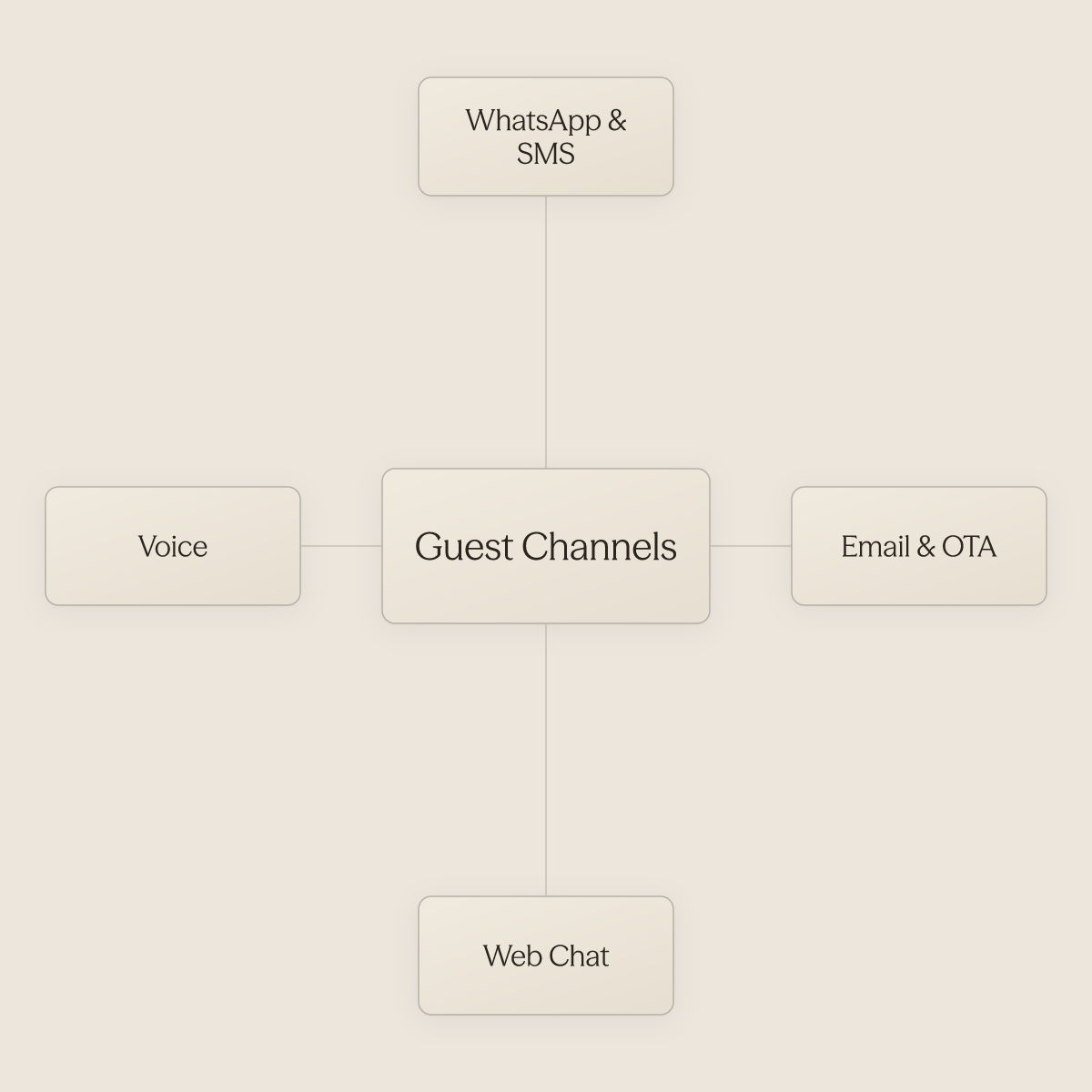
Every channel a guest might use to reach your property, WhatsApp, SMS, email, OTA messaging, web chat, represents a genuine communication preference worth supporting. The operational problem isn't adding channels; it's what happens to your team's workflow when each channel lives in a separate inbox and no single view ties them together.
The Six Channels Guests Actually Use
"Most guest messaging platforms are focused on marketing automation and pre-arrival upsells, not operational communication during the stay, leaving a critical gap for operators who need in-stay request management."
Guest messaging platforms support a consistent set of channels: WhatsApp, SMS, email, OTA messaging, web chat, and increasingly voice. According to industry data (2025), WhatsApp functions as a complement to email and SMS rather than a replacement, meaning no single channel covers the full guest journey from booking to post-stay. The operational debt accumulates when a WhatsApp message arrives while your front desk is watching the OTA portal.
At a 20-property scale, that's not a one-off slip, it's a systemic blind spot baked into the workflow. There's a deeper problem operators run into before they even reach that scale: most guest messaging platforms are built around marketing automation and pre-arrival upsells, not operational communication during the stay. That leaves a critical gap precisely when guests are most likely to reach out, mid-stay requests, in-room issues, late check-out asks.
A platform that handles the pre-arrival sequence well but drops the thread the moment the guest walks through the door forces your team to context-switch back to manual channels anyway.
What a Unified Inbox Really Does
If a guest books via an OTA, follows up on WhatsApp, and then sends an email the morning of check-in, the agent sees one continuous history, not three disconnected fragments across three platforms. A unified inbox removes the tab-switching cost entirely and gives every team member the same starting point. The AI Inbox is designed to be most beneficial when managing guest communications across multiple platforms or properties simultaneously, not as a passive archive, but as an active working environment used by the operations or support team to monitor, review, and manage all conversations the AI agent is handling on an ongoing basis.
Critically, that coverage runs continuously: before, during, and after a stay, closing the in-stay gap that marketing-first platforms routinely leave open.
PMS Integration as the Data Layer
PMS integration is what separates a consolidated inbox from a contextual inbox. Platforms connected to a PMS like Cloudbeds can automatically pull a guest's name, room type, arrival time, and booking details to trigger a personalized pre-arrival message 24 hours before check-in, without a staff member manually initiating it. Without that data layer, the inbox is a better filing system; with it, it becomes an active communication engine.
Setup requires no IT team or developer. An operator or ops lead connects tools like Notion, Google Drive, or Airbnb directly, meaning the platform can leverage existing content without manual re-entry from day one. The same no-IT setup applies to loading SOPs and manuals that train the AI agent, and to configuring the rules that govern automated workflows.
The operator or ops lead owns every layer of the configuration without a single support ticket to an engineering team.
Why Unified Inbox and PMS Integration Work as a Pair
Neither capability delivers its full value alone. A unified inbox without PMS data consolidates channels but still requires staff to look up reservation details manually. PMS integration without a unified inbox means contextual data feeds into one channel while messages on others remain disconnected.
Together, they create the infrastructure that makes it possible to manage guest communication across dozens of properties without adding coordination headcount. That infrastructure also determines what happens to in-stay requests that fall outside the pre-arrival automation sequence. When a guest sends a mid-stay message on WhatsApp asking about a late check-out, the unified inbox surfaces it in context, the PMS data layer supplies the reservation details, and, where the AI agent has been trained on the property's SOPs, the platform can resolve it autonomously without pulling a staff member in.
AI agents are most beneficial precisely when the business receives a high volume of repetitive guest messages and has existing documentation to train on, with the first automated reply typically live within days of connecting those materials. A unified inbox backed by PMS data closes the channel fragmentation gap, but it only moves the bottleneck from "which channel did the guest use?" to "who on the team handles this request?"
A unified inbox that aggregates five channels but routes every message to a human queue has traded one coordination problem for another. The combination of unified inbox, PMS-connected context, and a trained AI agent is what breaks the queue rather than simply reorganizing it.
How AI Agents Resolve the Routing Problem
A unified inbox surfaces every message in one place, but surface-level consolidation still leaves the routing decision to a human. When message volume scales across multiple properties, that decision point becomes the new bottleneck. An AI agent trained on property-specific SOPs, house rules, and common request patterns can handle the classification and response step autonomously, without waiting for a staff member to open the thread and assess it.
The practical effect is that a mid-stay maintenance request arriving at 11pm on WhatsApp receives the same quality of response as one sent at 11am via email, because the agent isn't dependent on shift coverage or channel preference. For operators managing properties across time zones or running lean overnight teams, that consistency isn't a convenience feature, it's the operational baseline that prevents guest experience from degrading outside business hours. The AI agent doesn't replace the judgment call on complex escalations; it handles the high-volume, repetitive tier so that human attention is reserved for requests that genuinely require it.
Measuring What the Infrastructure Actually Changes
Operators evaluating guest messaging platforms often focus on feature lists rather than the operational metrics the infrastructure is meant to move. The relevant numbers are response time across all channels, not just the primary one; the percentage of in-stay requests resolved without staff intervention; and the coordination overhead per property as the portfolio scales. A platform that consolidates channels but leaves in-stay gaps, or one that automates pre-arrival sequences but routes everything else to a human queue, will show improvement on some metrics while leaving others flat.
The combination of unified inbox, PMS-connected context, and a trained AI agent is designed to move all three simultaneously. Response time drops because no message waits in a siloed channel. Autonomous resolution increases because the agent has both the guest context and the property knowledge to act. Coordination overhead per property flattens because the infrastructure handles the volume that would otherwise require additional headcount. Those three shifts together are what make it possible to grow a portfolio without a proportional increase in the operations team supporting it.
AI and Automation in Guest Messaging - Why Most Tools Stop Short (and What Changes When They Don't)
Somewhere between the demo and the first live deployment, most operators discover an uncomfortable truth: their new AI-powered guest communication platform handles check-in times and parking instructions without a hitch, then immediately pages the duty manager the moment a guest asks anything that requires actual property knowledge. The gap between what was promised and what gets automated is not a small one.
Rule-Based AI Agents vs. Genuine AI
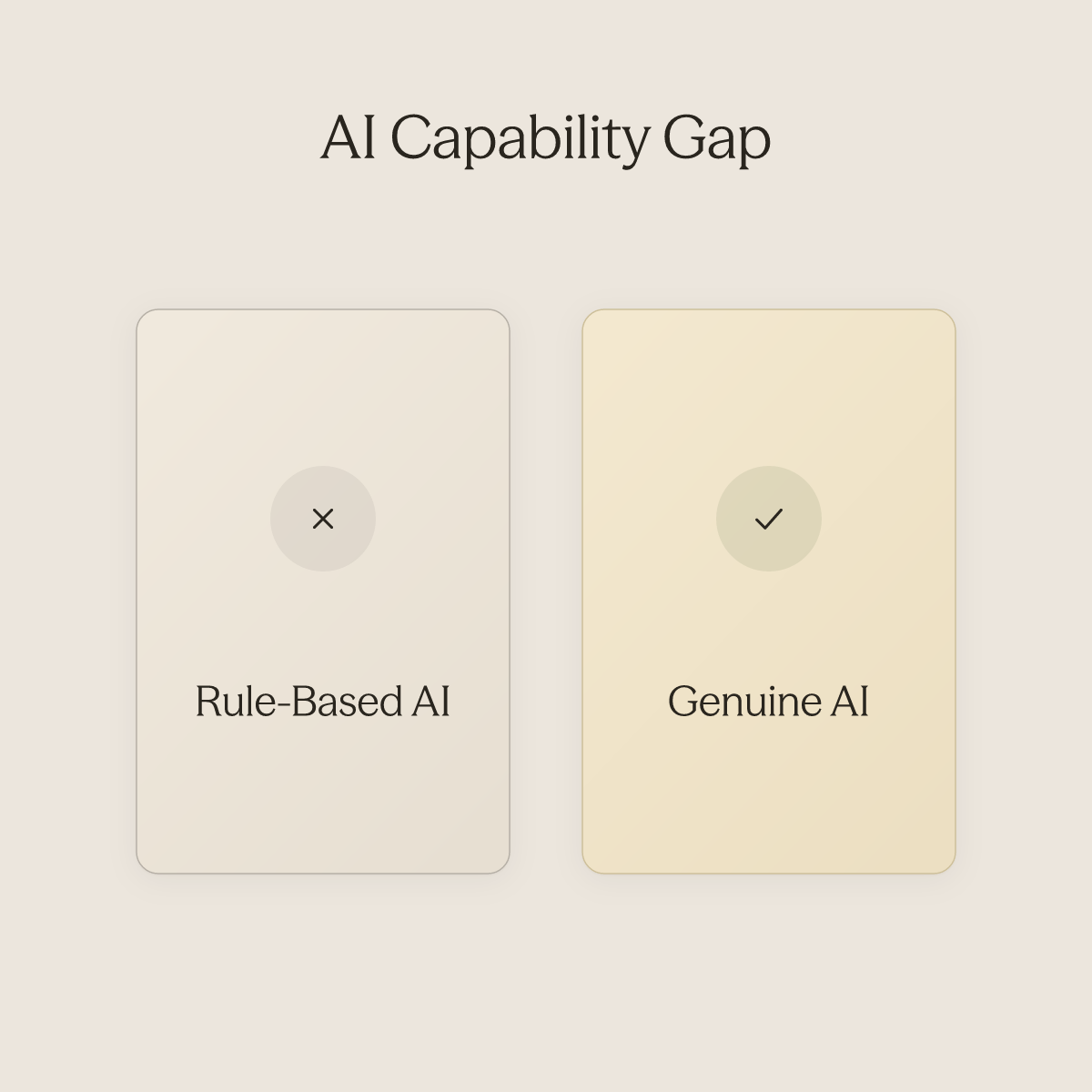
When the question fits a known pattern, the system replies instantly. When it doesn't, the system escalates. Rule-based systems, and platforms running shallow natural language processing on top of generic hospitality FAQs, can deflect high-frequency, low-complexity queries reliably.
But the moment a guest asks about a rate dispute, a specific comp policy, or a multi-part request touching three departments, the system hits its ceiling and routes back to a human. There is a subtler failure mode that operators discover even faster: messages that are too long and information-dense get ignored by guests entirely, so even a "successful" automated reply produces no resolution. And when third-party AI summarization tools misrepresent your property's reviews to arriving guests, incorrectly flagging positive or neutral feedback as negative, the confusion lands in your inbox as a conflict you now have to defuse manually.
Worst of all, rule-based systems tend to collapse at exactly the moments that matter most. A guest locked out at midnight who types "I can't find the door" does not need a paragraph about your cancellation policy; they need an actionable, property-specific answer in seconds. Generic AI consistently fails that test.
The Automation Ceiling Problem
The automation ceiling that plagues most guest messaging deployments is not inherent to the technology. It is a documentation failure. When an AI agent is trained only on generic hospitality FAQs, it is structurally incapable of resolving edge cases because those cases live inside operator-specific SOPs, rate fence logic, and exception workflows that never made it into the training layer.
The cognitively expensive queries, the ones that actually consume staff time overnight and across time zones, never get automated at all. The team absorbs that load as fixed overhead and accepts it as the cost of doing business. Conduit's AI Agents are most beneficial precisely when a business receives a high volume of repetitive guest messages and has existing documentation, SOPs, FAQs, property manuals, to train the agent on.
That second condition is the unlock. Operators who already have that documentation in tools like Notion or Google Drive can connect it directly through Conduit's Integrations layer, so the agent leverages existing content without manual re-entry. When both conditions are met, the ceiling lifts quickly: the first automated guest reply typically arrives within days of connecting your SOPs and manuals.
SOP-Trained AI Agents - Property-Specific Accuracy Instead of Scripted Guesses
The distinction that separates high-ceiling automation from basic deflection is what the AI was trained on. Operators who encode their actual rate fence logic, comp policies, and exception workflows into the agent's knowledge base have demonstrated 96% autonomous resolution at scale, according to published deployment data. Erwan Le Roy achieved that figure across 35 properties with sub-1-minute response times and zero additional headcount because the AI agents were trained on property-level documentation rather than generic content.
If that documentation doesn't exist yet, the ceiling stays low regardless of which platform you choose. The staffing impact is equally direct for operators managing growth. Jack, CEO of Haven Vacation Rentals, captures it plainly: "We added 14 listings in January."
That is not a marginal efficiency gain; it is a structural change in how headcount scales with portfolio size. The Conduit Inbox gives the operations team ongoing visibility into every conversation the AI agent is handling across all platforms and properties simultaneously, so managers stay in control without being in every thread. As Jack described his Sunday check-in after deploying: "I remember looking at my phone, and I'm like, how in the world am I gonna look at all 100 of these problems? Then on Sunday, I looked, and there was three things. And I was like, oh, this is great." That reduction, from 100 open items to three, is what property-specific training actually produces at the operations level.
Conduit's AI Agents run continuously, responding before, during, and after a stay whenever a guest sends a message. Workflows layer on top of that, triggering automated actions after booking confirmation, check-in, or specific keyword detection, handling the recurring, predictable guest touchpoints that currently require manual staff action. The combination means the cognitively expensive queries get resolved by the agent, and the human team focuses only on the exceptions that genuinely require judgment.
For operators managing guest communications across multiple platforms or properties simultaneously, that is where the staffing math changes for good. Learn more about how AI chatbots for hotels close this gap.
Related Reading
- Hotel Budgeting And Forecasting
- Hotel Demand Forecasting
- How To Improve Hotel Operations
- Hospitality Operations Management
- Adr Vs Revpar
- How To Increase Revpar
- Hotel Upselling
- Hotel Revenue Management Strategies
- Automated Hotel Reservation System
- Hospitality Automation
Guest Messaging Across the Full Guest Journey - Pre-Arrival, In-Stay, and Post-Stay
Three messaging windows sit inside every guest journey. Most operators treat them as administrative tasks. The ones who treat them as sequential revenue gates consistently outperform on both guest satisfaction and net operating income, and the gap between those two groups is widening.
Pre-Arrival - The Highest-Yield Upsell Window
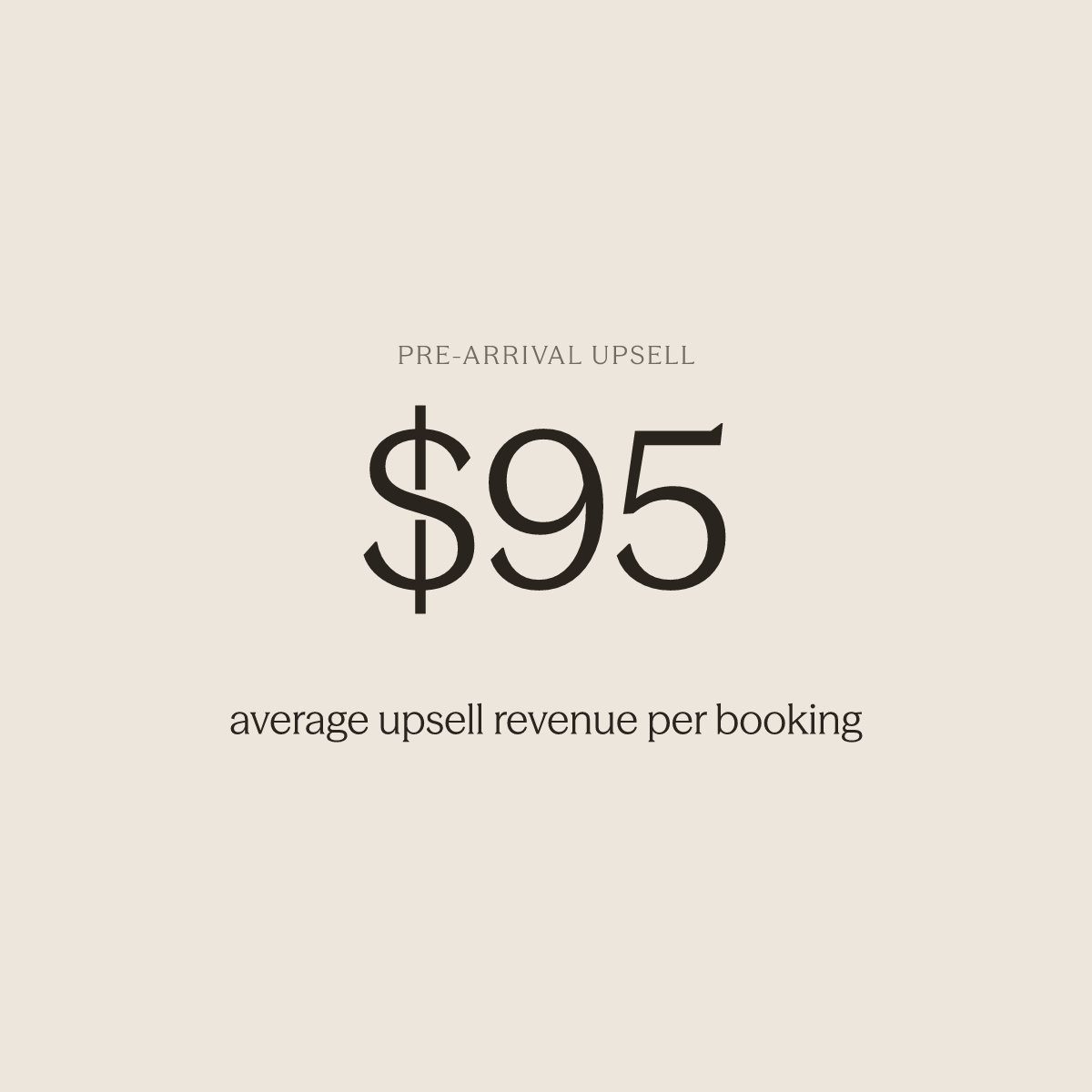
Pre-arrival emails generate an average of $95 per booking in upsell revenue. Structured upsell offers sent 48-to-72 hours before arrival convert at 15 to 25 percent. Yet most properties send a PDF with check-in instructions and call it done.
The core reason is structural: the same AI training gap that creates an automation ceiling on support queries creates an identical revenue ceiling on upsell automation. Personalized offer logic, which room category to upgrade, which F&B package fits a honeymoon booking versus a corporate rate, when a rate fence exception applies, is property-specific SOP knowledge that a generic tool cannot execute without human intervention. AI Agents are most beneficial precisely when a business has existing documentation (SOPs, FAQs, manuals) to train the agent on.
Once that training is in place, the same infrastructure that handles repetitive guest inquiries day or night also executes pre-arrival upsell sequences, triggered automatically after a booking is confirmed, without leaking a single inquiry to an unmonitored channel. Operators who solve the SOP-training problem for support resolution automatically unlock the same infrastructure for upsell automation. The two problems share one root cause and one fix.
Conduit's Workflows allow a single pre-arrival sequence, brand voice standardized, offer logic encoded, to fire consistently at every property the moment a trigger event occurs, whether that is a confirmed booking or a detected keyword signaling a honeymoon or anniversary stay. The result is standardized guest communication quality and brand voice across a large, distributed portfolio, without multiplying staff hours proportionally.
In-Stay Messaging - Real-Time Requests and Mid-Stay Revenue
The in-stay window is where routing failures cost the most. A maintenance request in the wrong inbox, or an F&B order unacknowledged for 40 minutes, creates the negative review that appears before the morning shift reads it. Faster in-stay response times correlate consistently with higher CSAT and NPS, with that correlation tightening when requests resolve without a handoff chain.
Ai addresses this through two layers working in parallel. The Inbox gives the operations or support team a single place to monitor, review, and manage all conversations the AI agent is handling across every channel, so nothing falls into a gap between platforms. Simultaneously, AI Agents respond to every guest message the moment it arrives, before, during, or after a stay, capturing every inquiry around the clock without leaking revenue to delayed or missed responses.
Workflows add the second layer: when a specific keyword is detected mid-stay, a dinner reservation request, a spa inquiry, a late-checkout ask, a structured response and routing action fires immediately, rather than waiting for a staff member to notice the message in a separate app. Mid-stay upsell prompts add a second revenue layer to the same window, provided the messaging system knows enough about the reservation and offer inventory to send something relevant rather than generic. Ai Integrations allow the AI agent to leverage existing content from tools like Notion, Google Drive, or Airbnb without manual re-entry, so offer inventory and reservation context are available to the agent at the moment the guest sends a message, making relevance the default, not the exception.
Post-Stay Follow-Up That Drives Rebooking
Timing and personalization both matter in the post-stay window. A post-stay message referencing the actual stay gives the guest a reason to respond, to review, and to rebook. Conduit.ai Workflows trigger post-stay sequences automatically after the relevant lifecycle event, maintaining the same brand voice that carried through pre-arrival and in-stay communications. For operators managing a distributed portfolio, that consistency, standardized across every property, every channel, every guest, is the compounding advantage that separates the operators who treat messaging as a revenue system from the ones who are still sending a PDF and calling it done.
The 15 Best Hotel Guest Messaging Tools to Boost Stays in 2026
Ninety-six percent of guest messages resolved without a human touching the thread. That is not a projection from a vendor deck; it is a verified outcome across 35 properties, documented by operators who built it by feeding their actual SOPs into a purpose-built AI platform. The number matters because it reframes the entire exercise below.
If your evaluation criteria are channel count and template variety, almost every platform on this list will pass. If your criteria are how far autonomous resolution climbs before a person enters the conversation, the list sorts into very different tiers. The platforms reviewed below are: Conduit.ai, Canary Technologies, Cloudbeds Messaging, Duve, HiJiffy, Bookboost, GuestTouch, Asksuite, Akia, SiteMinder, Wildix Wilma AI, Konexus, Guestivo, RoomMaster Messaging, and Smart Host Messaging.
Most operators managing 20-plus properties recognize the pattern: the platform handles check-in reminders and FAQ replies at speed, then routes anything property-specific back to whoever is on shift. That hidden labor cost compounds quietly. Each handoff lands back on a human, and across a portfolio those handoffs add up to a second ops layer that never shows on the automation dashboard.
The platforms that break this pattern do so by training the AI on the operator's own knowledge base, so the resolution ceiling rises with institutional knowledge rather than plateauing at generic hospitality scripts. That is the lens applied to every entry below. AI for hospitality built on operator-specific SOPs resolves a structurally different category of query than a platform running on generic hotel FAQ logic, and that difference separates the top tier from the middle.
1. Conduit.ai - Best Purpose-Built AI for Hotel & Hospitality Guest Messaging
Conduit.ai earns the top position because its AI agents are trained on each operator's own SOPs, manuals, and property documentation rather than generic hospitality scripts, which enables verified outcomes like 96% autonomous resolution across 35 properties with sub-1-minute response times. For a VP of Operations managing a distributed portfolio, that ceiling matters more than channel count. The honest tradeoff: the platform delivers its highest value when you already have documented SOPs to feed it; operators without structured internal documentation will need to build that foundation before the automation ceiling rises meaningfully.
2. Canary Technologies - Best for Full-Suite AI Guest Messaging with Verified Reviews
Canary Technologies is among the most reviewed options in the hotel segment by published review volume, with a substantial number of verified hotelier reviews on HotelTechReport and consistent top rankings in HotelTechAwards. Its suite covers digital check-in, upselling, messaging, and tipping in one platform, reducing vendor sprawl for full-service hotel operators. The tradeoff for multi-brand groups is that suite breadth can introduce rollout complexity, and the automation layer handles predictable touchpoints well but still routes nuanced, property-specific queries to a human at a rate that operators managing 20-plus properties will notice.
3. Cloudbeds Messaging - Best for All-in-One PMS-Integrated Guest Communication
Cloudbeds Messaging is the natural choice for operators already running Cloudbeds as their PMS, because the integration is native rather than bolted on. Reservation data triggers contextual messages without manual configuration, keeping communication in sync with booking status, check-in windows, and room assignments in real time. The limitation is portability: operators running a mixed PMS environment will find the messaging layer difficult to extend outside the Cloudbeds ecosystem, making it a strong single-stack solution but a weak fit for heterogeneous portfolios.
4. Duve - Best for Personalized Digital Guest Journey Messaging
Duve centers its product around a branded digital guest portal that sequences communication across the full stay, from pre-arrival upsells through post-stay review requests. Hotels that want a guest-facing app experience alongside messaging will find the combination coherent. The operational consideration for large portfolios is a guest-adoption dependency: in segments with lower smartphone adoption or OTA-dominant booking patterns, that engagement rate can limit the platform's measurable impact on resolution volume.
5. HiJiffy - Best AI Chatbot for Multilingual Hotel Guest Messaging at Scale
HiJiffy supports a wide range of languages through its WhatsApp-native AI layer, making it a relevant option for urban hotels or resort groups serving international guest segments where language fragmentation is a real operational problem. Independent third-party benchmark data on specific deflection rates was not available at time of writing. The ceiling question is relevant: the platform performs well on volume reduction for predictable queries, but property-specific or SOP-dependent questions still require human escalation, so the autonomous-resolution rate for complex multi-property operators will land below what SOP-trained platforms can reach.
6. Bookboost - Best for Omnichannel Guest Messaging with CRM-Driven Segmentation
Bookboost combines a unified inbox with a CRM segmentation layer, letting operators target guest cohorts with differentiated messaging based on stay history, booking channel, and loyalty status. Published operator results from Bookboost deployments point to measurable improvements in email open rates and upsell conversion when segmentation is applied to pre-arrival and post-stay sequences. The tradeoff is setup investment: extracting the segmentation value requires clean guest data and time to configure audience logic, making Bookboost a stronger fit for operators with a dedicated CRM or marketing function than for lean teams seeking out-of-the-box automation.
7. GuestTouch - Best for WhatsApp Business API-Powered Hotel Guest Messaging
GuestTouch is built around the WhatsApp Business API for hotels where WhatsApp is the dominant guest communication channel, particularly across Europe, Latin America, and Southeast Asia. The platform handles automated messaging sequences, review requests, and real-time chat within WhatsApp without requiring guests to download anything. The channel concentration is both the strength and the constraint: properties serving North American guests who default to SMS will find coverage gaps that require a secondary tool, reintroducing the channel fragmentation problem the platform is designed to solve.
8. Asksuite - Best AI Reservation Chatbot with Integrated Guest Messaging
Asksuite focuses on the pre-booking and reservation inquiry window, using AI to handle rate questions, availability checks, and booking-path conversations before a reservation is confirmed. For hotels with high direct-booking ambitions and a leaky web-chat funnel, it addresses a specific revenue gap. The operational scope is narrower than full-journey platforms: Asksuite is strongest in the acquisition window, so operators looking for a single platform to cover the entire guest journey will need to pair it with a complementary tool.
9. Akia - Best SMS and WhatsApp Automation for Contactless Hotel Guest Messaging
Akia automates contactless check-in, digital key delivery, and scheduled SMS and WhatsApp sequences, making it a practical fit for limited-service hotels and vacation rental operators who want to reduce front-desk touchpoints without building a complex AI layer. The automation ceiling is real and acknowledged: Akia is designed for structured, templated interactions, and anything requiring judgment or property-specific SOP knowledge will route to a human. Evaluate it as a high-reliability automation layer for defined touchpoints rather than a general-purpose AI resolution engine.
10. SiteMinder - Best for Messaging Integrated with a Global Hotel Distribution Platform
SiteMinder's messaging capability sits inside a broader distribution and channel management platform, so operators already using SiteMinder for rate management and OTA connectivity can add guest communication without a separate vendor relationship. The honest limitation is that messaging is not SiteMinder's primary product; operators who prioritize automation depth, AI resolution rates, or advanced segmentation will find the messaging layer functional but not differentiated compared to platforms built specifically around guest communication.
11. Wildix Wilma AI - Best for Voice-First Hotel Communication with AI Messaging Overlay
Wildix Wilma AI layers AI messaging onto a voice and telephony infrastructure, reducing the number of systems a front-desk team manages for hotels where phone calls remain a significant inbound channel alongside digital messaging. The tradeoff is that the product's roots are in enterprise telephony, not hospitality-specific guest experience, so the AI's contextual understanding of hospitality workflows and depth of PMS integration will not match platforms built exclusively for the hotel segment.
12. Konexus - Best for Emergency and Mass Notification Messaging in Hotel Guest Safety
Konexus serves a specific and non-negotiable use case: emergency alerts, mass notifications, and safety communications to guests and staff during critical incidents. For large hotel groups with compliance obligations around guest safety communication, it fills a gap that general-purpose messaging platforms are not designed to address. Konexus is not a guest experience or AI resolution platform and should be evaluated as a safety-critical communications layer that sits alongside, not instead of, a full-journey guest messaging platform.
13. Guestivo - Best Lightweight AI Concierge Messaging for Boutique and Independent Hotels
Guestivo is an accessible AI concierge layer for independent and boutique properties that want automated guest messaging without the implementation complexity or cost structure of enterprise platforms. For a single-property operator or small portfolio with limited IT resources, the lighter configuration requirement is a genuine advantage. The ceiling is proportional to the scope: Guestivo handles common concierge queries well but is not architected for multi-brand SOP training or cross-property orchestration that a VP of Operations managing 20-plus properties would require.
14. RoomMaster Messaging - Best for Budget-Conscious Hotels Wanting Integrated PMS Messaging
RoomMaster Messaging is integrated within the RoomMaster PMS and targets independent and limited-service hotels that want basic automated communication without a separate messaging platform investment. The value is consolidation at a lower price point: one vendor, one support relationship, messaging tied directly to reservation data. The messaging layer is designed for scheduled sends and standard touchpoints, not AI-driven autonomous resolution, making it the right fit for operators whose primary goal is reducing manual email work rather than raising their automation ceiling.
Related Reading
- Digital Concierge Software
- Best Hotel Channel Manager Software
- Hospitality Chatbot
- Hotel Distribution Management
- Hospitality Conferences
- Best Revenue Management Software For Hotels
- Siteminder Competitors
- Canary Technologies Competitors
- Cloudbeds Alternatives
How to Choose the Right Hotel Guest Messaging Platform: and Implement It Without Starting Over
Choosing a guest communication platform feels like a feature comparison until you're six months post-launch, watching your coordinator field the same SOP-specific questions the AI was supposed to handle. The decision that actually determines long-run ROI is not which channels a platform supports, but how high its autonomous-resolution ceiling reaches when trained on your specific operating knowledge, and whether adding a tenth or twentieth property multiplies that ceiling or multiplies your headcount.
The Four-Criterion Filter That Scales Past 20 Properties
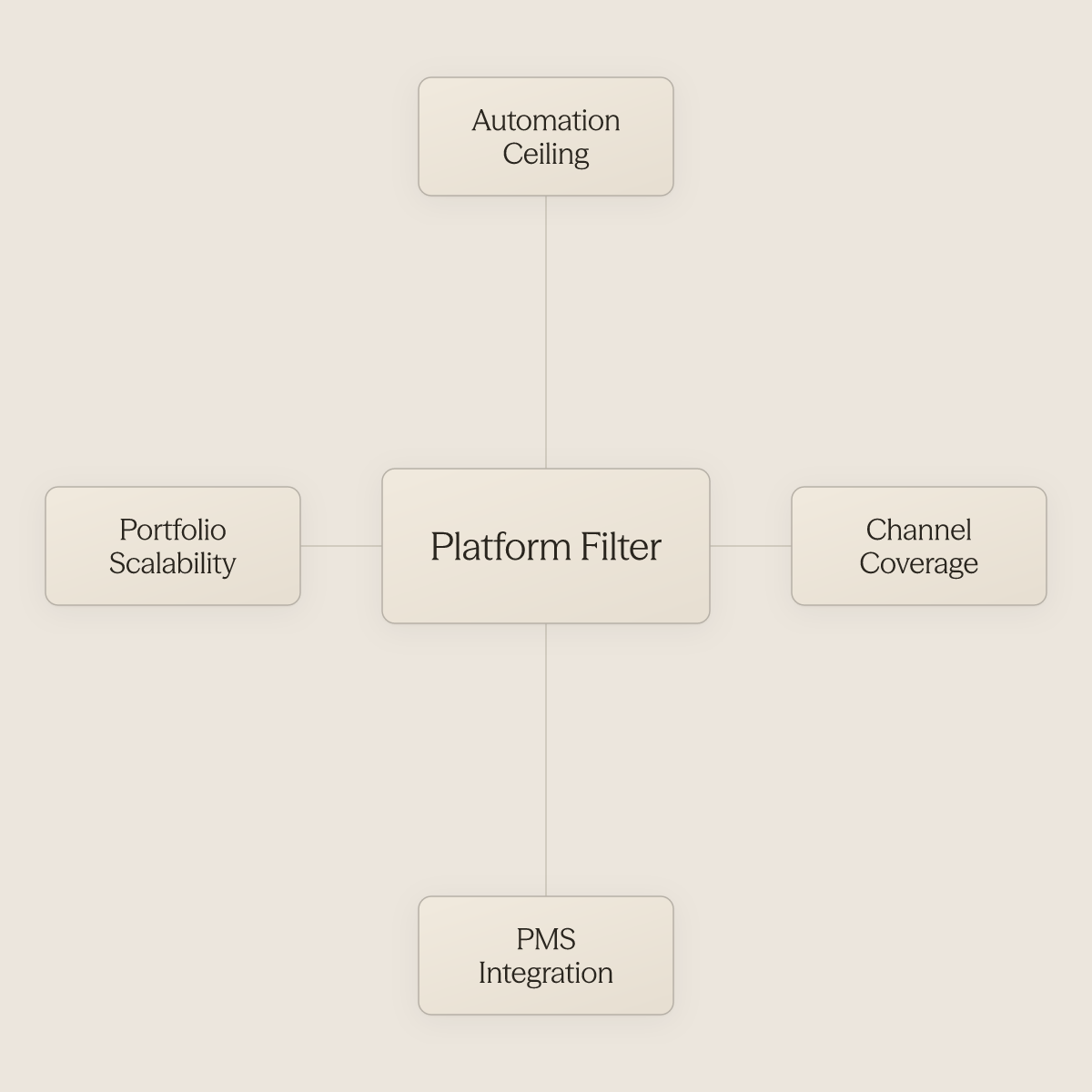
Best practice for implementing guest messaging starts with filtering on four criteria before any demo: automation ceiling, channel coverage, PMS integration depth, and portfolio scalability.
| Criterion | What to Evaluate | Red Flag |
|---|---|---|
| Automation ceiling | What % of property-specific queries resolve without human handoff? | Tops out at FAQ deflection only |
| Channel coverage | Does the platform cover WhatsApp, SMS, email, OTA, and web chat natively? | Requires third-party bridges for core channels |
| PMS integration depth | Does reservation data trigger contextual messages automatically? | Manual sync or limited PMS list |
| Portfolio scalability | Can each new property's SOPs be loaded into the same AI layer? | Bespoke integration required per property |
Automation ceiling is the most overlooked. A platform that tops out at FAQ deflection will still route every nuanced, property-specific query back to a human. Platforms that connect in real time to reservation data reduce manual entry errors and enable context-aware guest communication at scale, which is why PMS integration depth belongs on the shortlist, not the nice-to-have column.
Portfolio scalability means the platform absorbs each new property's SOPs into the same AI layer without a bespoke integration project per site, and that distinction is what separates tools that let you add properties without adding coordination headcount from tools that simply shift the coordination burden from guests to your ops team. Conduit's Integrations feature directly addresses this: when your business already uses tools like Notion, Google Drive, or Airbnb, the AI agent pulls from that existing content without manual re-entry, so each new property you onboard draws on documentation you've already written rather than requiring a fresh configuration project.
The One-Property Pilot Rule - Tune Your AI on SOPs Before You Roll Out
Cascadia Getaways achieved meaningfully higher automation and guest communications scores by training the AI on property-specific SOPs before going live, not after. A pilot on one property lets you validate the automation rate against real guest queries, identify edge cases your documentation does not yet cover, and fix them before the same gap exists across twenty properties. Conduit's AI Agents are most beneficial precisely when the business receives a high volume of repetitive guest or customer messages and has existing documentation, SOPs, FAQs, manuals, to train the agent on.
Connect your SOPs and you can have your first automated guest reply live within days, not weeks. Industry experience consistently shows that implementations using existing operational documentation for configuration reduce onboarding time and avoid costly custom integration work, which is why the pilot-on-one-property rule works: you're pressure-testing documentation quality, not rebuilding an integration from scratch. Once the pilot validates your automation rate, the scale argument becomes structural rather than aspirational.
The portfolio grows; the coordination headcount does not need to. Hospitalitynet notes that cost-control strategy in hospitality is increasingly defined by the ability to scale operations without proportionally increasing staff, and an AI layer trained on your own SOPs is the mechanism that makes that possible in guest communications specifically. Conduit's Inbox gives your operations or support team an ongoing view of every conversation the AI agent is handling, before, during, or after a stay.
It's most valuable when managing guest communications across multiple platforms or properties simultaneously, because it surfaces the edge cases your pilot didn't catch and lets you close documentation gaps before they compound across the portfolio.
The Three KPIs That Tell You Whether Implementation Is Working
Automation rate, response time, and guest satisfaction score are the three numbers that tell you whether your AI layer is actually performing or merely deflecting. Conduit.ai's Workflows complement these metrics directly: they fire after a trigger event, a booking confirmation, a check-in, a detected keyword, so recurring, predictable guest touchpoints that currently require manual staff action are handled automatically and consistently, keeping response time low and satisfaction scores stable as the portfolio grows. Monitor all three KPIs through the Inbox from day one of your pilot, and you'll have the data to justify, or recalibrate, your rollout before it reaches property twenty.
Next steps
If your automation rate has plateaued at FAQ deflection while property-specific questions keep routing back to a human, the path forward starts with recognizing that the ceiling reflects what your AI was trained on, not what the technology can do.
The documentation failure insight from the body makes this concrete: AI agents fed generic hospitality scripts are structurally incapable of resolving edge cases, because that resolution logic lives inside your rate fence policies, comp exceptions, and SOP workflows, not inside a shared FAQ library. The pre-arrival revenue ceiling insight sharpens the stakes further: the same training gap that keeps support queries in a human queue also blocks personalized upsell automation in the 48-to-72 hour window that converts at 15 to 25 percent. Together, they point to one action: load your existing documentation into an AI layer built to act on it, not just store it.
Start with AI for hospitality to see how Conduit's agents ingest your SOPs and operational manuals directly. Once connected, your first automated guest reply typically goes live within days, and the same training infrastructure that closes the support resolution gap also executes pre-arrival upsell sequences automatically, across every property, without adding coordination headcount.
Frequently Asked Questions
What exactly is hotel guest messaging software?
Hotel guest messaging software is the system that connects a property to its guests across every digital channel, SMS, WhatsApp, email, OTA threads, and web chat, from the moment a booking is confirmed to the review request sent after checkout. It is two-way, real-time communication that requires no app download from the guest, meeting them on the channels they already use. A unified inbox aggregates every conversation from every channel into one view, and PMS integration makes those conversations contextual rather than generic.
Does the automation really cover the full guest journey, or just pre-arrival messages?
The guest journey has three distinct messaging windows, pre-arrival, in-stay, and post-stay, and most marketing-first platforms cover pre-arrival well but drop the thread once the guest walks through the door, forcing teams back to manual channels mid-stay. A platform built for the full journey handles real-time in-stay service requests and issue resolution, then captures post-stay review requests while sentiment is still fresh. Conduit's inbox is designed to run continuously before, during, and after a stay, closing the in-stay gap that marketing-first platforms routinely leave open.
How does pre-arrival messaging get set up without staff manually sending each one?
When a platform is connected to a PMS like Cloudbeds, it can automatically pull a guest's name, room type, arrival time, and booking details to trigger a personalized pre-arrival message 24 hours before check-in, without a staff member manually initiating it. The messages are triggered by reservation data rather than staff memory. Inside Conduit, connecting those integrations requires no IT team or developer; an operator or ops lead connects the tools directly.
Why do so many AI guest messaging tools still end up paging the duty manager for every non-basic question?
The automation ceiling most operators hit is not a technology limit, it is a training problem. When an AI agent is trained only on generic hospitality FAQs, it is structurally incapable of resolving edge cases because those cases live inside operator-specific SOPs, rate fence logic, and exception workflows that never made it into the training layer. FAQ-level automation handles the predictable 20% of conversations, and the remaining 80% land in a staff queue, a pattern that holds regardless of how many channels the platform covers.
What actually stops missed messages when guests use different channels at different points in the stay?
A unified inbox consolidates every guest conversation into a single thread regardless of which channel the guest started on, so if a guest books via an OTA, follows up on WhatsApp, and then sends an email the morning of check-in, the agent sees one continuous history rather than three disconnected fragments across three platforms. PMS integration then supplies reservation context to that unified view, so staff are not manually looking up booking details. Together, unified inbox and PMS-connected context close the channel fragmentation gap, but the post notes that multi-channel coverage is still insufficient on its own unless the AI layer can also resolve property-specific queries autonomously across all those channels.

Stay in the loop
Get the latest on AI automation, product updates, and customer stories.


