23 Best Hotel Revenue Management Software Tools in 2026


Hotel Revenue Software
Best Revenue Management Software for Hotels
Your RMS sets the perfect rate. But if a midnight inquiry sits unanswered until morning, the guest is already gone. Here is what hotel revenue management software can and cannot do for your bottom line.
Most head of operations and VP of operations at multi-brand or enterprise hospitality groups think the right RMS with the best AI forecasting will close the revenue gap on its own, if rates are optimized, the rest of the operation follows. That logic is sound as far as it goes. The problem is where it stops.
Rate optimization operates inside a narrow window. Before any pricing engine can do its job, a guest has to arrive, engage, and stay in your funnel long enough for the rate to matter. When that sequence breaks, the RMS never gets a chance to fire.
See our AI for hospitality for how this works in practice.
For teams managing distributed portfolios, the gap between rate optimization and realized revenue is where the real money is hiding. Hotel revenue management software helps hotels automate pricing, analyze market demand, and optimize revenue by adjusting rates based on competition, demand signals, and local events. The system ingests data from your property management system, competitor rate feeds, and historical booking patterns, then recommends or automatically sets rates across room types and channels.
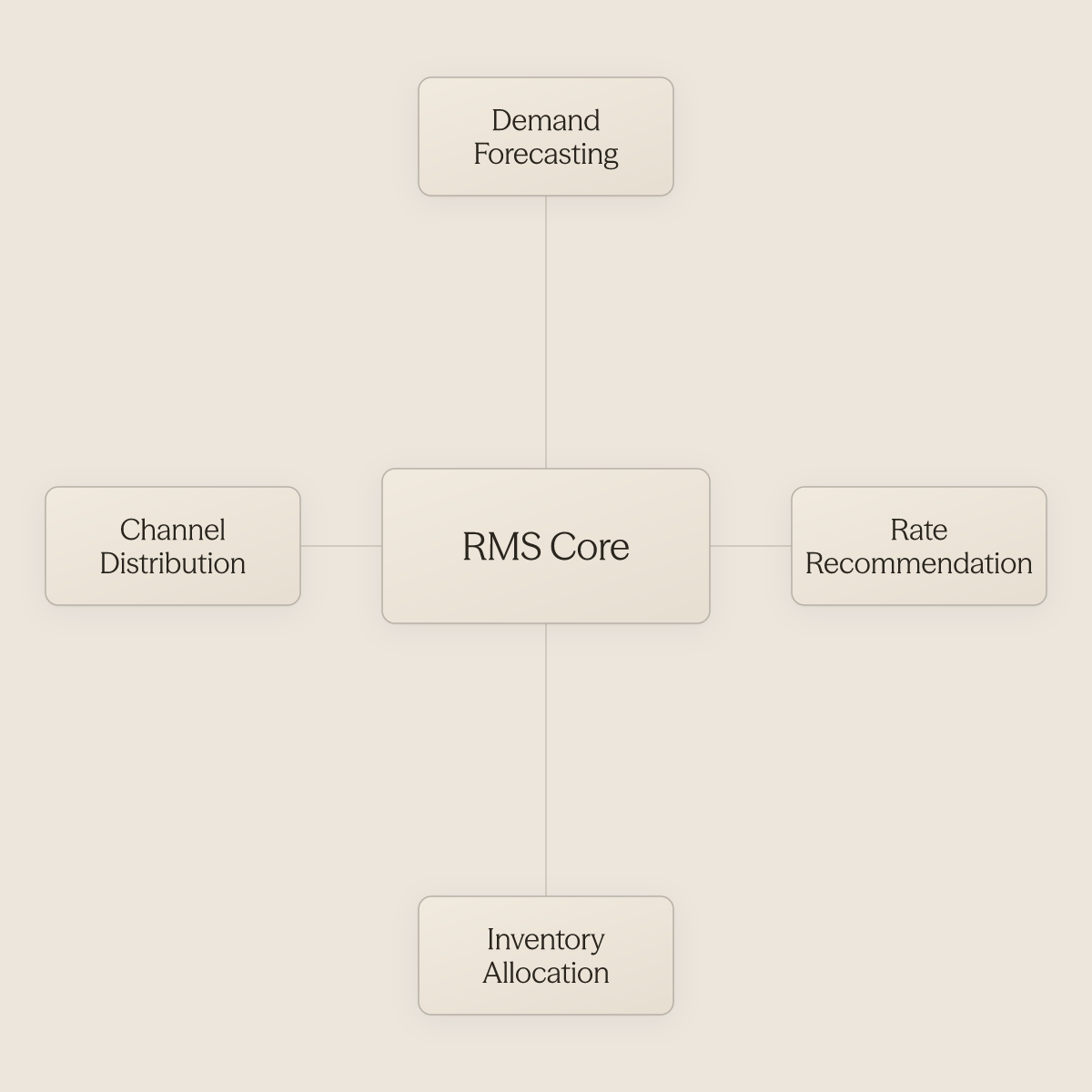
2 billion in 2024 and is projected to grow at a compound annual rate above 15% through 2026, a category well past early adoption into standard infrastructure for competitive properties. Every RMS runs on three interdependent mechanics: demand forecasting, rate recommendation, and inventory allocation. An RMS recalibrates when it detects a shift in pickup pace, competitor pricing, or a new demand signal.
It does not recalibrate when a guest sends an inquiry at 1am and receives no reply. That event is invisible to the system entirely. The critical assumption embedded in every RMS is that demand has already arrived.
Dynamic pricing optimizes the rate for a guest actively considering your property, it cannot recover the guest who asked a question at midnight, got no response, and booked a competitor by 7am. Industry data on hospitality response-time conversion consistently points in the same direction: fast responses drive bookings, and the falloff in conversion probability is steep once an inquiry ages past the first hour. Hotels that respond to inquiries within 5 minutes are 100x more likely to convert than those that respond after 30 minutes, a finding consistent with broader hospitality sales-velocity research.
"Small boutique hotel operators are overwhelmed managing operations manually, leaving little bandwidth to focus on strategic functions like revenue management or pricing optimization."
Dynamic pricing optimizes the rate for a guest actively considering your property, it cannot recover the guest who asked a question at midnight, got no response, and booked a competitor by 7am.
100x more likely to convert within 5 minutes
Key takeaways
- Rate optimization is a narrow window, it only generates revenue if the inquiry that triggered it converts before a competitor answers first.
- The most common revenue leak in multi-property operations isn't a bad pricing algorithm; it's the 1am inquiry that gets a 9am response.
- Most RMS evaluation checklists score dynamic pricing, forecast depth, and PMS integrations, none of them score response latency, which is where bookings actually disappear.
- Erwan Le Roy's 35-property operation hit a 96% AI automation rate and sub-1-minute response times around the clock, not by upgrading its rate strategy, but by removing the human bottleneck from guest communication.
- Total cost of ownership for hotel revenue management software consistently runs higher than the license fee; the gap between sticker price and all-in cost is where revenue strategies quietly unravel.
- conduit.ai's AI Agents close the communication gap by handling guest inquiries autonomously, 24/7, across every channel, pulling answers directly from a property's own SOPs, manuals, and FAQs so no inquiry waits for a human to come online.
Key Features of Hotel Revenue Management Software: and the One Layer Most Tools Miss
That assumption runs deep in multi-brand and enterprise hospitality groups: get the RMS right, get the AI forecasting right, and the revenue gap closes. If rates are optimized, the rest of the operation follows. And the evaluation checklists that heads of revenue and VPs of operations bring into vendor reviews are not wrong. Dynamic pricing, demand forecasting, competitor rate shopping, PMS integration, and open pricing architecture are real capabilities that produce real RevPAR gains. The problem is that a complete feature checklist still leaves one operational layer unaddressed, and that layer is where a measurable share of revenue quietly disappears every week.
The Core RMS Feature Checklist Every Operator Should Audit Against
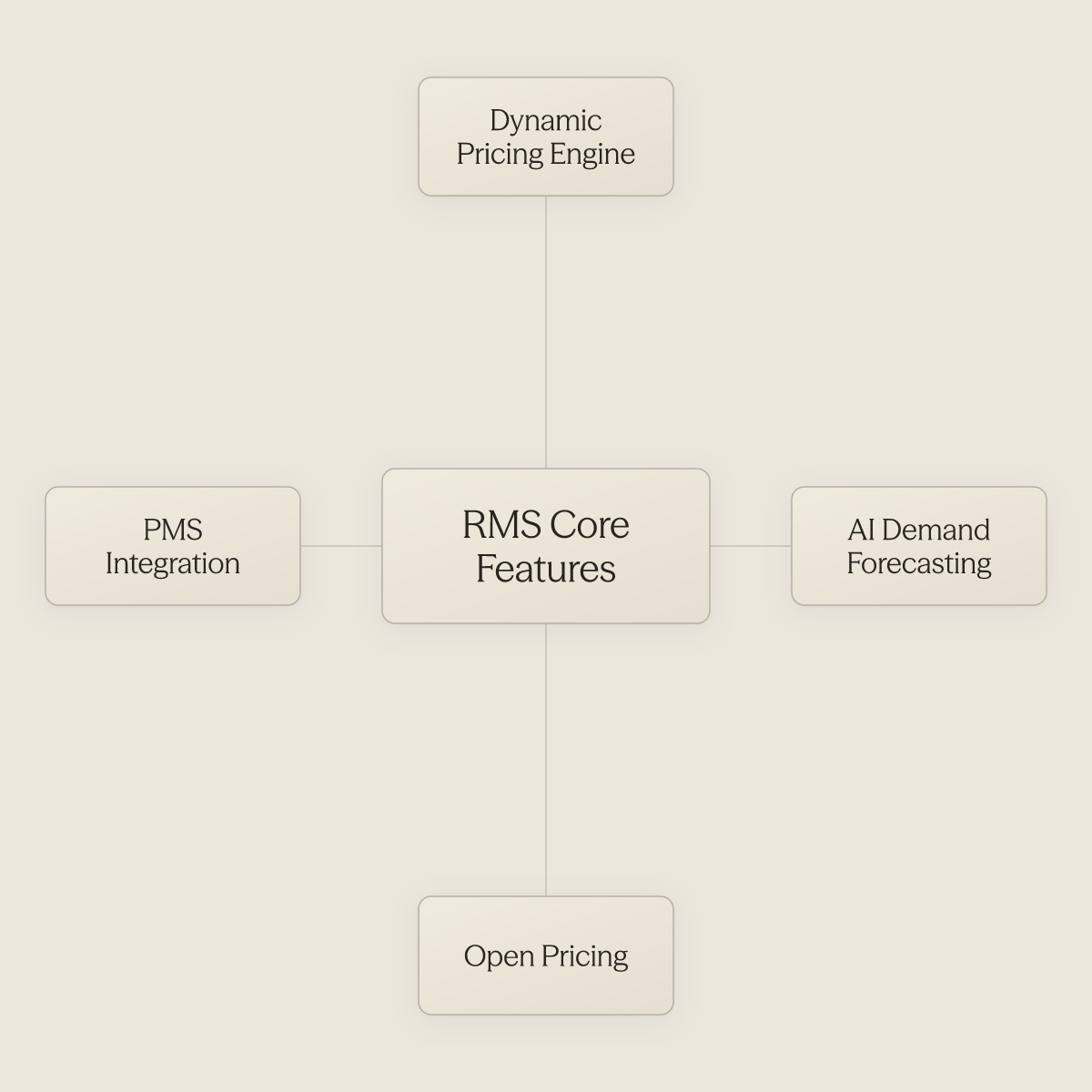
A credible RMS audit starts with four non-negotiables:
- A dynamic pricing engine that reads live competitor rates, OTA demand signals, local event calendars, and historical pickup patterns to adjust rates in real time.
- AI forecasting that segments demand by room type, booking window, and channel rather than averaging across the portfolio.
- Open pricing capability, meaning the system can set independent rates for each room category rather than moving all inventory in a single offset from a base rate.
- Deep hotel RMS integrations with your PMS and channel manager so rate changes publish without manual intervention.
Any tool missing one of these four is not a complete system.
Why Dynamic Pricing Fires Too Late When Inquiry Response Is Slow
Here is the sequence most operators overlook. A guest searches at 1am, finds your property, and sends an inquiry before booking. Your RMS has already set the optimal rate.
But the inquiry sits in a queue until 9am, and by then the guest has confirmed somewhere else. The pricing algorithm worked perfectly. The booking still did not happen.
Response time is a well-documented driver of booking conversion in hospitality, a dynamic Enso Connect quantified in their 2025 research, and one that operators across the industry consistently report in post-mortem booking analyses. The gap between inquiry and response is a structural revenue loss that no rate optimization tool is designed to close.
How to Evaluate AI Agent Capabilities When Selecting Hotel Revenue Management Software
Most operators accept after-hours inquiry loss as an unavoidable staffing constraint. The real cost is a booking your pricing engine optimized for but never got the chance to confirm. Conduit's hospitality-specific AI agents eliminate that latency by reading from a property's own SOPs and FAQs to respond accurately and autonomously across every channel, 24/7. Erwan Le Roy's 35-property operation reached a 96% AI automation rate with sub-1-minute response times around the clock, documented in Conduit's published case study, a benchmark that illustrates what closing the inquiry-latency gap looks like at portfolio scale.
How to Choose the Right Hotel Revenue Management Software for Your Property Type and Size
Choosing the Right Hotel Revenue Management Software
The right revenue management software depends as much on your property's operational readiness as it does on the features a platform offers. Feature checklists tell you what an RMS can do. They rarely tell you whether your operation is ready to convert what that RMS delivers. According to Business Research Insights, the RMS market is on track to more than double by 2035, and the segmentation logic driving that growth distinguishes enterprise multi-property operators from independent sub-50-room properties on the basis of integration depth, portfolio dashboards, and API capability.
What that segmentation logic does not account for is the communication layer sitting upstream of every rate recommendation, where demand is either captured or lost before the algorithm ever fires. That upstream layer is where operators consistently bleed yield without realizing it. Easy BnB is a concrete illustration: the business relied on 14 virtual assistants to maintain 24/7 guest coverage, creating a heavy labor drag on EBITDA margins.
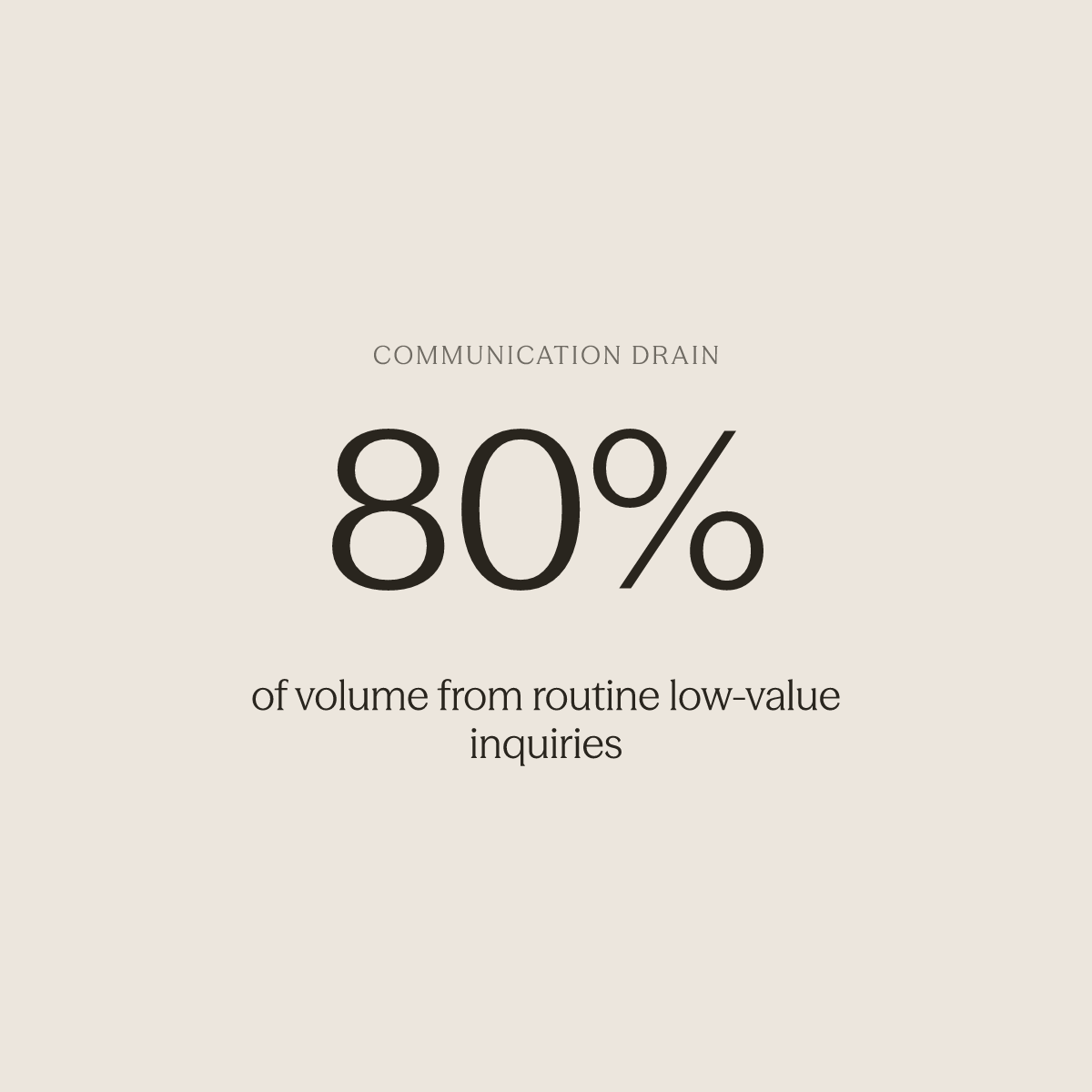
Routine, low-value inquiries consumed 80% of communication volume, staff reliability was poor, with missed overnight shifts and secret second jobs, and the business could not scale its property portfolio without adding costly headcount, directly capping the exit valuation multiplier. An RMS cannot solve that problem. The communication infrastructure beneath it must be resolved first, or rate optimization surfaces revenue that the front-of-house layer immediately gives back.
Boutique and Independent Hotels - Prioritize Fast Onboarding and PMS Plug-and-Play
Boutique operators running lean front desks consistently encounter the same friction: an enterprise-grade RMS with a 12-to-16-week onboarding timeline and opaque pricing creates more disruption than revenue lift for a property running a two-person front desk. Boutique operators should shortlist tools that publish tiered pricing, offer a trial or sandbox period, and connect to their existing PMS within days, not quarters. Feature depth you cannot operationalize in the first 90 days is feature depth you are paying for without return.
The same 90-day clock applies to the communication layer. Conduit's AI Agents can deliver a first automated guest reply within days of connecting your existing SOPs and manuals, no bespoke training project required. For a boutique property whose staff is already stretched across rate management, housekeeping, and check-in, removing routine, repetitive inquiries from the human queue immediately frees the bandwidth that RMS onboarding demands.
The Inbox consolidates guest conversations across platforms in a single view, so a two-person team monitoring multiple booking channels does not lose a booking during the weeks the RMS is being configured. A lighter-weight RMS built for fast onboarding typically sacrifices granular segmentation controls and multi-channel demand forecasting, acceptable for a 30-room inn, but a constraint the moment you add a second property or a group segment. Confirm the vendor has a clear upgrade path before you sign.
Full-Service and Group Hotels - Demand Forecasting, Function-Space Pricing, and Multi-Segment Reporting
Full-service and group-focused properties carry revenue complexity that basic dynamic pricing engines cannot resolve. Transient, group, and function-space demand compete for the same inventory, and an RMS that cannot model that displacement in real time will consistently under-price or over-commit one segment at the expense of another. Multi-segment reporting is not a premium add-on for these properties; it is the core use case.
Group and conference hotels should pressure-test the vendor's function-space pricing module specifically. Many RMS platforms treat meeting room and banquet revenue as a manual line item rather than an optimized inventory class. If your property derives 20 percent or more of total revenue from events, that gap in the algorithm is a structural revenue leak.
Multi-property and full-service operators face a compounding version of the communication problem boutique operators face: brand voice, escalation policies, and SOPs must travel consistently across every property and market. Conduit's Workflows fire automatically after trigger events in the guest lifecycle, booking confirmation, check-in, detected keywords, removing the manual staff action that creates inconsistency at scale. AI Agents trained on property-specific SOPs and FAQs standardize that brand voice without requiring a supervisor to review every exchange, which is where the labor drag surfaces in operations running across multiple segments and booking channels.
Best Revenue Management Software for Vacation Rentals
The best revenue management software for vacation rentals is purpose-built for STR inventory logic, not adapted from hotel room-night models. STR-focused operators consistently compare tools such as PriceLabs, Beyond Pricing, and Wheelhouse on two criteria: how granular the minimum-stay controls are and how quickly rate changes push to OTA listings.
If a tool requires a separate channel manager to push rates to your primary OTA, that is an integration risk and a lag risk you should price into the total cost of ownership before signing. The compounding delays between a rate update and its live appearance on Airbnb or Vrbo can meaningfully erode the dynamic pricing advantage you are paying for. STR operators managing multiple listings face the same headcount trap Easy BnB encountered: 80% of guest communication volume is routine and repetitive, but it arrives around the clock across Airbnb, Vrbo, and direct channels simultaneously. Conduit's Integrations pull existing content from tools like Notion, Google Drive, and Airbnb directly, so the AI Agent can be trained on house manuals and check-in instructions without manual re-entry.
The result is that guest communications are handled continuously, before, during, and after a stay, without the overnight shift reliability problems that make human VA coverage expensive and fragile.
Hotel RMS Selection Framework - Match Tool to Property Type
| Property Type | Primary Criterion | Secondary Criterion | Tools to Shortlist |
|---|---|---|---|
| Boutique / Independent (<50 rooms) | Fast PMS onboarding (days, not weeks) | Transparent published pricing | RoomPriceGenie, Happyhotel, Ampliphi RMS |
| Full-Service / Group Hotel | Multi-segment demand forecasting | Function-space pricing module | IDeaS G3, Duetto, Infor EzRMS |
| Vacation Rental / STR | STR-native min-stay rules | Direct OTA channel breadth | PriceLabs, Beyond Pricing, Wheelhouse |
| Multi-Property Enterprise | Portfolio dashboard + API depth | PMS/ERP integration | IDeaS G3, Duetto, Apaleo |
| Asia-Pacific Market | Localized OTA connectivity | Regional PMS support | Yanolja Cloud Solution |
| Emerging Market / Budget-Constrained | Affordable entry-level pricing | Basic dynamic pricing | Exely, Eviivo |
Decision rule: If you cannot operationalize a feature within the first 90 days, do not pay for it at contract signing. Confirm a clear upgrade path before you commit. And before you finalize any RMS selection, audit the communication layer it depends on: an algorithm that surfaces the right rate cannot protect revenue that leaks through slow, inconsistent, or understaffed guest responses upstream of the booking.
Related Reading
- How To Improve Hotel Operations
- Hotel Demand Forecasting
- Hospitality Operations Management
- How To Increase Revpar
- Hotel Revenue Management Strategies
- Hotel Upselling
- Hospitality Automation
- Automated Hotel Reservation System
- Hotel Budgeting And Forecasting
- Hotel Guest Messaging
- Adr Vs Revpar
The 23 Best Hotel Revenue Management Software Tools in 2026
The shortlist most operators build evaluates pricing engines in isolation. Rate accuracy, forecast depth, PMS integrations, these are the criteria that dominate every RFP spreadsheet. What those spreadsheets miss is the sequence: a rate only generates revenue if the inquiry that triggered it converts to a confirmed booking. The tools below are ranked with that sequence in mind, starting with the communication layer that determines whether a rate ever reaches a reservation, then moving through the forecasting and pricing engines that optimize what gets captured.
1. Conduit.ai - Best AI-Powered Guest Communication & Revenue Tool for Hotels
Conduit.ai earns the top slot not because it sets rates, but because it determines whether any rate ever converts. Erwan Le Roy's Cash Flow Street operation, spanning 35 properties, achieved a 96% AI automation rate and sub-1-minute response times around the clock, documented in Conduit's published case study. Most operators evaluating this list will spend weeks comparing rate algorithms while their 1am inquiries sit unanswered until 9am; every hour of response latency is a booking window a competitor's instant-reply system is closing.
Conduit's AI Agents handle guest communication autonomously, reading from the operator's own SOPs and FAQs to answer accurately across channels without human intervention. The benefit materializes most powerfully when a portfolio already has documentation in place, SOPs, FAQs, or guest manuals, and receives a high volume of repetitive guest inquiries. Operations that lack this documentation will need to build that knowledge base first before the agent reaches full accuracy; the tool is not the right fit until that foundation exists.
2. IDeaS Revenue Solutions - Best Enterprise-Grade RMS for Large Hotel Groups
IDeaS G3 RMS is the pricing infrastructure choice for full-service and branded hotel properties that need automated, precise rate decisions at scale. Deployed at properties like Novotel Bali Nusa Dua, it delivers AI-driven forecasting and automated pricing that removes manual rate-setting from the daily workflow. The platform positions itself as delivering "precise, automated decisions" that make it the world's leading revenue infrastructure, yet its own August 2025 onboarding innovations, including "Hot Start" and projections drawn from comparable properties, signal meaningful implementation complexity, which means the total cost of ownership expands well beyond license fees into setup, ramp time, and PMS integration work.
IDeaS G3 RMS is purpose-built for rate optimization and demand forecasting, which is exactly what it should do. Like every RMS on this list, it operates downstream of the initial guest inquiry: the system fires on demand signals once a guest is in the funnel, not before. Operators who want to maximize what G3 delivers will find that pairing it with a dedicated guest communication layer, one that handles pre-booking inquiries around the clock, captures the demand the RMS then prices.
Best suited for enterprise groups with dedicated revenue management teams and IT resources; not the right fit for independent operators expecting self-service setup or transparent published pricing.
3. Duetto - Best for Total Revenue Optimization Across All Hotel Revenue Streams
GameChanger by Duetto is the answer for boutique and independent hotels asking which RMS best supports open pricing strategies. It delivers real-time, AI-driven rate adjustments and an open pricing model that prices each segment independently rather than cascading rates off a single BAR, producing measurable RevPAR lift for properties with complex segment mixes including F&B, spa, and meeting space. The trade-off is configuration depth: operators who want the full open pricing benefit need a revenue manager or consultant to set up segment rules correctly. Without that internal expertise, the sophistication can sit unused.
4. RoomPriceGenie - Best Automated RMS for Independent Hotels and B&Bs
For independent hoteliers, RoomPriceGenie is the clearest answer to which RMS offers the fastest, most user-friendly setup. Properties consistently report moving from connection to live automated pricing in hours, not weeks, the lowest time-to-value option on this list for sub-50-room properties. The algorithm pulls competitor rates, local demand signals, and booking pace to adjust prices automatically without requiring a dedicated revenue manager. The limitation is ceiling: as a property scales to multi-property or adds complex segment pricing, RoomPriceGenie's feature depth does not match enterprise-grade systems. Pick it when simplicity and speed matter more than configuration depth.
5. Mews Revenue Management System - Best RMS Natively Embedded in a Modern PMS
Mews RMS removes the integration friction that plagues most RMS deployments by building revenue management directly into the Mews PMS. Rate recommendations surface inside the same interface the front desk and reservations team already use, shortening the adoption curve and eliminating data-sync delays common in third-party integrations. Best suited for properties already running on Mews or actively evaluating a PMS switch. If your PMS is Opera, Cloudbeds, or another platform, the native advantage disappears and the tool becomes a less compelling standalone option compared to purpose-built alternatives.
6. Pricepoint - Best Autonomous AI Pricing Agent for 24/7 Rate Optimization
Pricepoint is a fully autonomous pricing agent, adjusting rates continuously without manual approval cycles. For properties where the owner or manager doubles as the revenue manager, that autonomy removes a daily operational burden. The system monitors demand signals and competitor rates in real time, updating prices across connected channels without human sign-off. The trade-off: the hands-off design means less granular override capability compared to platforms built for revenue managers who want to inspect and adjust recommendations. Best for lean operations prioritizing automation over configurability.
7. Hotellab - Best RMS for Mid-Scale Hotels Needing Deep PMS & Channel Manager Integration
Hotellab targets mid-scale hotels where the primary pain is fragmented data across a PMS, channel manager, and OTA extranets. The platform consolidates those data streams into a single forecasting and pricing layer, giving revenue managers a unified view before setting rates. Its integration library covers regional PMS and channel manager combinations that larger enterprise vendors sometimes overlook. The limitation is brand recognition: Hotellab is less established in North American markets, making peer references and community support thinner than with IDeaS or Duetto. Best evaluated when your PMS is a regional system and integration depth is the deciding criterion.
8. Infor EzRMS - Best RMS for Large Hotel Chains Requiring Deep ERP Integration
Infor Revenue Management is the best all-in-one AI revenue management solution for large hotel chains where the RMS must connect to an enterprise ERP, not just a PMS. Integrated AI forecasting, modular pricing controls, and group management features make it the strongest option when revenue management is one layer inside a broader enterprise technology stack. The platform handles demand forecasting, group displacement analysis, and function space pricing in a single architecture. The realistic trade-off: implementation timelines are measured in months, not weeks, and the system requires dedicated IT and revenue management resources to configure and maintain. Independent and mid-market operators will find the complexity exceeds their needs.
9. Ampliphi RMS - Best AI RMS for RevPAR-Focused Independent Hotels Seeking Measurable Gains
Ampliphi RMS is built for independent hotel operators who want AI-driven rate optimization with a direct line to RevPAR outcomes, without enterprise implementation overhead. Its reporting surfaces rate decisions alongside their RevPAR impact, giving owners the language to justify the investment to ownership groups or investors. The limitation is scale: Ampliphi is optimized for single-property and small portfolio operators, and multi-property groups will outgrow its portfolio management capabilities.
10. SiteMinder - Best Channel Manager with Built-In Rate Intelligence for Distribution-Heavy Hotels
SiteMinder is primarily a channel manager. Its rate intelligence layer helps distribution-heavy properties monitor and respond to OTA rate parity issues and demand shifts, but it is not a full revenue management system in the IDeaS or Duetto sense. The right pick when the primary pain is channel distribution complexity and rate parity enforcement, not deep demand forecasting. Operators who need AI-driven automated pricing recommendations will find SiteMinder's revenue features useful as a complement to a dedicated RMS, not a replacement.
11. Cloudbeds - Best All-in-One PMS + Revenue Tools for Small to Mid-Size Independent Hotels
Cloudbeds earns its place for small to mid-size independent hotels that want PMS, channel management, and basic revenue tools in a single subscription without managing multiple vendor relationships. Its pricing intelligence layer automates rate suggestions based on demand signals, and its channel manager pushes those rates across OTAs without manual updates. The honest limitation: Cloudbeds' revenue management depth does not match dedicated RMS platforms. Properties with complex segment pricing, group business, or multi-property portfolios will hit the ceiling quickly. Best evaluated when vendor consolidation outweighs pricing sophistication.
12. Happyhotel - Best Intuitive RMS for European Independent Hotels Prioritizing Ease of Use
Happyhotel is built for European independent hotels where the operator wants automated pricing without a steep learning curve or a dedicated revenue manager on staff. The interface surfaces rate recommendations in plain language with clear reasoning, shortening the time between setup and confident daily use, and its OTA connectivity covers the European distribution landscape well. The trade-off is depth: operators who want custom pricing rules, segment-level strategies, or complex forecasting models will find Happyhotel's configurability limited compared to mid-market alternatives. Best suited for properties under 80 rooms where ease of adoption is the primary criterion.
13. Atomize - Best Real-Time Automated Pricing for Tech-Forward Hotels Wanting Zero Manual Work
Atomize is the answer for tech-forward hotels asking which RMS offers the highest level of automated pricing with the least manual intervention. The platform updates rates in real time using live demand data, requiring no manual approval step between the algorithm's recommendation and the rate going live across channels, and it holds a 4.7/5 rating across 200+ verified reviews as of mid-2025.
The trade-off is control: operators who want to review and approve rate changes before they publish will find Atomize's automation philosophy at odds with their workflow. Best for properties where revenue strategy is set at the rule level and daily manual oversight is a cost the operation wants to eliminate.
14. OTA Insight (Lighthouse): Best Competitive Rate Intelligence Platform for Data-Driven Revenue Teams
OTA Insight, now operating as Lighthouse, is one of the most widely adopted competitive rate intelligence platforms for revenue teams, used by over 65,000 hospitality businesses globally as of 2025, for teams that make decisions based on market positioning data. Its rate shopping engine tracks competitor pricing across OTAs in near real time, giving revenue managers the context to set rates relative to the competitive set rather than in isolation. Lighthouse is a research and intelligence layer, not a full RMS with automated pricing output; it is best paired with a pricing engine like IDeaS or Atomize, where the intelligence layer informs strategy and the RMS executes it. Operators expecting Lighthouse to set and push rates automatically will need a dedicated pricing tool alongside it.
15. Cendyn RMS - Best Revenue Management for Casino Hotels and Complex Resort Properties
Cendyn RMS is purpose-built for casino hotels and complex resort properties where revenue management extends beyond room pricing to gaming floors, F&B outlets, spa, and event space. Its total revenue optimization architecture accounts for non-room revenue streams that standard RMS platforms ignore. The limitation is specificity: for a standard hotel without gaming or complex ancillary revenue, Cendyn's architecture exceeds operational needs, and simpler platforms will deliver faster time-to-value at lower total cost.
16. Apaleo - Best Open PMS Platform for Hotels Building Custom Revenue Management Workflows
Apaleo is a developer-first, API-native PMS for hotel groups that want to build custom technology stacks rather than accept a vendor's pre-packaged solution. Revenue management is assembled through integrations with third-party RMS tools, including options like FLYR Hospitality and RevControl, giving tech-forward operators the flexibility to connect best-in-class pricing engines, communication platforms, and analytics tools without vendor lock-in. The trade-off is clear: operators who want an out-of-the-box RMS with built-in pricing recommendations will not find that in Apaleo. Best suited for groups with internal development resources or a technology partner managing the integration layer.
17. Revinate - Best CRM-Driven Revenue Platform for Hotels Focused on Direct Booking Growth
Revinate approaches revenue management from the guest data layer rather than the rate algorithm layer. Its CRM-driven platform uses guest history, segmentation, and marketing automation to drive direct bookings, reducing OTA commission dependency and improving repeat guest revenue. For hotels where the revenue gap is primarily a direct channel problem, not a rate optimization problem, Revinate addresses the right lever. The limitation: Revinate is not a dynamic pricing engine. Properties that need automated rate optimization alongside their CRM strategy will need to pair Revinate with a dedicated RMS, adding integration complexity and cost.
18. Qualpro Channel Manager - Best for Multi-Property Groups Needing Centralized Distribution Control
Qualpro targets multi-property groups where the primary operational pain is managing rate parity and inventory allocation across a large number of OTA connections from a single interface. For groups managing 10 or more properties with complex distribution requirements, that centralization delivers real operational leverage. The trade-off is depth: Qualpro's pricing intelligence is distribution-focused, not forecasting-focused, so groups that need demand-driven rate recommendations will need a dedicated RMS alongside it.
19. Eviivo - Best All-in-One Platform for Small Independent Hotels and Vacation Rental Crossover Properties
Eviivo serves the crossover segment of small independent hotels and vacation rental operators who need a single platform to manage bookings, channel distribution, and basic pricing without separate subscriptions for each function. Its design assumes a non-specialist user, making onboarding fast and daily use accessible for owner-operators. The ceiling is real: Eviivo's revenue management features are basic compared to dedicated RMS platforms, and properties with more than 30 units or complex pricing strategies will outgrow the tool. Best evaluated when operational simplicity and the vacation rental and hotel crossover use case align with the property's actual mix.
20. Yanolja Cloud Solution - Best RMS for Asia-Pacific Hotel Markets with Localized OTA Connectivity
Yanolja Cloud Solution is the strongest option for hotels operating in Asia-Pacific markets where localized OTA connectivity is a prerequisite that Western-built RMS platforms routinely underdeliver. Its integration with regional distribution channels and local booking platforms gives revenue managers accurate demand signals from the markets that actually drive their occupancy, a functional requirement for properties in Southeast Asia, South Korea, and adjacent markets. The trade-off: Yanolja's distribution network and support infrastructure are optimized for Asia-Pacific, and the platform's value diminishes significantly outside that geography.
21. Exely - Best Revenue and Distribution Platform for Emerging Market Hotels Seeking Affordable Automation
Exely targets hotels in emerging markets where the primary barrier to revenue management adoption is cost, not feature preference. Its pricing and distribution automation tools deliver measurable rate optimization at a price point accessible to properties that cannot justify enterprise RMS licensing fees. For hotels where even basic dynamic pricing represents a significant upgrade over manual rate-setting, Exely delivers a practical entry point. The limitation is ceiling: as a property grows and its revenue strategy becomes more complex, Exely's feature depth will require supplementing with more specialized tools.
22. Beonprice - Best RMS for European Mid-Scale Hotels Combining Market Intelligence with Automated Pricing
Beonprice combines competitive market intelligence with automated pricing recommendations in a single platform, targeting European mid-scale hotels that want both layers without managing two separate vendor relationships. Its Hotel Quality Index methodology factors in property quality signals alongside rate data, producing pricing recommendations that account for competitive positioning beyond raw rate comparison. Tools such as Smartpricing and Revolution Plus occupy a similar mid-market niche, making Beonprice's European market intelligence depth a key differentiator for operators in that geography. The trade-off is geographic concentration: Beonprice's market intelligence is strongest in European markets, and operators outside Europe will find the competitive benchmarking less comprehensive.
Best evaluated by mid-scale European hotels where market positioning relative to the competitive set drives rate strategy. Each tool above solves a specific piece of the revenue puzzle. Knowing which tools belong in your stack is only half the equation; the other half is understanding what each layer is actually worth to your bottom line, and where the gaps between them are quietly costing you, which is exactly what the next section quantifies.
96% AI automation rate across 35 properties
Related Reading
- Siteminder Competitors
- Digital Concierge Software
- Hospitality Conferences
- Hotel Distribution Management
- Best Hotel Channel Manager Software
- Canary Technologies Competitors
- Cloudbeds Alternatives
- Hospitality Chatbot
Benefits of Using Hotel Revenue Management Software: and the Revenue You're Still Leaving on the Table
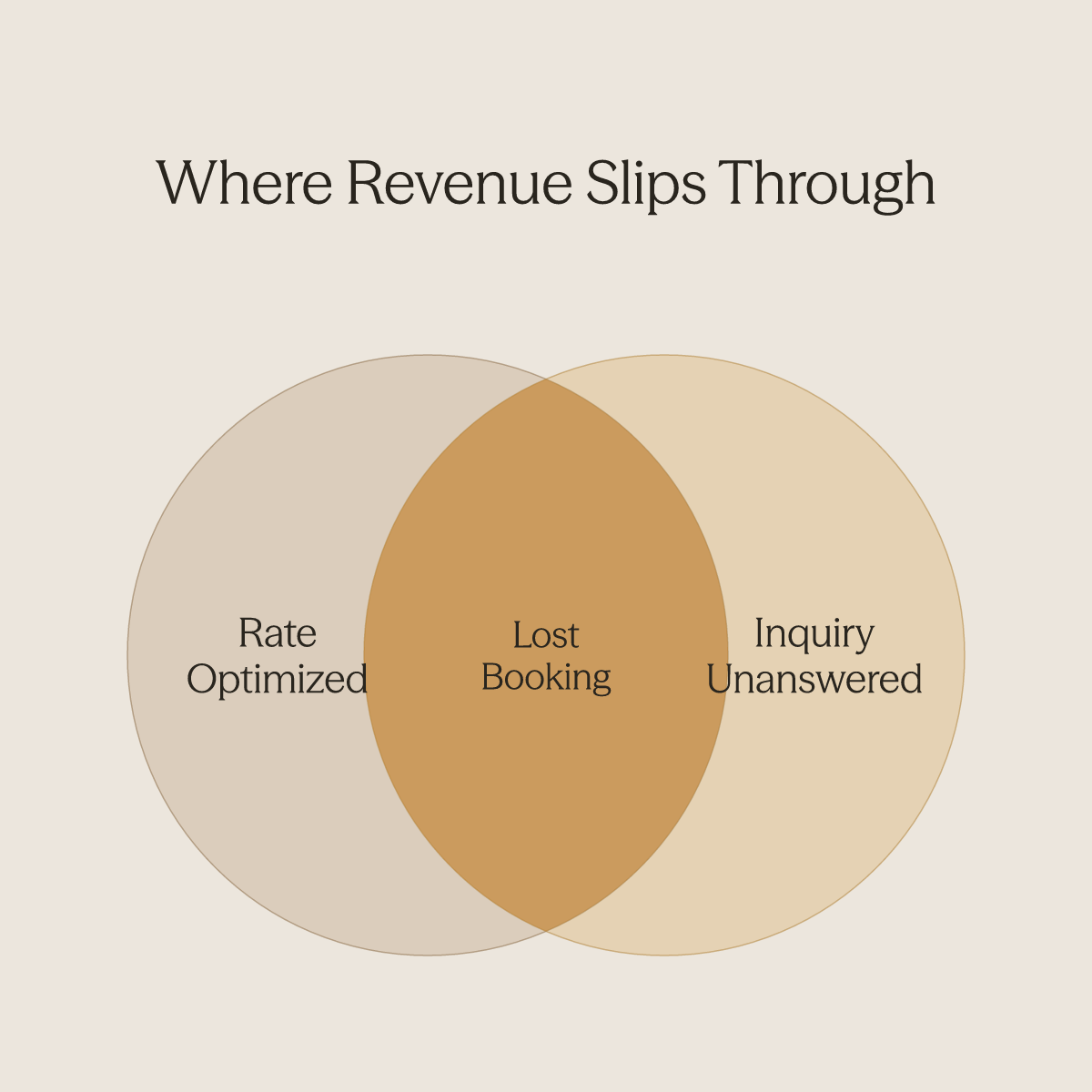
The gaps between tools are rarely where operators expect them. A fully configured RMS can set the perfect rate for a Tuesday night in October, but if the guest who inquired at 1am gets a response at 9am, that rate was never relevant. The booking went elsewhere, and no dashboard recorded the miss.
What a Well-Deployed RMS Actually Delivers
The documented benefits are real. In Epic Rev's 2024 analysis of AI-driven RMS deployments at leading hotel chains, properties using automated rate optimization saw measurable improvements in both RevPAR and ADR, with ADR gains averaging 6–12% at properties that fully automated their pricing cycle, driven by dynamic pricing that responds to competitor rate changes, OTA demand signals, and booking pace in real time. Rate adjustments happen in minutes, not the next morning.
The Revenue Sink RMS Vendors Don't Put in Their ROI Calculators
The same Epic Rev analysis flags a gap vendors don't address in their case studies: inquiry-to-confirmation latency. An optimized rate presented to a guest who already booked elsewhere produces zero revenue. What most teams report, across property types and price tiers, is that conversion drops sharply for every hour an inquiry goes unanswered, with the steepest falloff past the first hour.
The RMS fired correctly. The communication layer didn't. That failure never appears on an RMS performance report.
This problem is viscerally familiar to boutique operators who have tried to patch it with traditional support models. Noel Poler cycled through multiple solutions, Jurny's PMS and call center combination, other hospitality call services, at costs reaching $4,000 per month, and still faced guest wait times of up to 57 minutes, mounting refund requests, and found himself personally fielding questions on Slack at off-hours. The spend was real; the coverage was not.
That 57-minute wait time is not a staffing anomaly. It is what a manually dependent communication layer looks like under normal after-hours demand. And for a boutique GM already buried under operational chaos with no dedicated revenue management infrastructure, adding a communication monitoring burden on top is not a sustainable answer. The documented outcome from Noel's case makes plain what the RMS vendor's ROI slide never will: the cost of inquiry latency is paid in refunds, lost bookings, and owner time, none of which appear in the pricing engine's performance report.
The Synthesis No RMS Vendor States
Operators who have closed that gap, including multi-property groups that have reached high AI automation rates on guest communications, consistently report that the pricing engine's impact becomes more legible once the upstream inquiry loss is removed from the equation. No RMS vendor includes this in their case study methodology, because the leakage happens upstream of the data they track. The mechanics of closing that gap matter.
Conduit's AI Agents are designed specifically for operations receiving a high volume of repetitive guest messages, the pre-stay inquiry load that spikes after hours and on weekends, exactly when human coverage collapses. Once connected to a property's existing SOPs, FAQs, or manuals, the first automated guest reply can be live within days, not after a lengthy implementation cycle. The agent responds continuously, before, during, and after a stay, across every platform simultaneously.
The Inbox layer gives the operations or support team a single place to monitor, review, and manage every conversation the AI is handling across multiple properties, removing the Slack-firefighting dynamic that costs operators like Noel hours of personal time per week. Integrations with tools like Notion, Google Drive, and Airbnb mean existing documentation feeds the agent directly, without manual re-entry, which matters to a boutique GM who does not have a RevOps team to maintain a separate knowledge base.
How the Communication Latency Gap Compounds Across a Multi-Property Portfolio
The math gets uncomfortable at scale. If a 10-property group receives 20 after-hours inquiries per night and converts half of what a sub-60-second response rate would capture, the annual revenue loss runs into six figures before a single rate error is made. Noel's experience illustrates the single-property version of this: $4,000 per month in support spend, still producing 57-minute wait times and refunds.
At 10 properties, that cost and that latency multiply together. This isn't a pricing problem. It's a communication yield problem, and it compounds with every property added.
Conduit's Workflows layer addresses the compounding directly, triggering automated guest touchpoints after booking confirmation, check-in, or specific keyword detection, so that the recurring, predictable moments in a guest lifecycle no longer require a staff member to manually act on each one.
Realized Revenue vs. Optimized Rates
Most operators treat RevPAR improvement from RMS adoption as the full ROI story, and stop there. The more complete picture includes the demand that was priced correctly but never captured because the communication layer upstream of the RMS did not convert the inquiry. Closing that gap is what moves realized RMS ROI toward its potential.
The Epic Rev data documents what a functioning pricing engine can produce; the Noel Poler case documents what happens when the communication layer underneath it is left to manual processes and call center contracts. The two findings belong in the same analysis. Operators who treat them separately will keep reporting RMS ROI that is real, and still lower than it should be.
Hotel Revenue Management Software Pricing - What These Tools Cost and How to Budget
Sign a contract for an RMS license and the invoice feels complete. It rarely is. The total cost of ownership for hotel revenue management software consistently runs higher than the line item most operators budget for, and the gap between sticker price and all-in cost is where revenue strategies quietly unravel.
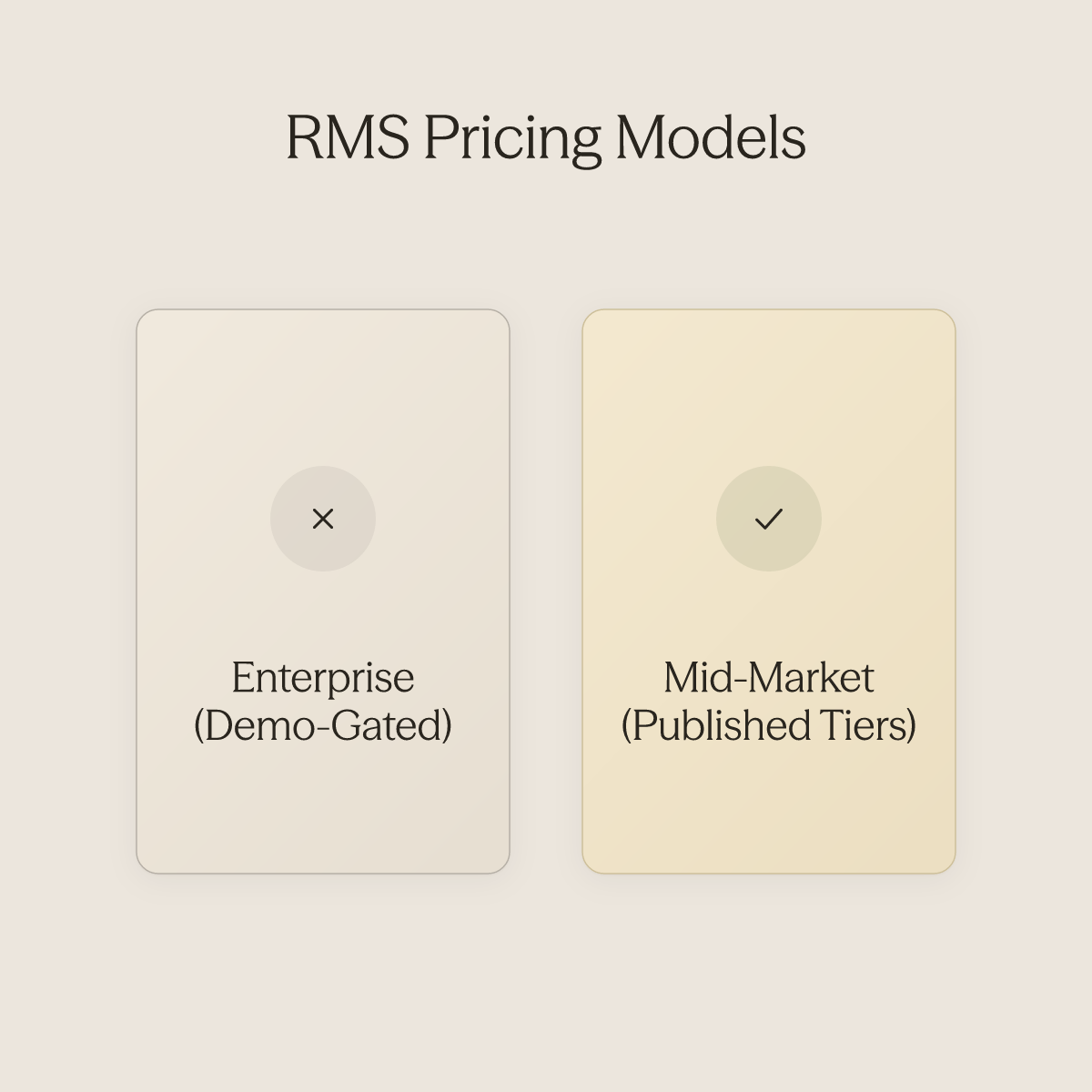
Enterprise RMS Pricing Is Demo-Gated by Design - What to Expect Behind the Wall
IDeaS G3 RMS publishes no pricing on its website. Contract value is calculated on room count and property volume, making meaningful benchmarking nearly impossible before a demo. The G3 release notes reference a "Hot Start" onboarding feature and projections built from comparable properties, both of which signal real implementation complexity.
That complexity has a cost, and it does not appear in the license quote. What also rarely appears in that quote: the ongoing labor required to manage guest communications and reservations activity that spikes precisely when a new RMS goes live. Operators who reduce that operational overhead before implementation, by automating repetitive guest messaging, arrive at go-live with a leaner cost baseline and a team that can focus on the configuration work that actually matters.
Mid-Market and STR Tool Pricing Models - Tiered Subscriptions vs. Percentage-of-Revenue
Mid-market platforms like RoomPriceGenie and Atomize publish tiered subscription pricing structured by property size and room count, making budget modeling more straightforward for independent and regional operators. STR-focused tools like PriceLabs use a per-unit monthly fee, while Beyond Pricing charges a percentage of revenue, meaning cost scales directly with booking volume. For operators managing 10 to 100 units, the percentage-of-revenue model can outpace a flat fee at higher occupancy. Run both calculations against your actual RevPAR before you commit.
The calculus shifts further when you account for the labor costs a centralized reservations or guest services team carries: reducing that operational overhead is one of the clearest ways to widen the margin between RMS cost and RMS-driven revenue. AI Agents are most beneficial precisely in this scenario, when a property or portfolio receives a high volume of repetitive guest messages and already has documentation (SOPs, FAQs, manuals) that can train the agent without additional staff lift. The first automated guest reply can go live within days of connecting those materials, not weeks.
The True Cost of Ownership - Implementation, Integration, and Support Fees Most Buyers Miss
Implementation, PMS integration, onboarding, and ongoing support SLAs add 30 to 60 percent on top of base license cost for mid-market and enterprise RMS deployments. The RMS market is on a trajectory from an estimated $3.8 billion in 2025 toward significant expansion through the end of the decade, which means vendor pricing power is increasing, not decreasing. Lock in contract terms that include integration support and a defined upgrade path, because the cost of switching mid-growth cycle typically exceeds the cost of negotiating those terms upfront.
Hidden inside that ownership cost is also the recurring manual labor of guest touchpoints that happen around the RMS: booking confirmations, pre-arrival messages, post-stay follow-ups. AI Workflows deliver the most value, firing automatically after a booking is confirmed, after check-in, or when a specific keyword is detected in a conversation. For multi-property operators, the Inbox layer sits above all of it, giving operations and support teams a single place to monitor, review, and manage every conversation the AI agent is handling across platforms simultaneously.
AI integrates with tools operators already use, Notion, Google Drive, Airbnb, so the AI agent can leverage existing content without requiring manual re-entry, which means the integration cost that typically inflates RMS total cost of ownership does not replicate itself on the guest communications side. The honest total-cost model accounts for both the software stack and the staffing stack. Operators who audit both before signing an RMS agreement negotiate from a stronger position and carry less overhead into the contract term they are about to be locked into.
Next steps
If your optimized rates are failing to close the revenue gap across your portfolio, the path forward starts with recognizing that an RMS is a rate engine, not a revenue capture engine. Pricing infrastructure only converts when the inquiry that precedes it is answered. Start with our AI for hospitality.
The body established two findings that belong in the same analysis. First, realized RMS ROI is always a fraction of potential RMS ROI until the communication gap is closed, because a portion of the demand a pricing engine was meant to capture is already lost before a rate is ever quoted. Second, Erwan Le Roy's 35-property operation reached a 96% AI automation rate with sub-1-minute response times around the clock, not by refining a pricing model, but by removing the human bottleneck from the inquiry-response cycle entirely. Together, they point to one action: automate the communication layer that determines whether your rate ever reaches a confirmed reservation.
Start with conduit.ai to see how Conduit's AI Agents connect to your existing SOPs and FAQs, then handle guest inquiries across every channel, 24 hours a day, so the demand your RMS prices is the demand your operation actually captures.
Frequently Asked Questions
Does dynamic pricing alone guarantee I won't lose bookings?
No, dynamic pricing optimizes the rate for a guest already considering your property, but it cannot recover a guest who sent an inquiry at midnight, got no response, and booked a competitor by morning. Hotels that respond to inquiries within 5 minutes are 100x more likely to convert than those that respond after 30 minutes, so the communication layer upstream of your pricing engine is just as critical as the algorithm itself.
What core features should every hotel RMS have?
A complete RMS needs four non-negotiables: a dynamic pricing engine that reads live competitor rates, OTA demand signals, local event calendars, and historical pickup patterns; AI forecasting segmented by room type, booking window, and channel; open pricing capability to set independent rates per room category; and deep PMS and channel manager integrations so rate changes publish without manual intervention. Any tool missing one of these is not a complete system.
How do I pick the right RMS if I run a small boutique hotel versus a large full-service property?
For a sub-50-room independent property, implementation speed and PMS compatibility matter more than forecasting sophistication, prioritize tools with published tiered pricing, a trial or sandbox period, and a PMS connection that goes live in days, not quarters. Full-service and group hotels, by contrast, need multi-segment demand forecasting and a function-space pricing module, since transient, group, and event inventory all compete for the same rooms and a basic dynamic pricing engine cannot model that displacement in real time.
Which hotel RMS tools are recommended for vacation rentals specifically?
The post recommends STR-native tools, PriceLabs, Beyond Pricing, and Wheelhouse, evaluated primarily on how granular their minimum-stay controls are and how quickly rate changes push directly to Airbnb, Vrbo, and Booking.com. If a tool requires a separate channel manager to publish rates to your primary OTA, that integration lag erodes the dynamic pricing advantage you are paying for.
How does AI automation actually help close the revenue gap that an RMS leaves open?
An RMS cannot act on an inquiry it never sees, when a guest reaches out at 1am and receives no reply until 9am, the booking is already lost before the pricing algorithm has any chance to matter. Conduit.ai's AI Agents read from a property's own SOPs and FAQs to respond accurately and autonomously across every channel 24/7, with Erwan Le Roy's 35-property operation documented at a 96% AI automation rate and sub-1-minute response times around the clock.
Stay in the loop
Get the latest on AI automation, product updates, and customer stories.


