13 Best Hotel Chatbots to Boost Bookings in 2026


Best Hotel Chatbots
Boost Bookings in 2026
Not all hospitality chatbots are built the same. The architecture your team buys determines whether AI resolves 30% of guest queries or 90%, and getting that choice wrong compounds across every property you add.
Most VPs of Operations and heads of operations at multi-brand or enterprise hospitality groups assume that consistent, high-quality guest communication at scale requires either a large centralized human team or an enterprise software stack custom-built for their operation, and that there is no middle path that is both affordable and brand-safe. That assumption shapes how they evaluate vendors, set budgets, and ultimately which tier of tool they end up buying.
That range matters enormously when you are responsible for guest communication quality across 10, 20, or 35 properties. Buying the wrong tier does not just mean modest underperformance; it means locking your operation into a ceiling you cannot grow through. Vendors use "AI-powered" as a marketing badge regardless of what the underlying system can actually do, and most evaluation frameworks never surface the distinction.
AI for hospitality has to mean something measurable, not just a logo swap on a generic support widget. A hospitality chatbot is an AI-powered virtual assistant purpose-built to automate guest interactions across the hotel and travel sector. Unlike a repurposed generic support widget, a hotel-specific system is trained on reservation modifications, late check-out requests, property-specific amenity questions, and mid-stay escalations that a horizontal tool would misroute or answer incorrectly.
AI communication tools are now treated as a distinct operational layer alongside CRM platforms and attribute-based selling systems. The critical difference operators miss is that three fundamentally different architectures share the same label. Tier one is the keyword-matching script: it pattern-matches exact phrases and returns a pre-written answer. Tier two adds natural language processing, handling more query variety and degrading more gracefully. Tier three is the property-trained AI agent: it ingests your actual SOPs, manuals, and FAQs, then reasons through novel situations your scripting team never anticipated.
Key takeaways
- Most hospitality chatbots cap out around 30% automation because they run on scripted flows, every question outside the script routes back to a human, which defeats the purpose at scale.
- The architecture decision (rule-based vs. AI) does not reveal itself on day one; it shows up at month six when your overnight queue is identical to what it was before deployment.
- A chatbot trained on generic hotel data behaves like a call-center script, it cannot answer property-specific questions accurately because it has never seen your SOPs, your room types, or your policies.
- Multi-property operators face a compounding version of this problem: inconsistent guest communication across brands is a brand-safety risk, not just an efficiency gap.
- Erwan Le Roy's 35-property operation hit a 96% AI automation rate and sub-1-minute response times, 24/7, without adding headcount or replacing existing staff.
- Buying on feature claims (NLP, PMS integrations, dashboard aesthetics) is how enterprise operators end up with a 30% automation rate when their operation was capable of 90% or more.
- Conduit's AI Agents close that gap by training directly on your own SOPs, manuals, and FAQs, then handling guest conversations autonomously, across every channel, without human intervention, so the answers guests get reflect your actual property, not a generic script.
Key Benefits of Hotel Chatbots: and What Separates Good ROI from Great ROI
Most VPs of Operations and heads of operations at multi-brand or enterprise hospitality groups assume that consistent, high-quality guest communication at scale requires either a large centralized human team or an enterprise software stack custom-built for their operation, and that there is no middle path that is both affordable and brand-safe. Operators who have deployed an AI agent and still see staff fielding the same repetitive questions every morning already know the uncomfortable truth: not all automation is equal. The capability gap between a tool that resolves only a fraction of guest queries and one that resolves the vast majority is not a minor difference in polish. It is a structural difference in how the tool was trained, and the compounding labor cost of that gap grows with every property you add.
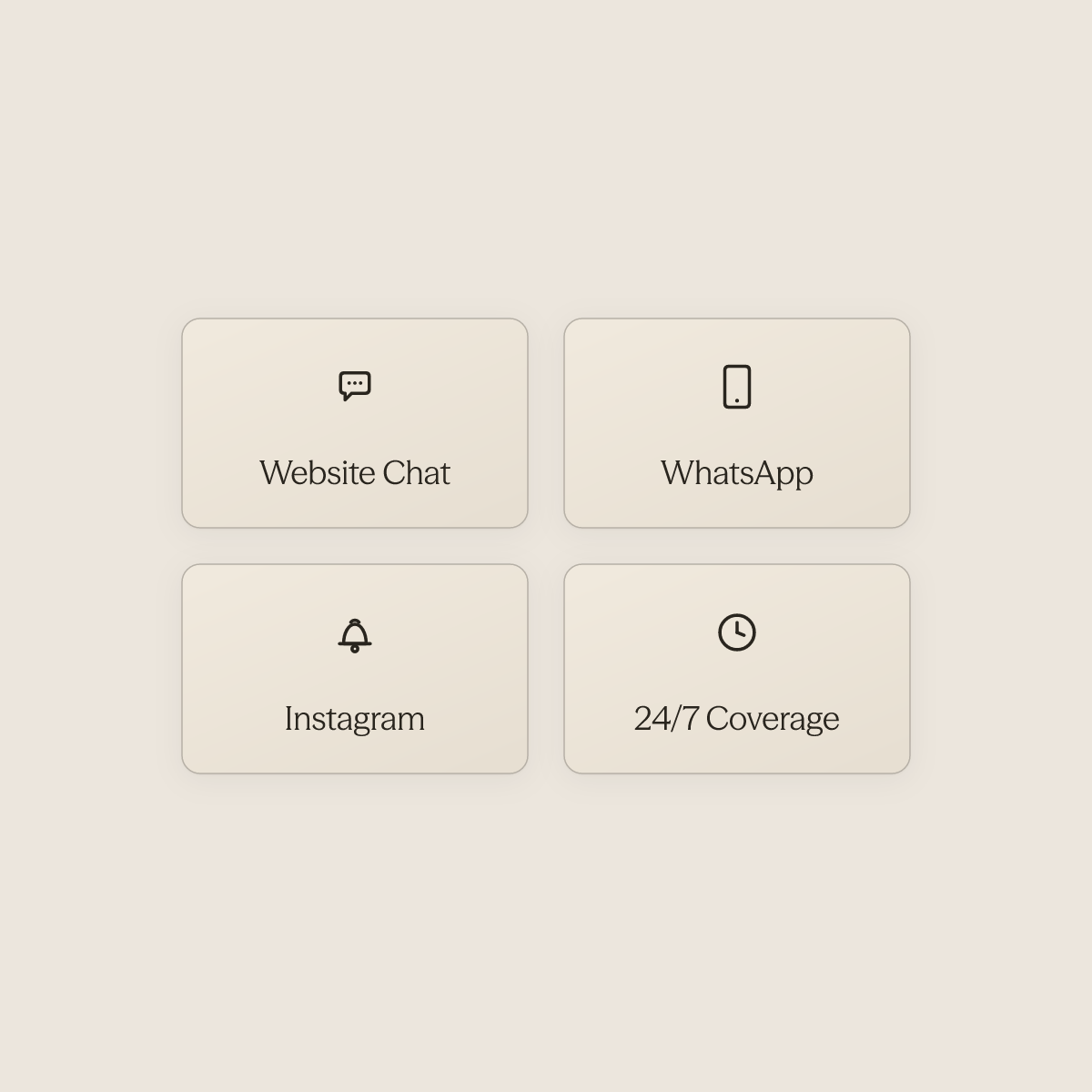
Always-on Coverage Across Websites, WhatsApp, and Instagram
AI agents operate continuously across every channel a guest reaches you on, website chat, WhatsApp, and Instagram, responding to inquiries before, during, and after a stay, without requiring a staff member to be present. The capability is most impactful when your operation already receives a high volume of repetitive guest messages, because that is precisely the volume the agent absorbs so your team does not have to.
Consider a guest asking about your cancellation window for a specific rate tier. A generic tool sends a canned reply. A well-trained AI agent reads your actual rate logic and answers correctly, because it was trained on the SOPs, FAQs, and operational manuals you already have.
An AI agent can deliver the first automated guest reply within days of connecting those documents, not weeks of custom configuration. After-hours inquiries represent a significant share of missed direct booking opportunities, because guests who hit a dead end overnight rarely return in the morning. That means the agent captures revenue that a delayed or generic reply permanently loses.
Direct Booking Conversion and Personalized Upselling
Hospitality AI agents drive direct bookings and upsell revenue by engaging guests at the exact moment of intent, rather than letting them drift to an OTA. Hotels using AI-assisted direct booking tools report capturing 35% more direct bookings compared to properties relying on traditional website chat or no automation, a figure that compounds quickly across a multi-property portfolio. Direct hotel website conversion rates typically sit between 1 and 3 percent, well below OTA benchmarks, a gap that hospitality revenue analysts have documented consistently across market conditions and that AI-assisted direct booking tools are specifically architected to close.
That uplift is most reliably reproduced when the agent is trained on the property's actual rate structure and service menus rather than a generic upsell script. The integration layer matters operationally: if your rate documentation, room-type details, or upsell menus already live in Notion, Google Drive, or a connected property management system, the AI agent can pull from those sources without requiring manual re-entry. The benefit, maximizing revenue per property by improving both occupancy and guest satisfaction, materializes most clearly when the agent has accurate, property-specific context to act on, not generic copy.
A unified inbox gives your operations and support team a single place to monitor, review, and manage every conversation the agent is handling across all platforms simultaneously. For multi-property groups, that means a single operations team can maintain oversight of guest communications across an entire portfolio without proportionally scaling headcount.
Multilingual Support Removes Booking Friction for International Travelers
Multilingual guest communication removes the friction international travelers hit at the exact moment they are ready to commit. A guest writing in Portuguese or Mandarin who receives a confident, natural-language reply in their own language moves forward. One who receives a stilted machine translation, or no reply at all, abandons the inquiry. Mayra, Global Head of Customer Experience at Wynwood House, which operates across seven countries, put it plainly: "You cannot tell the difference between an AI agent and a human agent." That quality bar is what converts a multilingual feature into a multilingual revenue capture, and it is the standard against which any AI agent deployed across an international portfolio should be measured.
The 30-Percent-to-90-Plus Automation Gap
Most operators accept a low automation rate because they assume that the gap between their current tool and a higher-performing one reflects tuning or configuration, not a structural difference in architecture. Closing it feels like a project, not a platform switch. In practice, moving from a keyword-matching system to a property-trained AI agent is less about configuration effort and more about whether the vendor's architecture can ingest the documentation an operation already has.
A well-architected AI agent is built around that starting point. If the business has existing SOPs, FAQs, or operational manuals, and most multi-property operations do, the agent ingests them directly, and the first automated guest reply goes live within days of connecting those sources. Integrations with tools like Notion, Google Drive, and Airbnb mean that content your team already maintains does not need to be re-entered or reformatted.
The structural gap between a low-performing resolution rate and a high-performing one closes not through months of custom development, but through an architecture designed to learn from the documentation your operation already runs on.
Related Reading
- Hotel Budgeting And Forecasting
- Hotel Demand Forecasting
- How To Improve Hotel Operations
- How To Increase Revpar
- Hotel Upselling
- Hotel Revenue Management Strategies
- Automated Hotel Reservation System
- Hotel Guest Messaging
- Hospitality Automation
- Hospitality Operations Management
- Adr Vs Revpar
Hotel Chatbot Use Cases - From Routine FAQs to Full-Cycle Guest Journeys
Front-desk staff at busy properties will tell you the same thing shift after shift: the questions never change. Wi-Fi password, breakfast time, checkout hour, parking instructions. The volume is relentless, and every minute spent answering the same query is a minute not spent on the guest who actually needs human attention.
Most VPs of Operations and heads of operations at multi-brand or enterprise hospitality groups think that consistent, high-quality guest communication at scale requires either a large centralized human team or an enterprise software stack custom-built for their operation, and that there is no middle path that is both affordable and brand-safe. What separates operators with strong automation rates from those still fielding those calls manually is not the size of their team. It is how far they have extended their AI agent's reach across the guest journey.
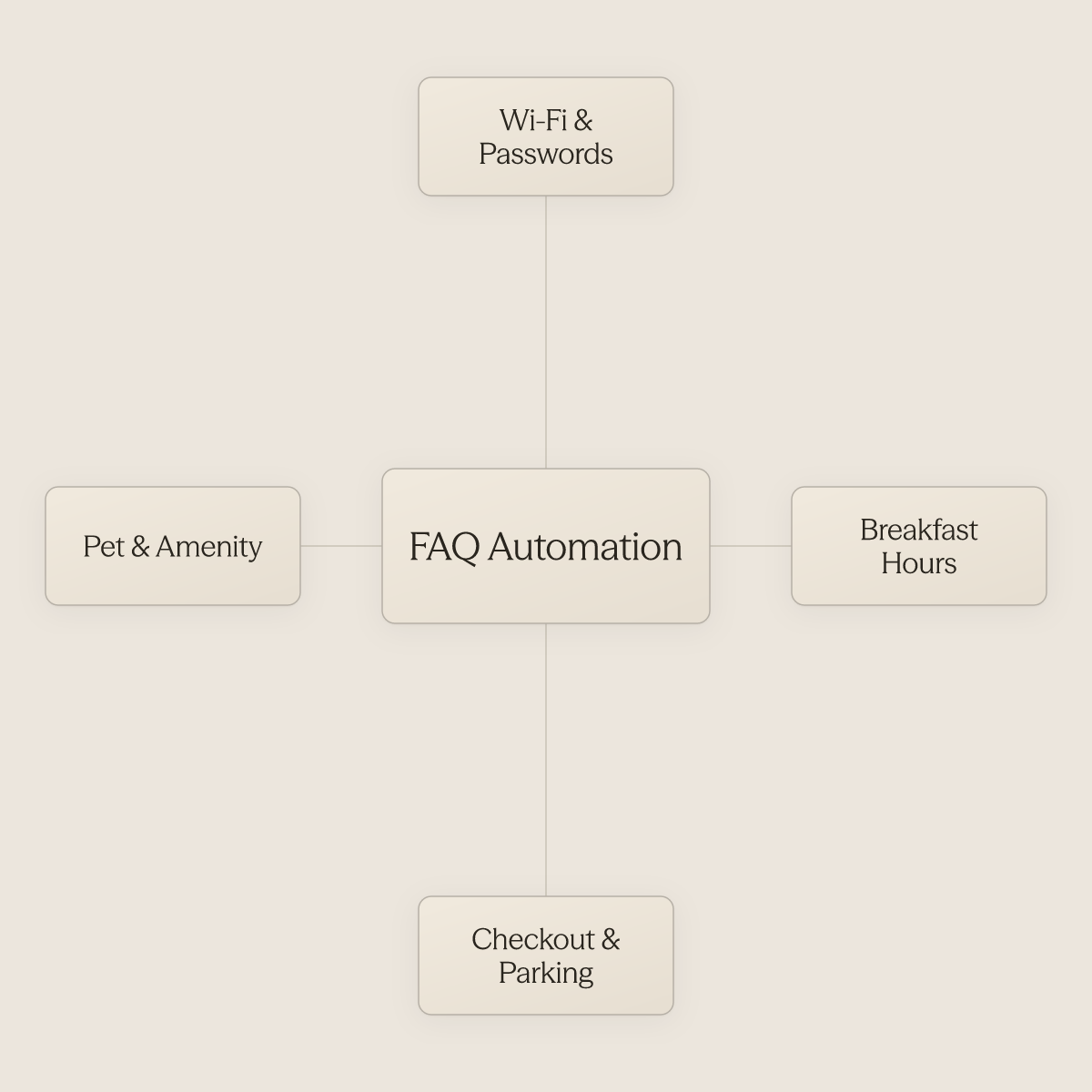
The FAQ Floor - Wi-Fi, Policies, Amenities, and the Inquiries Every Property Handles Daily
"Guests frequently encounter unanswered questions during check-in and off-hours, highlighting the gap in 24/7 human support availability."
Across large hospitality deployments, Wi-Fi credentials, breakfast hours, checkout times, parking, pet policies, and amenity details account for the overwhelming majority of inbound chat volume, a pattern that holds regardless of property type or market segment. These are not complex requests. They are lookup tasks, and routing them to a human is a structural inefficiency, not a service standard.
When each property fields a high volume of these questions daily, a multi-property group absorbs an enormous number of identical interactions around the clock. AI Agents are most beneficial when a business receives a high volume of repetitive guest messages and already has existing documentation, SOPs, FAQs, property manuals, to train the agent on. That documentation does not need to be reformatted or manually re-entered.
Through AI integrations, properties already using tools like Notion or Google Drive can connect those knowledge sources directly, so the agent draws on content that operations teams have already built and maintain. The first automated guest reply goes live days after connecting those materials, not after months of configuration. Automating that layer does not degrade the guest experience; it protects the staff capacity needed for interactions that actually require judgment.
One gap that operations leaders consistently underestimate is off-hours coverage. Guests frequently encounter unanswered questions during check-in and in the late evening, moments when front-desk staffing is thinnest and the cost of a delayed response is highest. An AI Agent operates continuously, before, during, and after a stay, eliminating the operational bottleneck of around-the-clock guest communication without adding headcount.
Transactional Requests That Move Beyond Information - Late Check-Outs, Housekeeping, Room Service, and Transportation
Guest service requests go well beyond information retrieval. Late check-out approvals, housekeeping scheduling, room service orders, and airport transfer bookings are transactional in nature, and guests increasingly expect them resolved without a phone call or a wait at the front desk. At scale, AI agents are now handling this class of request by cross-referencing occupancy data and property SOPs to give accurate, property-specific responses.
AI Workflows are designed for exactly this use case. They are most beneficial when a business has recurring, predictable guest touchpoints that currently require manual staff action, and they activate after a trigger event occurs in a conversation or guest lifecycle, such as after a booking is confirmed, after check-in, or when a specific keyword is detected. The distinction matters operationally: a deflection creates a queue; an accurate automated response closes the loop.
The AI Inbox gives the operations or support team a single place to monitor, review, and manage every conversation the AI agent is handling, so nothing falls through the gaps between properties.
Complaint Detection and Clean Escalation to Human Specialists
Not every conversation should stay with an AI agent. A meaningful share of guest conversations involve a complaint signal that warrants human review, a noise complaint at midnight, a billing dispute, or a service failure that has already affected the stay. The handoff logic is, in practice, the most technically tricky part of any hybrid guest communication design.
Controlling exactly when the AI should respond versus when a conversation must transfer, and doing so without the guest noticing friction, is where many chatbot implementations break down. An AI Agent does not attempt to resolve high-sensitivity conversations autonomously. It detects the emotional register of the message, acknowledges the guest, and routes the conversation to a named team member through the Inbox with context already attached, so the human who picks it up is not starting from scratch.
The result is a cleaner escalation than a phone queue, a shorter resolution window than an unmonitored inbox, and a measurable improvement in guest satisfaction metrics that operations leaders can demonstrate to leadership, the kind of outcome that justifies automation investment across an entire portfolio.
AI vs. Rule-Based Hotel Chatbots - Why the Architecture Gap Determines Your Automation Ceiling
Choosing the wrong architecture for guest communication does not show up on day one. It shows up at month six, when your operations team is still fielding the same overnight questions across every property, and the maintenance queue for your scripted flows is longer than when you started. The distinction between rule-based and AI-powered guest communication is not a feature gap you can close with configuration. It is a structural ceiling, and for multi-property operators, that ceiling has a direct cost.
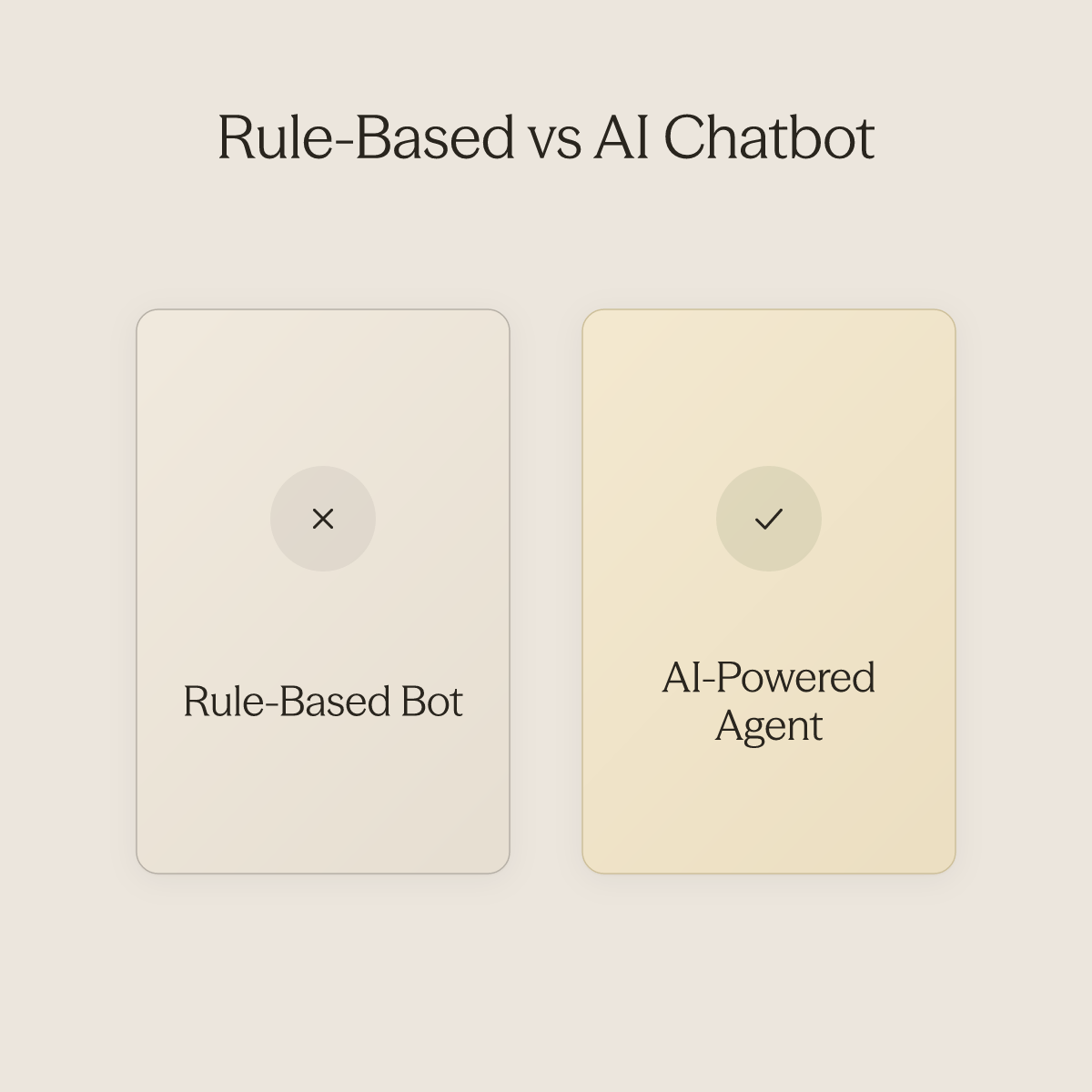
Rule-Based Bots - The 30 to 40 Percent Ceiling
Rule-based systems operate on decision-tree logic. Every answer they give was written by a human in advance. Rule-based architectures top out at roughly 30 to 40 percent automation across typical hotel query volumes, a ceiling that reflects decision-tree logic reaching the boundary of what was scripted in advance, not a failure of implementation. The remaining 60 to 70 percent, noise complaints at 2 a.m., custom group rate requests, mid-stay service changes, falls through to staff. That is not a tuning problem. That is the architecture doing exactly what it was designed to do.
AI-Powered Agents - Reasoning from Your Actual Knowledge
A hotel-specific AI agent does not match a guest's question to a pre-written answer. It reads from your actual documentation, SOPs, manuals, FAQs, and reasons from there. Erwan Le Roy's 35-property operation reached a significantly higher AI automation rate after deploying an agent layer trained on property-specific knowledge, without re-scripting each location individually. The agent knew the properties because it had read the same documents a senior team member would have read.
Why Hotel-Specific AI Outperforms Generic Models
A general-purpose AI model was not trained on your cancellation policy, your pet fee structure, or your brand's tone of voice. It produces plausible-sounding answers that may be confidently wrong for your context. Hotel-specific AI for hospitality ingests your proprietary operating knowledge so the agent reflects your actual policies, not a statistical average of what hotels typically say. This matters most when your brand voice and SOPs are the differentiator across a multi-property portfolio, where guests moving between your properties expect a consistent experience, and a generic AI answer that contradicts your actual policy creates the same trust problem as a poorly trained front-desk hire.
The 13 Best Hotel Chatbots to Boost Bookings in 2026
That structural staffing dependency is the clearest signal that the choice between rule-based tools and AI agents is ultimately an architecture decision, not a feature comparison. Hotels that evaluate chatbots primarily on marketing claims, response accuracy rates, integration counts, or dashboard aesthetics tend to optimize for the wrong variable and discover the mismatch only after the maintenance costs have already compounded. The factor that consistently reframes the ROI calculation is portfolio trajectory: where the property is today matters less than how quickly the operational complexity is growing, because the architecture that fits a single-property operation today can become the bottleneck that constrains a multi-property operation tomorrow.
Thirteen platforms now claim the top-hotel-chatbot crown. None is universally the best; each is the best fit for a specific operator profile, at a specific scale, with a specific architecture need. That reframes the entire vendor selection exercise: you are not shopping for a support cost reduction tool; you are shopping for a revenue recovery instrument, and the architecture that best closes the after-hours gap is the one that deserves the most scrutiny.
The right method is matching tool architecture to operator context, then checking where the automation ceiling actually sits.
1. Conduit.ai - Best Purpose-Built Hospitality Chatbot for Hotels & Vacation Rentals
Conduit's core separation from every other entry on this list is architectural: its AI agents for hospitality train directly on a property's own SOPs, manuals, and operating knowledge, so the automation ceiling is set by documentation depth, not a generic script library. Erwan Le Roy's 35-property operation reached a dramatically higher AI automation rate, with response times compressed substantially and support costs reduced significantly. That result materializes most powerfully when the operator already has structured documentation and receives high volumes of repetitive guest messages across multiple properties. The honest trade-off: a single-location B&B with no existing SOPs will need to build that knowledge base before deployment value compounds.
2. Asksuite - Best Hospitality Chatbot for Direct Booking Conversion
Asksuite is the scale benchmark on this list. According to its own published figures, Asksuite serves 5,500+ hotels across 80+ countries, with 147M+ travelers served and 400+ integrations, making it one of the largest-scale hotel chatbot platforms in the market. Its omnichannel architecture centralizes properties, channels, human agents, and AI agents into one platform, making it a credible choice for mid-to-large hotel groups that need direct booking lift without building a custom stack. The trade-off: 400 integrations and enterprise-grade omnichannel infrastructure is overkill for a boutique group that needs SOP enforcement more than channel breadth.
3. Canary Technologies - Best Hotel Chatbot for Full Guest Journey Automation
Canary Technologies covers the widest span of the guest journey among purpose-built hotel platforms, from pre-arrival digital check-in and contactless payment through in-stay messaging and post-stay review collection. Its guest journey automation has earned strong adoption across branded and independent full-service properties that want a single vendor managing every digital touchpoint. For operators whose primary need is end-to-end journey coverage with a proven integration track record, it is a credible enterprise choice. The honest trade-off: operators who need the AI to behave like a trained team member on property-specific edge cases will find that journey breadth and knowledge-base granularity are difficult to optimize simultaneously within a single platform.
4. HiJiffy - Best Hospitality Chatbot for WhatsApp-First Guest Messaging
WhatsApp penetration in European and Latin American hospitality markets makes channel architecture a genuine strategic decision. HiJiffy's platform is built around that reality, with a purpose-engineered omnichannel layer that centralizes WhatsApp, web chat, and social channels with genuine multilingual depth, making it a strong operational fit for European and Latin American hotel groups where WhatsApp is the dominant guest communication channel. Its guest satisfaction scores in those markets are consistently high. The honest trade-off is regional fit: operators in North American markets where SMS and email still dominate will get meaningfully less leverage from a WhatsApp-first architecture and should weight channel alignment heavily in their evaluation.
5. Quinta (formerly Quicktext): Best AI Chatbot for Hotel Revenue Intelligence
Quinta differentiates on data layer depth. Beyond answering guest queries, it aggregates conversation data into revenue intelligence, helping operators identify which inquiry types convert and which fall off before booking. For revenue managers who want their guest communication platform to feed commercial decision-making, that data loop is a real advantage. The trade-off is that the revenue intelligence layer adds onboarding complexity, and smaller operations without a dedicated revenue manager may lack the internal capacity to act on the insights surfaced.
6. Oaky - Best Hospitality Chatbot for Automated Pre-Arrival Upselling
Oaky occupies a focused lane: pre-arrival upsell automation. Room upgrades, spa packages, early check-in, and ancillary add-ons are delivered through automated pre-arrival messaging sequences with conversion tracking built in. For full-service hotels with genuine upsell inventory, the specialization is a strength. The limitation is scope: operators who want a single tool to handle inquiry response, booking, and upselling will need to pair Oaky with a separate messaging layer, adding integration overhead.
7. Runnr.ai - Best Hospitality Chatbot for Holiday Parks and Campgrounds
Runnr.ai is the most niche entry on this list, and that specificity is its value. Holiday parks and campground operators deal with communication patterns that differ materially from hotel contexts: longer pre-arrival lead times, activity scheduling, site-specific logistics, and a guest base that skews heavily toward WhatsApp in key markets. Runnr.ai's architecture reflects those requirements. The trade-off is obvious: hotel and urban property operators will find the feature set misaligned with their workflows.
8. Hoteza AI Concierge - Best Multilingual Hotel Chatbot for International Properties
Hoteza's AI Concierge is built for properties where multilingual guest communication is a daily operational reality. Its in-room tablet and mobile-first interface supports a wide language range, making it a practical fit for international resort properties and urban hotels with diverse traveler mixes. The trade-off is channel coverage: operators who need robust pre-arrival and post-stay communication across external channels will need to supplement it with a broader messaging platform.
9. D3X - Best Hospitality Chatbot for Real-Time Guest Messaging and Service Requests
D3X focuses on in-stay service request routing, connecting guest messages to the right department in real time. Maintenance tickets, housekeeping requests, and F&B orders flow through a structured dispatch layer rather than landing in a general inbox. For operators whose biggest operational pain is internal coordination during a guest stay, that dispatch architecture reduces the manual relay work that typically falls on front desk staff. The limitation: D3X works best as part of a broader stack rather than a standalone guest communication solution.
10. NexGen Guest - Best Hotel Chatbot for Front Desk Workload Reduction
NexGen Guest is built around a clear operational promise: reduce the volume of routine inquiries that reach the front desk. FAQ automation, check-in information, and common request handling are its core use cases. The honest limitation is that its automation ceiling is lower than that of SOP-trained AI agents. It handles the easy 40 percent of queries well; complex, revenue-critical conversations still require human intervention.
11. Zanobe - Best AI Chatbot Strategy for Boutique Hotels Capturing Direct Bookings
The direct booking case for AI is not primarily a cost story. The primary revenue mechanism is after-hours OTA leakage recovery: hotel direct-site conversion already underperforms OTAs during staffed hours, and overnight coverage gaps widen that gap further. Zanobe's approach targets that specific window, with reported direct booking lifts concentrated in after-hours traffic. For boutique hotels where OTA commission costs are a meaningful P&L line, that framing repositions the tool from a support expense to a revenue recovery instrument. The trade-off: enterprise multi-property groups will outgrow its architecture.
12. Myma.ai - Best Hotel Chatbot for Deep PMS Integration and Operational Accuracy
Myma.ai's differentiation is PMS integration depth. Guest-facing AI that cannot read live reservation data, room availability, or rate information will confidently give wrong answers; operators who have experienced that failure know exactly how damaging it is. Myma.ai prioritizes live PMS data as the foundation for AI responses, reducing the accuracy risk that plagues more generic platforms. The trade-off is a more involved technical onboarding process, and operators without a clear PMS standardization strategy across their portfolio will hit friction during setup.
13. Otto the Agent - Best AI Booking Agent for Measuring Hotel Chatbot ROI
Otto the Agent takes a measurement-first position that is rare on this list. Most platforms report automation rate and response time; Otto surfaces booking attribution data that connects AI conversations to confirmed reservations. For operators who need to justify platform spend to a finance committee or ownership group, that attribution layer is practically useful. The limitation is scope: operators who need a platform to handle the full spectrum of guest interactions will find it narrower than enterprise-grade alternatives.
Most operators reading this list will recognize their current tool somewhere in entries 2 through 13, and the quiet reality that follows: the platform handles routine questions well, while staff still manually fields the complex ones that actually move revenue. The structural reason is that most platforms are built on a generic knowledge base, not the operator's own documentation. Conduit's AI agents close that gap by training on a property's actual SOPs and manuals, so the automation ceiling rises in direct proportion to how well-documented the operation already is.
Enterprise groups with existing documentation are, counterintuitively, already deployment-ready. Knowing which tools exist is only half the decision. The harder question is which architecture tier, integration depth, and operator-profile match your specific portfolio right now.
The next section gives you a concrete buyer's criteria framework so you can score any vendor on this list against your actual operational requirements, not their marketing claims.
Related Reading
- Best Revenue Management Software For Hotels
- Siteminder Competitors
- Digital Concierge Software
- Hospitality Conferences
- Hotel Distribution Management
- Best Hotel Channel Manager Software
- Canary Technologies Competitors
- Cloudbeds Alternatives
How to Choose the Best Hotel Chatbot for Your Property - A Buyer's Criteria Framework
Vendor feature lists in hospitality AI are deliberately convergent. Every platform claims natural language processing, multi-channel support, and PMS integration, which means buying on those claims alone is how enterprise operators end up with a 30% automation rate when their operation was capable of delivering 90% or more. The criteria below are designed to close that gap before you sign anything.
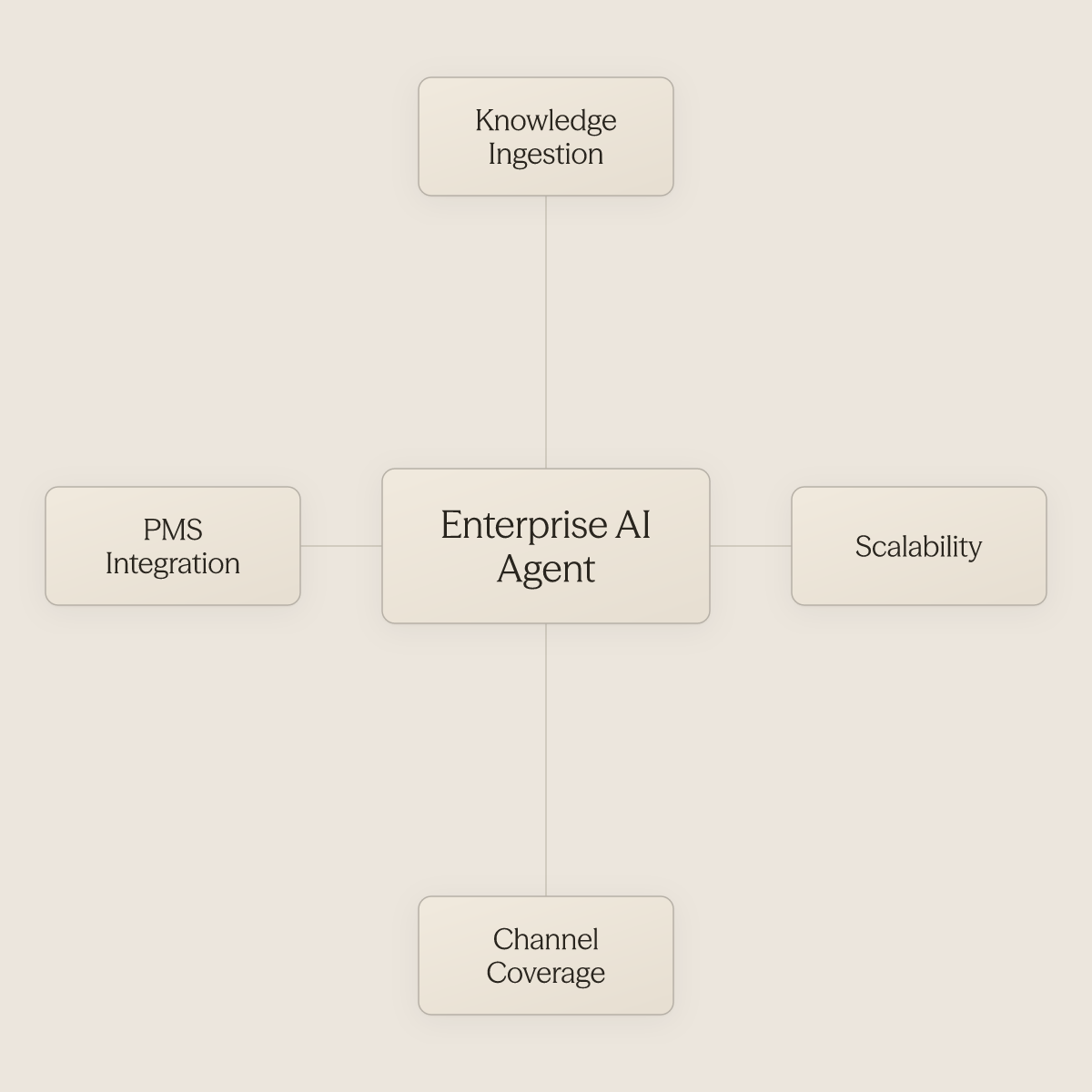
The Five Criteria That Actually Separate Enterprise-Grade AI Agents from Dressed-Up FAQ Widgets
The real separation between platforms is architectural depth: can the platform ingest your actual SOPs, manuals, and property-specific knowledge, or is it running on a generic hospitality script any competitor could license? That single question eliminates most of the market. The remaining criteria, scalability without re-scripting, channel coverage, PMS integration depth, and measurable automation readiness, tell you which of the survivors is built for a portfolio your size.
Knowledge-Base Ingestion - The Single Question That Exposes a Vendor's Real Architecture
Knowledge-base depth, not NLP sophistication or integration count, is the primary predictor of whether a platform delivers 30% automation or 90% automation. A platform running on a generic hospitality script will confidently answer questions, just not your questions, about your policies, at your properties. Ask every vendor directly: "Can your system ingest our uploaded SOPs and FAQs and use them as the primary source of truth for guest responses?"
If the answer involves a professional services engagement or a multi-month onboarding, the architecture is not built for this. The benefit materializes most clearly when you already have existing documentation, SOPs, manuals, and policy guides, because that documentation becomes the agent's knowledge, not a generic fallback script. Conduit's AI Agents are specifically designed for exactly this scenario: they are most beneficial when a business receives a high volume of repetitive guest messages and has existing documentation to train on, with the first automated guest reply going live days after connecting your SOPs and manuals, not after a multi-month implementation.
Conduit's Integrations pull that existing content directly into the agent without manual re-entry, eliminating the hidden cost of documentation duplication. This matters beyond operational efficiency. Industry research confirms that the quality and relevance of AI-delivered responses, not merely the presence of AI, drives measurable gains in guest satisfaction and loyalty.
Generic scripts don't move that needle; property-specific knowledge does. The practical upshot is that improving guest satisfaction through accurate, on-brand AI responses directly supports the occupancy and revenue-per-property outcomes enterprise operators are actually managing toward. Noel Poler, Owner of The Lauderdale Boutique Hotel, captures the strategic logic plainly: "The more hands-off the property, the higher the valuation." That framing matters for enterprise evaluation: the right knowledge-base architecture doesn't just automate replies, it reduces the operational drag that suppresses asset value across a portfolio.
Multi-Property Scalability - Why Per-Property Re-Scripting Is a Hidden Tax
A platform that requires per-property configuration means every policy update, seasonal change, or SOP revision triggers a manual re-scripting cycle across every location. Multi-property groups can deploy a centralized guest communication platform across their entire portfolio without per-property re-scripting, but only when the underlying architecture ingests a shared knowledge base rather than maintaining separate scripted flows per location. This is where brand standards and escalation complexity expose weak platforms.
Conduit is specifically built to be most beneficial for businesses with specific brand standards, escalation policies, or complex multi-property operations that require differentiated agent behavior, meaning the architecture accounts for properties that share a portfolio-level knowledge base but still need to express distinct escalation rules or brand voice at the property level. Standardizing brand voice and SOPs across every property and market while retaining that differentiation is the architectural outcome enterprise operators should be testing for, not simply asking whether multi-property deployment is "supported."
The practical test remains the same: ask the vendor what happens when you update a cancellation policy. If the answer is "update it in one place and it propagates," the architecture supports scale. If the answer involves a location-by-location configuration queue, the per-property re-scripting tax will grow with every property you add. For portfolio operators, that tax compounds, in staff time, in error risk, and in the valuation drag that comes from operations that cannot run without constant manual intervention. The goal of maximizing revenue per property by improving occupancy and guest satisfaction is structurally incompatible with a platform that scales linearly in management overhead.
Next steps
If your portfolio is absorbing nightly booking losses because overnight coverage gaps push guests toward OTAs, the path forward starts with removing the human router entirely and replacing it with an agent trained on your actual operating knowledge.
The direct booking lift from hotel AI is concentrated in after-hours traffic, which means every unmonitored overnight window is a measurable revenue deletion event, not a service gap. Knowledge-base depth, not integration count or NLP sophistication, is what separates a 30-percent automation ceiling from a 90-percent one. Together, those two dynamics point to one action: deploy an agent trained on your SOPs before your next overnight gap costs another calculable dollar amount from your GOP.
Start with AI for hospitality for the full product overview. If your operation already has SOPs or property manuals, you are deployment-ready today.
Frequently Asked Questions
Can a hotel chatbot actually handle guest messages at 2 a.m. without any staff involvement?
Yes, a property-trained AI agent operates continuously before, during, and after a stay, across channels like website chat, WhatsApp, and Instagram, without requiring a staff member to be present. After-hours inquiries represent a significant share of missed direct booking opportunities, because guests who hit a dead end overnight rarely return in the morning, so an agent that answers correctly at 2 a.m. captures revenue that a delayed or generic reply permanently loses.
How much of a revenue difference does an AI chatbot actually make for direct bookings?
Hotels using AI-assisted direct booking tools report capturing 35% more direct bookings compared to properties relying on traditional website chat or no automation. Direct hotel website conversion rates typically sit between 1 and 3 percent, well below OTA benchmarks, and AI-assisted tools are specifically architected to close that gap, with the uplift most reliably reproduced when the agent is trained on the property's actual rate structure rather than a generic upsell script.
Why does my current chatbot still send so many questions to the front desk?
If your chatbot is rule-based, that is an architectural ceiling, not a configuration problem, rule-based systems top out at roughly 30 to 40 percent automation across typical hotel query volumes because every answer was written by a human in advance and the system cannot handle anything outside those scripts. The remaining 60 to 70 percent of queries, including noise complaints, custom rate requests, and mid-stay service changes, fall through to staff by design.
Does a hospitality chatbot work in multiple languages for international guests?
A well-trained AI agent handles multilingual guest communication at a quality level where, as Mayra, Global Head of Customer Experience at Wynwood House, put it, "you cannot tell the difference between an AI agent and a human agent." A guest writing in Portuguese or Mandarin who receives a confident, natural-language reply in their own language moves forward with a booking, while one who receives a stilted machine translation or no reply at all abandons the inquiry.
How long does it take to get a hospitality AI agent live if we already have SOPs and property manuals?
If your operation already has existing SOPs, FAQs, or operational manuals, the agent can ingest them directly and deliver the first automated guest reply within days of connecting those documents, not after weeks or months of custom configuration. Integrations with tools like Notion, Google Drive, and Airbnb mean that content your team already maintains does not need to be re-entered or reformatted.
Stay in the loop
Get the latest on AI automation, product updates, and customer stories.

